

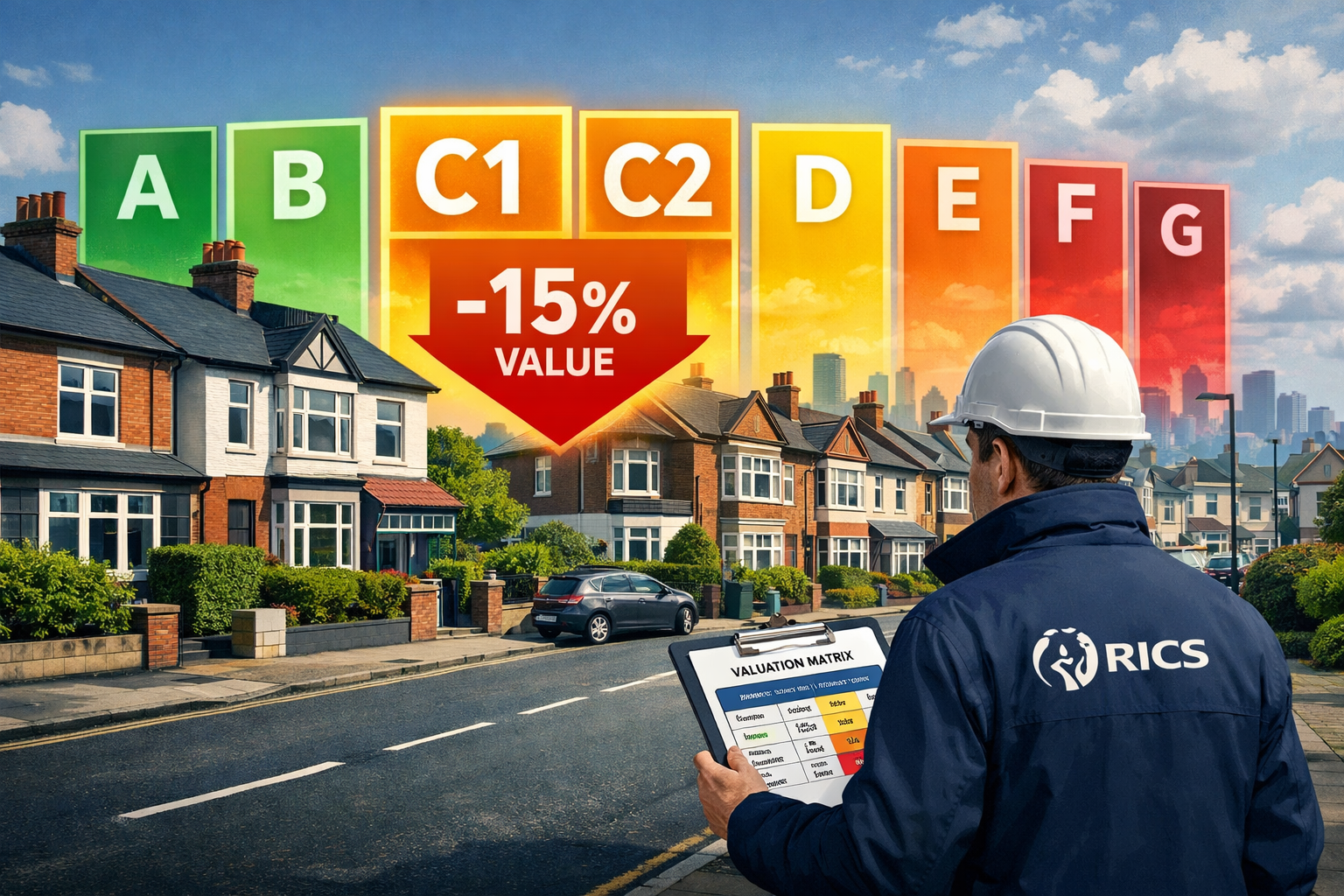
Properties rated below EPC C are now losing up to 15% of their market value — and 2026 marks the year that figure becomes impossible for surveyors, lenders, and landlords to ignore. With RICS embedding ESG criteria as formally value-relevant from April 2026 [4] and a sweeping overhaul of the EPC framework arriving in October 2026 [1], the rules governing how energy performance affects property worth have fundamentally changed. Understanding the Valuation Impacts of EPC C1/C2 Ratings in 2026: RICS Adjustments for Minimum Energy Efficiency Standards in Sales and Lettings is no longer optional — it is a professional and financial necessity.
Key Takeaways 📌
- RICS now treats energy performance as a value-relevant factor in all property assessments from April 26, 2026 onwards [4].
- New EPC metrics launching October 2026 will assess energy costs, fabric performance, smart readiness, and heating system efficiency — replacing the single cost metric [1].
- All leased residential properties must reach EPC C by 2028, rising sharply from the current minimum E standard [3].
- Properties below EPC C face measurable valuation discounts — RICS-trained surveyors are now expected to apply structured adjustments in their reports.
- Commercial properties face even steeper requirements, with EPC B potentially mandated within five to ten years [2].
What the 2026 EPC Overhaul Actually Means
The UK's Energy Performance Certificate system is undergoing its most significant transformation since its introduction. From October 2026, residential EPCs will no longer be judged on a single cost-based metric. Instead, four headline metrics will define a property's rating [1]:
| New EPC Metric | What It Measures |
|---|---|
| Energy Costs | Estimated annual running costs for heating and hot water |
| Fabric Performance | Insulation quality, double glazing, wall and roof construction |
| Smart Readiness | Presence of smart meters and demand-response capability |
| Heating System Efficiency | Heat pumps, boiler type, hot water cylinder performance |
A secondary carbon-based metric will also be retained, and a new energy demand metric will be introduced to give a fuller picture of how a property performs under real-world conditions [1]. This multi-dimensional approach means that a property which previously scraped through on cost grounds alone may now score poorly across several dimensions — directly affecting its EPC band and, by extension, its market value.
💡 Pull Quote: "The shift from a single cost metric to four headline indicators means energy efficiency is no longer a box-ticking exercise — it is a core component of property value."
The C1/C2 Sub-Band Distinction
Within the EPC C band, a further distinction is emerging between C1 (higher-performing C) and C2 (lower-performing C). While the government's minimum threshold is set at C, properties sitting at the lower end of that band — C2 — may still attract valuation discounts relative to C1-rated peers, particularly as lenders and institutional buyers apply their own internal scoring criteria. Surveyors conducting property valuations in London and across the UK are increasingly required to note where within the C band a property sits.
How RICS Adjustments Work: A Data-Driven Framework
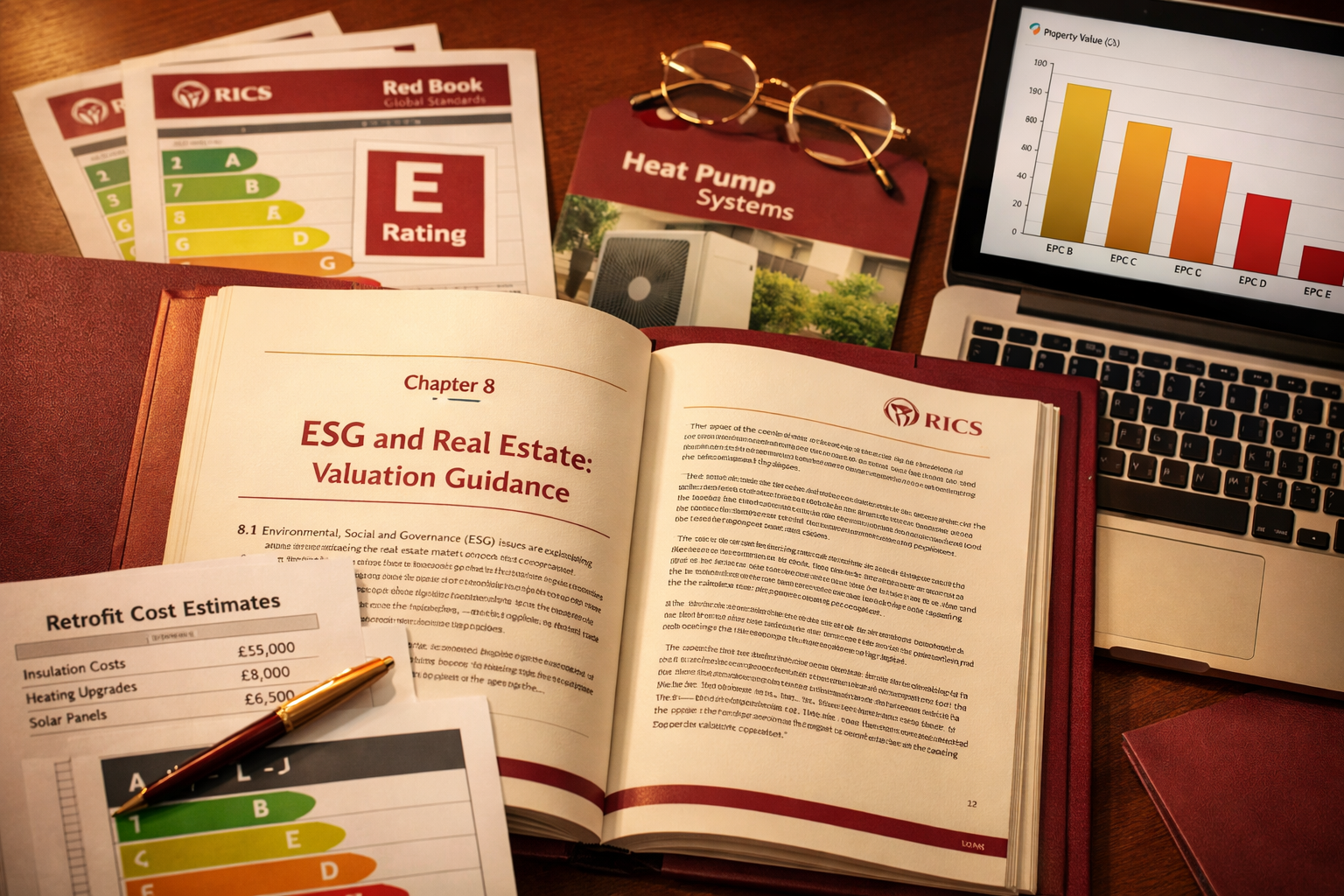
The most significant professional development of 2026 is RICS formally embedding energy performance as a value-relevant criterion in its valuation standards, effective April 26, 2026 [4]. This means chartered surveyors can no longer treat EPC ratings as background information — they must actively adjust valuations to reflect energy efficiency compliance status.
The RICS Valuation Matrix for Energy Performance
RICS guidance directs valuers to apply structured adjustments based on:
- Current EPC rating vs. minimum required standard — Is the property compliant, borderline, or non-compliant?
- Cost to remediate — What is the estimated cost of upgrading to the required standard?
- Rental income risk — For investment properties, does non-compliance create a void risk?
- Market evidence — What do comparable sales show about buyer appetite for sub-C properties?
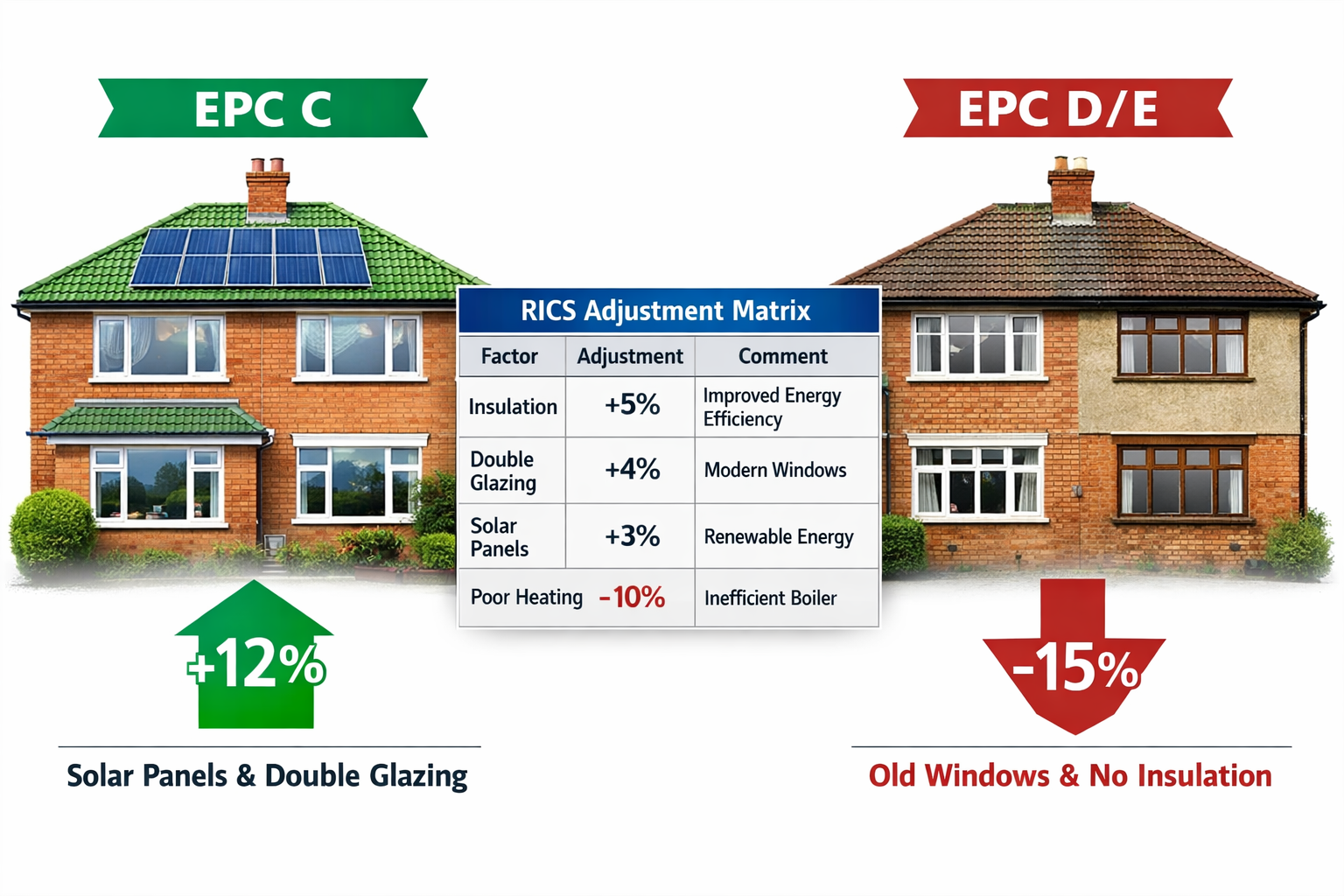
For properties rated D, E, F, or G, the adjustment is straightforward: the estimated cost of achieving EPC C is deducted from the gross market value, with an additional risk premium applied to reflect uncertainty, disruption, and potential rental voids during works.
For C2-rated properties, the adjustment is more nuanced. While technically compliant with the 2028 minimum, C2 properties may still attract a discount relative to C1 equivalents — particularly in competitive markets where buyers have access to better-rated stock. Understanding the full range of key property valuation factors is essential when contextualising these adjustments.
Typical Valuation Adjustments by EPC Band (2026 Data)
| EPC Rating | Estimated Value Impact vs. EPC B | Lettings Compliance Status (2026) |
|---|---|---|
| A | +3% to +5% | ✅ Fully compliant |
| B | Benchmark (0%) | ✅ Fully compliant |
| C1 | -2% to -4% | ✅ Compliant (2028 threshold) |
| C2 | -5% to -8% | ✅ Compliant (2028 threshold) |
| D | -8% to -12% | ⚠️ Non-compliant from 2028 |
| E | -10% to -15% | ❌ Non-compliant (lettings banned) |
| F/G | -15%+ | ❌ Non-compliant (lettings banned) |
⚠️ Note: These figures represent market-observed ranges based on comparable evidence. Individual adjustments will vary by property type, location, and specific upgrade costs.
Minimum Energy Efficiency Standards: The Regulatory Timeline
The Minimum Energy Efficiency Standards (MEES) have tightened progressively since 2018. Since April 1, 2020, landlords have been unable to commence new tenancies or renew existing ones for properties rated F or G. Since April 1, 2023, all letting of sub-E rated properties has been prohibited [3].
The next step is the most demanding yet:
- By 2028: All leased residential properties must achieve a minimum EPC rating of C [3].
- Commercial properties: EPC B may be required within five to ten years, though final government announcements remain pending [2].
This regulatory escalation is the primary driver behind the Valuation Impacts of EPC C1/C2 Ratings in 2026: RICS Adjustments for Minimum Energy Efficiency Standards in Sales and Lettings. Properties that cannot reach C without significant expenditure are already being discounted in the market — and surveyors who fail to reflect this in their reports risk producing misleading valuations.
For those requiring a formal assessment, a professional RICS valuation report will now routinely include energy performance commentary as a material consideration.
Practical Implications for Sales, Lettings, and Investment Portfolios
Residential Sales: What Buyers and Sellers Need to Know
In the residential sales market, EPC ratings are increasingly influencing mortgage lending decisions. Several major lenders have introduced preferential rates for properties rated A or B, and some are applying stricter loan-to-value (LTV) ratios for properties below EPC C. This creates a compounding effect: a sub-C property not only achieves a lower sale price but may also be accessible to a narrower pool of buyers.
Sellers of C2-rated properties should consider:
- 🔧 Commissioning a pre-sale energy audit to identify low-cost improvements that could push the rating to C1 or B.
- 📋 Obtaining an updated EPC under the new October 2026 framework before listing, to demonstrate performance across all four metrics.
- 💷 Factoring in the cost of improvements versus the likely uplift in sale price — in many cases, targeted upgrades deliver a positive return.
Buyers should request the full EPC certificate and scrutinise which of the four new metrics are driving the rating. A property with poor fabric performance (e.g., solid walls, single glazing) may carry significantly higher upgrade costs than one with a low smart readiness score.
The Listed Buildings Question 🏛️
One of the most significant policy shifts in 2026 is the government's intention to remove the current limited exemption for listed buildings. Under the proposed changes, all heritage properties will be required to obtain an EPC, regardless of whether compliance would alter their character or appearance [1]. This creates a new valuation challenge: how should a surveyor adjust for a Grade II listed property that is structurally unable to achieve EPC C without compromising its heritage status?
RICS guidance is expected to address this through a heritage adjustment methodology, but in the interim, surveyors are advised to document the specific constraints and apply a conservative risk premium. For complex cases, a retrospective property valuation may also be required to establish a baseline before remediation works are undertaken.
Commercial Property: A Looming Crisis 🏢
The commercial sector faces arguably the most acute exposure. With a large proportion of commercial property currently below the EPC B threshold, landlords face substantial portfolio investment requirements [2]. Institutional investors are already pricing in the cost of compliance — and in some cases, refusing to acquire assets that cannot credibly reach EPC B within a five-year business plan.
For commercial landlords, the implications extend beyond valuation to lease structuring, rent review provisions, and dilapidations liability. A commercial dilapidations survey may be essential to establish the current condition of a property before energy upgrade works are planned, ensuring that improvement costs are accurately scoped and attributed.
Investment Portfolio Strategy
Landlords with mixed portfolios should undertake an EPC audit of all assets immediately, categorising properties by:
- Already at C or above — Monitor for the new October 2026 metric changes; may need re-assessment.
- Currently D or E — Prioritise for upgrade works; factor costs into yield calculations.
- F or G rated — Already unlettable; require urgent remediation or disposal strategy.
The Valuation Impacts of EPC C1/C2 Ratings in 2026: RICS Adjustments for Minimum Energy Efficiency Standards in Sales and Lettings are particularly acute for portfolio lenders, who must now stress-test their entire book against the 2028 MEES threshold. For landlords with leasehold assets, understanding the interaction between energy compliance and lease terms is critical — a freehold valuation may reveal additional complexities where upgrade obligations are shared between freeholder and leaseholder.
For those with tax-sensitive portfolios, it is also worth noting that energy improvement costs may interact with capital gains tax valuation calculations — particularly where works are undertaken between acquisition and disposal.
What Surveyors Must Do Differently in 2026
The RICS mandate is clear: energy performance is now a material valuation consideration, not a footnote. Chartered surveyors conducting residential or commercial valuations must:
- ✅ Record the current EPC rating and identify which band sub-division (C1/C2 where applicable) applies.
- ✅ Assess compliance status against current and forthcoming MEES thresholds.
- ✅ Estimate remediation costs using current contractor rates and approved methodologies.
- ✅ Apply a structured adjustment to the market value, documented with supporting comparable evidence.
- ✅ Note any exemptions (e.g., listed building status) and apply appropriate risk premiums.
- ✅ Reference the new EPC metric framework when the October 2026 certificates become available.
Surveyors who have not yet reviewed the updated RICS guidance should do so as a matter of urgency. The RICS valuation cost for a compliant 2026 assessment may be marginally higher than previous years, reflecting the additional analysis required — but the liability risk of an under-adjusted valuation is far greater.
Conclusion: Actionable Next Steps for 2026 and Beyond
The convergence of new RICS valuation standards, a reformed EPC framework, and tightening MEES regulations has created a genuinely transformative moment for UK property. The Valuation Impacts of EPC C1/C2 Ratings in 2026: RICS Adjustments for Minimum Energy Efficiency Standards in Sales and Lettings are no longer theoretical — they are being priced into transactions, mortgage decisions, and investment strategies right now.
Immediate Actions for Different Stakeholders:
For property owners:
- Commission an updated EPC under the new 2026 framework before selling or re-letting.
- Obtain quotes for energy improvement works and compare against likely valuation uplift.
- Consult a RICS-qualified surveyor to understand your specific adjustment exposure.
For landlords:
- Audit your entire portfolio against the 2028 C-rating threshold immediately.
- Build remediation costs into your 2026/27 capital expenditure planning.
- Review lease terms for any provisions relating to energy improvement obligations.
For surveyors:
- Update valuation methodology to reflect the April 2026 RICS ESG guidance.
- Develop a structured adjustment matrix for EPC-related discounts, supported by local comparable evidence.
- Prepare for the October 2026 EPC metric changes and their impact on existing certificates.
For buyers and investors:
- Treat EPC rating as a primary due diligence criterion, not a secondary consideration.
- Model the cost of achieving EPC C (or B for commercial) into your acquisition pricing.
- Seek specialist advice for listed buildings or heritage assets where compliance pathways are unclear.
The 2028 deadline may feel distant, but the valuation adjustments are happening now. Properties that fail to meet the C threshold are already trading at a discount — and that discount will only widen as the deadline approaches and buyer awareness increases. Acting early is not just prudent; in 2026, it is essential.
References
[1] EPCs and MEES – Is 2026 the Year for Reform? – https://www.reedsmith.com/articles/epcs-and-mees-is-2026-the-year-for-reform/
[2] Mitigation Strategies MEES EPCs Business Rates – https://ww3.rics.org/uk/en/journals/property-journal/mitigation-strategies-mees-epcs-business-rates.html
[3] Minimum Energy Efficiency Standard: What Property Owners Need to Know – https://www.ricsfirms.com/residential/improvements/going-green/minimum-energy-efficiency-standard-what-property-owners-need-to-know/
[4] RICS Tightens Real Estate Valuation: ESG Becomes Value-Relevant from 2026 – https://www.purpose-green.com/en/article/rics-verschaerft-immobilienbewertung-esg-wird-ab-2026-wertrelevant





