
Qualified party wall surveyors are in shorter supply than at any point in the past decade — and with London's property market recovery driving a surge in loft conversions, rear extensions, and basement digs, that shortage is pushing fees higher. Understanding the cost breakdown of party wall agreements in 2026: £1000 average fees, hourly rates, and ways to minimise surveyor expenses has never been more financially important for homeowners and developers alike.
Whether you are the building owner planning works or an adjoining owner suddenly served a party wall notice, the fees involved can range from a few hundred pounds to well over £3,000 — depending on complexity, location, and the surveyor model chosen. This guide cuts through the jargon and gives you a clear, up-to-date picture of what to expect in 2026.
Key Takeaways 📋
- Average party wall surveyor fees in 2026 sit around £1,000–£1,500 per surveyor, with London rates typically higher than the national average.
- Hourly rates have climbed to £150–£200/hour due to a shortage of qualified surveyors and rising demand from the construction market recovery.
- The "agreed surveyor" model can cut total costs almost in half compared to appointing two separate surveyors.
- Who pays is determined by the Party Wall etc. Act 1996 — usually the building owner, but not always.
- A well-prepared Schedule of Condition and early neighbour engagement are the two most effective cost-saving strategies available.
What Drives Party Wall Surveyor Costs in 2026?
The Surveyor Shortage Problem
The UK is experiencing a measurable shortfall in RICS-accredited party wall surveyors. Retirement rates among experienced practitioners, combined with a post-pandemic construction boom and rising planning approvals in Greater London, have created a classic supply-demand imbalance. The result? Hourly rates have risen sharply, with most London-based party wall surveyors now charging between £150 and £200 per hour — up from the £120–£160 range seen just three years ago.
Outside London, rates tend to be slightly lower, typically £100–£150/hour, but rural areas can see premiums if a specialist must travel.
What the £1,000 Average Actually Covers
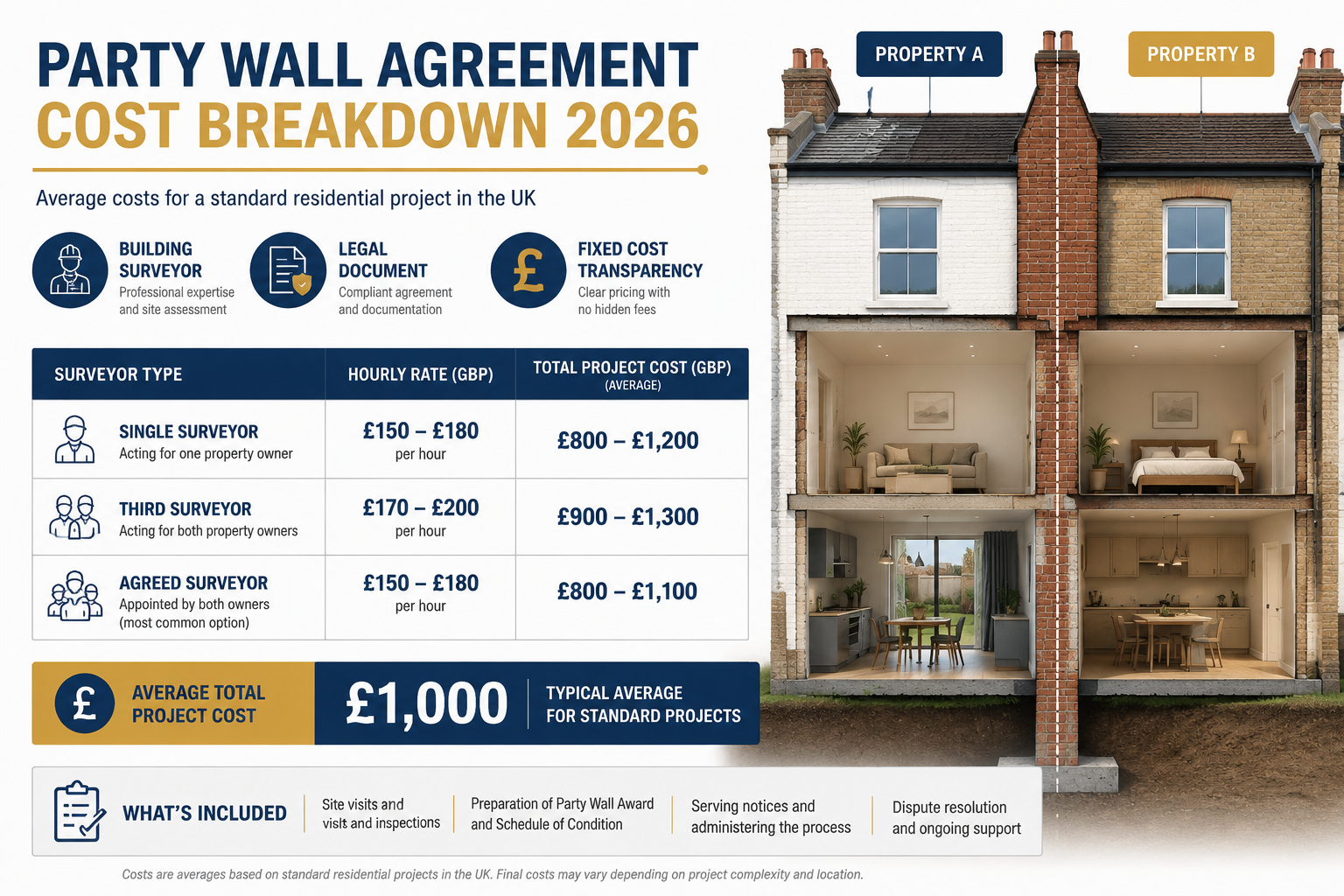
The oft-cited £1,000 average fee for a party wall agreement reflects a straightforward single-notice case handled by one surveyor. In practice, this figure covers:
- Initial review of the party wall notice
- Site inspection and measurement
- Preparation of the Schedule of Condition (a photographic and written record of the adjoining property's pre-works state)
- Drafting and serving the Party Wall Award (the formal legal document)
- Any reasonable correspondence between parties
💬 "The Schedule of Condition is arguably the most valuable document in the entire process — it protects both parties from spurious damage claims after construction ends."
For more complex projects — basement excavations, structural beam insertions, or works affecting shared chimneys — fees can escalate to £2,000–£4,000 per surveyor. You can explore specific scenarios in detail via this guide to party wall disputes.
Geographic Variation in 2026 Fees
| Location | Typical Hourly Rate | Typical Award Fee (Single Notice) |
|---|---|---|
| Central London | £175–£200/hr | £1,200–£2,000 |
| Greater London (Zones 3–6) | £150–£175/hr | £900–£1,500 |
| South East England | £120–£150/hr | £750–£1,200 |
| Rest of UK | £100–£130/hr | £600–£1,000 |
The Full Cost Breakdown of Party Wall Agreements in 2026: Who Pays What?
The Building Owner Pays — Usually
Under the Party Wall etc. Act 1996, the default rule is clear: the building owner (the one carrying out the works) pays all reasonable surveyor fees — including those of the adjoining owner's surveyor if one is appointed. This is a point many building owners overlook when budgeting for extensions or loft conversions.
For a typical rear extension in London in 2026, the total party wall surveyor bill could look like this:
| Cost Item | Estimated Fee |
|---|---|
| Building owner's surveyor (Award preparation) | £900–£1,400 |
| Adjoining owner's surveyor (if separately appointed) | £800–£1,300 |
| Third surveyor (if dispute arises) | £500–£1,500 |
| Total (two-surveyor model) | £1,700–£4,200 |
| Total (agreed surveyor model) | £900–£1,800 |
The adjoining owner's surveyor fees are recoverable from the building owner, provided they are reasonable. If an adjoining owner appoints an expensive specialist unnecessarily, the building owner can challenge those costs — though this itself can trigger the appointment of a third surveyor to adjudicate, adding further expense.
For a detailed look at surveyor cost structures, see this breakdown of party wall surveyor costs.
When the Adjoining Owner Pays
There are limited circumstances where the adjoining owner bears costs:
- If they request additional works beyond what the building owner originally proposed (e.g., asking for extra weatherproofing)
- If they cause unnecessary delay or act unreasonably, and a third surveyor rules accordingly
- If they consent in writing and later withdraw, causing abortive work
The Three-Surveyor Model: When Disputes Escalate
If the two appointed surveyors cannot agree on the terms of the Award, either party can refer the matter to a third surveyor — selected at the outset and named in the Award. Third surveyor fees are typically charged at the same hourly rate and are usually paid by the party whose position the third surveyor rejects. This is one of the costliest outcomes in any party wall dispute and is best avoided through early communication.

Agreed Surveyor vs. Two Surveyors: The Model That Saves the Most Money
How the Agreed Surveyor Works
The agreed surveyor model is the single most effective way to reduce party wall costs. Under this arrangement, both the building owner and the adjoining owner appoint the same single surveyor to act impartially for both parties. This is explicitly permitted under Section 10(1)(b) of the Party Wall etc. Act 1996.
Benefits include:
- ✅ Only one set of fees to pay (typically saving £700–£1,500 on a standard project)
- ✅ Faster process — no back-and-forth between two separate professionals
- ✅ Reduced risk of procedural disputes
- ✅ Simpler communication for all parties
For a full explanation of how this model works in practice, read this guide on the party wall agreed surveyor.
The Trade-Off: Independence vs. Cost
Some adjoining owners are understandably cautious about sharing a surveyor with the person whose building works might affect their home. The agreed surveyor must act impartially and owes a duty to both parties — but the perception of conflict can be a barrier. In practice, for straightforward projects with cooperative neighbours, the agreed surveyor model works extremely well and is widely recommended by industry professionals.
💬 "For a standard loft conversion between two cooperative neighbours, the agreed surveyor model can reduce the total party wall bill from £2,500 to under £1,200."
Ways to Minimise Party Wall Surveyor Expenses in 2026
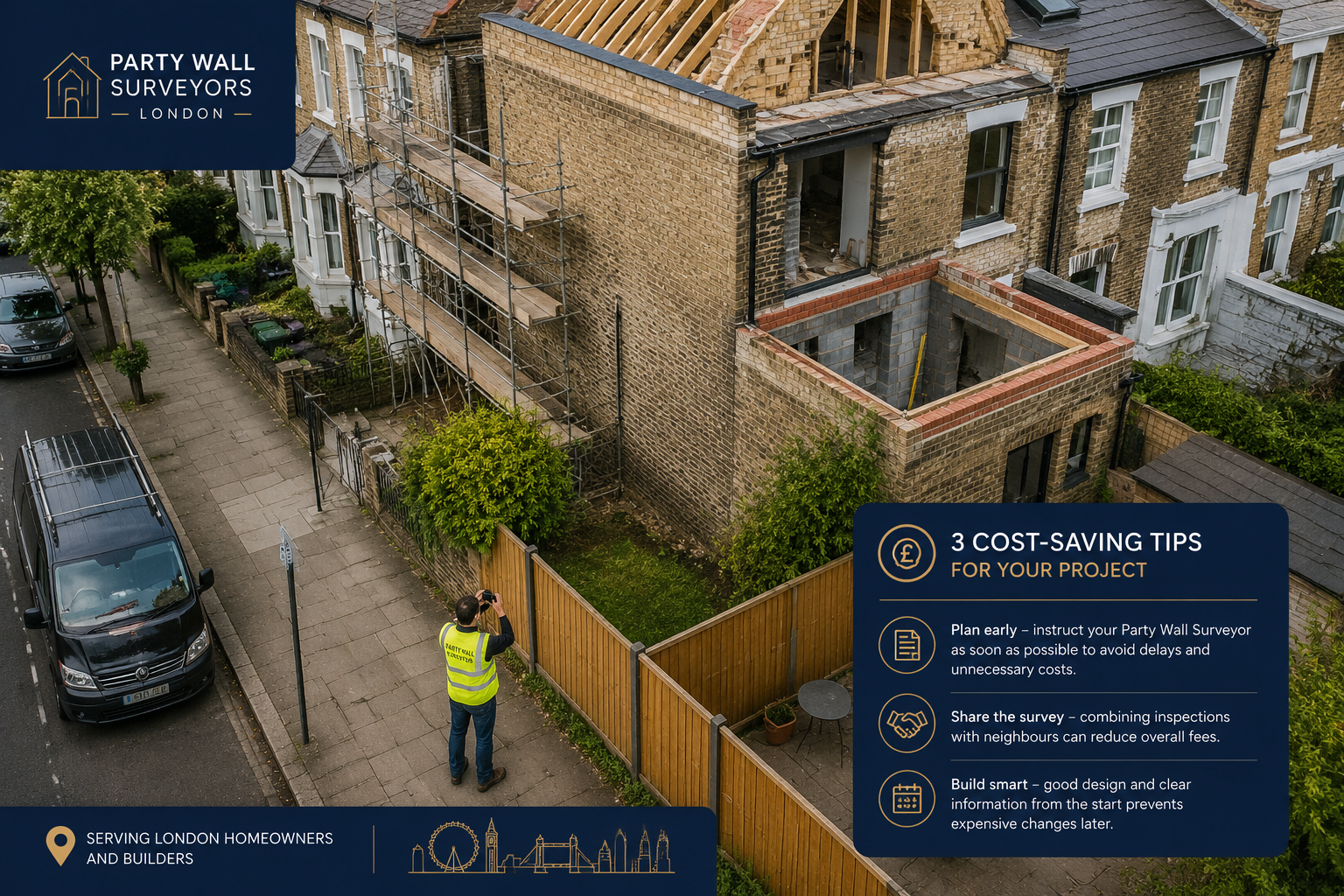
1. Serve Notice Early and Correctly 📅
Errors in the initial party wall notice — wrong dates, missing details, or incorrect property descriptions — can invalidate the notice and force a restart. This wastes time and money. Use a surveyor or solicitor to draft the notice correctly the first time.
Minimum notice periods under the Act:
- 2 months for works to the party wall itself
- 1 month for excavation works near the boundary
2. Invest in a Thorough Schedule of Condition
A detailed Schedule of Condition — photographs and written descriptions of the adjoining property's current state — protects both parties. Without one, any post-works crack or damage becomes a contested liability. With one, disputes are resolved quickly and cheaply. The cost of a thorough Schedule of Condition (typically £200–£400 as a standalone item) is almost always recovered through avoided disputes.
3. Negotiate Consent Before Formal Appointment
If the adjoining owner consents in writing to the proposed works within 14 days of receiving notice, no Award is needed and no surveyors need to be formally appointed. This is the cheapest possible outcome — total cost: £0 in surveyor fees (though you may still want a Schedule of Condition for protection).
Encouraging this outcome requires:
- Clear, friendly communication with your neighbour before serving notice
- Explaining the works in plain language, not just legal terms
- Offering to share plans and answer questions
4. Choose the Right Surveyor for the Job
Not all party wall surveyors charge the same rates, and not all complex-sounding cases actually require a specialist. For standard residential works, a competent RICS-accredited party wall surveyor charging mid-range rates will produce the same legally valid Award as a premium specialist at twice the price.
Get at least three quotes and check:
- RICS membership or Faculty of Party Wall Surveyors (FPWS) accreditation
- Experience with your specific type of works
- Clear, itemised fee estimates (not just hourly rates)
5. Avoid Unnecessary Scope Creep
Every additional site visit, letter, or phone call is potentially billable at £150–£200/hour. Minimise back-and-forth by:
- Providing complete and accurate drawings from the outset
- Responding to surveyor queries promptly
- Keeping your contractor briefed on party wall obligations to avoid on-site surprises
6. Understand the 3-Metre Rule
Works within 3 metres of an adjoining structure that will go deeper than the neighbour's foundations trigger additional notice requirements under the Party Wall Act 3-metre rule. Knowing this in advance allows proper planning and avoids costly retrospective compliance.
7. Consider Location-Specific Expertise
Surveyors who specialise in a particular area often work more efficiently in that geography — fewer travel charges, better knowledge of local building stock, and established relationships with local contractors. For example, homeowners in North London can benefit from working with chartered surveyors in North London who understand the specific challenges of Victorian and Edwardian terraced properties common in that area.
Common Party Wall Scenarios and Their Typical 2026 Costs
| Project Type | Complexity | Typical Total Cost (2026) |
|---|---|---|
| Loft conversion (terraced house) | Low–Medium | £900–£1,800 |
| Single-storey rear extension | Low–Medium | £800–£1,600 |
| Double-storey rear extension | Medium | £1,200–£2,500 |
| Basement excavation | High | £2,500–£5,000+ |
| Shared chimney works | Medium | £800–£1,500 |
| New boundary wall construction | Low | £600–£1,200 |
For shared chimney scenarios specifically, the rules can be surprisingly nuanced — see this dedicated guide on party wall shared chimneys for more detail.
Frequently Asked Questions About Party Wall Costs
❓ Can I use a free party wall notice template?
Yes — templates are widely available and legally valid if completed correctly. However, errors are common and can be costly to fix. A surveyor reviewing your notice before service typically charges £100–£200 and is usually worth it.
❓ What if my neighbour ignores the notice?
If no response is received within 14 days, a deemed dispute arises automatically, triggering the formal surveyor appointment process. This is not a crisis — it is a standard procedural step.
❓ Are party wall surveyor fees tax deductible?
For investment properties or commercial developments, yes — party wall fees are typically deductible as a business expense. For owner-occupied residential properties, they are generally not deductible for income tax purposes. Always confirm with an accountant.
❓ Can I challenge my neighbour's surveyor's fees?
Yes. If you believe the adjoining owner's surveyor's fees are unreasonable, you can refer the matter to the third surveyor for determination. This is a legitimate and sometimes necessary step.
For more answers to common questions, visit this comprehensive resource on party wall act questions.
Conclusion: Take Control of Your Party Wall Costs in 2026
The cost breakdown of party wall agreements in 2026 reveals a market under pressure — rising hourly rates of £150–£200, a shortage of qualified surveyors, and a construction recovery driving more boundary works than at any point in recent years. But the total bill is far from fixed.
Actionable next steps to minimise your party wall expenses:
- 🗣️ Talk to your neighbour first — written consent costs nothing and saves everything
- 📋 Serve notice correctly and on time — errors are expensive
- 🤝 Propose the agreed surveyor model — it is the single biggest cost lever available
- 📸 Commission a Schedule of Condition — it prevents far more expensive disputes later
- 🔍 Get three itemised quotes from RICS-accredited surveyors before appointing anyone
- 📐 Understand your specific obligations under the Act before works begin
Party wall compliance is not optional — but the cost of getting it right does not have to be excessive. With the right preparation, the right surveyor model, and early neighbour engagement, most standard residential projects can be handled efficiently and within budget.
References
- Department for Communities and Local Government. (2016). Party Wall etc. Act 1996: explanatory booklet. HM Government.
- Royal Institution of Chartered Surveyors. (2023). Party Wall Legislation and Procedure Guidance Note (7th ed.). RICS.
- Faculty of Party Wall Surveyors. (2024). Fee guidance and professional standards. FPWS.
- Office for National Statistics. (2025). Construction output in Great Britain: 2024 annual review. ONS.
- HomeOwners Alliance. (2024). Party wall agreements: costs and process explained. HomeOwners Alliance.