

Nearly one in three home extension projects in England and Wales stalls before a single brick is laid — not because of planning delays, but because the building owner failed to serve a valid party wall notice. With RICS Spring 2026 signals pointing to rising transaction volumes and a surge in home improvement activity, getting the paperwork right from day one has never been more important.
This guide covers everything homeowners need to know about Party Wall Notice Essentials for 2026 Home Extensions: Free Templates, Timelines, and Neighbour Consent Strategies — from the exact wording required on a valid notice to the fastest legal route to written consent without appointing a surveyor.
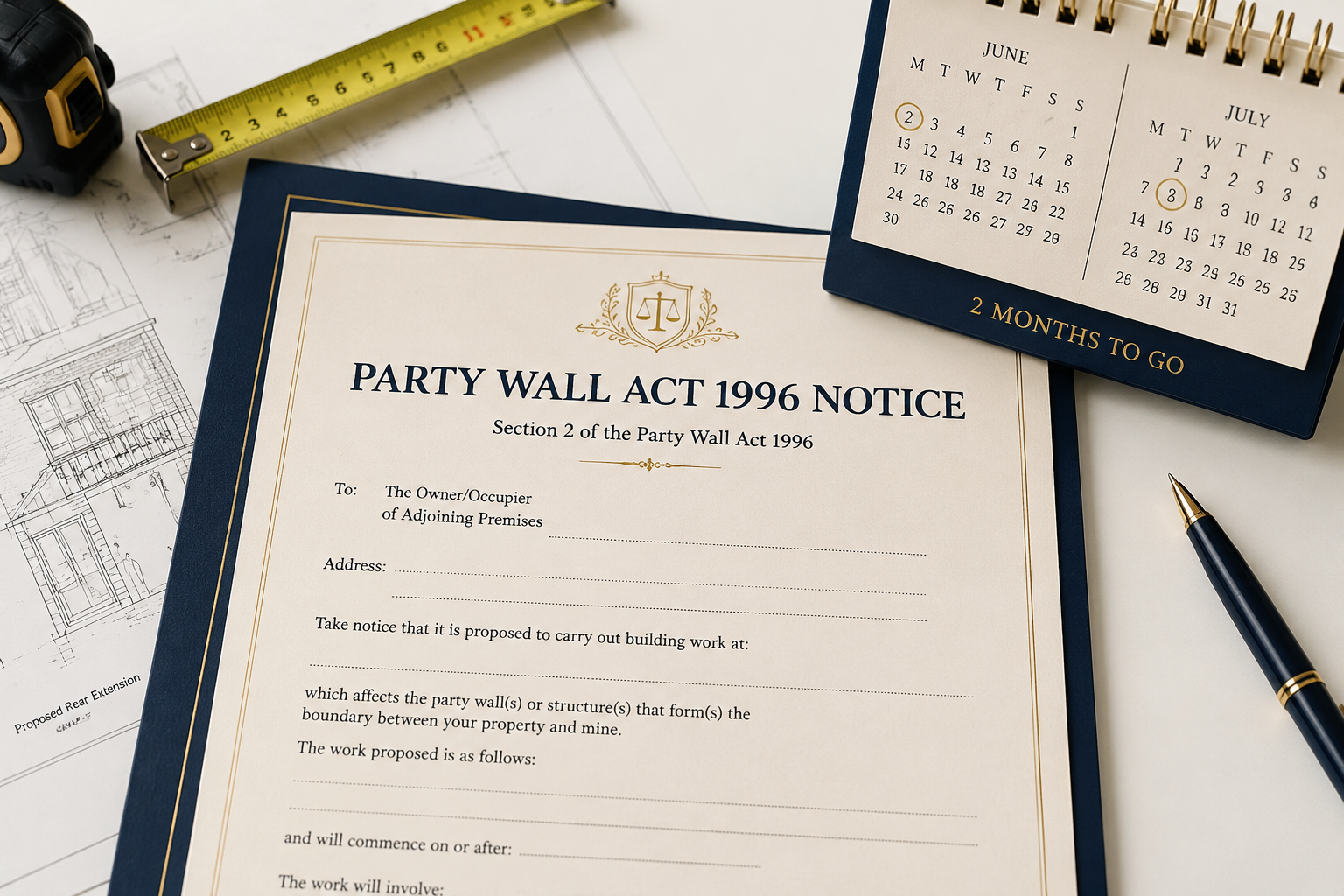
Key Takeaways 📋
- Two notice types, two timelines: Most party wall work requires two months' notice; boundary building and excavation require one month.
- Vague descriptions invalidate notices — every notice must name specific works, not just "extension works."
- Written neighbour consent eliminates the need for a party wall surveyor in straightforward cases.
- Notices can be served up to one year in advance, giving homeowners maximum project planning flexibility.
- Failing to serve notice carries serious legal consequences, including injunctions and unexpected repair costs.
What Is a Party Wall Notice and Who Needs to Serve One?
A party wall notice is a formal legal document served under the Party Wall etc. Act 1996. It informs an adjoining owner that building work is planned which may affect a shared wall, boundary, or nearby foundations.
Homeowners planning a rear or side extension in 2026 must ask a simple question first: does the proposed work touch, cut into, or excavate near a shared structure? If yes, a notice is almost certainly required.
The Three Sections of the Party Wall Act 1996
The Act creates three distinct notice categories, each with its own rules [1]:
| Section | Trigger | Notice Period |
|---|---|---|
| Section 1 | Building on the line of junction (new wall at boundary) | 1 month |
| Section 2 | Work to an existing party wall (cutting in, raising, thickening) | 2 months |
| Section 6 | Excavating within 3m or 6m of neighbour's foundations | 1 month |
For most home extensions, Section 2 is the most relevant. This covers work such as:
- 🔩 Inserting steel beams into a party wall
- 🏠 Raising or making a party wall thicker
- 🔧 Cutting into a shared wall for a second-storey extension
- 🪚 Removing a chimney breast on a party wall
- 💧 Inserting a new damp-proof course
For a deeper understanding of how these provisions interact with excavation work, see this guide on party wall excavation notices and the important Party Wall Act 3-metre rule.
Understanding the Timelines: 2026 Notice Periods Explained
Getting the timing right is one of the most critical party wall notice essentials for 2026 home extensions.
Two-Month Notice Period (Section 2 Works)
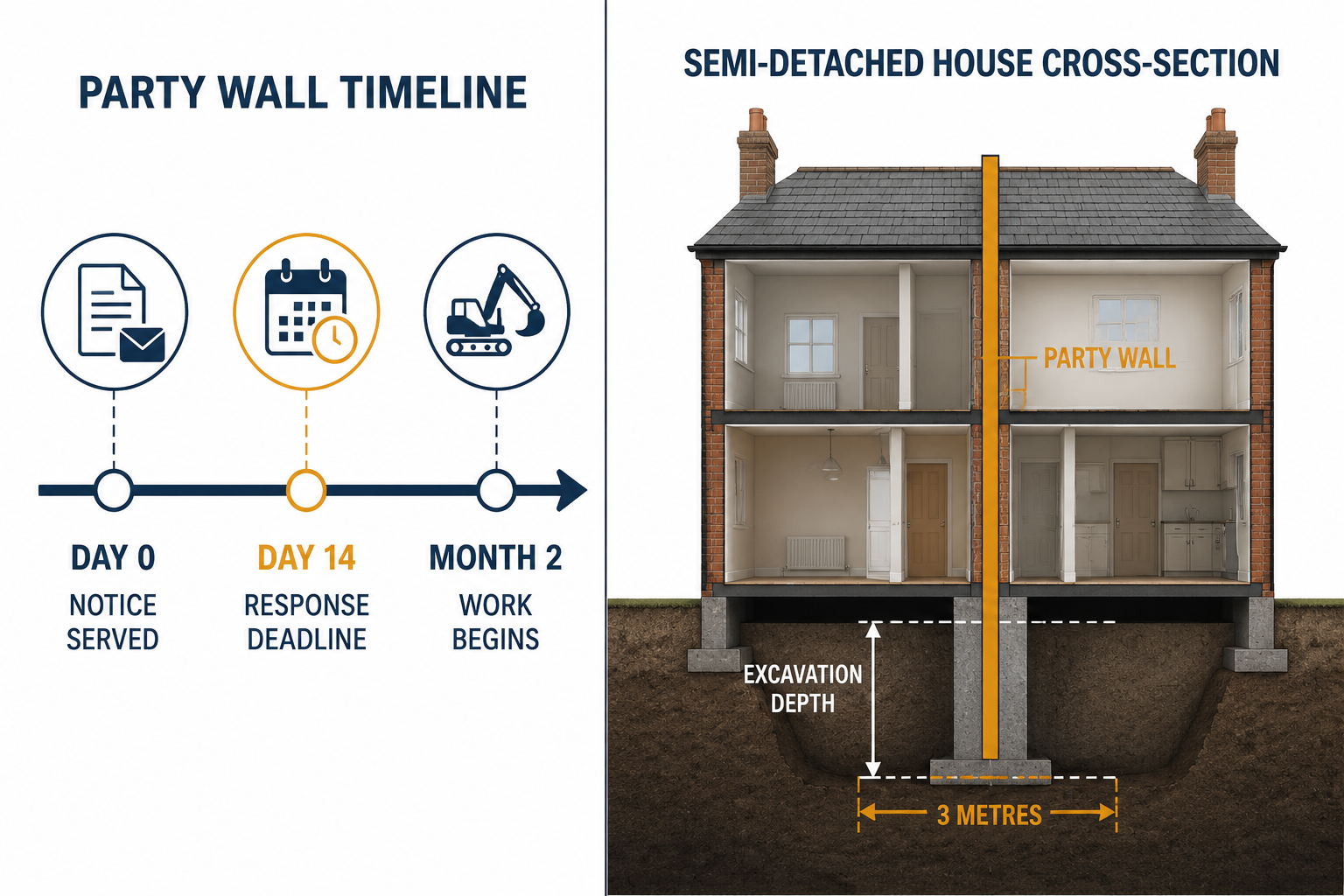
When work involves an existing party wall — the most common scenario for rear extensions — the building owner must give two full calendar months' notice before work begins [1]. If a neighbour ignores the notice entirely, a dispute is automatically deemed to have arisen after 14 days, triggering the surveyor appointment process [2].
💡 Pull Quote: "Silence from a neighbour is not consent — it is a deemed dispute. Plan your timeline accordingly."
One-Month Notice Period (Sections 1 and 6)
Building a new wall on the boundary line or excavating near a neighbour's foundations requires only one month's notice [1]. This shorter window allows faster project starts where the work is less intrusive.
How Far in Advance Can Notice Be Served?
Homeowners can serve a party wall notice up to twelve months before work is scheduled to begin [2]. This is particularly useful for 2026 projects where planning permission timelines overlap with party wall procedures. Serving notice early does not require planning permission to already be in place — the two processes run independently.
The 14-Day Response Window ⏱️
Once a notice is served, the adjoining owner has 14 days to respond [2]. They can:
- Consent in writing — the simplest outcome; no surveyor needed
- Dissent and agree to a single surveyor — both parties share one surveyor
- Dissent and appoint their own surveyor — each party appoints separately
- Ignore the notice — after 14 days, a dispute is deemed to have arisen
Free Party Wall Notice Templates: What Must Be Included
A valid party wall notice is not simply a letter saying "we're building an extension." Courts and surveyors consistently see notices fail because of vague or incomplete wording [1].
Mandatory Elements of a Valid Notice
Every notice served in 2026 must include:
- ✅ Full name and address of the building owner (the person doing the work)
- ✅ Full name and address of the adjoining owner (verified via HM Land Registry)
- ✅ Property address where work will take place
- ✅ Specific description of works — not "extension works" but, for example, "cut into the party wall at ground floor level to accommodate a steel beam at 2.4m height"
- ✅ Proposed start date of the works
- ✅ Reference to the relevant section of the Party Wall etc. Act 1996
- ✅ Drawings or plans where required (especially for Section 6 excavation notices showing depth)
⚠️ Common Mistakes That Invalidate a Notice
Incorrect owner details are one of the most frequent causes of invalid notices [1]. If a neighbour's name is wrong — even slightly — the notice may be legally unenforceable. Always verify ownership at HM Land Registry before serving.
Other invalidating errors include:
- Describing works as simply "extension works" without specifics [1]
- Failing to include the proposed start date
- Omitting required statements about the Act
- Including overhanging design details (e.g., gutters extending onto the neighbour's land) — these are not permitted under the Act [1]
Free Template Structure (Section 2 Notice)
Below is a simplified template structure homeowners can adapt:
PARTY WALL ETC. ACT 1996 — NOTICE UNDER SECTION 3
To: [Adjoining Owner Full Name], [Adjoining Property Address]
From: [Building Owner Full Name], [Building Owner Address]
Property where works will be carried out: [Full Address]
Description of proposed works: [Specific, detailed description — e.g., "Cut into the party wall at ground floor level to install a steel RSJ beam at 2.4m height to support a single-storey rear extension. The wall will be made good on completion."]
Proposed start date: [Date — minimum 2 months from date of this notice]
This notice is served under Section 3 of the Party Wall etc. Act 1996.
Signed: [Building Owner Signature] Date: [Date]
For professional guidance on completing a party wall agreement correctly, or to understand what happens when things go wrong, the party wall disputes resource provides practical context.
Neighbour Consent Strategies: Getting to Yes Without a Surveyor
The fastest and cheapest route through the party wall process is written neighbour consent. When a neighbour provides written assent within the 14-day window, there is no requirement to appoint a party wall surveyor or obtain a formal Party Wall Award [2].
Why Written Consent Matters So Much in 2026
With surveyor fees ranging from £700 to £2,000+ per party (and sometimes both sides), securing written consent can save thousands of pounds and weeks of delay. As home improvement activity rises through 2026, surveyors' diaries are filling up — making early consent even more valuable.
Practical Strategies for Securing Neighbour Consent 🤝
1. Talk before you serve
Never serve a notice as the first communication. Have an informal conversation explaining the project. Show plans, explain the timeline, and address concerns early. Neighbours who feel respected are far more likely to consent.
2. Serve notice with a cover letter
A plain-English cover letter alongside the formal notice reduces anxiety. Explain what the notice means, what happens next, and that consent simply means the work can proceed smoothly.
3. Offer a Schedule of Condition
Propose commissioning a Schedule of Condition report before work begins. This documents the existing state of the neighbour's property and protects both parties if any damage to property during party wall work is later claimed.
4. Keep records even when consent is given
When a neighbour consents in writing, both parties should take dated photographs of any existing cracks or defects and keep copies of all written correspondence [2]. This simple step prevents disputes after construction ends.
5. Respond promptly to concerns
If a neighbour raises questions after receiving the notice, respond within 48 hours. Delays breed suspicion. A quick, transparent response builds the trust needed for consent.
What Happens If a Neighbour Dissents?
If a neighbour formally dissents — or simply does not respond within 14 days — a party wall dispute is triggered. At this point, surveyors must be appointed to produce a Party Wall Award setting out how work will proceed. This is not the end of the project, but it does add time and cost.
For homeowners whose neighbours are already carrying out work that affects a shared boundary, this resource on what to do if a neighbour is carrying out party wall work is equally relevant.
Legal Consequences of Getting It Wrong
Failing to serve a valid party wall notice is not a minor administrative oversight — it carries real legal and financial consequences [4].
What Courts and Surveyors Say
Courts take a very dim view of building owners who proceed without serving notice [4]. Consequences can include:
- 🚫 Civil injunctions halting all building work until proper agreements are in place
- 💷 Liability for repair costs that would not normally be the building owner's responsibility
- 📋 Retrospective party wall awards — expensive and time-consuming to obtain after work has started
- ⚖️ Legal costs if the matter escalates to court
The Verbal Notice Trap
One of the most common mistakes in 2026 is assuming a friendly conversation with a neighbour constitutes legal notice. It does not. Only written notice — served by hand, recorded post, or (increasingly) by agreed electronic means — satisfies the requirements of the Act. Verbal agreements, text messages, and informal emails are not sufficient substitutes.
Excavation Rules: The 3-Metre and 6-Metre Thresholds
Extensions with deep foundations — particularly those involving basement conversions or reinforced concrete slabs — must consider Section 6 of the Act carefully.
When Excavation Notice Is Required
A Section 6 notice is required when [1]:
- Excavating within 3 metres of a neighbour's building and deeper than their foundations
- Excavating within 6 metres under the 45-degree rule (where a line drawn at 45 degrees from the bottom of the neighbour's foundations intersects with the planned excavation)
The notice must include detailed plans showing the proposed depth of excavation — a vague description will not satisfy the Act's requirements [1].
For a full breakdown of how these rules apply in practice, the Party Wall Act 3-metre rule guide provides detailed technical context.
Neighbour Consent and the Surveyor Process: A Quick Comparison

| Outcome | Surveyor Required? | Typical Cost | Typical Delay |
|---|---|---|---|
| Written consent given | ❌ No | £0 | None |
| Single agreed surveyor | ✅ Yes | £700–£1,200 | 4–8 weeks |
| Two surveyors appointed | ✅ Yes (×2) | £1,500–£4,000+ | 6–12 weeks |
| Dispute escalates | ✅ Yes + third surveyor | £3,000–£6,000+ | 3–6 months |
The table makes the case clearly: investing time in neighbour consent strategies at the outset pays dividends throughout the project.
For homeowners who do need professional support, understanding party wall surveyor costs in advance helps with accurate budgeting.
Frequently Asked Questions About Party Wall Notices in 2026
Q: Does a party wall notice expire?
Yes. A notice is valid for 12 months from the date it is served. If work has not started within that period, a fresh notice must be served.
Q: Can notice be served by email?
Technically, the Act specifies written notice served in person or by post. However, where both parties agree in writing to accept electronic service, email is increasingly accepted in practice. Always confirm acceptance in writing first.
Q: What if there are multiple adjoining owners?
A separate notice must be served on each adjoining owner. If a property is jointly owned, both owners must be named and served individually.
Q: Is a party wall notice the same as planning permission?
No. They are entirely separate legal processes. Planning permission (where required) is granted by the local authority. A party wall notice is a private legal matter between property owners under the 1996 Act.
For more answers to common queries, the party wall act questions resource covers a wide range of scenarios.
Conclusion: Your 2026 Action Plan for Party Wall Success
The Party Wall Notice Essentials for 2026 Home Extensions come down to four core principles: serve the right notice, use precise language, respect the timelines, and invest in neighbour relationships before the legal process begins.
Actionable Next Steps ✅
- Identify which section of the Act applies to your planned works (Section 1, 2, or 6) before anything else.
- Verify your neighbour's ownership details at HM Land Registry — incorrect names invalidate notices.
- Have an informal conversation with adjoining owners before serving formal notice.
- Use a detailed, specific description of works — never vague phrases like "extension works."
- Serve notice as early as possible — up to 12 months in advance — to protect your project timeline.
- Secure written consent where possible; document everything with dated photographs.
- Seek professional advice if a neighbour dissents or the works are complex.
With the right preparation, party wall compliance in 2026 does not have to be a source of stress or delay. It can be a straightforward process that protects both the building owner and their neighbours — and keeps the project on track from day one.
References
[1] Party Wall Notices Explained A Simple Guide For Home Extensions – https://www.prideroad.co.uk/party-wall-notices-explained-a-simple-guide-for-home-extensions/
[2] Party Wall Agreement – https://hoa.org.uk/advice/guides-for-homeowners/i-am-improving/party-wall-agreement/
[3] Simple Guide To Party Wall Notice Reply – https://fpws.uk/simple-guide-to-party-wall-notice-reply/
[4] Party Wall Agreements What You Need To Know – https://www.fmb.org.uk/find-a-builder/ultimate-guides-to-home-renovation/party-wall-agreements-what-you-need-to-know.html
[5] Party Wall Notices For Sustainable Home Extensions In 2026 Eco Compliance Clauses – https://nottinghillsurveyors.com/blog/party-wall-notices-for-sustainable-home-extensions-in-2026-eco-compliance-clauses
[6] House Extension Rules 2026 What You Need To Know – https://devisarchitecture.com/home-extensions/house-extension-rules-2026-what-you-need-to-know/