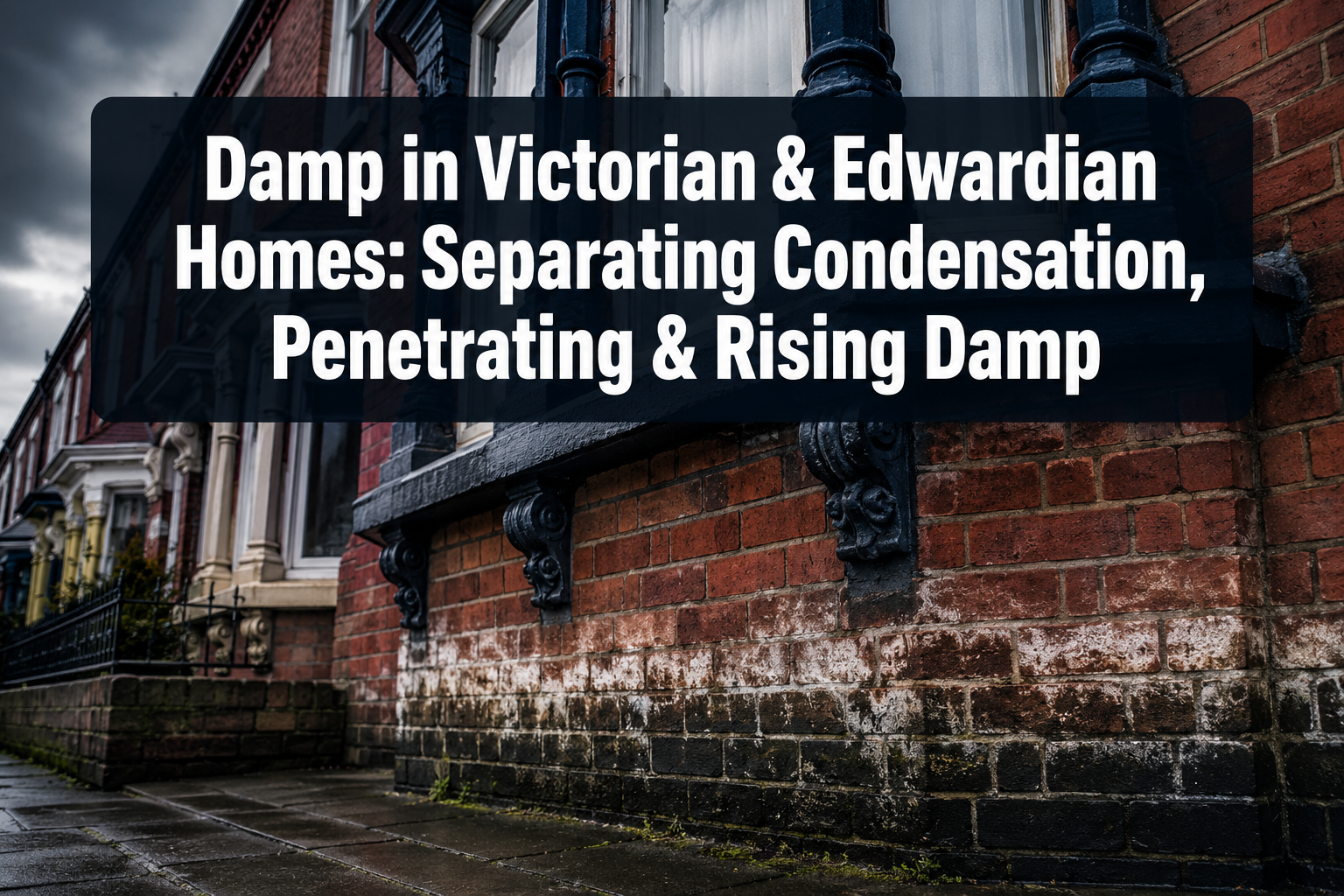

Around 5 million Victorian and Edwardian properties still stand in England and Wales today — and misdiagnosed damp is one of the most expensive mistakes made when buying or maintaining them. A buyer hears "rising damp" from a damp-proofing contractor and spends thousands on a chemical injection course that does nothing, because the real culprit was condensation. Or a surveyor flags "condensation" on a report, and the new owner repaints the wall — only to watch the plaster blow off six months later because penetrating damp was quietly saturating the masonry.
Understanding damp in Victorian and Edwardian homes: surveyor clues that separate condensation, penetrating damp, and rising damp is not just academic. It directly determines whether remediation costs £200 or £20,000 — and whether a purchase proceeds, is renegotiated, or is walked away from entirely.
Key Takeaways 📋
- Three distinct damp types — condensation, penetrating damp, and rising damp — each have different causes, locations, and visual signatures in older properties.
- Victorian and Edwardian construction details (solid brick walls, lime mortar, suspended timber floors, slate DPCs) make these homes uniquely vulnerable to specific damp pathways.
- Misdiagnosis is common and often benefits contractors, not homeowners — an independent surveyor's assessment is essential before any remediation work begins.
- Location and pattern of moisture are the most reliable diagnostic clues; a moisture meter alone is never sufficient for a definitive diagnosis.
- Specialist investigation — including thermal imaging, borescope inspection, or a specific defect report — is justified when the damp type remains ambiguous after visual inspection.
Why Victorian and Edwardian Homes Are Uniquely Vulnerable
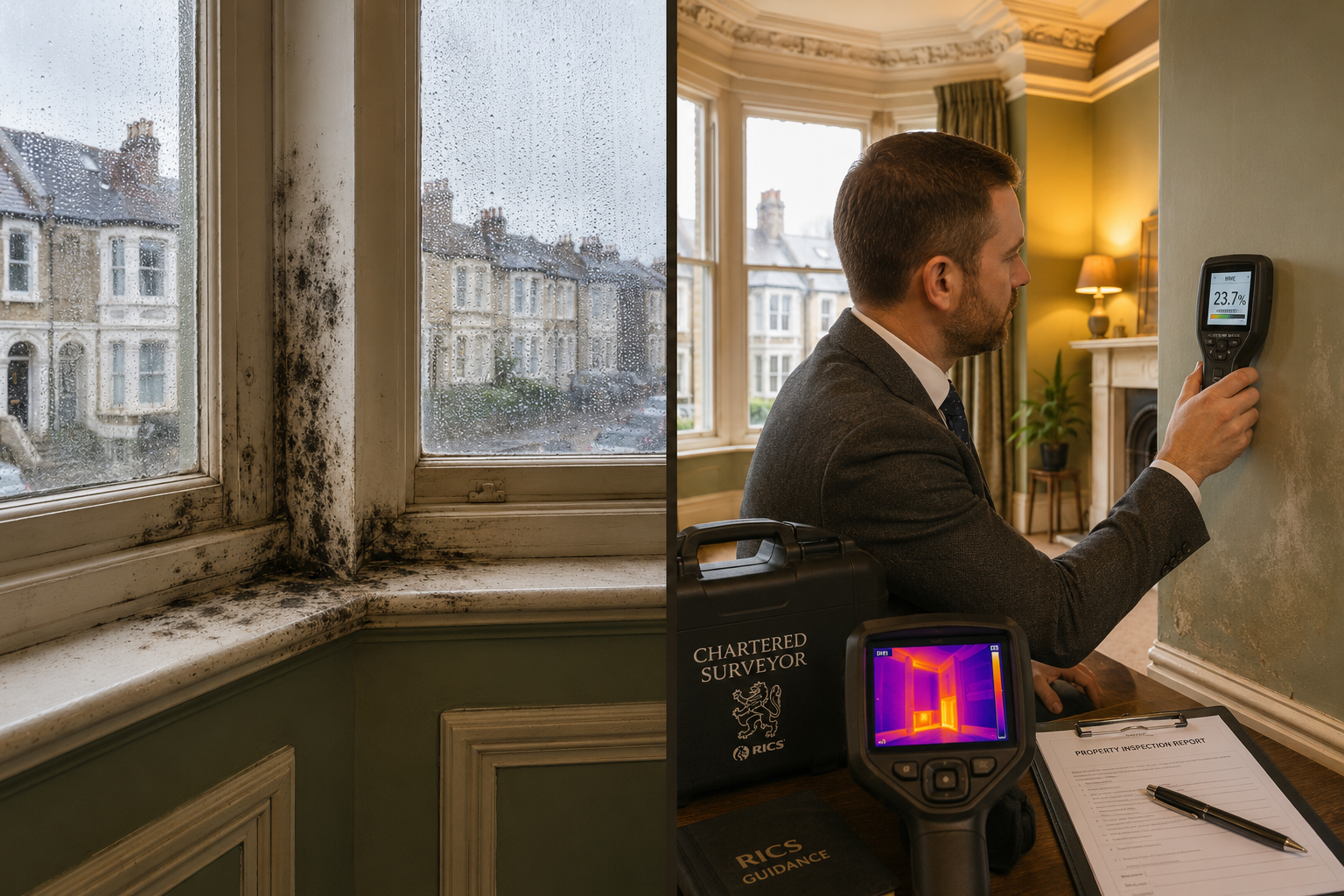
Modern homes are built with cavity walls, plastic DPCs, and vapour barriers. Victorian and Edwardian homes were not. Their construction logic was fundamentally different — and understanding that logic is the first step to accurate diagnosis.
The Original Construction Philosophy
Solid brick walls (typically 225mm or 337mm thick) were designed to absorb and release moisture through a process called hygroscopic buffering. The walls breathed. Lime mortar was soft, sacrificial, and permeable — it allowed moisture to evaporate from the mortar joints rather than from the brick face. Original internal finishes were lime plaster, which also breathed.
When modern interventions arrive — cement pointing, impermeable masonry paint, gypsum plaster on damp walls — this breathing mechanism is blocked. Moisture that once evaporated freely now becomes trapped, and what was a manageable situation becomes a damp problem.
Key original features that affect damp diagnosis:
| Feature | Original Design | Common Modern Alteration | Risk Created |
|---|---|---|---|
| Mortar joints | Soft lime mortar | Hard cement repointing | Traps moisture in brickwork |
| Internal plaster | Lime-based, permeable | Gypsum skim on battens | Hides moisture, traps it |
| DPC (if present) | Slate or engineering brick | None, or failed | Rising damp pathway |
| Floors | Suspended timber with air bricks | Solid concrete overlay | Eliminates sub-floor ventilation |
| Windows | Single-glazed sash | Double-glazed UPVC | Reduces ventilation, increases condensation |
The Role of the Surveyor
A chartered surveyor approaching a Victorian or Edwardian property must read the building as a system, not as a collection of isolated defects. Damp is almost always a symptom — the question is always: what is the moisture source, and what is the pathway?
Surveyor Clues That Separate Condensation, Penetrating Damp, and Rising Damp
1. Condensation: The Most Common and Most Misidentified
Condensation occurs when warm, moist air contacts a surface cold enough to drop below the dew point. It is overwhelmingly the most common form of damp in occupied Victorian and Edwardian homes — yet it is frequently blamed on structural defects.
🔍 Diagnostic clues for condensation:
- Location: Cold surfaces — external wall corners, behind furniture, around window reveals, on north-facing walls, inside wardrobes
- Pattern: Diffuse, spreading moisture with no clear tide mark or defined upper boundary
- Mould type: Black mould (Cladosporium or Aspergillus niger) growing on the surface of plaster or paint, often wiping off initially
- Seasonality: Worse in winter, better in summer — correlates with occupancy and heating patterns
- Moisture meter readings: Elevated on the surface layer only; readings drop significantly 10–15mm into the wall
- Thermal imaging: Shows cold bridging at structural elements — lintels, joist ends, solid wall sections
"A moisture meter reading of 25% on a wall surface means nothing in isolation. The depth profile of that reading — and where the moisture is highest — tells the real story."
Common triggers in Victorian homes:
- Blocking up original fireplaces (eliminating stack ventilation)
- Installing draught-proof double glazing without trickle vents
- Increased occupancy and lifestyle moisture (cooking, showering, drying clothes indoors)
- Inadequate extract ventilation in bathrooms and kitchens
When to suspect condensation over structural damp:
The property is occupied, the affected areas are on internal surfaces of external walls (especially corners and reveals), and the pattern does not follow a consistent height line. A building surveyor will also note whether air bricks are blocked — a critical check in Victorian terraces.
2. Penetrating Damp: Following the Water Trail
Penetrating damp enters through the building envelope — walls, roof, windows, or below-ground structures. In Victorian and Edwardian homes, the number of potential entry points is substantial, and the water pathway is often indirect.
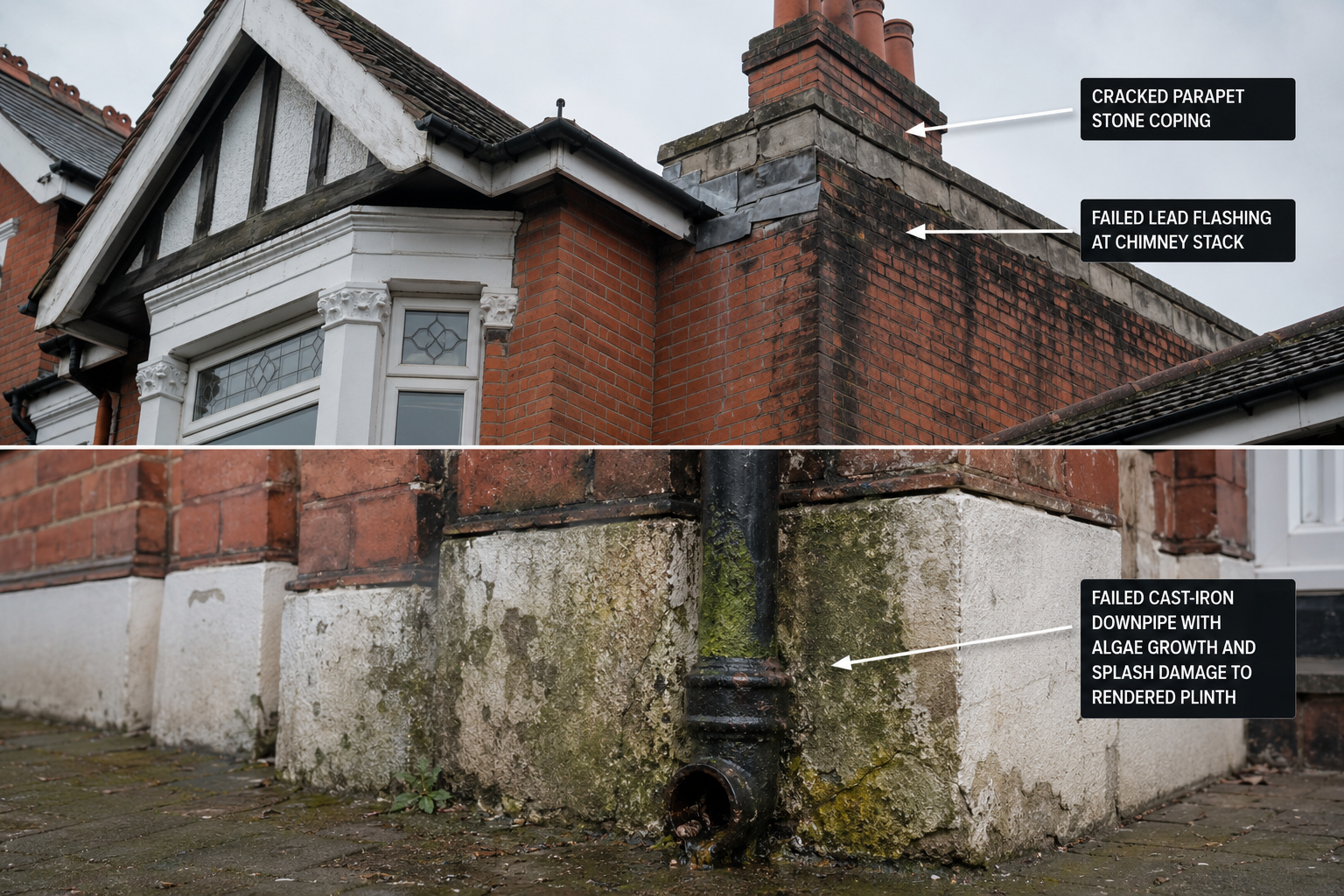
🔍 Diagnostic clues for penetrating damp:
- Location: Directly related to an external defect — below a failed parapet, adjacent to a blocked gutter, around a chimney breast, beneath a bay roof
- Pattern: Defined, localised patches that correspond to a specific external feature; often has a clear wet patch that dries and reappears
- Seasonality: Strongly correlates with rainfall events — worsens during or immediately after heavy rain
- Moisture meter readings: High readings concentrated in a specific area, often highest mid-wall or at ceiling level
- Internal evidence: Staining may be yellow or brown (from dissolved minerals or organic material in the water), plaster may be blown or detached in the affected zone
Common penetrating damp sources in Victorian and Edwardian properties:
- ❌ Failed parapet copings — a very common source in flat-roofed bay windows and rear extensions
- ❌ Cracked or missing chimney flashings — lead flashings deteriorate and are frequently bodged with mortar
- ❌ Blocked or leaking cast-iron gutters and downpipes — original cast iron corrodes and joints fail; water splashes onto walls or runs behind downpipes
- ❌ Hard cement repointing — cracks between hard cement and soft brick allow water ingress that lime mortar would have shed
- ❌ Failed window sills — stone or timber sills with no drip groove allow water to track back to the wall face
- ❌ Basement and lower ground floor walls — lateral penetration from surrounding ground, especially where external ground levels have been raised
The indirect pathway problem: In solid-wall construction, water entering at one point can travel laterally through the wall by capillary action before appearing internally. A wet patch on an internal wall may be 600mm or more from the actual point of entry. This is why surveyors must always inspect the external envelope methodically before drawing conclusions from internal evidence.
A roof survey is often a critical companion to a damp investigation — many penetrating damp cases in Victorian properties originate at or near the roofline.
3. Rising Damp: The Most Controversial Diagnosis
Rising damp is the movement of moisture upward through masonry by capillary action, drawing ground moisture through the base of walls. It is real — but it is also the most over-diagnosed form of damp in the UK, largely because damp-proofing contractors have a commercial incentive to identify it.
🔍 Diagnostic clues for rising damp:
- Location: Base of walls only — ground floor and basement/lower ground floor; never above first floor
- Pattern: Classic "tide mark" — a distinct upper boundary to the damp zone, typically between 0.5m and 1.2m above floor level; the pattern is consistent around the perimeter of the room
- Salt analysis: Rising damp carries hygroscopic salts (nitrates and chlorides) from the ground; these salts remain in the plaster even after the wall dries and cause ongoing moisture absorption — a crucial diagnostic marker
- Moisture meter readings: Highest at the base, decreasing as the meter moves upward; readings at floor level significantly higher than at 1.2m height
- External evidence: Corresponding damp at the external base of the wall, eroded mortar joints at low level, salt efflorescence on external brickwork
"True rising damp produces a consistent tide mark, hygroscopic salt contamination of the plaster, and moisture readings that decrease with height. Without all three, the diagnosis should be questioned."
The DPC question in Victorian homes:
Many Victorian properties were built with a slate DPC or engineering brick DPC. These can fail by:
- Physical fracture (from settlement or loading)
- Being bridged by raised external ground levels
- Being bypassed by internal floor screeds poured against the wall base
When rising damp is NOT the answer:
- Damp that appears above 1.2m height is almost never rising damp
- Damp on upper floors is never rising damp
- Damp that varies significantly with rainfall is more likely penetrating damp
- Damp concentrated on one wall only (rather than all perimeter walls) suggests a localised source
Buyers considering properties in areas with high concentrations of Victorian stock — such as those covered by chartered surveyors in Islington, chartered surveyors in Hammersmith, or chartered surveyors in Ealing — should be particularly alert to the risk of misdiagnosed damp in pre-purchase surveys.
The Diagnostic Toolkit: What Surveyors Use
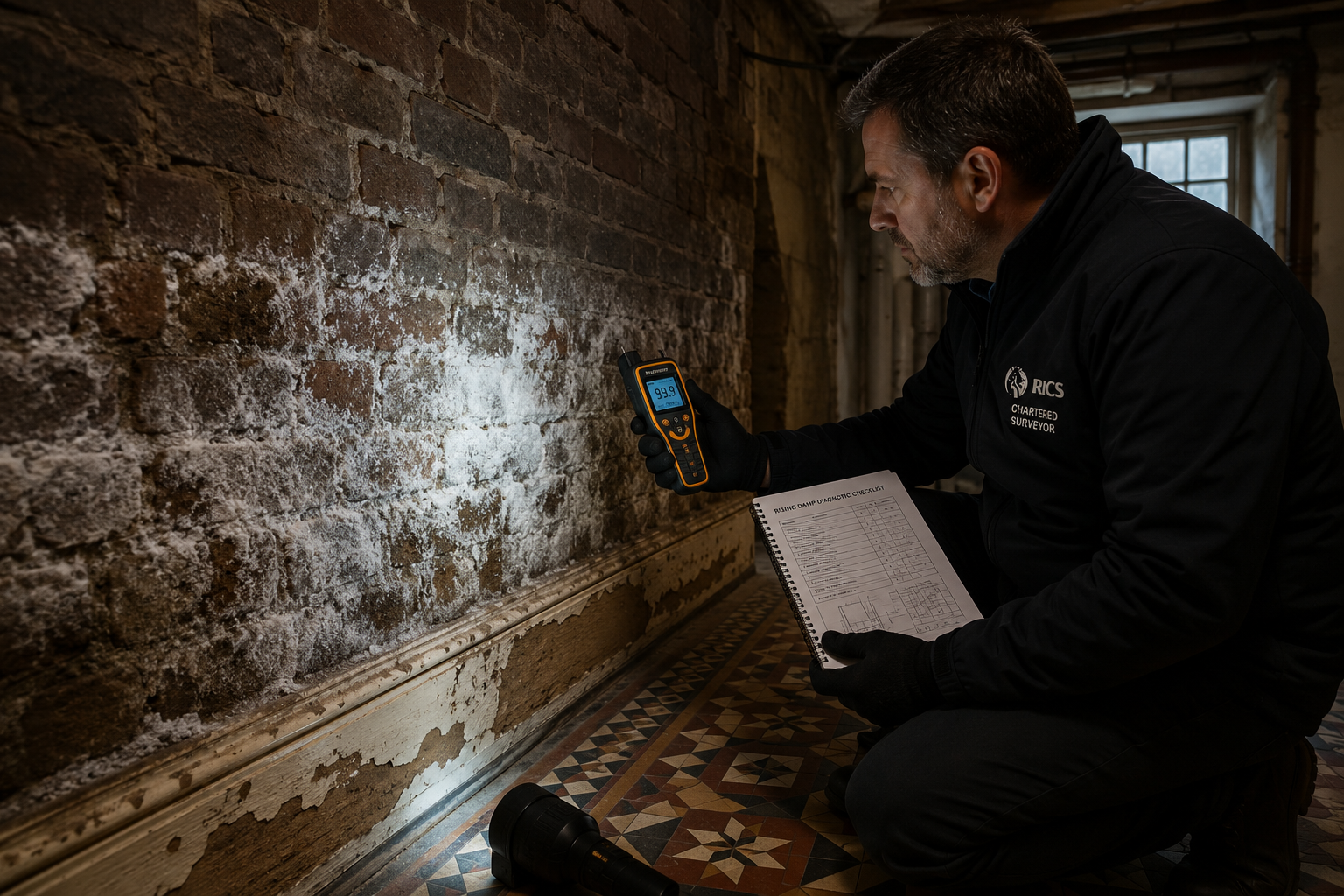
A professional surveyor does not rely on a single tool or a single observation. Accurate diagnosis of damp in Victorian and Edwardian homes requires a structured, multi-method approach.
Essential Diagnostic Methods
1. Visual inspection (external and internal)
The starting point. External inspection identifies potential ingress points; internal inspection maps the location, pattern, and extent of damp. The two must be read together.
2. Moisture meter (resistance-type)
Useful for mapping moisture distribution and comparing readings at different heights and depths. Not diagnostic on its own — many materials give false high readings (plaster salts, foil-backed insulation, certain paints).
3. Calcium carbide (speedy) moisture test
More accurate than a resistance meter — measures actual moisture content of a drilled sample. Useful for confirming whether a wall is genuinely wet or merely salt-contaminated.
4. Thermal imaging (infrared camera)
Excellent for identifying cold bridges (condensation risk), hidden water pathways, and areas of evaporative cooling (indicating active moisture movement). Best used in cold weather with a significant temperature differential between inside and outside.
5. Borescope inspection
A small camera inserted into a drilled hole can reveal the condition of a cavity (if present), the DPC layer, or internal wall construction. Particularly useful in ambiguous cases.
6. Salt analysis
Laboratory analysis of plaster samples to identify the type and concentration of salts. High nitrates and chlorides confirm rising damp; high sulphates suggest a different source.
When to Commission a Specialist Report
A standard Level 2 or Level 3 survey will flag damp as a concern and recommend further investigation. If the type of damp remains unclear — or if the proposed remediation costs are significant — a specific defect report focused solely on the damp issue is the appropriate next step. This provides a detailed diagnosis, identifies the moisture source, and recommends targeted remediation rather than blanket damp-proofing works.
Unsure which type of survey is right for your situation? The guide on what survey you need is a useful starting point before commissioning any inspection.
The Cost of Getting It Wrong
Misdiagnosis has real financial consequences:
| Scenario | Misdiagnosis | Actual Cost of Wrong Treatment | Correct Treatment Cost |
|---|---|---|---|
| Condensation on cold walls | Rising damp | £3,000–£8,000 (chemical DPC + replastering) | £200–£500 (ventilation improvement) |
| Penetrating damp from failed gutter | Rising damp | £5,000–£12,000 (DPC + replastering) | £150–£800 (gutter repair) |
| Salt contamination from old rising damp | Active rising damp | £4,000–£10,000 (new DPC works) | £1,500–£3,000 (replastering with salt-resistant render) |
| Condensation from blocked air bricks | Penetrating damp | £2,000–£6,000 (external waterproofing) | £50–£200 (clearing air bricks) |
These figures illustrate why an independent surveyor's diagnosis — rather than a contractor's free damp survey — is always the more cost-effective starting point.
Conclusion: Structured Diagnosis Protects Buyers and Properties
Damp in Victorian and Edwardian homes is rarely straightforward — but it is always diagnosable when approached systematically. The surveyor's role is to read the building's history, construction logic, and moisture patterns together, rather than reaching for the nearest label.
Actionable next steps for buyers and owners:
- ✅ Commission an independent survey before accepting any contractor's damp diagnosis — a chartered surveyor has no commercial interest in recommending unnecessary works.
- ✅ Request a specific defect report if the type of damp is unclear or if remediation costs exceed £1,000 — targeted investigation pays for itself.
- ✅ Check the basics first — blocked air bricks, overflowing gutters, and failed flashings cause the majority of damp problems in older properties and cost very little to fix.
- ✅ Understand that salt contamination persists — even after the moisture source is resolved, hygroscopic salts in old plaster will continue to attract moisture until the plaster is replaced.
- ✅ Never apply cement-based renders or impermeable coatings to solid brick walls — they trap moisture and accelerate deterioration of the original fabric.
Buyers in 2026 purchasing Victorian or Edwardian stock should treat any damp report as the beginning of an investigation, not the end of one. The right diagnosis, reached through structured surveyor methodology, is the only reliable foundation for proportionate, effective remediation.