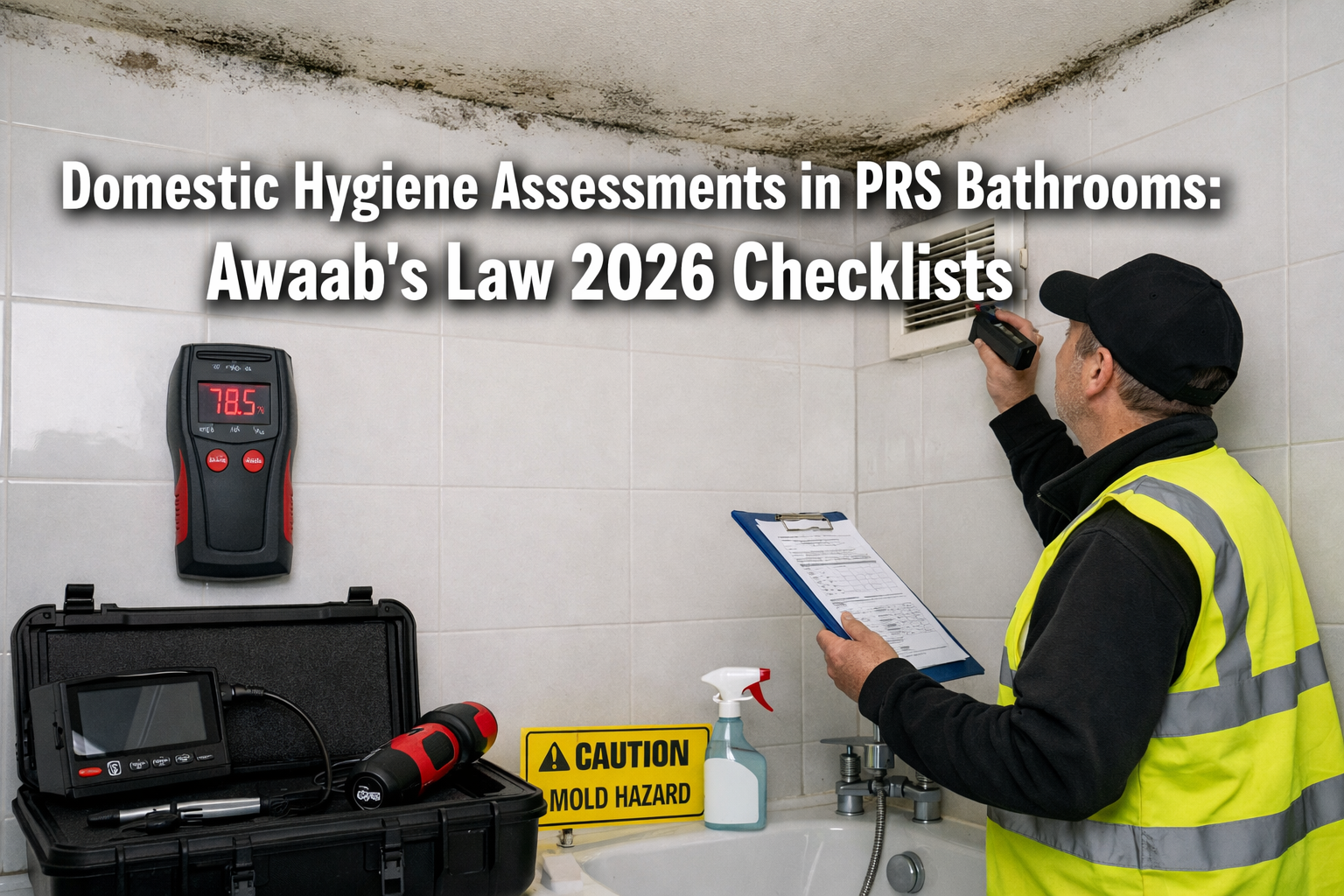
The death of two-year-old Awaab Ishak from prolonged exposure to black mould in his family's social housing bathroom shocked the nation and triggered sweeping legislative change. In 2026, building surveyors conducting Domestic Hygiene Assessments in PRS Bathrooms: Awaab's Law 2026 Checklists for Building Surveyors face unprecedented accountability standards that demand precision, documentation, and rapid response protocols never before required in rental property inspections.
Awaab's Law, formally enacted through amendments to the Social Housing (Regulation) Act 2023, establishes strict timelines for investigating and remediating damp, mould, and other health hazards in private rental sector (PRS) properties[1]. For building surveyors, this legislation transforms bathroom assessments from routine property inspections into critical health protection exercises with legal consequences for non-compliance.
Key Takeaways
- 10-day investigation mandate: Surveyors must investigate reported damp and mould hazards within 10 working days, with written summaries delivered to tenants within 3 working days of completing the investigation[2]
- Emergency response protocols: Significant health hazards require action within 24 hours, with landlords having just 7 days to begin repair work once hazards are confirmed[1]
- Person-centred assessment approach: Hazard severity must be evaluated based on individual tenant circumstances, meaning identical mould patches may qualify differently depending on occupant vulnerability[2]
- Expanding hazard scope: Phase 2 (2026) extends requirements beyond damp/mould to include excess cold, heat, fire, electrical issues, and structural collapse, with Phase 3 (2027) covering all remaining HHSRS hazards[2]
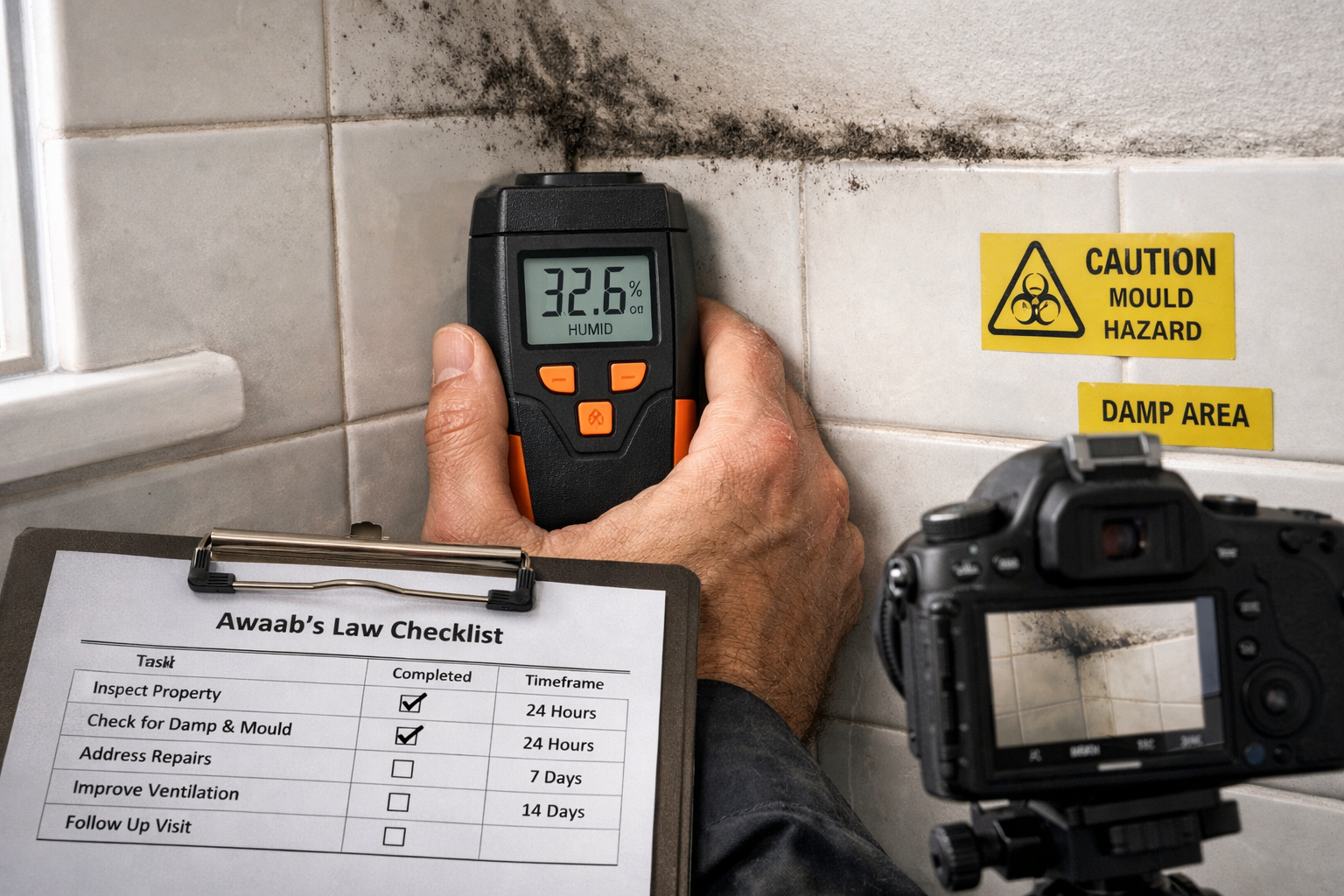
- Comprehensive documentation requirements: Inspections must include time-stamped notes, photographs, moisture readings, root cause analysis, ventilation assessments, and external perimeter checks[3]
Understanding Awaab's Law Requirements for Bathroom Hygiene Assessments
Bathrooms represent the highest-risk zones for damp and mould hazards in rental properties due to inherent moisture generation, inadequate ventilation, and temperature fluctuations. Awaab's Law specifically targets these conditions by establishing mandatory investigation timelines and remediation standards that building surveyors must implement during property assessments.
The Legislative Framework
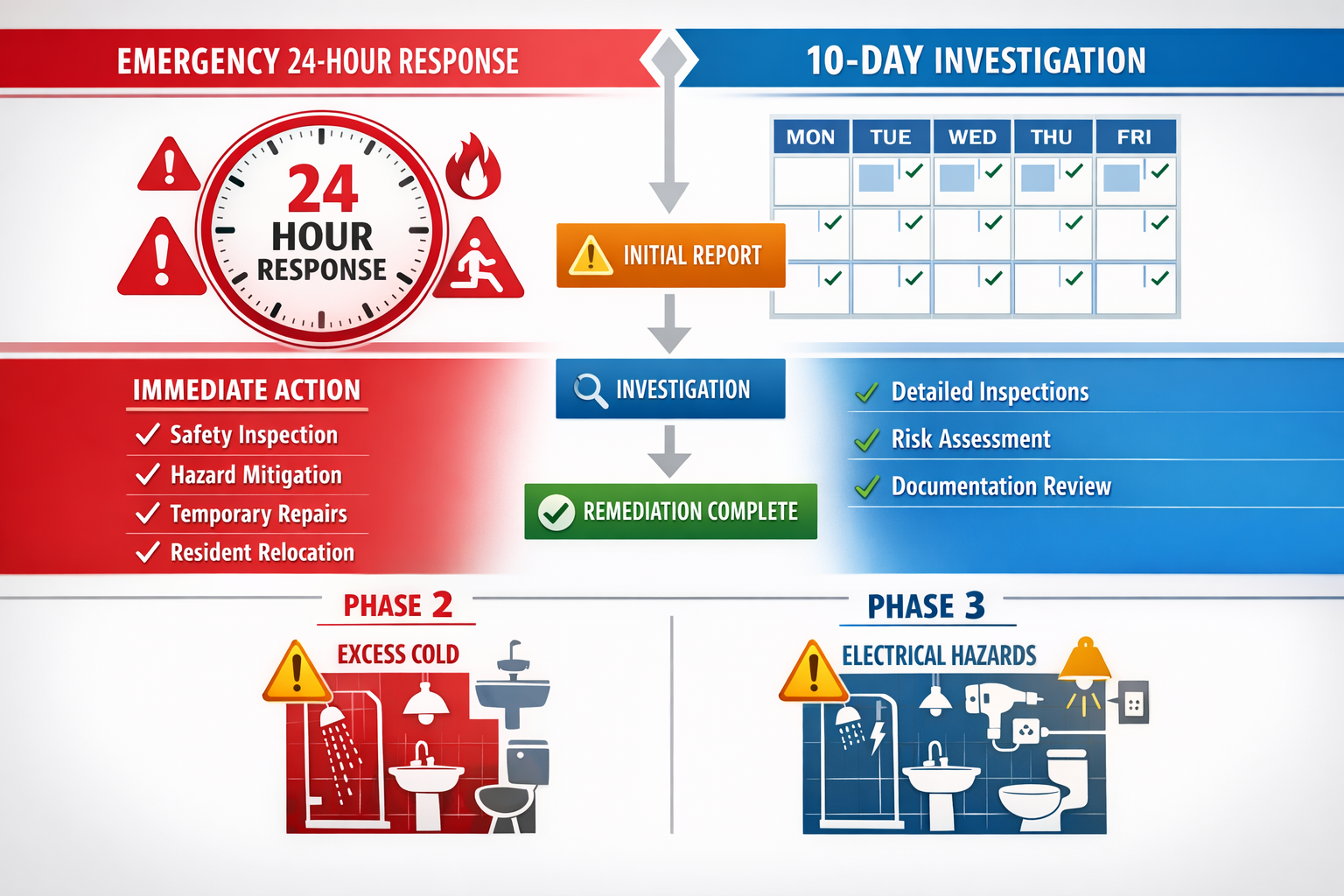
The legislation operates on a phased implementation schedule:
Phase 1 (2024-2025): Focused exclusively on damp and mould hazards in social housing[4]
Phase 2 (2026): Expands to include:
- Excess cold and heat hazards ❄️🔥
- Fire safety deficiencies 🔥
- Electrical hazards ⚡
- Structural collapse risks 🏚️
Phase 3 (2027): Encompasses all 29 HHSRS (Housing Health and Safety Rating System) hazards, including asbestos, carbon monoxide, and radon exposure[2]
For chartered surveyors in London and across the UK, this phased approach means continuously updating assessment protocols and documentation systems to meet expanding compliance requirements.
Critical Timeline Requirements
Building surveyors conducting Domestic Hygiene Assessments in PRS Bathrooms: Awaab's Law 2026 Checklists for Building Surveyors must adhere to strict response timelines:
| Hazard Type | Investigation Deadline | Written Summary | Remediation Start | Completion Deadline |
|---|---|---|---|---|
| Emergency hazards | 24 hours[1] | 3 working days | 7 days[1] | Case-dependent |
| Significant hazards | 10 working days[2] | 3 working days[2] | 14 days | 12 weeks[3] |
| Category 2 hazards | 28 days | 5 working days | 28 days | 16 weeks |
These timelines are non-negotiable unless formal extensions are agreed upon in writing with affected tenants[3]. Failure to meet deadlines can result in enforcement action, financial penalties, and potential prosecution under the Housing Act 2004.
Bathroom-Specific Hazards and Level 3 Survey Techniques
Bathroom environments present unique assessment challenges that require specialized surveying techniques beyond standard property inspections. When conducting structural surveys in London properties, surveyors must employ Level 3 survey methodologies to identify both visible and concealed hygiene hazards.
Primary Bathroom Hazards Under Awaab's Law
1. Damp and Mould Growth 🦠
The most prevalent bathroom hazard, mould develops when relative humidity exceeds 70% for extended periods. Surveyors must assess:
- Surface mould: Visible growth on walls, ceilings, grout lines, and sealant
- Concealed mould: Behind bath panels, under flooring, within wall cavities
- Root causes: Condensation, penetrating damp, rising damp, or plumbing leaks
2. Inadequate Ventilation 💨
Poor air circulation creates moisture accumulation. Assessment points include:
- Mechanical extraction fan capacity (minimum 15 litres/second for bathrooms)[6]
- Window opening functionality and size
- Passive ventilation through trickle vents
- Air brick condition and clearance
3. Excess Cold ❄️
Bathroom heating inadequacy contributes to condensation and mould. Surveyors evaluate:
- Heating provision (radiator, heated towel rail, or underfloor heating)
- Insulation quality in external walls
- Thermal bridging at junctions
- Window thermal performance
4. Water Ingress and Plumbing Defects 💧
Leaks create persistent moisture sources. Inspection focuses on:
- Visible water staining on ceilings and walls
- Plumbing fixture integrity (toilets, basins, baths, showers)
- Waste pipe condition and sealing
- Shower tray and bath sealing effectiveness
Essential Survey Equipment for Bathroom Assessments
Professional Domestic Hygiene Assessments in PRS Bathrooms: Awaab's Law 2026 Checklists for Building Surveyors require specialized diagnostic tools:
Moisture Meters 📊
- Pin-type meters for quantitative readings in timber and plaster
- Non-invasive meters for initial surface scanning
- Calibration certificates maintained for evidential purposes
Thermal Imaging Cameras 🌡️
- Identify cold spots indicating insulation deficiencies
- Detect concealed moisture behind surface finishes
- Reveal thermal bridging and air leakage paths
Hygrometers and Data Loggers 📈
- Measure relative humidity levels
- Record temperature and humidity fluctuations over time
- Provide evidence of persistent condensation conditions
Borescopes and Inspection Cameras 🔍
- Examine concealed spaces behind bath panels
- Inspect under-floor voids and wall cavities
- Document hidden defects without destructive investigation
For properties requiring comprehensive assessment, drone roof surveys can identify external water ingress sources affecting bathroom ceilings and upper-level moisture penetration.
Person-Centred Assessment Methodology
A revolutionary aspect of Awaab's Law is the person-centred assessment requirement[2]. This means hazard severity must be evaluated based on the specific vulnerabilities of actual occupants, not theoretical average residents.
Example scenarios:
🏠 Scenario 1: Small mould patch (150mm diameter) in bathroom corner
- Standard occupant: Category 2 hazard (low risk)
- Elderly tenant with COPD: Category 1 hazard (significant risk)
- Family with asthmatic child: Category 1 hazard (significant risk)
🏠 Scenario 2: Bathroom temperature of 16°C in winter
- Healthy adult: Category 2 hazard
- Tenant over 75 years: Category 1 hazard (excess cold)
- Infant under 12 months: Category 1 hazard
Surveyors must document tenant demographics, health conditions (with consent), and vulnerability factors in their assessment reports. This approach aligns with the specific defect reporting methodology used for targeted property investigations.
Comprehensive Checklist for Domestic Hygiene Assessments in PRS Bathrooms: Awaab's Law 2026 Compliance
Building surveyors require systematic checklists to ensure no critical elements are overlooked during bathroom hygiene assessments. The following framework provides the foundation for Awaab's Law compliant inspections[3].
Pre-Inspection Preparation ✅
Documentation Review
- Previous inspection reports and hazard assessments
- Tenant complaint history and correspondence
- Maintenance records for ventilation systems
- Building plans showing bathroom layout and construction
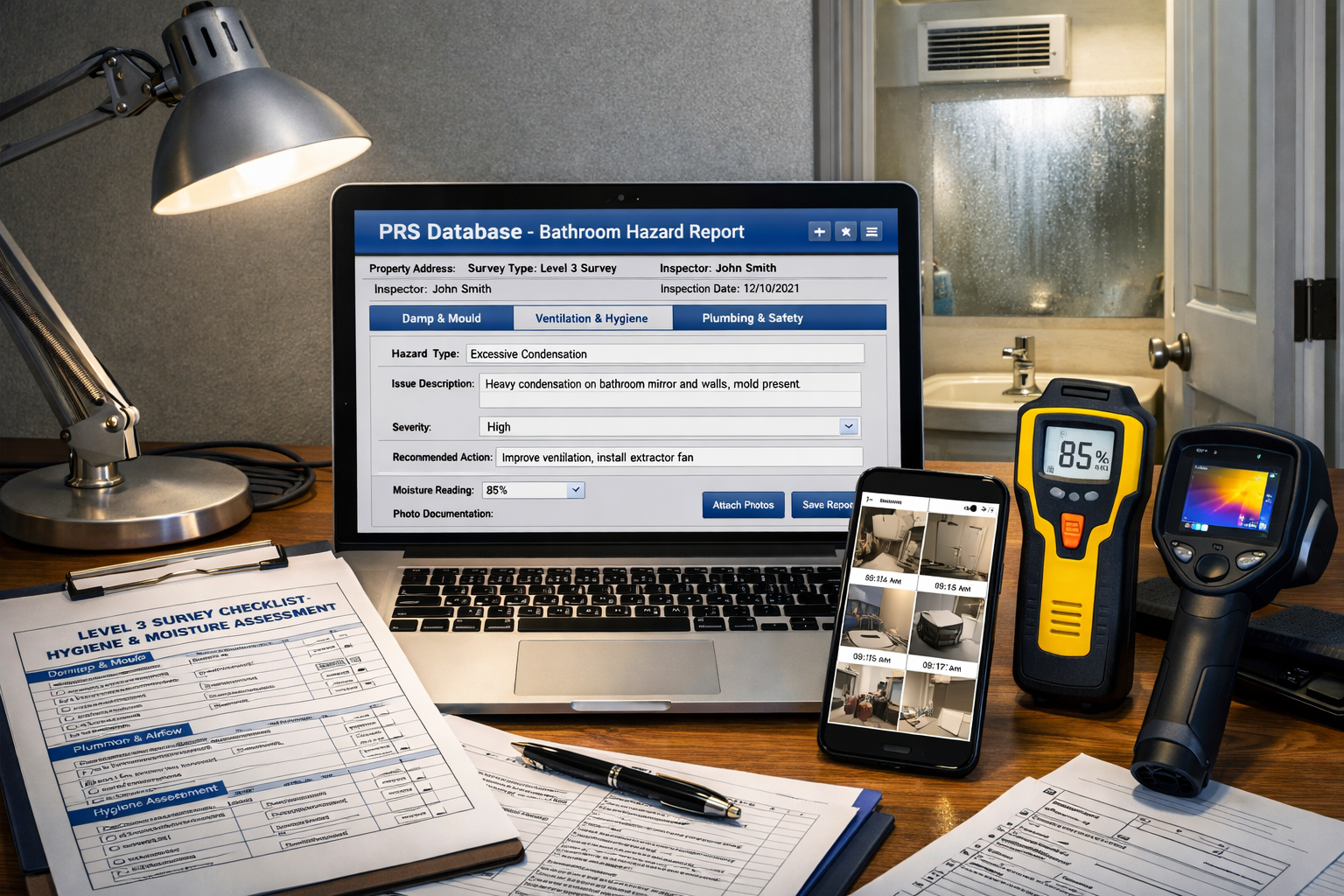
- PRS database entries for the property
Tenant Communication
- Appointment confirmation with 48-hour notice minimum
- Explanation of inspection scope and duration
- Request for access to concealed areas (bath panels, ceiling hatches)
- Health vulnerability questionnaire (with consent provisions)
- Photography consent documentation
Equipment Calibration
- Moisture meter calibration verification (within 12 months)
- Thermal camera functionality test
- Hygrometer accuracy check
- Camera battery and storage capacity confirmation
On-Site Inspection Protocol 🔍
Initial Visual Assessment
- Ceiling condition: Staining, discoloration, mould growth, paint deterioration
- Wall surfaces: All four walls inspected at multiple heights
- Floor condition: Tile integrity, grout condition, water pooling
- Window and door frames: Rot, mould, condensation patterns
- Fixtures and fittings: Toilet, basin, bath, shower, taps, waste pipes
Ventilation System Evaluation
- Mechanical extraction fan presence and type
- Fan operation test (switch activation and sound confirmation)
- Airflow measurement using anemometer (target: ≥15 l/s)
- Duct inspection for blockages or disconnection
- Window opening mechanism functionality
- Trickle vent presence and clearance
- Door undercut measurement (10-15mm clearance required)
Moisture and Thermal Assessment
- Surface moisture readings at multiple locations (walls, ceiling, floor)
- Thermal imaging scan of all surfaces
- Cold spot identification and measurement
- Relative humidity reading (target: <70%)
- Temperature measurement (target: ≥18°C in winter)
- Condensation evidence on windows, mirrors, tiles
Plumbing and Water Integrity
- Toilet cistern and pan inspection for leaks
- Basin waste and trap condition
- Bath panel removal and void inspection
- Shower tray sealing and waste integrity
- Tap and mixer valve operation and sealing
- Visible pipework condition and insulation
- Water pressure test at fixtures
Heating Provision Assessment
- Radiator or heated towel rail presence
- Heating system operation test
- Heat output adequacy for room volume
- Thermostat control availability and function
- Insulation quality of external walls
External Factors Investigation
- External wall condition above bathroom
- Roof condition and gutter functionality (if applicable)
- External ground level relative to internal floor
- Drainage condition around building perimeter
- Adjacent room conditions affecting bathroom environment
Documentation Requirements 📝
Awaab's Law mandates comprehensive documentation for all bathroom hygiene assessments[3]. Surveyors must compile:
Photographic Evidence
- Time-stamped images of all defects
- Wide-angle shots showing room context
- Close-up detail of specific hazards
- Comparison images with scale references
- Thermal imaging captures with temperature scales
Measurement Records
- Moisture meter readings with location mapping
- Humidity and temperature data
- Ventilation airflow measurements
- Room dimensions and volume calculations
- Heating output capacity
Written Analysis
- Root cause determination for identified hazards
- Hazard categorization (Category 1 or 2 under HHSRS)
- Person-centred risk assessment based on occupant vulnerability
- Remediation recommendations with priority ranking
- Estimated costs and timescales for repairs
Tenant Summary Report
- Plain-language explanation of findings
- Clear statement of identified hazards
- Timeline for landlord remediation actions
- Tenant rights and escalation procedures
- Contact information for follow-up queries
For chartered surveyors in Central London and other urban areas, documentation must also address multi-occupancy building factors such as shared ventilation systems and communal plumbing infrastructure.
Post-Inspection Actions and Compliance Monitoring ⏱️
Immediate Actions (Within 24 Hours)
- Emergency hazard notification to landlord and local authority
- Temporary risk mitigation advice to tenant
- Formal hazard notice issuance if required
Short-Term Actions (Within 3 Working Days)
- Written summary report delivery to tenant[2]
- Detailed technical report submission to landlord
- PRS database entry or update
- Remediation timeline establishment
Medium-Term Actions (Within 10 Working Days)
- Full investigation completion for significant hazards[2]
- Specialist referrals if required (structural engineers, damp specialists)
- Landlord remediation plan approval or modification
Long-Term Monitoring (12-Week Cycle)
- Follow-up inspection scheduling
- Remediation progress verification
- Completion certification
- Post-remediation environmental monitoring
The 12-week completion deadline[3] is absolute unless formal extensions are documented with tenant consent. Surveyors working across regions from chartered surveyors in Surrey to chartered surveyors in Essex must maintain consistent timeline adherence regardless of geographic location.
PRS Database Integration and Digital Compliance Systems
The Private Rented Sector Database requirements under Awaab's Law demand digital integration of assessment findings. Building surveyors must ensure their inspection data feeds directly into landlord compliance systems and local authority monitoring frameworks.
Digital Reporting Standards
Mandatory Data Fields
- Property unique reference number (UPRN)
- Inspection date and time
- Surveyor credentials and professional indemnity details
- Hazard categories identified with HHSRS scores
- Tenant vulnerability factors (anonymized where required)
- Remediation timelines and responsible parties
- Photographic evidence with metadata preservation
Interoperability Requirements
Modern survey practices require compatibility with:
- Local authority housing enforcement systems
- Landlord property management software
- Tenant communication portals
- Insurance claim documentation platforms
Surveyors conducting commercial building surveys in London often use similar digital frameworks that can be adapted for PRS bathroom hygiene assessments.
Quality Assurance and Peer Review
To maintain professional standards, Domestic Hygiene Assessments in PRS Bathrooms: Awaab's Law 2026 Checklists for Building Surveyors should incorporate:
Internal Review Processes
- Checklist completion verification before report issuance
- Photographic evidence quality control
- Measurement data validation
- Timeline compliance confirmation
External Validation
- Peer review for complex or disputed cases
- Expert witness preparation for potential legal proceedings
- Professional body audit compliance (RICS, CIOB)
For properties with multiple defects, surveyors may also need to prepare expert witness reports for tribunal or court proceedings related to housing condition enforcement.
Remediation Oversight and Re-Inspection Protocols
Building surveyors' responsibilities extend beyond initial assessment to include remediation verification and compliance certification. This oversight ensures landlords complete required works to acceptable standards within mandated timelines.
Remediation Plan Approval
Surveyors must evaluate landlord-proposed remediation strategies for:
Technical Adequacy
- Root cause addressing (not just symptom treatment)
- Material specifications meeting building standards
- Contractor qualifications and insurance coverage
- Methodology appropriateness for identified hazards
Timeline Feasibility
- Realistic completion schedules within 12-week deadline[3]
- Phasing plans for complex multi-element works
- Tenant disruption minimization strategies
- Weather-dependent work contingencies
Cost Reasonableness
- Proportionate expenditure for hazard severity
- Value engineering without compromising effectiveness
- Alternative solution evaluation
Re-Inspection Standards
Follow-up inspections verify remediation completion and effectiveness:
Immediate Post-Completion Inspection
- Visual verification of completed works
- Material quality and workmanship assessment
- Building regulation compliance confirmation
- Snagging list preparation for deficiencies
Similar to snagging report procedures used in new construction, bathroom remediation inspections must document any incomplete or substandard work requiring correction.
Environmental Monitoring Period
- 4-week post-completion monitoring recommended
- Humidity and temperature data logging
- Mould recurrence surveillance
- Tenant satisfaction and health impact feedback
Certification and Closeout
- Compliance certificate issuance
- PRS database status update
- Tenant notification of completion
- Documentation archiving for future reference
Common Pitfalls and Professional Liability Considerations
Building surveyors face significant professional liability risks when conducting Domestic Hygiene Assessments in PRS Bathrooms: Awaab's Law 2026 Checklists for Building Surveyors. Understanding common errors helps prevent compliance failures and protects professional reputation.
Frequent Assessment Errors ⚠️
1. Superficial Visual-Only Inspections
- Failing to use moisture meters and thermal imaging
- Missing concealed defects behind panels and finishes
- Inadequate root cause investigation
2. Timeline Non-Compliance
- Missing the 10-working-day investigation deadline[2]
- Delayed tenant summary report delivery
- Insufficient urgency for emergency hazards
3. Generic Hazard Categorization
- Ignoring person-centred assessment requirements[2]
- Applying standard HHSRS scores without occupant context
- Failing to document vulnerability factors
4. Incomplete Documentation
- Insufficient photographic evidence
- Missing measurement data
- Inadequate written analysis of root causes
5. Poor Communication
- Technical jargon in tenant reports
- Unclear remediation timelines
- Failure to explain tenant rights
Professional Indemnity Considerations
Surveyors should ensure their professional indemnity insurance specifically covers:
- Awaab's Law compliance assessments
- Regulatory enforcement defense costs
- Tenant personal injury claims related to assessment failures
- Landlord third-party claims for incorrect categorization
Policies should provide minimum £2 million coverage for PRS assessment work, with higher limits recommended for surveyors conducting high-volume inspections across multiple properties.
Continuing Professional Development
Staying current with evolving requirements demands ongoing education:
Essential Training Topics
- Phase 2 and Phase 3 hazard identification (2026-2027)
- Advanced moisture investigation techniques
- Person-centred assessment methodologies
- Digital reporting system operation
- Legal updates and case law developments
Professional bodies including RICS and CIOB offer specialized Awaab's Law training programs that building surveyors should complete annually to maintain competence and professional standing.
Regional Variations and Multi-Property Portfolio Management
While Awaab's Law establishes national standards, regional factors influence assessment approaches and remediation strategies. Surveyors working across different geographic areas must adapt their methodologies accordingly.
Urban vs. Rural Considerations
Urban Properties (e.g., chartered surveyors in Islington, chartered surveyors in Camden)
- Higher occupancy density affecting moisture generation
- Shared ventilation systems in converted buildings
- Limited external access for perimeter inspections
- Complex building ownership structures
Rural Properties (e.g., chartered surveyors in Berkshire, chartered surveyors in Hampshire)
- Older building stock with traditional construction
- Septic tank and non-mains drainage systems
- Greater exposure to weather and ground moisture
- Limited contractor availability for remediation
Portfolio-Wide Assessment Strategies
Landlords with multiple PRS properties benefit from systematic assessment programs:
Risk-Based Prioritization
- Properties with previous damp/mould complaints inspected first
- Older buildings (pre-1980) prioritized for ventilation deficiencies
- Ground-floor and basement bathrooms flagged for rising damp risk
- Properties with vulnerable tenants given priority scheduling
Standardized Reporting Templates
- Consistent data collection across all properties
- Comparative analysis identifying systemic issues
- Bulk remediation planning for common defects
- Predictive maintenance scheduling
Centralized Compliance Tracking
- Digital dashboard monitoring inspection schedules
- Automated timeline alerts for approaching deadlines
- Remediation progress tracking across portfolio
- Compliance certificate repository
Future Developments and Phase 3 Preparation
As Awaab's Law expands to encompass all 29 HHSRS hazards in Phase 3 (2027)[2], building surveyors must prepare for significantly broader assessment scope beyond bathroom-specific hygiene issues.
Phase 3 Hazard Categories Affecting Bathrooms
Additional hazards requiring assessment:
- Carbon monoxide: Bathroom gas heaters and boilers
- Asbestos: Ceiling tiles, floor vinyl, pipe lagging in older properties
- Falls on surfaces: Slippery tiles, trip hazards, inadequate lighting
- Electrical hazards: Faulty switches, inadequate IP ratings, poor earthing
- Personal hygiene: Inadequate handwashing facilities, poor drainage
Technological Advancements
Emerging technologies will enhance assessment capabilities:
Artificial Intelligence Integration
- Automated mould detection from photographs
- Predictive hazard modeling based on building characteristics
- Natural language generation for tenant reports
IoT Environmental Monitoring
- Continuous humidity and temperature sensors
- Real-time hazard alerts to landlords and surveyors
- Long-term trend analysis for persistent conditions
Augmented Reality Assessment Tools
- Overlay of thermal imaging data during physical inspections
- Virtual annotation of defects for remote expert consultation
- Interactive remediation planning visualization
Regulatory Evolution
Anticipated legislative developments include:
- Extension to private rental sector beyond social housing (already implemented in some regions)
- Stricter enforcement penalties for non-compliance
- Tenant compensation frameworks for health impacts
- Mandatory surveyor registration for Awaab's Law assessments
Building surveyors must monitor regulatory updates through professional bodies and government housing departments to maintain compliance as requirements evolve.
Conclusion
Domestic Hygiene Assessments in PRS Bathrooms: Awaab's Law 2026 Checklists for Building Surveyors represent a fundamental shift in rental property standards and professional surveying practice. The tragic circumstances that prompted this legislation demand unwavering commitment to thorough inspection, accurate documentation, and timely remediation oversight.
Building surveyors must embrace their expanded role as tenant health protectors, not merely property assessors. The person-centred assessment approach[2], strict timeline requirements[1][2], and comprehensive documentation standards[3] establish a new professional baseline that goes far beyond traditional survey methodologies.
Actionable Next Steps for Building Surveyors
Immediate Actions ✅
- Review and update inspection checklists to incorporate all Awaab's Law requirements
- Verify professional indemnity insurance covers Awaab's Law assessments
- Calibrate and maintain specialized assessment equipment (moisture meters, thermal cameras)
- Establish digital reporting systems compatible with PRS database requirements
Short-Term Development 📚
- Complete specialized Awaab's Law training through RICS or CIOB
- Develop person-centred assessment protocols and vulnerability questionnaires
- Create standardized timeline tracking systems to ensure deadline compliance
- Build relationships with specialist contractors for rapid remediation response
Long-Term Strategic Planning 🎯
- Prepare for Phase 3 expansion to all HHSRS hazards in 2027
- Invest in emerging assessment technologies (AI, IoT monitoring, AR tools)
- Develop portfolio-wide assessment services for multi-property landlords
- Establish peer review networks for quality assurance and complex case consultation
The professional surveyors who excel under Awaab's Law will be those who recognize that every bathroom assessment protects vulnerable tenants from preventable health hazards. By implementing rigorous checklists, maintaining strict timeline compliance, and documenting findings with forensic precision, building surveyors fulfill both their legal obligations and their ethical duty to safeguard tenant wellbeing.
For surveyors seeking guidance on comprehensive property assessment methodologies, resources on what survey you need provide valuable context for integrating Awaab's Law requirements into broader inspection frameworks.
The legacy of Awaab Ishak demands nothing less than excellence in every assessment, documentation of every hazard, and protection of every vulnerable tenant. Building surveyors carry this responsibility with every bathroom inspection they conduct in 2026 and beyond.
References
[1] Awaabs Law Surveyors – https://goreport.com/awaabs-law-surveyors/
[2] Awaabs Law Is Here The Surveyors Guide For Compliance – https://www.surventrix.com/blog/awaabs-law-is-here-the-surveyors-guide-for-compliance
[3] Compliance Checklist – https://awaabslawguide.co.uk/guides/compliance-checklist
[4] Awaabs Law What Social Landlords Need To Know About Tackling Damp And Mould – https://www.rawlinspaints.com/blog/awaabs-law-what-social-landlords-need-to-know-about-tackling-damp-and-mould/
[6] Building Survey Checklists For Awaabs Law Compliance 2026 Rental Health And Safety Mandates For Landlords – https://nottinghillsurveyors.com/blog/building-survey-checklists-for-awaabs-law-compliance-2026-rental-health-and-safety-mandates-for-landlords