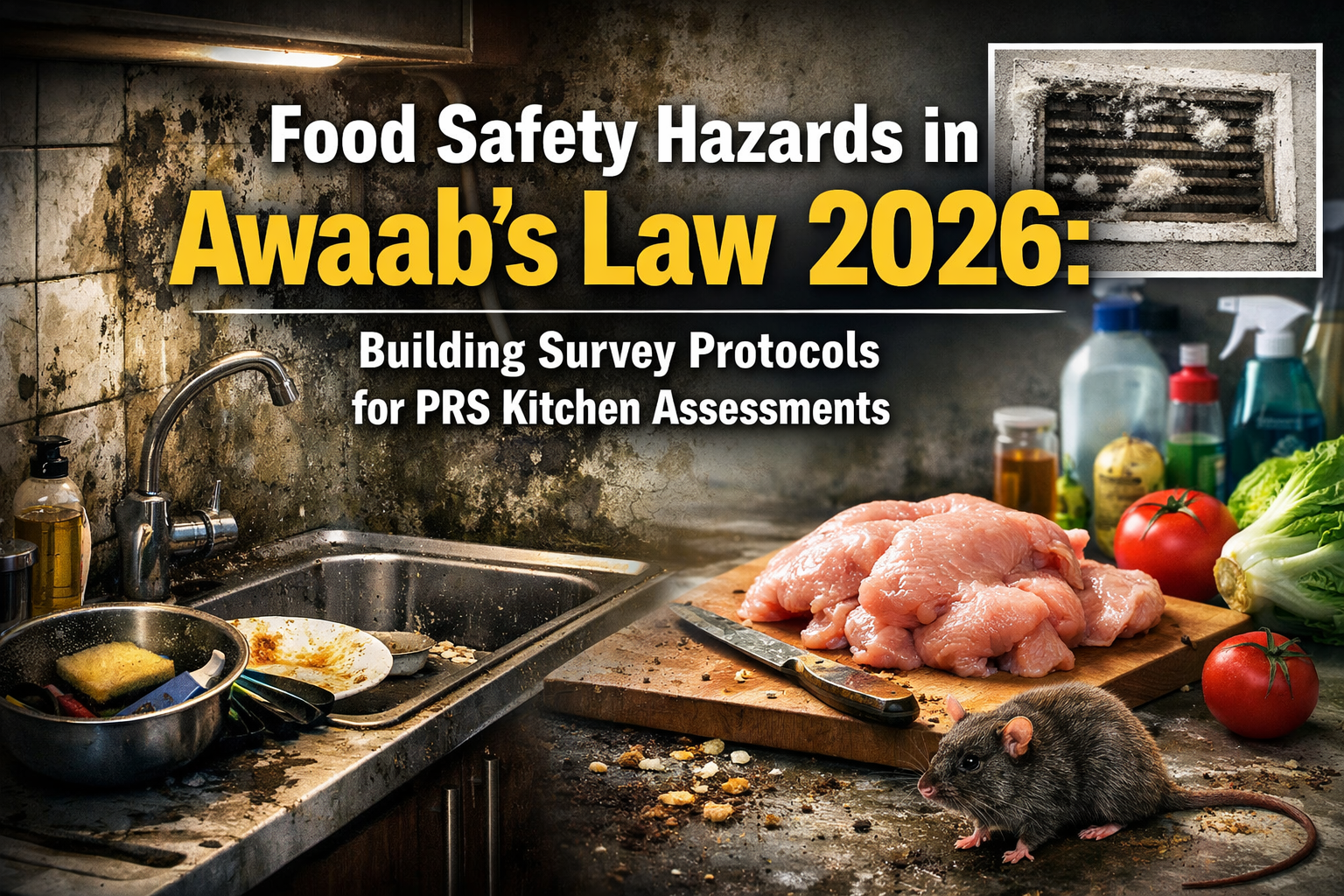
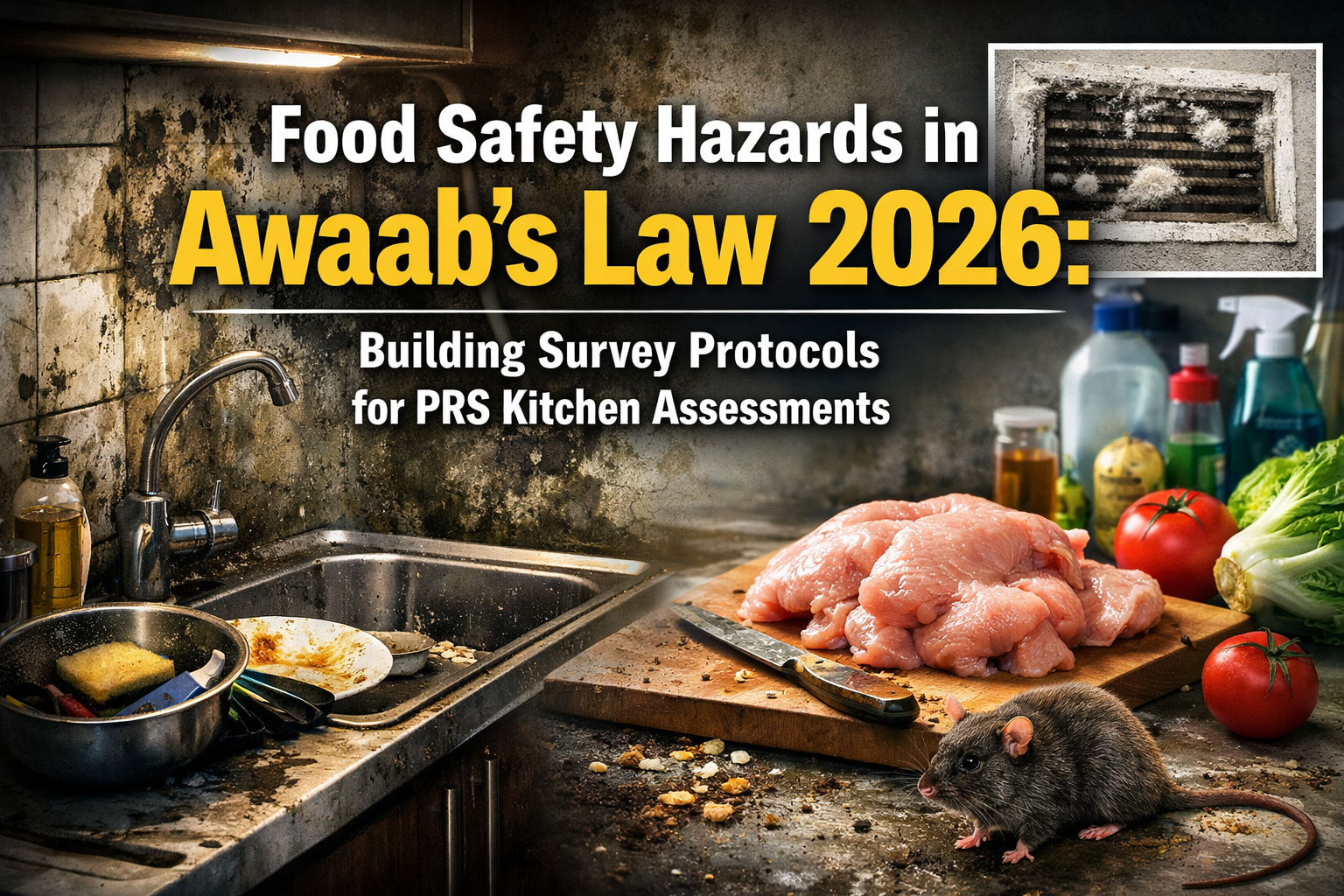
{"cover":"Professional landscape format (1536×1024) hero image with bold text overlay: 'Food Safety Hazards in Awaab's Law 2026: Building Survey Protocols for PRS Kitchen Assessments' in extra large 72pt white sans-serif font with dark shadow effect, positioned in upper third. Background shows split composition: left side displays modern PRS kitchen with surveyor conducting inspection using digital tablet and checklist, right side shows close-up of kitchen hazards including damaged worktop, exposed pipes, and pest entry points. Color scheme: professional navy blue, white, safety orange accents. High contrast, magazine cover quality, editorial style with subtle gradient overlay for text readability","content":["Detailed landscape format (1536×1024) image showing comprehensive kitchen inspection checklist being completed on digital tablet in foreground, with annotated kitchen layout diagram visible on screen highlighting multiple food safety hazard zones including refrigeration unit, waste disposal area, ventilation system, and water supply points. Background shows professional surveyor wearing high-visibility vest examining kitchen surfaces with moisture meter and thermal imaging camera. Infographic overlay displays Phase 2 timeline calendar marking October 2026 implementation date with 15-day repair deadline highlighted in red. Clean, technical aesthetic with blue and white color scheme, professional documentation style","Detailed landscape format (1536×1024) image presenting side-by-side comparison of compliant versus non-compliant PRS kitchen conditions. Left panel shows hazardous kitchen with visible pest infestation evidence, damaged seals around appliances, mould growth on walls, broken ventilation grille, and inadequate food storage areas with measurement annotations. Right panel displays remediated kitchen meeting Awaab's Law standards with sealed entry points, functional extraction system, proper food preparation surfaces, and compliant waste management. Each hazard labeled with risk category tags and repair priority indicators. Technical survey report aesthetic with red warning markers and green compliance checkmarks","Detailed landscape format (1536×1024) image showing comprehensive building survey documentation process for PRS properties. Central focus on detailed survey report template spread across desk with sections visible for food safety hazards assessment, photographic evidence attachments, repair timeline schedules, and landlord compliance checklist. Surrounding elements include professional surveying equipment (moisture meters, thermal cameras, measuring tools), laptop displaying property database entry screen, and smartphone showing tenant complaint reporting app interface. Background shows blurred kitchen environment. Professional color scheme with document blues, safety oranges, and compliance greens, organized workflow aesthetic"]"}
Social landlords face a compliance deadline that will fundamentally reshape property inspections: by October 2026, food safety hazards in rental kitchens will carry legally mandated repair timeframes under Awaab's Law Phase 2. While the legislation currently applies to social housing, the private rented sector (PRS) must prepare for inevitable expansion as tenant advocacy groups and regulatory bodies push for universal standards. For building surveyors, this represents a critical evolution in assessment protocols—transforming kitchen inspections from general condition reports into forensic food safety hazard evaluations that could determine landlord liability and tenant wellbeing.
The expansion of Food Safety Hazards in Awaab's Law 2026: Building Survey Protocols for PRS Kitchen Assessments demands immediate attention from property professionals. With Phase 2 introducing specific timeframes for domestic hygiene and food safety repairs, surveyors must develop standardized methodologies that identify, categorize, and document kitchen hazards with unprecedented precision.
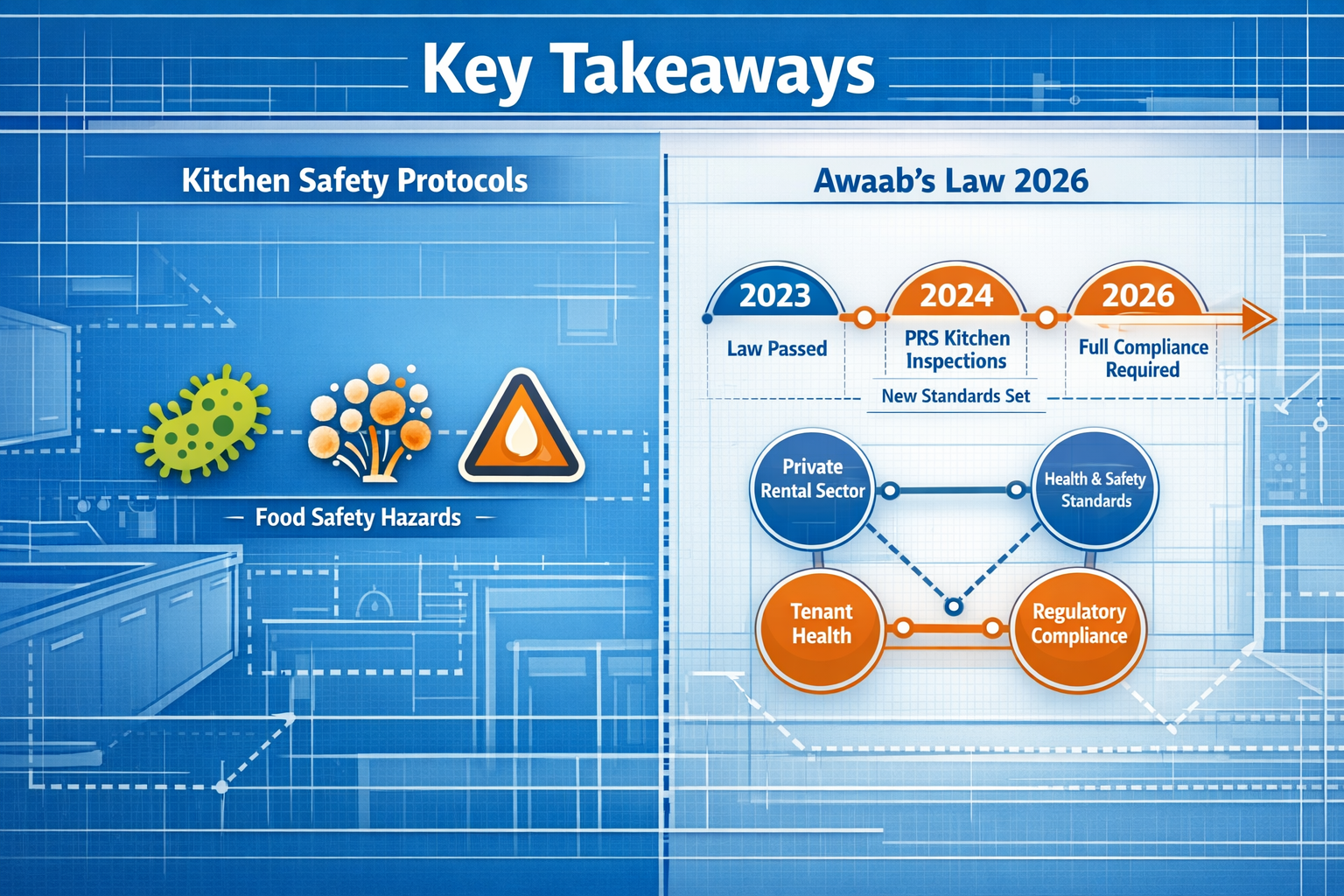
Key Takeaways
- 🔍 Phase 2 Implementation: Awaab's Law expands in October 2026 to include food safety and domestic hygiene hazards with a 15-day repair deadline for social landlords
- ⚠️ Vulnerable Tenant Escalation: Food safety risks affecting children under five, elderly residents, or those with health conditions escalate to 24-hour emergency status
- 🐀 Pest Infestations Included: Pest control issues are explicitly classified as food safety hazards requiring rapid remediation
- 📋 PRS Preparation Essential: While currently social housing-focused, PRS landlords and surveyors should implement protocols now ahead of likely legislative expansion
- ✅ Standardized Assessment Required: Building surveyors need comprehensive kitchen inspection checklists covering ventilation, pest entry points, water quality, and food preparation surfaces
Understanding Awaab's Law Phase 2: Food Safety Hazards in Awaab's Law 2026
Legislative Background and Timeline
Awaab's Law emerged from the tragic death of two-year-old Awaab Ishak in 2020, who died from prolonged exposure to mould in social housing. The legislation introduced mandatory repair timeframes for social landlords, beginning with Phase 1 in April 2024, which focused on emergency hazards and damp/mould conditions. Phase 2, scheduled for October 2026, extends these requirements to domestic and personal hygiene hazards, including food safety risks [1][6].
The expansion represents a significant shift in how rental properties are assessed and maintained. Social landlords will have 15 days to address identified food safety hazards once reported—substantially longer than the 24-hour emergency hazard standard but still requiring rapid mobilization of resources and contractors [5].
What Qualifies as a Food Safety Hazard?
Under Phase 2 guidance, food safety hazards encompass multiple risk categories:
Primary Food Safety Hazards:
- ✗ Pest infestations (rodents, cockroaches, flies) in food preparation areas
- ✗ Inadequate or non-functional kitchen ventilation systems
- ✗ Contaminated water supply to kitchen facilities
- ✗ Damaged or unhygienic food preparation surfaces
- ✗ Broken refrigeration or food storage facilities
- ✗ Inadequate waste disposal systems leading to contamination risks
- ✗ Structural defects allowing pest entry or harbourage
Escalation to Emergency Status:
Food safety hazards affecting vulnerable populations—including children under five, elderly residents, pregnant women, or individuals with respiratory or cardiovascular conditions—are escalated to emergency status requiring 24-hour remediation rather than the standard 15-day timeframe [4]. This distinction fundamentally changes risk assessment protocols for surveyors conducting property inspections.
Current Application and PRS Implications
As of 2026, Awaab's Law applies exclusively to social landlords registered with the Regulator of Social Housing. However, the PRS should not view this as a distant concern. Regulatory trends consistently show social housing standards eventually extending to private rentals, as evidenced by the progression of energy efficiency requirements, electrical safety standards, and smoke alarm regulations [8].
For building surveyor services, proactive implementation of Food Safety Hazards in Awaab's Law 2026: Building Survey Protocols for PRS Kitchen Assessments offers competitive advantage and risk mitigation. Landlords seeking comprehensive property assessments will increasingly demand surveyors capable of identifying potential food safety liabilities before they trigger tenant complaints or regulatory scrutiny.
Developing Comprehensive Building Survey Protocols for PRS Kitchen Assessments
Essential Components of Food Safety Kitchen Inspections
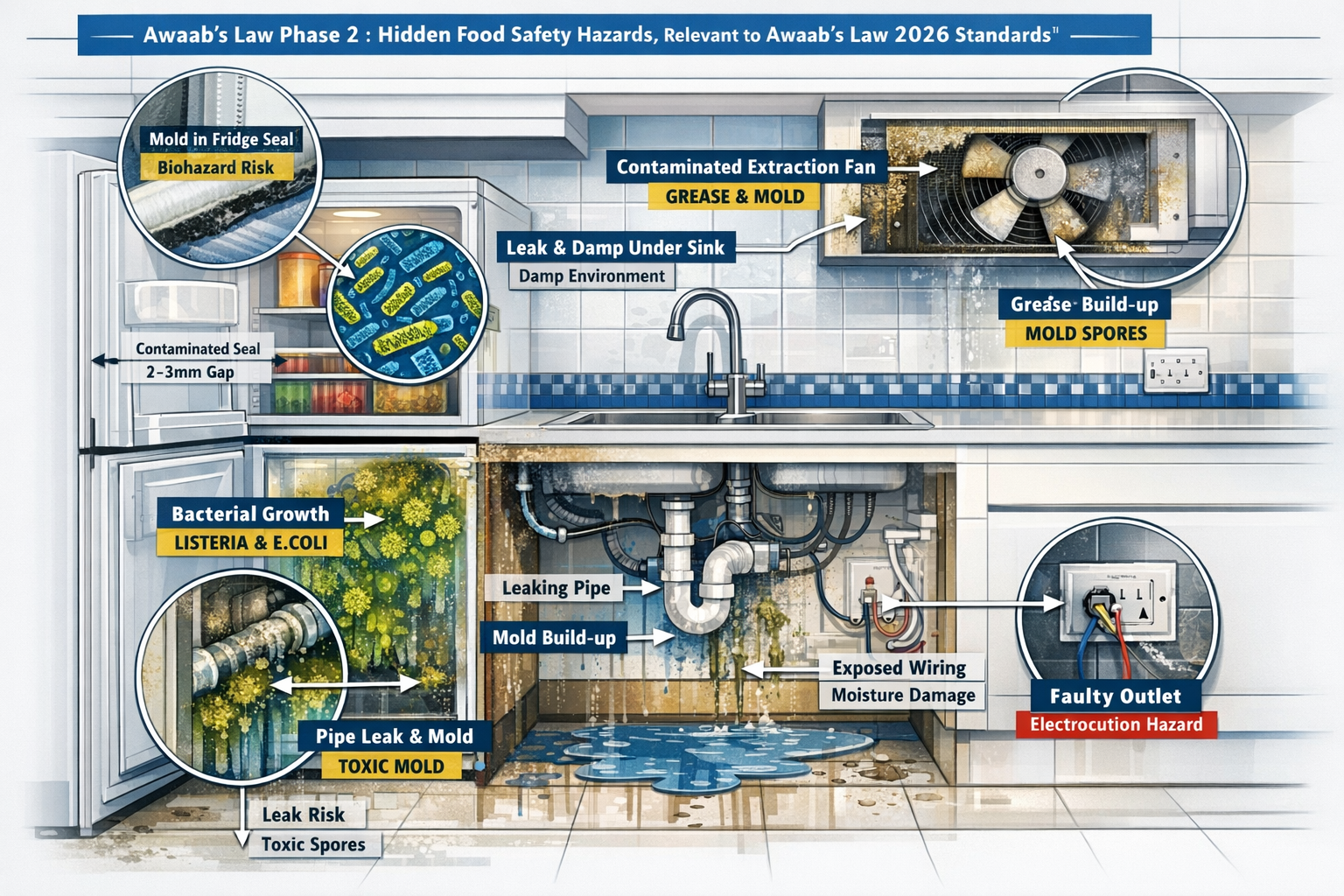
Professional surveyors must develop systematic approaches to kitchen assessments that go beyond traditional building condition surveys. The following protocol framework addresses Food Safety Hazards in Awaab's Law 2026: Building Survey Protocols for PRS Kitchen Assessments comprehensively.
1. Pre-Inspection Preparation
Documentation Requirements:
- Property history including previous pest control treatments
- Tenant complaint records related to kitchen facilities
- Previous survey reports highlighting kitchen defects
- Local authority environmental health records (where accessible)
- Building age and construction type (affecting pest vulnerability)
Equipment Checklist:
- Digital moisture meter for detecting hidden water damage
- Thermal imaging camera for identifying ventilation failures
- Pest activity detection tools (UV lights for rodent urine, monitoring devices)
- Water testing capability or sampling equipment
- Comprehensive photographic equipment with macro capability
- Detailed kitchen assessment checklist aligned with Phase 2 requirements
2. Structural and Fabric Assessment
Pest Entry Point Evaluation:
Surveyors must conduct thorough examinations of potential pest access routes, which represent critical food safety hazards [2][3]:
| Assessment Area | Specific Checks | Risk Indicators |
|---|---|---|
| External walls | Gaps around pipes, vents, cables | Openings >6mm for mice, >12mm for rats |
| Door thresholds | Gaps beneath external doors | Space allowing pest entry |
| Ventilation systems | Damaged or missing grilles/screens | Unprotected openings to exterior |
| Service penetrations | Unsealed utility entry points | Gaps around water/gas pipes |
| Drainage systems | Damaged inspection covers, broken pipes | Access routes from sewers |
Ventilation System Assessment:
Inadequate kitchen ventilation creates multiple food safety risks including moisture accumulation, mould growth, and inadequate removal of cooking contaminants:
- Mechanical extraction functionality testing
- Extraction rate measurement (minimum 60 litres/second for cooking areas)
- Ductwork integrity and cleanliness
- Natural ventilation adequacy (window/vent provision)
- Filter condition and maintenance accessibility
3. Water Supply and Drainage Evaluation
Water Quality Indicators:
While comprehensive water testing requires laboratory analysis, surveyors should identify visible contamination risks:
- Discoloration or unusual odours from kitchen taps
- Evidence of cross-contamination between waste and supply pipes
- Damaged or corroded supply pipework
- Inadequate backflow prevention on appliance connections
- Standing water in sink areas indicating drainage problems
Drainage System Assessment:
Blocked or inadequate drainage creates pest attraction and contamination risks:
- Sink waste functionality and flow rates
- Evidence of persistent blockages or slow drainage
- Condition of waste pipes and trap seals
- Adequacy of waste disposal facilities
- External drainage connection integrity
4. Food Preparation Surface Standards
Surface Integrity Assessment:
Kitchen worktops and preparation areas must meet hygiene standards:
- Damaged surfaces: Cracks, chips, or delamination allowing bacterial harbourage
- Material suitability: Non-porous, cleanable materials in good condition
- Sealing integrity: Gaps between worktops and walls/appliances
- Appliance integration: Proper sealing around hobs, sinks, and fixtures
5. Waste Management Facilities
Internal Waste Storage:
- Adequate provision of waste bins with lids
- Proper location preventing pest access
- Cleanable surfaces around waste storage areas
External Waste Facilities:
- Secure bin storage preventing pest access
- Regular collection service adequacy
- Distance from kitchen windows and ventilation intakes
Documenting Food Safety Hazards in Awaab's Law 2026: Building Survey Protocols for PRS Kitchen Assessments
Professional documentation forms the cornerstone of effective survey protocols. Surveyors must create reports that clearly identify hazards, assess severity, and provide actionable remediation guidance.
Hazard Classification System:
Category 1: Emergency (24-hour response required)
- Active pest infestation with vulnerable occupants present
- Complete loss of water supply to kitchen
- Sewage contamination of food preparation areas
- Structural collapse risk affecting kitchen safety
Category 2: Urgent (15-day response under Phase 2)
- Pest evidence without vulnerable occupants
- Inadequate ventilation causing persistent condensation
- Damaged food preparation surfaces
- Blocked drainage affecting kitchen use
- Pest entry points requiring sealing
Category 3: Routine (timeframe to be determined)
- Minor surface damage not affecting hygiene
- Cosmetic issues not presenting food safety risks
- Maintenance items not directly impacting health
Photographic Evidence Standards
High-quality photographic documentation proves essential for Food Safety Hazards in Awaab's Law 2026: Building Survey Protocols for PRS Kitchen Assessments:
Required Photography:
- 📸 Wide-angle shots showing overall kitchen condition
- 📸 Close-up images of specific hazards with measurement references
- 📸 Evidence of pest activity (droppings, gnaw marks, grease trails)
- 📸 Ventilation system condition and accessibility
- 📸 Drainage and water supply defects
- 📸 Damaged surfaces with scale references
- 📸 Before/after images for follow-up inspections
Each photograph should include metadata recording date, time, and specific location within the property. For commercial building surveys in London and residential assessments alike, comprehensive photographic records protect both surveyors and clients.
Implementing Practical Assessment Protocols for PRS Properties
Standardized Kitchen Inspection Checklist
Professional surveyors require systematic checklists ensuring consistent assessment across all properties. The following framework addresses Food Safety Hazards in Awaab's Law 2026: Building Survey Protocols for PRS Kitchen Assessments comprehensively.
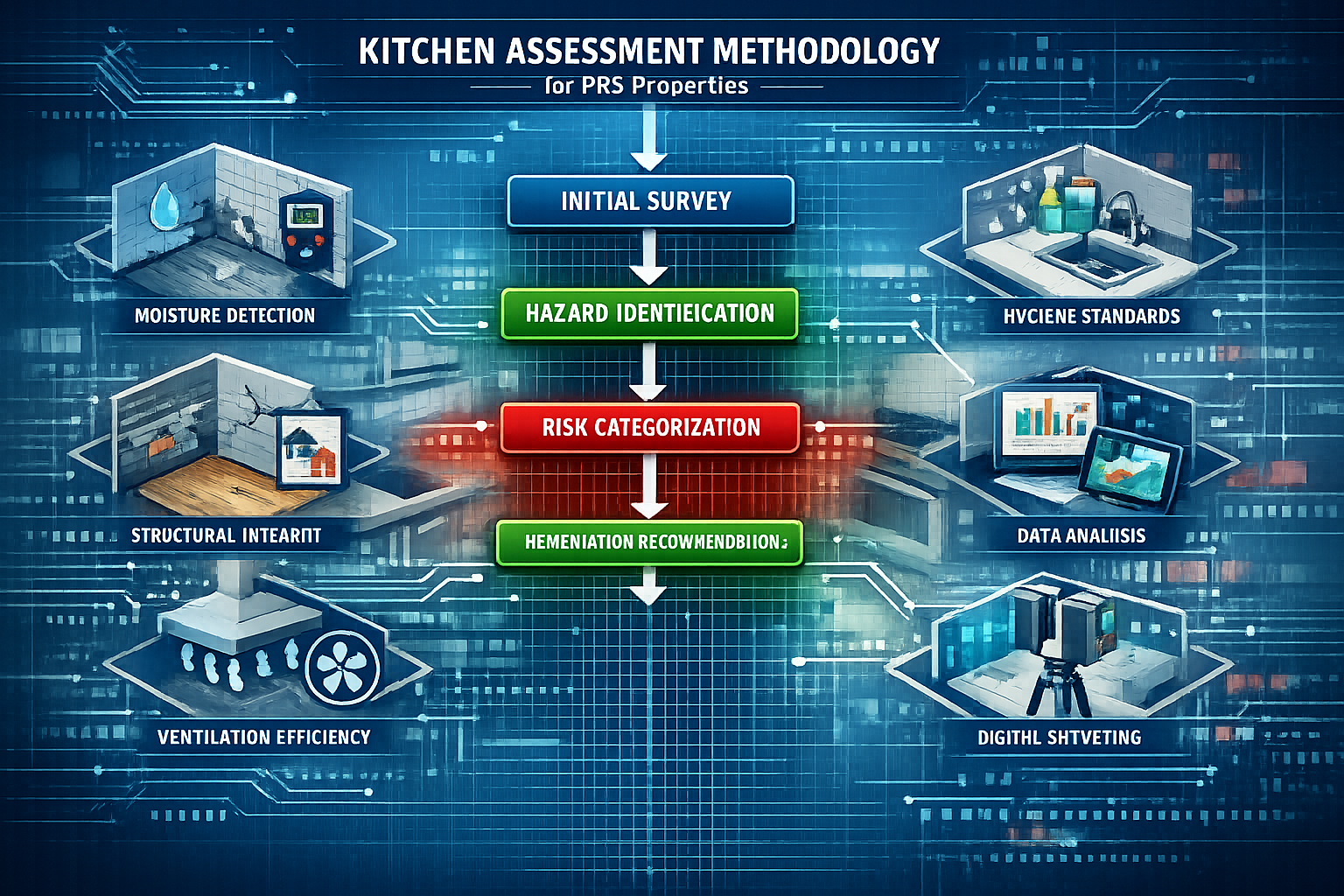
Phase 1: Initial Visual Assessment (15-20 minutes)
✅ Overall kitchen cleanliness and maintenance state
✅ Visible pest evidence (droppings, nesting materials, damage)
✅ Obvious structural defects affecting food safety
✅ Ventilation system presence and apparent functionality
✅ Water supply and drainage basic functionality
✅ Food storage facilities condition
✅ Waste management provision adequacy
Phase 2: Detailed Technical Assessment (30-45 minutes)
Pest Risk Evaluation:
- External wall inspection for entry points (ground level focus)
- Door and window seal integrity
- Service penetration sealing
- Drainage system integrity
- Evidence of previous pest activity
- Harbourage opportunities (stored items, clutter)
Ventilation Performance:
- Mechanical extraction testing (if present)
- Extraction rate measurement
- Natural ventilation adequacy assessment
- Ductwork condition (accessible areas)
- Filter condition and maintenance history
Water and Drainage Systems:
- Hot and cold water supply functionality
- Water pressure and flow rate assessment
- Visible pipework condition
- Drainage flow testing
- Trap seal integrity
- Evidence of leaks or water damage
Surface and Structural Conditions:
- Worktop material and condition assessment
- Sealing integrity around fixtures
- Wall and floor surface condition
- Ceiling condition (moisture staining, damage)
- Appliance integration and sealing
Phase 3: Reporting and Recommendations (20-30 minutes)
Surveyors should prepare reports following a consistent structure:
- Executive Summary: Key hazards identified with risk categorization
- Detailed Findings: Room-by-room assessment with photographic evidence
- Hazard Prioritization: Emergency, urgent, and routine classifications
- Remediation Recommendations: Specific actions required with cost estimates
- Compliance Statement: Assessment against Phase 2 standards
- Follow-up Requirements: Recommended re-inspection intervals
Integration with Existing Survey Services
Food Safety Hazards in Awaab's Law 2026: Building Survey Protocols for PRS Kitchen Assessments should integrate seamlessly with existing survey offerings. For properties requiring comprehensive assessment, surveyors can combine kitchen-specific protocols with broader structural survey services.
Service Integration Opportunities:
Level 1: Basic Kitchen Safety Assessment
- Standalone kitchen inspection for landlord compliance
- Focused on food safety hazard identification
- Suitable for routine compliance checks
- Duration: 1-1.5 hours
- Ideal for portfolio landlords requiring regular assessments
Level 2: Enhanced Building Survey with Kitchen Focus
- Comprehensive property survey including detailed kitchen assessment
- Integration with homebuyer reports and building surveys
- Full structural and services evaluation
- Duration: 3-4 hours
- Suitable for property purchases or major refurbishments
Level 3: Specialist Food Safety Hazard Investigation
- Detailed investigation following tenant complaints
- Expert witness capability for dispute resolution
- Laboratory testing coordination (water quality, pest identification)
- Duration: Variable based on complexity
- Links to expert witness report services
Regional Considerations for London and Surrounding Areas
Property age, construction type, and location significantly influence food safety hazard prevalence. Surveyors operating across different regions must adapt protocols accordingly.
Victorian and Edwardian Properties (Pre-1919):
Common in areas served by chartered surveyors in Camden, Chelsea, and Fulham:
- Higher pest vulnerability due to age and construction methods
- Original ventilation often inadequate for modern cooking
- Historic pipework may present contamination risks
- Extensive service penetrations from multiple upgrades
- Basement kitchens with damp and ventilation challenges
Inter-War Properties (1919-1939):
Common across West London and South West London:
- Cavity wall construction with potential pest access routes
- Original timber windows often with poor sealing
- Drainage systems may be aging and problematic
- Ventilation typically relies on natural airflow
Post-War and Modern Properties (1945-Present):
Found throughout Surrey, Hertfordshire, and Essex:
- Better baseline ventilation standards
- Improved drainage systems but aging in older stock
- Plastic pipework may have deteriorated
- Modern sealed construction can create condensation issues
Tenant Communication and Complaint Response
Awaab's Law emphasizes tenant reporting as the trigger for mandatory repair timeframes. Surveyors must understand the complaint-to-remediation pathway:
Tenant Reporting Process:
- Tenant identifies and reports food safety hazard to landlord
- Landlord must investigate within specified timeframe
- Professional survey confirms hazard and categorizes severity
- Remediation must commence within statutory timeframe (15 days for Phase 2 hazards)
- Follow-up inspection confirms satisfactory completion
Surveyor's Role in Complaint Response:
- Rapid mobilization for emergency assessments (24-hour hazards)
- Objective hazard verification and categorization
- Clear communication with both landlords and tenants
- Documentation suitable for regulatory compliance
- Follow-up verification of remediation quality
Quality Assurance and Professional Standards
Professional surveyors conducting Food Safety Hazards in Awaab's Law 2026: Building Survey Protocols for PRS Kitchen Assessments must maintain rigorous quality standards:
Professional Qualifications:
- RICS (Royal Institution of Chartered Surveyors) membership
- Relevant CPD (Continuing Professional Development) on Awaab's Law requirements
- Understanding of environmental health standards
- Knowledge of pest control principles and identification
- Building pathology expertise
Insurance and Liability:
- Professional indemnity insurance covering food safety assessments
- Clear limitation of liability statements in reports
- Appropriate disclaimers regarding specialist testing (water quality, pest species identification)
Peer Review and Calibration:
Regular peer review ensures consistency across surveyors within practices, particularly important for firms operating across multiple regions including chartered surveyors in London and surrounding counties.
Preparing for Legislative Expansion and Future Compliance
Anticipated PRS Extension of Awaab's Law
While Awaab's Law currently applies exclusively to social housing, multiple indicators suggest eventual PRS extension:
Regulatory Trajectory Indicators:
- Government consultation on PRS standards ongoing
- Tenant advocacy groups campaigning for universal application
- Local authority environmental health officers already applying similar standards
- Insurance industry increasingly requiring food safety compliance evidence
- Mortgage lenders incorporating hazard assessments into valuation requirements
Proactive Preparation Benefits:
Landlords and surveyors implementing Food Safety Hazards in Awaab's Law 2026: Building Survey Protocols for PRS Kitchen Assessments ahead of mandatory requirements gain significant advantages:
💡 Reduced liability exposure from tenant health complaints
💡 Enhanced property marketability to quality-conscious tenants
💡 Improved insurance terms through demonstrated risk management
💡 Competitive advantage in increasingly regulated market
💡 Reduced emergency repair costs through preventative maintenance
Database and Record-Keeping Systems
Effective compliance requires robust documentation systems tracking:
Property-Level Records:
- Complete inspection history with dates and findings
- Photographic evidence archives
- Remediation work completion certificates
- Tenant complaint logs and response times
- Follow-up inspection results
Portfolio-Level Management:
- Risk profiling across property portfolio
- Planned inspection scheduling
- Contractor performance tracking
- Compliance dashboard showing hazard status
- Budget forecasting for remediation works
Training and Competency Development
Surveying firms must invest in team training covering:
Technical Knowledge:
- Phase 2 hazard categories and definitions
- Pest identification and risk assessment
- Ventilation standards and testing methods
- Food safety principles and contamination routes
- Remediation specification and contractor management
Practical Skills:
- Systematic inspection methodologies
- Photographic evidence collection
- Report writing for regulatory compliance
- Client communication on sensitive issues
- Expert witness testimony preparation (for disputes)
Collaboration with Specialist Contractors
Effective Food Safety Hazards in Awaab's Law 2026: Building Survey Protocols for PRS Kitchen Assessments require collaboration with:
Pest Control Professionals:
- Identification of pest species and infestation severity
- Integrated pest management recommendations
- Proofing specification and implementation
- Follow-up monitoring programs
Ventilation Engineers:
- Mechanical extraction system design and installation
- Performance testing and certification
- Maintenance program development
Environmental Health Consultants:
- Water quality testing and analysis
- Contamination risk assessment
- Regulatory compliance verification
Building Contractors:
- Structural repairs affecting food safety
- Surface replacement and sealing works
- Drainage system repairs
- Service penetration sealing
Conclusion
Food Safety Hazards in Awaab's Law 2026: Building Survey Protocols for PRS Kitchen Assessments represent a fundamental evolution in property inspection standards. While Phase 2 implementation in October 2026 currently targets social landlords, the PRS must recognize this as the future direction of rental property regulation. Surveyors who develop comprehensive kitchen assessment protocols now position themselves as essential partners in landlord compliance and tenant protection.
The 15-day repair timeframe for food safety hazards—and 24-hour requirement for vulnerable occupants—demands rapid, accurate hazard identification and clear remediation specifications. Professional surveyors must master systematic inspection methodologies covering pest risk evaluation, ventilation performance, water quality, drainage adequacy, and food preparation surface standards.
Actionable Next Steps
For Building Surveyors:
- ✅ Develop standardized kitchen inspection checklists aligned with Phase 2 requirements
- ✅ Invest in appropriate testing equipment (moisture meters, thermal cameras, ventilation testing tools)
- ✅ Establish relationships with specialist contractors for remediation work
- ✅ Create template reporting formats addressing food safety hazard categorization
- ✅ Undertake CPD training on Awaab's Law and food safety principles
- ✅ Implement quality assurance processes ensuring consistent assessments
For PRS Landlords:
- ✅ Commission proactive kitchen safety assessments before complaints arise
- ✅ Establish preventative maintenance programs addressing common hazards
- ✅ Implement tenant communication systems for hazard reporting
- ✅ Budget for potential remediation works across property portfolios
- ✅ Engage chartered surveyors with Awaab's Law expertise
- ✅ Document all assessments and remediation works comprehensively
For Property Managers:
- ✅ Integrate food safety hazard checks into routine property inspections
- ✅ Develop rapid response protocols for tenant complaints
- ✅ Create compliance dashboards tracking hazard status across portfolios
- ✅ Establish approved contractor lists for emergency remediation
- ✅ Train staff on hazard identification and reporting procedures
The expansion of Awaab's Law to include food safety hazards reflects growing recognition that rental property standards must protect tenant health comprehensively. Professional surveyors implementing robust assessment protocols today will lead the industry as these requirements become universal across the rental sector. By combining technical expertise, systematic inspection methodologies, and clear communication, building professionals can ensure that Food Safety Hazards in Awaab's Law 2026: Building Survey Protocols for PRS Kitchen Assessments deliver genuine improvements in housing quality and tenant wellbeing.
References
[1] Awaabs Law Phase 2 Is Coming What Social Landlords Need To Know About Additional Hazard Compliance In 2026 – https://www.mobysoft.com/resources/blogs/awaabs-law-phase-2-is-coming-what-social-landlords-need-to-know-about-additional-hazard-compliance-in-2026/
[2] Awaabs Law – https://www.ecosafegroup.co.uk/post/awaabs-law
[3] Awaabs Law Guidance – https://www.npta.org.uk/awaabs-law-guidance/
[4] Awaabs Law Policy Web Version 10 – https://www.southernhousing.org.uk/media/cxvlllnp/awaabs-law-policy-web-version-10.pdf
[5] What Is Awaabs Law And What Do You Need To Do – https://selo.global/what-is-awaabs-law-and-what-do-you-need-to-do/
[6] Awaabs Law Guidance For Social Landlords Timeframes For Repairs In The Social Rented Sector – https://www.gov.uk/government/publications/awaabs-law-guidance-for-social-landlords/awaabs-law-guidance-for-social-landlords-timeframes-for-repairs-in-the-social-rented-sector
[7] Awaabs Law Phase 2 What It Covers And What Housing Providers Should Be Doing Now – https://www.madetech.com/blog/awaabs-law-phase-2-what-it-covers-and-what-housing-providers-should-be-doing-now/
[8] Awaabs Law A Guide For Social And Private Landlords – https://cydinnovation.com/knowledge_hub/awaabs-law-a-guide-for-social-and-private-landlords/