
The Renters' Rights Act received Royal Assent on 27 October 2025, fundamentally reshaping the landscape of residential property valuation in England. With Section 21 'no fault' evictions now abolished and the legislation taking full effect from 1 May 2026, property valuers and expert witnesses face unprecedented challenges in assessing market value, possession timelines, and risk profiles for rental properties involved in eviction disputes.
Expert Witness Strategies for Section 8 Eviction Valuation Disputes: RICS Guidance Amid Abolition of Section 21 have become critical as landlords must now rely exclusively on Section 8 grounds for repossession. This seismic shift requires valuers to recalibrate their methodologies, interrogate comparable evidence more rigorously, and provide courts with defensible opinions that reflect the new legal reality. The stakes are high: incorrect valuation assumptions can lead to significant financial losses for clients and damage professional reputations.
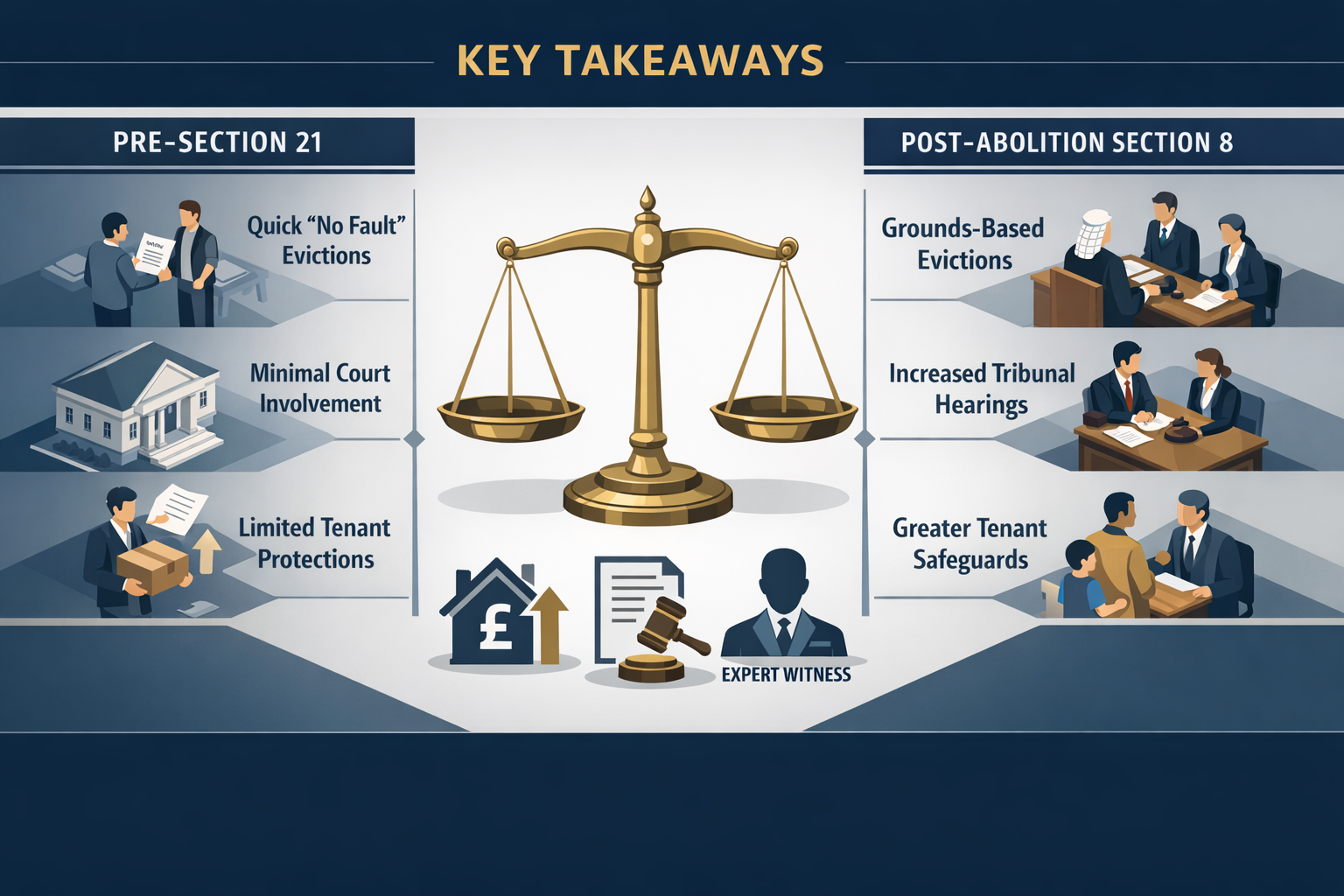
Key Takeaways
- 🏛️ Section 21 abolition is now law: The Renters' Rights Act eliminated 'no fault' evictions from 27 October 2025, with full implementation by May 2026, requiring complete reassessment of possession assumptions
- ⚖️ RICS maintains vacant possession assumptions remain valid: Despite legislative changes, RICS guidance confirms that vacant possession valuations are still reasonable when supported by available Section 8 grounds and professional judgment[1]
- 📊 Comparable evidence requires careful adjustment: Valuers must distinguish between pre-Act and post-Act market data, applying appropriate adjustments to reflect materially changed risk profiles and possession timelines[1]
- ⏱️ Extended possession timelines impact value: The removal of Section 21's streamlined process means longer, more complex eviction proceedings under Section 8, affecting discount rates and investment calculations
- 📋 Expert witness independence is paramount: RICS emphasizes statutory independence and impartiality, particularly relevant where expert witness reports intersect with landlord-initiated works and Section 8 proceedings[2]
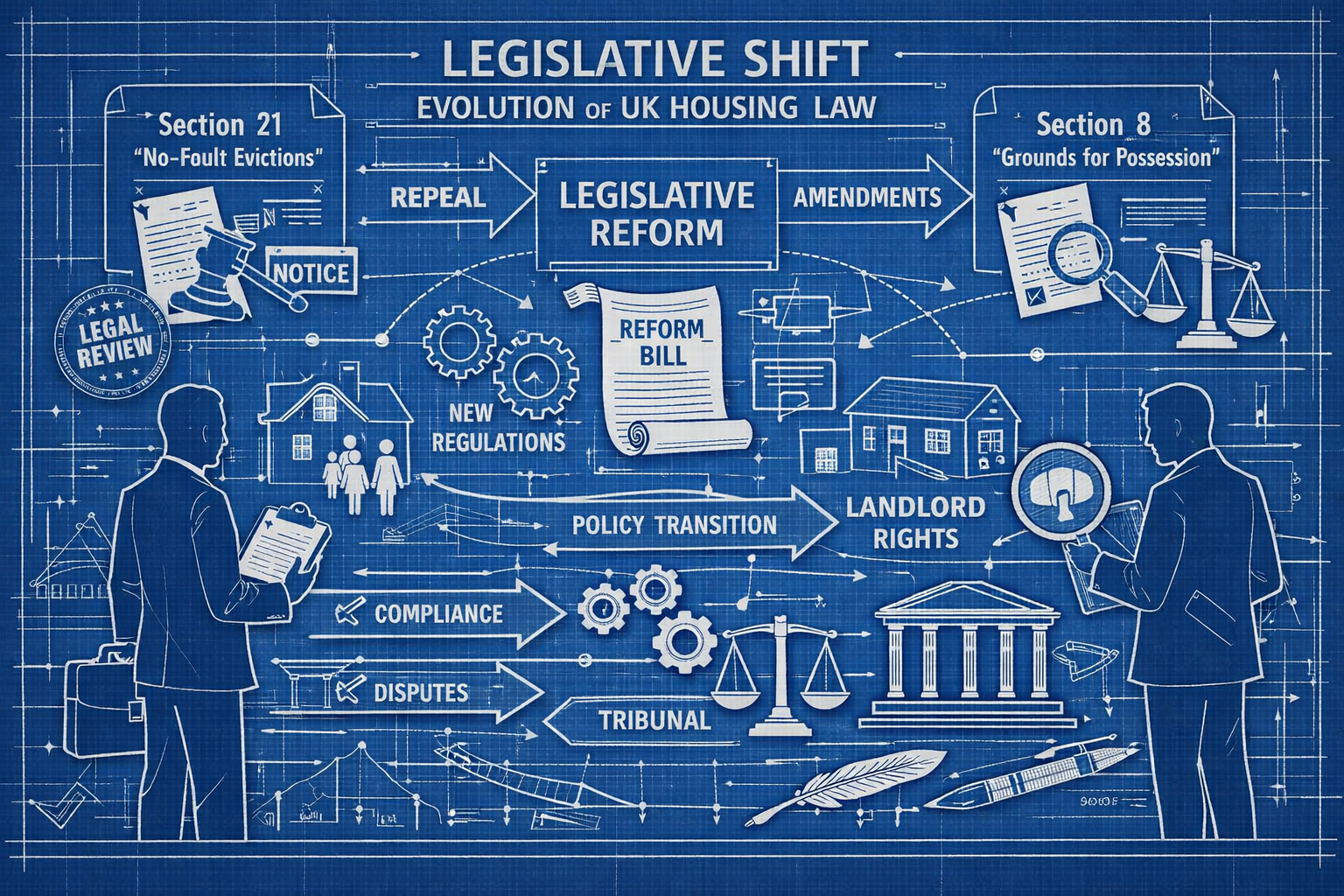
Understanding the Legislative Shift: From Section 21 to Section 8 Eviction Grounds
The End of 'No Fault' Evictions
For decades, Section 21 of the Housing Act 1988 provided landlords with a straightforward mechanism to regain possession of their properties. Requiring only two months' notice and no stated reason, Section 21 offered certainty and speed that fundamentally influenced property valuations. Assured Shorthold Tenancies (ASTs) provided contractual certainty with defined term lengths, supporting specific valuation methodologies that assumed relatively predictable possession timelines.
The Renters' Rights Act has completely eliminated this route. From 1 May 2026, all new tenancies operate as periodic tenancies with no minimum term—essentially monthly rolling contracts that continue indefinitely until terminated through lawful grounds[1]. This represents a fundamental shift in the landlord-tenant power dynamic and introduces new complexity into possession proceedings.
Section 8 Grounds: The New Framework
With Section 21 abolished, landlords must now rely exclusively on Section 8 grounds to regain possession. These grounds fall into two categories:
Mandatory grounds (where the court must grant possession if proven):
- Ground 8: Serious rent arrears (at least two months overdue)
- Ground 7A: Repeated rent arrears
- Grounds 1-5: Landlord requires property for personal occupation or sale
Discretionary grounds (where the court may grant possession):
- Ground 10: Some rent arrears
- Ground 11: Persistent delay in paying rent
- Ground 12: Breach of tenancy agreement
- Ground 13: Deterioration of property condition
- Ground 14: Nuisance or illegal activity
The critical difference: Section 8 requires evidence and court proceedings. Landlords must prove their grounds, and even with mandatory grounds, the process involves court applications, hearings, and potential appeals—all of which extend timelines and increase costs compared to the former Section 21 route[1].
Expert Witness Strategies for Section 8 Eviction Valuation Disputes: Evidence and Methodology
Interrogating Comparable Evidence in the Post-Act Market
One of the most significant challenges for expert witnesses involves appropriately adjusting comparable evidence obtained before and after the Act's implementation. RICS explicitly states that valuers must interrogate comparables to ensure they reflect current market conditions[1].
Pre-Act comparables (transactions before 27 October 2025) occurred in a market where:
- Section 21 evictions provided landlords with greater control
- Investment calculations assumed shorter possession timelines
- Risk premiums reflected the availability of 'no fault' evictions
- Buyer expectations incorporated AST certainty
Post-Act comparables (transactions after 27 October 2025) reflect:
- Exclusive reliance on Section 8 grounds
- Extended possession timelines and increased legal costs
- Higher risk premiums due to reduced landlord control
- Periodic tenancy uncertainty
Expert witnesses must apply appropriate adjustments when using pre-Act comparables in post-Act valuations. This requires documenting:
- The date of each comparable transaction
- The legislative framework in effect at that time
- Quantified adjustments reflecting changed risk profiles
- Market evidence supporting adjustment percentages
When providing RICS valuation services, professionals should maintain detailed records of their adjustment methodology to withstand cross-examination.
The Vacant Possession Assumption: RICS Guidance
Despite the abolition of Section 21, RICS maintains that the vacant possession assumption remains reasonable for most valuations[1]. This position rests on the continued availability of Section 8 grounds, which provide legal mechanisms for landlords to regain possession when legitimate circumstances arise.
However, RICS emphasizes that valuers must exercise professional judgment on a case-by-case basis. Factors to consider include:
- Strength of available Section 8 grounds: Mandatory grounds (like serious rent arrears) support vacant possession assumptions more strongly than discretionary grounds
- Tenant circumstances: Long-term tenants with strong payment histories present different risk profiles than tenants with documented breaches
- Property condition: Properties requiring significant work to achieve vacant possession may warrant adjusted assumptions
- Local market conditions: Court backlogs and regional enforcement variations affect possession timelines
Expert witnesses should document their reasoning for adopting or adjusting vacant possession assumptions, particularly in dispute scenarios where opposing parties may challenge this fundamental valuation basis.
Quantifying the Impact of Extended Possession Timelines
The practical reality of Section 8 evictions is clear: possession may be regained more slowly than under the former Section 21 regime[1]. This extended timeline has quantifiable impacts on property value that expert witnesses must address.
Timeline comparison:
| Process Stage | Section 21 (Pre-Act) | Section 8 (Post-Act) |
|---|---|---|
| Notice period | 2 months | 2-4 months (varies by ground) |
| Court application | Not required if tenant leaves | Required in all cases |
| Court hearing wait | N/A | 3-6 months (depending on backlog) |
| Possession order execution | N/A | 2-4 weeks after order |
| Total timeline | 2-3 months | 7-14 months |
This extended timeline affects valuation through:
- Lost rental income: Longer void periods reduce net present value
- Legal costs: Court proceedings, solicitor fees, and potential appeals increase expenses
- Property deterioration: Extended occupation by problem tenants may cause additional damage
- Opportunity cost: Delayed possession prevents alternative use or sale
Expert witnesses should incorporate these factors into their valuation models, using discount rates that reflect increased risk and extended timelines. When working with RICS registered valuers, ensure that financial models explicitly account for these timing differences.
RICS Guidance on Professional Standards for Expert Witnesses in Section 8 Disputes
Independence and Impartiality Requirements
The Royal Institution of Chartered Surveyors has consistently emphasized that surveyor appointments are personal and statutory, independent of client instruction[2]. This principle carries particular weight for expert witnesses involved in Section 8 eviction valuation disputes.
Key independence requirements:
✅ Duty to the court supersedes duty to client: Expert witnesses must provide objective, unbiased opinions regardless of which party instructed them
✅ Disclosure of conflicts: Any relationship with parties, properties, or circumstances that might affect impartiality must be disclosed
✅ Evidence-based conclusions: Opinions must rest on verifiable data, accepted methodologies, and transparent reasoning
✅ Acknowledgment of limitations: Experts should clearly state the boundaries of their expertise and any uncertainties in their conclusions
This independence becomes particularly relevant where Section 8 proceedings intersect with landlord-initiated works. For example, if a landlord seeks possession under Ground 1 (requiring the property for extensive renovation), an expert witness might be asked to value the property both with and without the proposed works. In such cases, the expert must remain impartial about whether the works justify possession, focusing solely on valuation impacts.
Applying Professional Judgment in Uncertain Markets
RICS acknowledges that the market is still adjusting to the Renters' Rights Act and has committed to continuing monitoring of market feedback[1]. This creates a challenging environment for expert witnesses, who must provide definitive opinions despite evolving market conditions.
Professional judgment in this context requires:
1. Transparent methodology disclosure
- Document all assumptions explicitly
- Explain the rationale for each methodological choice
- Acknowledge alternative approaches and why they were rejected
2. Sensitivity analysis
- Provide valuation ranges reflecting different scenarios
- Quantify the impact of key assumptions (e.g., possession timeline variations)
- Demonstrate how changing variables affect conclusions
3. Market evidence integration
- Reference actual transaction data where available
- Cite investor sentiment surveys and market reports
- Distinguish between theoretical impacts and observed market behavior
4. Regular guidance updates
- Monitor RICS publications for revised guidance
- Adjust methodologies as market data accumulates
- Maintain continuing professional development on legislative changes
Expert witnesses should consider the valuation factors most relevant to post-Act market conditions and ensure their reports address each systematically.
Intersection with Party Wall Matters
RICS recently launched a consultation on the draft 8th edition of Party Wall Legislation and Procedure (April 2026), emphasizing surveyor independence and proper jurisdiction[2]. This guidance has particular relevance where Section 8 eviction disputes involve landlord-initiated works.
Scenario example: A landlord serves notice under Section 8, Ground 1 (requiring the property for occupation by themselves or family), claiming the property needs substantial renovation including party wall works. The tenant disputes the valuation impact of these works and challenges whether the renovation justifies eviction.
In such cases, expert witnesses must:
- Understand the statutory independence of party wall surveyors, who act impartially regardless of who appointed them
- Distinguish between party wall compliance issues and valuation impacts
- Assess whether proposed works are genuine and proportionate to the claimed possession ground
- Value the property accounting for both the current condition and the realistic post-work condition
For properties where party wall disputes complicate Section 8 proceedings, expert witnesses should coordinate with party wall surveyors while maintaining their independent valuation role.
Practical Strategies for Expert Witnesses in Section 8 Valuation Disputes

Building a Defensible Valuation Report
A robust expert witness report in a Section 8 eviction dispute must withstand rigorous cross-examination. Key components include:
Executive Summary
- Clear statement of the valuation question
- Concise conclusion with supporting rationale
- Identification of critical assumptions
Legislative Context
- Explanation of the Renters' Rights Act changes
- Analysis of applicable Section 8 grounds
- Assessment of possession likelihood and timeline
Methodology
- Detailed description of valuation approach
- Justification for chosen methods
- Explanation of any departures from standard practice
Comparable Evidence
- Comprehensive comparable analysis with adjustments
- Clear distinction between pre-Act and post-Act data
- Quantified adjustments for legislative changes
Market Analysis
- Current market conditions assessment
- Investor sentiment and demand factors
- Risk premium analysis
Valuation Conclusion
- Supported by evidence and reasoning
- Sensitivity analysis showing impact of key assumptions
- Clear statement of confidence level
When preparing reports, consider the standards applied to expert surveyor advice and ensure all professional requirements are met.
Addressing Common Challenges in Cross-Examination
Expert witnesses in Section 8 disputes should anticipate and prepare for common challenges:
Challenge 1: "The vacant possession assumption is no longer valid without Section 21"
Response strategy:
- Reference RICS guidance explicitly supporting continued use[1]
- Detail available Section 8 grounds applicable to the case
- Provide evidence of successful Section 8 possession cases
- Acknowledge extended timelines but demonstrate possession remains achievable
Challenge 2: "Your comparables are outdated—they don't reflect the new legislation"
Response strategy:
- Demonstrate your adjustment methodology with supporting data
- Show market evidence of actual price changes post-Act
- Explain why adjusted pre-Act comparables remain relevant
- Present any available post-Act comparables, even if limited
Challenge 3: "You haven't accounted for the increased risk to landlords"
Response strategy:
- Detail your risk premium analysis explicitly
- Reference investor surveys and market sentiment data
- Show how your discount rate or yield reflects increased risk
- Provide sensitivity analysis demonstrating risk impact quantification
Challenge 4: "Your opinion favors your client's position"
Response strategy:
- Emphasize your independence and duty to the court
- Reference professional standards and RICS requirements
- Show how your methodology would apply equally regardless of which party instructed you
- Acknowledge any limitations or uncertainties transparently
Coordinating with Legal Teams
Effective expert witnesses work collaboratively with legal teams while maintaining independence. Best practices include:
📋 Early engagement: Participate in case strategy discussions to ensure valuation questions are properly framed
📋 Clear communication: Explain technical concepts in accessible language for legal professionals and courts
📋 Document requests: Proactively identify documents and information needed for thorough analysis
📋 Timeline management: Provide realistic timeframes for report preparation and be transparent about any delays
📋 Court preparation: Work with solicitors and barristers to prepare for cross-examination, but never compromise independence
When cases involve multiple technical aspects, such as properties requiring commercial building surveys or specialized valuations, ensure proper coordination between different expert witnesses.
Future Outlook: Monitoring Market Response and Evolving Guidance
RICS Commitment to Ongoing Review
The Royal Institution has explicitly stated it will continue monitoring market feedback as the Renters' Rights Act takes effect and may revise guidance based on actual market responses[1]. This creates an evolving landscape for expert witnesses.
What to watch for:
🔍 Transaction volume changes: Reduced landlord confidence may decrease rental property sales, affecting comparable availability
🔍 Pricing adjustments: Market evidence of actual value impacts from Section 21 abolition versus theoretical predictions
🔍 Investor behavior: Shifts in buy-to-let investment strategies, portfolio disposals, or market exits
🔍 Court precedents: Judicial decisions interpreting Section 8 grounds and their impact on possession timelines
🔍 Lender policies: Changes in mortgage lending criteria or loan-to-value ratios for rental properties
Expert witnesses should maintain awareness of these developments and adjust their methodologies as market evidence accumulates. Subscribing to RICS updates and participating in professional development ensures continued competence in this evolving area.
Regional Variations and Local Market Factors
The impact of Section 21 abolition will not be uniform across England. Regional factors affecting valuation include:
London and Southeast 🏙️
- Higher property values amplify financial impacts
- Greater tenant demand may offset landlord concerns
- More sophisticated investor base with diversified portfolios
- Potential for chartered surveyors in West London to observe different market dynamics
Northern regions 🏘️
- Lower yields may make increased risk less acceptable
- Smaller landlord portfolios increase individual property importance
- Different court backlogs affecting possession timelines
- Local market liquidity varies significantly
University towns 🎓
- Student tenancies present unique risk profiles
- Seasonal demand patterns affect possession timing
- Different tenant behavior patterns
Expert witnesses must account for these regional variations when selecting comparables and assessing market conditions. A valuation approach appropriate for Central London may require significant adjustment for properties elsewhere.
Integrating Technology and Data Analytics
The complexity of post-Act valuations creates opportunities for enhanced analytical approaches:
Data-driven risk modeling
- Machine learning algorithms analyzing possession success rates
- Predictive models for court timeline variations
- Automated comparable adjustment calculations
Market intelligence platforms
- Real-time transaction data tracking
- Sentiment analysis of investor forums and surveys
- Yield comparison tools accounting for legislative changes
Scenario modeling software
- Interactive sensitivity analysis for court presentations
- Visual representations of valuation ranges
- Timeline impact calculators
Expert witnesses who adopt these technologies while maintaining professional judgment can provide more robust, defensible opinions. However, technology should enhance rather than replace the fundamental requirement for professional expertise and case-specific analysis.
Conclusion: Navigating the New Landscape with Professional Excellence
The abolition of Section 21 evictions represents the most significant change to residential property valuation in decades. Expert Witness Strategies for Section 8 Eviction Valuation Disputes: RICS Guidance Amid Abolition of Section 21 must evolve to reflect this new reality while maintaining the core principles of professional independence, evidence-based reasoning, and transparent methodology.
RICS guidance provides a solid foundation: vacant possession assumptions remain reasonable when supported by available Section 8 grounds and professional judgment[1]. However, the practical challenges are substantial—extended possession timelines, increased legal costs, and market uncertainty all require careful quantification and transparent disclosure in expert reports.
Actionable Next Steps for Expert Witnesses
✅ Update your knowledge base: Review the Renters' Rights Act provisions and RICS guidance thoroughly
✅ Revise report templates: Incorporate specific sections addressing legislative changes and their valuation impacts
✅ Build comparable databases: Distinguish clearly between pre-Act and post-Act transactions with documented adjustment methodologies
✅ Develop risk assessment frameworks: Create systematic approaches to quantifying possession timeline impacts and risk premiums
✅ Enhance professional development: Attend RICS seminars, webinars, and training on the Act's implications
✅ Monitor market evidence: Track actual transaction data, investor behavior, and court outcomes to refine methodologies
✅ Maintain independence: Ensure all opinions prioritize duty to the court over client preferences
✅ Document everything: Create audit trails showing how each conclusion was reached and what evidence supports it
The transition period following the Act's full implementation in May 2026 will be challenging, but it also presents opportunities for expert witnesses to demonstrate their value. Those who master the new legislative framework, apply rigorous analytical methods, and communicate complex concepts clearly will be best positioned to serve clients and courts effectively.
For property professionals seeking expert witness services or comprehensive property valuation guidance, working with RICS-qualified experts who understand these evolving requirements is essential. The stakes in Section 8 eviction disputes are high, and the quality of expert evidence can determine outcomes with significant financial consequences.
As the market continues to adjust and RICS guidance evolves, expert witnesses must remain adaptable, evidence-focused, and committed to the highest professional standards. The end of Section 21 marks not the end of defensible valuation practice, but rather the beginning of a more sophisticated, nuanced approach that better serves the interests of justice and market transparency.
References
[1] Consideration Of Implications Of Renters Rights Act On Valuation – https://www.rics.org/news-insights/consideration-of-implications-of-renters-rights-act-on-valuation
[2] Rics Launches Consultation On Updated Party Wall Practice Guidance – https://www.rics.org/news-insights/rics-launches-consultation-on-updated-party-wall-practice-guidance