
The construction industry accounts for nearly 40% of global carbon emissions, yet fewer than 15% of party wall awards in 2026 currently incorporate whole life carbon assessments. This gap represents a critical oversight as homeowners pursue extensions and retrofits under increasingly stringent environmental regulations. Party Wall Awards Incorporating Whole Life Carbon Checks: PAS 2080:2023 for 2026 Extensions represents the convergence of traditional property law with modern sustainability imperatives, creating a new standard for responsible construction practices.
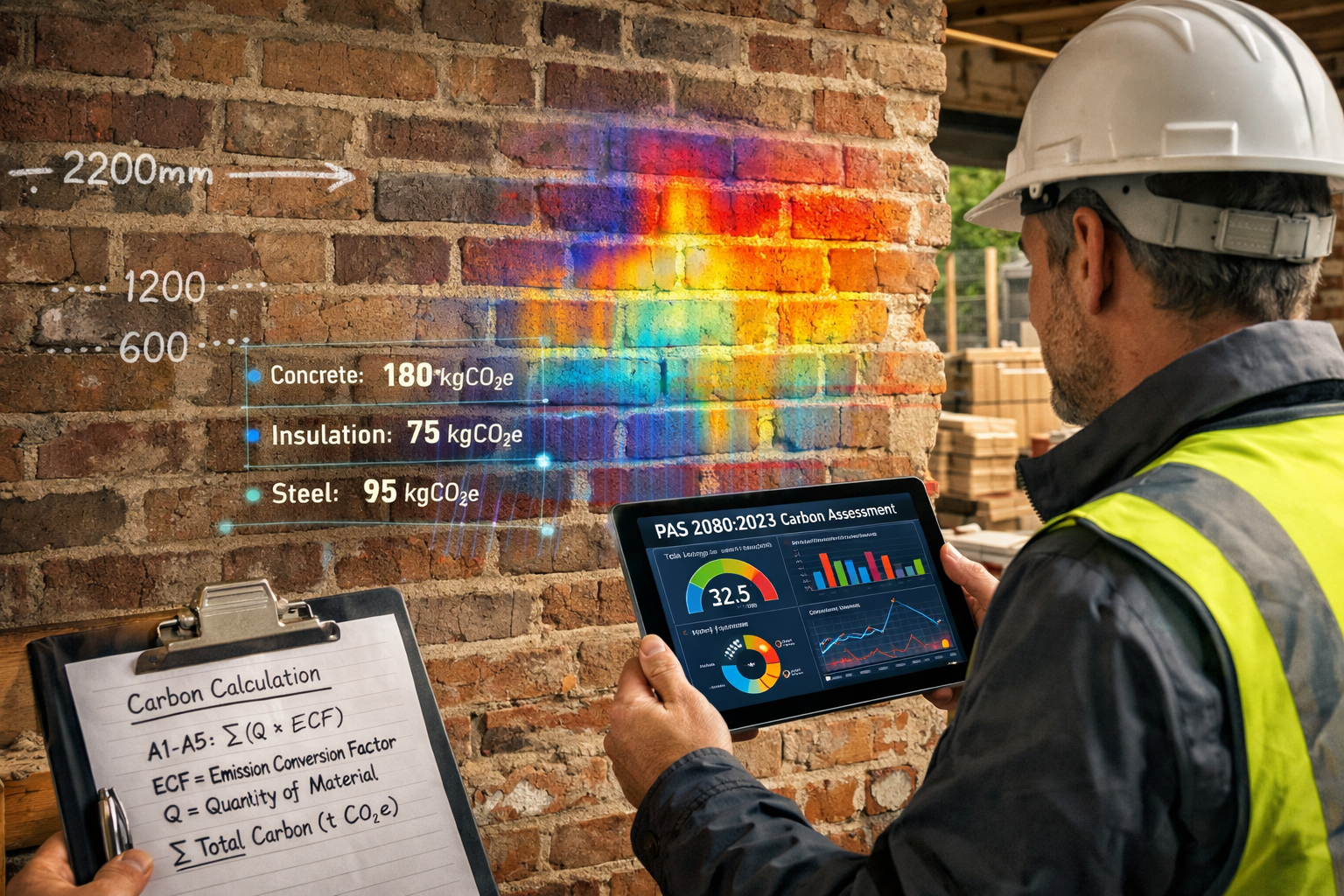
The integration of PAS 2080:2023 standards into party wall procedures marks a fundamental shift in how surveyors approach residential extensions. This framework, relaunched in March 2023 and renamed "Carbon Management in Buildings and Infrastructure," provides the methodology needed to embed sustainability considerations directly into party wall agreements [3][4]. For property owners planning extensions in 2026, understanding this integration is no longer optional—it's essential for compliance, neighbor relations, and future-proofing investments.
Key Takeaways
- PAS 2080:2023 integration: Party wall awards must now incorporate whole life carbon assessments for extensions, combining traditional structural considerations with sustainability metrics
- Surveyor responsibilities expanded: Party wall surveyors require new competencies in carbon assessment, material selection, and retrofit compliance verification
- Legal and practical benefits: Incorporating carbon checks reduces future disputes, ensures regulatory compliance, and enhances property value in an increasingly eco-conscious market
- 2026 compliance framework: New protocols establish clear procedures for documenting carbon impacts within standard party wall award templates
- Neighbor engagement: Carbon transparency in awards facilitates smoother negotiations and demonstrates commitment to responsible development
Understanding PAS 2080:2023 and Its Application to Party Wall Matters
What Is PAS 2080:2023?
PAS 2080:2023 represents the evolution of carbon management standards for the built environment. Originally focused on infrastructure projects, the 2023 revision expanded its scope to encompass buildings, creating a comprehensive framework for managing carbon across entire project lifecycles [3]. The standard addresses whole life carbon—encompassing both embodied carbon (materials, construction, maintenance) and operational carbon (energy use during building occupation).
For party wall surveyors, this standard introduces several critical considerations:
- Material selection documentation: Awards must now reference the carbon impact of materials used in party wall works
- Construction methodology: Carbon-efficient construction techniques should be specified where they affect party wall structures
- Long-term maintenance: Provisions for future maintenance should consider carbon implications
- Retrofit integration: Extensions must be assessed for their impact on the existing building's overall carbon performance
The framework establishes clear roles for "carbon management" throughout project stages, from initial design through to demolition or end-of-life [4]. For residential extensions affecting party walls, this means surveyors must consider carbon implications alongside traditional concerns like structural integrity and noise disturbance.
The Legal Context of Party Wall Awards
Party wall awards serve as legally binding documents that govern construction work affecting shared walls, boundaries, or excavations near neighboring properties. Governed by the Party Wall etc. Act 1996 in England and Wales, these awards protect both building owners and adjoining owners by establishing clear terms for proposed works.
Traditional party wall awards address:
- Scope of works: Detailed descriptions of construction activities
- Access arrangements: Rights of entry for surveyors and contractors
- Condition schedules: Pre-work documentation of adjoining properties
- Dispute resolution: Procedures for addressing disagreements
- Cost allocation: How expenses are divided between parties
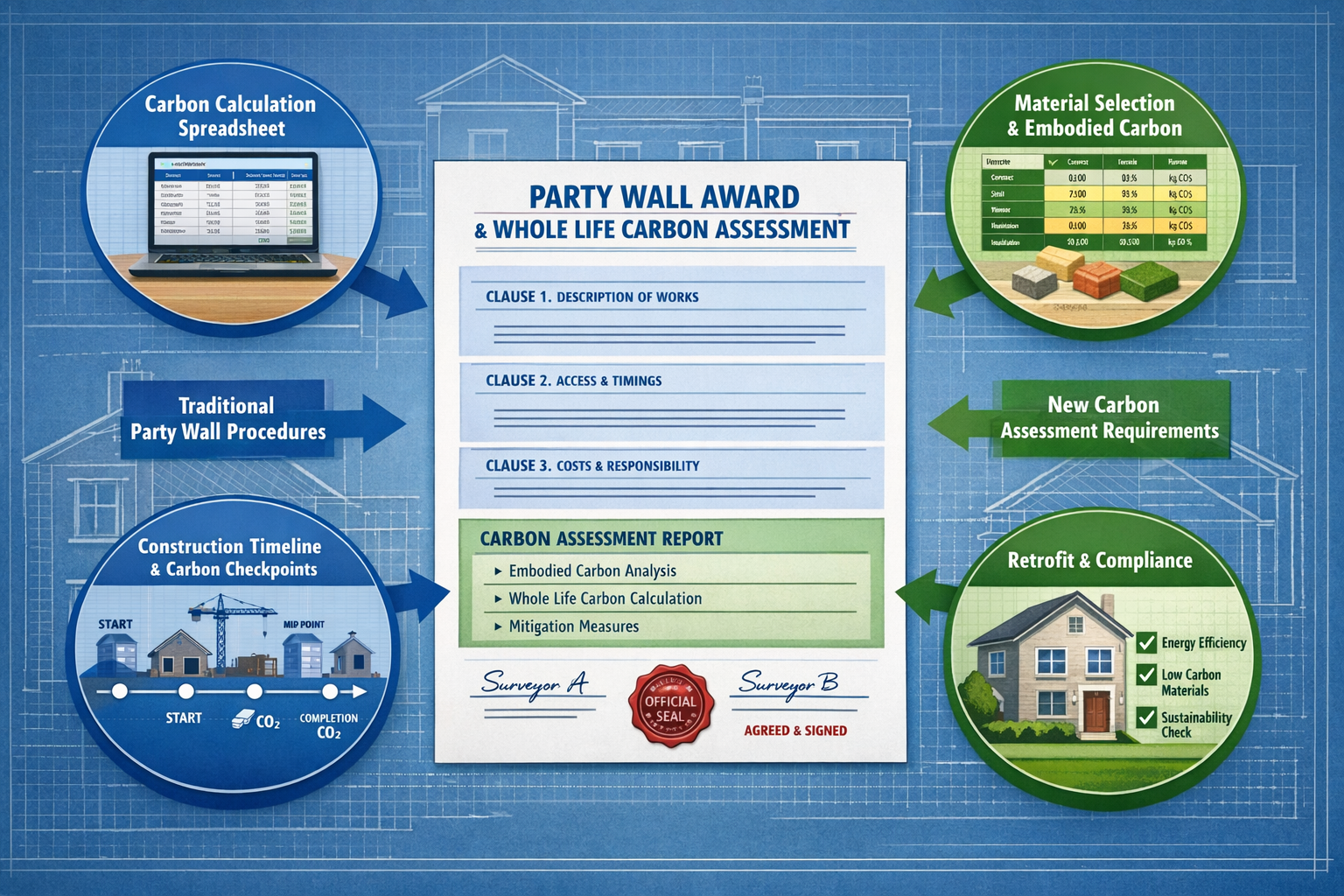
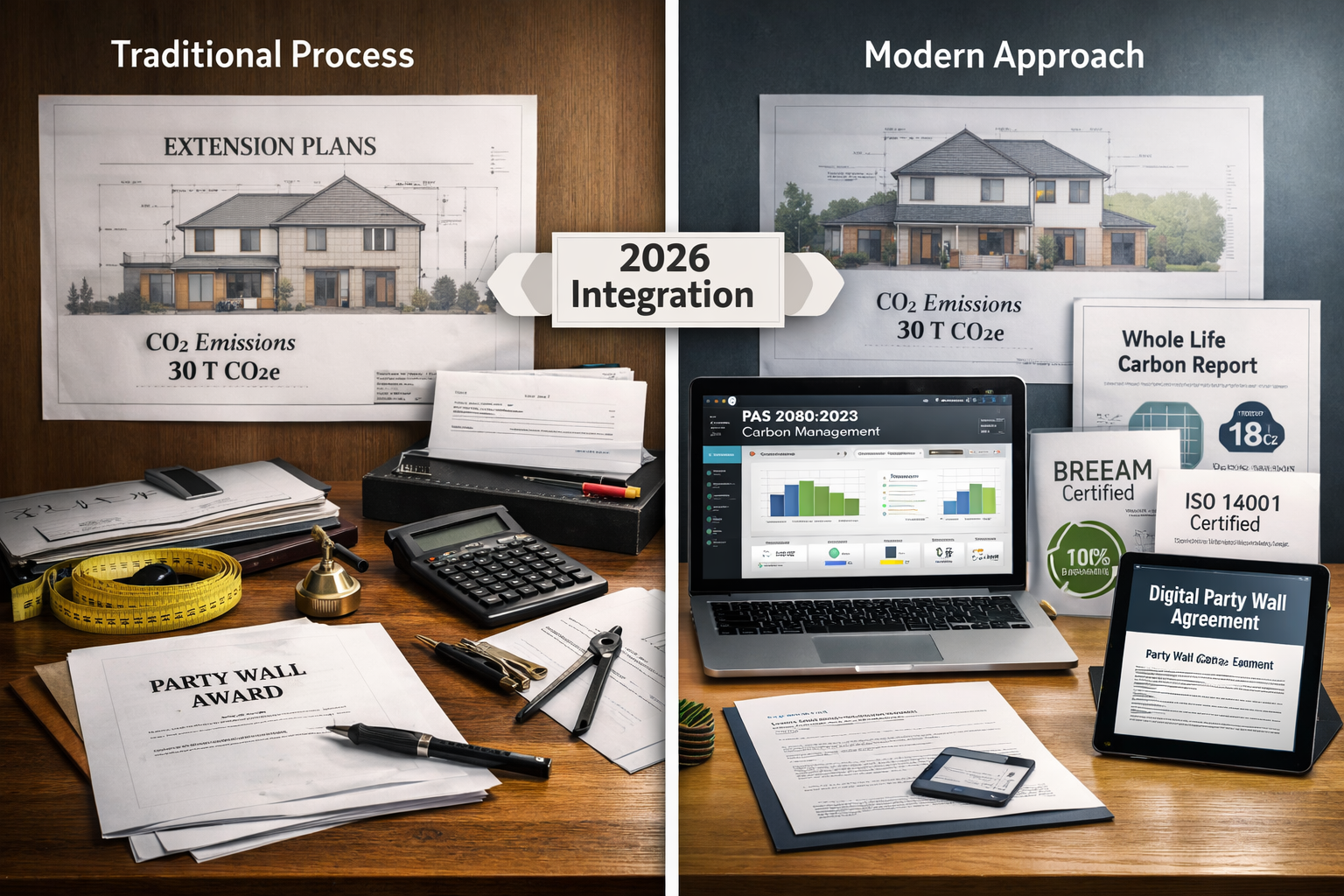
The integration of Party Wall Awards Incorporating Whole Life Carbon Checks: PAS 2080:2023 for 2026 Extensions adds a new dimension to these established procedures. Rather than replacing traditional elements, carbon considerations complement existing requirements, creating more comprehensive and forward-thinking agreements.
When issuing a party wall notice, building owners must now consider whether their proposed extension includes carbon reduction measures that might benefit both properties. This transparency can actually facilitate smoother negotiations, as neighbors increasingly value sustainable development practices.
Integrating Whole Life Carbon Assessments into Party Wall Awards
The Carbon Assessment Framework for Extensions
Implementing Party Wall Awards Incorporating Whole Life Carbon Checks: PAS 2080:2023 for 2026 Extensions requires a structured approach to carbon evaluation. The assessment should occur in parallel with traditional party wall surveys, ensuring carbon considerations inform design decisions before awards are finalized.
Key Carbon Assessment Components:
| Assessment Stage | Carbon Considerations | Party Wall Integration |
|---|---|---|
| Pre-Design | Baseline carbon audit of existing structures | Incorporated into initial condition survey |
| Design Development | Material selection and embodied carbon calculations | Referenced in scope of works descriptions |
| Construction Planning | Carbon-efficient methodology specification | Detailed in construction method statements |
| Post-Completion | Verification of carbon performance | Included in completion certificates |
The assessment process begins with establishing a carbon baseline for both the building owner's property and any affected portions of the adjoining owner's structure. This baseline provides the reference point against which the extension's carbon impact is measured.
For a typical rear extension project, the carbon assessment would evaluate:
- 🏗️ Embodied carbon in materials: Concrete foundations, brickwork, timber framing, insulation, glazing
- ⚡ Operational carbon implications: How the extension affects the existing building's energy performance
- 🔄 Circular economy opportunities: Use of reclaimed materials, design for disassembly
- 📊 Carbon reduction targets: Specific goals aligned with UK net-zero commitments
Surveyor Checklists for Retrofit Projects
Party wall surveyors undertaking Party Wall Awards Incorporating Whole Life Carbon Checks: PAS 2080:2023 for 2026 Extensions require expanded competencies beyond traditional structural and procedural knowledge. The following checklist provides a framework for incorporating carbon assessments into party wall procedures:
Pre-Award Carbon Assessment Checklist:
✅ Documentation Review
- Obtain design drawings showing material specifications
- Review energy performance calculations for the extension
- Verify compliance with Building Regulations Part L (conservation of fuel and power)
- Check for any planning conditions related to sustainability
✅ Material Carbon Evaluation
- Calculate embodied carbon for primary structural materials
- Document carbon intensity (kgCO2e/unit) for key components
- Identify opportunities for lower-carbon alternatives
- Assess use of recycled or reclaimed materials
✅ Construction Methodology
- Review proposed construction sequence for carbon efficiency
- Evaluate waste management and reduction strategies
- Consider transportation and logistics carbon impacts
- Assess temporary works and their carbon footprint
✅ Whole Building Integration
- Analyze how extension affects existing building performance
- Identify thermal bridging risks at party wall junctions
- Evaluate opportunities for fabric-first improvements
- Consider renewable energy integration possibilities
✅ Neighbor Impact Assessment
- Document carbon benefits that may extend to adjoining property
- Identify any shared sustainability opportunities
- Consider long-term maintenance carbon implications
- Evaluate impact on adjoining property's energy performance
This checklist should be adapted to project-specific circumstances, with particular attention to the type of work being undertaken. Excavation work for basement extensions, for example, requires additional carbon considerations related to soil disposal, temporary works, and waterproofing systems.
Drafting Carbon-Conscious Party Wall Awards
The actual party wall award document must clearly articulate carbon-related provisions alongside traditional clauses. This integration should feel natural rather than bolted-on, creating a cohesive document that addresses both structural and environmental responsibilities.
Essential Carbon Clauses for 2026 Awards:
1. Carbon Baseline Declaration
"The Building Owner has undertaken a whole life carbon assessment in accordance with PAS 2080:2023 principles. The baseline carbon footprint of the proposed works has been calculated at [X] kgCO2e, with a target reduction of [Y]% through material selection and construction methodology."
2. Material Specification Requirements
"All materials used in works affecting the party wall shall be selected with consideration for embodied carbon. Where practicable, materials with Environmental Product Declarations (EPDs) shall be prioritized. The Building Owner shall maintain records of material carbon intensity for inclusion in the completion documentation."
3. Construction Methodology Carbon Provisions
"Construction methods shall minimize carbon emissions through efficient sequencing, waste reduction, and responsible sourcing. The appointed contractor shall provide a carbon management plan addressing transportation, energy use, and waste disposal."
4. Monitoring and Verification
"Upon completion, the Building Owner shall provide carbon performance documentation demonstrating compliance with the carbon targets established in this award. This documentation shall be made available to the Adjoining Owner and appointed surveyors."
5. Future Maintenance Considerations
"Maintenance provisions outlined in this award shall consider whole life carbon implications. Where maintenance activities may affect party wall structures, carbon-efficient approaches shall be prioritized."
These clauses establish clear expectations while maintaining the enforceability essential to party wall awards. They create accountability without imposing unreasonable burdens on building owners, striking the balance necessary for practical implementation.
When party wall disputes arise, having carbon provisions clearly documented in the award provides an additional framework for resolution. Adjoining owners increasingly recognize the value of sustainable development, and transparent carbon accounting can actually reduce conflict by demonstrating responsible stewardship.
Practical Implementation: Case Studies and Best Practices for 2026
Case Study: Two-Story Rear Extension in Southwest London
A homeowner in Richmond planned a two-story rear extension requiring party wall agreements with neighbors on both sides. The appointed surveyor implemented Party Wall Awards Incorporating Whole Life Carbon Checks: PAS 2080:2023 for 2026 Extensions from project inception.
Project Parameters:
- Extension size: 4m x 6m, two stories
- Party wall implications: Structural work to both side walls
- Excavation depth: 1.2m for new foundations
- Timeline: 6 months construction
Carbon Assessment Outcomes:
The surveyor's carbon evaluation revealed that switching from standard concrete blocks to hempcrete for internal leaf construction would reduce embodied carbon by 35% while improving thermal performance. This change benefited both the building owner's extension and reduced heat loss through the party walls, providing measurable energy savings for the adjoining properties.
The party wall award included specific carbon targets:
- Baseline carbon: 18,500 kgCO2e
- Target reduction: 25% (4,625 kgCO2e)
- Achieved reduction: 28% (5,180 kgCO2e)
Key Success Factors:
- Early engagement with adjoining owners on sustainability goals
- Transparent carbon accounting throughout design development
- Material substitutions that provided cost neutrality or savings
- Documentation that satisfied both party wall and planning requirements
The adjoining owners appreciated the carbon transparency, which facilitated party wall consent without disputes. One neighbor subsequently engaged the same surveyor for their own extension, specifically requesting similar carbon assessment integration.
Best Practices for Surveyors in 2026
Professional surveyors implementing Party Wall Awards Incorporating Whole Life Carbon Checks: PAS 2080:2023 for 2026 Extensions should adopt the following best practices:
🎯 Early Integration
Begin carbon assessments during initial design consultation, not as an afterthought. Early evaluation enables meaningful design optimization without delaying projects or increasing costs.
📊 Transparent Communication
Provide clear, accessible carbon information to all parties. Avoid overly technical jargon in party wall awards while maintaining accuracy. Consider providing supplementary carbon reports for interested parties.
🤝 Collaborative Approach
Engage adjoining owners in sustainability discussions. Frame carbon considerations as shared benefits rather than additional burdens. Highlight opportunities for mutual gain, such as improved thermal performance at party wall junctions.
📚 Continuous Professional Development
Invest in training on carbon assessment methodologies, sustainable construction practices, and evolving regulations. Organizations like RICS offer specialized courses on whole life carbon assessment for built environment professionals.
🔍 Proportionate Assessment
Scale carbon assessment complexity to project size and impact. A single-story kitchen extension requires less detailed carbon evaluation than a large multi-story addition. Maintain proportionality to avoid unnecessary costs.
📝 Standardized Templates
Develop standardized carbon assessment templates and award clauses that can be adapted to specific projects. Standardization improves efficiency while ensuring consistency and completeness.
Addressing Common Challenges
Challenge 1: Cost Concerns
Solution: Many carbon-reduction measures are cost-neutral or provide long-term savings. Focus on "no-regrets" interventions like improved insulation, which reduce both carbon and energy costs. Document the financial case alongside environmental benefits.
Challenge 2: Adjoining Owner Resistance
Solution: Frame carbon provisions as risk mitigation and future-proofing. Properties with documented low-carbon credentials increasingly command premium values. Position carbon assessment as protecting all parties' investments.
Challenge 3: Data Availability
Solution: Build relationships with suppliers who provide Environmental Product Declarations (EPDs). Utilize industry databases like the Inventory of Carbon and Energy (ICE) for materials lacking specific EPDs. Document assumptions clearly.
Challenge 4: Verification Complexity
Solution: Establish clear verification protocols at the award stage. Specify what documentation will demonstrate compliance (invoices showing material specifications, contractor carbon reports, etc.). Keep verification proportionate to project scale.
Challenge 5: Regulatory Uncertainty
Solution: Stay informed about evolving building regulations and planning policies. Design carbon provisions to exceed current minimum standards, providing buffer against regulatory tightening. Monitor guidance from bodies like RICS and BSI.
Understanding party wall surveyor costs in the context of carbon assessment integration is important. While initial fees may be slightly higher due to additional assessment work, the value delivered through optimized design, dispute avoidance, and regulatory compliance typically far exceeds the incremental cost.
The Role of Technology in Carbon-Integrated Party Wall Procedures
Digital tools increasingly facilitate Party Wall Awards Incorporating Whole Life Carbon Checks: PAS 2080:2023 for 2026 Extensions. Software platforms now enable:
- Automated carbon calculations: Input material quantities and receive instant embodied carbon estimates
- Digital award management: Cloud-based systems for drafting, sharing, and signing party wall awards
- Condition survey integration: Photographic documentation linked to carbon baseline assessments
- Compliance tracking: Automated monitoring of carbon targets against actual performance
- Reporting dashboards: Visual presentation of carbon data for stakeholder communication
These technologies reduce administrative burden while improving accuracy and transparency. Surveyors who embrace digital tools can deliver more comprehensive services more efficiently, enhancing both client satisfaction and professional competitiveness.
Regulatory Context and Future Developments
Current Regulatory Landscape in 2026
The integration of carbon considerations into party wall awards reflects broader regulatory trends across the UK construction sector. While PAS 2080:2023 is not currently a legal requirement for residential extensions, several regulatory drivers encourage its adoption:
Building Regulations Part L: Increasingly stringent energy efficiency requirements indirectly drive consideration of embodied carbon, as highly insulated extensions must balance operational and embodied carbon.
Planning Policy: Many local authorities now request carbon assessments for larger residential developments. While single extensions typically fall below these thresholds, demonstrating carbon consciousness can facilitate planning approval.
Future Homes Standard: The government's commitment to net-zero homes by 2025 (now being implemented through 2026) creates expectations for carbon consideration in all residential construction.
EPC Requirements: Anticipated changes to Energy Performance Certificate regulations may eventually require whole-building carbon assessments, making early adoption of carbon accounting practices prudent [1].
Professional Standards and Guidance
The Royal Institution of Chartered Surveyors (RICS) has increasingly emphasized sustainability competencies for building surveyors. While specific guidance on Party Wall Awards Incorporating Whole Life Carbon Checks: PAS 2080:2023 for 2026 Extensions is still emerging, RICS professional standards require members to:
- Act in the public interest, which increasingly includes environmental stewardship
- Maintain current knowledge of relevant regulations and best practices
- Provide comprehensive advice that considers long-term implications
- Promote sustainable practices within their professional activities
Party wall surveyors who proactively integrate carbon considerations demonstrate professional leadership and position themselves favorably as regulations inevitably tighten.
Anticipated Developments Beyond 2026
Several trends suggest that carbon integration in party wall procedures will become increasingly mainstream:
Mandatory Carbon Reporting: Government consultations have explored mandatory whole life carbon assessments for all new construction. If implemented, this would make carbon provisions in party wall awards legally necessary rather than voluntary best practice.
Enhanced Neighbor Rights: Future amendments to party wall legislation may explicitly incorporate environmental considerations, giving adjoining owners formal rights to challenge high-carbon construction approaches.
Insurance and Warranty Requirements: Building warranty providers may begin requiring carbon assessments as a condition of coverage, particularly for larger extensions and retrofit projects.
Market Differentiation: Properties with documented low-carbon credentials will likely command price premiums, making carbon-conscious party wall awards a value-adding service.
Surveyors who establish expertise in Party Wall Awards Incorporating Whole Life Carbon Checks: PAS 2080:2023 for 2026 Extensions now will be well-positioned as these developments unfold.
Conclusion
The integration of whole life carbon checks into party wall awards represents a natural evolution of professional practice, aligning traditional property law with contemporary sustainability imperatives. Party Wall Awards Incorporating Whole Life Carbon Checks: PAS 2080:2023 for 2026 Extensions is not merely a compliance exercise—it's an opportunity to deliver enhanced value, reduce disputes, and contribute meaningfully to carbon reduction goals.
For property owners planning extensions in 2026, engaging surveyors who understand carbon assessment ensures projects meet current best practices while future-proofing against evolving regulations. The modest additional cost of carbon-integrated party wall services typically delivers substantial returns through optimized material selection, improved neighbor relations, and enhanced property value.
For surveyors, developing competency in PAS 2080:2023 application represents a professional imperative and competitive advantage. The skills required—carbon literacy, sustainable construction knowledge, and integrated assessment capabilities—position practitioners as comprehensive advisors rather than narrow specialists.
Actionable Next Steps
For Building Owners:
- Engage early: Discuss carbon considerations with your surveyor during initial design consultation
- Request carbon assessment: Ask specifically for party wall awards incorporating whole life carbon checks
- Communicate proactively: Share sustainability goals with adjoining owners to facilitate positive engagement
- Document thoroughly: Maintain records of material specifications and carbon calculations for future reference
For Adjoining Owners:
- Ask questions: Request information about the carbon implications of proposed works
- Identify opportunities: Consider whether the works create opportunities for mutual sustainability improvements
- Engage constructively: Approach carbon discussions as collaborative rather than adversarial
- Seek advice: Consult with party wall surveyors who understand carbon assessment if concerns arise
For Surveyors:
- Invest in training: Pursue professional development in whole life carbon assessment and PAS 2080:2023
- Develop templates: Create standardized carbon assessment procedures and award clauses
- Build networks: Establish relationships with carbon consultants and sustainable material suppliers
- Share knowledge: Contribute to professional discourse on carbon-integrated party wall practice
- Monitor developments: Stay current with regulatory changes and emerging best practices
The convergence of party wall procedures and carbon management is not a passing trend but a fundamental realignment of construction practice with environmental reality. Those who embrace this integration now will lead the profession into a more sustainable future, delivering better outcomes for clients, communities, and the planet.
Understanding that damage to property in party wall situations can be minimized through careful planning, and that carbon-conscious construction often correlates with higher quality workmanship, the integration of these considerations serves multiple objectives simultaneously.
As 2026 progresses and beyond, Party Wall Awards Incorporating Whole Life Carbon Checks: PAS 2080:2023 for 2026 Extensions will transition from innovative best practice to standard procedure. The question is not whether to integrate carbon considerations, but how quickly and effectively to do so. The tools, frameworks, and knowledge exist—what remains is the professional will to implement them consistently and comprehensively.
References
[1] Valuation Techniques For Uk Net Zero Retrofit Projects Rics Standards Amid 2026 Epc Mandates – https://nottinghillsurveyors.com/blog/valuation-techniques-for-uk-net-zero-retrofit-projects-rics-standards-amid-2026-epc-mandates
[3] Pas 2080 Construction Emissions Davos2023 – https://www.weforum.org/stories/2023/01/pas-2080-construction-emissions-davos2023/
[4] Pas 2080 2023 Guidance Document For Pas 2800 – https://www.scribd.com/document/780163397/PAS-2080-2023-Guidance-Document-for-PAS-2800