Seven years after the Grenfell Tower fire claimed 72 lives, the UK's fire safety legislative landscape has undergone its most sweeping transformation in decades — and 2026 marks the year that transformation becomes fully enforceable. For valuation expert witnesses, this is not background noise. Non-compliance with 2026 fire safety regulations can result in financial penalties, insurance complications, and severe legal consequences that materially alter property values [4]. Surveyors who fail to integrate these changes into their assessments risk producing indefensible valuations — a career-defining liability in courtroom settings.
Fire Safety Regulation Updates in Building Surveys: 2026 Compliance for Valuation Expert Witnesses sits at the intersection of post-Grenfell legislative reform, Awaab's Law extensions, and the evolving standards of expert evidence. This article provides a structured, practical guide for surveyors navigating this complex terrain.
Key Takeaways 📋
- Approved Document B (ADB) amendments take effect 30 September 2026, mandating second staircases and evacuation lifts in new residential buildings above 18m — creating a bifurcated compliance landscape for valuers.
- Personal Emergency Evacuation Plans (PEEPs) became mandatory from 6 April 2026 for buildings between 11–18m, directly affecting liability assessments.
- 15-day fire hazard remediation requirements for social landlords and property managers represent a significant financial burden that must be reflected in valuations.
- European fire test standards (BS EN 13501 and BS EN 1634-1) have replaced BS 476, requiring surveyors to verify certification on all passive fire protection systems.
- Expert witnesses must now document compliance status with digital reporting standards and maintain courtroom-ready evidence trails for every fire safety assessment.
The Post-Grenfell Legislative Arc: What Changed and Why It Matters in 2026
The Building Safety Act 2022 set the structural framework. The Fire Safety (England) Regulations 2022 added operational teeth. But 2026 is the year the enforcement machinery reaches full speed. Understanding this arc is essential for any expert witness preparing defensible building survey evidence.
Approved Document B Amendments: The September 2026 Deadline
The most significant structural change arrives on 30 September 2026, when amendments to Approved Document B (ADB) take full effect. Key requirements include:
| Requirement | Threshold | Impact on Valuation |
|---|---|---|
| Second staircase (mandatory) | New residential buildings >18m | Significant cost uplift; affects GDV calculations |
| Evacuation lifts | Tall residential blocks | Capital expenditure obligation |
| Sprinkler expansion | Buildings >11m, care homes, student housing | Retrofit cost affects asset value |
| Dual-path alarm monitoring | High-risk buildings | Ongoing maintenance liability |
All new planning applications must comply with the 2026 version of ADB. However, some ongoing projects may continue under previous regulations — creating a bifurcated compliance landscape that valuation experts must document clearly for each individual property [1]. This distinction is critical: a building designed before the September 2026 cut-off may carry materially different compliance obligations than one designed after it, even if they appear structurally similar.
For expert witnesses instructed on high-rise or high-risk conversions, this bifurcation is a primary source of valuation dispute. Clearly documenting which regulatory framework applies — and why — is the foundation of a defensible opinion.
Awaab's Law Extensions and the 15-Day Remediation Rule
Awaab's Law, originally enacted to address damp and mould in social housing, has been extended in scope. Social landlords and property managers must now fix fire hazards — including all fire doors reported as defective — within 15 days [6]. This accelerated timeline has direct financial implications:
- 🔴 Immediate liability exposure for landlords with a backlog of fire door defects
- 🔴 Valuation adjustments required where remediation costs are material
- 🔴 Insurance complications where non-compliance is identified during survey
For expert witnesses conducting commercial building surveys in London or residential assessments, the 15-day rule means that identified fire hazards cannot be treated as deferred maintenance. They must be costed and reflected in the valuation immediately.
💬 "Non-compliance with 2026 fire safety regulations can result in financial penalties, insurance complications, and severe legal consequences — all of which materially affect property valuations." [4]
Core 2026 Compliance Requirements: A Surveyor's Checklist
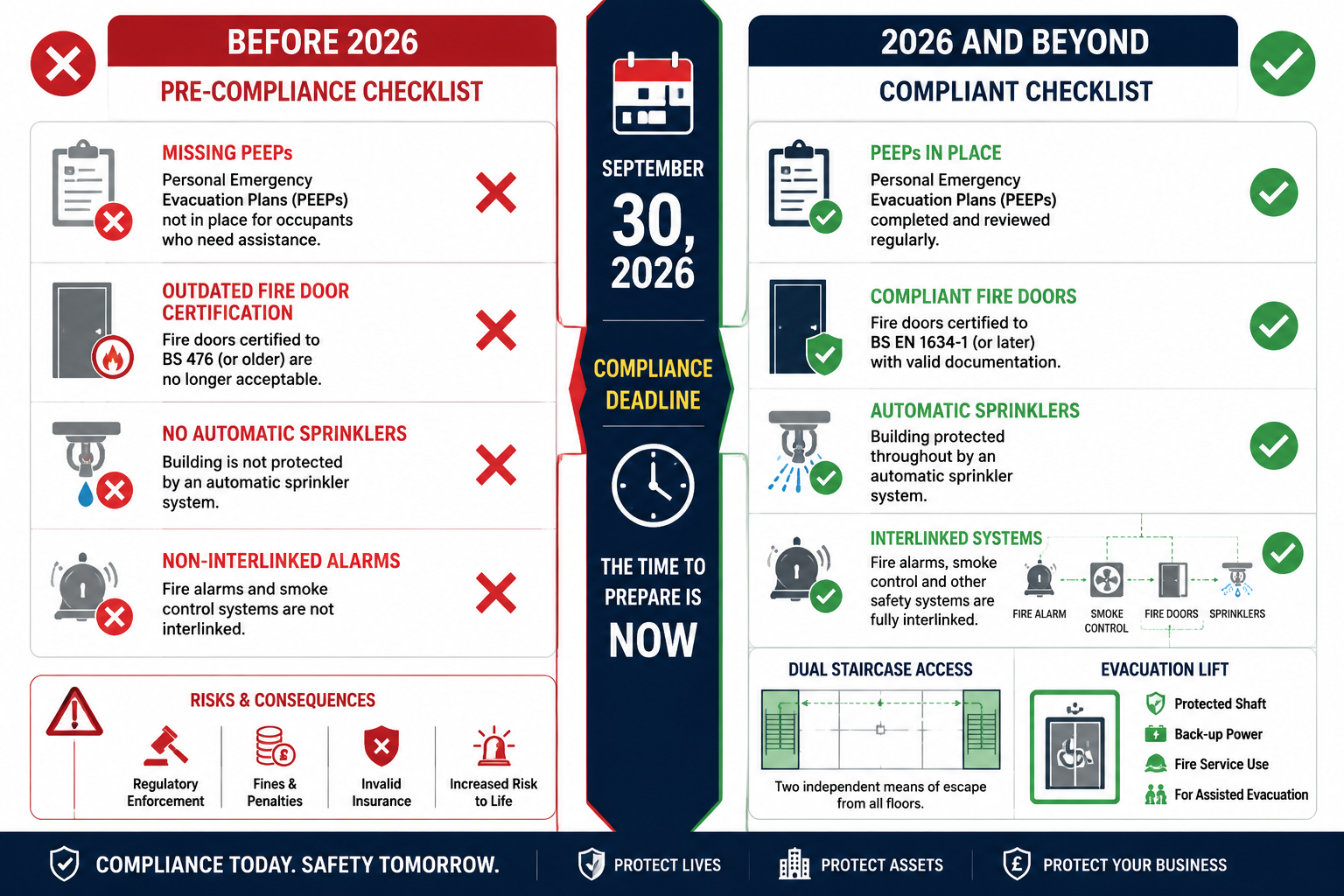
Fire Safety Regulation Updates in Building Surveys: 2026 Compliance for Valuation Expert Witnesses demands a systematic approach. The following checklist reflects the key regulatory changes surveyors must assess and document.
🔥 Passive Fire Protection: The European Standards Transition
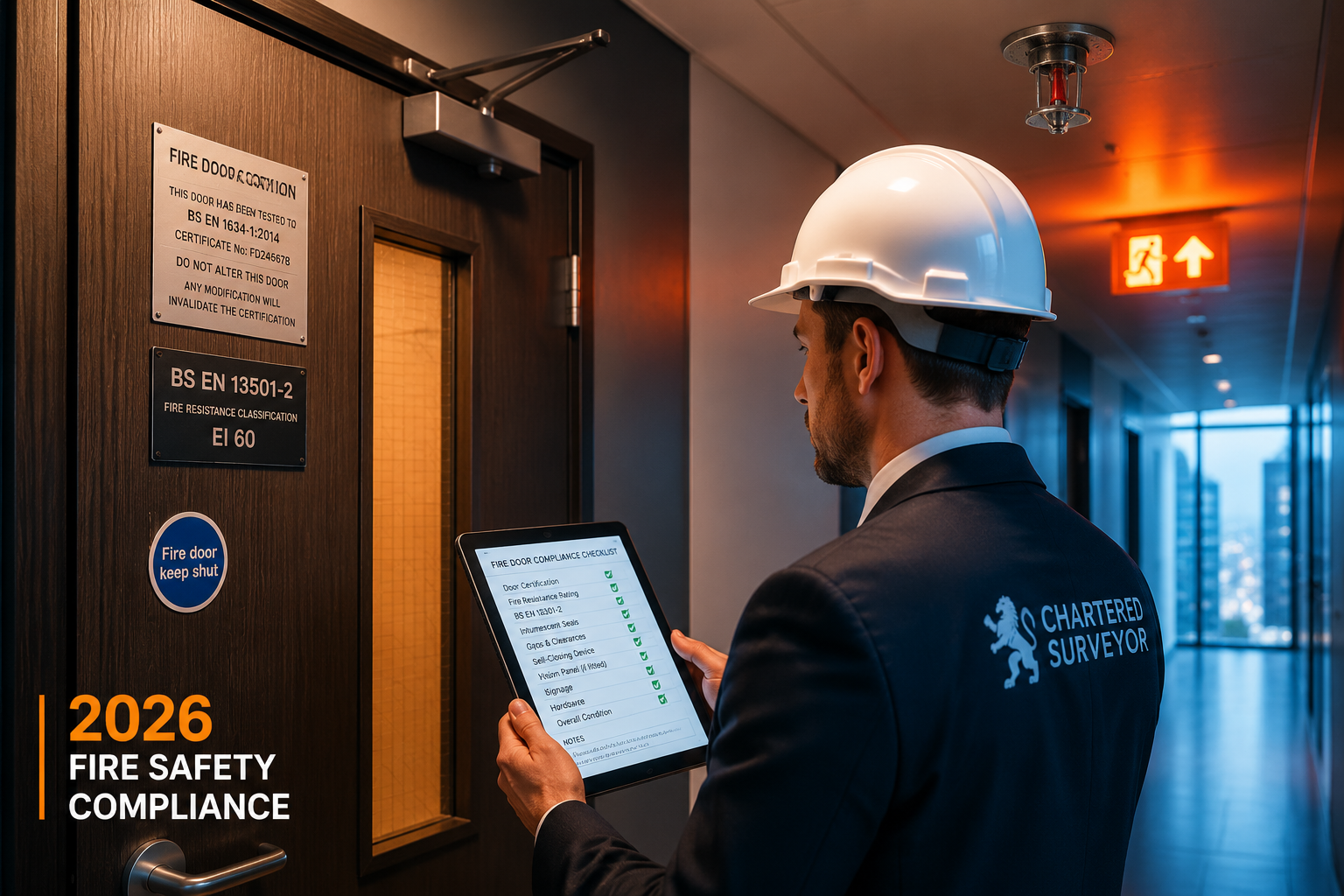
The shift from BS 476 to BS EN 13501 and BS EN 1634-1 is one of the most technically demanding changes for surveyors [1]. All passive fire protection systems — particularly fire doors, shutters, and compartmentation elements — must now be certified to updated European benchmarks.
What to check on site:
- ✅ Fire door certification labels — confirm BS EN 1634-1 compliance (not just BS 476)
- ✅ Intumescent seals and smoke brushes — verify specification matches current standards
- ✅ Door closers — confirm self-closing mechanism is functional and correctly rated
- ✅ Glazing panels — check fire-resistance rating under European classification
- ✅ Compartmentation integrity — identify any breaches in walls, floors, or service penetrations
Buildings with fire doors certified only under the old BS 476 standard face a specification gap that must be flagged in survey reports and reflected in remediation cost estimates. This is particularly relevant for commercial dilapidation surveys where lease-end obligations may include fire door upgrades.
🚨 Detection and Alarm Systems: Interlinked Requirements
New standards require smoke and heat detectors to meet higher sensitivity thresholds, with interlinked alarms becoming mandatory in certain building categories [4]. Interlinked systems ensure that when one detector activates, all alarms on the floor — or throughout the building — sound simultaneously.
Surveyor verification points:
- Confirm alarm grade and category meets 2026 requirements for the building type
- Check interlink configuration — wired or wireless, and whether it covers all required zones
- Verify dual-path communication in alarm monitoring systems for high-risk buildings [7]
- Review last test and maintenance records — undocumented systems are a red flag
🧯 Sprinkler Systems: Expanded Mandatory Coverage
Mandatory sprinkler installation has been significantly expanded to cover [4]:
- Residential buildings above 11 metres
- Care homes (all new and substantially refurbished)
- Student accommodation
- High-risk commercial premises
For expert witnesses assessing properties in these categories, the absence of a compliant sprinkler system is not merely a defect — it is a material non-compliance that affects insurability, lettability, and market value. A specific defect report should be considered where sprinkler compliance is in doubt.
🏃 Personal Emergency Evacuation Plans (PEEPs)
Effective 6 April 2026, PEEPs are mandatory for residents in buildings between 11–18m who require evacuation support [1][6]. Responsible Persons must:
- Identify residents with evacuation support needs
- Create individual PEEPs in coordination with fire services
- Maintain and update plans regularly
- Demonstrate compliance on inspection
For valuation expert witnesses, the absence of documented PEEPs in qualifying buildings is a compliance failure that must be noted. Where a building is subject to enforcement action, the impact on value can be substantial.
📋 Staff Training and Evacuation Documentation
Building managers must maintain detailed, documented evacuation procedures and conduct regular drills [4]. Expert witnesses should request and review:
- Evacuation drill records (dates, participants, outcomes)
- Staff fire safety training certificates
- Fire risk assessment — must be current and signed by a competent person
- Logbook entries for all fire system tests and maintenance visits
Missing or incomplete documentation is itself a compliance risk and should be flagged in survey reports with an assessment of the likely cost to remediate.
Expert Witness Obligations: Courtroom-Ready Fire Safety Evidence

Fire Safety Regulation Updates in Building Surveys: 2026 Compliance for Valuation Expert Witnesses carries particular weight in litigation contexts. Courts increasingly expect expert witnesses to demonstrate not just technical knowledge, but a systematic, documented approach to compliance assessment.
Digital Reporting Standards for High-Rise Buildings
Annual inspection documentation for buildings over 7–8 storeys must now follow updated digital submission standards [3]. Fire departments require clear digital records of:
- Alarm system testing
- Sprinkler system inspection
- Standpipe and hose reel checks
- Smoke control system performance
Expert witnesses should verify that building owners and managers have complied with these digital reporting requirements. Where records are incomplete or non-existent, this represents both a regulatory breach and a valuation risk that must be quantified.
Battery Storage Systems: An Emerging Compliance Frontier
As retrofitted buildings increasingly incorporate renewable energy systems, new standards add suppression, ventilation, and hazard analysis requirements for battery storage installations [3]. This is a rapidly evolving area that affects:
- Modern residential conversions with solar and battery storage
- Commercial properties with EV charging infrastructure
- Mixed-use developments with on-site energy management systems
Surveyors assessing such properties should confirm that battery storage systems have been subject to a fire hazard analysis and that appropriate suppression measures are in place. This emerging requirement is not yet widely understood, making it a potential source of expert witness differentiation in complex cases.
Building the Defensible Valuation: Key Principles
For expert witnesses, a defensible valuation in the context of fire safety compliance rests on four pillars:
- Regulatory identification — Clearly state which regulatory framework applies to the property and why (pre- or post-September 2026 ADB, building height category, use class)
- Compliance gap analysis — Systematically document every area of non-compliance with reference to the specific regulation breached
- Remediation costing — Provide credible, evidenced cost estimates for bringing the property into compliance
- Value impact assessment — Quantify the effect of non-compliance on market value, using comparable evidence where available
For properties subject to RICS Red Book valuations, fire safety compliance status is a material factor that must be addressed in the valuation report. Omitting it creates professional liability exposure.
Transitional Arrangements: Documenting the Regulatory Framework
Some ongoing projects are permitted to continue under previous regulations, but all new planning applications must comply with the 2026 version [1]. Expert witnesses must:
- Confirm the date of planning permission for the property
- Identify which version of ADB applies
- Document any transitional arrangements in the survey report
- Note where a property straddles regulatory periods (e.g., phased developments)
This documentation is particularly important in disputes involving commercial lease dilapidations or freehold valuations where the compliance status of the building at a specific date is contested.
Preparing for Cross-Examination
Expert witnesses giving fire safety evidence in court should be prepared to address:
- The basis of their compliance assessment — which standards were applied and why
- The methodology for remediation costing — how figures were derived and by whom
- The comparables used — how the market treats similar non-compliant properties
- The regulatory timeline — demonstrating command of the 2026 changes and their effective dates
A chartered surveyor acting as an expert witness should also be familiar with the Civil Procedure Rules (CPR) Part 35 obligations — the duty is to the court, not the instructing party. Fire safety compliance evidence that is incomplete, inconsistent, or poorly documented will be challenged.
💬 "Expert witnesses must now thoroughly assess compliance status as part of building survey work, as regulatory breaches materially affect property valuations." [4]
Conclusion: Actionable Next Steps for Valuation Expert Witnesses in 2026
The 2026 fire safety regulatory landscape is not a single change — it is a layered, evolving framework built on post-Grenfell lessons, Awaab's Law extensions, European standards transitions, and new building typology requirements. For valuation expert witnesses, the stakes are high: an incomplete or outdated compliance assessment can undermine an entire valuation opinion in court.
Immediate actions for surveyors and expert witnesses:
- ✅ Update survey templates to include all 2026 ADB requirements, PEEP obligations, and European standards verification points before the September 30, 2026 deadline
- ✅ Build a remediation cost database for common fire safety defects — sprinkler retrofits, fire door upgrades, alarm interlink installations — to support defensible valuation adjustments
- ✅ Review digital reporting compliance for any high-rise building instructions — missing records are both a regulatory breach and a valuation risk
- ✅ Identify battery storage systems in all modern or retrofitted properties and confirm hazard analysis compliance
- ✅ Engage with fire safety specialists where technical complexity exceeds surveying expertise — and document that engagement in the survey report
- ✅ Review CPR Part 35 obligations and ensure all expert witness reports clearly state the regulatory framework applied, the compliance gaps identified, and the methodology for value impact assessment
For complex high-risk conversions, mixed-use developments, or properties subject to litigation, consider commissioning a specific defect report alongside the valuation to provide a clear, court-ready record of fire safety compliance status.
The 2026 changes are not a compliance burden to be minimised — they are a professional opportunity for expert witnesses who invest in understanding them. Those who do will produce valuations that stand up to scrutiny. Those who do not will find their opinions challenged at precisely the moment it matters most.
References
[1] Preparing For 2026 The Future Of Fire Safety Legislation And What It Means For You – https://www.totalfiregroup.org/preparing-for-2026-the-future-of-fire-safety-legislation-and-what-it-means-for-you/
[2] Fire Safety In Construction – https://www.ajg.com/uk/news-and-insights/fire-safety-in-construction/
[3] 2026 California Fire Code Changes Explained – https://kordfire.com/2026-california-fire-code-changes-explained/
[4] Fire Safety Regulations Whats New In 2026 – https://www.jensengroup.co.uk/fire-safety-regulations-whats-new-in-2026/
[5] 2026 Fire Code Updates And Post Fire Repairs What California Commercial Building Owners Should Know – https://www.zaricode.com/articles-discussions/2026-fire-code-updates-and-post-fire-repairs-what-california-commercial-building-owners-should-know/
[6] The Key Changes In 2026 That You Need To Be Aware Of – https://selo.global/the-key-changes-in-2026-that-you-need-to-be-aware-of/
[7] How 2026 Fire Safety Regulations Could Affect Your Commercial Property – https://natfiresafety.com/news/how-2026-fire-safety-regulations-could-affect-your-commercial-property/
[8] 2026 Fire Life Safety Industry Report Key Trends Shaping Fire Protection – https://www.inspectpoint.com/2026-fire-life-safety-industry-report-key-trends-shaping-fire-protection/
[9] Building Safety Legislation Updates 2026 – https://www.ventrogroup.com/building-safety-legislation-updates-2026