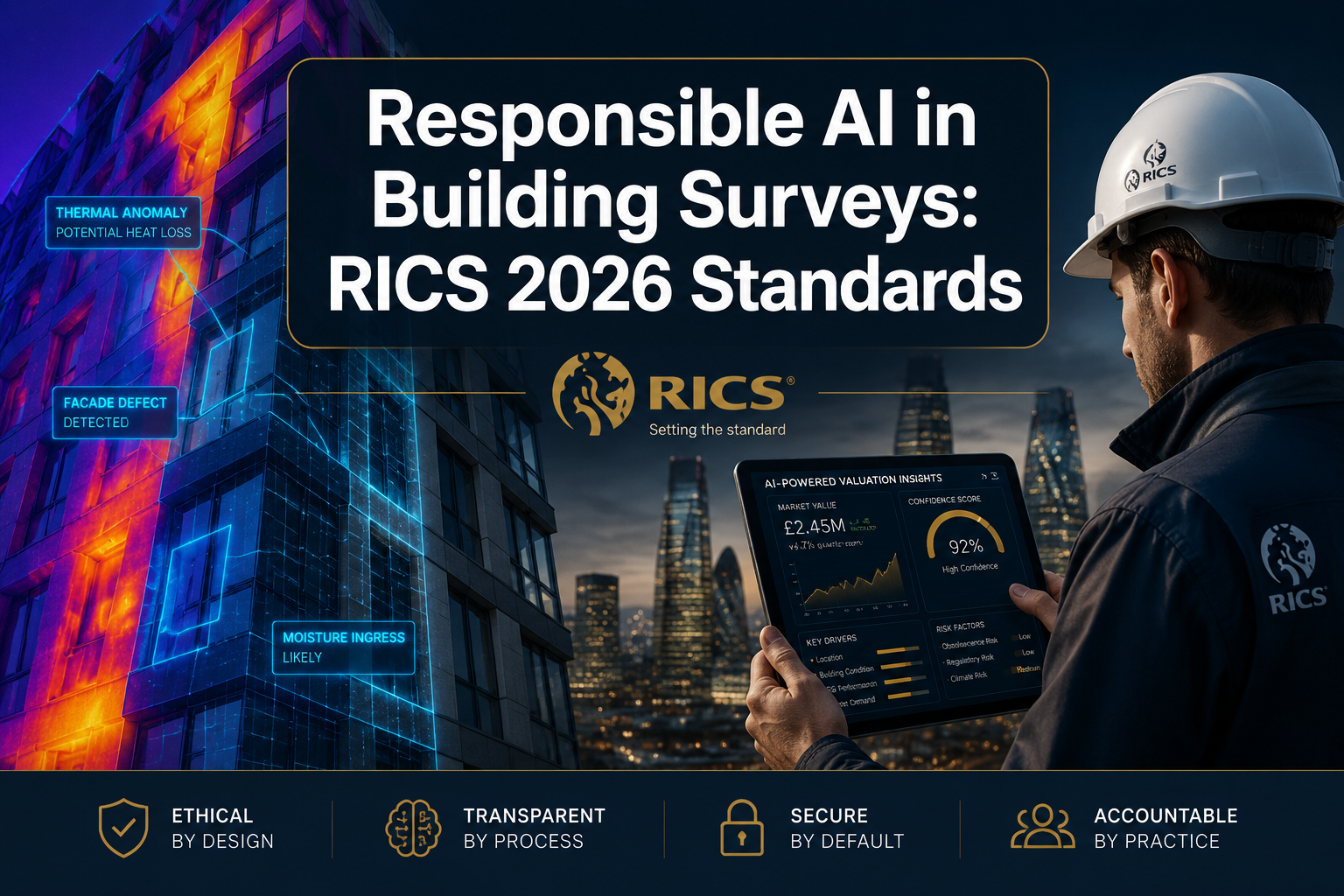

Automated valuation models have been shown to diverge from RICS-qualified surveyor assessments by as much as 20% on properties with complex defect profiles — a gap that carries real financial consequences for buyers, lenders, and insurers alike. That divergence is precisely why Responsible AI in Building Surveys: RICS March 2026 Standards for Valuation Accuracy and Defect Detection represents one of the most significant regulatory shifts the surveying profession has seen in a generation. Effective from 9 March 2026, RICS's first-ever professional standard on AI use is now binding on all regulated members and firms globally, setting clear protocols for how artificial intelligence may — and may not — be used in building surveys and property valuations [2].
This article unpacks what the standard demands, why it matters for defect detection and valuation accuracy, and how surveyors can integrate AI responsibly to strengthen — rather than undermine — professional credibility.
Key Takeaways 📋
- ✅ The RICS AI standard became mandatory on 9 March 2026 for all regulated members and firms worldwide.
- ✅ The standard applies only where AI has a "material impact" on surveying service delivery — professional judgment determines this threshold.
- ✅ Firms must maintain written risk registers, responsible use policies, and procurement due diligence records for all material-impact AI applications.
- ✅ Inherent bias and erroneous outputs are explicitly identified as high-risk areas, particularly for automated valuations and defect detection.
- ✅ Surveyors remain fully and personally accountable for all professional advice, regardless of what AI tools are used.
Why the RICS AI Standard Changes Everything for Building Surveyors
The Problem AI Was Supposed to Solve — and the Risks It Introduced
AI tools entered the surveying market promising faster inspections, more consistent defect identification, and data-driven valuations that could process thousands of comparable transactions in seconds. For commercial building surveys and complex residential assessments alike, the appeal was obvious. But speed and scale brought new vulnerabilities: training data that reflected historic market biases, pattern-recognition models that struggled with unusual property types, and outputs that looked authoritative but contained fundamental errors.
The core tension is this — AI systems learn from the past, but surveyors must advise on the present and future. A model trained predominantly on standard suburban housing stock may systematically undervalue Georgian townhouses with known structural quirks, or miss the significance of a defect pattern that an experienced surveyor would immediately flag.
RICS identified these risks explicitly. The standard names inherent bias and erroneous outputs as specific high-risk categories that must be documented in every firm's risk register when AI is used in ways that materially affect service delivery [4]. This is not a theoretical concern — it is a regulated compliance requirement as of 2026.
What "Material Impact" Actually Means
One of the most practically important concepts in the standard is the "material impact" threshold. The standard does not apply to every piece of software a surveyor uses. It applies specifically to AI systems whose use materially affects how a surveying service is delivered [1].
Determining materiality requires informed professional judgment. RICS has confirmed that the Regulatory Tribunal acts as the final arbiter in disputed cases, which means firms cannot simply self-certify that their AI tools fall below the threshold without documented reasoning [1].
"AI assists professional practice; it does not replace it." — RICS, March 2026 [2]
In practical terms for building surveys, this means:
| AI Application | Likely Material Impact? |
|---|---|
| Automated valuation model (AVM) used in final report | ✅ Yes |
| AI-generated thermal imaging analysis for defect detection | ✅ Yes |
| Grammar-checking software for report writing | ❌ No |
| AI scheduling tool for appointment booking | ❌ No |
| Machine learning model flagging subsidence risk | ✅ Yes |
| Standard property database search tool | ❌ Likely No |
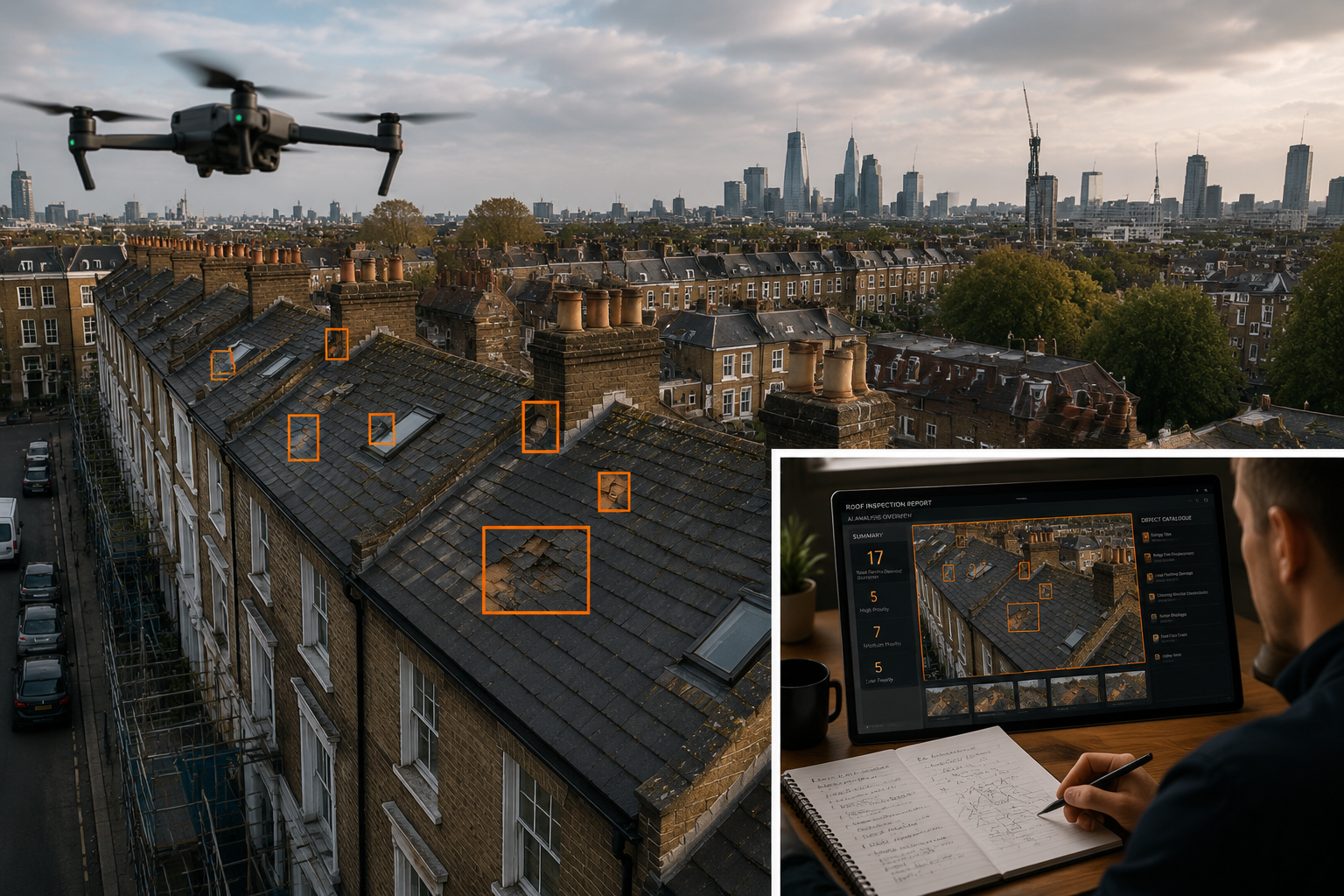
This distinction matters enormously. Firms that have deployed AI-assisted structural surveys or roof survey analysis — including drone-based roof surveys with automated defect flagging — must now treat those tools as material-impact systems and apply the full suite of compliance requirements.
The Four Governance Pillars of Responsible AI in Building Surveys: RICS March 2026 Standards for Valuation Accuracy and Defect Detection
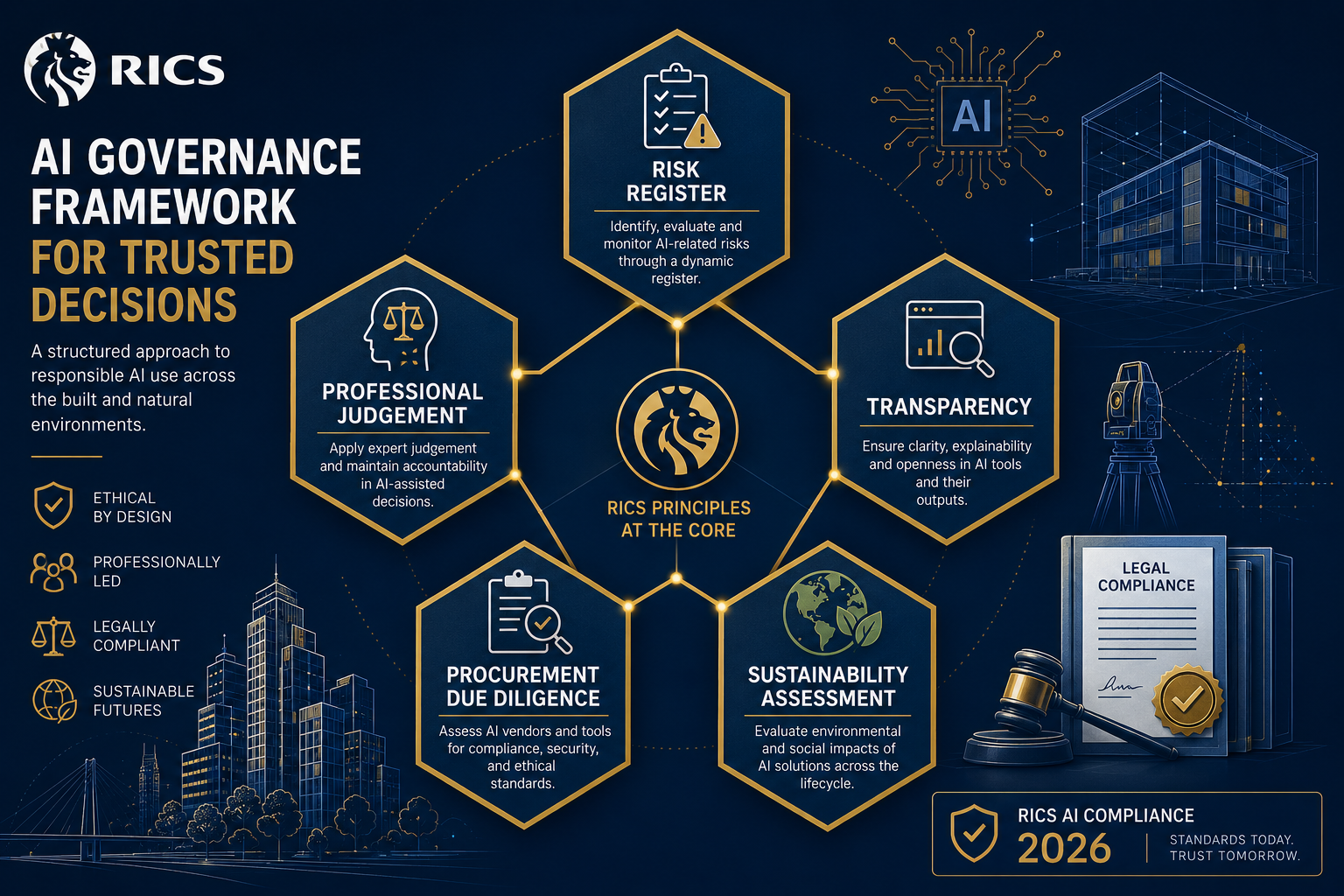
RICS has structured its standard around four core governance areas that every regulated firm must address [2]. Understanding each pillar helps surveyors move from abstract compliance to practical implementation.
1. 🏛️ Governance and Risk Management
This is the operational backbone of the standard. Firms must maintain a comprehensive risk register for every material-impact AI application. That register must document [4]:
- A clear description of each identified risk
- An assessment of likelihood and potential impact
- Mitigation and management plans
- The firm's stated risk appetite
- Regular status updates as the AI tool or its context changes
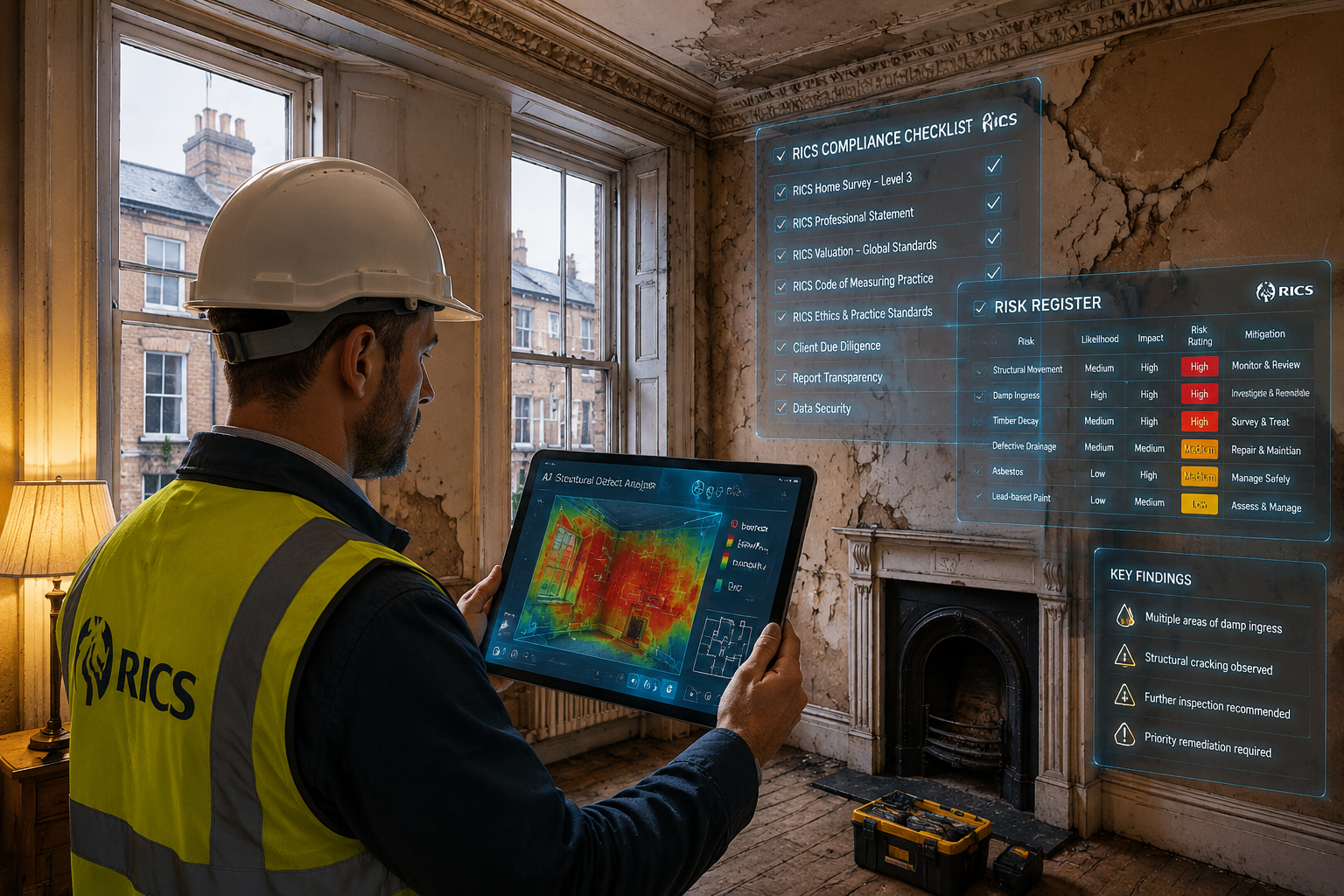
For a firm using an AI-assisted automated valuation model, the risk register might document: the risk of the model underperforming on leasehold properties with complex service charge structures, the likelihood assessed as medium, a mitigation plan requiring the surveyor to cross-reference against at least three manually verified comparables, and a quarterly review cycle.
Firms must also carry out written documentation for each material-impact application covering: the identifiable application of the AI system, potential risks and benefits relative to the specific task, and alternative approaches to the same task [4]. This last requirement — documenting alternatives — is particularly important. It forces firms to demonstrate that AI adoption was a considered professional choice, not a default.
2. 🧠 Professional Judgement and Oversight
The standard is unambiguous: surveyors remain fully accountable for all professional advice, regardless of what tools they use [2]. This has direct implications for how AI outputs are used in Level 3 building surveys, specific defect reports, and subsidence surveys.
An AI system may flag a crack pattern as consistent with thermal movement. A qualified surveyor must evaluate that output against the property's age, construction type, soil conditions, and any visible evidence of progressive movement. The AI output is an input to professional judgment — not a substitute for it.
This principle has significant implications for dispute scenarios. In 2026, property disputes increasingly involve scrutiny of how valuations and defect assessments were reached. A surveyor who can demonstrate structured AI oversight — documented in a risk register and a responsible use policy — is in a far stronger professional position than one who simply adopted an AI tool's output without recorded verification.
3. 📢 Transparency and Client Communication
Clients have a right to know when AI has materially influenced the advice they receive. The RICS standard mandates transparency as a core governance requirement [2]. In practice, this means:
- Disclosure in reports when AI tools have materially contributed to findings
- Explaining limitations of AI-generated outputs in accessible language
- Ensuring clients understand that professional judgment — not the AI — is the basis of the surveyor's advice
For property owners seeking a London property valuation or a reinstatement cost valuation for insurance purposes, this transparency requirement protects their ability to make informed decisions about the advice they are receiving.
4. 🌱 Responsible Development of AI
This pillar applies specifically to firms that develop their own AI systems rather than purchasing third-party solutions. RICS anticipates most firms will use third-party tools, but for those building proprietary systems, an additional requirement applies: a written sustainability impact assessment of the proposed AI technology must be carried out and documented [4].
This reflects growing recognition that AI systems have environmental costs — in data centre energy consumption, for example — that responsible firms must consider and record.
Practical Implementation: How Surveyors Are Applying the Standard in 2026
Building a Compliant Risk Register: A Worked Example
Consider a surveying firm that uses a third-party AI platform to assist with dilapidation surveys on commercial properties. The AI tool analyses photographic evidence and flags potential breaches of lease covenants, producing a preliminary schedule of items for the surveyor to review.
A compliant risk register for this application would include:
Risk 1: Inherent Bias in Training Data
- Description: The AI was trained predominantly on retail and office properties; performance on industrial units is unvalidated.
- Likelihood: Medium | Impact: High
- Mitigation: Surveyor manually verifies all AI-flagged items on industrial instructions; additional comparable review required.
- Status: Active — quarterly review scheduled.
Risk 2: Erroneous Output on Specialist Fit-Out
- Description: AI may misclassify tenant-installed specialist equipment as landlord's fixtures, affecting liability assessment.
- Likelihood: Low | Impact: High
- Mitigation: Lease review conducted prior to AI analysis; surveyor cross-checks all fixture classifications.
- Status: Active.
This level of documentation is now a regulatory requirement, not a best-practice aspiration [3].
Procurement Due Diligence: Asking the Right Questions
Before adopting any third-party AI tool for material-impact applications, the standard requires firms to conduct and document procurement due diligence [1]. Key questions firms should be asking AI vendors include:
- 🔍 What datasets was this system trained on, and are they representative of the UK property market?
- 🔍 How is model performance monitored and updated?
- 🔍 What is the documented error rate, and under what conditions does performance degrade?
- 🔍 Does the vendor provide transparency about algorithmic decision-making?
- 🔍 What data protection and security protocols are in place?
Firms that cannot obtain satisfactory answers to these questions face a compliance problem — because deploying an AI tool without adequate procurement documentation is itself a breach of the standard.
AI in Level 3 Surveys and Valuation Accuracy
The highest-stakes application of AI in building surveys is arguably its use in Level 3 Building Survey reports and formal property valuations. These are the reports that inform mortgage lending decisions, probate valuations, and high-value property transactions. Errors carry significant financial and legal consequences.
AI tools used in this context — whether for automated comparable analysis, defect severity scoring, or structural risk flagging — must now be subject to the full governance framework. The standard's requirement to document alternative approaches is particularly valuable here: it forces surveyors to consider whether the AI-assisted approach genuinely adds accuracy and reliability, or whether a traditional methodology would be more appropriate for a given property type.
💡 Key insight: The RICS standard does not restrict AI use — it structures it. Firms that implement robust governance frameworks can use AI more confidently, knowing their processes are defensible.
Responsible AI in Building Surveys: RICS March 2026 Standards for Valuation Accuracy and Defect Detection — Compliance Checklist
With the compliance deadline now passed, every RICS-regulated firm using material-impact AI should be able to confirm the following are in place [3]:
- Written responsible AI use policy — reviewed and approved at firm level
- Risk register — covering all material-impact AI applications with all five required elements
- Procurement due diligence records — for all third-party AI tools in use
- Written documentation — for each AI application covering application description, risks/benefits, and alternatives
- Client disclosure protocols — embedded in report templates where AI has materially contributed
- Sustainability impact assessment — required only for firms developing their own AI systems
- Staff training — ensuring all surveyors using AI tools understand the governance requirements
- Review schedule — risk registers and policies must be updated regularly, not filed and forgotten
For firms offering specialist services such as snagging reports on new-build properties or boundary surveys, the same framework applies wherever AI tools are used in ways that materially affect the service delivered.
Conclusion: Turning Compliance Into Competitive Advantage
The RICS March 2026 standard on responsible AI represents a maturation of the profession's relationship with technology. It does not position AI as a threat to be resisted, nor as a silver bullet to be adopted uncritically. Instead, it establishes a structured, accountable framework within which AI can genuinely enhance the quality, consistency, and credibility of building surveys and valuations.
Surveyors who treat compliance as a minimum baseline will meet the standard. Those who treat it as a professional opportunity will exceed it.
Actionable Next Steps for Surveying Firms in 2026:
- Audit current AI tool usage — identify every application that may constitute material impact and document your reasoning.
- Draft or update your responsible AI use policy — ensure it covers both third-party tools and any internally developed systems.
- Build your risk registers now — use the five required elements as a template and assign ownership for regular updates.
- Review procurement contracts — ensure AI vendors can provide the transparency and performance data the standard requires.
- Train your team — every surveyor using an AI tool needs to understand both its capabilities and its documented limitations.
- Embed disclosure in client communications — update report templates to reflect transparency requirements before the next instruction.
The firms that invest in robust AI governance in 2026 will be better positioned to defend their professional advice in disputes, win client trust through demonstrated accountability, and adopt future AI innovations with confidence — because the governance infrastructure will already be in place.
References
[1] Responsible Use Of Ai – https://www.rics.org/profession-standards/rics-standards-and-guidance/conduct-competence/responsible-use-of-ai
[2] Rics First Ever Standard On Responsible Ai Use Now In Effect – https://www.rics.org/news-insights/rics-first-ever-standard-on-responsible-ai-use-now-in-effect
[3] Implementing Rics Responsible Ai Standards In Building Surveys From March 2026 Compliance To Competitive Advantage – https://nottinghillsurveyors.com/blog/implementing-rics-responsible-ai-standards-in-building-surveys-from-march-2026-compliance-to-competitive-advantage
[4] Responsible Use Of Artificial Intelligence In Surveying Practice September 2025 – https://www.rics.org/content/dam/ricsglobal/documents/standards/Responsible-use-of-artificial-intelligence-in-surveying-practice_September-2025.pdf