

Roughly one in three party wall disputes in urban areas involves some form of access disagreement — and scaffolding is at the centre of a significant proportion of those conflicts. Party Wall and Scaffolding Access: How Surveyors Assess Temporary Access, Overhangs, and Occupier Risk is a subject that sounds procedural on paper but becomes intensely practical the moment a scaffold pole is positioned inches from a neighbour's window or a platform overhang extends across a shared boundary. Understanding how surveyors navigate this terrain — legally, technically, and diplomatically — is essential for building owners, adjoining owners, and occupiers alike.
Key Takeaways
- Section 8 of the Party Wall etc. Act 1996 grants a statutory right of access to adjoining land, but that right is conditional, time-limited, and must be properly notified.
- Scaffolding that overhangs or stands on neighbouring land requires explicit consent and should be addressed within the Party Wall Award.
- Surveyors must assess whether access is genuinely necessary for the works or merely convenient, and this distinction carries legal weight.
- A Schedule of Condition recorded before access begins is one of the most important protections available to adjoining owners and occupiers.
- Occupiers — not just owners — are entitled to reasonable notice and may be entitled to compensation for disturbance caused by access.

The Legal Framework: What Section 8 Actually Permits
The Party Wall etc. Act 1996 is the primary legislation governing works to shared boundaries and party structures in England and Wales. Section 8 of the Act grants building owners a statutory right to enter adjoining land during usual working hours, provided they give at least 14 days' written notice to the adjoining owner and any occupier [1]. This is not a courtesy — it is a legal requirement, and the notice must be served on both the owner and the occupier separately if they are different people.
The right of access under Section 8 is not unlimited. It applies only where access is necessary for the execution of notifiable works — for example, raising a party wall, cutting into a shared structure, or constructing a new wall along a boundary line. Access that is merely convenient, or that relates to works that are not notifiable under the Act, does not automatically attract this statutory protection [2].
This distinction matters enormously in practice. A building owner who assumes that any neighbouring access is covered by the Act may find themselves exposed to claims of trespass if the works fall outside the Act's scope. Equally, an adjoining owner who refuses access to genuinely notifiable works without reasonable cause risks committing a criminal offence — obstruction of a statutory right of entry is treated seriously by the courts [1].
For a comprehensive overview of how the legislation applies to different types of work, the legal requirements for party walls resource provides a useful starting point.
Scaffolding Overhangs: Why Consent Is Not Optional
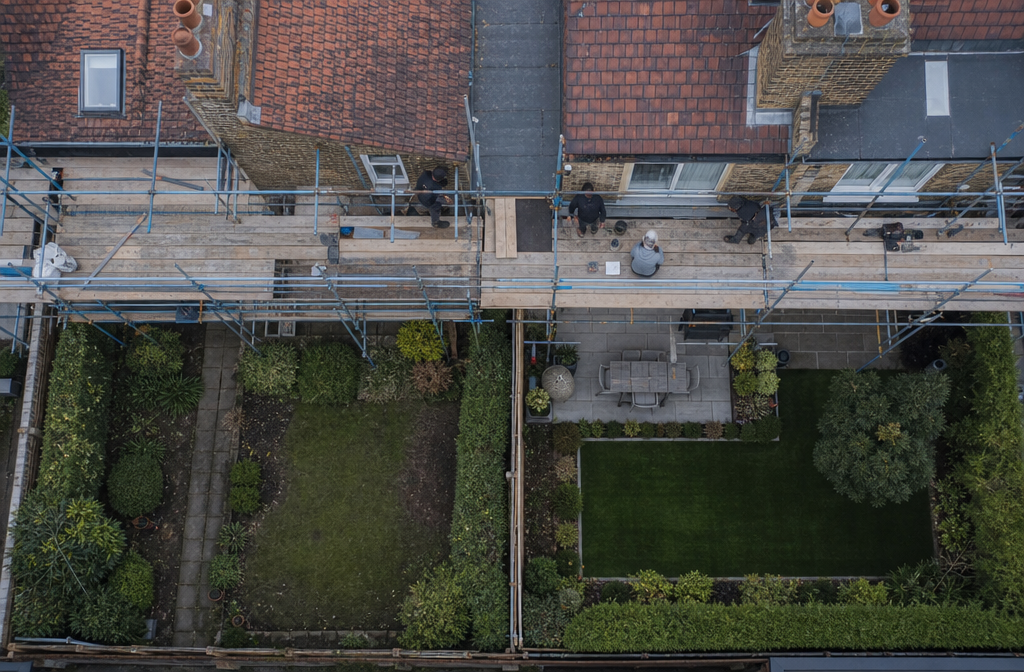
Scaffolding is where the theory of party wall access meets its most contentious real-world application. In dense urban settings — terraced streets, Victorian conversions, narrow side returns — there is often no way to erect scaffolding on the building owner's land alone. Poles must be anchored, boards must extend, and tie-backs must be fixed in positions that inevitably cross the boundary.
The critical legal point is this: erecting scaffolding on or over a neighbour's land is not automatically permitted by the Party Wall etc. Act 1996. It requires explicit consent, and where scaffolding is necessary for notifiable works, it must be addressed directly within the Party Wall Award [3].
"Scaffolding is not a footnote in the party wall process — it is a substantive issue that requires the same rigour as the works themselves."
The Party Wall Award should specify:
- The precise extent of the scaffolding footprint
- The duration for which access is required
- The protective measures to be implemented
- Working hours and any restrictions on noise or disturbance
- The process for rectifying any damage caused
Where scaffolding access goes beyond what the Act permits — for instance, where it is needed for works that are not notifiable, or where the extent of access is greater than strictly necessary — a separate access licence or formal agreement between the parties is required [4]. This is a negotiated document, not a statutory one, and it should clearly set out the terms, duration, and any compensation arrangements.
Surveyors working on party wall matters in London and Surrey regularly encounter scenarios where the scaffolding footprint was not adequately addressed in the initial Award, leading to disputes that could have been avoided with more precise drafting at the outset.
How Surveyors Assess Necessity, Risk, and Proportionality
Party Wall and Scaffolding Access: How Surveyors Assess Temporary Access, Overhangs, and Occupier Risk requires surveyors to apply a structured analytical framework. The assessment is not simply about whether access is requested — it is about whether that access is justified, proportionate, and properly protected.
Assessing Necessity
The first question a surveyor must answer is whether the proposed access is genuinely necessary. This involves reviewing the construction methodology, the site constraints, and whether alternative approaches — such as a different scaffold design, a MEWP (mobile elevated work platform), or a modified build sequence — could achieve the same result without requiring access to the adjoining land [2].
If a contractor proposes scaffolding that overhangs a neighbour's garden primarily because it is cheaper or faster to erect, that is a convenience argument, not a necessity argument. Surveyors are expected to probe this distinction and, where access is not strictly necessary, to require the building owner to explore alternatives.
Evaluating Occupier Risk
Occupier risk is a distinct consideration from property risk. An adjoining owner may be a landlord who does not live at the property — the person most directly affected by scaffolding access may be a tenant or other occupier who has no formal role in the party wall process but is entitled to reasonable notice and consideration [1].
Key risk factors surveyors assess include:
| Risk Factor | Surveyor's Consideration |
|---|---|
| Vulnerable occupiers (elderly, disabled, young children) | Extended notice periods, restricted working hours |
| Ground-floor access points blocked | Alternative access arrangements, safety lighting |
| Scaffold overhang above habitable rooms | Protective sheeting, noise restrictions |
| Security concerns from scaffold proximity to windows | Anti-climb measures, security lighting |
| Loss of natural light | Duration limits, compensation assessment |
| Damage to gardens, outbuildings, or boundary structures | Pre-works Schedule of Condition |
Recording Constraints Clearly
One of the most important functions a surveyor performs in this context is clear and precise documentation. Vague Awards create disputes. A well-drafted Award will specify not just that scaffolding access is permitted, but the exact grid reference of each scaffold standard, the maximum overhang in metres, the protective boarding requirements, and the reinstatement obligations on completion.
A party wall schedule of condition completed before any access begins is an indispensable tool. It creates a photographic and written record of the adjoining property's condition prior to works, making it straightforward to attribute any damage that occurs during the access period.
The Party Wall Award: Drafting Access Provisions That Hold Up
The Party Wall Award is the formal document through which appointed surveyors set out the rights and obligations of both parties. When it comes to scaffolding and temporary access, the quality of the drafting directly determines whether the access period runs smoothly or ends in a dispute.
A robust Award addressing scaffolding access will typically cover:
1. Access rights and their scope
The Award should specify which parts of the adjoining land may be accessed, by whom, and for what purpose. Generic language such as "access as required" is inadequate.
2. Notice requirements
Even where the 14-day statutory notice has been served, the Award may impose additional operational notice requirements — for example, 48 hours' notice before each working visit.
3. Working hours
Standard working hours under the Act are typically 8am to 5pm on weekdays, but the Award can restrict these further where occupier circumstances warrant it.
4. Protective measures
The Award should specify sheeting, boarding, dust suppression, and any other protective measures. These are not optional extras — they are conditions of the access right.
5. Reinstatement
Any damage caused by the access must be made good promptly. The Award should specify the standard of reinstatement and the timeframe.
6. Compensation
Where access causes measurable inconvenience or loss to the occupier — loss of amenity, restricted parking, reduced light — the Award may include a compensation provision [1].
For those navigating a party wall agreement for the first time, understanding that the Award is a legally binding document — not a gentlemen's agreement — is fundamental.
Occupier Rights: A Frequently Overlooked Dimension
Occupiers of adjoining properties occupy a legally distinct position from owners. Under the Act, notice must be served on both the owner and the occupier, and surveyors have a duty to consider the occupier's interests when drafting access provisions [1].
In practice, this is an area where the party wall process sometimes falls short. Owners may consent to access arrangements without fully considering the impact on tenants. Surveyors should make it their business to understand who actually lives at the adjoining property and what their circumstances are.
Vulnerable occupiers deserve particular attention. An elderly resident who relies on a ground-floor rear entrance that will be obstructed by scaffold bases, or a family with young children whose garden will be overshadowed by a platform for three months, has legitimate interests that the Award should address. The surveyor's role is not simply to facilitate the building owner's works — it is to ensure that the adjoining owner and occupier are adequately protected throughout.
Where an occupier believes their interests have not been properly addressed, the party wall disputes process provides a formal mechanism for resolution. Surveyors appointed under the Act have the authority to vary or supplement an Award where circumstances change or where initial provisions prove inadequate.

Party Wall and Scaffolding Access: Dispute Scenarios and How Surveyors Resolve Them
Understanding Party Wall and Scaffolding Access: How Surveyors Assess Temporary Access, Overhangs, and Occupier Risk also means understanding what happens when things go wrong. The following scenarios illustrate common points of conflict and how they are typically resolved.
Scenario 1: Adjoining Owner Refuses Access
Where an adjoining owner refuses access without reasonable cause, the building owner's remedy is a court order. Preventing a statutory right of entry is a criminal offence under the Act [1]. In practice, most refusals stem from inadequate notice, poor communication, or unresolved concerns about protective measures — all of which a competent surveyor can address before the situation escalates.
Scenario 2: Scaffolding Damage to Adjoining Property
If scaffolding erected under an Award causes damage to the adjoining property — broken roof tiles, damaged guttering, crushed planting — the building owner is liable for that damage. The Schedule of Condition is the primary evidential tool for establishing what damage occurred and when. Without it, disputes about pre-existing versus works-related damage become very difficult to resolve.
Scenario 3: Access Duration Exceeds What Was Agreed
Projects overrun. Scaffolding that was supposed to be removed after eight weeks may still be in place at sixteen weeks. The Award should anticipate this possibility and include a mechanism for extending access — ideally with a compensation provision that activates if the original duration is exceeded.
Scenario 4: Scaffolding Required for Non-Notifiable Works
Sometimes a project includes both notifiable and non-notifiable elements, and the scaffolding serves both. In this case, the statutory access right covers only the notifiable portion. For the remainder, a separate access licence is required [4]. Failing to obtain this licence exposes the building owner to a trespass claim even if the party wall process was otherwise correctly followed.
For projects involving excavation near boundaries — where scaffolding access issues often arise alongside deeper structural concerns — the guidance on party wall excavation notices is directly relevant.
Practical Steps for Building Owners and Adjoining Owners in 2026
For anyone involved in a project where scaffolding access to neighbouring land is anticipated, the following steps represent current best practice in 2026.
For building owners:
- Engage a party wall surveyor early — before the scaffold design is finalised
- Instruct the contractor to provide a detailed scaffold drawing showing the footprint relative to the boundary
- Serve notice on both the adjoining owner and any occupier at least 14 days before access is required
- Ensure the Party Wall Award specifically addresses scaffolding access, duration, and protective measures
- Obtain a separate access licence for any access that falls outside the Act's scope
For adjoining owners and occupiers:
- Respond formally to any party wall notice — silence is not consent, but it does trigger the dispute resolution process
- Appoint a surveyor to represent your interests — the building owner typically meets the cost
- Request a Schedule of Condition before any access begins
- Keep a record of any disturbance, damage, or deviation from the agreed access terms
- Raise concerns with the appointed surveyors promptly — delays in raising issues can complicate compensation claims
The party wall matters hub provides a comprehensive resource for both building owners and adjoining owners navigating these issues across London and the surrounding counties.
Conclusion
Scaffolding access under the party wall regime is one of the most practically complex aspects of the entire process. The legal framework is clear in principle — Section 8 grants access, the Award governs the terms, and both parties have defined rights and obligations. But the gap between principle and practice is where disputes are born.
Surveyors who handle these matters well do three things consistently: they assess necessity rigorously rather than accepting the contractor's preferred method at face value; they document constraints and conditions with precision; and they keep the occupier's lived experience at the centre of their assessment, not as an afterthought.
Actionable next steps:
- If a project involving scaffolding access to neighbouring land is planned, engage a qualified party wall surveyor before serving any notices.
- Ensure the Party Wall Award addresses scaffolding in specific, enforceable terms — not general permissions.
- Commission a Schedule of Condition before access begins, regardless of how straightforward the works appear.
- If access is required for non-notifiable works, negotiate a formal access licence rather than relying on implied consent.
- If a dispute arises, engage the appointed surveyors immediately — the formal resolution process exists precisely to avoid costly litigation.
For professional guidance on party wall and scaffolding access matters across London and the South East, chartered surveyors in London can provide expert support from the notice stage through to Award completion and beyond.
References
[1] Jan 22 Party Wall Legislation And Procedure 7th Edition – https://www.rics.org/content/dam/ricsglobal/documents/standards/jan_22_party_wall_legislation_and_procedure_7th_edition.pdf?utm_source=openai
[2] Rights Of Access Onto Neighbour S Land – https://www.partywall.info/rights-of-access-onto-neighbour-s-land.html?utm_source=openai
[3] Access To A Neighbours Land For Scaffolding Hoardings And Safety – https://www.houricanassociates.com/party-wall-news/access-to-a-neighbours-land-for-scaffolding-hoardings-and-safety/?utm_source=openai
[4] About 6 1 – https://www.partywallservice.com/about-6-1?utm_source=openai