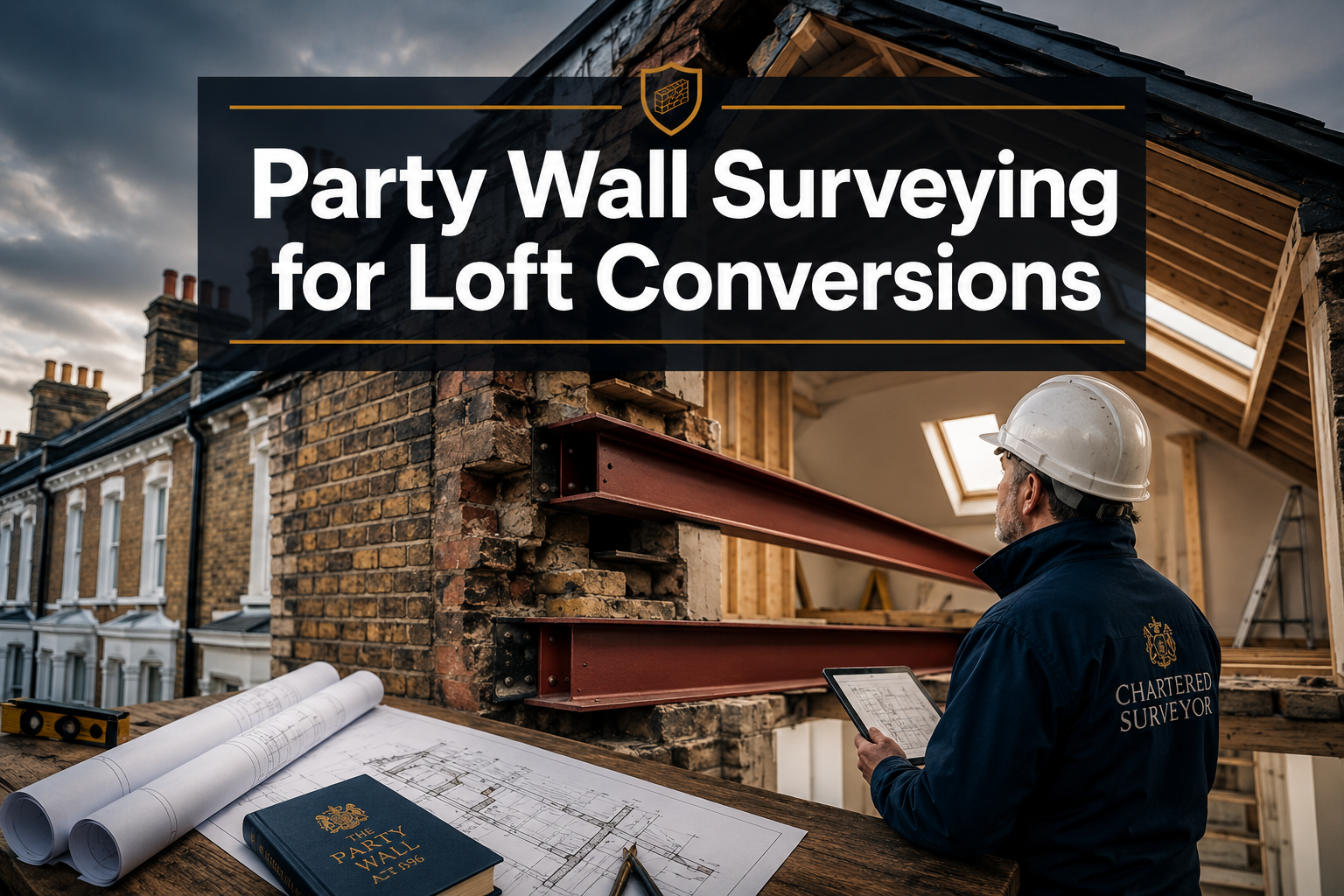
Nearly 60% of homeowners who undertake loft conversions on terraced or semi-detached properties fail to serve the correct party wall notices before work begins — a costly oversight that can halt construction, trigger legal disputes, and leave neighbours with uncompensated structural damage. Party wall surveying for loft conversions is one of the most technically demanding areas of the Party Wall etc. Act 1996, precisely because loft works almost always cut into, load onto, or expose a shared structure.
This guide breaks down the statutory rights most commonly exercised, the drawings surveyors must scrutinise, and the structural checks that should be completed before any Party Wall Award is finalised. Whether a building owner is planning a dormer conversion or a full mansard, understanding these obligations from the outset protects everyone involved.
Key Takeaways 📋
- Loft conversions on terraced and semi-detached homes almost always trigger Section 2 of the Party Wall etc. Act 1996, requiring a 2-month notice before work starts.
- The three most commonly exercised rights are cutting in (Section 2(2)(f)), raising the wall (Section 2(2)(a)), and exposing the structure (Section 2(2)(n)).
- Surveyors should not finalise a Party Wall Award until they have reviewed architectural drawings, structural calculations, and bearing/padstone details.
- Costs in 2026 range from £700–£1,200 for a single agreed surveyor to £3,000–£6,000+ where disputes arise or multiple neighbours are involved.
- The typical timeline from structural design to construction start is 6–10 weeks — homeowners who ignore this window risk project delays.
Why Loft Conversions Almost Always Trigger the Party Wall Act
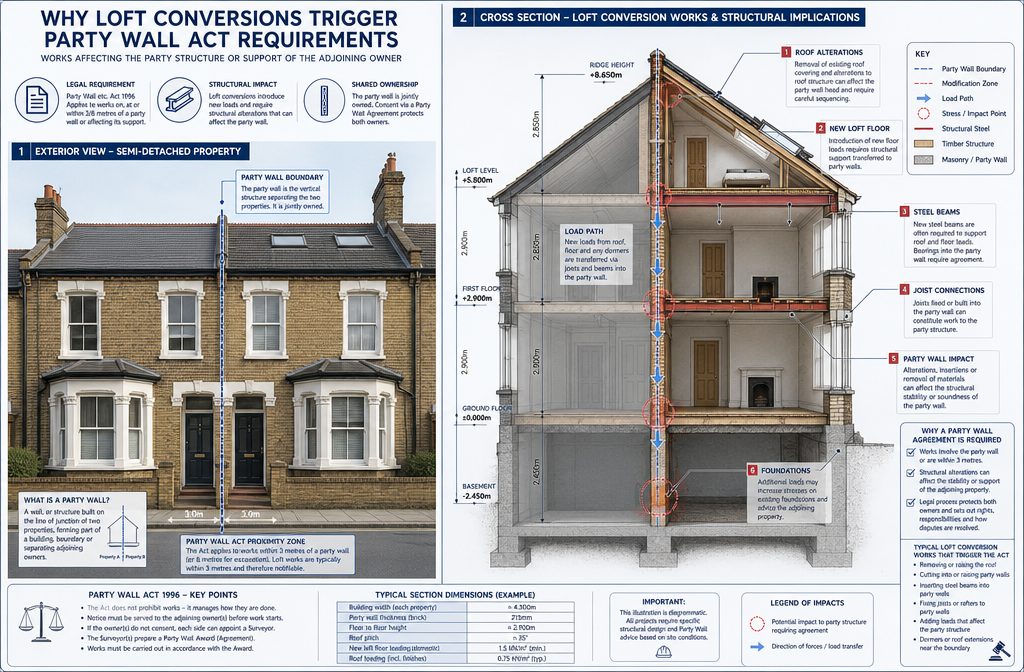
Most homeowners assume the Party Wall etc. Act 1996 only applies when building an extension at ground level. In reality, loft conversions on terraced and semi-detached properties are among the most frequent triggers of party wall obligations — and the most frequently misunderstood.
The reason is structural. A loft conversion typically involves:
- Cutting steel or timber beams into the shared wall to support a new floor or roof structure
- Raising the party wall to form a new gable or support a dormer
- Removing or altering chimney breasts that form part of the shared structure
- Exposing previously enclosed party wall surfaces during roof removal or alteration
Each of these operations falls squarely within Section 2 of the Act, which governs works to party structures. According to Peter Barry Surveyors, the specific subsections most commonly engaged are 2(2)(a), 2(2)(f), and 2(2)(n) [3]. SBS Structures confirm that "loft conversions almost always trigger Section 2," making notices mandatory for the vast majority of terraced and semi-detached properties [1].
💡 Pull Quote: "Loft conversions almost always trigger Section 2 — the notice is not optional, it is a legal requirement before any beam goes into that wall." — SBS Structures [1]
For a detailed overview of how party wall matters apply specifically to loft projects, the party wall for loft conversions guide provides a useful starting point.
The 2-Month Notice Requirement
Under Section 2, the building owner must serve written notice on each adjoining owner at least 2 months before work begins [1]. This is a hard statutory minimum — it cannot be shortened unless the adjoining owner consents in writing. In 2026, with surveying capacity stretched by high demand, many Awards are taking closer to the upper end of a 6–10 week window from notice to construction start [4].
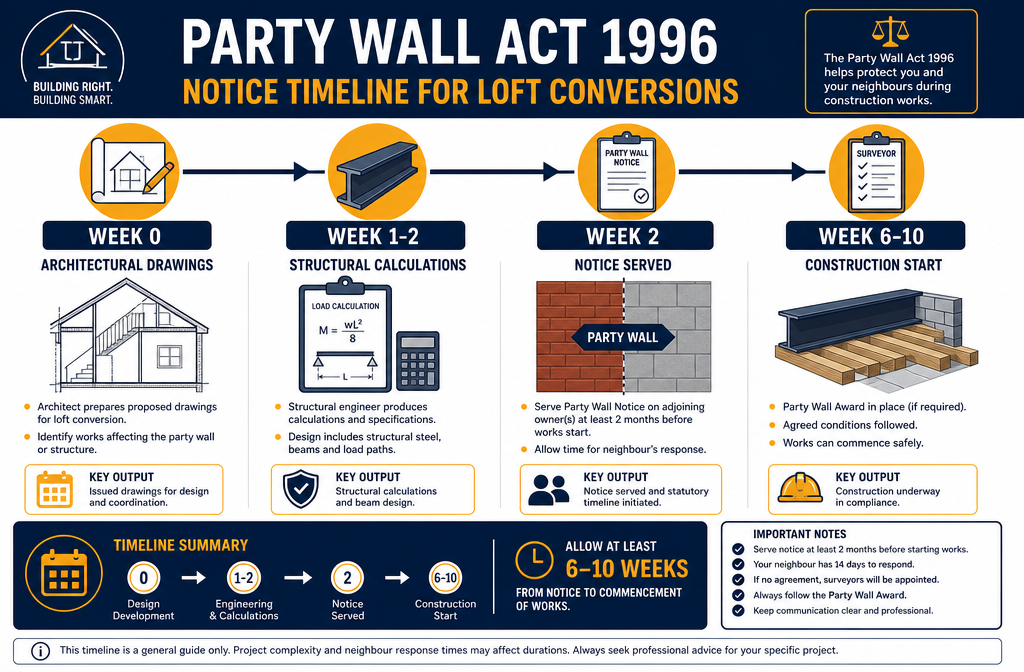
The typical recommended workflow looks like this:
| Week | Action |
|---|---|
| 0 | Architectural loft drawings completed |
| 1–2 | Structural calculations and bearing details produced |
| 2 | Party wall notice served (including structural details) |
| 2–6/10 | Statutory notice period; Award preparation |
| 6–10 | Construction begins |
Homeowners and their contractors who skip or compress these steps risk having works stopped under a court injunction — an outcome far more disruptive and expensive than the surveying process itself.
Common Rights, Drawings, and Structural Checks Surveyors Must Review for Loft Conversions
This is where party wall surveying for loft conversions becomes genuinely technical. A surveyor's role is not simply to draft a notice and collect a fee — it is to review the proposed works in detail, ensure the correct statutory rights are being exercised, and protect the adjoining owner's property from foreseeable damage.
The Three Core Statutory Rights for Loft Works
1. Section 2(2)(f) — Cutting Into the Party Structure
This is the most frequently exercised right in loft conversions. When a structural engineer specifies RSJ steel beams to support a new loft floor, those beams must be "pocketed" into the party wall — meaning a hole is cut into the shared structure to create a bearing point. Section 2(2)(f) grants the building owner the right to cut into a party structure for any purpose [3].
The surveyor must verify:
- ✅ The size and depth of each pocket cut
- ✅ Whether the cut affects the structural integrity of the wall
- ✅ Whether padstones or bearing plates are specified to distribute load
- ✅ Whether the works are confined to the building owner's side or encroach further
2. Section 2(2)(a) — Raising the Party Wall
Dormer loft conversions often require the party wall to be raised in height to form a new gable end or to support the dormer cheeks. Section 2(2)(a) covers raising, thickening, or underpinning a party wall [3].
The surveyor must verify:
- ✅ The proposed new height of the wall
- ✅ Whether the raised section is to be built at the building owner's cost
- ✅ How the raised wall will be weatherproofed at the junction with the neighbour's roof
- ✅ Whether the additional loading is accounted for in the structural calculations
3. Section 2(2)(n) — Exposing the Party Wall
When a roof is stripped back or a chimney breast removed, previously enclosed sections of the party wall become exposed to the elements or to view. Section 2(2)(n) covers the right to expose a party structure in connection with other permitted works [3].
The surveyor must verify:
- ✅ How long the wall will remain exposed during construction
- ✅ What temporary weatherproofing measures are in place
- ✅ Whether the exposure reveals pre-existing defects that could become a dispute
Drawings Surveyors Must Review Before Issuing an Award
A common and serious mistake is issuing a Party Wall Award based solely on architectural plans. In 2026, best practice — and increasingly standard expectation — is that the surveyor will not finalise the Award until they hold all three of the following [1]:
- Architectural loft layout drawings — showing the proposed floor plan, dormer positions, and roof alterations
- Structural calculations — engineer-certified calculations for all steel beams, timber joists, and point loads
- Structural details for bearing into the party wall — including padstone specifications, pocket dimensions, and any temporary propping requirements
As SBS Structures put it: "The party wall surveyor needs the structural drawings to issue the Award — they have to know what's going into the wall." [1]
Without these documents, the surveyor cannot accurately assess the risk to the adjoining owner's property, making any Award incomplete and potentially challengeable.
Structural Checks: A Surveyor's Pre-Award Checklist
Before signing off on a Party Wall Award for a loft conversion, a competent surveyor should work through the following checks:
🔩 Steel and Beam Checks
- Are RSJ sizes specified and engineer-certified?
- Are flitch beams or steel plates used, and do they require wall pockets?
- Is temporary propping specified during beam installation?
🧱 Party Wall Integrity Checks
- What is the existing condition of the party wall (documented in a Schedule of Condition)?
- Are there pre-existing cracks, movement, or damp that could be attributed to the works later?
- Does the wall have adequate thickness to accept the proposed pockets without risk of spalling or collapse?
🏠 Chimney and Flue Checks
- Does the loft conversion affect any shared chimney stack?
- Are flue liners being altered or removed?
- For shared chimneys, see the party wall shared chimneys guidance for specific obligations.
🪜 Scaffold and Access Checks
- Will scaffold be erected over or adjacent to the neighbour's property?
- If scaffold is placed on the neighbour's land, a separate licence may be required in addition to the Award.
📐 Tolerance and Specification Checks
- Are construction tolerances specified to avoid over-cutting into the party wall?
- Are finishing details (fire stopping, insulation at wall junctions) included in the drawings?
For a broader understanding of what the Party Wall Act 3-metre rule means for excavation works that may accompany a loft project, that resource is worth reviewing alongside these checks.
Party Wall Surveying for Loft Conversions: Costs, Timelines, and Appointing the Right Surveyor
Understanding the financial and procedural landscape of party wall surveying for loft conversions helps building owners plan realistically and avoid nasty surprises.
2026 Cost Benchmarks
Costs vary significantly depending on whether neighbours consent or dissent, and how many adjoining owners are involved.
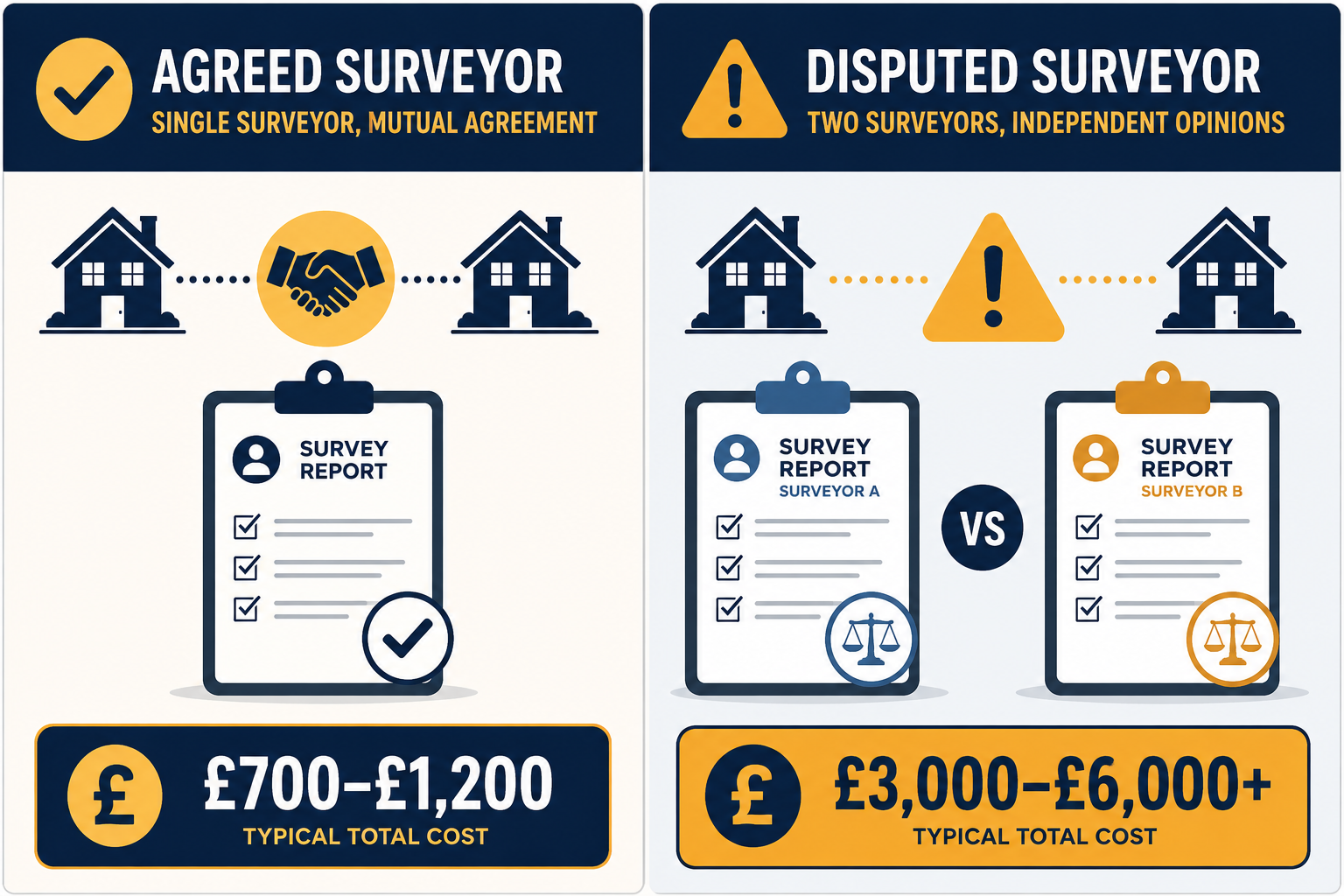
| Scenario | Estimated Cost (2026) |
|---|---|
| Single agreed surveyor (both owners) | £700 – £1,200 |
| Two surveyors (one each, straightforward) | £1,500 – £3,000 total |
| Disputes or multiple neighbours | £3,000 – £6,000+ |
Source: SBS Structures [1] and HomeOwners Alliance [5]
The HomeOwners Alliance notes that for a standard loft conversion with a single agreed surveyor, £900–£1,200 is a typical range [5]. However, where neighbours dissent and appoint their own surveyor, costs escalate quickly — and it is usually the building owner who bears the cost of the adjoining owner's surveyor.
For a detailed breakdown of what drives surveying fees, the party wall surveyor cost guide is an essential reference.
Agreed Surveyor vs. Separate Surveyors
When an adjoining owner does not dissent to the works but wants professional oversight, both parties can appoint a single agreed surveyor to act impartially for both. This is typically the most cost-effective route and is encouraged where the relationship between neighbours is amicable.
For a full explanation of this arrangement, the party wall agreed surveyor guide covers the key considerations, including how impartiality is maintained.
Where neighbours dissent, each party appoints their own surveyor, and those two surveyors then appoint a third surveyor in case of disagreement. This three-surveyor tribunal is rarely needed in practice but adds to the overall cost and timeline.
What Happens If No Notice Is Served?
Proceeding without serving notice is not merely a procedural oversight — it is a breach of statutory duty. Adjoining owners can apply for an injunction to stop the works, and the building owner may be liable for all costs of remediation if damage occurs [2]. In 2026, with more homeowners undertaking loft conversions and greater awareness of party wall rights, the risk of a neighbour taking legal action is higher than ever [4].
The party wall consent process explains what happens after notice is served and how consent or dissent triggers the formal Award process.
The Schedule of Condition: A Critical Pre-Work Document
Before any loft conversion work begins, the surveyor should prepare a Schedule of Condition — a detailed photographic and written record of the adjoining owner's property. This document:
- Establishes the baseline condition of ceilings, walls, and structures
- Protects the building owner from inflated or spurious damage claims
- Protects the adjoining owner by documenting pre-existing defects
Without a Schedule of Condition, any crack or mark that appears during or after the loft works can become a dispute. For guidance on what happens when damage does occur, the damage to property in party wall situations resource provides practical next steps.
Conclusion: Actionable Next Steps for Building Owners and Surveyors
Party wall surveying for loft conversions is not a bureaucratic formality — it is a legally mandated process that protects structural integrity, neighbour relations, and project timelines. The checks surveyors must carry out go well beyond checking a notice has been served; they extend to scrutinising every beam, pocket, padstone, and exposed surface that touches or loads the shared wall.
Here are the immediate actions to take in 2026:
-
Engage a structural engineer early. Structural calculations and bearing details must be ready before the party wall notice is served — not after.
-
Serve notice at least 2 months before the planned start date. Factor in the full 6–10 week window from design to construction.
-
Commission a Schedule of Condition before any work begins, regardless of how cooperative the neighbour appears.
-
Appoint a qualified party wall surveyor with specific experience in loft conversions — not just general party wall matters. The complexity of Section 2 works demands specialist knowledge.
-
Do not allow work to start without a finalised Award that includes full structural drawings, calculations, and bearing details.
-
If in doubt about boundary or wall ownership, resolve this before serving notice. The guide to boundary dispute and party wall surveyors in London can help clarify ownership questions.
For homeowners and surveyors working across London and the South East, getting the party wall process right from the outset is the single most effective way to keep loft conversion projects on time, on budget, and free from legal complications.
References
[1] Party Wall Agreement Extensions Lofts London – https://sbsstructures.co.uk/blog/party-wall-agreement-extensions-lofts-london
[2] Party Wall Surveys For Loft Conversions In 2026 Avoiding Costly Structural Surprises – https://partywallsurveyorlondon.uk/blogs/party-wall-surveys-for-loft-conversions-in-2026-avoiding-costly-structural-surprises/
[3] Loft Conversions And The Party Wall Act – https://www.peterbarry.co.uk/blog/loft-conversions-and-the-party-wall-act/
[4] Party Wall Surveying Surge In 2026 Loft Conversions Navigating High Demand Compliance During Housing Uptick – https://nottinghillsurveyors.com/blog/party-wall-surveying-surge-in-2026-loft-conversions-navigating-high-demand-compliance-during-housing-uptick
[5] Party Wall Surveyor Cost – https://hoa.org.uk/advice/guides-for-homeowners/i-am-improving/party-wall-surveyor-cost/