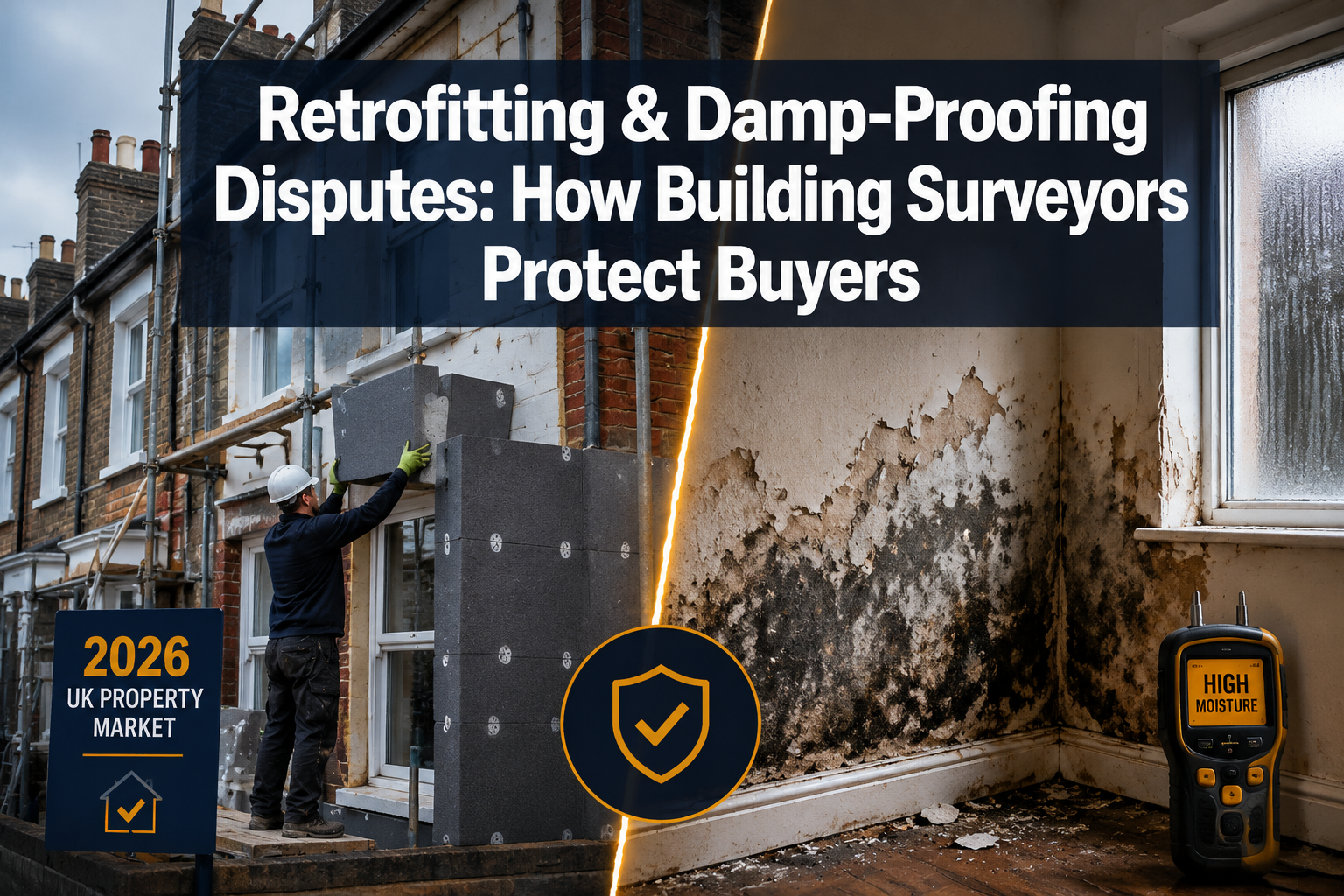

Over 700,000 UK homes received some form of insulation or energy retrofit upgrade in 2023 alone — yet industry data consistently shows that a significant proportion of those installations are later found to have introduced new moisture problems rather than solving old ones. For buyers purchasing a property where retrofit work has already been carried out, the risks are invisible, expensive, and often bitterly contested. This is precisely the territory where retrofitting and damp-proofing disputes: how building surveyors protect buyers when energy upgrades go wrong becomes one of the most consequential conversations in modern residential property.
Key Takeaways 📋
- Poorly executed retrofit and insulation work is one of the fastest-growing sources of damp-related building disputes in the UK.
- Building surveyors use thermal imaging, moisture meters, and ventilation assessments to identify defects that standard visual inspections miss entirely.
- Cold bridging, trapped moisture, and inadequate ventilation are the three most common failure modes following energy upgrade works.
- Survey findings directly influence property valuations and can support or undermine legal claims in dispute resolution.
- Commissioning a specialist survey before purchase — not after — is the most effective way to protect buyers from inheriting retrofit-related defects.
Why Retrofit Works Are Creating a New Wave of Property Disputes
The UK government's push toward net-zero housing has accelerated dramatically. Schemes incentivising external wall insulation (EWI), cavity wall insulation, solid wall insulation, and heat pump installations have placed thousands of contractors — of wildly varying competence — into Britain's existing housing stock.
The problem? Britain's older housing stock was never designed to be airtight. Victorian and Edwardian terraces, inter-war semis, and 1960s system-built homes all rely on a degree of natural air movement to manage moisture. When insulation is added without a corresponding upgrade to ventilation strategy, the building's moisture balance is disrupted.
The result is a predictable cascade of failures:
- 💧 Condensation forming within wall structures rather than on surfaces
- 🍄 Mould growth in corners, behind furniture, and within cavities
- 🧱 Spalling brickwork caused by freeze-thaw cycles in moisture-laden masonry
- 🌡️ Cold bridges at junctions where insulation is interrupted or poorly fitted
- 🪟 Interstitial condensation within the fabric of the wall itself
These defects are not always visible to the naked eye during a standard viewing. They may not even be visible to a generalist home inspector. This is where a qualified chartered building surveyor becomes indispensable.
How Building Surveyors Identify Retrofit Defects Others Miss
Understanding retrofitting and damp-proofing disputes and how building surveyors protect buyers when energy upgrades go wrong starts with understanding the diagnostic toolkit that separates a specialist survey from a basic mortgage valuation.
Thermal Imaging: Seeing the Invisible
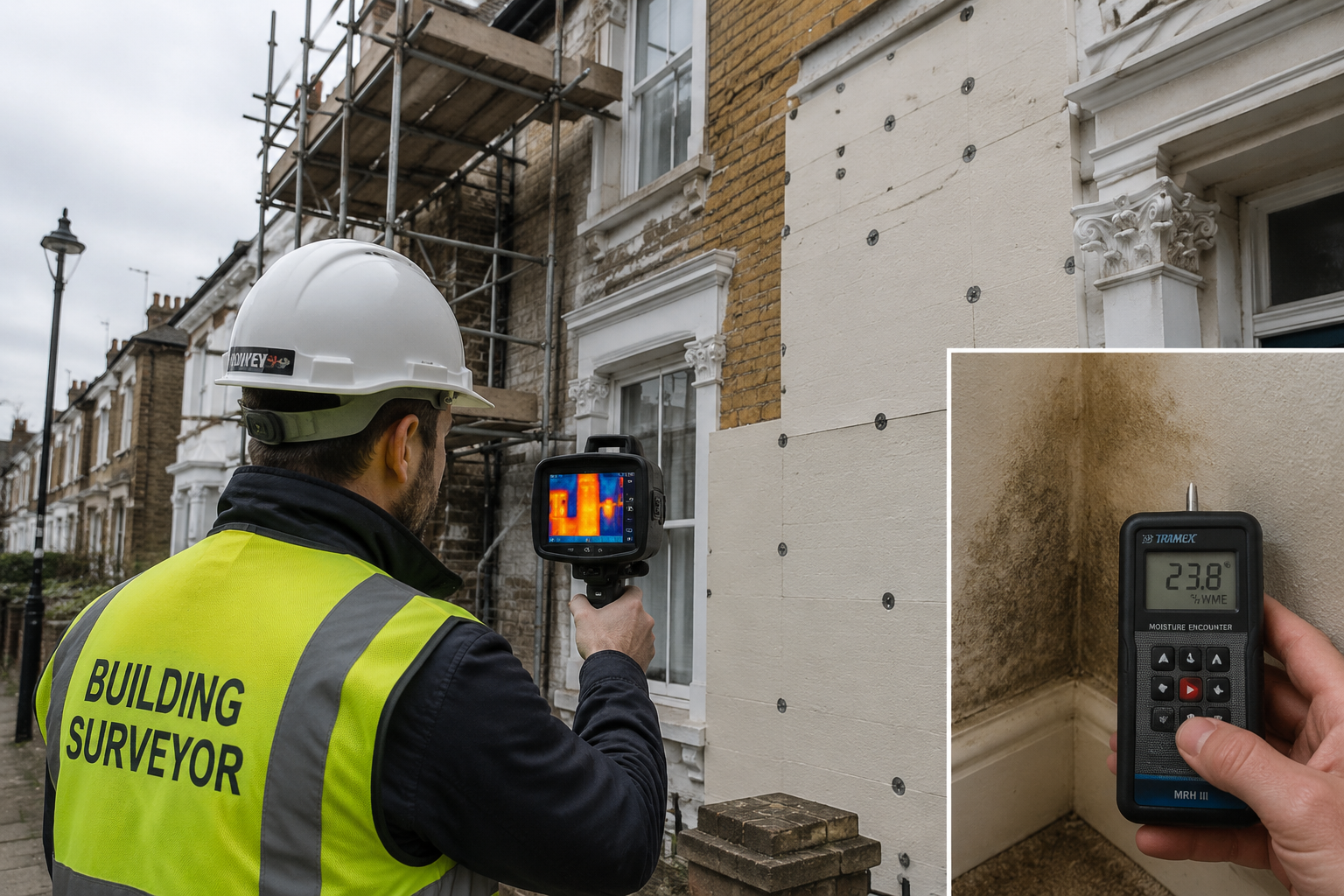
Thermal imaging cameras detect surface temperature variations across walls, ceilings, and floors. When insulation has been installed incorrectly — with gaps, compressions, or missing sections — the thermal camera reveals cold patches that indicate either heat loss or moisture accumulation. Cold bridges, which occur at structural junctions such as lintels, window reveals, floor-wall junctions, and party walls, are particularly revealing.
A competent surveyor will conduct thermal imaging surveys under the right conditions: when there is a minimum 10°C differential between internal and external temperatures, typically in autumn or winter. Results obtained outside these conditions can be misleading, which is itself a point of dispute in some cases.
Moisture Meters and Invasive Testing
Surface moisture meters provide a rapid first-pass assessment, but experienced surveyors know their limitations. Calcium carbide (speedy) testing and relative humidity probes drilled into wall cores give far more reliable readings of moisture content within the building fabric. When these readings exceed acceptable thresholds behind what appears to be a freshly insulated wall, it is a significant red flag.
For properties where specific defect investigations are warranted, surveyors can commission targeted opening-up works — removing sections of plasterboard or insulation to inspect the substrate directly.
Ventilation Strategy Assessment
This is perhaps the most overlooked element of retrofit inspection. When a building is made significantly more airtight through insulation, the ventilation strategy must be upgraded in parallel. Surveyors assess:
- Whether mechanical extract ventilation (MEV) or mechanical ventilation with heat recovery (MVHR) has been installed
- Whether trickle vents in windows have been sealed or removed
- Whether existing air bricks have been blocked by external insulation
- Whether the kitchen and bathroom extraction rates are adequate for the new airtightness level
Failure to address ventilation is one of the most common — and most legally significant — defects found in retrofit disputes.
The Most Common Retrofit Defects Found in Disputes
| Defect Type | Typical Cause | Risk Level |
|---|---|---|
| Interstitial condensation | No vapour control layer, wrong insulation type | 🔴 High |
| Cold bridging at reveals | Insulation not returned around window frames | 🔴 High |
| Blocked air bricks | EWI installed over existing vents | 🔴 High |
| Cavity fill contamination | Blown fibre bridging existing damp | 🟠 Medium-High |
| Inadequate MVHR sizing | System too small for airtight envelope | 🟠 Medium |
| Surface condensation mould | Insufficient heating post-retrofit | 🟡 Medium |
| Render cracking over EWI | Poor base coat application or movement | 🟡 Medium |
💬 "The single most damaging phrase in retrofit disputes is 'it looked fine when we sold it.' A building surveyor's job is to prove — or disprove — that claim with evidence."
From Survey Findings to Valuation: The Financial Stakes
A building survey report documenting retrofit defects does not exist in isolation. Its findings feed directly into the property's market valuation, and this is where disputes often escalate from a building matter into a legal one.
Chartered surveyors across London and the South East are increasingly being asked to produce valuations that reflect the cost of remediation for failed retrofit works. This involves:
- Quantifying the remediation cost — stripping back failed insulation, treating underlying damp, reinstating breathable finishes, upgrading ventilation
- Assessing the stigma discount — some buyers will discount a property even after remediation due to residual concern about hidden damage
- Comparing to an unaffected comparable — establishing what the property would be worth without the defects
These valuations become central documents in any subsequent dispute, whether that dispute is pursued through the contractor's warranty, a trade body complaints process, or civil litigation.
For properties in areas with high concentrations of retrofit activity — including many Surrey properties and South West London homes — the volume of such instructions has grown considerably since 2022.
Building Surveyors as Expert Witnesses in Retrofit Disputes
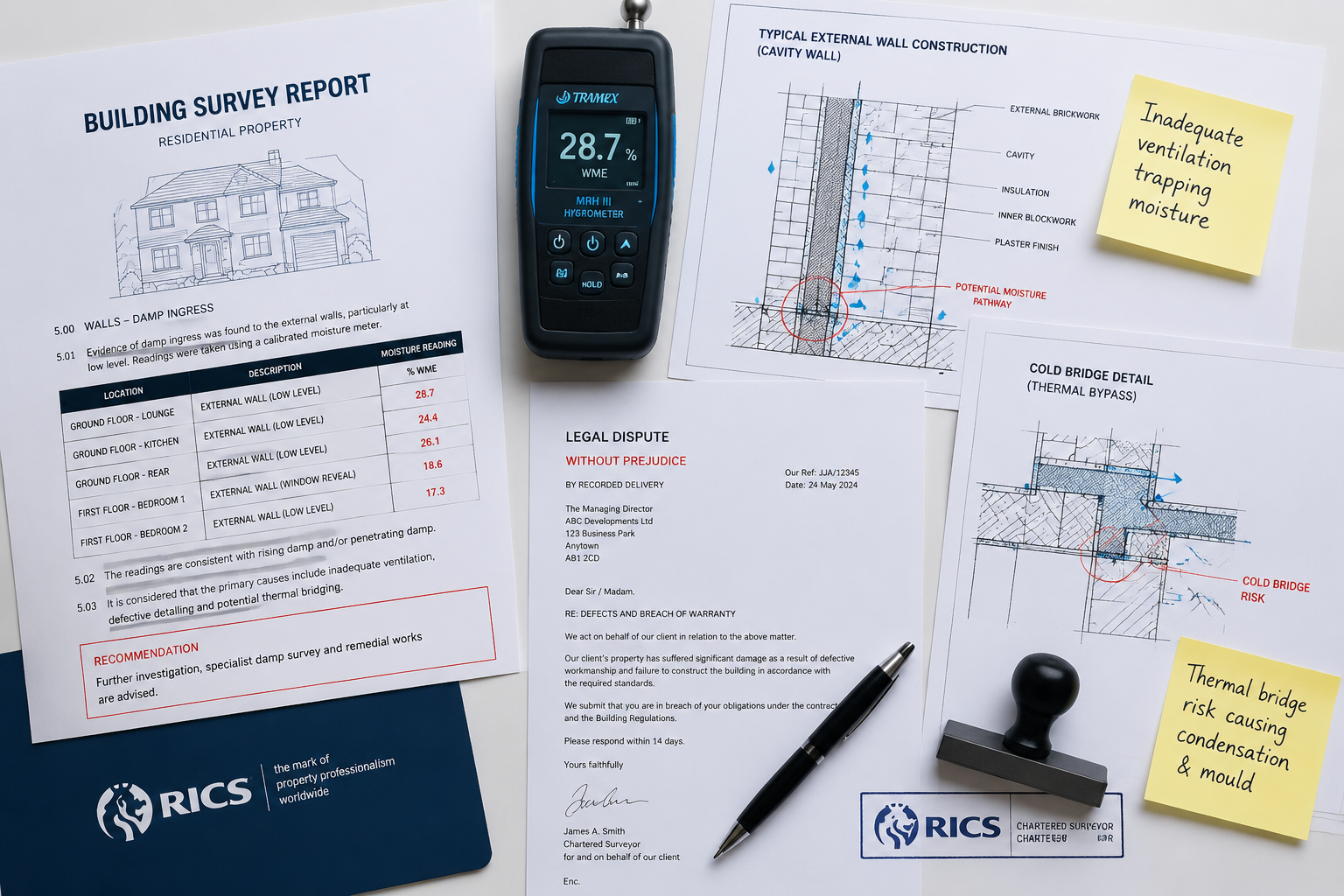
When a dispute cannot be resolved through negotiation or a contractor's complaints process, it frequently proceeds to adjudication, mediation, or the courts. At this point, the building surveyor's role shifts from advisor to expert witness — and the standards applied to their evidence change accordingly.
What Expert Witness Instructions Involve
A surveyor acting as an expert witness in a retrofit or damp-proofing dispute must:
- Produce a written report that complies with Civil Procedure Rules (CPR) Part 35
- Declare their overriding duty to the court, not to the instructing party
- Set out their methodology, findings, and opinion clearly and without advocacy
- Be prepared to meet with the opposing expert and produce a joint statement identifying areas of agreement and disagreement
This is highly specialist work. Not every building surveyor has the experience or accreditation to act in this capacity, and instructing the wrong expert can seriously undermine a case.
Common Expert Witness Instructions in Retrofit Cases
- Causation disputes: Was the damp pre-existing or caused by the retrofit work?
- Standard of workmanship: Did the contractor meet the relevant PAS 2035 or PAS 2030 standards?
- Quantum of loss: What is the reasonable cost of putting the building back to its pre-defect condition?
- Contributory negligence: Did the homeowner's actions (e.g., blocking vents, failing to heat the property) contribute to the damage?
Surveyors with experience in construction disputes resolution are best placed to navigate these complex instructions.
The Role of PAS 2035: The Standard Contractors Should Be Meeting
Since 2019, PAS 2035 has been the overarching standard for the energy retrofit of domestic buildings in the UK. It requires that retrofit works are:
- Designed by a qualified Retrofit Coordinator
- Assessed by a Retrofit Assessor before work begins
- Installed by a PAS 2030-certified installer
- Accompanied by a Medium-Term Improvement Plan that considers the property holistically
When a building surveyor investigates a failed retrofit, one of the first questions is whether PAS 2035 was followed. In many dispute cases — particularly those involving government-funded schemes — the answer is that it was not. This is powerful evidence of a breach of the applicable standard of care.
Surveyors reviewing properties in areas with high retrofit activity, from West London to Guildford, regularly find that PAS 2035 documentation is missing, incomplete, or inconsistent with the work actually carried out.
Protecting Buyers: Practical Steps Before and After Purchase
Retrofitting and damp-proofing disputes and how building surveyors protect buyers when energy upgrades go wrong is not purely a reactive story. The most effective protection happens before exchange of contracts, not after.
Before Purchase: What Buyers Should Do ✅
- Commission a Level 3 Building Survey — not a HomeBuyer Report — for any property where retrofit or insulation work has been carried out. A Level 3 survey includes a detailed assessment of the building fabric and any alterations.
- Request all retrofit documentation — installer certificates, PAS 2035 compliance documents, EPC before and after, any warranties or guarantees.
- Ask specifically about ventilation upgrades — if insulation was added but no ventilation work is documented, treat this as a significant risk.
- Consider a thermal imaging survey — particularly for properties with external wall insulation or solid wall insulation installed within the last ten years.
- Check for active warranties — schemes such as CIGA (Cavity Insulation Guarantee Agency) or SWIGA (Solid Wall Insulation Guarantee Agency) provide some recourse if work fails.
After Purchase: If Defects Emerge 🔧
- Instruct a chartered building surveyor to produce a specific defect report documenting the nature, extent, and likely cause of the problem.
- Gather all original documentation from the seller and the installer.
- Contact the relevant trade guarantee body in the first instance.
- If the guarantee body does not resolve the matter, seek legal advice — and ensure your surveyor is prepared to support an expert witness instruction if required.
- For commercial properties affected by retrofit failures, a commercial building survey may be required to establish the full extent of the defects.
Why the Surge in Retrofit Activity Makes Specialist Surveys Non-Negotiable in 2026
The pace of retrofit activity in the UK is not slowing. Government targets, rising energy costs, and lender pressure around EPC ratings are all driving more insulation and energy upgrade works into the existing housing stock. In 2026, the proportion of properties on the market that have undergone some form of energy upgrade — with all the associated risks — is higher than at any point in recent history.

For buyers, this means the probability of encountering a property with poorly executed retrofit work is growing. For sellers, it means that undisclosed or inadequately documented retrofit defects are increasingly likely to be identified — and to affect the sale price or even the transaction itself.
The building surveyor services available from RICS-regulated firms have evolved to meet this challenge. Thermal imaging, moisture profiling, ventilation assessments, and PAS 2035 compliance reviews are now standard components of a thorough pre-purchase inspection for any property where energy works have been carried out.
For buyers and owners in areas from Richmond to Twickenham and beyond, the message is consistent: the cost of a specialist survey is a fraction of the cost of inheriting a retrofit dispute.
Conclusion: Actionable Steps for Buyers, Sellers, and Property Professionals
Retrofitting and damp-proofing disputes — and how building surveyors protect buyers when energy upgrades go wrong — will remain one of the defining property issues of the mid-2020s. The combination of government retrofit incentives, an ageing housing stock, and variable installation quality has created conditions in which defects are common, disputes are rising, and the financial stakes are significant.
Here is what to do right now:
- 🏠 Buyers: Always commission a Level 3 Building Survey on any property where energy upgrade works are visible or documented. Ask for thermal imaging as a standard addition.
- 📄 Sellers: Gather all retrofit documentation before listing. Gaps in paperwork will be identified during due diligence and will affect your negotiating position.
- ⚖️ Those in dispute: Instruct a RICS-regulated chartered building surveyor with demonstrable experience in retrofit defect investigations and, where needed, expert witness work.
- 🔍 Property professionals: Treat the absence of PAS 2035 documentation as a material risk factor in any transaction involving post-2019 insulation works.
The building surveyor's role in this landscape is not simply to find problems — it is to quantify them, contextualise them, and provide the evidence base that protects buyers, supports fair valuations, and, when necessary, stands up in court.