Fewer property disputes generate as much confusion, and as many unexpected invoices, as those involving party walls. A homeowner in South London recently received three separate quotes for the same loft conversion project: the lowest was under £900, the highest exceeded £3,500. All three surveyors were qualified. All three were quoting for the same shared wall. Understanding party wall surveyor fees in 2026: what changes the cost and what you should expect to pay is not just useful, it can save thousands of pounds and prevent a straightforward renovation from derailing into a protracted dispute.
This guide cuts through the confusion. It explains the real fee drivers, the typical cost ranges for common project types, the difference between appointment structures, and the extras that rarely appear in headline quotes.
Key Takeaways
- Party wall surveyor fees in 2026 have no statutory cap; costs are set by individual surveyors and vary significantly by location, project complexity, and appointment type.
- A straightforward single-neighbour project in the regions typically costs £700,£1,200 all-in; London projects routinely run £1,500,£3,000 or more.
- Appointing a single agreed surveyor is almost always cheaper than each party appointing their own surveyor.
- The building owner is generally liable for all reasonable surveyor fees, including the adjoining owner's surveyor.
- Hidden extras such as schedule of condition surveys, monitoring visits, and dispute escalation can add hundreds or thousands of pounds to the base fee.
What Drives Party Wall Surveyor Fees in 2026
The single most important fact about party wall surveyor fees in 2026 is that there is no statutory fee scale. The Party Wall etc. Act 1996 gives surveyors the authority to determine their own reasonable fees, and the building owner is ordinarily responsible for paying all costs, including those of the adjoining owner's surveyor [1][5]. This creates a market where fees can vary dramatically, even for identical work.
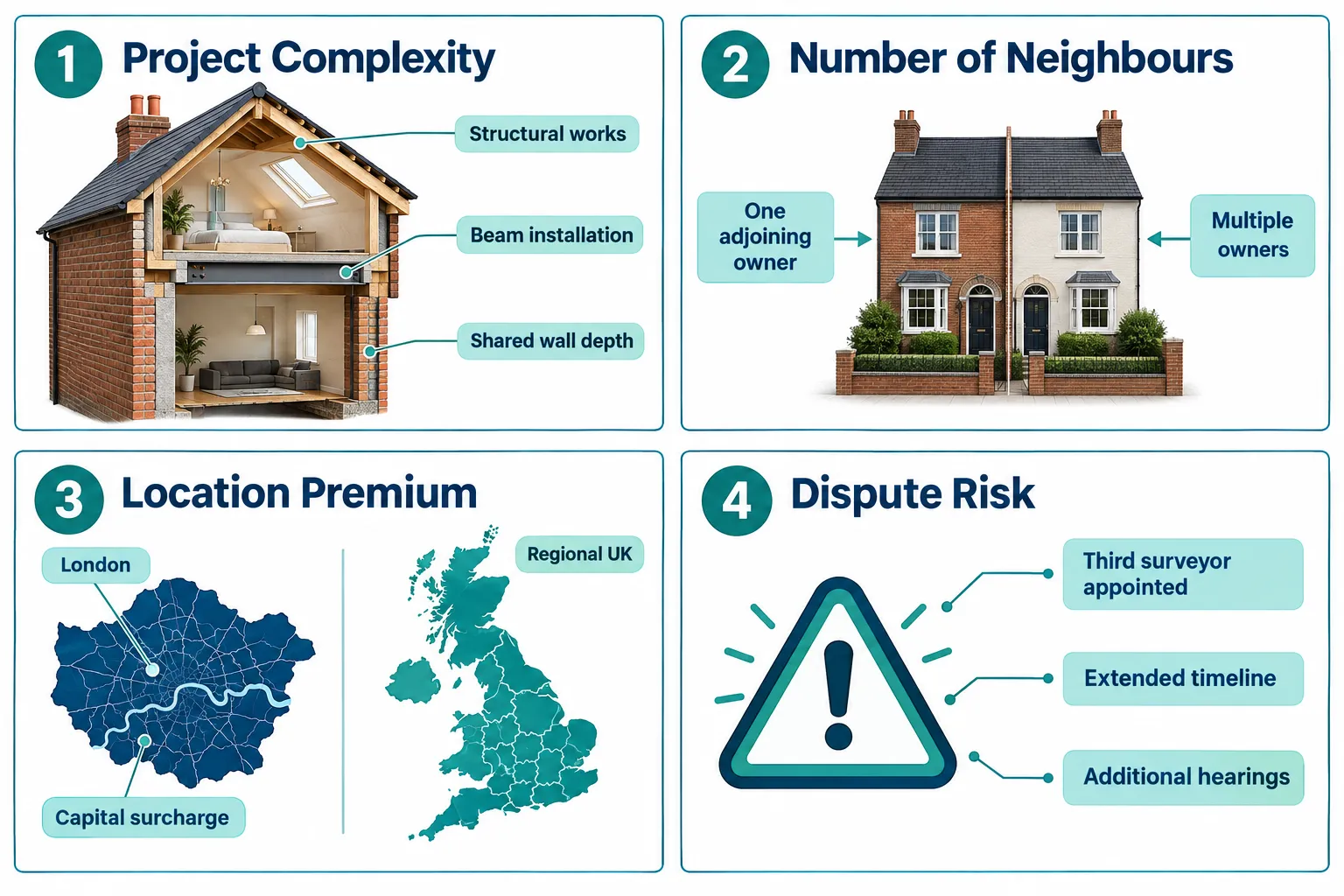
Several core factors determine where a quote lands on the spectrum.
Project Complexity
A simple single-storey rear extension touching a shared fence line is a very different proposition from a basement excavation beneath a shared party wall. More complex structural works require more detailed inspection, longer award documents, and often multiple site visits. Projects involving steel beam installation, underpinning, or significant excavation near the boundary attract higher fees across the board [7].
Common project types and their typical fee ranges in 2026 include:
| Project Type | Typical Fee Range (London) | Typical Fee Range (Regions) |
|---|---|---|
| Rear extension (single-storey) | £1,200, £2,000 | £700, £1,200 |
| Loft conversion | £1,500, £2,500 | £900, £1,500 |
| Basement/excavation | £2,500, £5,000+ | £1,500, £3,000 |
| Chimney removal | £800, £1,500 | £600, £1,000 |
| New build/larger development | £3,000, £8,000+ | £2,000, £5,000+ |
Sources: [1][6][7]
For loft conversions specifically, the works almost always engage the party wall directly, see the detailed guidance on party wall matters for loft conversions for what the surveyor will need to assess.
Number of Adjoining Owners
Every adjoining owner who dissents to a party wall notice triggers a separate surveyor appointment. A mid-terrace property with neighbours on both sides could generate two separate awards, two separate schedules of condition, and, in a worst case, two separate sets of surveyor fees. Each adjoining owner's surveyor fees are generally payable by the building owner [5].
Location: The London Premium
London commands a consistent premium over the rest of the UK. Surveyors in the capital typically charge hourly rates of £150,£250, compared with £90,£150 in most regional markets [6][7]. On a typical loft conversion, this differential alone can add £600,£1,000 to the total bill. The premium reflects higher overheads, travel time, and demand rather than any difference in the legal work itself [9].
Surveyor Experience and Firm Type
A sole practitioner with 20 years of party wall experience may charge more per hour than a larger firm using junior staff. Conversely, some specialist firms charge premium rates for brand recognition. Neither model is inherently better value, the key metric is the total cost for a fully scoped engagement, not the headline hourly rate.
Appointment Structures and Their Cost Impact
How the surveyors are appointed has a direct and often underestimated effect on total fees. There are three possible structures under the Act.
The Agreed Surveyor: The Most Cost-Effective Route
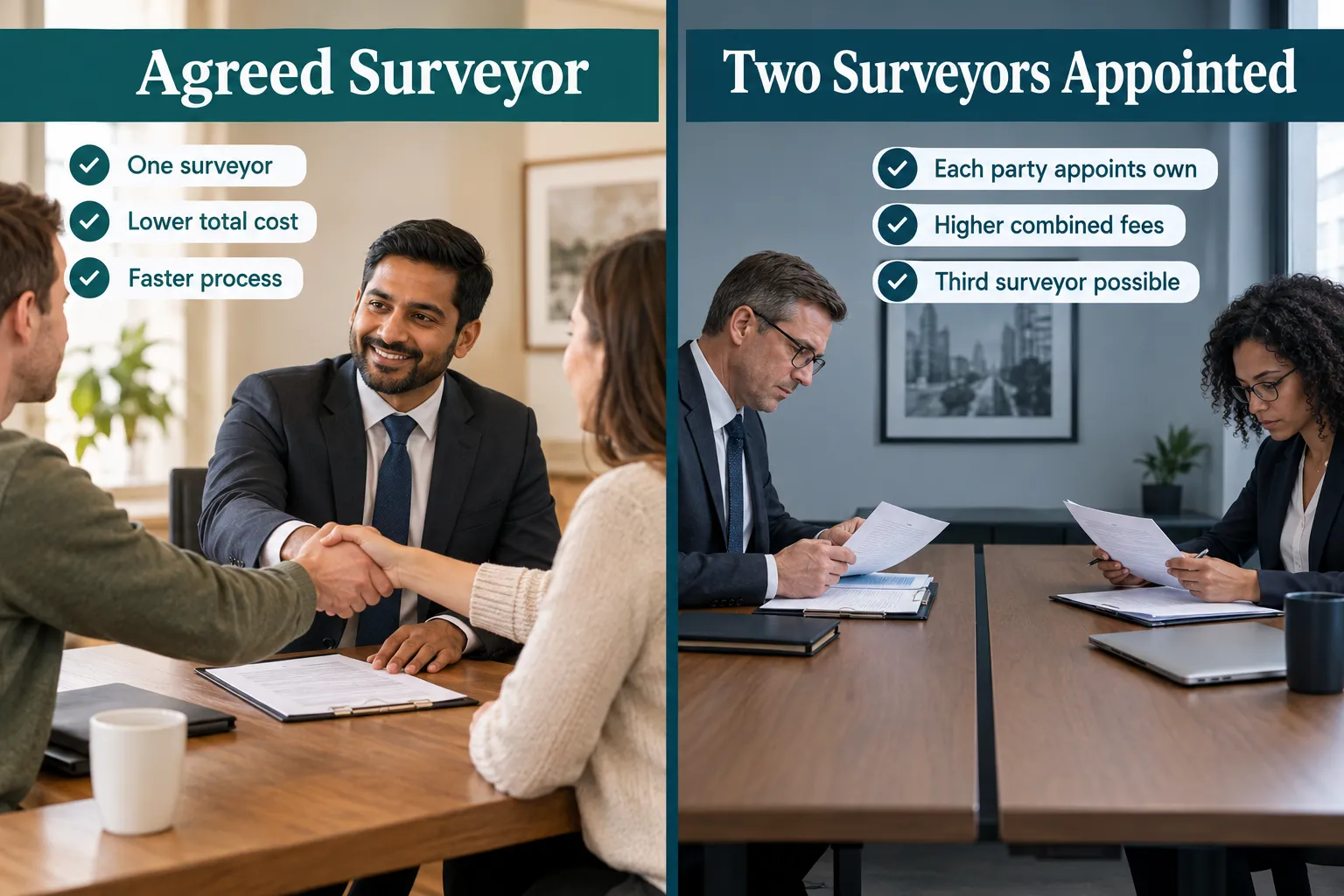
An agreed surveyor is a single professional appointed jointly by both the building owner and the adjoining owner to act impartially for both parties. Because only one surveyor is involved, the total fee is typically 30-50% lower than the two-surveyor route [8].
In 2026, an agreed surveyor for a standard rear extension in London typically charges £900,£1,600 all-in, compared with £1,800,£3,000 or more when each party appoints their own surveyor [6][7]. For a full breakdown of how this process works, the complete guide to streamlining party wall procedures with an agreed surveyor covers the mechanics in detail.
"The agreed surveyor route is the most underused cost-saving tool available to building owners. Many homeowners assume they need separate surveyors, they do not." [8]
Two Surveyors: Each Party Appoints Their Own
When the adjoining owner dissents and appoints their own surveyor, the building owner must pay both sets of fees. The adjoining owner's surveyor has no incentive to keep fees low, and some surveyors charge at the higher end of the market knowing the building owner will foot the bill. Hourly rates in London for this route can reach £200,£250 per hour, and complex awards may take 10-15 hours of professional time to complete [5][7].
The Third Surveyor
If the two appointed surveyors cannot agree, either party can call in a third surveyor, selected at the outset and named in the award. The third surveyor adjudicates the dispute. Their fees are also generally payable by the building owner, and third surveyor interventions can add £1,500,£4,000 or more to the total cost [1][5]. For more on how disputes escalate and what rights are involved, see the guide to party wall disputes, resolution, costs and your rights.
The Line Items Most Quotes Leave Out
A headline quote from a party wall surveyor rarely represents the full cost. Several additional services are standard parts of the process but are often quoted separately, or not mentioned at all until the invoice arrives.
Party Wall Notices
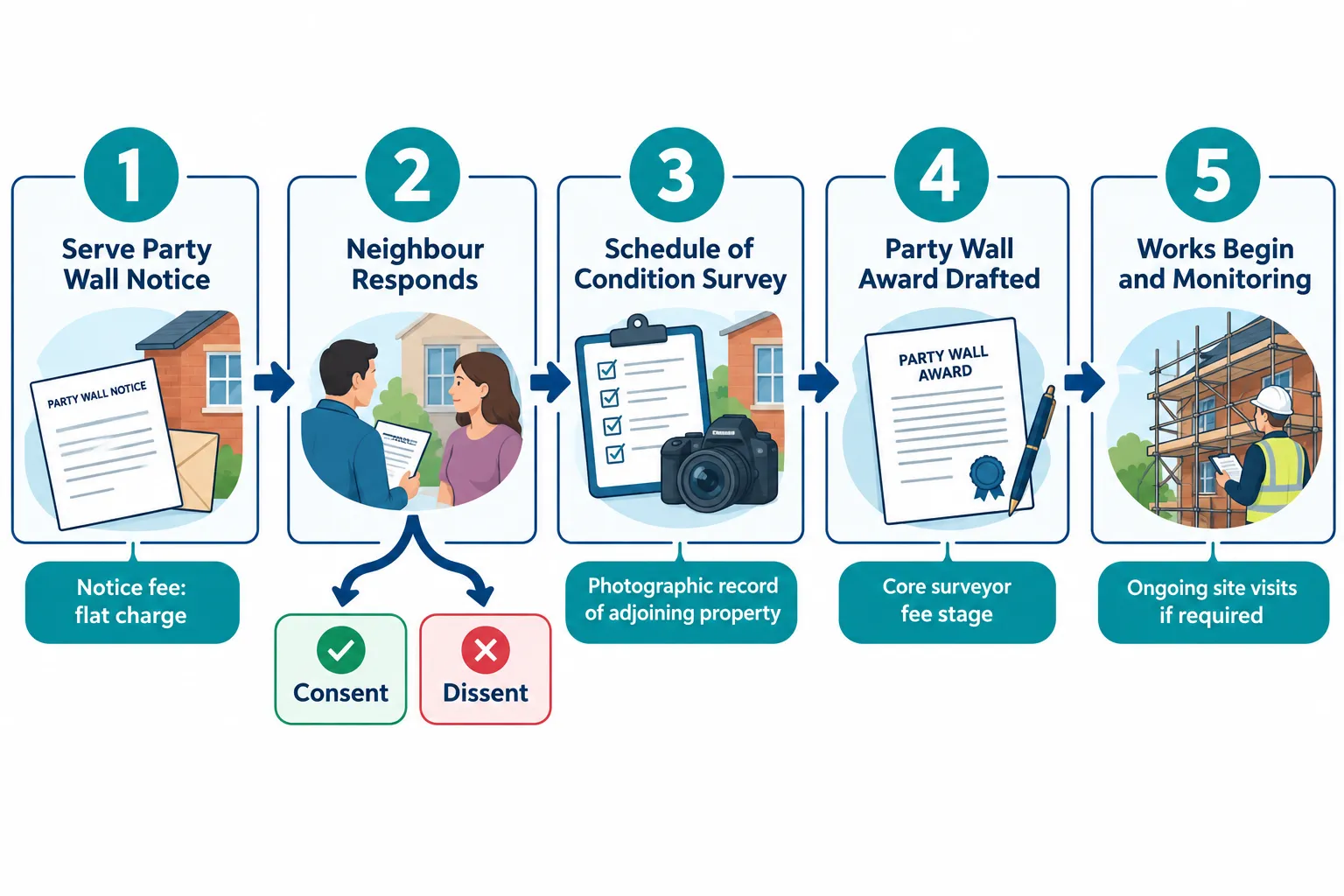
Serving the correct notice is the first legal step. Some surveyors include notice preparation in their overall fee; others charge separately, typically £150,£350 per notice [2][3]. Where multiple notices are required, for example, a line of junction notice and a party structure notice, costs compound. If a neighbour has already started work without serving notice, the situation becomes more complex; the page on what to do if a neighbour is carrying out party wall work on your boundary explains the options.
Schedule of Condition
A schedule of condition is a photographic and written record of the adjoining property's condition before works begin. It is the primary evidence used to assess any damage claims after the project. Most surveyors charge £300,£600 for a standard schedule of condition on a residential property, rising to £800,£1,500 for larger or more complex properties [4][6].
This is not an optional extra, it protects both parties. More detail on what this document covers and why it matters is available on the party wall schedule of condition page.
Monitoring Visits During Construction
For complex projects, particularly basement excavations and projects with significant structural risk, the surveyor may need to attend site periodically to check that works comply with the award. Each visit is typically charged at £200,£400 in London, and a long project may require four to eight visits [7]. This cost is rarely included in an initial quote and can add £800,£3,000 to the final bill.
Award Amendments
If the scope of works changes during the project, the party wall award may need to be amended. Each amendment typically attracts an additional fee of £300,£800 [7]. Keeping the original scope as stable as possible is one of the most effective ways to control total party wall costs.
Hourly Rates and How to Use Them
Most party wall surveyors charge on a time basis rather than a fixed fee, which means understanding hourly rates is essential for evaluating quotes.
2026 hourly rate benchmarks:
- London specialist surveyors: £150,£250 per hour [5][7]
- Regional surveyors (England and Wales): £90,£150 per hour [6]
- Junior or associate surveyors: £80,£120 per hour [2]
A standard party wall award for a residential project takes approximately 6-12 hours of professional time, covering site inspection, schedule of condition, award drafting, correspondence, and file management [4][7]. At London rates, this translates to a fee range of £900,£3,000 before disbursements.
Practical budgeting rules of thumb for 2026:
- Simple project, one neighbour, agreed surveyor, regional: budget £700,£1,200
- Simple project, one neighbour, agreed surveyor, London: budget £1,200,£2,000
- Two surveyors appointed, London: budget £2,000,£4,000
- Complex project (basement/excavation), London, two surveyors: budget £4,000,£8,000+
Sources: [1][6][7][9]
Fees Rising: The 2026 Market Context
Party wall surveyor fees have increased materially since 2020. Inflation in the construction sector, rising professional indemnity insurance premiums, and increased demand for party wall services, driven by a surge in home renovation activity, have all pushed costs upward [5][7].
Between 2020 and 2026, average party wall surveyor fees in London rose by an estimated 25-35%, broadly in line with wider construction cost inflation [7][10]. Regional fees have seen similar proportional increases, though from a lower base. There is no indication that fees will stabilise in the near term; anyone budgeting for a project in late 2026 or 2027 should factor in continued upward pressure.
The Party Wall Act 1996 explained provides the legal framework within which all these fees operate, understanding the Act helps building owners challenge unreasonable charges with confidence.
How to Compare Quotes and Avoid Scope Misunderstandings
Getting three quotes is standard advice, but comparing party wall surveyor quotes is only meaningful if they cover the same scope. When requesting quotes, ask each surveyor to confirm whether the following are included:
- Notice preparation and service (per notice, per neighbour)
- Schedule of condition (per adjoining property)
- Award drafting (including correspondence)
- Site visits during construction (number included, cost per additional visit)
- Award amendments (cost per amendment)
- Third surveyor selection (whether this is handled as part of the base fee)
A quote that appears 40% cheaper than a competitor may simply exclude the schedule of condition and monitoring visits, items that will inevitably be charged once the project is underway.
Red flags when reviewing quotes:
- No mention of the schedule of condition
- Hourly rate quoted without an estimate of total hours
- No clarity on what triggers additional charges
- No mention of the adjoining owner's surveyor fees
For projects where the scope is genuinely uncertain, for example, where a neighbour's response is unpredictable, ask for a worst-case estimate as well as a base case. The difference between a cooperative neighbour and a dissenting one can easily double the total cost [1][5].
If a neighbour refuses to engage with the process at all, the implications are significant; the page on whether a neighbour can refuse a party wall agreement sets out what the Act allows in those circumstances.
Conclusion
Party wall surveyor fees in 2026 are higher than they have ever been, less predictable than most homeowners expect, and almost entirely within the building owner's financial responsibility. The good news is that informed preparation significantly reduces both the cost and the risk of surprises.
Actionable next steps:
- Confirm whether the Party Wall Act applies to the planned works before instructing anyone. The do I need a party wall agreement guide is a reliable starting point.
- Approach the neighbour early and discuss the agreed surveyor route. A cooperative neighbour who accepts a joint appointment can cut total fees by 30-50%.
- Request fully scoped quotes that itemise notice fees, schedule of condition, monitoring visits, and amendment costs separately.
- Budget for the worst case, especially on complex projects or where neighbour relations are uncertain.
- Verify surveyor credentials, RICS membership or membership of the Faculty of Party Wall Surveyors provides a baseline of professional accountability.
Understanding the full picture of party wall surveyor fees in 2026, what changes the cost and what to expect to pay, is the single most effective way to keep a renovation project on budget and on schedule.
References
[1] Party Wall Surveyor Cost – checkatrade.com
[2] Party Wall Surveyor Cost Uk – bestbuilders.co.uk
[3] Party Wall Notices And Agreements Costs And Process – beamsrenovation.com
[4] Party Wall Surveyor Costs – harperlatterarchitects.co.uk
[5] Negotiating Party Wall Surveyor Fees Rics Scales And Strategies For Building Owners In 2026 – princesurveyors.co.uk
[6] Party Wall Surveyor Costs – princesurveyors.co.uk
[7] 2026 Party Wall Surveyor Fees Hourly Rates Project Benchmarks And Strategies To Avoid Overlooked Monitoring Costs – partywallsurveyorlondon.uk
[8] Party Wall Agreed Surveyor – princesurveyors.co.uk
[9] Party Wall Agreement London 2026 – mayfairstudio.co.uk
[10] How Much Does A Surveyor Cost Uk Fees By Service 2026 – princesurveyors.co.uk