Over 40% of adaptive reuse planning applications in England involve buildings constructed before 1920 — structures where shared walls, buried foundations, and centuries of informal alterations make party wall compliance not just a legal formality, but a genuine structural safety issue. As the 2026 housing market shows its first sustained signs of recovery after several years of stagnation, developers and property owners are returning to heritage conversion projects with renewed appetite. That revival brings a specific set of legal and technical challenges that demand expert attention.
Party Wall Surveys for Adaptive Reuse Projects: RICS Guidance on Heritage Conversions in 2026 Market Recovery sits at the intersection of property law, structural engineering, and heritage conservation — a niche that is growing rapidly in importance. This article breaks down what building owners, developers, and surveyors need to know about navigating the Party Wall etc. Act 1996 when repurposing period buildings, with reference to current RICS professional standards and the practical realities of 2026's recovering market.
Key Takeaways 📋
- Heritage conversions carry unique party wall risks — original construction methods, undocumented alterations, and fragile shared structures demand specialist survey approaches.
- A thorough schedule of condition is non-negotiable before any adaptive reuse work begins on a period building.
- RICS guidance in 2026 increasingly integrates technology such as 3D scanning and AI-assisted analysis into party wall assessments for complex heritage structures.
- Rising demand from the 2026 market recovery means faster project timelines — but cutting corners on party wall notices can result in costly disputes and injunctions.
- Early engagement with an agreed surveyor is the single most effective way to protect all parties in a heritage conversion project.
Why Heritage Conversions Are Driving Demand for Specialist Party Wall Surveys
The 2026 property market recovery has not been uniform. New-build activity remains constrained by planning delays and material costs, but adaptive reuse — converting redundant commercial, industrial, and institutional buildings into residential or mixed-use spaces — has surged. Former mills, Victorian schools, Edwardian warehouses, and Georgian townhouses are being reimagined across the country.
This trend is driven by two converging forces:
- Sustainability targets — Retrofitting existing structures produces significantly lower embodied carbon than demolition and rebuild.
- Housing demand — Local authorities are actively supporting heritage conversions as a fast route to increasing housing supply without greenfield development.
💡 "Adaptive reuse is not simply a planning trend — it is becoming the primary vehicle for urban housing delivery in the 2026 recovery cycle."
But these projects are structurally complex. Period buildings were rarely built with modern construction tolerances. Party walls in Victorian terraces, for example, may carry loads from multiple floors, contain original chimney stacks, and share foundations that were never formally documented. Understanding what constitutes a party wall dispute before work begins is essential for any developer entering this space.
Understanding the Legal Framework: Party Wall Act Obligations in Heritage Contexts
What the Party Wall etc. Act 1996 Requires
The Party Wall etc. Act 1996 applies to any work that affects a shared wall, boundary wall, or involves excavation near an adjoining owner's property. For adaptive reuse projects, the most commonly triggered provisions are:
| Section | Trigger | Typical Heritage Scenario |
|---|---|---|
| Section 1 | New wall on boundary | Adding extension to converted warehouse |
| Section 2 | Works to existing party wall | Cutting into Victorian shared wall for beams |
| Section 3 | Excavation within 3–6 metres | Underpinning or basement creation |
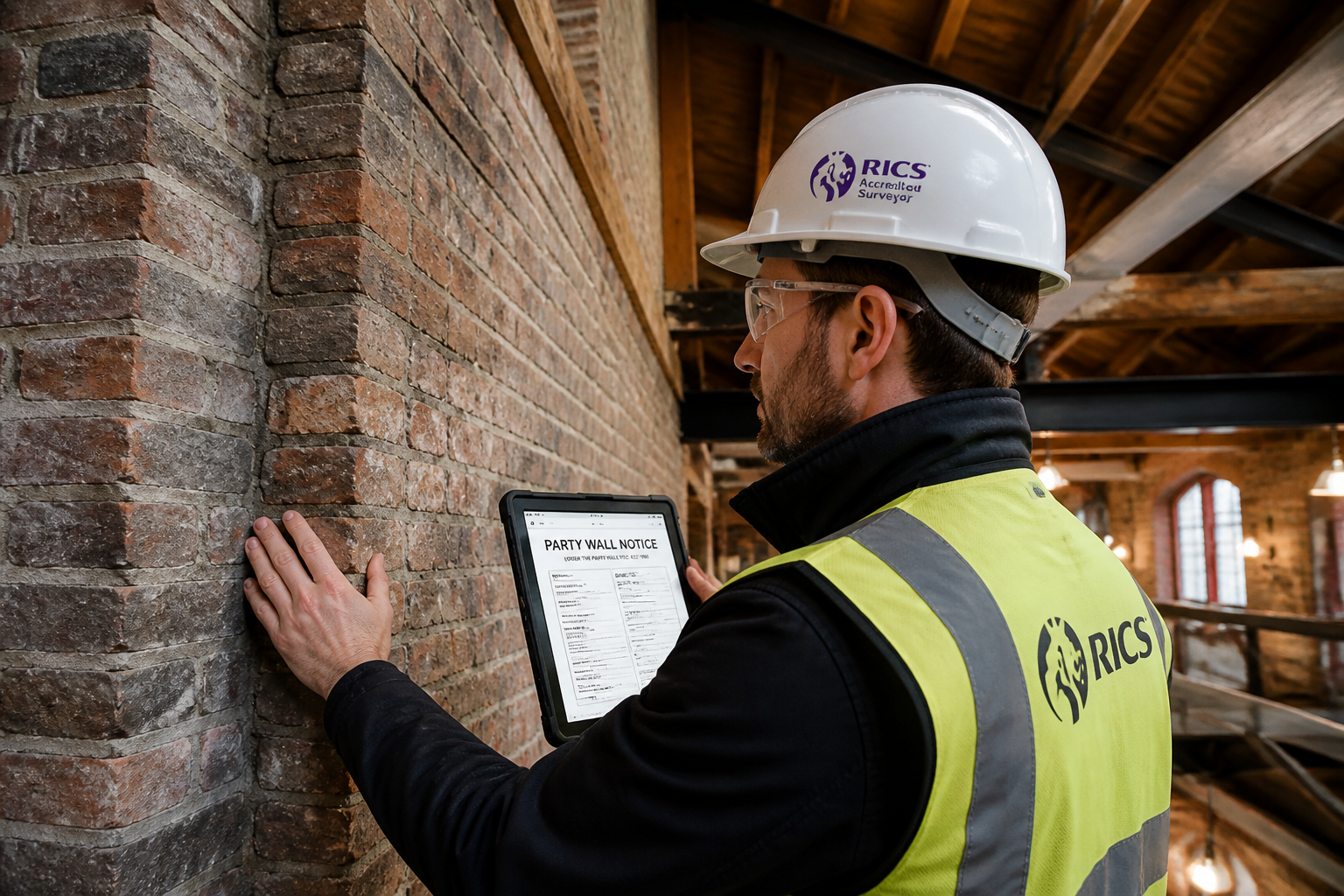
For heritage conversions, Section 2 is most frequently triggered — and most frequently underestimated. Cutting into a 200-year-old party wall to insert steel beams, remove chimney breasts, or install new floor joists can have consequences that ripple through to an adjoining property in ways that modern construction rarely does.
The legal requirements for party walls are clear: a valid party wall notice must be served before any notifiable work begins. For Section 2 works, this notice period is two months. For excavation under Section 6, it is one month. Failure to serve notice does not make the work illegal, but it removes the legal protections the Act provides and opens the building owner to injunctions and civil liability.
Serving Notice on Heritage Projects: Practical Complications
Heritage buildings often involve multiple adjoining owners — a converted terrace may share walls with three or four separate properties. Each must receive a separate notice. Where the adjoining property is itself listed or in a conservation area, the adjoining owner may have heightened concerns about vibration, dust, and structural movement — and is more likely to dissent.
When an adjoining owner dissents (or fails to respond within 14 days), a party wall agreement must be reached through the appointment of surveyors. This is not a setback — it is the mechanism through which all parties are protected.
Schedules of Condition: The Most Critical Document in Any Heritage Conversion
Why a Schedule of Condition Cannot Be Skipped
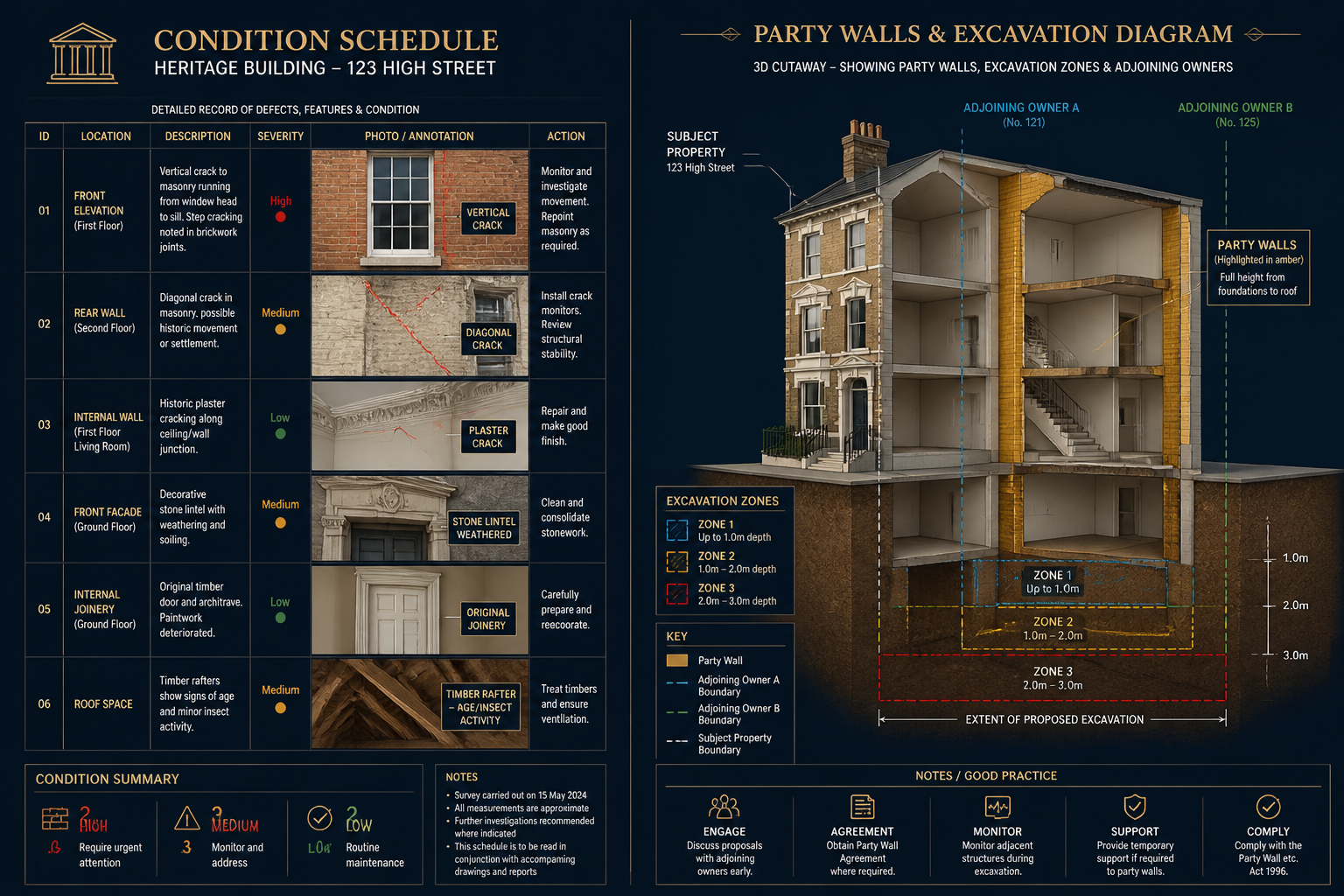
A party wall schedule of condition is a detailed photographic and written record of the adjoining property's condition before work begins. In standard new-build or extension projects, this document is important. In heritage conversions, it is absolutely essential.
Period buildings are more susceptible to:
- ✅ Pre-existing cracking from settlement
- ✅ Vibration sensitivity in lime mortar joints
- ✅ Fragile original plasterwork and cornicing
- ✅ Undocumented voids, cavities, and informal repairs
- ✅ Shared chimney stacks that may be structurally interdependent
Without a thorough schedule of condition, any crack or damage discovered after work begins becomes a disputed liability. The building owner may face claims for damage to property in party wall situations that are impossible to defend without baseline documentation.
What a Heritage-Specific Schedule Should Include
A schedule of condition for a heritage conversion should go beyond standard photographic records. Best practice in 2026 includes:
- Room-by-room photographic survey of all adjoining spaces, including cellars and roof voids
- Crack monitoring data — noting width, length, and direction of any pre-existing movement
- Chimney stack condition — particularly relevant where party wall shared chimneys are present
- Thermal imaging to identify hidden moisture or structural anomalies
- 3D laser scanning for complex geometries — increasingly standard in 2026 [1]
📌 A schedule of condition is not just protective paperwork — it is the evidentiary foundation for resolving any dispute that arises during or after a heritage conversion.
RICS Guidance on Party Wall Surveys for Adaptive Reuse Projects: RICS Guidance on Heritage Conversions in 2026 Market Recovery
The Evolving RICS Professional Standard
RICS does not publish a standalone practice note exclusively for party wall surveys in heritage conversions, but its broader guidance on party wall matters — combined with its heritage and conservation standards — creates a clear professional framework. In 2026, RICS has placed increasing emphasis on:
- Technology integration — AI and digital tools are now identified as critical skills for surveyors working on complex assessments [2]. For heritage party wall work, this means using point cloud scanning, drone surveys, and AI-assisted crack analysis to supplement traditional inspection methods.
- Proportionality — The award (the formal document produced by party wall surveyors) must be proportionate to the actual risk. For a heritage conversion, this typically means more detailed conditions and longer monitoring periods than a standard extension project.
- Conservation sensitivity — Surveyors working on listed buildings or conservation area properties must be familiar with the principles of minimal intervention and like-for-like repair.
The Role of the Agreed Surveyor in Heritage Projects
Where both the building owner and adjoining owner are willing, a single party wall agreed surveyor can act for both parties. This is often the most efficient route in heritage conversions, where the technical complexity benefits from a single expert with deep knowledge of period construction.
The agreed surveyor's role in a heritage context includes:
- Assessing the structural interaction between the proposed works and the existing party wall
- Determining appropriate conditions for vibration limits, working hours, and dust suppression
- Specifying remediation methods that are compatible with heritage fabric
- Setting out a monitoring regime for the duration of works
For projects involving excavation — such as basement creation beneath a Victorian terrace — the party wall excavation notice process adds an additional layer of complexity, particularly where foundations may be shared or undocumented.
Common Disputes in Heritage Conversions and How to Avoid Them
Party wall disputes in heritage conversion projects tend to cluster around three issues:
| Dispute Type | Common Cause | Prevention Strategy |
|---|---|---|
| Vibration damage claims | Mechanical demolition near fragile lime plaster | Specify hand tools; set vibration limits in award |
| Chimney instability | Removal of chimney breast without structural support | Engage structural engineer before notice served |
| Foundation interference | Underpinning affecting shared footings | Commission trial pits; agree monitoring protocol |
⚠️ The most expensive party wall disputes in heritage conversions are almost always the result of inadequate pre-work investigation — not the works themselves.
Technology and the 2026 Market Recovery: Transforming Heritage Party Wall Practice
Digital Tools Reshaping the Survey Process
The 2026 property market recovery has coincided with a significant shift in how surveyors approach complex building assessments. A technological revolution is transforming building survey methodology, particularly for non-standard constructions [1]. For heritage party wall work, the most impactful tools include:
- LiDAR and 3D laser scanning — Produces millimetre-accurate models of existing party walls, enabling precise assessment of structural geometry before and after works.
- Drone roof surveys — Particularly valuable for assessing party wall junctions at roof level in converted terraces and warehouse buildings.
- AI-assisted crack analysis — Emerging tools can classify crack patterns and predict propagation risk, supporting more defensible schedule of condition reports [2].
- Vibration monitoring sensors — Wireless sensors placed on party walls during construction provide real-time data, creating an objective record that protects both parties.
These tools do not replace the surveyor's professional judgement — they enhance it. RICS has been clear that AI adoption must be accompanied by appropriate professional oversight [2].
The Sustainability Dimension
Adaptive reuse is inherently more sustainable than demolition and rebuild. But heritage conversions also create specific sustainability challenges in the context of party wall work:
- Insulation upgrades — Retrofitting insulation to party walls in period buildings requires careful attention to moisture management. Poorly specified party wall insulation can cause condensation and interstitial moisture damage in historic fabric.
- Thermal bridging — Original party walls often create significant thermal bridges that must be addressed without compromising structural integrity.
- Breathability — Lime-based mortars and renders must be preserved or replicated to maintain the building's moisture management system.
The party wall award in a heritage conversion should explicitly address any insulation or thermal upgrade works to the shared wall, specifying materials and methods that are compatible with the existing construction.

Practical Steps for Building Owners and Developers in 2026
Navigating party wall surveys for adaptive reuse projects does not have to be overwhelming. A structured approach protects all parties and keeps projects on programme.
Step-by-Step Party Wall Process for Heritage Conversions
Step 1: Pre-application investigation 🔍
Commission a structural survey and review historic records before serving any notice. Understanding the existing party wall construction — thickness, materials, foundation type — shapes the entire notice and award process. A specific defect report on the party wall itself can be invaluable at this stage.
Step 2: Serve notice correctly and early 📬
Allow for the full statutory notice periods. For complex heritage projects, serve notice as early as possible — ideally 3–4 months before the planned start date to allow time for dissent, surveyor appointment, and award preparation.
Step 3: Commission a comprehensive schedule of condition 📷
This must cover all adjoining properties, not just the immediately adjacent one. In a terrace conversion, this may mean three or four separate schedules.
Step 4: Engage a surveyor with heritage experience 🏛️
Not all party wall surveyors have experience with listed buildings or conservation area properties. Seek a chartered surveyor with demonstrable heritage conversion experience.
Step 5: Build monitoring into the award 📊
Specify vibration limits, crack monitoring protocols, and reporting frequencies in the party wall award. This creates an objective framework for managing any issues that arise during construction.
Step 6: Maintain communication with adjoining owners 🤝
The Party Wall Act is a dispute prevention mechanism, not just a legal process. Regular updates to adjoining owners during works reduce the likelihood of formal complaints and disputes.
Conclusion: Acting Now in the 2026 Recovery Window
The convergence of market recovery, sustainability imperatives, and an ageing building stock means that adaptive reuse of heritage buildings will define a significant portion of the UK's property development activity through the remainder of the 2020s. For every one of these projects, party wall compliance is not optional — it is the legal and professional foundation on which successful conversions are built.
Party Wall Surveys for Adaptive Reuse Projects: RICS Guidance on Heritage Conversions in 2026 Market Recovery demands a level of technical expertise and procedural rigour that goes well beyond standard residential extension work. The stakes — structurally, legally, and financially — are higher. The buildings are more complex. The adjoining owners are often more concerned. And the consequences of getting it wrong are more severe.
Actionable Next Steps ✅
- If you are planning a heritage conversion — commission a structural investigation and seek specialist party wall advice before finalising your project programme.
- If you are an adjoining owner — understand your rights under the Act. You are entitled to appoint your own surveyor at the building owner's expense.
- If you are a surveyor — invest in CPD around heritage construction methods and emerging survey technologies. RICS is clear that these skills are increasingly critical [2].
- For all parties — engage early, document thoroughly, and treat the party wall process as a collaborative protection mechanism rather than an adversarial one.
The 2026 market recovery offers a genuine window of opportunity for heritage conversion projects. Protecting that opportunity means getting party wall compliance right from the very start.
References
[1] Technology For Early Property Insight In 2026 Building Surveys Reducing Delays In Complex Valuations – https://nottinghillsurveyors.com/blog/technology-for-early-property-insight-in-2026-building-surveys-reducing-delays-in-complex-valuations
[2] Modus By Rics January 2026 – https://www.rics.org/content/dam/ricsglobal/documents/to-be-sorted/MODUS-by-RICS-January-2026.pdf
[3] Party Wall Surveys For Mixed Use Developments Tackling Zoning And Neighbour Disputes In 2026 Urban Revivals – https://nottinghillsurveyors.com/blog/party-wall-surveys-for-mixed-use-developments-tackling-zoning-and-neighbour-disputes-in-2026-urban-revivals