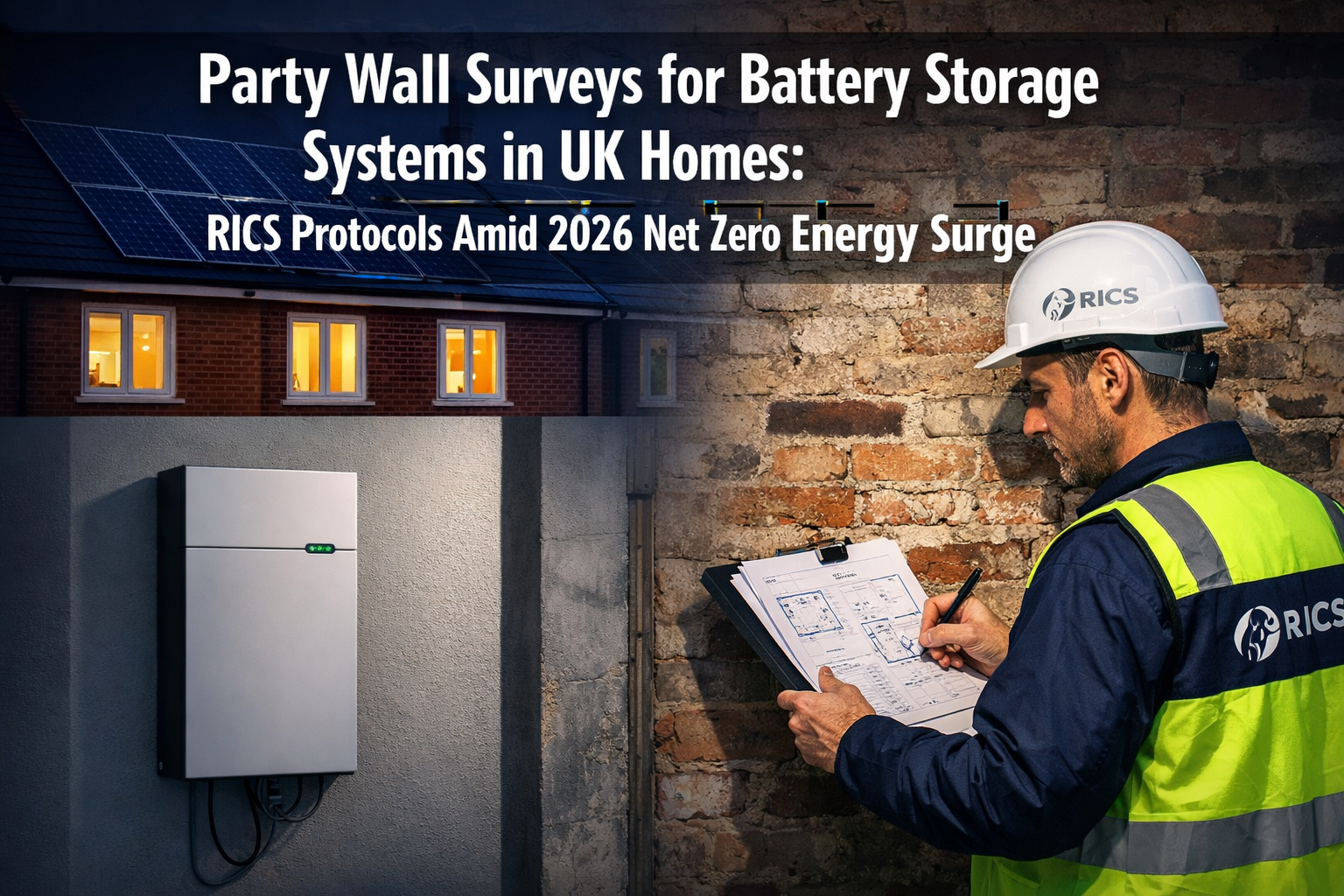

Over 300,000 UK households installed home battery storage systems in 2025 alone — and that number is accelerating sharply in 2026 as grid electricity costs remain volatile and solar adoption hits record levels. Yet a critical legal question is catching thousands of homeowners off guard: does mounting a battery storage system on or near a party wall trigger obligations under the Party Wall etc. Act 1996?
The answer, in many cases, is yes. Party Wall Surveys for Battery Storage Systems in UK Homes: RICS Protocols Amid 2026 Net Zero Energy Surge has become one of the most pressing compliance topics in UK residential property in 2026. As RICS updates its guidance framework [1] and the construction sector experiences a significant turnaround [3], surveyors, homeowners, and green energy installers must all understand where the Party Wall Act applies — and how to navigate it correctly.
Key Takeaways 📋
- Battery storage systems mounted on or adjacent to party walls can constitute notifiable works under the Party Wall etc. Act 1996, requiring formal notice to neighbours.
- RICS is actively updating its party wall practice guidance through a 2026 consultation on the 8th edition of Party Wall Legislation and Procedure [1].
- A Schedule of Condition report should be completed before any battery installation near a shared wall to protect both the building owner and the adjoining owner.
- Fire risk, structural loading, and cable penetrations are the three primary technical concerns surveyors must address in party wall awards for battery storage works.
- Failing to serve notice can expose homeowners to injunctions, disputes, and costly remediation — even for seemingly minor green energy retrofits.
Why Battery Storage Systems Are Now a Party Wall Issue
The Scale of the 2026 Net Zero Energy Surge
The UK construction industry is experiencing a major resurgence in 2026 [3], and home energy retrofits are at the heart of it. Government incentives, rising energy costs, and net zero commitments have combined to make home battery storage — typically paired with rooftop solar — one of the fastest-growing home improvement categories in the country.
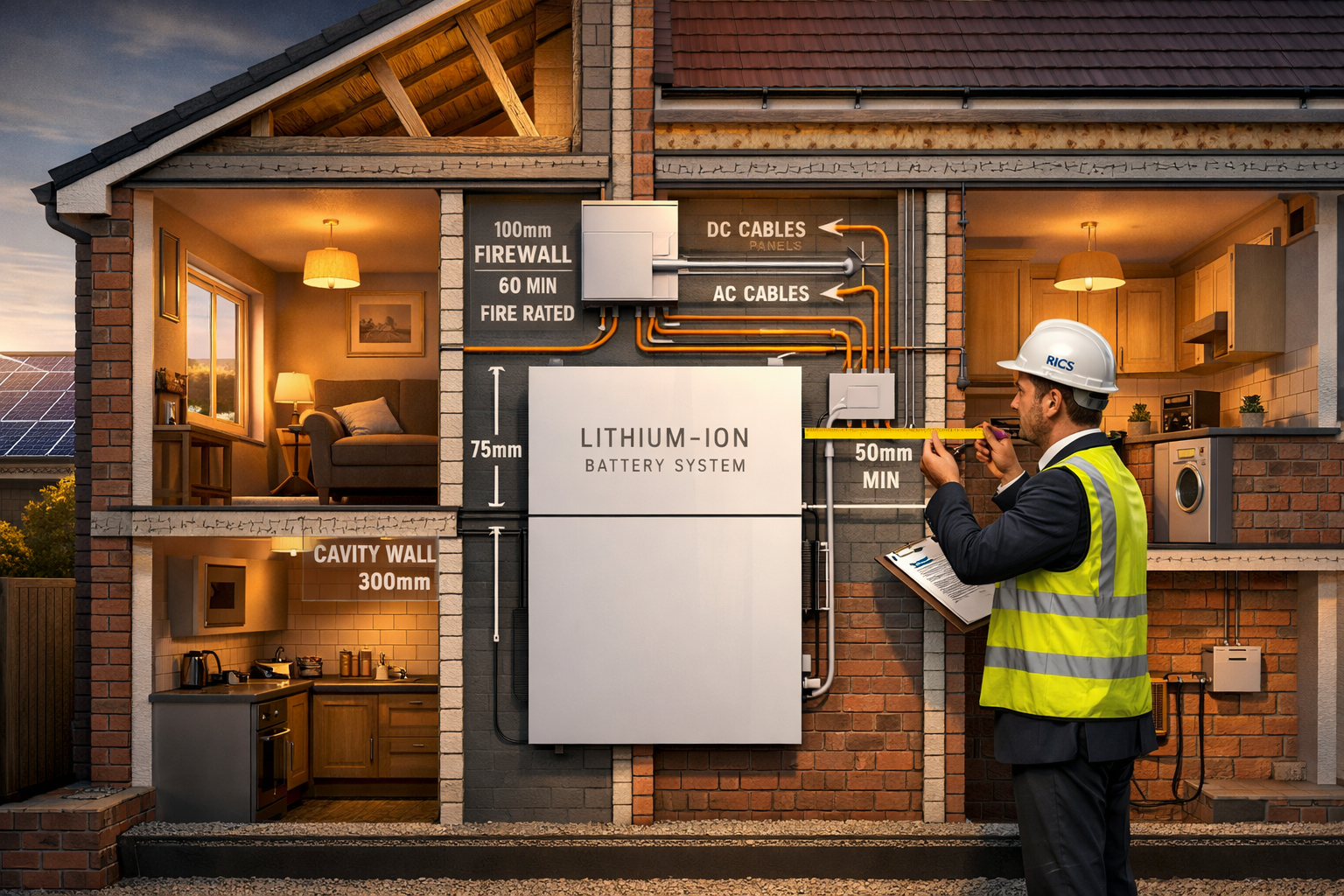
Most popular battery storage units, such as large wall-mounted lithium-ion systems, are:
- Heavy (often 100–200 kg when fully installed)
- Mounted directly onto structural walls, including party walls
- Accompanied by cable runs that may penetrate wall cavities
- Heat-generating, raising fire safety concerns in shared structures
In terraced and semi-detached housing — which accounts for the majority of UK housing stock — the wall chosen for battery installation is frequently the party wall shared with a neighbour. This is where the Party Wall etc. Act 1996 becomes directly relevant.
What the Party Wall Act Actually Covers
The Party Wall etc. Act 1996 was designed to regulate works that affect shared walls, boundaries, and excavations near adjoining properties. It applies when a building owner proposes to:
- Cut into a party wall (e.g., for cable penetrations or fixing brackets)
- Place a load on a party wall (e.g., heavy battery fixings into shared masonry)
- Carry out works within 3 or 6 metres of a neighbour's structure (relevant for external battery cabinets near foundations)
💡 Pull Quote: "A 150 kg battery system bolted into shared masonry is not a minor DIY job — it is a structural intervention with legal implications for both sides of the wall."
Understanding the Party Wall Act 3-metre rule is particularly important where battery systems are installed in garages, outbuildings, or extensions close to the boundary line.
RICS Protocols and the 2026 Guidance Update
The 8th Edition Consultation: What Surveyors Need to Know
RICS launched a formal consultation in April and May 2026 on the draft 8th edition of Party Wall Legislation and Procedure [1]. This update is the most significant revision to RICS party wall practice guidance in years, and it arrives at a critical moment — just as green energy retrofits are generating a new wave of party wall matters.
The consultation seeks input from:
- Chartered surveyors
- Legal professionals
- Property developers
- Adjoining owners and building owners
While the specific treatment of battery storage systems in the draft 8th edition has not been fully detailed in public summaries [1], the broader update is expected to sharpen guidance on non-traditional works — a category that clearly encompasses battery storage installations.
The RICS Building Surveying Conference, scheduled for 7 May 2026, includes sessions on party walls and dispute resolution [2], making it a key event for surveyors handling green retrofit cases.
📌 For the most current guidance, surveyors are advised to review the draft 8th edition consultation document directly from RICS and monitor outputs from the May 2026 conference [2].
RICS Sector Pathways and Competency for Battery Storage Cases
RICS sector pathways [4] set out the competency standards expected of chartered surveyors operating in the building surveying space. For party wall matters involving battery storage, relevant competencies include:
| Competency Area | Relevance to Battery Storage |
|---|---|
| Legal/regulatory compliance | Party Wall Act notice requirements |
| Building pathology | Structural loading and fire risk assessment |
| Construction technology | Understanding battery system specifications |
| Dispute resolution | Award drafting and neighbour negotiations |
Surveyors who are not familiar with battery storage technology should seek specialist input — particularly regarding thermal runaway risks and electrical installation standards — before drafting a party wall award.
Practical RICS-Compliant Steps for Battery Storage Party Wall Works
Step 1: Determine Whether Notice Is Required
Not every battery installation triggers the Party Wall Act. The key questions are:
- Is the battery being fixed directly to a party wall? If so, Section 2 of the Act (works to party walls) almost certainly applies.
- Does the installation involve cutting or chasing into the wall for cables or brackets? This is a notifiable act.
- Is the battery in an outbuilding or garage within 3 metres of the neighbour's structure? The Party Wall Act 3-metre rule and excavation provisions may apply.
If any of these conditions are met, the building owner must serve a Party Wall Notice on the adjoining owner before works begin.
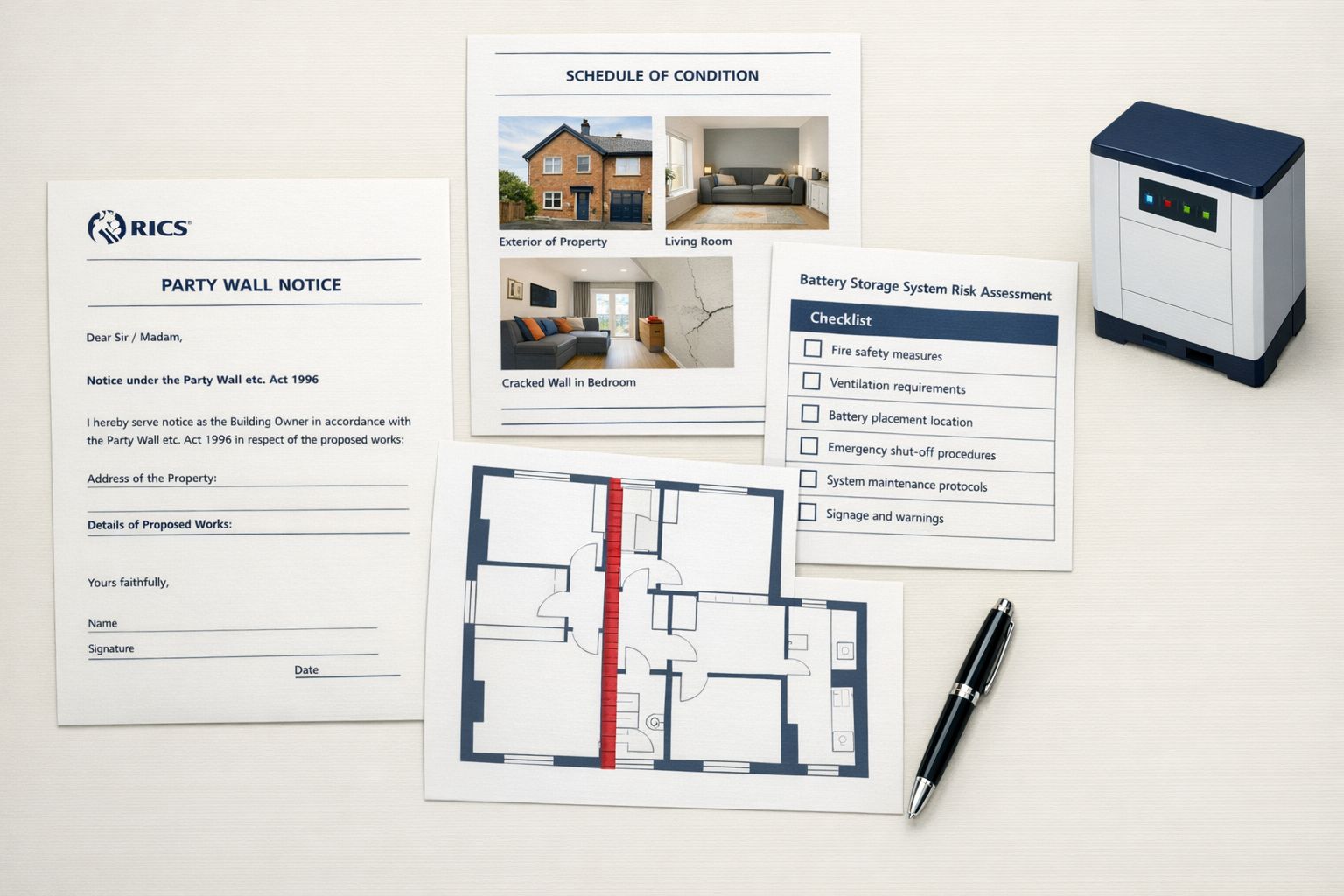
Step 2: Serve the Correct Notice
The type of notice depends on the nature of the works:
- Party Structure Notice — for works directly to the party wall (fixing, cutting, loading)
- Line of Junction Notice — if a new wall is being built at the boundary
- Three/Six Metre Notice — if excavation or groundworks are involved near the boundary
A notice must be served at least two months before works begin for party structure works. Homeowners who skip this step risk injunctions and neighbour disputes that can halt installation entirely.
Step 3: Complete a Schedule of Condition
Before any battery storage installation begins near a party wall, a Schedule of Condition report should be prepared. This document:
✅ Records the pre-works condition of the adjoining property
✅ Provides photographic evidence of existing cracks, damp, or damage
✅ Protects the building owner from spurious claims after installation
✅ Protects the adjoining owner by establishing a clear baseline
This step is not optional in good practice — it is essential. A Schedule of Condition commissioned by a RICS-registered surveyor carries significant weight in any subsequent dispute.
Step 4: Draft the Party Wall Award
If the adjoining owner dissents (or fails to respond within 14 days), surveyors must be appointed and a Party Wall Award must be drafted. For battery storage works, the award should specifically address:
🔥 Fire Risk Provisions
- Minimum clearances from combustible materials
- Requirement for fire-rated wall penetrations where cables pass through
- Reference to relevant British Standards (BS EN 62619 for battery safety)
⚖️ Structural Loading
- Confirmation that the party wall can bear the additional load
- Specification of approved fixing methods and anchor types
- Requirement for a structural engineer's sign-off where loads are significant
🔌 Cable Penetrations
- Details of how and where cables will pass through or along the wall
- Requirement for fire stopping at all penetrations
- Restrictions on chasing depth to protect structural integrity
🏠 Access and Remediation
- Rights of access for inspection during and after installation
- Obligations to make good any damage to the adjoining property
- Insurance requirements for the installation contractor
For complex cases — particularly in loft conversions or where battery systems are being installed alongside broader renovation works — the award may need to address multiple interacting works simultaneously.
Step 5: Obtain Consent or Proceed via Award
If the adjoining owner consents in writing to the works, the process is straightforward. Understanding party wall consent and what it legally means is important for both parties. Consent does not waive the neighbour's right to compensation if damage occurs — it simply allows works to proceed without a formal award.
Where an agreed surveyor is acceptable to both parties, this can significantly reduce costs and timescales compared to appointing two separate surveyors.
Common Risks and How to Avoid Them
Risk 1: Assuming Permitted Development Means No Party Wall Obligation
Many battery storage installations fall within Permitted Development rights and do not require planning permission. However, Permitted Development and the Party Wall Act are entirely separate legal regimes. Planning permission being unnecessary does not remove the obligation to serve party wall notices.
This is one of the most common — and costly — misconceptions among homeowners and even some installers.
Risk 2: Underestimating Thermal Runaway Risk
Lithium-ion batteries carry a risk of thermal runaway — a chain reaction that can cause rapid overheating and fire. When a battery is mounted on a party wall, this risk extends to the adjoining property. A competent party wall surveyor must:
- Reference the battery manufacturer's installation specifications
- Ensure the award includes adequate fire separation requirements
- Consider whether the adjoining owner's insurer needs to be notified
Risk 3: Inadequate Notice Drafting
A poorly drafted Party Wall Notice that fails to accurately describe the works can be challenged and declared invalid. This restarts the notice period and delays the entire project. Notices for battery storage works should include:
- The make, model, and weight of the battery unit
- The proposed fixing method and wall type
- Details of any cable penetrations or chasing
- The proposed installation date range

The 2026 Landscape: What's Driving Demand
The UK construction sector's 2026 resurgence [3] is being partly driven by green energy retrofits, and this is creating a surge in party wall matters that many surveying practices were not fully prepared for. Key drivers include:
- Government net zero targets pushing households toward solar-plus-storage systems
- Grid resilience concerns following high-profile energy supply events
- Falling battery costs making home storage economically viable for a wider market
- Energy bill pressures incentivising households to store cheap off-peak electricity
For surveyors in high-density urban areas — particularly across London and the South East where terraced housing dominates — the volume of battery storage-related party wall enquiries is growing rapidly. Surveyors operating across London and Surrey are already seeing this trend in their caseloads.
A Note on Leasehold Properties
Leaseholders face an additional layer of complexity. Installing a battery storage system may require landlord consent under the lease, in addition to party wall compliance. A Licence to Alter may be required from the freeholder before any works affecting the structure can proceed. Leaseholders should always check their lease terms before commissioning an installation.
Conclusion: Actionable Next Steps for Homeowners and Surveyors
Party Wall Surveys for Battery Storage Systems in UK Homes: RICS Protocols Amid 2026 Net Zero Energy Surge is not a niche concern — it is a mainstream compliance issue that will affect hundreds of thousands of UK households over the coming years. The 2026 net zero energy surge is real, the legal obligations are clear, and the consequences of getting it wrong are significant.
✅ For Homeowners Planning a Battery Storage Installation:
- Before booking an installer, check whether the proposed location involves a party wall.
- Engage a RICS-registered party wall surveyor early — ideally before signing any installation contract.
- Allow adequate time for the notice period (minimum two months for party structure works).
- Commission a Schedule of Condition to protect yourself before works begin.
- Check your lease if you are a leaseholder — a Licence to Alter may also be required.
✅ For Surveyors Handling Battery Storage Cases:
- Familiarise yourself with the RICS 8th edition consultation [1] and monitor outputs from the May 2026 Building Surveying Conference [2].
- Build technical knowledge of battery storage systems, including fire safety standards and structural loading characteristics.
- Draft awards with specific provisions for thermal runaway risk, cable penetrations, and structural loading — do not rely on generic award templates.
- Advise clients proactively that Permitted Development approval does not remove party wall obligations.
The intersection of green energy policy and property law is only going to grow more complex. Surveyors who develop expertise in this area now will be well-positioned to serve the growing demand — and to protect both their clients and the adjoining owners who share their walls.
References
[1] RICS Launches Consultation On Updated Party Wall Practice Guidance – https://www.rics.org/news-insights/rics-launches-consultation-on-updated-party-wall-practice-guidance
[2] RICS Building Surveying Conference – https://www.rics.org/training-events/conferences/rics-building-surveying-conference
[3] Party Wall Surveys Amid 2026 Construction Boom Handling Disputes In High Demand UK Housing Markets – https://nottinghillsurveyors.com/blog/party-wall-surveys-amid-2026-construction-boom-handling-disputes-in-high-demand-uk-housing-markets
[4] Sector Pathways – https://www.rics.org/join-rics/sector-pathways