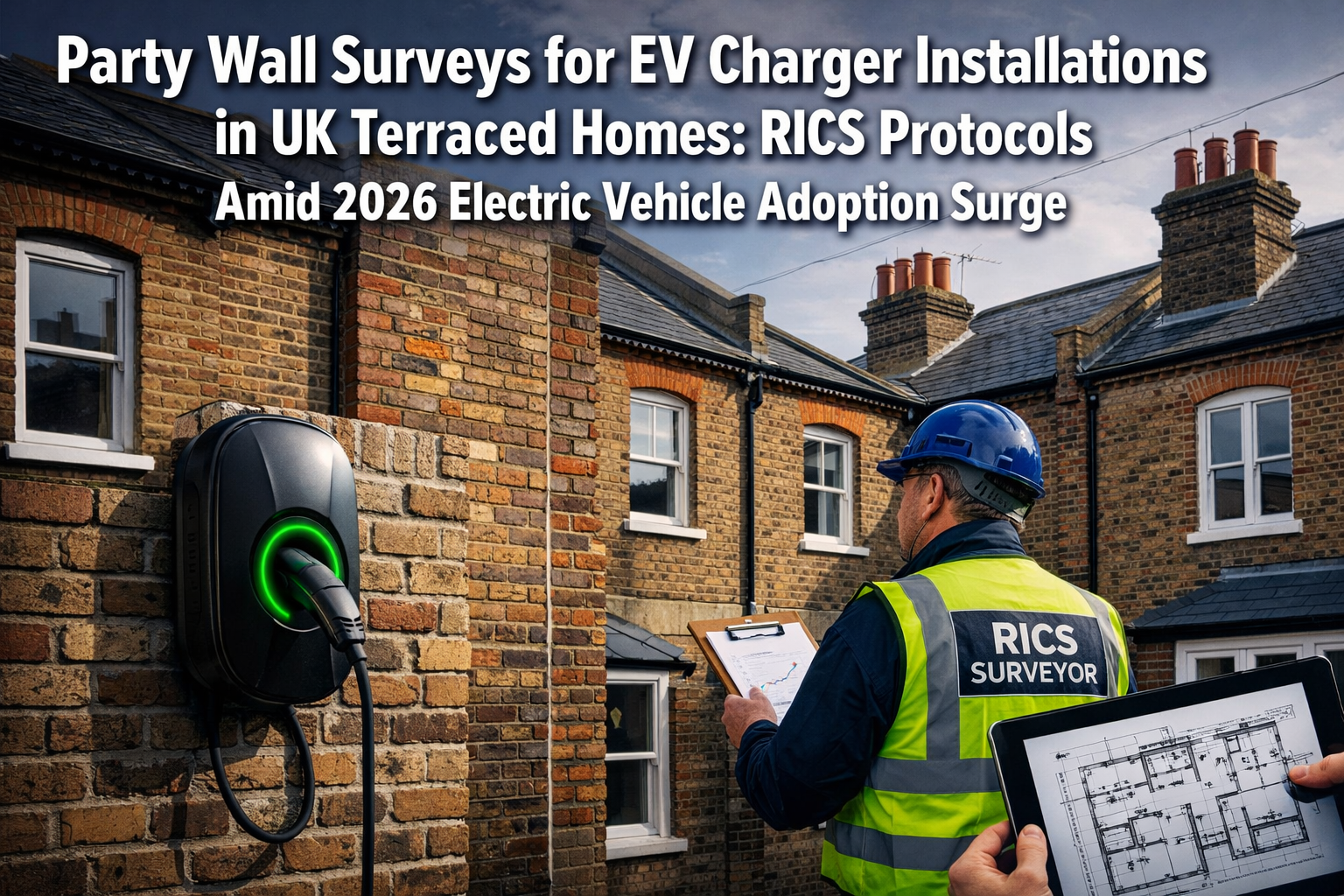
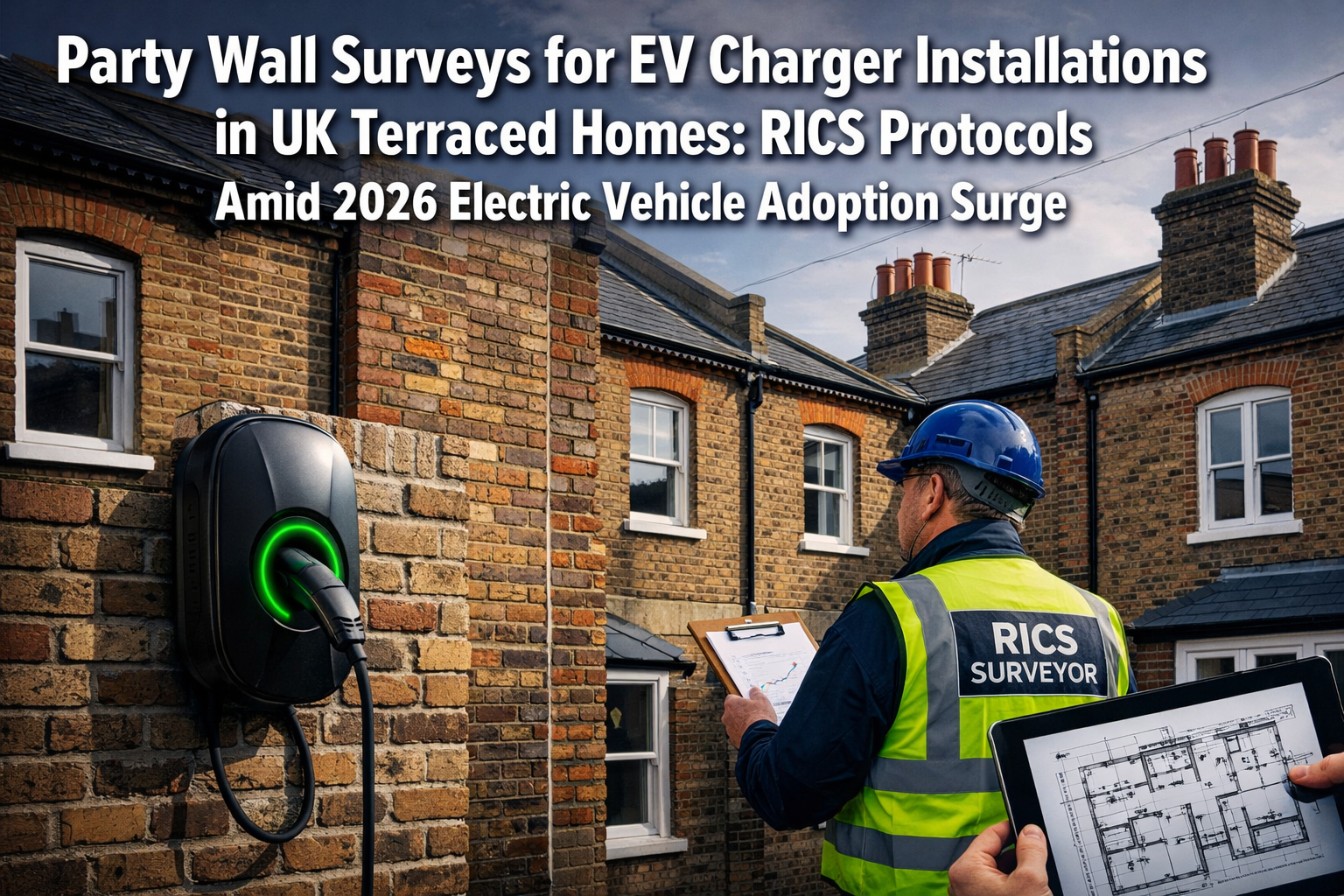
UK electric vehicle registrations surged by 43% in Q1 2026, with terraced homeowners now representing the fastest-growing segment of EV adopters[6]. This unprecedented shift has created a complex legal landscape where Party Wall Surveys for EV Charger Installations in UK Terraced Homes: RICS Protocols Amid 2026 Electric Vehicle Adoption Surge have become essential to prevent costly neighbour disputes and ensure regulatory compliance. As charging infrastructure retrofits require cable penetrations through shared walls, understanding party wall legislation has transformed from optional due diligence to mandatory risk management.
The collision between Victorian-era housing stock and modern electrification demands has placed chartered surveyors at the frontline of a technical and legal challenge. With over 3.2 million terraced properties in England lacking dedicated off-street parking, EV charger installations increasingly involve modifications to party walls—triggering statutory obligations under the Party Wall etc. Act 1996 that many homeowners remain unaware of until disputes arise.
Key Takeaways
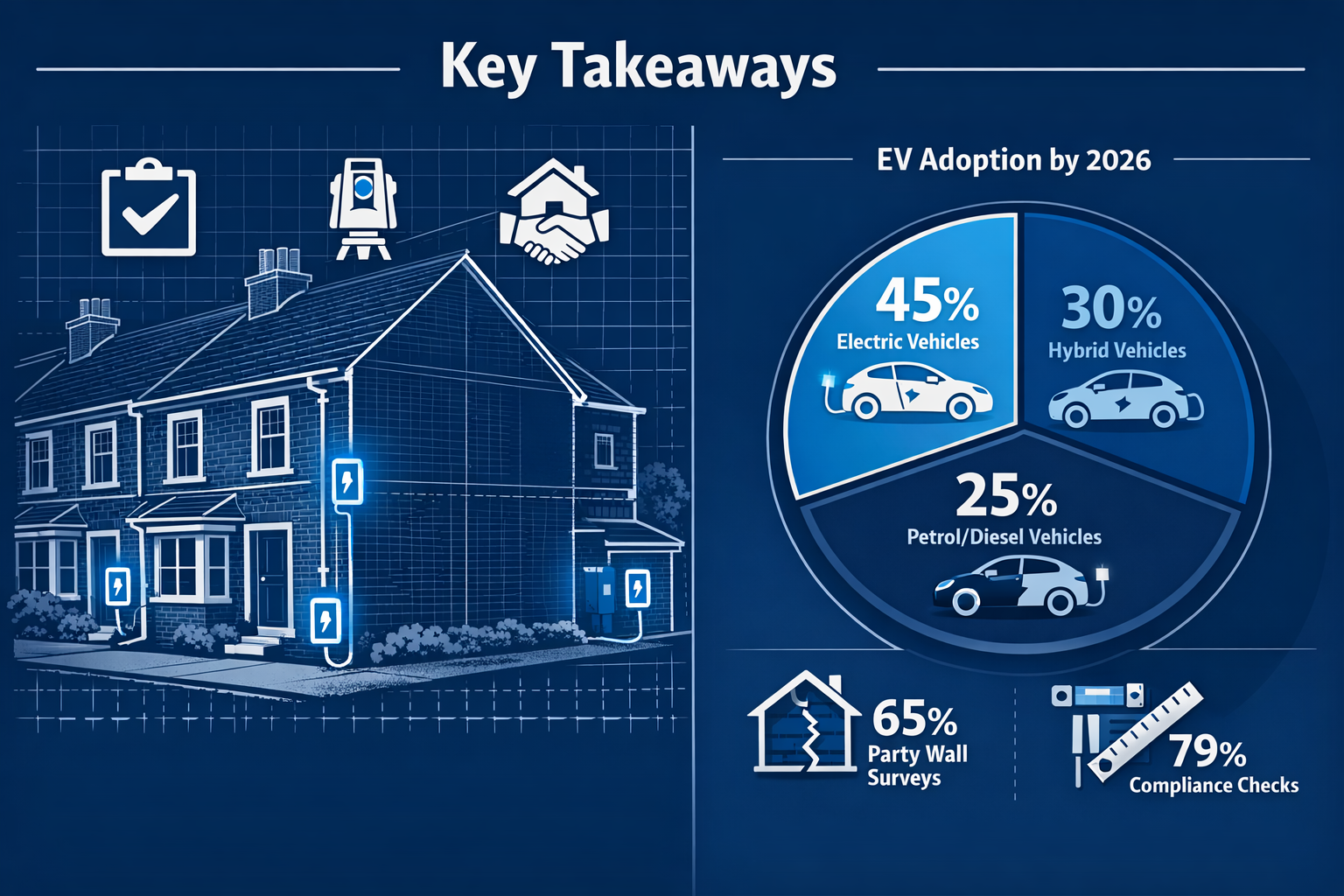
- Party Wall Act compliance is mandatory for EV charger installations involving cable penetrations through shared walls in terraced properties, requiring formal notices and potential surveyor appointments
- RICS protocols for 2026 emphasize pre-installation Schedule of Condition surveys to document existing defects and protect both building owners and adjoining owners from liability disputes
- Building Regulations Part S establishes technical standards for EV charging infrastructure, working alongside but separately from party wall legislation requirements[4]
- Defect risk assessments conducted by qualified surveyors identify structural vulnerabilities before cable routing, preventing expensive remediation and neighbour conflicts
- Award strategies that include detailed installation specifications, access provisions, and dispute resolution mechanisms reduce completion delays by an average of 6-8 weeks
Understanding Party Wall Legislation for EV Charger Installations
The Party Wall etc. Act 1996 governs building work affecting shared structures between properties. When installing EV chargers in terraced homes, the legislation becomes relevant the moment installation plans involve penetrating, cutting into, or affixing equipment to a party wall—the shared vertical structure separating adjoining properties.
When Does the Party Wall Act Apply to EV Chargers?
Three specific scenarios trigger party wall legislation requirements for EV installations:
Section 2(2)(a) – Cutting into party walls: Drilling through shared walls to route electrical cables from the consumer unit to an external charging point constitutes "cutting into" the party structure. This represents the most common trigger for terraced properties where the electrical supply must traverse the shared wall to reach the street-facing elevation.
Section 2(2)(e) – Cutting into party fence walls: For properties with shared boundary walls (party fence walls), mounting external cable conduits or support brackets requires formal notice, even if the penetration depth appears minimal.
Section 2(2)(m) – Reducing chimney stacks: While less common, some installations utilize redundant chimney structures for cable routing, which may involve reducing or modifying shared chimney stacks—a notifiable activity requiring surveyor oversight.
The Notice Period and Response Timeline
Building owners planning EV charger installations must serve formal Party Wall Notices to adjoining owners at least two months before work commences for Section 2 matters. This timeline frequently catches homeowners unprepared, particularly when they've already contracted electricians without understanding their statutory obligations.
The adjoining owner has 14 days to respond with either:
- ✅ Consent – Work proceeds without surveyor involvement
- ⚠️ Dissent or no response – Triggers the Party Wall Award process requiring surveyor appointment
- 📋 Counter-notice – Requests additional protective works at the building owner's expense
Failure to serve proper notice doesn't invalidate the work legally, but it exposes building owners to injunction applications and liability for any damage—whether caused by the installation or pre-existing.
RICS Protocols for Party Wall Surveys in Terraced Home EV Installations
The Royal Institution of Chartered Surveyors (RICS) has established professional standards that govern how Party Wall Surveys for EV Charger Installations in UK Terraced Homes should be conducted amid the 2026 adoption surge. These protocols balance technical rigour with practical implementation timelines.
Pre-Installation Schedule of Condition Requirements
RICS guidance emphasizes comprehensive Schedule of Condition documentation before any penetration work begins. This photographic and written record serves multiple purposes:
Baseline defect documentation: Surveyors catalogue existing cracks, settlement patterns, damp ingress points, and structural anomalies in both the building owner's and adjoining owner's properties. This evidence proves invaluable when post-installation disputes arise about causation.
Material condition assessment: The survey identifies wall construction types (solid brick, cavity wall, timber frame), insulation presence, and hidden services that could complicate cable routing. Victorian terraced properties frequently contain asbestos-containing materials in wall cavities—a critical discovery before drilling commences.
Photographic evidence protocols: RICS standards require time-stamped, geo-located photographs with measurement scales visible. Modern surveyors increasingly use 360-degree cameras and photogrammetry to create defensible records that withstand legal scrutiny.
Technical Assessment Components for EV Installations
Beyond standard party wall surveys, EV charger installations demand additional technical evaluations:
| Assessment Component | Purpose | RICS Requirement Level |
|---|---|---|
| Structural load analysis | Verify wall can support cable conduit and mounting brackets | Mandatory for Section 2(2)(e) works |
| Electrical service capacity | Confirm consumer unit rating supports 7kW+ charging | Recommended (Building Regs Part S)[4] |
| Moisture ingress risk | Assess penetration sealing requirements | Mandatory for external wall penetrations |
| Fire resistance continuity | Ensure cable penetrations maintain fire ratings | Mandatory per Building Regulations Part B |
| Thermal bridging evaluation | Prevent condensation at penetration points | Recommended for cavity wall installations |
The 2026 update to RICS Home Survey Standards now explicitly references EV charging infrastructure considerations, reflecting the profession's adaptation to market demands[5].
Surveyor Selection and Appointment Procedures
When adjoining owners dissent or fail to respond to Party Wall Notices, the Act requires surveyor appointment. Three appointment models exist:
Agreed Surveyor approach: Both parties jointly appoint a single party wall agreed surveyor who acts impartially. This reduces costs significantly—typically £800-£1,200 for straightforward EV installations versus £1,800-£2,500 for separate surveyors.
Separate surveyors with Third Surveyor: Each party appoints their own surveyor, who then jointly appoint a Third Surveyor to resolve any disputes. While more expensive, this provides maximum protection for complex installations involving structural concerns.
Building owner's surveyor selection: If the adjoining owner refuses to appoint a surveyor within 10 days of dissent, the building owner's surveyor can make the appointment on their behalf—though this creates potential conflict perception.
RICS members must maintain professional indemnity insurance covering party wall work, with minimum coverage of £250,000 for residential appointments. Verify surveyor credentials through the RICS Find a Surveyor directory before engagement.
Defect Risk Assessments and Award Strategies for 2026 EV Installations
The surge in Party Wall Surveys for EV Charger Installations in UK Terraced Homes during 2026 has revealed patterns of defect risks that surveyors must proactively address through comprehensive Award strategies. Understanding these risks transforms party wall procedures from bureaucratic compliance exercises into valuable risk mitigation tools.
Common Defect Risks in Terraced Property EV Installations
Chartered surveyors conducting pre-installation assessments consistently identify five critical risk categories:
1. Hidden service conflicts 🔌
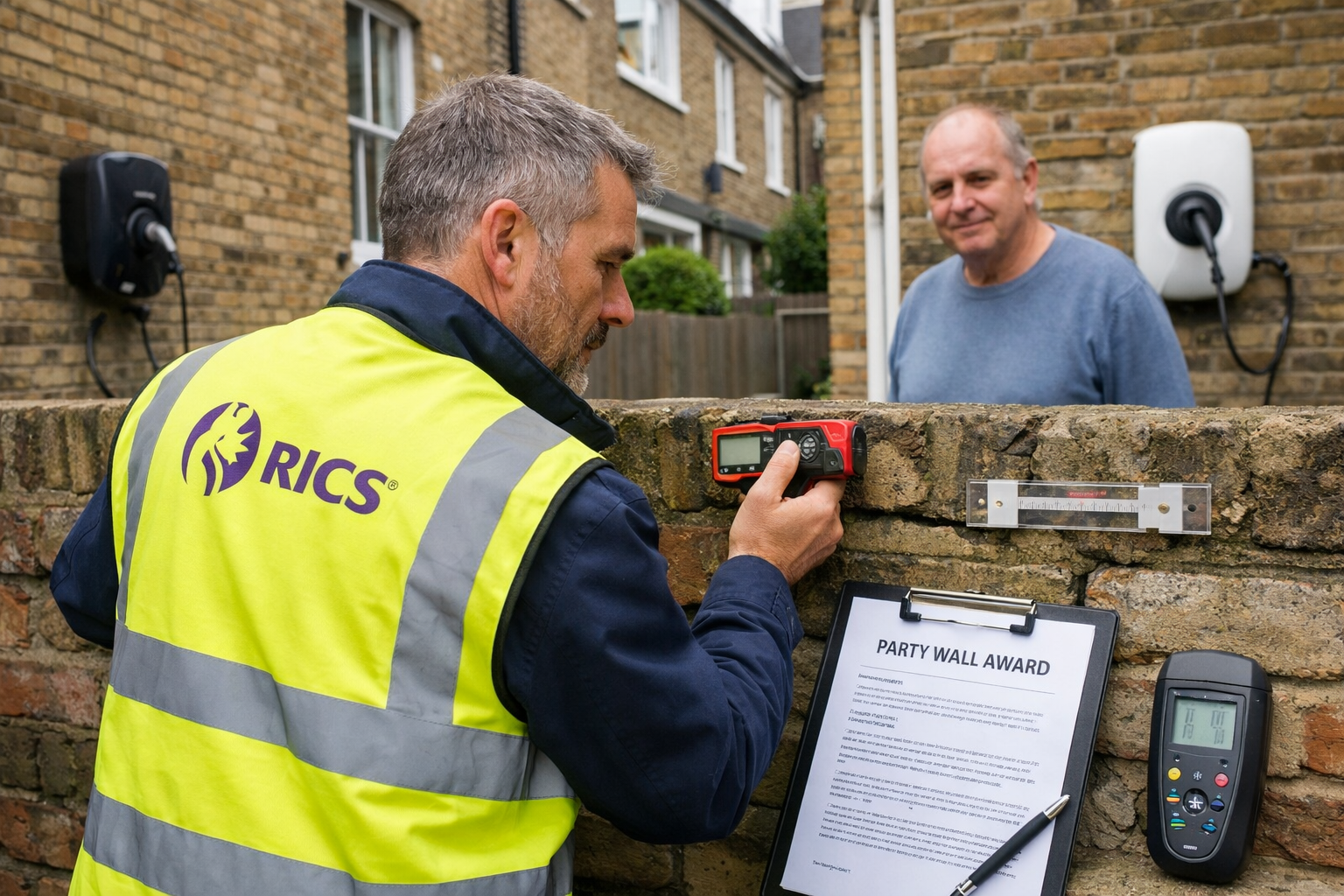
Victorian and Edwardian terraced properties frequently contain undocumented electrical cables, gas pipes, and water services within party walls. Penetrating these during cable routing creates immediate safety hazards and expensive emergency repairs. Thermal imaging surveys and cable detection equipment have become standard tools in the RICS surveyor's toolkit for 2026 installations.
2. Structural settlement differentials
Terraced properties often exhibit different settlement patterns due to varied foundation depths, soil conditions, or previous underpinning work. Drilling through party walls experiencing differential movement can propagate existing cracks or create new fracture lines. Surveyors must assess crack patterns, measure deviations from vertical, and recommend installation locations that avoid stress concentration zones.
3. Damp penetration pathways
Every wall penetration creates potential moisture ingress routes. Properties with existing damp issues—particularly those with failed damp-proof courses common in pre-1920 construction—face accelerated deterioration if cable entry points aren't properly sealed. Specific defect reports should identify damp risks before drilling proceeds.
4. Fire resistance compromise
Party walls in terraced properties provide critical fire compartmentation between dwellings. Cable penetrations must maintain the wall's fire resistance rating through proper fire-stopping materials and techniques. Building Control approval under Part B becomes essential alongside party wall compliance.
5. Thermal performance degradation
Poorly executed penetrations through insulated cavity walls create thermal bridges, leading to condensation, mould growth, and energy efficiency losses. This concern has intensified under Building Regulations Part S requirements for EV infrastructure[4].
Drafting Effective Party Wall Awards for EV Charger Work
The Party Wall Award represents the legal document governing installation work. RICS protocols for 2026 emphasize specific clauses that prevent disputes:
Detailed work specifications: Awards must describe cable routing precisely—not merely "install EV charger" but "drill 25mm diameter penetration at 1.2m above ground level, 450mm from party wall junction, install fire-rated cable gland, seal with intumescent mastic to maintain 60-minute fire rating."
Access provisions: Specify when and how the building owner's contractors can access adjoining property for inspection or remedial work. Typical provisions allow 48-hour notice for access during working hours (8am-6pm Monday-Friday).
Protective measures: Mandate dust suppression, vibration monitoring for sensitive installations, and temporary weatherproofing during multi-day installations. These provisions prevent party wall disputes from escalating.
Damage liability framework: Establish clear protocols for damage assessment, notification timelines (typically 7 days for visible damage, 12 months for latent defects), and repair standards. Awards should specify that repairs match existing materials and finishes.
Cost allocation: While building owners bear costs for their chosen works, Awards clarify responsibility for additional protective measures, surveyor fees (typically split or borne by building owner), and remedial work costs.
Managing Neighbour Relations During Installation
Technical compliance alone doesn't prevent disputes—communication strategies prove equally vital:
Pre-notice consultation: Before serving formal Party Wall Notices, discuss plans informally with neighbours. Explain the installation necessity, expected timeline, and noise/disruption mitigation measures. This courtesy frequently converts potential dissent into consent.
Progress updates: During installation, provide regular updates to adjoining owners. Photograph completed stages and share images demonstrating careful workmanship and site cleanliness.
Post-completion verification: Invite adjoining owners to inspect completed work alongside the party wall surveyor. This transparency builds confidence that the installation met Award specifications.
For properties where boundary disputes exist or neighbour relations are already strained, engaging experienced surveyors early prevents escalation into legal proceedings that delay installations by months.
Building Regulations Compliance Alongside Party Wall Requirements
Party Wall Surveys for EV Charger Installations in UK Terraced Homes: RICS Protocols Amid 2026 Electric Vehicle Adoption Surge must address dual regulatory frameworks—the Party Wall Act 1996 and Building Regulations 2010 (as amended). These operate independently but intersect at critical points.
Building Regulations Part S: EV Charging Infrastructure Standards
Introduced in June 2022 and refined through 2026 guidance updates, Part S establishes technical requirements for residential EV charging points[4]. Key provisions include:
- Minimum charging capacity: 7kW (32A) for new residential buildings and major renovations
- Smart charging capability: Installations must include connectivity for demand response and load management
- Cable management: Proper routing and protection to prevent trip hazards and weather damage
- Electrical safety: Compliance with BS 7671 wiring regulations and appropriate RCD protection
Part S compliance requires Building Control approval through either Local Authority Building Control or Approved Inspectors. This process runs parallel to party wall procedures—both must be satisfied before installation proceeds legally.
Planning Permission Simplification in 2025-2026
England's 2025 regulatory changes removed planning permission requirements for domestic EV chargers under 0.2 cubic meters positioned at least two meters from public highways[2]. This simplification eliminated one regulatory hurdle but doesn't affect party wall obligations—a common misconception among homeowners.
The planning exemption applies to the charging unit itself, not to associated works like wall penetrations or electrical upgrades that trigger party wall procedures. Surveyors must educate clients that "permitted development" for the charger doesn't mean "permission-free installation" when party walls are involved.
Coordinating Multiple Approval Pathways
Experienced surveyors coordinate three parallel approval streams:
- Party Wall Act compliance – Notice service, Award preparation, Schedule of Condition
- Building Regulations approval – Part S technical standards, Part B fire safety, Part P electrical work
- Distribution Network Operator (DNO) notification – Required for installations exceeding 3.68kW single-phase capacity
The critical path typically follows: Party Wall Notice (2-month minimum) → Building Control application (2-4 weeks) → DNO approval (up to 6 weeks) → Installation (1-2 days) → Post-work inspection and certification.
Government grant schemes for EV chargers in 2026 increasingly require evidence of comprehensive regulatory compliance, including Party Wall Awards where applicable[3]. This financial incentive drives homeowners toward proper procedures rather than informal installations that risk later enforcement action.
Cost Implications and Fee Structures for 2026
Understanding the financial dimensions of Party Wall Surveys for EV Charger Installations helps homeowners budget appropriately and avoid installation delays due to funding gaps.
Typical Party Wall Surveyor Costs
Party wall surveyor costs for EV charger installations in 2026 typically range:
- Agreed Surveyor (single appointment): £800-£1,200 for straightforward installations
- Separate surveyors: £1,200-£1,800 per surveyor (building owner pays both sets of reasonable fees)
- Schedule of Condition survey: £350-£600 per property depending on size and complexity
- Party Wall Award drafting: Included in surveyor fees above
- Dispute resolution (if Third Surveyor required): Additional £1,500-£3,000
These costs sit atop the physical installation expenses (£800-£1,500 for standard 7kW charger installation), making total project costs £2,000-£4,500 for terraced properties requiring party wall procedures.
Cost-Benefit Analysis of Proper Compliance
While party wall procedures add upfront costs, the risk-adjusted economics strongly favour compliance:
Avoided litigation costs: Neighbour disputes escalating to court proceedings typically cost £8,000-£25,000 in legal fees, far exceeding surveyor costs. Injunction applications to halt non-compliant work add further expense.
Insurance implications: Home insurance policies may exclude damage claims arising from non-compliant building work. A £15,000 structural repair bill following improper installation becomes uninsurable without proper Party Wall Awards.
Property transaction complications: Non-compliant EV installations create title defects that solicitors identify during property sales. Retrospective Party Wall Awards cost 40-60% more than proactive compliance and delay completions by 8-12 weeks.
Peace of mind value: Proper procedures documented through RICS surveyors provide legal defensibility and neighbour relationship preservation—intangible benefits with substantial long-term value.
Future Outlook: Party Wall Considerations in the EV Transition
The trajectory of Party Wall Surveys for EV Charger Installations in UK Terraced Homes: RICS Protocols Amid 2026 Electric Vehicle Adoption Surge suggests several emerging trends:
Standardized Award templates: RICS is developing model Party Wall Awards specifically for EV installations, reducing drafting time and costs while maintaining legal robustness. Expected release in Q3 2026 will streamline procedures significantly.
Technology integration: Digital party wall platforms enabling electronic notice service, online consent management, and cloud-based Schedule of Condition documentation are gaining adoption. These tools reduce administrative timelines by 30-40%.
Regulatory harmonization: Industry consultation suggests potential amendments to the Party Wall Act to create simplified procedures for low-risk works like EV charger installations—though legislative change timelines remain uncertain.
Professional specialization: A cohort of chartered surveyors is developing EV installation expertise, combining party wall knowledge with electrical engineering understanding. This specialization improves risk assessment accuracy and Award quality.
Neighbourhood charging schemes: Some terraced property areas are exploring communal charging infrastructure that serves multiple properties through single installations, potentially reducing individual party wall procedure requirements while creating new collective agreement frameworks.
The UK government's 2030 petrol and diesel vehicle sales ban (delayed from 2026 but still approaching) ensures EV charging infrastructure demand will intensify. Terraced homeowners and surveyors who master party wall procedures now position themselves advantageously for this inevitable transition[6].
Practical Steps for Homeowners and Surveyors
For Terraced Homeowners Planning EV Charger Installation
- Assess party wall implications early – Before contracting electricians, determine whether your preferred charger location requires party wall penetrations
- Engage RICS surveyors proactively – Consult chartered surveyors during planning stages, not after disputes arise
- Communicate with neighbours – Informal discussion before formal notices improves consent rates significantly
- Budget comprehensively – Include party wall surveyor fees, Building Control costs, and contingency for protective measures
- Document everything – Maintain records of notices served, responses received, and all correspondence
For RICS Surveyors Managing EV Installation Instructions
- Conduct thorough pre-instruction assessments – Identify all regulatory touchpoints (Party Wall Act, Building Regulations, DNO requirements)
- Educate clients on timelines – Set realistic expectations about 2-4 month total timelines from initial consultation to installation completion
- Coordinate with electrical contractors – Ensure installation specifications in Party Wall Awards match technical requirements
- Maintain professional indemnity coverage – Verify insurance adequately covers EV installation party wall work
- Stay current on regulatory updates – Monitor RICS guidance updates and Building Regulations amendments affecting EV infrastructure
Understanding party wall agreements and their application to modern infrastructure needs represents essential competency for surveyors operating in 2026's evolving built environment.
Conclusion
Party Wall Surveys for EV Charger Installations in UK Terraced Homes: RICS Protocols Amid 2026 Electric Vehicle Adoption Surge represent a critical intersection of Victorian-era property law and 21st-century electrification demands. As EV adoption accelerates—with registrations hitting record levels in early 2026—the technical and legal complexities of retrofitting charging infrastructure into dense urban housing stock require professional navigation.
The Party Wall etc. Act 1996 remains fully applicable to EV installations involving shared wall penetrations, with no simplified procedures yet established despite the technology's environmental importance. RICS protocols emphasizing comprehensive Schedule of Condition surveys, detailed Party Wall Awards, and proactive defect risk assessments provide the framework for compliant installations that protect both building owners and adjoining owners.
The financial case for proper compliance proves compelling when weighed against litigation risks, insurance complications, and property transaction obstacles. While party wall procedures add £800-£2,000 to installation costs, they prevent disputes costing £8,000-£25,000 and provide legal defensibility that informal arrangements cannot match.
Actionable Next Steps
For homeowners: Schedule consultations with RICS chartered surveyors before contracting electricians. Serve Party Wall Notices immediately if installations will affect shared structures—the 2-month statutory period represents the critical path timeline.
For surveyors: Develop EV installation expertise through RICS training programs on Building Regulations Part S and electrical infrastructure fundamentals. Create template Party Wall Awards specific to charging infrastructure to improve efficiency.
For the industry: Advocate for regulatory modernization that maintains neighbour protections while streamlining procedures for standardized, low-risk EV installations. Support development of digital party wall platforms that reduce administrative friction.
The electrification of UK transport is inevitable and accelerating. Terraced homeowners who proactively engage party wall procedures position themselves to participate fully in this transition without legal complications or neighbour conflicts. RICS surveyors who master the intersection of historic property law and modern infrastructure demands provide invaluable guidance through this complex landscape—ensuring that the UK's EV charging network expands legally, safely, and harmoniously across its dense urban housing stock.
For properties experiencing ongoing party wall work or requiring specialist advice on complex installations, professional surveyor engagement remains the most reliable path to successful outcomes.
References
[1] Uk Ev Charging Rule Update 2026 – https://chulmleighparishcouncil.org.uk/uk-ev-charging-rule-update-2026/
[2] England Eases Driveway Rules For Home Ev Chargers 524685 – https://evrimagaci.org/gpt/england-eases-driveway-rules-for-home-ev-chargers-524685
[3] Government Grants Ev Chargers Uk April 2026 – https://www.lampsltd.co.uk/government-grants-ev-chargers-uk-april-2026
[4] Uk Part S And Electric Vehicle Charging Installation Webinar – https://www.rics.org/training-events/online-training/scheduled/uk-part-s-and-electric-vehicle-charging-installation-webinar
[5] Home Survey Standard 2nd Edition April 2026 Update – https://www.rics.org/news-insights/home-survey-standard-2nd-edition-april-2026-update
[6] How Uk Ev Regulation Reshaping The Road Ahead 2026 – https://www.evinfrastructurenews.com/emobility/how-uk-ev-regulation-reshaping-the-road-ahead-2026