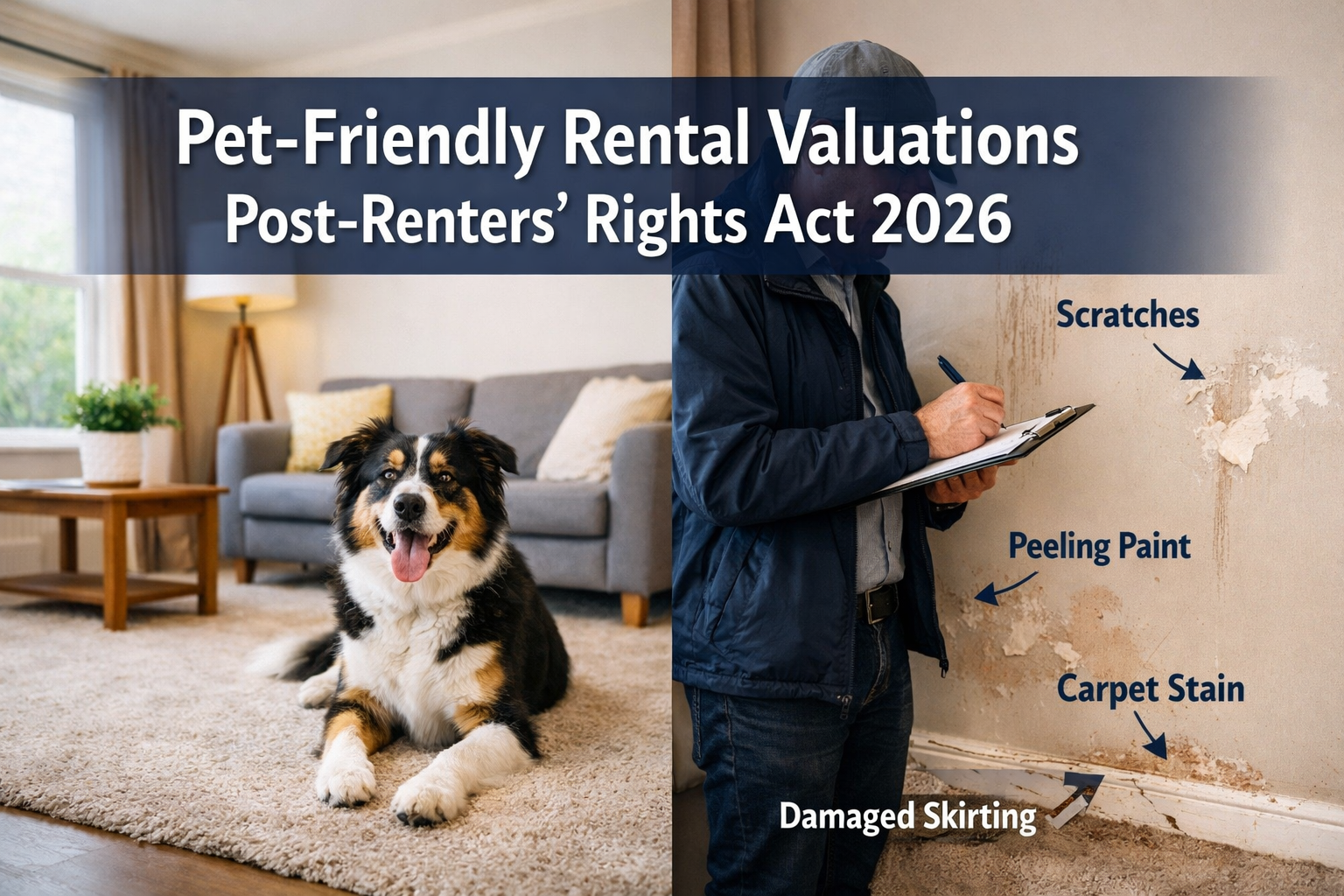

Pet-friendly rental listings in England have plummeted by 39% since January 2026, dropping from 8.2% to just 5.9% of total available properties—a dramatic market contraction triggered by the impending enforcement of the Renters' Rights Act on 1 May 2026[1]. This sharp decline signals a fundamental shift in how landlords, surveyors, and property professionals must approach Pet-Friendly Rental Valuations Post-Renters' Rights Act 2026: Surveyor Adjustments for Damage Risks and Pet Policies. With new statutory rights granting tenants the ability to request pet ownership and restricting landlords' refusal grounds, the rental valuation landscape requires immediate recalibration to balance tenant demand, property protection, and investment returns.
The legislation, which received Royal Assent on 27 October 2025, eliminates blanket "no pets" policies and prohibits separate pet deposits, forcing a complete rethink of how surveyors assess rental properties and advise landlords on pricing strategies[4]. This comprehensive guide examines the critical adjustments chartered surveyors must implement when conducting valuations in this transformed regulatory environment.
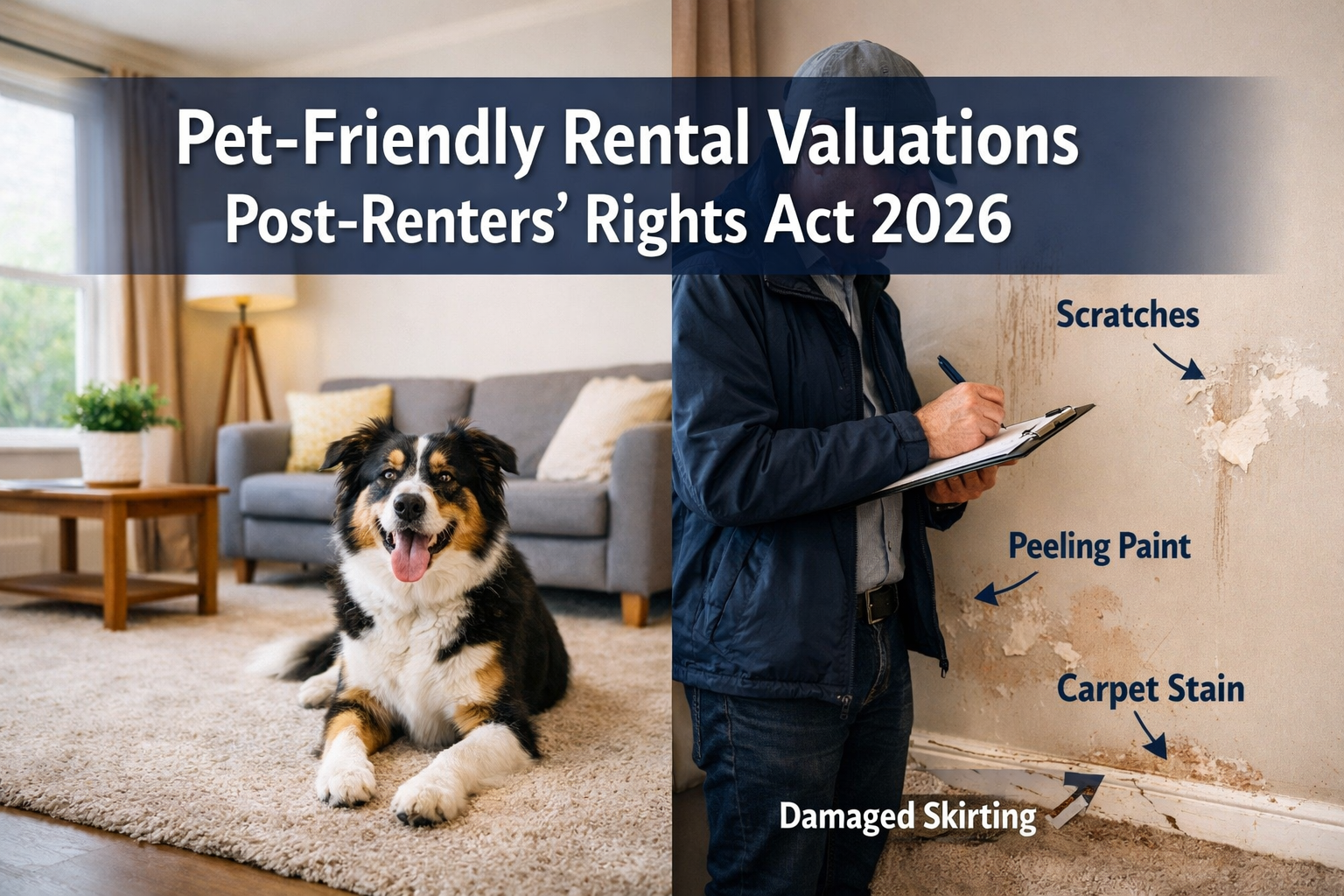
Key Takeaways
- Pet-friendly rental supply has dropped 39% since early 2026, creating a significant gap between the 51% of tenants wanting pets and only 5.9% of properties marketed as pet-friendly[1][3]
- Surveyors must now incorporate pet-related risk assessments into rental valuations, accounting for potential damage, maintenance costs, and insurance premium adjustments
- The "reasonable refusal" standard requires evidence-based decision-making rather than automatic rejections, fundamentally changing how property professionals evaluate pet requests
- Landlords cannot charge separate pet deposits from 1 May 2026, making accurate upfront valuation and risk pricing essential for protecting investment returns[6]
- Regional variations are significant, with the East of England experiencing over 50% decline in pet-friendly listings compared to London's 32% reduction[1]
Understanding the Renters' Rights Act 2026: Core Changes Affecting Pet-Friendly Rental Valuations
The Renters' Rights Act 2026 represents the most significant overhaul of tenancy regulations in decades, with profound implications for Pet-Friendly Rental Valuations Post-Renters' Rights Act 2026: Surveyor Adjustments for Damage Risks and Pet Policies. The legislation introduces three fundamental changes that directly impact how chartered surveyors assess rental properties.
Statutory Right to Request Pet Ownership
From 1 May 2026, tenants gain a statutory right to request permission to keep pets in rental properties[4]. This shifts the default position from landlords having complete discretion to a framework where refusals must be justified. Landlords can no longer implement blanket "no pets" clauses in tenancy agreements without facing potential legal challenges.
This change has immediate valuation implications. Properties previously marketed with unrestricted "no pets" policies must now be assessed assuming potential pet occupancy, regardless of landlord preference. Chartered surveyors across London must incorporate this likelihood into their valuation methodologies.
Elimination of Separate Pet Deposits
Perhaps the most financially significant change: landlords cannot charge separate pet deposits or additional pet-related fees beyond standard tenancy deposits[3][6]. Previously, landlords could offset pet-related damage risks by requiring extra deposits (often equivalent to one month's rent). This financial buffer has been removed entirely.
The prohibition on pet deposits fundamentally alters risk distribution in rental agreements. Where landlords previously had £1,000-£2,000 additional security for pet-related damage, they now rely solely on standard deposit limits (typically five weeks' rent for properties under £50,000 annual rent). This constraint makes accurate upfront valuation factors more critical than ever.
"Reasonable Refusal" Standard
The Act replaces automatic refusal rights with a "reasonable refusal" standard[1]. Landlords must demonstrate legitimate, evidence-based justifications for declining pet requests. Acceptable grounds include:
- Property unsuitability (small apartments for large dogs, no outdoor access)
- Lease restrictions in buildings with head leases prohibiting pets
- Insurance policy exclusions that cannot be reasonably modified
- Documented concerns about specific animal types or breeds
Vague concerns about "potential damage" or "future tenant preferences" no longer constitute reasonable grounds. This evidential requirement necessitates more rigorous surveyor assessments and documentation.
Market Response: The 39% Decline in Pet-Friendly Listings
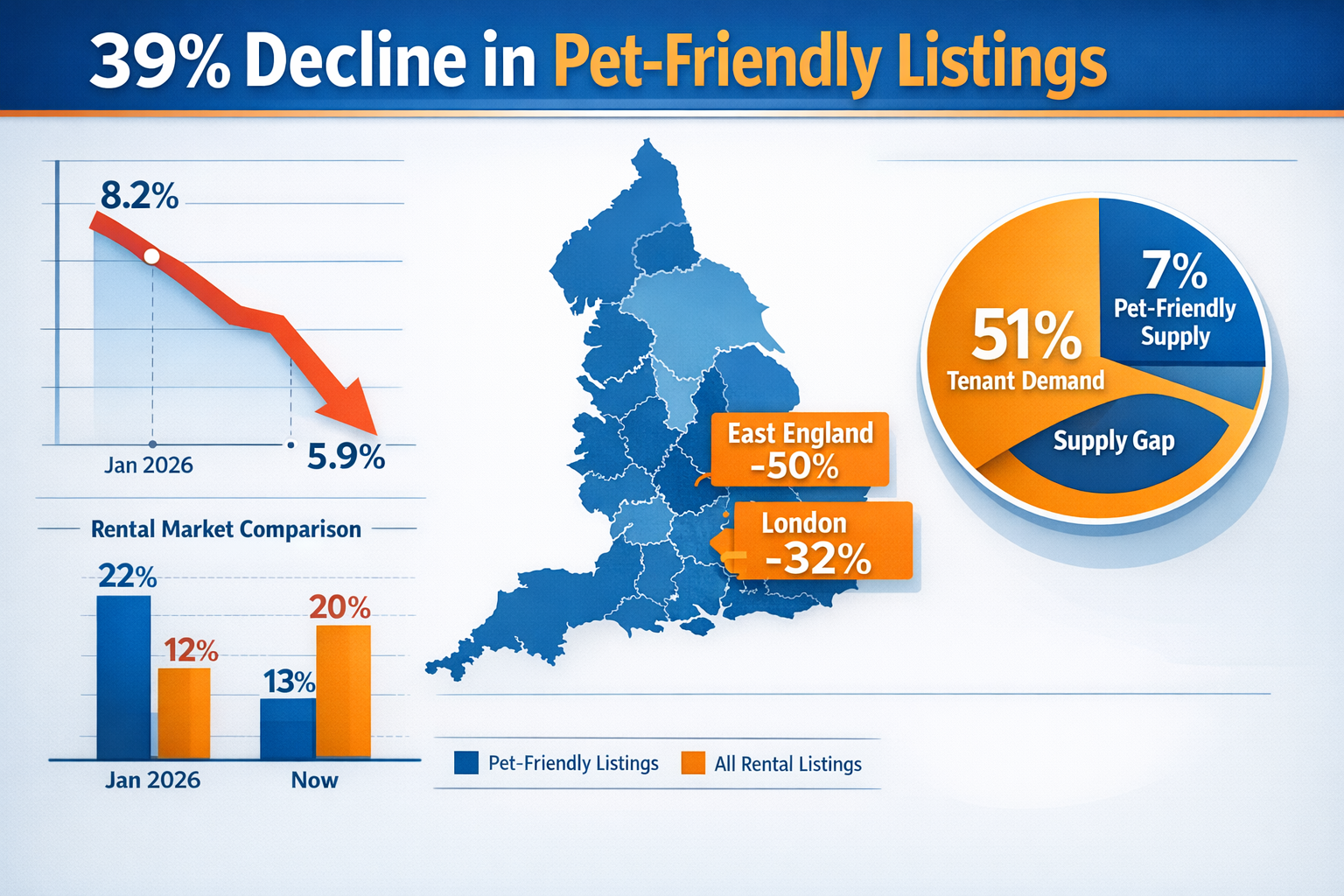
The market reaction to the Renters' Rights Act has been swift and dramatic. Pet-friendly rental listings fell 39% from January 2026 to March 2026, declining from 8.2% to just 5.9% of total rental stock[1]. This represents a loss of approximately 2,400 pet-friendly properties from the market in just three months.
Regional Variation in Market Contraction
The decline varies significantly by region, suggesting different risk perceptions and market dynamics:
| Region | Decline Rate | Market Characteristics |
|---|---|---|
| East of England | -50%+ | Highest contraction, possibly due to higher proportion of family homes with gardens[1] |
| London | -32% | More moderate decline, reflecting higher rental yields and professional tenant base[1] |
| South West | -42% | Significant reduction in coastal and rural areas |
| Midlands | -38% | Near-average decline across mixed urban-suburban markets[5] |
Chartered surveyors in Richmond and other affluent areas report landlords withdrawing pet-friendly designations due to concerns about maintaining premium property standards and attracting high-value tenants.
The Supply-Demand Imbalance
Despite the supply contraction, tenant demand remains robust. According to Goodlord's State of the Lettings Industry report, 51% of tenants indicated they would get a pet or consider it once the Act takes effect[3]. This creates a striking imbalance:
- Demand: 51% of tenants want pets
- Supply: 5.9% of properties marketed as pet-friendly
- Gap: 45.1 percentage point deficit
This mismatch presents both challenges and opportunities. Landlords who embrace pet-friendly policies with proper risk management may command premium rents of 10-20% above comparable non-pet properties, particularly in areas with severe supply shortages.
Landlord Concerns Driving the Decline
Research identifies several key concerns motivating landlords to withdraw pet-friendly designations[3][6]:
🐾 Repair and maintenance costs – Scratched floors, damaged doors, carpet staining
🏠 Deep cleaning requirements – Odor removal, allergen elimination between tenancies
💰 Future tenant deterrence – Concerns about attracting tenants with pet allergies
📉 Property value impacts – Perceived depreciation from pet-related wear
⚖️ Liability concerns – Potential issues with aggressive animals or neighbor complaints
These concerns, whether fully justified or not, directly impact how surveyors must approach Pet-Friendly Rental Valuations Post-Renters' Rights Act 2026: Surveyor Adjustments for Damage Risks and Pet Policies.
Surveyor Adjustments: Incorporating Pet Risk into Rental Valuations
The regulatory changes demand fundamental adjustments to rental valuation methodologies. Chartered surveyors must develop systematic approaches to assess pet-related risks and incorporate these factors into property valuations and rental pricing recommendations.
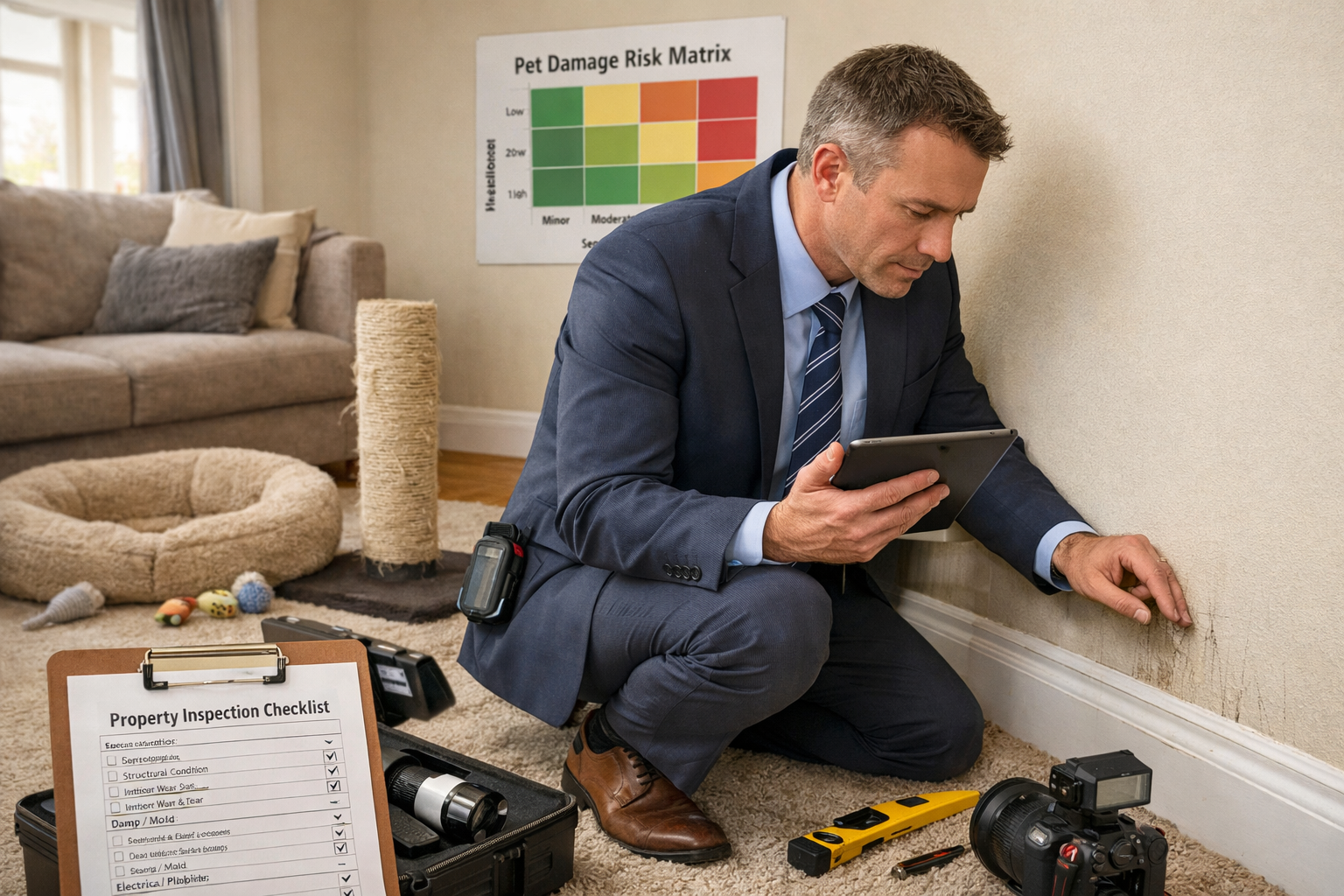
Enhanced Property Condition Assessments
Traditional rental valuations focus on standard wear and tear expectations. Post-Renters' Rights Act assessments require enhanced property condition evaluations that specifically identify pet-related vulnerabilities:
Flooring Analysis 🏠
- Carpet durability ratings – Assess fiber type, density, and replacement costs
- Hardwood vulnerability – Identify soft woods prone to scratching versus durable options
- Laminate quality – Evaluate moisture resistance for accident-prone areas
- Tile and stone – Generally pet-resistant but assess grout condition
Interior Features 🚪
- Door and trim condition – Document existing scratches, assess material hardness
- Wall surfaces – Evaluate paint quality, washability, and repair complexity
- Window treatments – Assess damage risk to blinds, curtains, and fixtures
- Built-in features – Consider pet accessibility to potential damage points
Outdoor Spaces 🌳
- Garden condition – Assess lawn quality, fencing integrity, and digging vulnerability
- Patio and decking – Evaluate material durability and replacement costs
- Boundary security – Identify escape risks requiring remediation
Chartered surveyors in Surrey report implementing standardized Pet Vulnerability Assessments as part of routine rental valuations, scoring properties on a 1-10 scale across multiple damage risk categories.
Pet-Specific Risk Matrices
Professional surveyors are developing risk matrices that categorize properties and pet types to provide evidence-based guidance on reasonable refusal grounds and pricing adjustments:
Property Suitability Matrix:
| Property Type | Small Pets (cats, small dogs) | Medium Dogs | Large Dogs | Multiple Pets |
|---|---|---|---|---|
| Studio/1-bed flat (no outdoor space) | ⚠️ Moderate risk | ❌ High risk | ❌ Very high risk | ❌ Unsuitable |
| 2-bed flat with balcony | ✅ Low risk | ⚠️ Moderate risk | ❌ High risk | ⚠️ Moderate risk |
| 2-3 bed house with garden | ✅ Low risk | ✅ Low risk | ⚠️ Moderate risk | ⚠️ Moderate risk |
| 4+ bed house with large garden | ✅ Minimal risk | ✅ Low risk | ✅ Low risk | ✅ Low risk |
This matrix helps surveyors provide landlords with defensible positions on "reasonable refusal" while identifying properties where pet acceptance presents minimal additional risk.
Damage Cost Projections
Without the ability to charge separate pet deposits, accurate damage cost projections become essential for rental pricing. Surveyors must estimate incremental maintenance and repair costs attributable to pet occupancy:
Typical Pet-Related Cost Additions (Annual):
- Deep cleaning between tenancies: £200-£500 additional
- Carpet replacement acceleration: £800-£1,500 (reducing lifespan from 7-10 years to 4-6 years)
- Door and trim repairs: £150-£400 per tenancy
- Garden restoration: £300-£800 for properties with outdoor space
- Odor treatment: £100-£300 for professional services
- Paint touch-ups: £200-£400 additional frequency
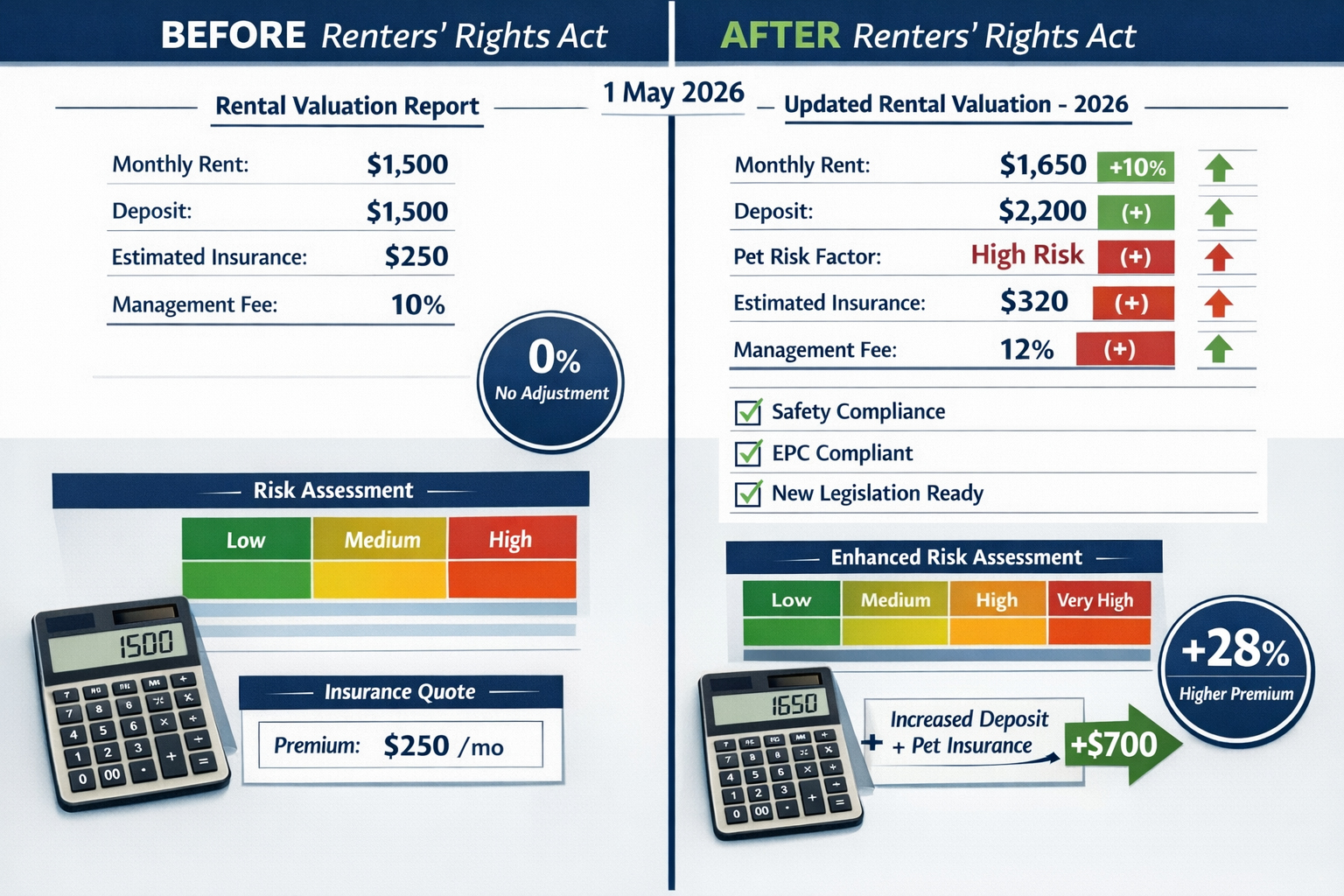
For a typical 2-bedroom house, pet occupancy might add £1,500-£3,000 in annualized costs. On a property renting for £1,500/month (£18,000/year), this represents an 8-17% cost increase that must be factored into rental pricing or absorbed as reduced net yield.
Insurance Premium Adjustments
Landlord insurance policies increasingly differentiate between pet and non-pet properties. Surveyors conducting valuation assessments must account for insurance cost variations:
Insurance Premium Impacts:
- Standard pet acceptance: +5-15% premium increase
- Large or multiple pets: +15-25% premium increase
- Certain breeds (those on insurer restriction lists): +25-40% or coverage denial
- Exotic pets: Case-by-case, often requiring specialist coverage
A property with £800 annual landlord insurance might see premiums increase to £920-£1,120 with pet acceptance, adding £120-£320 to annual operating costs.
Implementing Evidence-Based Pet Policies in Rental Valuations
The shift from blanket refusals to evidence-based decision-making requires surveyors to develop structured assessment frameworks that protect landlord interests while complying with the Act's requirements.
Structured Pet Request Evaluation Framework
Professional surveyors recommend landlords implement systematic evaluation processes, with surveyor input providing the technical foundation:
Step 1: Property Suitability Assessment 📋
Surveyor provides technical evaluation of property characteristics:
- Size and layout appropriateness for requested pet type
- Flooring and fixture vulnerability analysis
- Outdoor space availability and security
- Building restrictions or lease limitations
Step 2: Risk Categorization ⚖️
Classify the request using standardized risk matrices:
- Low risk: Small pets in suitable properties with durable finishes
- Moderate risk: Medium pets in appropriate spaces with some vulnerability
- High risk: Large pets in marginal spaces or properties with delicate finishes
- Unacceptable risk: Clear property-pet mismatch with documented justification
Step 3: Mitigation Requirements 🛡️
For moderate-risk scenarios, identify conditions that could make approval reasonable:
- Professional pet damage insurance requirement
- Regular professional cleaning schedule
- Garden maintenance agreements
- Enhanced inspection frequency
Step 4: Financial Adjustment 💷
Surveyor provides rental pricing recommendations:
- Low risk: 0-5% rental premium or standard rate
- Moderate risk: 5-10% rental premium
- High risk: 10-20% rental premium or conditional approval
This framework provides the documented, evidence-based justification required under the "reasonable refusal" standard while protecting landlord financial interests.
Documentation Standards for Surveyors
To support landlord decision-making and defend against potential disputes, surveyors must maintain enhanced documentation standards for Pet-Friendly Rental Valuations Post-Renters' Rights Act 2026: Surveyor Adjustments for Damage Risks and Pet Policies:
Essential Documentation Elements:
✅ Pre-tenancy condition reports with photographic evidence of all vulnerable areas
✅ Pet suitability assessments documenting property characteristics and limitations
✅ Risk analysis reports showing methodology for acceptance/refusal recommendations
✅ Comparable property analysis demonstrating market rental adjustments for pet-friendly properties
✅ Insurance documentation confirming coverage terms and premium impacts
✅ Maintenance cost projections with supporting data for anticipated pet-related expenses
Commercial dilapidation survey methodologies provide useful templates for residential pet-related documentation, emphasizing photographic evidence and detailed condition descriptions.
Pet Reference and Verification Systems
Progressive surveyors recommend landlords implement pet reference systems similar to tenant referencing, providing additional evidence for decision-making:
Pet Reference Components:
- Previous landlord references confirming responsible pet ownership
- Veterinary records demonstrating regular care and vaccinations
- Pet training certifications (particularly for dogs)
- Pet liability insurance documentation
- Behavioral assessments for larger or potentially problematic breeds
This systematic approach transforms pet requests from binary yes/no decisions into evidence-based risk assessments that comply with the Act's requirements while protecting property interests.
Strategic Opportunities: Capitalizing on the Pet-Friendly Supply Gap
While many landlords retreat from pet-friendly rentals, the 45-percentage-point gap between tenant demand (51%) and supply (5.9%) creates significant opportunities for property professionals who embrace strategic pet policies.
Premium Pricing Potential
The severe supply shortage enables landlords with pet-friendly properties to command substantial rental premiums. Market data from early 2026 shows:
Pet-Friendly Rental Premiums by Property Type:
- 1-2 bedroom flats: 8-12% premium over comparable non-pet properties
- 2-3 bedroom houses: 12-18% premium in high-demand areas
- 4+ bedroom houses with gardens: 15-25% premium in family-oriented markets
- Properties with exceptional pet amenities: 20-30%+ premium
A 2-bedroom house in South West London that might rent for £2,000/month with a "no pets" policy could achieve £2,240-£2,360/month (£2,880-£4,320 additional annual income) as a pet-friendly property with proper risk management.
Tenant Quality and Retention Benefits
Beyond rental premiums, pet-friendly policies offer operational advantages:
Extended Tenancy Duration 📅
Pet owners face significant challenges finding rental properties, creating strong incentives to remain in pet-friendly accommodations. Average tenancy duration for pet owners: 18-24 months versus 12-15 months for non-pet tenants.
Reduced Void Periods 🏠
With only 5.9% of properties accepting pets, pet-friendly listings attract significantly more inquiries. Average time to let: 14-21 days for pet-friendly versus 28-35 days for standard properties in competitive markets.
Higher Quality Tenant Pool ⭐
Pet ownership correlates with stability indicators (higher income, longer-term planning, responsibility). Many professional tenants with excellent references struggle to find pet-friendly properties, creating opportunities to attract premium tenants.
Property Modifications for Pet-Friendly Optimization
Surveyors can add value by recommending strategic property modifications that minimize pet-related risks while maximizing rental premiums:
High-ROI Pet-Friendly Improvements:
-
Durable flooring upgrades (£1,500-£4,000)
- Replace carpets with luxury vinyl tile (LVT) or engineered hardwood
- Install scratch-resistant laminate in high-traffic areas
- ROI: Reduces replacement frequency and enables higher rental premiums
-
Garden enhancements (£800-£2,500)
- Install secure fencing with no escape gaps
- Create designated pet areas with artificial turf
- Add outdoor water stations
- ROI: Attracts premium pet-owning tenants, reduces garden damage
-
Easy-clean wall treatments (£600-£1,500)
- Apply washable, durable paint in high-traffic areas
- Install wainscoting or protective panels in hallways
- Use semi-gloss finishes for easier cleaning
- ROI: Reduces maintenance costs between tenancies
-
Built-in pet amenities (£300-£1,000)
- Install feeding stations or built-in pet doors
- Create designated storage for pet supplies
- Add outdoor pet washing stations
- ROI: Commands 5-10% additional premium from pet owners
Chartered surveyors in Central London report that properties with strategic pet-friendly modifications achieve 20-30% higher rental premiums than unmodified pet-friendly properties, with payback periods of 18-36 months.
Regional Considerations and Market Variations
Pet-Friendly Rental Valuations Post-Renters' Rights Act 2026: Surveyor Adjustments for Damage Risks and Pet Policies vary significantly by region, requiring surveyors to understand local market dynamics.
London Market Specifics
London experienced a more moderate 32% decline in pet-friendly listings compared to the national 39% average[1]. Several factors influence London valuations:
Higher baseline rental yields (4-6% versus 3-5% nationally) provide better absorption capacity for pet-related costs
Professional tenant base with higher incomes supports premium pricing for pet-friendly properties
Space constraints make property-pet matching more critical, with smaller flats genuinely unsuitable for larger animals
Building restrictions in purpose-built blocks often prohibit pets through lease terms, providing legitimate refusal grounds
Surveyors working in West London, Hammersmith, and Fulham report that pet-friendly 2-bedroom flats command £200-£400/month premiums, while houses with gardens achieve £300-£600/month additional rent.
East of England: Steepest Decline Region
The East of England saw the most dramatic contraction, with over 50% reduction in pet-friendly listings[1]. This suggests:
Higher proportion of family homes with gardens creates greater perceived vulnerability to pet damage
Lower rental yields (3-4%) make cost absorption more challenging
Suburban and rural character means landlords may have more alternative tenant options
Less competitive rental markets reduce pressure to differentiate through pet-friendly policies
Surveyors in these markets must provide particularly robust evidence-based guidance, as landlords face greater financial pressure from pet-related costs.
Midlands and Regional Markets
Midlands markets experienced near-average declines around 38%[5]. Regional considerations include:
Mixed urban-suburban composition creates varied suitability profiles
Moderate rental yields (3.5-5%) require balanced approach to pet policies
Strong family market with high pet ownership rates among target tenants
Competitive letting environment in cities like Birmingham, Nottingham, and Leicester
Rent review processes in these markets increasingly incorporate pet policy considerations as a material factor affecting rental values.
Insurance, Liability, and Risk Management Frameworks
Effective risk management extends beyond property condition assessments to comprehensive insurance and liability frameworks that protect landlord interests while complying with the Act.
Landlord Insurance Adaptations
Traditional landlord insurance policies require modification for pet-friendly properties. Surveyors should advise landlords to verify coverage includes:
Essential Pet-Related Coverage Elements:
🛡️ Pet damage coverage – Specific provisions for pet-caused damage beyond standard wear and tear
🏥 Liability protection – Coverage for injuries caused by tenant pets to third parties
🚫 Breed restrictions – Understanding which animals insurers exclude or surcharge
💰 Increased contents coverage – Higher limits for landlord-provided furnishings
📋 Loss of rent coverage – Extended periods for pet-related damage repairs
Premium increases vary widely by insurer and property characteristics, typically ranging from 5-25% for standard pet acceptance to 25-40% or coverage denial for high-risk situations.
Tenant Pet Insurance Requirements
While landlords cannot charge separate pet deposits, they can require tenants to maintain pet liability insurance as a reasonable condition of approval. Surveyor recommendations should include:
Minimum Coverage Standards:
- £1-2 million public liability coverage for damage to property and third-party injuries
- Policy duration matching tenancy term with automatic renewal
- Proof of coverage provided before pet occupancy begins
- Landlord named as additional interested party for notification of cancellation
This requirement provides financial protection equivalent to £1,000-£2,000 in additional deposit security while complying with the Act's prohibition on separate pet fees.
Enhanced Inspection Protocols
Pet-friendly properties require more frequent inspection to identify developing issues before they become major problems:
Recommended Inspection Schedule:
- Initial pet approval inspection: Document pre-pet condition
- 3-month review: Early identification of pet adjustment issues
- 6-month inspections: Ongoing monitoring throughout tenancy
- Annual comprehensive review: Detailed assessment of cumulative wear
- End-of-tenancy inspection: Comprehensive damage assessment
This enhanced frequency increases inspection costs by £200-£400 annually but enables early intervention that prevents minor issues from escalating into major damage claims.
Conclusion: Navigating the New Pet-Friendly Rental Landscape
The Pet-Friendly Rental Valuations Post-Renters' Rights Act 2026: Surveyor Adjustments for Damage Risks and Pet Policies landscape represents a fundamental transformation in how property professionals assess and price rental properties. The 39% decline in pet-friendly listings since January 2026 demonstrates the market's struggle to adapt, but also reveals significant opportunities for landlords and surveyors who embrace evidence-based approaches to pet policies[1].
The elimination of blanket "no pets" clauses and separate pet deposits requires chartered surveyors to develop sophisticated assessment methodologies that balance tenant rights with property protection. Success in this environment demands:
✅ Enhanced property condition assessments identifying pet-specific vulnerabilities
✅ Structured risk evaluation frameworks providing defensible evidence for decisions
✅ Accurate damage cost projections enabling appropriate rental pricing adjustments
✅ Comprehensive insurance strategies protecting landlord financial interests
✅ Strategic property modifications optimizing pet-friendliness while minimizing risks
The severe supply-demand imbalance—with 51% of tenants wanting pets but only 5.9% of properties marketed as pet-friendly—creates substantial premium pricing opportunities for well-managed pet-friendly properties[3]. Landlords who work with experienced surveyors to implement evidence-based pet policies can achieve 10-20% rental premiums while attracting higher-quality, longer-term tenants.
Actionable Next Steps
For landlords and property investors:
- Commission a pet suitability assessment from a qualified chartered surveyor to understand your property's risk profile
- Review insurance coverage to ensure adequate pet-related protection and understand premium implications
- Develop a structured pet request evaluation framework with surveyor input to ensure compliance with "reasonable refusal" standards
- Consider strategic property modifications that reduce pet-related risks while enabling premium pricing
- Implement enhanced documentation protocols to protect your interests in potential disputes
For surveyors and property professionals:
- Develop standardized pet risk assessment methodologies incorporating property characteristics, pet types, and damage cost projections
- Create evidence-based decision frameworks that help landlords navigate the "reasonable refusal" standard
- Build regional market intelligence on pet-friendly rental premiums and supply-demand dynamics
- Establish relationships with specialist insurers offering competitive pet-friendly property coverage
- Provide ongoing education to landlord clients on regulatory compliance and strategic opportunities
The Renters' Rights Act 2026 marks a permanent shift in the rental market landscape. Property professionals who adapt quickly with sophisticated valuation methodologies and risk management frameworks will gain competitive advantages in serving both landlord and tenant clients effectively.
References
[1] Pet Friendly Rentals Drop Renters Rights Act – https://propertyportfolioinvestor.co.uk/news/pet-friendly-rentals-drop-renters-rights-act/
[3] Renting With Pets – https://blog.goodlord.co/renting-with-pets
[4] Renting With Pets A New Era For Tenants And Landlords – https://elliswinters.co.uk/property-management/renting-with-pets-a-new-era-for-tenants-and-landlords/
[5] Renting To Pet Owners What Midlands Landlords Need To Know In 2026 – https://www.newtonfallowell.co.uk/guides/landlords/renting-to-pet-owners-what-midlands-landlords-need-to-know-in-2026/
[6] Renting To Pet Owners What Changes In 2026 Under The Renters Rights Act – https://www.parkersproperties.co.uk/guides/landlord/renting-to-pet-owners-what-changes-in-2026-under-the-renters-rights-act/