Nearly one in seven homes on the market had its price cut last month, and more than half of the properties that came off agents' books in October did not sell at all. That is the picture emerging from new UK housing stock price reductions October 2026 data, analysed by property analyst Chris Watkin and reported by PropertyWire on 6 November 2026. For anyone buying or selling in Kingston upon Thames this November 2026, the numbers point firmly towards a buyer's market, but one where realistic pricing and solid evidence still win deals.
Key Takeaways
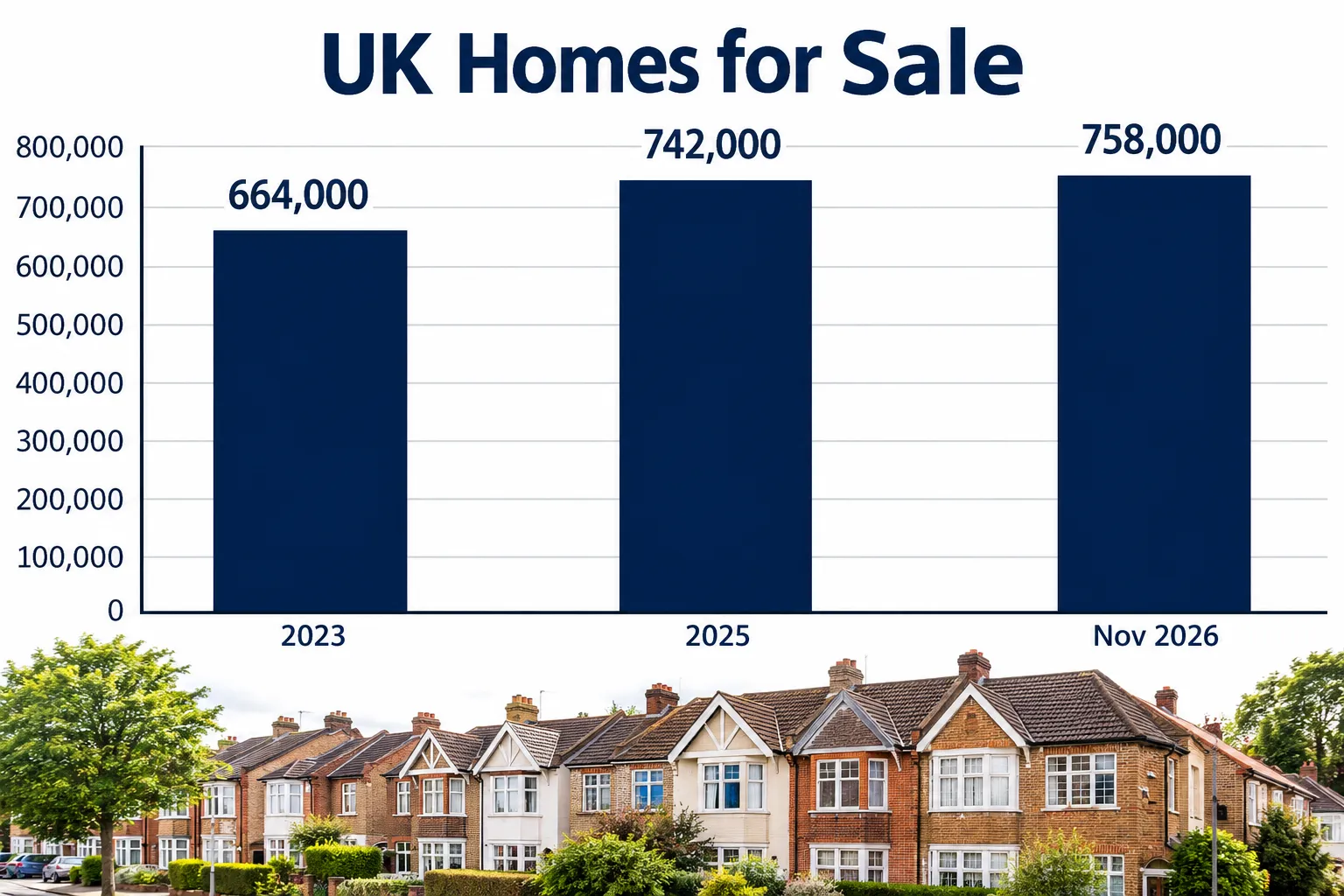
- UK homes for sale hit 758,000 on 1 November 2026, up from 742,000 a year earlier and 664,000 in November 2023.
- 13.7% of listings had a price reduction in October 2026, down slightly from 14.7% in September but still above the seven-year average of 11%.
- Only 49.2% of homes leaving agents' books in October completed an exchange; 50.8% were withdrawn unsold.
- The sell-through rate was 13.4% in October, below the pre-Covid average of 15.5%.
- Bank Rate rose to 4% on 5 November 2026, and London prices fell 3.1% annually according to Lloyds/Halifax.
The Headline Numbers Behind UK Housing Stock Price Reductions October 2026
According to Chris Watkin's analysis reported by PropertyWire, the stock of homes for sale across the UK reached 758,000 on 1 November 2026. That is a steady climb from 742,000 in November 2025 and 664,000 in November 2023, showing that sellers have been listing homes faster than buyers have been completing purchases.
Within that growing pool of stock, 13.7% of homes for sale had their asking price reduced during October 2026. That is a slight easing from September's 14.7%, but it remains well above the seven-year average of 11%. In plain terms, price cuts are now more common than normal, even though they are trending down month on month.
The report also flagged something more striking: of all the homes that left estate agents' books in October, only 49.2% completed an exchange of contracts. The remaining 50.8% were simply withdrawn unsold. The seven-year average for completed sales among exiting listings is 57.6%, so October's figure is a meaningful shortfall.
Why So Few Listings Are Converting to Sales
The sell-through rate, the proportion of total stock that actually sold in the month, was 13.4% in October 2026, compared with a pre-Covid average of 15.5%. Watkin's figures suggest that while demand has not collapsed, it is simply not keeping pace with the volume of homes coming to market.
There is some reassurance in the pricing detail, however. The gap between asking price and the price buyers agreed to pay was 15.5% in week 43, close to the long-term average of 16-17%. Fall-through rates, sales that collapse after being agreed, stood at 23.99% in week 43, only slightly below the decade average of 24.5%. So once a sale is agreed at a realistic figure, it is about as likely to complete as usual. The real bottleneck is getting a sale agreed in the first place.
Year to date, 1.032 million homes have sold subject to contract, which is 7.5% below the same point in 2025 but still 10.6% above 2023. New listings so far this year total 1.529 million, only marginally behind 2025's 1.532 million. Watkin's report described "widespread negative sentiment following the recent Budget" but noted that transaction volumes have, on balance, held up.
What Pricing Data Tells Kingston Sellers
Agreed sale prices averaged £338.98 per square foot in September 2026, up just 0.2% year on year nationally, essentially flat. Locally, the picture looks softer still. Lloyds/Halifax reported UK house prices down 0.6% in October and 1.2% annually, with London prices down 3.1% over the year. Kingston upon Thames, as part of the London market, sits within that broader downward pressure.
Layer on top of this the Bank of England's decision on 5 November 2026 to raise Bank Rate to 4%, the first increase since 2023, and the message for sellers is clear: borrowing costs are rising again, buyer affordability is tighter, and the days of ambitious asking prices sailing through are largely over.
"Widespread negative sentiment following the recent Budget" has not stopped transactions happening, but it has made buyers far more selective about which homes they pursue.
For a Kingston seller, this combination of rising rates, falling average London prices, and a 50.8% withdrawal rate is a strong signal to price at, not above, current market evidence from the outset.
How Kingston Buyers Can Use This Market to Their Advantage
With 758,000 homes on the market nationally and 13.7% already price-reduced, buyers in Kingston upon Thames have more genuine choice and more negotiating leverage than at almost any point since 2023. A RICS Level 2 (HomeBuyer Report) or Level 3 (Building Survey) survey gives buyers independent, written evidence of a property's condition, evidence that can be used directly in price negotiations.
Typically, a survey that identifies issues such as damp, roof defects, or ageing services gives buyers a concrete basis to ask for a price reduction or repair allowance, rather than relying on gut feeling. In a market where asking-to-agreed price gaps sit around 15.5%, having a surveyor's report in hand strengthens a buyer's position considerably.
Practical actions for Kingston buyers right now:
- Commission a RICS Level 2 or Level 3 survey before exchanging, not after, so findings can feed into negotiation.
- Use local sold-price evidence alongside the survey to justify any offer below asking price.
- Factor the higher 4% Bank Rate into mortgage affordability calculations before making an offer.
- Ask agents how long a property has been listed, longer time on market often signals room to negotiate.
- Avoid rushing; with 758,000 homes for sale nationally, there is rarely only one suitable property available.
Avoiding the 50.8% Withdrawal Rate: Advice for Sellers
The single most important figure for sellers in this report is the 50.8% withdrawal rate. Half of homes leaving the market in October did not sell. Typically, overpricing relative to current buyer sentiment is the main reason homes are withdrawn unsold rather than exchanged.
A pre-sale survey can help sellers avoid becoming part of that statistic. Commissioning a RICS survey before listing allows sellers to identify and address issues, or price them in, before a buyer's own survey brings up unwelcome surprises during negotiation. This reduces the risk of a sale falling through at the 23.99% fall-through stage recorded in week 43, and helps sellers set an asking price that reflects real market appetite rather than wishful thinking.
Sellers should also recognise that the 13.7% price-reduction rate, while down from September's 14.7%, remains above the seven-year average. This points to a market still correcting rather than one that has stabilised. Pricing realistically from day one, rather than reducing later, typically helps a property sell faster and closer to its original asking figure.
Frequently Asked Questions
What does "UK housing stock price reductions October 2026" actually measure?
It refers to the percentage of homes listed for sale in October 2026 that had their original asking price cut, as reported by Chris Watkin and PropertyWire. The figure was 13.7%, above the seven-year average of 11%.
Why are so many homes being withdrawn unsold?
Watkin's analysis found 50.8% of homes leaving agents' books in October did not complete, against a seven-year average of 57.6% completing. Growing stock levels and softer demand are the main drivers.
Does this mean Kingston house prices are falling?
Nationally, Lloyds/Halifax reported prices down 0.6% in October and down 1.2% annually, with London down 3.1%. Local Kingston conditions will vary by property type and condition, but the broader trend is downward pressure.
Should I still get a survey in a buyer's market?
Yes. With more stock available and price reductions common, a RICS Level 2 or Level 3 survey gives buyers independent evidence to negotiate and gives sellers a chance to fix issues before they derail a sale.
How does the Bank Rate rise to 4% affect buyers?
A higher Bank Rate, raised on 5 November 2026 for the first time since 2023, typically increases mortgage costs, which can reduce how much buyers can borrow and comfortably afford.
Conclusion
The UK housing stock price reductions October 2026 data paints a clear picture: more homes for sale, more price cuts, and fewer completed sales than normal. For Kingston upon Thames, sitting within a London market that Lloyds/Halifax shows falling 3.1% annually, this is a moment that rewards preparation over optimism. Buyers have genuine leverage and should back it with independent survey evidence. Sellers who price realistically and address issues early stand the best chance of avoiding the 50.8% withdrawal trap.
To discuss a RICS Level 2 or Level 3 survey, or to get a current valuation ahead of listing or offering on a Kingston property, contact the team at Kingston Surveyors to book an appointment.