
Subsidence insurance claims in the UK have surged by roughly 30% year-on-year in 2026, driven by successive hot, dry summers that shrink the clay soils beneath millions of homes [1]. Yet the vast majority of cracks that homeowners discover are not caused by subsidence at all. The challenge, and the skill, lies in knowing which crack is which. Understanding how surveyors read crack patterns in UK homes: hairline, step, diagonal and settlement cracks explained is not just useful knowledge for property professionals. It is increasingly essential for any homeowner who wants to protect their investment and avoid either unnecessary panic or costly delays in acting on a genuine structural problem.
Key Takeaways
- Hairline cracks under 1 mm in plaster are almost always cosmetic and do not indicate structural movement.
- Stepped cracks following mortar joints in a diagonal staircase pattern are the classic visual signal of subsidence and require professional assessment.
- Diagonal cracks radiating from window and door corners are common in older properties and are often historic settlement, but new or widening examples over 3 mm need investigation.
- Surveyors never rely on crack patterns alone, they assess width, location, seasonality, and a cluster of other symptoms such as sticking doors and uneven floors.
- In 2026, homes on shrink-swell clay soils in London, Essex and Kent face heightened scrutiny because climate-driven droughts are accelerating ground movement beneath foundations.
The Four Main Crack Types and What They Tell a Surveyor
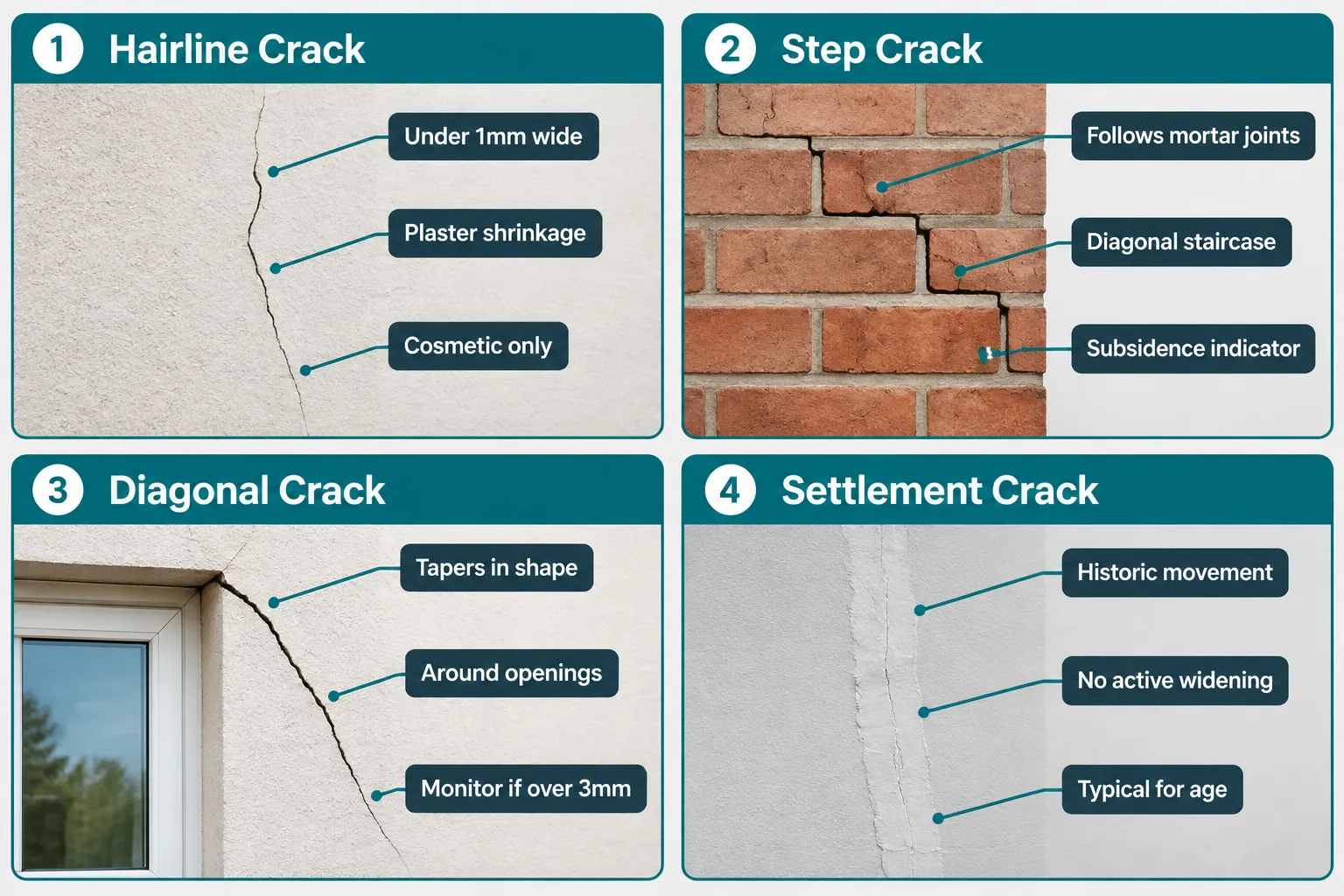
When a chartered surveyor inspects a property, every crack is read like a sentence in a language built from width, direction, location and context. The process of how surveyors read crack patterns in UK homes, hairline, step, diagonal and settlement cracks explained, begins with a simple but disciplined classification system.
Hairline Cracks: Cosmetic, Not Catastrophic
Hairline cracks are defined as those measuring less than approximately 1 mm in width. They appear most often in plaster or painted surfaces and are typically caused by:
- Plaster shrinkage as new render dries and cures
- Thermal expansion and contraction of building materials during seasonal temperature changes
- Historic settlement that occurred when the building first loaded its foundations and has long since stabilised
RICS guidance is clear that hairline cracks are rarely a cause for concern unless they are accompanied by other warning signs [3]. A useful diagnostic clue for surveyors is whether the crack has been painted over multiple times without reopening. If it has, this strongly suggests the movement has stabilised and the crack is purely cosmetic [7].
Gary Strong, a senior consultant at RICS, noted in September 2026 that cracking in homes often increases around September after hot summers, but that "not all cracks are serious", many are simply due to thermal movements rather than structural failure [1]. This professional perspective is important: discovering a hairline crack does not automatically warrant a structural investigation.
When hairline cracks become a concern:
- They reopen repeatedly after being filled
- They appear suddenly in a previously crack-free wall
- They are accompanied by sticking doors, rippling wallpaper or sloping floors
Stepped Cracks: The Classic Subsidence Red Flag
Stepped cracks are the pattern most strongly associated with subsidence in UK surveying practice. They follow the mortar joints between bricks in a diagonal staircase pattern, because mortar is the path of least resistance when foundations shift unevenly beneath a structure.
Surveyors pay particular attention to stepped cracks that:
- Appear near the junction between an original house and a later extension, where foundation depths often differ
- Are visible on both the internal and external faces of the same wall
- Measure more than approximately 5 mm in width
- Are new or visibly widening over time [7]
"Stepped diagonal cracks greater than about 5 mm wide, particularly when newly formed or widening over time and visible on both internal and external faces, are coded by surveyors as 'evidence of subsidence, monitoring recommended'.", ChatToYourBuilder, RICS-focused advisory guidance [7]
When these conditions are met, the surveyor's report will typically recommend formal crack monitoring using crack gauges installed over a period of several months. This monitoring quantifies whether the crack is actively progressing, which is critical information for both mortgage lenders and insurers [7].
Diagonal Cracks: Context Is Everything
Diagonal cracks are among the most commonly misunderstood findings in a home survey. They are not automatically a sign of subsidence, and their significance depends heavily on context.
Diagonal cracks that are usually benign:
- Cracks radiating from the corners of window and door openings in older properties, where modest past movement has clearly stabilised
- Cracks that taper to a hairline at one end and are consistent with historic thermal or loading movement
- Cracks that have been filled and painted over without reopening
Diagonal cracks that warrant investigation:
- New or rapidly expanding cracks around doors and windows, especially those wider than approximately 3 mm [7]
- Cracks with a pronounced taper, suggesting differential movement at one end of the opening
- Cracks that appear alongside sticking doors or windows, rippling wallpaper or uneven floors [3]
The RICS consumer guide on subsidence lists diagonal cracks around openings as one of the key indicators that should prompt a professional evaluation rather than simple cosmetic repair [3][4]. In 2026, with subsidence claims at record levels, surveyors in clay-soil areas of London, Essex and Kent are applying particular scrutiny to new diagonal cracks, even relatively narrow ones, especially when properties are near large trees or have a history of drainage issues [5].
For homeowners in areas such as South West London or Essex, where shrink-swell clay soils are prevalent, a diagonal crack that might be dismissed as routine in a sandstone-bedrock area can carry a very different implication.
Settlement Cracks: Historic Movement vs Active Subsidence
Settlement and subsidence are frequently confused, but surveyors treat them as fundamentally different conditions with different implications for a property's safety and value.
| Feature | Settlement | Subsidence |
|---|---|---|
| Timing | Historic, one-off | Ongoing, progressive |
| Cause | Initial foundation loading | Ground movement (clay shrinkage, tree roots, leaking drains) |
| Crack behaviour | Stable, painted over | Widens in dry summers, partially closes in wet winters |
| Urgency | Low, monitor only | High, professional assessment required |
| Typical crack pattern | Minor diagonal or horizontal | Stepped and diagonal, often at corners or extension junctions |
Settlement is the natural, largely benign process by which a building adjusts to its own weight after construction. Most UK homes of any age show some evidence of past settlement, and surveyors routinely record this as "cracking typical of age and construction", a phrase that is reassuring rather than alarming.
Subsidence, by contrast, is defined by RICS as downward movement of a building's foundations caused by changes in the supporting ground, most commonly clay shrinkage, tree root activity or leaking drains [3]. The critical diagnostic difference is activity: subsidence cracks tend to widen during dry summers as clay soils shrink, then partially close during wetter winters as the clay rehydrates. This seasonal opening and closing is one of the most reliable indicators that a crack is caused by clay-related subsidence rather than historic settlement [7].
How Surveyors Assess Crack Severity: Width Thresholds and the Multi-Indicator Approach
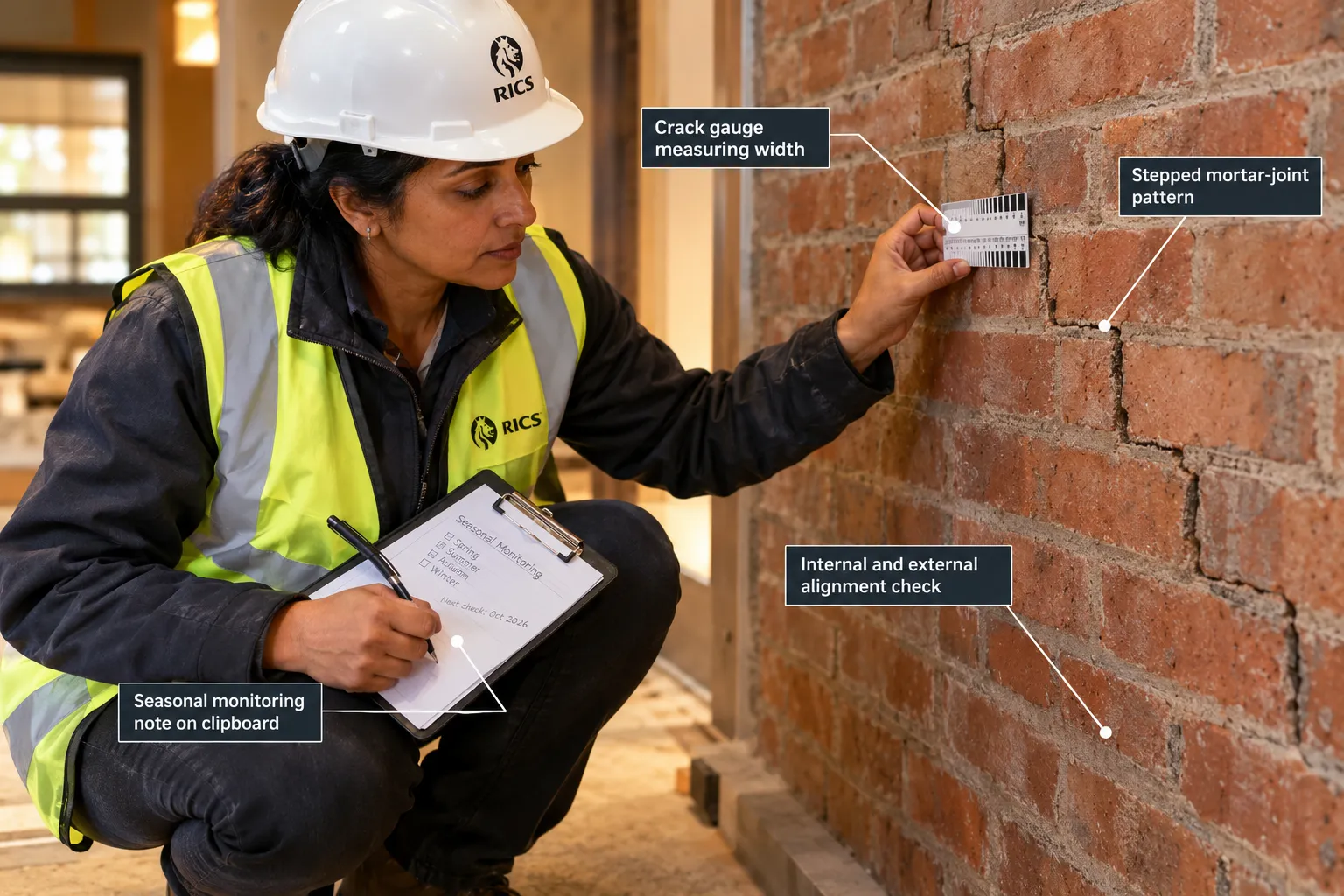
Understanding how surveyors read crack patterns in UK homes, hairline, step, diagonal and settlement cracks explained, requires more than memorising crack shapes. Professional assessment combines crack width measurement with a broader cluster of symptoms and contextual factors.
Crack Width Classification
The following thresholds are widely used in UK surveying practice and are consistent with guidance from RICS and surveyor-facing resources [7][3]:
| Category | Width | Typical Cause | Surveyor Action |
|---|---|---|---|
| Hairline | Under 1 mm | Plaster shrinkage, thermal movement | Record as cosmetic; no further action |
| Slight | 1-5 mm | Historic settlement or early movement | Assess pattern and location; monitor if new |
| Moderate | 5-15 mm | Significant structural movement | Recommend structural engineer assessment |
| Severe | Over 25 mm | Severe subsidence or structural failure | Urgent structural engineering input required |
Width alone is never the sole criterion. A 4 mm stepped crack that is new, visible externally and accompanied by a sticking door is treated very differently from a 4 mm diagonal crack that has been stable for 30 years [7].
The Cluster of Warning Signs
RICS guidance is explicit that surveyors assess crack patterns alongside a broader set of indicators [3][4]. The full cluster of warning signs that, taken together, suggest active ground movement includes:
- New or expanding cracks in plaster or brickwork, particularly if stepped or diagonal
- Doors and windows sticking without an obvious cause such as recent wet weather
- Rippling wallpaper that is not explained by damp
- Sloping or dipping solid floors that have changed noticeably
- Visible gaps between walls and ceilings, or at the junction between an original structure and an extension [2][7]
When three or more of these signs are present together, RICS recommends prompt specialist assessment by a chartered surveyor or structural engineer [3]. Insurers typically then appoint a loss adjuster and may commission a structural engineer's report at their own cost, followed by months of crack monitoring before any remedial work is agreed [7].
Crack Location and Building Context
Where a crack appears is as important as how it looks. Surveyors consider:
- Position relative to openings: Cracks at corners of windows and doors are common; cracks mid-wall are less so and carry more weight as a concern.
- Extension junctions: The boundary between an original structure and a later extension is a classic location for stepped and diagonal cracks because foundation depths often differ.
- Soil type: Properties on shrink-swell clay, prevalent across London, Essex and Kent, face a materially higher risk of subsidence-related cracking than those on chalk or sandstone [5][9].
- Nearby trees: Tree roots can extract moisture from clay soils, causing localised shrinkage and differential settlement directly beneath a wall.
- Drainage: Leaking underground drains can wash away fine soil particles, creating voids beneath foundations that lead to subsidence.
For a deeper overview of the most common property defects that surveyors encounter, including cracking alongside damp, roof deterioration and structural movement, the 10 most common property defects found in a building survey provides a useful reference.
Settlement vs Subsidence: The Diagnostic Process in Practice
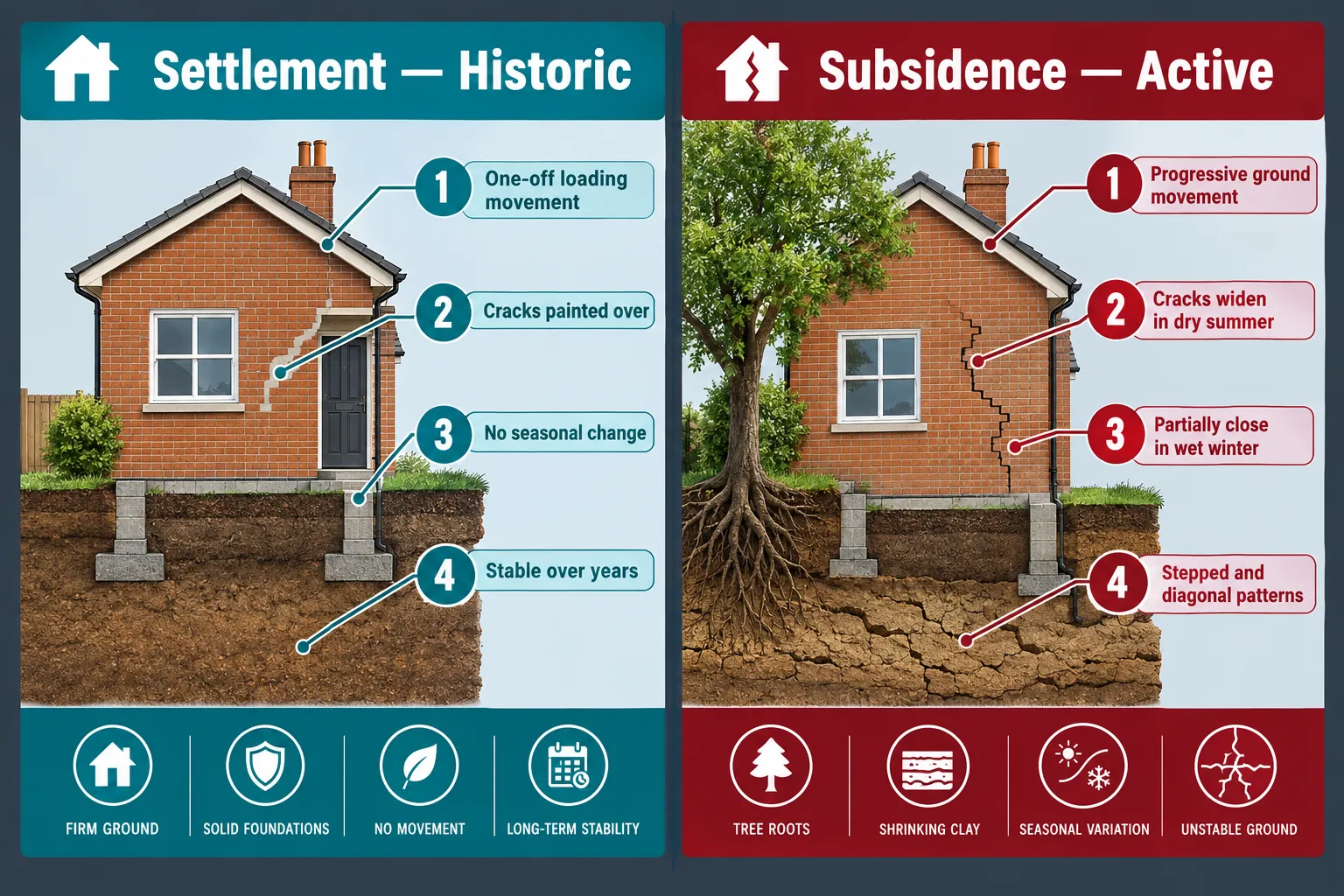
The distinction between settlement and subsidence is the central diagnostic question in any crack assessment. Getting it right matters enormously: a misclassification in either direction can lead to unnecessary remedial costs, failed mortgage applications or, in the worst case, a structural problem that is allowed to worsen.
How Surveyors Distinguish the Two
The process follows a structured logic:
- Measure and record crack width using a crack gauge card or digital callipers, noting the widest point and whether the crack tapers.
- Map the crack pattern, is it stepped through mortar joints, diagonal from an opening, horizontal through brickwork, or vertical in plaster?
- Check both faces of the wall, a crack visible internally and externally in the same location is a stronger indicator of structural movement than one confined to internal plaster.
- Assess the age and history of the crack, evidence of multiple paint layers over the crack suggests long-term stability; a fresh, clean crack edge suggests recent movement.
- Look for the full cluster of symptoms, sticking doors, rippling wallpaper, uneven floors, gaps at extension junctions.
- Consider the building's context, age, construction type, soil conditions, proximity to trees, local subsidence history.
If steps 1 to 6 produce a pattern consistent with active subsidence, particularly a new, stepped crack wider than 3 mm in a clay-soil area, accompanied by sticking doors and an uneven floor, the surveyor will recommend formal monitoring and specialist investigation [3][7].
For homeowners considering a professional inspection, understanding the difference between survey types is important. The HomeBuyers Report vs Building Survey comparison explains which level of survey is appropriate for different properties and levels of concern. Properties with visible crack patterns typically benefit from a Level 3 Building Survey, which provides the most detailed structural assessment available.
The Role of Crack Monitoring
When a surveyor cannot determine from a single inspection whether a crack is active or historic, crack monitoring is the standard next step. This involves:
- Installing crack gauges (tell-tales) across the crack at its widest point
- Recording readings at regular intervals, typically monthly, over a period of three to twelve months
- Correlating movement with weather patterns, widening in dry periods and partial closure in wet periods is the hallmark of clay-related subsidence
This data-driven approach has become increasingly important in 2026 as insurers face a record volume of subsidence claims and require objective evidence before committing to costly underpinning or resin-injection repairs [7][9]. The Association of British Insurers estimates that average subsidence claim costs reached approximately £27,000 in Q2 2026, making accurate diagnosis more financially significant than ever [6].
When to Contact Your Insurer
If a homeowner identifies what appears to be a potentially serious crack pattern, particularly a new stepped or diagonal crack wider than 3 mm, combined with sticking doors or windows and an uneven floor, the recommended course of action is:
- Photograph everything with date stamps, capturing the full length of the crack and any associated symptoms.
- Contact the home insurer promptly, delays can complicate claims.
- Request a structural survey or ask the insurer to appoint a structural engineer.
- Do not fill or paint over the crack before it has been assessed, as this destroys the evidence needed for monitoring.
Homeowners in areas with known clay-soil risk, such as Chelsea, Battersea or Hampshire, should be particularly alert to new crack patterns following dry summers, as these regions sit on the shrink-swell clay belts identified as highest-risk in 2026 environmental analysis [5][9].
The Climate Dimension
Environmental reporting in 2026 has confirmed what many surveyors have observed on the ground: millions of homes in London, Essex and Kent built on shrink-swell clay soils are at heightened risk as climate-driven heatwaves cause the ground to repeatedly shrink and swell [5]. Bloomberg analysis from late August 2026 describes record subsidence risk in London, directly linking heatwaves to widespread clay shrinkage and destabilised foundations [9]. Actuarial analysis frames 2026 as a potential fourth "subsidence event year" in the last decade, following 2018, 2022 and 2025 [6].
This climate context means that even relatively narrow new stepped or diagonal cracks in high-risk postcodes are being treated with greater caution than they might have been a decade ago. Surveyors in these areas are more likely to recommend monitoring and specialist investigation as a precaution, rather than waiting for cracks to reach the 5 mm threshold that would previously have triggered concern.
For homeowners who want a comprehensive understanding of when wall cracks cross the line from cosmetic to structural, the detailed guide on cracks in walls and when to worry provides an authoritative starting point. Those considering a professional survey can also review the structural survey cost guide to understand the investment involved.
Conclusion
The ability to read crack patterns accurately is one of the most practically valuable skills in UK property assessment. Most cracks, particularly hairline examples under 1 mm in plaster, are cosmetic and require nothing more than routine maintenance. Stepped cracks following mortar joints in a diagonal staircase pattern, especially when new, widening and visible on both faces of a wall, are the most reliable visual indicator of active subsidence and should always prompt professional investigation. Diagonal cracks around openings are common in older properties and are often historic, but any new diagonal crack wider than 3 mm deserves careful scrutiny, particularly in clay-soil areas.
Actionable next steps for homeowners:
- Inspect external brickwork and internal plaster after each dry summer, paying particular attention to corners, extension junctions and areas near large trees.
- Use a ruler or crack gauge card to measure any crack wider than a hairline. Record the width, date and location with photographs.
- Look for the full cluster of symptoms, sticking doors, rippling wallpaper, uneven floors and gaps at wall-ceiling junctions, rather than treating any single crack in isolation.
- If a crack is new, stepped, wider than 3 mm and accompanied by other symptoms, contact a chartered surveyor before contacting a decorator.
- Commission a Level 3 Building Survey for any property showing multiple indicators of structural movement, particularly in high-risk clay-soil areas.
Professional assessment is always the safest course when doubt exists. The cost of a structural survey is a fraction of the cost of underpinning, and far less than the financial and emotional cost of purchasing a property with undiagnosed active subsidence.
References
[1] Subsidence Uk Insurers Double Surge Claims Hot Summers – theguardian.com
[2] Uk Subsidence Claims Surge After Hottest Summer On Record – rocketnews.com
[3] Subsidence – rics.org
[4] Rics Consumer Guide Subsidence – rics.org
[5] Millions Homes London Essex And Kent Sinking Climate Crisis Subsidence – theguardian.com
[6] London Subsidence Heat Clay Soil Sinking Insurance – cnn.com
[7] Subsidence Claims Surge 140 What Homeowners Must Know – nesto.co.uk
[9] Heat Waves Are Fueling Record Subsidence Risk In London – bloomberg.com