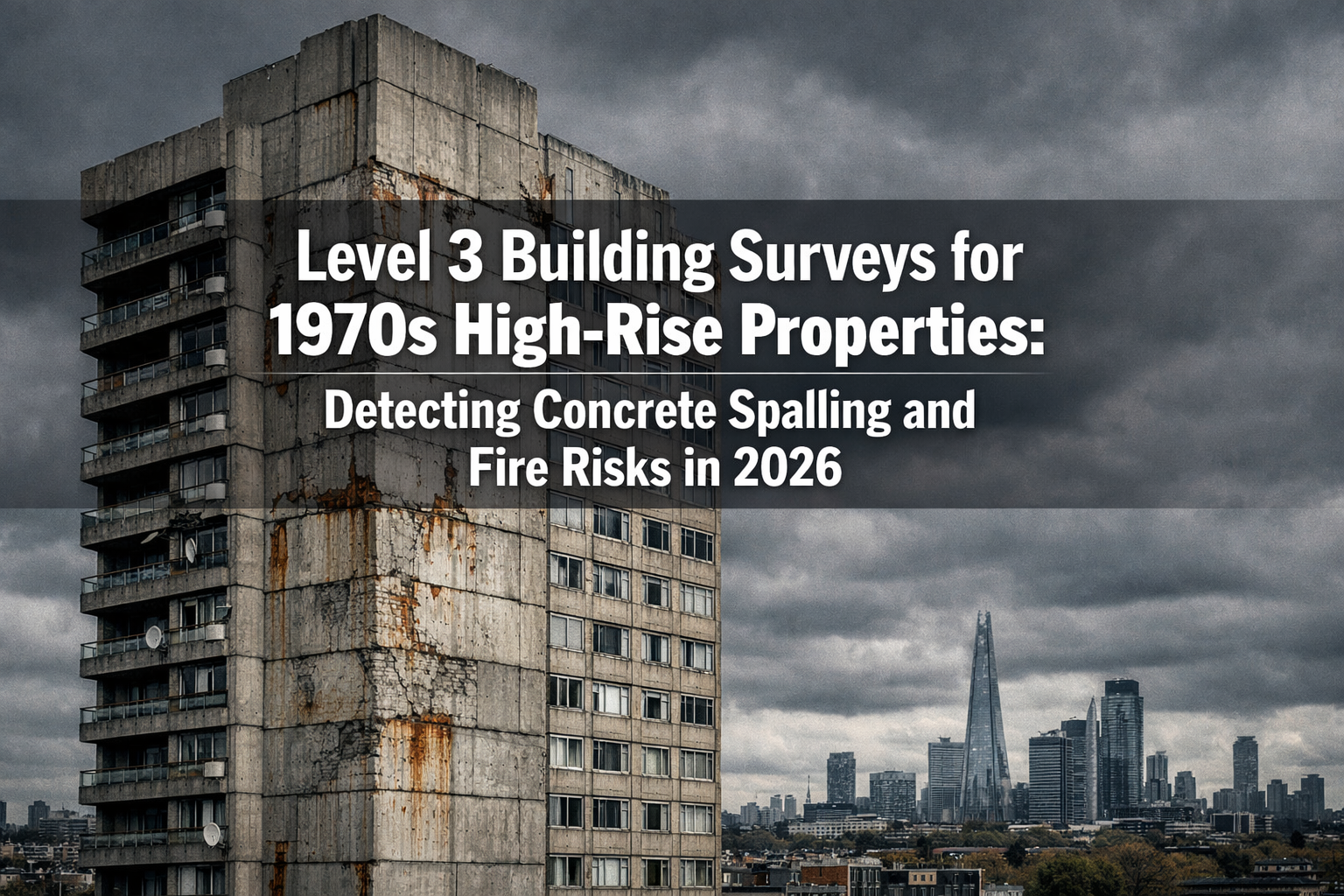

Over 1.5 million people in the UK live in high-rise residential buildings, and a significant proportion of those towers were built during the 1970s construction boom — an era defined by rapid delivery, cost-cutting, and concrete-first design philosophies that are now showing their age in dangerous ways. In 2026, Level 3 Building Surveys for 1970s High-Rise Properties: Detecting Concrete Spalling and Fire Risks in 2026 have moved from a professional best practice to an essential safeguard, driven by post-Grenfell regulatory reform, Awaab's Law extensions, and a cautious spring property market that demands full structural transparency before any transaction proceeds.
Key Takeaways 📋
- RICS Level 3 surveys are now the minimum standard for high-risk property assessments, including 1970s high-rise blocks, under the 2026 regulatory framework. [3]
- Concrete spalling and carbonation are the primary structural threats in 1970s towers, accelerated by water ingress and decades of deferred maintenance. [2]
- Fire risk in pre-1975 unsprinklered buildings is categorically different from modern equivalents — a single fire can become multi-floor untenable within minutes. [1]
- EWS1 certification and cladding assessments must be integrated into any Level 3 survey of a 1970s high-rise to satisfy lender and buyer requirements in 2026.
- Specialist follow-up investigations — including drone roof surveys, structural engineering reports, and specific defect reports — are frequently triggered by Level 3 findings.
Why 1970s High-Rises Demand the Highest Level of Survey Scrutiny
The post-Grenfell landscape has fundamentally changed how surveyors, lenders, and buyers approach older high-rise stock. Buildings constructed between 1965 and 1979 were built under entirely different standards — many predating the 1985 Building Regulations, and virtually all predating modern fire suppression requirements.
🔑 "The deterioration of vital life-safety systems in pre-1975 high-rises has been described by regulatory bodies as 'unconscionable' — and yet thousands of these buildings remain occupied today." [1]
In 2026, Level 3 Building Surveys for 1970s High-Rise Properties sit at the intersection of structural safety, fire compliance, and property law. The RICS framework now formally designates Level 3 (formerly known as the Full Building Survey or Structural Survey) as the minimum acceptable standard for high-risk property assessments. [3]
What Makes 1970s Construction Particularly Problematic?
| Construction Feature | Typical 1970s Approach | Risk in 2026 |
|---|---|---|
| Structural frame | In-situ reinforced concrete | Carbonation, spalling, rebar corrosion |
| Cladding | Precast concrete panels or early composite systems | Potential combustibility; EWS1 required |
| Fire stopping | Minimal cavity barriers | Rapid fire and smoke spread |
| Sprinkler systems | Rarely installed | Catastrophic escalation risk |
| Lift shafts | Open or poorly sealed | Chimney effect during fires |
| Flat roofs | Bitumen felt over concrete deck | Widespread water ingress |
These are not theoretical risks. A January 2026 fire at a pre-1975 high-rise in Towson, Maryland, documented generator failures, unsafe electrical conditions, unpermitted structural modifications, and ongoing sprinkler system failures — all in a single building. Investigators found that without sprinkler protection, the fire could have spread beyond the room of origin with untenable smoke conditions across multiple floors. [1]
For buyers, leaseholders, and freeholders of UK 1970s towers, this is a direct parallel to the risks present in similar domestic stock.
Understanding What Level 3 Building Surveys Cover in 1970s High-Rise Properties
A Level 3 survey is the most comprehensive inspection available through RICS-accredited surveyors. For a 1970s high-rise, the scope is both broader and deeper than for a standard residential property. [4]
Core Inspection Areas
A properly scoped Level 3 survey for a 1970s tower block will cover:
- ✅ Structural movement — subsidence, heave, differential settlement, and significant cracking patterns in the concrete frame
- ✅ Roof structure and coverings — condition of flat roof membranes, drainage, and any rooftop plant or mechanical equipment
- ✅ External walls and cladding — spalling concrete, panel fixings, joints, and EWS1-relevant cladding systems
- ✅ Internal walls, floors, and ceilings — construction details, evidence of movement, and damp penetration
- ✅ Damp and timber decay — particularly relevant in ground-floor and basement areas
- ✅ Fire safety observations — visible evidence of fire stopping, compartmentation, and sprinkler provision
- ✅ Maintenance planning advice — specific recommendations for the ongoing upkeep of older building fabric [4]
For chartered surveyors in London working on 1970s high-rise instructions, the survey report must go beyond standard condition ratings and provide actionable defect analysis with cost implications.
What Level 3 Surveys Do NOT Include ⚠️
It is equally important to understand the boundaries of a Level 3 survey:
- ❌ Invasive checks (lifting floorboards, drilling into walls)
- ❌ Testing of services (electrical, plumbing, gas)
- ❌ Specialist asbestos surveys
- ❌ Structural engineering calculations
- ❌ Fire risk assessments (FRA) — these require a separate qualified assessor [4]
When Level 3 findings indicate serious concerns, these trigger specialist follow-up. A residential structural engineer in London may be needed for frame analysis, while a specific defect report can provide targeted investigation of a single serious issue identified during the survey.
Detecting Concrete Spalling: The Hidden Structural Crisis in 1970s Towers
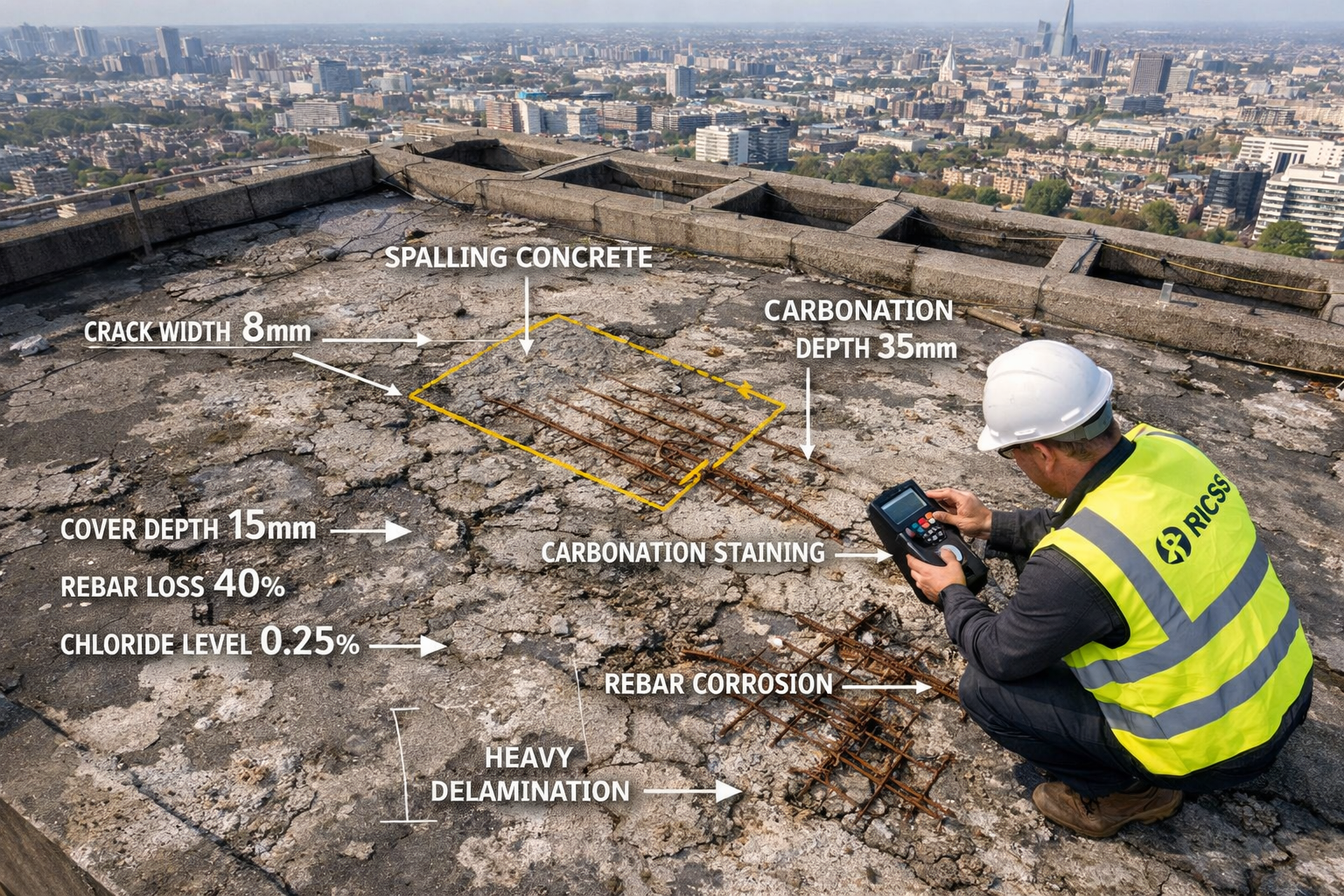
Concrete spalling is the single most common — and most dangerous — structural defect found in 1970s high-rise buildings. Understanding its causes and detection methods is central to Level 3 Building Surveys for 1970s High-Rise Properties: Detecting Concrete Spalling and Fire Risks in 2026.
How Concrete Spalling Develops
The process is gradual but accelerating:
- Water ingress — rainwater, condensation, or plumbing leaks penetrate the concrete matrix through cracks, joints, or porous surfaces. Water is the primary driver of major concrete damage in older high-rises. [2]
- Carbonation — atmospheric CO₂ reacts with calcium hydroxide in the concrete, raising acidity and reducing the alkaline protection that prevents rebar corrosion. Many 1970s structures are now reaching the point where carbonation depth has reached the reinforcement layer. [2]
- Rebar corrosion — once the protective alkalinity is lost, steel reinforcing bars begin to rust. Rust expands to approximately seven times the volume of the original steel.
- Delamination and spalling — the expanding rust exerts pressure that fractures the concrete cover, causing chunks to detach. In a high-rise, falling concrete fragments present a direct life-safety hazard.
🔑 "Predictions now suggest that many 1970s concrete structures are becoming carbon sinks — accelerating corrosivity and increasing the risk of partial or progressive collapse." [2]
Spalling Detection Checklist for Level 3 Surveyors
During a Level 3 survey of a 1970s high-rise, surveyors should systematically check:
| Location | What to Look For |
|---|---|
| External facade | Rust staining, cracking parallel to rebar, delaminated patches |
| Balconies and soffits | Exposed rebar, hollow-sounding concrete (tap test) |
| Stairwells and corridors | Ceiling delamination, damp patches, efflorescence |
| Car parks and podium decks | Chloride-induced corrosion from de-icing salts |
| Roof parapets | Freeze-thaw cracking, failed sealant joints |
| Expansion joints | Deteriorated sealants allowing water tracking |
A drone roof survey in London is increasingly used alongside Level 3 inspections to access areas of the building envelope that cannot safely be reached on foot — particularly upper-floor facades and roof plant areas.
EWS1 and Cladding Integration
Any 1970s high-rise with non-standard cladding, overcladding, or insulated render systems requires an EWS1 (External Wall System) assessment as part of the survey process. Without a valid EWS1 form, mortgage lenders will refuse to lend on affected units — a critical issue in the 2026 spring market where buyer confidence is already cautious.
Surveyors must flag:
- Presence of any combustible insulation within the external wall system
- Aluminium Composite Material (ACM) panels or similar products
- Overcladding applied to the original concrete frame without documented fire testing
- Missing or deteriorated cavity barriers
Fire Risk Assessment in 1970s High-Rise Buildings: What Level 3 Surveys Reveal
Fire safety in 1970s high-rises is not simply a matter of installing modern detectors. The structural design of these buildings creates systemic vulnerabilities that a Level 3 survey can identify — though a separate Fire Risk Assessment (FRA) is required for formal compliance. [1]
The Chimney Effect and Structural Fire Pathways
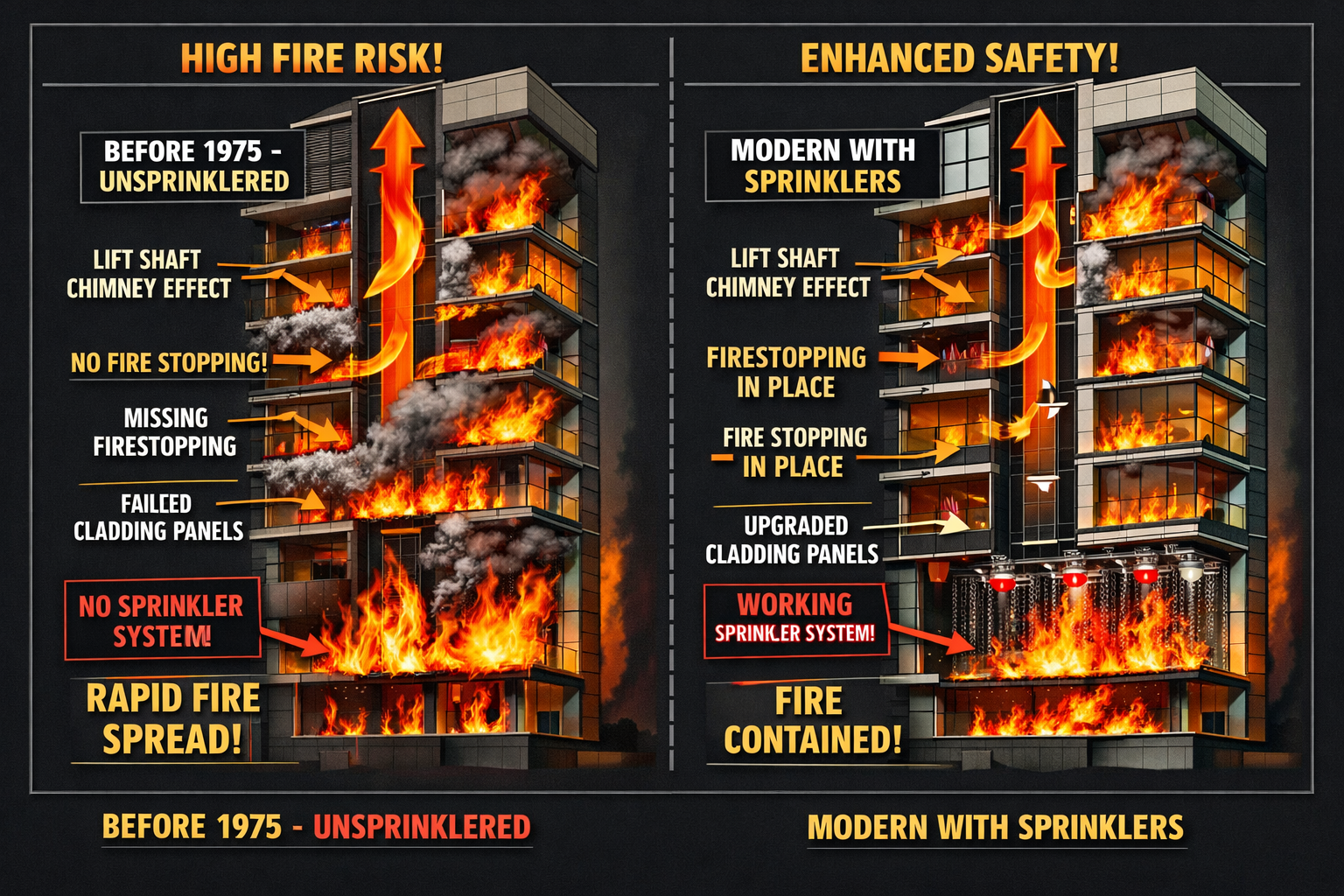
Historical case studies have demonstrated how 1970s high-rises are particularly vulnerable to rapid fire escalation. Empty or poorly sealed lift shafts act as chimneys, drawing flames and toxic smoke upward through the building at speed. Combustible modifications made by occupants over decades — suspended ceilings, partition walls, storage in service voids — compound this risk significantly. [2]
A layered fire protection approach is now required for high-rise safety, integrating:
- Automatic detection and alarm systems
- Emergency power and backup generators
- Smoke control systems
- Standpipes and dry/wet risers
- Automatic fire sprinkler systems
- Consistent inspection, testing, and maintenance programmes [1]
What a Level 3 Survey Can Observe
While a Level 3 survey is not a Fire Risk Assessment, a competent surveyor will note and report:
- Visible absence of sprinkler heads in communal areas or individual units
- Deteriorated fire doors — missing intumescent strips, damaged frames, propped-open positions
- Compromised compartmentation — holes in fire-rated walls or floors around service penetrations
- Failed or missing cavity barriers in the external wall system
- Evidence of unauthorised works that may have compromised fire stopping
- Condition of emergency lighting and signage (visual observation only)
For leaseholders considering alterations, understanding the implications for fire safety is essential — a licence to alter from the freeholder will typically require fire safety sign-off as a condition of consent.
The 2026 Regulatory Context
Under the Building Safety Act 2022 and its 2026 extensions, Principal Accountable Persons (PAPs) for high-rise residential buildings (over 18 metres or 7 storeys) face mandatory obligations including:
- Regular building assessments
- Resident engagement strategies
- Mandatory reporting of structural and fire safety defects
- Cooperation with the Building Safety Regulator
For buyers and leaseholders, this means that Level 3 Building Surveys for 1970s High-Rise Properties: Detecting Concrete Spalling and Fire Risks in 2026 are not just a due diligence exercise — they are a gateway to understanding the full regulatory liability attached to a property. [3]
Navigating the 2026 Spring Market: Survey Strategy for 1970s High-Rise Buyers
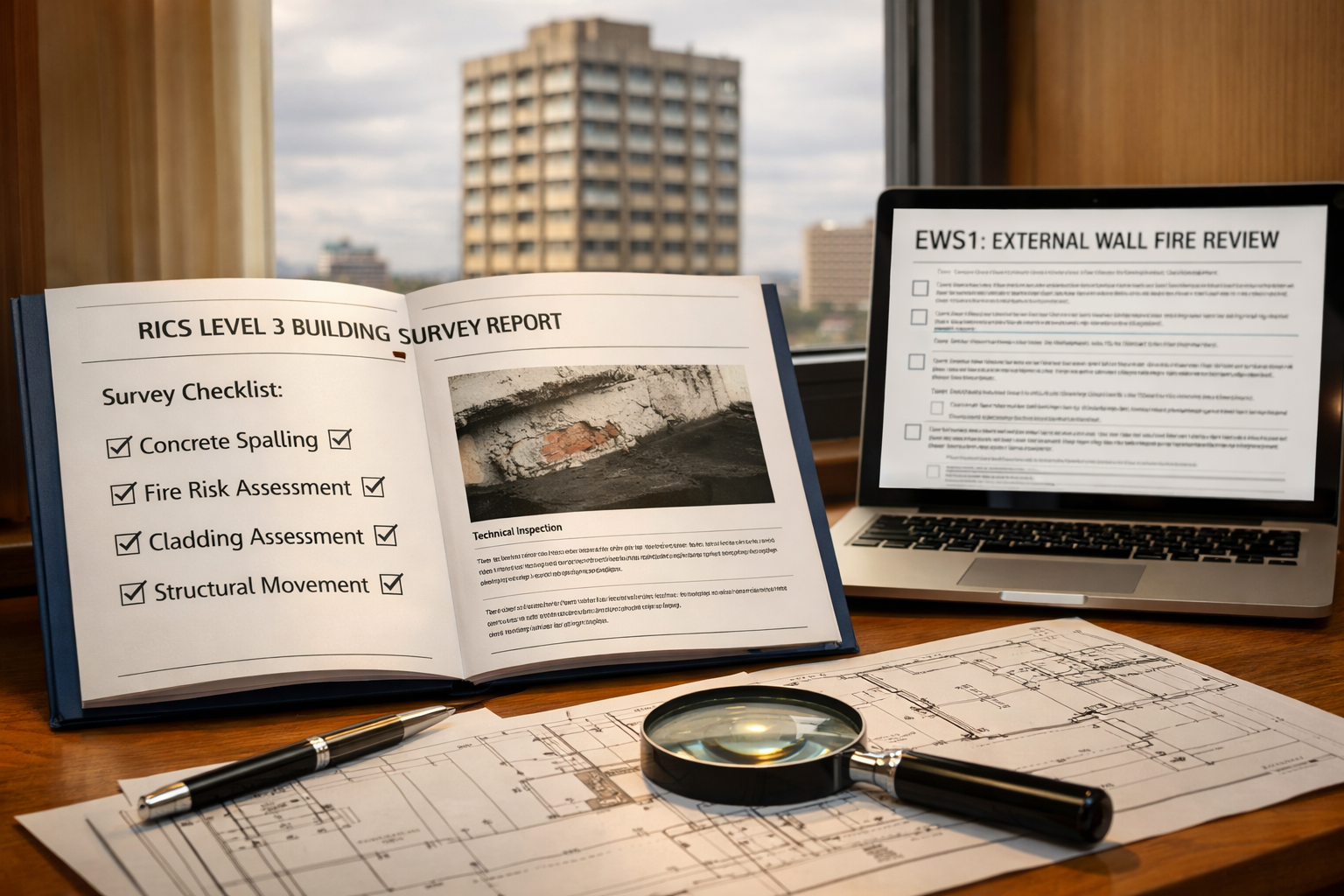
The 2026 spring property market has brought renewed activity to urban high-rise stock, but buyer caution remains high. Lenders, solicitors, and managing agents are all requesting greater documentation before transactions proceed on 1970s towers.
Before Instructing a Survey: Key Questions to Ask
🔍 Ask the vendor or managing agent:
- Is there a valid EWS1 certificate? When was it issued?
- Has a Fire Risk Assessment been completed in the last 12 months?
- Are there any active Section 20 notices for major works?
- What is the current reserve fund balance?
- Has the building been assessed under the Building Safety Act?
Choosing the Right Survey Type
Not all surveys are equal. For a 1970s high-rise, the decision is straightforward — a Level 3 survey is the only appropriate choice. For a comparison of survey levels and their scope, see this guide on homebuyer report vs building survey options to understand why a Level 2 report falls short for older high-rise stock.
If unsure which survey is right for a specific property type, a guide to what survey you need can help clarify the decision before instructing a surveyor.
Post-Survey Action Plan
When a Level 3 survey identifies serious defects — as it frequently does in 1970s high-rises — the following sequence is recommended:
- Obtain specialist reports for any flagged structural or fire issues before exchange
- Commission a specific defect report for concrete spalling or cladding concerns
- Request a drone roof survey if the roof condition is uncertain
- Instruct a structural engineer if frame integrity concerns are raised
- Negotiate on price or request remediation based on survey findings
- Check the Schedule of Condition for the property if taking on a lease — a schedule of condition report documents the property's state at the point of occupation, protecting against future dilapidations claims
For commercial high-rise transactions, the process is equally rigorous — commercial building surveys in London follow a similar Level 3 framework but with additional considerations for occupier fit-out and statutory compliance.
Conclusion: Actionable Steps for 1970s High-Rise Due Diligence in 2026
The combination of ageing concrete infrastructure, pre-modern fire safety design, and a tightening regulatory environment makes Level 3 Building Surveys for 1970s High-Rise Properties: Detecting Concrete Spalling and Fire Risks in 2026 an absolute non-negotiable for anyone buying, selling, or managing this type of asset.
✅ Actionable Next Steps
- Always instruct a RICS Level 3 survey — never a Level 1 or Level 2 — for any 1970s high-rise property transaction
- Verify EWS1 status before exchange — confirm the certificate covers all relevant parts of the external wall system
- Check for active Building Safety Act obligations on the specific building through the Building Safety Regulator's register
- Commission a drone roof survey if the Level 3 report flags roof or upper-facade concerns
- Instruct a structural engineer if carbonation, spalling, or frame movement is identified
- Request all fire safety documentation — FRA, sprinkler maintenance records, fire door inspection reports
- Budget for major works — most 1970s high-rises will have significant remediation costs within a 5–10 year horizon; factor this into purchase price negotiations
The risks embedded in 1970s high-rise stock are real, documented, and in many cases accelerating. A thorough Level 3 survey, conducted by an experienced RICS-accredited surveyor with high-rise expertise, is the most powerful tool available to buyers and owners navigating this complex market in 2026.
References
[1] High Rise Fire Safety Approach – https://nfsa.org/2026/01/20/high-rise-fire-safety-approach/
[2] Have Old High Rises Become Too High Risk – https://ww3.rics.org/uk/en/modus/business-and-skills/surveying-stories/have-old-high-rises-become-too-high-risk-.html
[3] Building Survey Protocols For Structural Collapse Risks Awaabs Law 2026 Extensions And High Risk Property Assessments – https://nottinghillsurveyors.com/blog/building-survey-protocols-for-structural-collapse-risks-awaabs-law-2026-extensions-and-high-risk-property-assessments
[4] What Does A Level 3 Survey Include 2025 – https://surveymatch.co.uk/what-does-a-level-3-survey-include-2025/