
Radon gas causes approximately 1,100 lung cancer deaths in the UK every year — more than road traffic accidents — yet the majority of homebuyers still complete a property purchase without any awareness of whether their new home sits above a high-risk geological zone. In granite-heavy regions like Devon, Cornwall, and parts of Northamptonshire, radon concentrations can exceed safe limits by a factor of ten or more. Understanding Building Survey Protocols for Radon Mitigation in High-Risk UK Regions: 2026 RICS Updates and Testing Strategies has never been more important for buyers, surveyors, and property professionals alike.
Key Takeaways 📋
- Surveyors identify radon risk; they do not measure it. A Level 3 Building Survey flags risk areas and recommends specialist testing — it does not replace dedicated radon measurement.
- The UK action level is 200 Bq/m³. Properties exceeding this threshold require remediation, and workplaces face additional regulatory obligations.
- RICS updated its Home Survey Standard in April 2026, strengthening how surveyors must report environmental hazards including radon in affected zones.
- Approved Document C (Building Regulations) has required radon-resistant construction since 1999, but millions of pre-1999 properties remain unprotected.
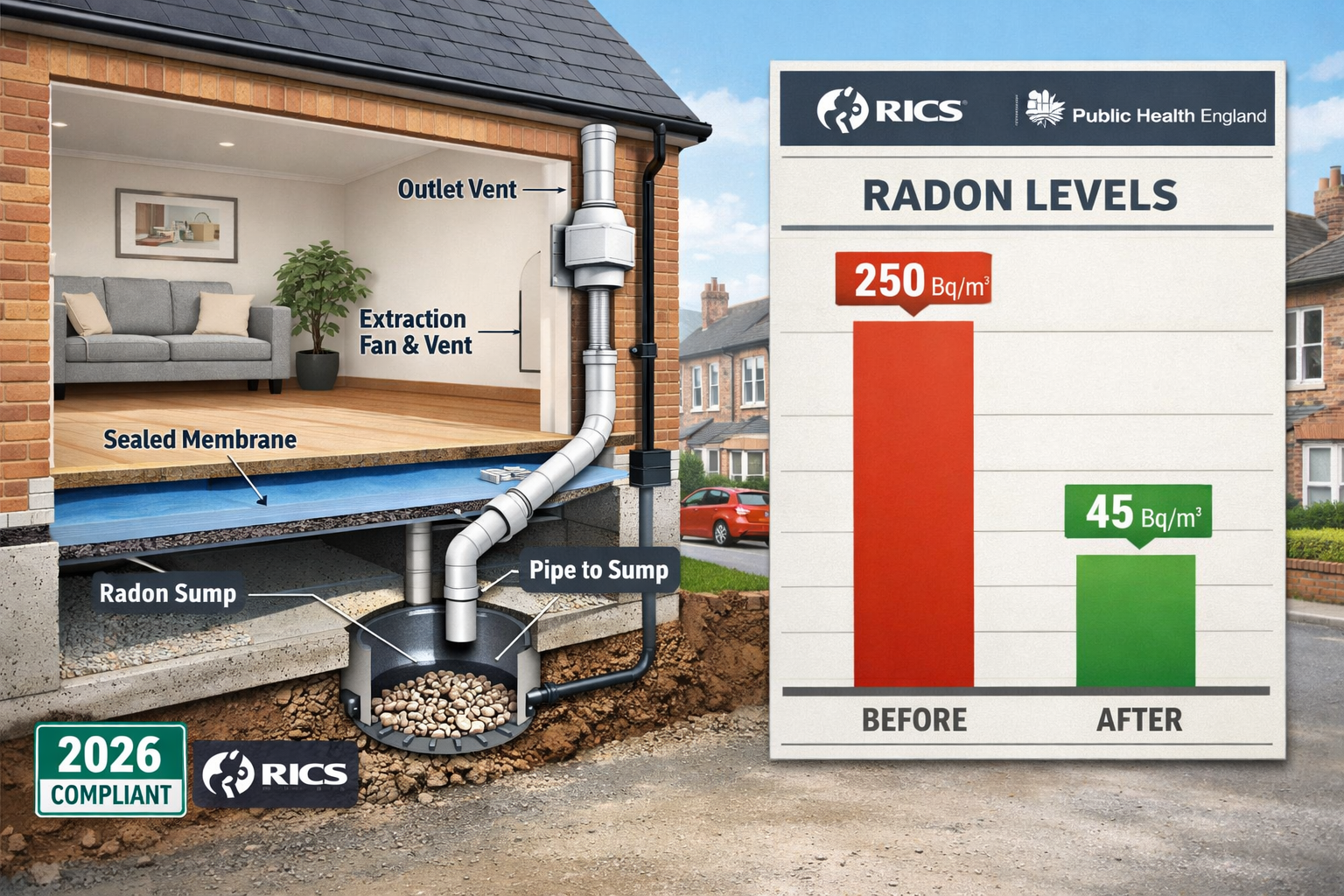
- Effective mitigation systems can reduce radon levels by up to 90%, making pre-purchase testing a highly cost-effective safeguard.
What Is Radon and Why Do Granite Regions Face Elevated Risk?
Radon is a naturally occurring radioactive gas produced by the decay of uranium in rocks and soils. It is colourless, odourless, and tasteless — entirely undetectable without specialist equipment. When radon seeps from the ground into enclosed buildings, it can accumulate to dangerous concentrations, particularly in lower floors and basements.
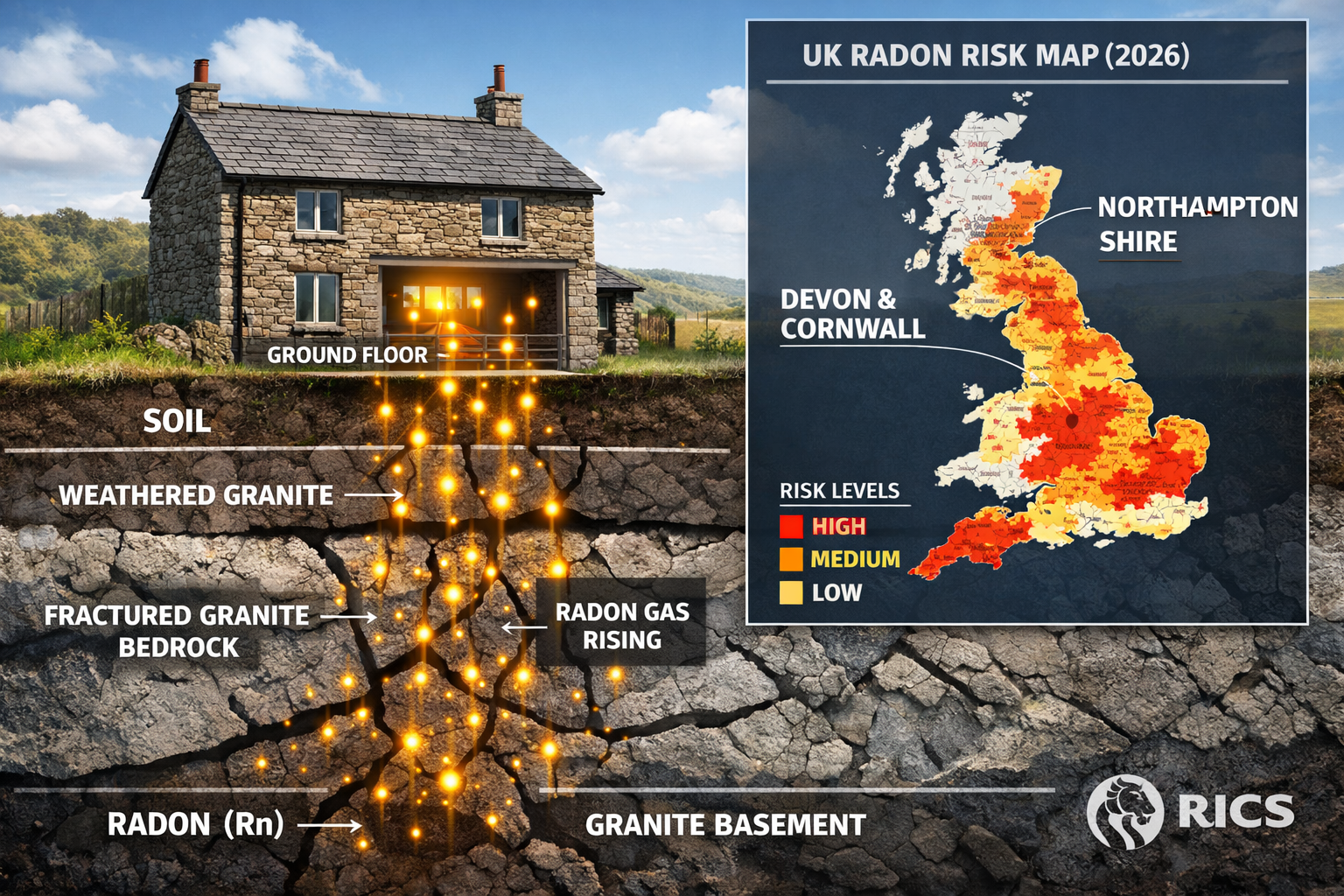
Granite geology is the primary driver of elevated radon risk in the UK. Granite contains higher concentrations of uranium than most other rock types, making areas underlain by granite — including much of Devon, Cornwall, Derbyshire, and parts of Scotland — statistically more likely to produce dangerous indoor radon levels [3].
💡 "Radon is the second leading cause of lung cancer in the UK after smoking, yet it remains one of the least-discussed environmental hazards in property transactions."
UK Radon Risk Zones at a Glance
| Region | Geology | Risk Level |
|---|---|---|
| Cornwall & Devon | Granite batholith | Very High |
| Northamptonshire | Limestone/ironstone | High |
| Derbyshire Peak District | Limestone & granite | High |
| Parts of Wales | Metamorphic/granite | Moderate–High |
| Most of London & SE England | Clay & chalk | Low–Moderate |
Public Health England (now UKHSA) maintains official radon maps that surveyors reference when assessing a property's environmental risk profile [2]. These maps define "radon affected areas" where 1% or more of homes are estimated to exceed the action level of 200 Bq/m³ [3].
Building Survey Protocols for Radon Mitigation in High-Risk UK Regions: 2026 RICS Updates and Testing Strategies
The April 2026 RICS Home Survey Standard Update
The Royal Institution of Chartered Surveyors published the second edition of its Home Survey Standard in April 2026, introducing enhanced requirements for how environmental hazards — including radon — must be identified, reported, and communicated to clients [7]. This update reflects growing recognition that environmental risk factors are material to property valuation and buyer decision-making [8].
Key changes relevant to radon in the 2026 standard include:
- Mandatory reference to official radon risk maps for all Level 2 and Level 3 surveys in England, Wales, Scotland, and Northern Ireland
- Clearer condition rating guidance for properties in high-risk zones where no radon mitigation measures are visually apparent
- Strengthened client advisory language, requiring surveyors to explicitly recommend specialist radon testing rather than offering it as a general suggestion [6]
- Enhanced documentation requirements for existing mitigation systems, including visual inspection of sumps, membranes, and extraction fans
For properties in Cornwall, Devon, and other granite-dominant areas, a Level 3 Building Survey — the most comprehensive inspection available — is strongly recommended. Chartered surveyors providing building surveyor services are now expected to apply heightened scrutiny to environmental risk factors under the updated standard.
What Surveyors Do (and Don't Do) Regarding Radon
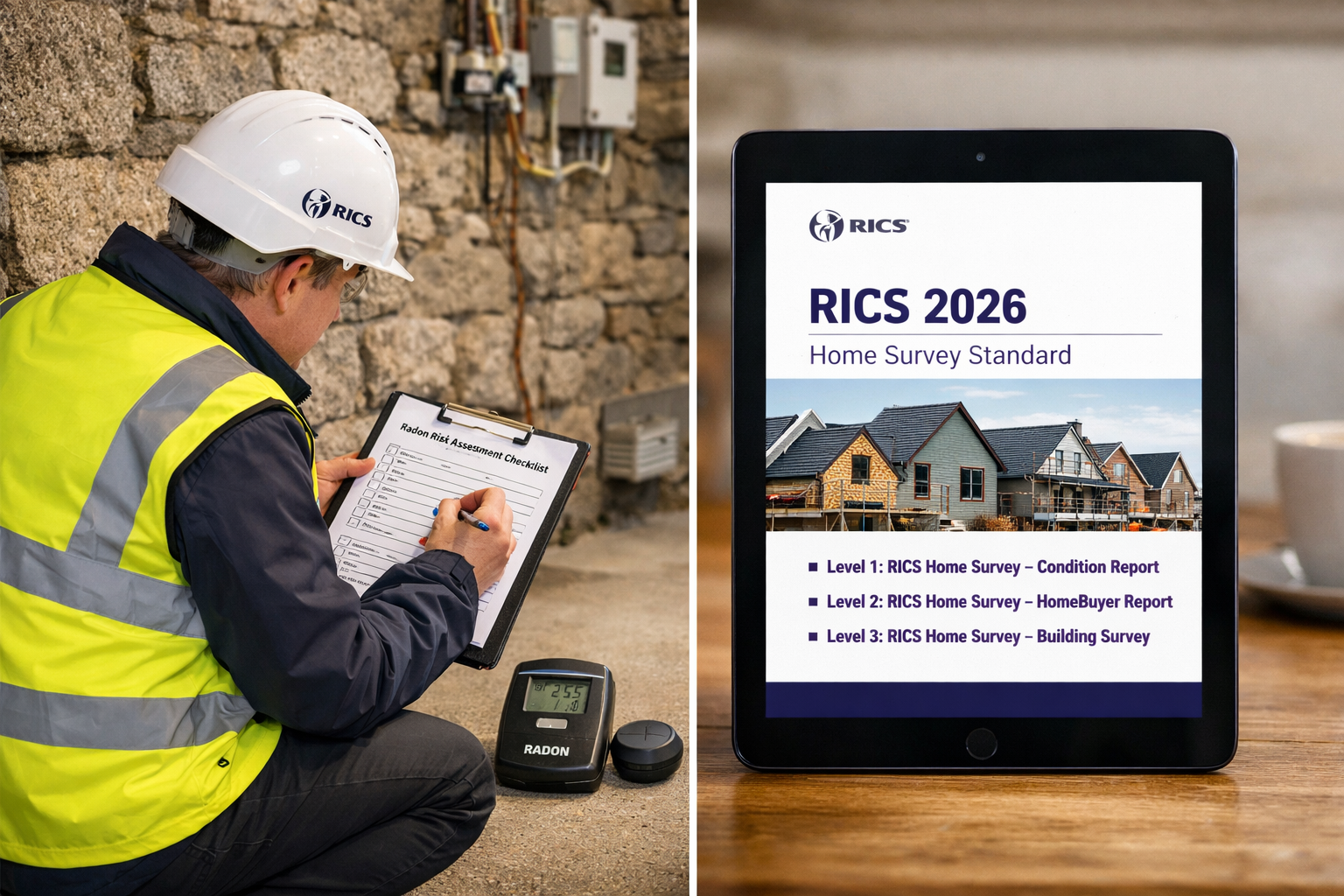
This is a critical distinction that many buyers misunderstand. Surveyors do not conduct radon testing. Their role is to:
- ✅ Identify whether a property falls within a radon-affected area using official maps
- ✅ Visually inspect for the presence or absence of radon-resistant construction features
- ✅ Note the age of the property relative to 1999 Building Regulations requirements
- ✅ Recommend specialist radon measurement where risk indicators are present
- ❌ They do not measure actual radon concentrations inside the building [2]
This means that even a clean Level 3 survey report does not confirm safe radon levels. The survey triggers the recommendation; a specialist test — typically using alpha-track detectors placed for a minimum of three months — provides the actual measurement data.
For buyers seeking expert surveyor advice on high-risk properties, understanding this boundary between survey scope and specialist testing is essential before exchange of contracts.
Testing Strategies: From Detection to Measurement
Types of Radon Testing Available in 2026
1. Alpha-Track Detectors (Long-Term Testing)
The gold standard for residential measurement. Small passive devices are placed in living areas and bedrooms for 90 days minimum (ideally over winter when buildings are better sealed). Results reflect average exposure and are the most reliable basis for mitigation decisions [5].
2. Electret Ion Chamber Detectors (Short-Term Testing)
Used for faster results — typically 2–7 days. Useful in property transactions where time is limited, but results are less reliable than long-term testing due to daily and seasonal radon fluctuations [1].
3. Continuous Electronic Monitors
Increasingly used in commercial and workplace settings. Provide real-time readings and data logging, making them valuable for properties where ground-floor and below-ground workplaces must comply with occupational health regulations [3].
When Testing Should Occur
| Scenario | Recommended Action |
|---|---|
| Pre-purchase in high-risk area | Commission short-term test; negotiate on results |
| New occupant in affected zone | Test within first year of occupation [3] |
| Post-remediation verification | Test after 3+ months to confirm reduction |
| Commercial/workplace premises | Mandatory assessment for ground-floor areas [3] |
| Pre-planning for extensions | Consult BRE Report BR 211 guidance [3] |
Public Health England advises that all new houses in radon-affected areas should be tested within the first year of occupation, and that existing homes where levels exceed the action level must be remediated [3]. For buyers of older properties in Devon or Cornwall, commissioning a test before exchange — rather than after completion — provides the strongest negotiating position.
Interpreting Results
- Below 100 Bq/m³: No action required
- 100–200 Bq/m³: Consider remediation, especially for vulnerable occupants
- Above 200 Bq/m³: Action level — remediation strongly recommended [3]
- Above 300 Bq/m³ (workplaces): HSE notification may be required if levels cannot be reduced below this threshold [3]
Remediation and Mitigation: What the Survey Should Flag
Building Regulations and Radon-Resistant Construction
Since 1999, Approved Document C of the Building Regulations has required all new homes in England to incorporate radon and damp-proof membranes. In more severely affected areas, passive radon sumps are also required, with provisions for active extraction fans to be added later if testing reveals elevated levels [3].
Equivalent requirements apply in Wales, Scotland, and Northern Ireland, ensuring that post-1999 new builds across the UK have baseline protection [3]. However, the vast majority of the UK's housing stock predates these requirements — and it is these older properties in high-risk zones that present the greatest concern.
The 2015 BRE Report BR 211 remains the definitive technical guide for radon protective measures across all building types, including extensions, conversions, and refurbishments [3]. Surveyors conducting Level 3 inspections should reference this document when assessing existing mitigation infrastructure.
Common Mitigation Methods
🔧 Positive Pressurisation (Positive Input Ventilation)
A fan unit — typically installed in the loft — pushes fresh air into the building, diluting radon concentrations. Effective in many property types and relatively low cost.
🔧 Radon Sump Systems
A pipe is inserted beneath the floor slab or into the sub-floor void, connected to an extraction fan that draws radon-laden air from the ground before it can enter the building. This is the most effective method, capable of reducing levels by up to 90% [4].
🔧 Sub-Floor Ventilation Enhancement
For suspended timber floors, improving underfloor ventilation through additional airbricks can significantly reduce radon entry. Surveyors should note blocked or insufficient airbricks in their reports.
🔧 Sealing Entry Points
Gaps around service pipes, floor joints, and cracks in solid floors can be sealed to reduce radon ingress, though this is rarely sufficient as a standalone measure.
For properties requiring structural assessment alongside radon mitigation planning, a residential structural engineer in London or regional equivalent can advise on whether proposed sump installation or sub-floor modifications require additional structural consideration.
Valuation Impacts and Pre-Purchase Certainty
How Radon Affects Property Value
Radon risk — particularly when confirmed by elevated test results — can materially affect property value. Buyers face the cost of:
- Specialist testing (typically £50–£150 for long-term detectors)
- Mitigation system installation (£500–£2,500 depending on method)
- Post-remediation testing to verify results
- Potential mortgage lender requirements for remediation before completion
Lenders are increasingly aware of radon risk in high-risk postcodes. Some may require evidence of acceptable radon levels or an installed mitigation system before releasing funds, particularly for properties in Cornwall and Devon.
For a comprehensive view of how environmental factors interact with property valuation, RICS registered valuers can provide formal valuations that account for remediation costs and risk discounts where appropriate.
The Role of Specific Defect Reports
Where a standard Level 2 survey identifies radon risk but a buyer requires more detailed investigation of a specific concern — such as an existing sump system of unknown age or a cracked floor slab — a specific defect report can provide focused technical analysis without the cost of a full Level 3 survey.
Similarly, buyers of newly built properties in high-risk zones should commission a snagging report to verify that radon-resistant construction measures specified under Approved Document C have been correctly installed by the developer.
Practical Checklist: Building Survey Protocols for Radon Mitigation in High-Risk UK Regions: 2026 RICS Updates and Testing Strategies
Use this checklist when commissioning or reviewing a building survey for a property in a radon-affected area:
Before Commissioning the Survey:
- Check the UKHSA radon map for the property's postcode
- Confirm the surveyor holds RICS membership and is familiar with the 2026 Home Survey Standard
- Request a Level 3 Building Survey for all properties in high-risk zones
- Ask the surveyor to specifically address radon risk in their scope of works
During the Survey Process:
- Surveyor should reference official radon risk maps [2]
- Visual inspection of sub-floor construction and any existing mitigation measures
- Assessment of floor slab integrity and potential radon entry points
- Review of any existing radon test results held by the vendor
After Receiving the Survey Report:
- If radon risk is flagged, commission specialist long-term testing before exchange
- Obtain quotes for mitigation if short-term test results are elevated
- Factor remediation costs into purchase price negotiations
- Verify post-remediation levels after any works are completed [5]
For properties in areas like Berkshire, Buckinghamshire, or Hertfordshire — which include pockets of elevated radon risk — chartered surveyors in Berkshire and chartered surveyors in Buckinghamshire can provide regionally informed Level 3 surveys that address local geological risk factors.
Conclusion: Actionable Next Steps for Buyers and Property Professionals
Radon is not a fringe concern — it is a legally recognised health hazard with clear regulatory frameworks, measurable action levels, and proven mitigation solutions. The 2026 RICS Home Survey Standard updates have strengthened the obligation on surveyors to address this risk transparently, particularly in high-risk regions where granite geology creates conditions for dangerous gas accumulation.
For property buyers:
- Always commission a Level 3 Building Survey for properties in Devon, Cornwall, Northamptonshire, Derbyshire, or any area flagged on the UKHSA radon map
- Treat a surveyor's radon risk flag as a trigger for specialist testing — not a reason to walk away
- Commission long-term alpha-track testing before exchange of contracts in high-risk areas
- Use confirmed elevated results as a negotiating tool for price reduction or vendor-funded remediation
For property professionals:
- Familiarise with the April 2026 RICS Home Survey Standard second edition requirements [7]
- Reference BRE Report BR 211 when assessing mitigation infrastructure in survey reports [3]
- Ensure client advisory language in reports explicitly recommends specialist testing rather than merely noting risk
- Maintain awareness of HSE notification thresholds for commercial and workplace premises [3]
Radon mitigation is not expensive relative to the cost of a property transaction — but the consequences of ignoring it can be severe. With the right survey protocols, testing strategies, and remediation measures in place, buyers can proceed with genuine confidence.
References
[1] How Will Radon Testing Impact My Development Project – https://www.scsengineers.com/how-will-radon-testing-impact-my-development-project/
[2] Do Surveyors Check For Radon – https://surveymatch.co.uk/do-surveyors-check-for-radon/
[3] Assessing Threats To Health From Radon – https://ww3.rics.org/uk/en/journals/property-journal/assessing-threats-to-health-from-radon-.html
[4] 07 Lutes VI Mitigation – https://iavi.rti.org/assets/docs/2026_West/07_Lutes-VI-mitigation.pdf
[5] 2026 Radon Awareness And Safety Guide – https://resphealth.org/2026-radon-awareness-and-safety-guide/
[6] Building Surveying Standards – https://www.rics.org/profession-standards/rics-standards-and-guidance/sector-standards/building-surveying-standards
[7] Home Survey Standard 2nd Edition April 2026 Update – https://www.rics.org/news-insights/home-survey-standard-2nd-edition-april-2026-update
[8] Building Survey Quality Standards 2026 Navigating Rics Updates And Enhanced Home Inspection Requirements – https://nottinghillsurveyors.com/blog/building-survey-quality-standards-2026-navigating-rics-updates-and-enhanced-home-inspection-requirements
Meta Title: Radon Mitigation Building Survey Protocols: 2026 RICS Updates
Meta Description: Discover 2026 RICS building survey protocols for radon mitigation in high-risk UK regions. Testing strategies, action levels, and remediation guidance for buyers.