
The North West England property market is experiencing a remarkable transformation in 2026, defying national trends and creating unprecedented opportunities for surveyors and property professionals. While London struggles with declining values and the South East stagnates, the North West has emerged as a powerhouse, recording annual house price growth of 4.5%—nearly double the UK average.[1] This dramatic shift represents more than just a statistical anomaly; it signals a fundamental realignment of the UK property landscape, with affordability-driven demand propelling northern regions to the forefront of market activity.
For surveyors operating in this dynamic environment, understanding the Valuation Surveys for North West England Boom: Surveyor Playbook for 2026 Regional Price Momentum has become essential to delivering accurate, forward-looking valuations that capture the region's unique trajectory. The traditional valuation frameworks designed for stable or declining markets must now adapt to accommodate sustained growth, increased transaction volumes, and evolving buyer demographics.
This comprehensive guide provides chartered surveyors, valuation professionals, and property specialists with actionable strategies to navigate the North West's booming market, leveraging RICS methodologies and regional insights to deliver exceptional service in 2026's most dynamic property landscape.
Key Takeaways
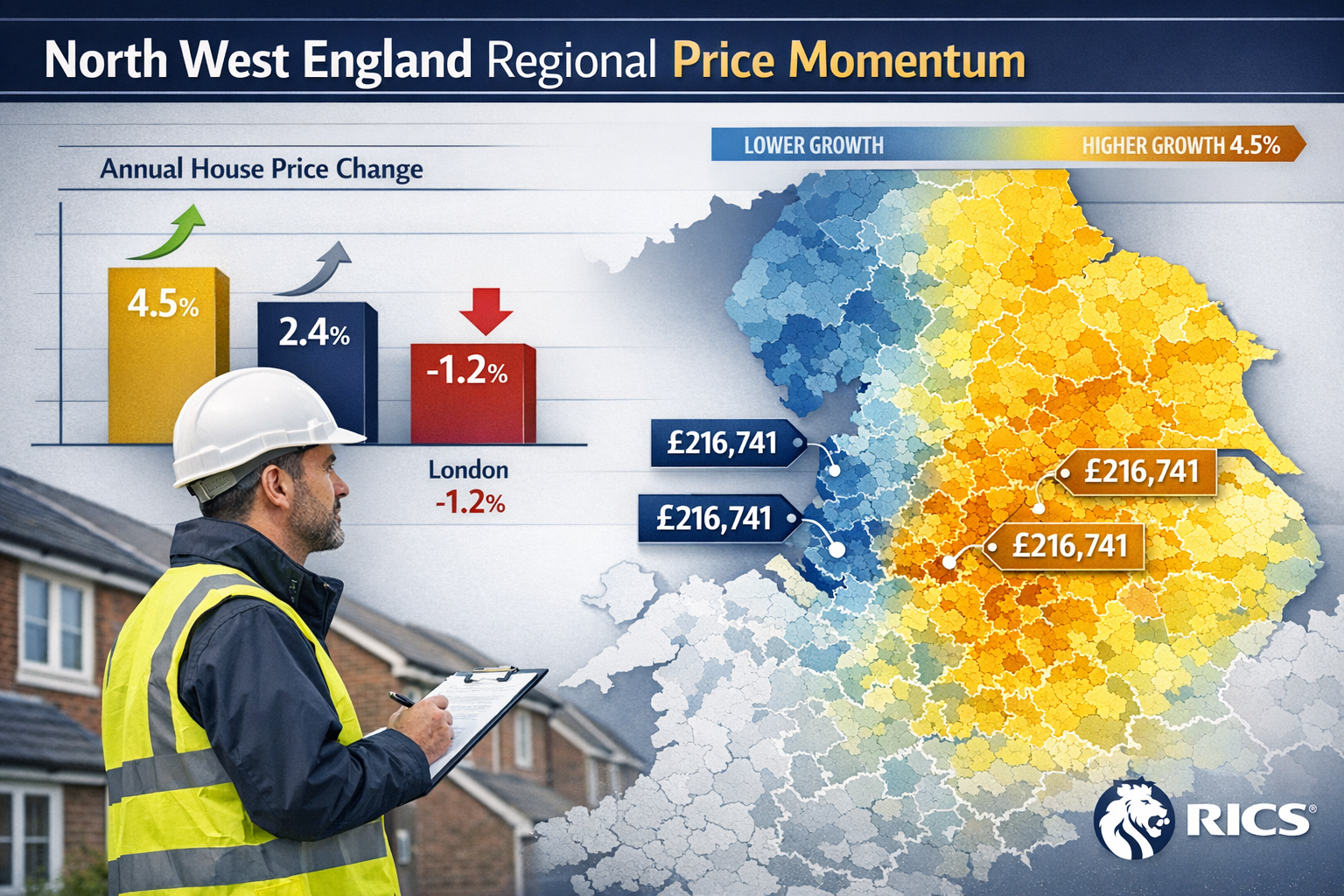
✅ North West England leads regional growth with 4.5% annual house price increases, significantly outperforming the UK average of 2.4% and contrasting sharply with London's -1.2% decline.[1][2]
✅ Affordability advantage drives demand, with average North West property prices at £216,741 compared to the UK average of £270,000, attracting buyers priced out of southern markets.[2]
✅ RICS survey data confirms upward trajectory for North West valuations, with market conditions "starting to turn a corner" and sustained buyer activity expected throughout 2026.[3][4]
✅ Mortgage accessibility improvements with rates stabilising at 3.75-4.75% and expanding 95-100% LTV products directly benefit the region's lower-value properties.[5]
✅ Strategic valuation approaches must incorporate regional growth patterns, comparable evidence from accelerating markets, and forward-looking adjustments to reflect momentum.
Understanding the North West England Property Boom: 2026 Market Dynamics
The North-South Divide Reaches Critical Mass
The UK property market has witnessed a dramatic geographical rebalancing in 2026, with the North West England boom representing the most visible manifestation of this transformation. According to the latest UK House Price Index data, the North West achieved annual growth of 4.5% in the year to December 2025, establishing itself as one of the strongest performing regions nationally.[1]
This performance stands in stark contrast to traditional market leaders. London recorded negative annual growth of -1.2%, while the South East managed only 1.0% growth—the slowest rate among all English regions.[2] The North East leads all regions with exceptional growth of 6.8%, followed by the North West at 4.1% and Yorkshire & Humber at 3.7%, creating a clear pattern of northern outperformance.[2]
Economic Fundamentals Driving Regional Momentum
Several interconnected economic factors underpin the Valuation Surveys for North West England Boom: Surveyor Playbook for 2026 Regional Price Momentum:
Affordability Advantage 📊
The North West's average property price of £216,741 represents approximately 80% of the national average, creating substantial purchasing power for buyers migrating from higher-cost regions.[2] This affordability gap has widened as southern markets have stagnated, making the North West increasingly attractive to first-time buyers, young families, and investors seeking rental yields.
Employment Growth and Economic Resilience
Peter Graham, head of real estate and construction for the North at RSM UK, reports "remarkable resilience" in the North West housing market, attributing sustained buyer activity to improving affordability and returning market confidence.[1] Major cities including Manchester, Liverpool, and Preston benefit from diversified economies, expanding technology sectors, and significant infrastructure investment.
Mortgage Market Evolution
UK inflation dropped to 3% in the year to January 2026, with further significant falls expected in April, supporting expectations for additional Bank of England interest rate reductions throughout 2026.[1] Mortgage rates are forecast to stabilise around 3.75% to 4.75% across most products, easing affordability pressures particularly for first-time buyers.[5] The expansion of 95% and 100% mortgage products directly benefits lower-value regional markets like the North West.[5]
RICS Market Intelligence: Turning the Corner
The RICS January 2026 Residential Market Survey provides authoritative confirmation that market conditions are "starting to turn a corner," with the North West and North of England reporting prices on an upward trajectory.[3][4] This represents a fundamental shift from the autumn 2025 period, when budget uncertainty suppressed market activity across the UK.
Rightmove data from January 2026 shows the largest monthly asking price increase in more than two decades, indicating strengthening buyer activity and renewed confidence.[1] For surveyors conducting Red Book valuations, this market intelligence provides critical context for assessing current values and near-term price expectations.
Valuation Surveys for North West England Boom: Core Methodology Adaptations
Comparable Evidence Selection in Accelerating Markets
Traditional comparable evidence analysis assumes relatively stable market conditions, but the North West England boom requires surveyors to adapt their selection criteria and weighting methodologies. When regional prices are rising at 4.5% annually—approximately 0.375% monthly—comparables from six months ago may significantly understate current market values.
Recommended Comparable Framework:
| Time Period | Weighting | Adjustment Factor | Rationale |
|---|---|---|---|
| 0-3 months | 70% | Minimal adjustment | Most reflective of current market |
| 3-6 months | 25% | +2-3% uplift | Captures recent momentum |
| 6-12 months | 5% | +4-5% uplift | Historical context only |
| 12+ months | Exclude | N/A | Market conditions fundamentally different |
This framework ensures valuations reflect current market dynamics while maintaining the evidential rigour required for RICS registered valuers and mortgage lending purposes.
Geographic Micro-Market Analysis
The North West encompasses diverse property markets with varying growth trajectories. Preston is forecast to outperform the UK average due to strong employment growth, university influence, and ongoing regeneration investment.[5] Meanwhile, established areas of Manchester and Liverpool experience different demand patterns based on proximity to employment centres, transport links, and amenity provision.
Surveyors must develop granular knowledge of these micro-markets:
- City Centre Apartments: High rental demand from young professionals, but potential oversupply concerns in some developments
- Victorian Terraces: Strong first-time buyer demand, particularly in regeneration areas with good transport links
- Suburban Family Homes: Benefiting from hybrid working patterns and school catchment area premiums
- Commuter Belt Properties: Attracting buyers priced out of southern markets seeking larger homes and gardens
When conducting valuation surveys, understanding which micro-market segment a property occupies is essential for selecting appropriate comparables and applying accurate adjustments.
Adjusting for Market Momentum in RICS Valuations
The RICS Valuation – Global Standards (Red Book) requires valuers to reflect market conditions at the valuation date, but rapidly appreciating markets present practical challenges. A property valued in January 2026 may exchange in March 2026, by which time market values could have increased by 0.75% based on current growth rates.
Momentum Adjustment Protocol:
- Establish Baseline Value: Use recent comparables (0-3 months) to determine current market value
- Apply Market Conditions Adjustment: Consider RICS net balance data showing upward trajectory[3][4]
- Document Market Evidence: Reference regional growth statistics and local demand indicators
- Provide Caveats: Note that values are subject to continued market movement
- Recommend Revaluation Triggers: Suggest revaluation if completion delays exceed 90 days
This approach balances professional conservatism with market reality, ensuring clients receive valuations that reflect genuine market conditions without speculative inflation.
Property Condition and Improvement Potential
In a rising market, properties requiring modernisation or improvement often represent particular value. Buyers in the North West increasingly view renovation projects as opportunities to add value while securing properties in desirable locations at entry-level prices.
Surveyors should clearly differentiate between:
- Current Market Value: Based on existing condition
- Improved Market Value: Reflecting potential post-renovation value
- Development Potential: Considering extensions, conversions, or change of use
Providing this tiered analysis helps buyers, lenders, and investors understand both current value and future potential—particularly relevant for building surveys that identify improvement opportunities.
Surveyor Playbook: Practical Strategies for 2026 Regional Price Momentum
Strategy 1: Develop Regional Market Intelligence Systems
Successful surveyors in the North West boom market maintain systematic intelligence-gathering processes:
Weekly Market Monitoring 🔍
- Track new listings and price changes on major portals (Rightmove, Zoopla, OnTheMarket)
- Monitor sold prices through Land Registry data
- Review local estate agent market reports and newsletters
- Attend property auctions to gauge buyer sentiment and pricing
Quarterly Trend Analysis
- Compile comparable evidence databases organized by property type and location
- Calculate average price per square foot/metre for key property categories
- Identify emerging hotspots and cooling areas
- Adjust valuation assumptions based on observed trends
Annual Strategic Review
- Assess regional economic indicators (employment, wages, infrastructure investment)
- Review RICS residential market surveys for directional guidance[3][4]
- Update comparable evidence weighting methodologies
- Refine micro-market boundaries based on observed price patterns
This systematic approach ensures valuations remain grounded in current market reality rather than outdated assumptions.
Strategy 2: Enhanced Client Communication and Expectation Management
The Valuation Surveys for North West England Boom: Surveyor Playbook for 2026 Regional Price Momentum requires surveyors to educate clients about market dynamics:
For Buyers:
- Explain that valuations reflect current market conditions, which are appreciating
- Discuss the importance of acting decisively in competitive markets
- Highlight that mortgage valuations may come in at or above offer prices in rising markets
- Recommend appropriate survey levels based on property type and condition
For Sellers:
- Provide evidence-based pricing recommendations that reflect recent comparable sales
- Explain how market momentum supports realistic pricing expectations
- Identify property improvements that maximize value in current market conditions
- Advise on optimal timing for market entry based on seasonal patterns
For Lenders:
- Document market evidence supporting valuations comprehensively
- Provide forward-looking market commentary based on RICS data and regional indicators
- Flag any concerns about sustainability of current price levels
- Recommend appropriate loan-to-value ratios reflecting market conditions
Transparent communication builds trust and positions surveyors as strategic advisors rather than mere technicians.
Strategy 3: Specialization in High-Growth Property Segments
Rather than attempting to cover all property types across the entire North West, successful surveyors increasingly specialize in specific segments:
First-Time Buyer Properties (£150,000-£220,000)
This segment experiences particularly strong demand due to expanding mortgage availability and affordability advantages. Specialization requires:
- Deep knowledge of Help to Buy, shared ownership, and 95% LTV mortgage criteria
- Understanding of leasehold valuation considerations
- Expertise in modern apartment developments and starter homes
- Awareness of local authority schemes and regeneration initiatives
Family Homes (£220,000-£400,000)
The core market benefiting from southern migration and hybrid working patterns:
- School catchment area analysis and premium quantification
- Garden and outdoor space valuation in post-pandemic context
- Period property expertise (Victorian/Edwardian terraces and semi-detached homes)
- Extension and improvement potential assessment
Investment Properties
Strong rental yields attract investors to the North West market:
- Rental valuation methodology and yield analysis
- HMO (House in Multiple Occupation) licensing and valuation implications
- Student accommodation market knowledge (Manchester, Liverpool, Preston)
- Portfolio valuation expertise for landlords and institutional investors
Specialization enables surveyors to command premium fees while delivering superior service quality.
Strategy 4: Technology Integration for Efficiency and Accuracy
Modern valuation practice increasingly relies on technology to enhance accuracy and efficiency:
Digital Measurement Tools 📱
- Laser distance measurers for precise floor area calculations
- Drone technology for roof surveys and external inspections
- 3D scanning for complex properties or heritage buildings
- Digital floor plan creation software
Valuation Software and Databases
- Automated Valuation Models (AVMs) as secondary evidence sources
- Comparable evidence databases with geographic search functionality
- Report generation software ensuring RICS compliance
- Client portals for efficient document delivery and communication
Market Intelligence Platforms
- Subscription services providing real-time market data
- Land Registry API integration for immediate sold price access
- Planning portal monitoring for development activity
- Economic data dashboards tracking regional indicators
Technology adoption doesn't replace professional judgment but enhances the evidence base supporting valuation conclusions.
Strategy 5: Continuous Professional Development and RICS Compliance
The rapidly evolving North West market demands ongoing professional development:
Essential CPD Topics for 2026:
- RICS Valuation – Global Standards updates and amendments
- Regional market analysis and forecasting methodologies
- Sustainability and EPC implications for property values
- Leasehold reform legislation and valuation impacts
- Mortgage market developments and lending criteria changes
Professional Networking:
- Active participation in RICS regional groups and events
- Collaboration with local estate agents and property professionals
- Attendance at property investment and development conferences
- Engagement with local authority planning and regeneration teams
Quality Assurance:
- Regular internal file reviews ensuring consistency and compliance
- Peer review arrangements for complex or high-value instructions
- Professional indemnity insurance adequate for market conditions
- Complaint handling procedures and client satisfaction monitoring
Maintaining the highest professional standards protects both clients and surveyors while supporting the profession's reputation.
Regional Hotspots and Valuation Considerations for 2026

Manchester: The Northern Powerhouse Engine
Manchester continues to drive North West growth through economic diversification, infrastructure investment, and cultural appeal. The city's property market exhibits distinct characteristics:
City Centre:
- High-rise apartment developments attracting young professionals and investors
- Rental yields of 5-7% supporting investment demand
- Potential oversupply concerns in specific developments requiring careful analysis
- Transport connectivity (Metrolink, rail) commanding significant premiums
Suburban Villages:
- Didsbury, Chorlton, and Altrincham experiencing strong family home demand
- School catchment areas creating localized price premiums of 10-15%
- Period property renovation projects popular with affluent buyers
- Hybrid working supporting demand in well-connected outer areas
Valuation Priorities:
- Assess new-build apartment developments for oversupply risk
- Quantify transport connectivity premiums accurately
- Evaluate renovation potential in period properties
- Consider rental market fundamentals for investment properties
Liverpool: Cultural Renaissance and Affordability
Liverpool offers exceptional value compared to other major UK cities while benefiting from cultural appeal and economic regeneration:
Waterfront and Baltic Triangle:
- Regeneration driving significant value appreciation
- Creative industries and digital sector employment growth
- New-build apartments and converted warehouses
- Tourism and leisure economy supporting rental demand
Residential Suburbs:
- Victorian terraces in areas like Aigburth and Sefton Park
- Family homes at prices significantly below national averages
- Strong first-time buyer market due to affordability
- University influence supporting rental markets
Valuation Priorities:
- Identify regeneration areas with sustainable growth prospects
- Assess student accommodation market dynamics
- Evaluate period property condition and improvement requirements
- Consider tourism and short-term rental potential in city centre locations
Preston: The Emerging Opportunity
Preston is forecast to outperform the UK average in 2026 due to strong fundamentals:[5]
Growth Drivers:
- University of Central Lancashire student population
- Major employers including BAE Systems and public sector
- Ongoing city centre regeneration and retail improvements
- Excellent transport links (M6, West Coast Main Line)
Property Market Characteristics:
- Exceptional affordability with average prices well below regional mean
- Strong rental demand from students and young professionals
- Period terraces and Victorian properties requiring modernisation
- New-build developments on brownfield sites
Valuation Priorities:
- Assess regeneration impact on specific locations
- Evaluate student rental market sustainability
- Consider transport connectivity premiums
- Identify properties with improvement potential
Smaller Towns and Commuter Belt
Towns including Warrington, Wigan, Bolton, and Stockport benefit from affordability and connectivity:
Market Characteristics:
- Family homes attracting buyers priced out of city centres
- Commuter demand for properties near rail stations
- Local employment bases reducing pure commuter dependency
- Schools and amenities supporting stable demand
Valuation Priorities:
- Quantify commuting time and cost implications
- Assess local employment diversity and resilience
- Evaluate school quality and catchment area impacts
- Consider hybrid working influence on location premiums
Risk Management and Professional Liability Considerations
Identifying and Disclosing Market Risks
While the North West boom presents opportunities, professional surveyors must identify and disclose potential risks:
Market Sustainability Concerns ⚠️
- Assess whether current growth rates are sustainable long-term
- Consider potential interest rate increases dampening demand
- Evaluate local employment vulnerability to economic downturns
- Monitor new-build supply potentially exceeding demand
Property-Specific Risks:
- Structural issues common in period properties (subsidence, damp, defective construction)
- Leasehold ground rent and service charge escalation clauses
- Environmental concerns (flooding, contamination, radon)
- Planning restrictions limiting improvement or development potential
Valuation Report Disclosures:
- Clearly state assumptions and limitations
- Reference market conditions and growth rates
- Identify risks that could affect future values
- Recommend specialist investigations where appropriate
Professional Indemnity Insurance Adequacy
Rising property values require surveyors to review professional indemnity insurance coverage:
Coverage Considerations:
- Ensure per-claim limits reflect current property values
- Verify aggregate annual limits provide adequate protection
- Confirm coverage for all valuation types undertaken
- Review retroactive coverage for historical instructions
Claims Prevention:
- Maintain comprehensive file documentation
- Use standard terms of engagement clearly defining scope
- Obtain client confirmations of key assumptions
- Implement quality assurance reviews before report issue
Regulatory Compliance and RICS Standards
All valuations must comply with RICS Valuation – Global Standards:
Key Requirements:
- Independence and objectivity in all instructions
- Competence for property type and location
- Appropriate basis of value clearly stated
- Market evidence supporting conclusions
- Compliance with mandatory technical standards
For surveyors working across regions, understanding how chartered surveyors operate in different areas provides valuable perspective on maintaining consistent professional standards.
Future Outlook: Sustaining the North West Momentum Through 2026 and Beyond
Economic Forecasts and Market Predictions
Paula Higgins, HomeOwners Alliance CEO, forecasts UK house prices will be approximately 2% higher in 2026, with the north-south divide expected to persist as northern regions continue outperforming the south.[2] For the North West specifically, several factors support continued momentum:
Positive Indicators: ✅
- Inflation declining to 3% with further falls expected[1]
- Interest rate reductions anticipated throughout 2026
- Mortgage rates stabilising at 3.75-4.75%[5]
- Sustained affordability advantage versus southern regions
- Infrastructure investment (HS2, Northern Powerhouse Rail)
- Economic diversification reducing regional vulnerability
Potential Headwinds: ⚠️
- Global economic uncertainty affecting UK growth
- Potential interest rate volatility if inflation proves sticky
- New-build supply potentially exceeding demand in specific locations
- Political uncertainty affecting investor confidence
- Climate change adaptation costs for older properties
Preparing for Market Evolution
Surveyors must prepare for evolving market conditions:
Scenario Planning:
- Continued Growth Scenario: Maintain current methodologies with regular comparable evidence updates
- Stabilisation Scenario: Adjust weighting toward longer-term comparables as growth moderates
- Correction Scenario: Revert to conservative valuation approaches emphasizing downside risks
Adaptive Strategies:
- Maintain flexible comparable evidence frameworks
- Monitor leading indicators (mortgage approvals, new listings, viewing activity)
- Develop relationships with multiple market intelligence sources
- Invest in technology enabling rapid methodology adjustments
Sustainability and Energy Efficiency Impact
Environmental considerations increasingly affect property values:
EPC Regulations:
- Minimum EPC ratings for rental properties rising to Band C by 2028
- Potential future requirements for owner-occupied properties
- Retrofit costs affecting values of poorly performing properties
- Premium values for energy-efficient homes
Valuation Implications:
- Assess improvement costs to achieve required EPC ratings
- Quantify value differential between efficient and inefficient properties
- Consider future regulatory risks in valuation assumptions
- Advise clients on improvement priorities maximizing value
Understanding these trends positions surveyors as strategic advisors helping clients navigate the evolving property landscape.
Conclusion: Mastering the North West England Valuation Opportunity

The Valuation Surveys for North West England Boom: Surveyor Playbook for 2026 Regional Price Momentum represents both significant opportunity and professional responsibility for chartered surveyors and property professionals. With annual growth of 4.5% outpacing the UK average by nearly double, and average prices at £216,741 providing substantial affordability advantages, the region has established itself as the UK's most dynamic property market.[1][2]
Success in this environment requires surveyors to adapt traditional methodologies to accommodate sustained growth, develop deep regional market intelligence, and maintain the highest professional standards while delivering client value. The strategies outlined in this playbook—from enhanced comparable evidence frameworks to technology integration and specialization—provide a comprehensive foundation for excellence.
Actionable Next Steps for Surveyors
Immediate Actions (Next 30 Days): 📋
- Review and update comparable evidence databases with recent North West sales data
- Assess current valuation methodologies for adequacy in rising market conditions
- Verify professional indemnity insurance coverage reflects current property values
- Identify target specialization areas aligned with market demand
- Schedule CPD activities addressing regional market analysis and RICS standards
Medium-Term Initiatives (Next 90 Days):
- Develop systematic market intelligence gathering processes
- Invest in technology tools enhancing efficiency and accuracy
- Build relationships with local estate agents, developers, and property professionals
- Create client education materials explaining market dynamics and valuation approaches
- Implement quality assurance procedures ensuring consistency and compliance
Strategic Positioning (Next 12 Months):
- Establish recognized expertise in specific property segments or geographic areas
- Contribute to professional discussions through RICS events and publications
- Develop predictive market analysis capabilities using economic indicators
- Build referral networks with complementary professionals (solicitors, mortgage brokers, financial advisors)
- Monitor market evolution and adjust strategies based on emerging trends
The North West England property boom of 2026 represents a generational opportunity for surveyors who combine professional expertise with market insight and client service excellence. By implementing the strategies outlined in this comprehensive playbook, property professionals can deliver exceptional value while building sustainable, successful practices in the UK's most dynamic regional market.
For surveyors seeking to expand their expertise across different valuation types, exploring resources on valuation reports and understanding what survey you need for different property transactions provides valuable context for comprehensive service delivery.
The combination of affordability-driven demand, economic resilience, and improving mortgage accessibility positions the North West for sustained outperformance throughout 2026 and beyond. Surveyors who master the regional dynamics, maintain rigorous professional standards, and adapt to evolving market conditions will find themselves at the forefront of the UK's most exciting property market transformation.
References
[1] Uk House Price Index North West Outperforms As Buyers Chase Value Beyond The South – https://www.liverpoolchamber.org.uk/news/2026/02/uk-house-price-index-north-west-outperforms-as-buyers-chase-value-beyond-the-south/
[2] House Price Forecast – https://hoa.org.uk/advice/guides-for-homeowners/i-am-buying/house-price-forecast/
[3] Uk Residential Market Survey January 2026 – https://www.rics.org/content/dam/ricsglobal/documents/market-surveys/uk-residential-market-survey/UK-Residential-Market-Survey_January-2026.pdf
[4] Uk Resi Survey Jan 2026 Report Shows Early Signs Market Recovery Despite Caution – https://www.rics.org/news-insights/uk-resi-survey-jan-2026-report-shows-early-signs-market-recovery-despite-caution
[5] Uk Property Market Forecast For 2026 What Buyers Should Expect – https://www.farrellheyworth.co.uk/blog/uk-property-market-forecast-for-2026-what-buyers-should-expect/