
Nearly one in five property transactions in the UK is affected by a down-valuation at some point in the buying process, a figure that has remained stubbornly persistent even as the market has shifted through 2025 and into 2026. For buyers, sellers, and brokers alike, the surveyor's report is not a formality. It is the document that can confirm a mortgage offer, trigger restrictive lending conditions, or unravel an agreed sale entirely.
Understanding mortgage lending: how surveyor reports influence approval, conditions and down-valuations is therefore essential knowledge for anyone navigating a property purchase or refinance in 2026. This guide explains the valuation methodology surveyors use, how defects and market conditions feed into their findings, and what practical steps can be taken when a report produces an unwelcome result.
Key Takeaways
- Lenders rely on RICS-qualified surveyors to produce independent mortgage valuation reports before approving a loan, and those reports directly determine how much is lent.
- New RICS professional standards effective January 2026 require surveyors to apply formally tighter, more conservative valuation criteria when assessing property as loan security [1].
- A down-valuation occurs when the surveyor's assessed value falls below the agreed purchase price, forcing buyers to renegotiate, increase their deposit, or walk away.
- Defect reporting, covering structural issues, damp, roofing problems, and more, can trigger additional lending conditions that must be satisfied before funds are released.
- Buyers have practical options to challenge a down-valuation, including commissioning an independent survey, submitting comparable evidence, and requesting a formal review.
The Surveyor's Role in the Mortgage Lending Process
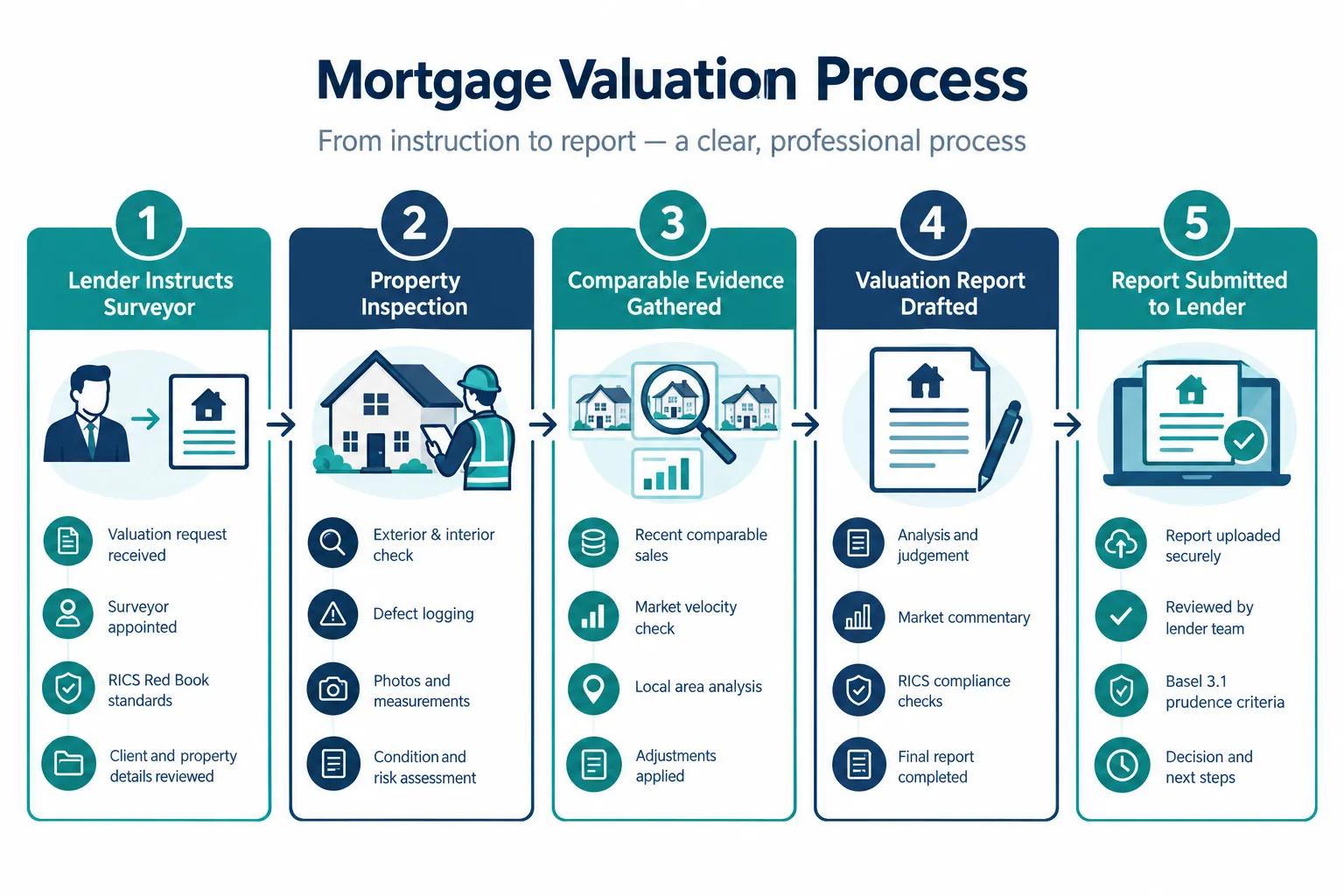
When a buyer applies for a mortgage, the lender does not simply accept the agreed purchase price as proof of the property's worth. Instead, the lender instructs a RICS-qualified surveyor to carry out an independent mortgage valuation. This report answers one central question: is the property worth at least as much as the loan being requested?
The surveyor's findings sit at the heart of mortgage lending: how surveyor reports influence approval, conditions and down-valuations. Without a satisfactory valuation, the lender has no reliable basis on which to advance funds.
What a Mortgage Valuation Report Contains
A standard mortgage valuation report is not the same as a full structural survey. It is a shorter document prepared for the lender's benefit, not the buyer's. However, its contents carry enormous weight. A typical report will include:
- The assessed market value of the property as at the date of inspection
- Comparable sales evidence, recent transactions of similar properties nearby
- A condition summary flagging material defects or risks
- Reinstatement cost for insurance purposes
- Any special assumptions or qualifications that affect the valuation
The RICS Valuation – Global Standards (the Red Book), reissued in January 2025, provides the overarching framework surveyors must follow when preparing these reports [7][8]. The UK national supplement, also reissued in January 2025, adds country-specific requirements that apply to all residential mortgage valuations in England, Wales, Scotland, and Northern Ireland [10].
For buyers who want a more detailed picture of the property's condition alongside the lender's valuation, it is worth understanding the differences outlined in the HomeBuyers Report vs Building Survey guide before instructing any survey work.
The New 2026 Professional Standards
A significant development for 2026 is the introduction of the RICS "Bank Lending Valuations" professional standard, which formally came into effect on 1 January 2026 [1]. This standard tightens the framework for how surveyors value property specifically as loan security across Europe. Key changes include:
- Greater transparency in the assumptions underpinning each valuation
- Explicit requirements to reflect market velocity, how quickly or slowly properties are selling in a given area
- Structured risk commentary addressing buyer demand weakness and local price divergence
- Closer alignment with Basel 3.1 "prudently conservative valuation criteria" (PCVC), which pushes lenders and their appointed valuers toward adjusted, cautious collateral values rather than pure market value [2]
"Mortgage valuations in 2026 are intentionally conservative. Lender risk tolerance remains low even as interest rates ease, and the new RICS standards codify that caution into every report."
This shift matters because it means surveyors are now formally required to factor in market softness, not just the headline comparable sales figure. A property in an area where buyer enquiries have weakened, or where price reductions are common, may receive a lower valuation than a comparable property in a more active market, even if the bricks-and-mortar condition is identical [5].
How Surveyor Reports Shape Mortgage Approval and Lending Conditions
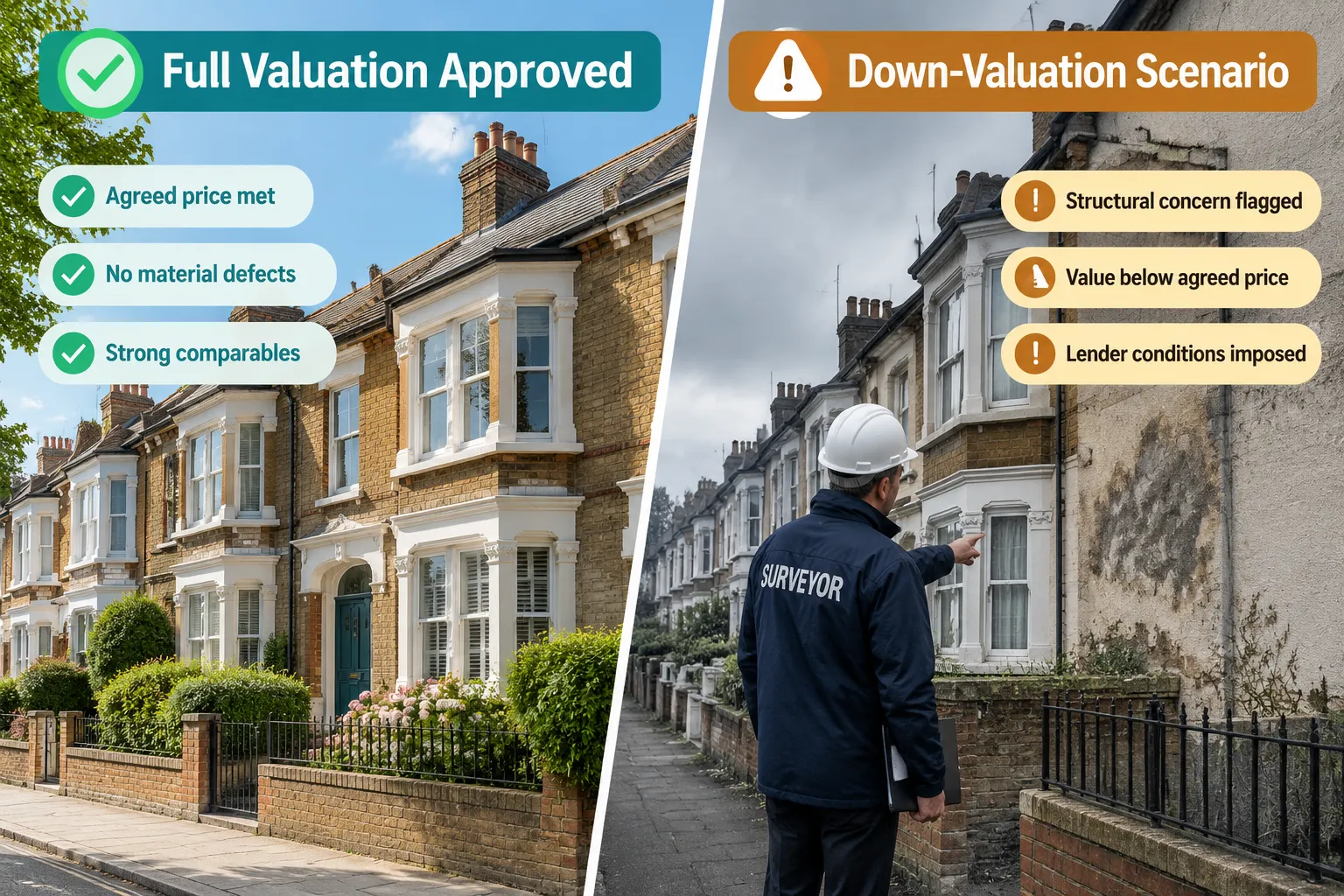
The relationship between the surveyor's report and the lender's decision is direct and largely non-negotiable. Once the report is submitted, the lender's underwriting team uses it as the primary basis for three outcomes: full approval, conditional approval, or refusal to lend at the agreed level.
Full Approval
When the surveyor's assessed value meets or exceeds the agreed purchase price, and no material defects are flagged, the lender can proceed to issue a formal mortgage offer. This is the straightforward outcome most buyers hope for.
Conditional Approval
Conditional approval is far more common than many buyers expect. The lender agrees in principle to advance the funds, but attaches specific conditions to the offer. These conditions typically arise from the defect section of the surveyor's report and may include:
| Condition Type | Typical Trigger | Common Requirement |
|---|---|---|
| Retention | Roof in poor condition | Funds withheld until repair completed |
| Specialist report | Suspected structural movement | Independent structural engineer's report |
| Damp investigation | Rising or penetrating damp noted | Specialist damp survey before completion |
| Electrical inspection | Outdated wiring flagged | NICEIC or equivalent electrical certificate |
| Legal indemnity | Unauthorised extension | Indemnity insurance policy obtained |
A retention means the lender holds back a portion of the mortgage funds, sometimes several thousand pounds, until the buyer or seller provides evidence that the flagged defect has been remedied. This can delay or complicate completion significantly.
For buyers dealing with properties that have structural or condition concerns, reviewing the most common property defects found in a building survey provides useful context on what surveyors are likely to flag.
Refusal to Lend
In some cases, the surveyor's findings are serious enough that the lender declines to advance any funds at all. This is relatively rare but can occur when:
- The property has severe structural failure
- There is evidence of subsidence without a satisfactory engineer's report
- The property is unmortgageable in its current state (e.g., no kitchen or bathroom)
- The title or lease has issues that make the security unacceptable
Understanding what a Red Book valuation involves helps buyers appreciate the rigour behind these assessments and why lenders treat the surveyor's conclusions as authoritative.
Down-Valuations: Causes, Consequences and How to Respond

A down-valuation is the outcome that causes the most disruption in a property transaction. It occurs when the surveyor's assessed value is lower than the price the buyer has agreed to pay. The gap between the two figures is the problem: the lender will only advance a percentage of the surveyor's value, not the agreed price.
Example: A buyer agrees to pay £400,000 for a property. The surveyor values it at £375,000. With an 80% loan-to-value mortgage, the lender will advance 80% of £375,000 (£300,000), not 80% of £400,000 (£320,000). The buyer must find an additional £20,000 from their own resources or renegotiate the price.
Why Down-Valuations Happen in 2026
Down-valuations are sufficiently common in 2026 that brokers and sellers are now advised to prepare evidence packs proactively [6]. Several factors drive them:
- Overpriced asking prices: Sellers and agents sometimes price optimistically, particularly in slower markets
- Weak comparable evidence: In areas with few recent transactions, surveyors have limited data and tend toward caution
- Market velocity adjustments: Under the new 2026 RICS standards, surveyors must explicitly reflect weakening buyer demand, which can pull valuations below agreed prices [5]
- Property-specific defects: Structural issues, short leases, or non-standard construction all reduce assessed value
- New-build premiums: New-build properties often carry a developer premium that the open market may not fully support, heightening down-valuation risk [3]
The Consequences for Buyers
A down-valuation does not automatically end a transaction, but it does force a decision. The buyer's options are:
- Renegotiate the price with the seller to match the surveyor's figure
- Increase the deposit to cover the gap between the surveyor's value and the agreed price
- Challenge the valuation through a formal review or independent report
- Walk away from the transaction entirely
Option three is increasingly relevant in 2026. Industry guidance confirms that buyers can and should challenge down-valuations when they believe the surveyor's figure is wrong [6]. The challenge process typically involves:
- Submitting comparable sales evidence that supports the agreed price
- Commissioning an independent RICS valuation
- Requesting that the original surveyor reconsiders specific comparable properties
- In some cases, escalating to a formal dispute resolution process
For buyers who believe a surveyor has acted negligently or produced a materially incorrect report, the surveyor negligence expert witness service provides specialist support in building a formal case.
Practical Steps for Sellers and Agents
Sellers are not passive in this process. Preparing a property for a mortgage valuation, and having evidence ready to support the asking price, can reduce the risk of a down-valuation:
- Compile a comparable sales pack showing recent transactions of similar properties within a half-mile radius
- Address visible defects before the valuation inspection takes place
- Provide documentation for any improvements, extensions, or planning permissions
- Be transparent about lease length on leasehold properties, short leases are a common trigger for both down-valuations and lending conditions
Buyers and sellers in London and the South East can access specialist support from chartered surveyors in Surrey and central London surveyors who understand local market nuances that national panel valuers may overlook.
Choosing the Right Survey Alongside the Mortgage Valuation
A mortgage valuation is carried out for the lender, not the buyer. It does not provide the buyer with a detailed assessment of the property's condition. Buyers who rely solely on the mortgage valuation report, and many do, risk missing significant defects that could cost thousands of pounds to remedy after completion.
The RICS residential survey framework offers three levels of survey:
- RICS Level 1 (Condition Report): Basic traffic-light condition ratings, suitable for newer properties in good condition
- RICS Level 2 (HomeBuyer Report): More detailed, includes a market valuation and condition ratings; suitable for conventional properties
- RICS Level 3 (Building Survey): Comprehensive structural inspection; recommended for older, larger, or unusual properties
For buyers uncertain which level is appropriate, the property surveys overview provides a clear starting point, and the structural survey cost guide for 2026 sets out current fee expectations.
Commissioning a Level 2 or Level 3 survey alongside the mortgage valuation gives buyers independent knowledge of the property's condition. This matters for two reasons: it protects the buyer from unexpected repair costs, and it provides evidence that can be used to challenge a mortgage valuation if defects are assessed differently by the buyer's own surveyor.
Defects That Commonly Trigger Lending Conditions
Surveyors preparing mortgage valuation reports are trained to identify defects that represent a risk to the lender's security. The most frequently flagged issues include:
- Damp and timber decay, rising damp, penetrating damp, dry rot, wet rot
- Roof defects, missing tiles, failed flat roofs, deteriorating flashings
- Structural movement, cracking patterns consistent with subsidence or settlement
- Non-standard construction, concrete panel, prefabricated, or steel-framed buildings
- Short leasehold, leases below 70 years are routinely flagged; below 60 years can make a property unmortgageable with many lenders
- Japanese knotweed, presence within seven metres of the property triggers mandatory disclosure and often a retention
Each of these defects can result in either a reduced valuation, a retention condition, or a requirement for a specialist report before the mortgage offer is confirmed [4].
The Broader Framework: RICS Standards and Lender Expectations in 2026
The professional standards governing mortgage valuations have become more demanding, not less, in recent years. The RICS Valuation – Global Standards (Red Book Global) sets the international baseline [7], while the UK national supplement and the new Bank Lending Valuations standard layer on additional requirements specific to loan security work [1][10].
Key themes running through the 2026 framework include:
- Transparency of assumptions: Surveyors must now clearly state the assumptions underpinning their valuation, including any adjustments made for market conditions
- Loan-security context: Valuations prepared for mortgage purposes must explicitly address the property's suitability as security, not just its market value
- Conservative bias: Basel 3.1 PCVC requirements mean that where there is uncertainty, surveyors are expected to err on the side of caution [2]
- Residential complexity: New-build properties, shared ownership, and evolving tenure structures require additional care and often produce more cautious valuations [3]
For buyers or investors who need a formal RICS valuation for purposes beyond mortgage lending, such as capital gains tax, lease extension, or right-to-buy, the RICS valuation cost guide provides current fee benchmarks across different valuation types.
Conclusion
Surveyor reports are not a bureaucratic hurdle in the mortgage lending process, they are the mechanism through which lenders assess risk, set loan amounts, and impose conditions that protect both the institution and, indirectly, the borrower. In 2026, with new RICS professional standards formally in force and lender risk appetite remaining cautious, the surveyor's role has become more influential, not less.
Actionable next steps for buyers:
- Commission a Level 2 or Level 3 survey alongside the lender's mortgage valuation to gain independent knowledge of the property's condition.
- Research comparable sales in the area before the valuation inspection and have evidence ready to submit if a down-valuation occurs.
- Address visible defects and gather documentation for any improvements before the surveyor's visit.
- If a down-valuation is received, do not accept it passively, request a review, submit comparable evidence, and consider an independent RICS valuation.
- For leasehold properties, check the remaining lease term before proceeding; a short lease can trigger conditions or prevent lending entirely.
- Work with a locally experienced RICS surveyor who understands the specific market dynamics of the area, rather than relying solely on a national panel valuer.
Understanding mortgage lending: how surveyor reports influence approval, conditions and down-valuations is not just useful knowledge, in a market where one report can determine whether a transaction proceeds, it is essential.
References
[1] Bank Lending Valuations – rics.org
[2] Valuation Standards – rics.org
[3] Residential Valuations – rics.org
[4] Valuation December 2025 – rics.org
[5] Valuation Adjustments Amid February 2026 Rics Survey Slump Techniques For Weak Buyer Enquiries And Price Caution – princesurveyors.co.uk
[6] Mortgage Valuation Came In Low What To Do Uk 2026 – valuq.co.uk
[7] Red Book Global – rics.org
[8] Red Book – rics.org
[10] Uk National Supplement Reissuedjan25 – rics.org