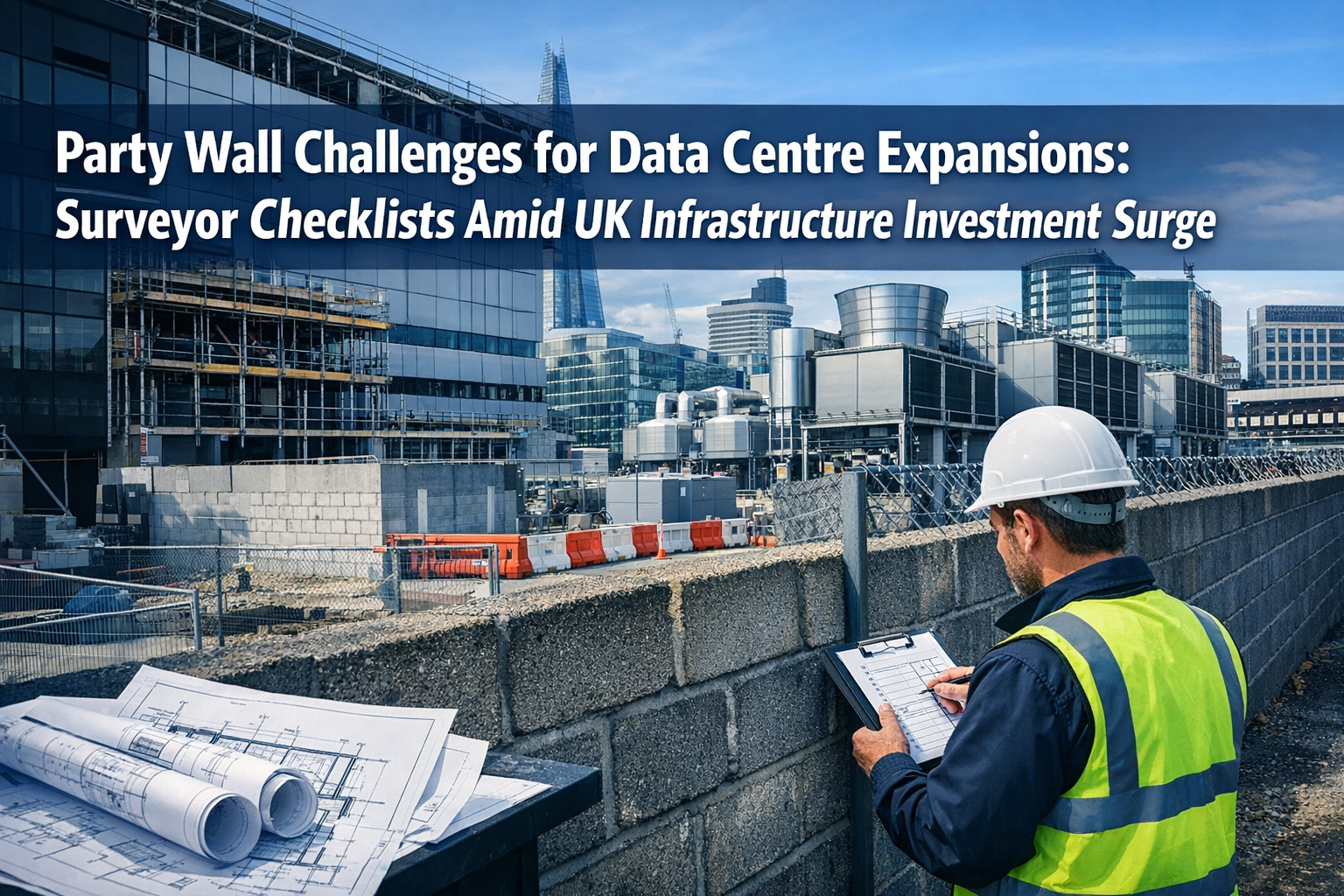
As the United Kingdom positions itself at the forefront of the global artificial intelligence revolution, data centres have emerged as the infrastructure backbone supporting this digital transformation. However, the rapid expansion of these critical facilities—particularly in dense urban environments like London—has introduced a complex web of party wall challenges that developers and surveyors must navigate with precision. The Party Wall Challenges for Data Centre Expansions: Surveyor Checklists Amid UK Infrastructure Investment Surge represents one of 2026's most pressing issues in commercial property development, where billion-pound investments meet century-old property laws.
The collision between cutting-edge technology infrastructure and traditional property boundaries has created unprecedented scenarios. Data centre operators racing to secure grid connections and capitalize on government-backed AI Growth Zones now find themselves entangled in party wall matters that can delay projects by months and add significant costs to already capital-intensive developments. 📊
Key Takeaways
- Investment Surge: UK data centre capacity is projected to grow exponentially through 2026, with London remaining the primary hub despite power grid constraints [1][2]
- Party Wall Complexity: Dense urban data centre builds trigger Party Wall Act 1996 obligations requiring specialized surveyor expertise and strict compliance protocols
- RICS Compliance Essential: Chartered surveyors must implement comprehensive checklists covering notice periods, condition surveys, and award documentation to avoid costly disputes
- Proactive Engagement: Early identification of adjoining owners and pre-construction dialogue reduces dispute risk by up to 70% in commercial developments
- Regulatory Convergence: Data centre projects must simultaneously satisfy Building Regulations, planning requirements, and party wall legislation—creating multi-layered compliance challenges
The 2026 UK Data Centre Investment Boom: Context and Scale

Unprecedented Infrastructure Growth
The United Kingdom's data centre sector is experiencing what industry analysts describe as a "full acceleration" phase in 2026 [1]. This growth trajectory stems from several converging factors:
Government Policy Support: The establishment of AI Growth Zones and streamlined planning processes has created favorable conditions for rapid data centre deployment. These designated areas offer expedited approvals and enhanced grid connectivity, making them highly attractive to global hyperscale operators [3].
Power Demand Explosion: AI workloads require substantially more computational power than traditional cloud services. A single large-scale AI data centre can consume as much electricity as a small city, driving unprecedented demand for grid connections and backup power infrastructure [2].
Strategic Location Imperatives: Despite power constraints, London and the South East remain the epicenter of UK data centre development. The proximity to financial services, low-latency connectivity to European markets, and established fiber infrastructure make urban locations irreplaceable [5].
| Investment Metric | 2024 | 2026 Projection | Growth Rate |
|---|---|---|---|
| Total UK Capacity (MW) | 1,200 | 2,400+ | +100% |
| London Market Share | 62% | 58% | Slight decline as regions grow |
| Average Project Value | £350M | £580M | +65% |
| Construction Timeline | 24-30 months | 18-24 months | Compressed schedules |
Urban Density Creates Party Wall Pressure Points
The concentration of data centre development in established commercial districts has created a perfect storm for party wall complications. Unlike greenfield industrial sites, urban data centres must contend with:
- Shared boundaries with occupied commercial and residential properties
- Existing structural connections through foundations, walls, and service corridors
- Vibration-sensitive neighbors including financial trading floors and medical facilities
- Limited construction access requiring work on or near boundary lines
These constraints transform party wall compliance from a routine administrative task into a critical path item that can make or break project timelines.
Understanding Party Wall Challenges for Data Centre Expansions
What Makes Data Centre Party Wall Issues Unique?
Data centre construction differs fundamentally from conventional commercial development in ways that amplify party wall complexity:
Foundation Requirements: The extraordinary weight of server equipment, battery backup systems, and cooling infrastructure demands deep, reinforced foundations. These often extend beyond the building footprint, triggering Party Wall Act Section 6 excavation notices when digging occurs within three to six meters of an adjoining property [4].
Vibration Management: Modern data centres operate 24/7 with significant mechanical equipment. Cooling systems, backup generators, and uninterruptible power supplies generate continuous vibration that must be isolated from adjacent structures. This requirement often necessitates specialized foundation designs that impact party walls and shared structures.
Security and Access Conflicts: Data centre operators maintain stringent security protocols that can conflict with adjoining owners' rights to appoint surveyors and conduct inspections. Balancing operational security with statutory access rights requires careful coordination and often specialized party wall agreements.
Accelerated Timelines: The competitive race for grid connections and first-mover advantages in AI infrastructure creates intense pressure to compress construction schedules. This urgency can lead to inadequate party wall planning, resulting in disputes that ultimately cause greater delays than proper advance preparation would have required.
Common Party Wall Scenarios in Data Centre Projects
Scenario 1: Excavation Adjacent to Occupied Buildings
A hyperscale operator acquires a former industrial site in East London for conversion to a 50MW AI data centre. The excavation for cooling system infrastructure extends to 8 meters depth, within 4 meters of an occupied warehouse with shallow foundations.
Party Wall Implications:
- Section 6 notice required at least one month before work commences
- Detailed condition survey of adjoining property mandatory
- Structural engineer's assessment of underpinning requirements
- Potential for temporary propping during excavation phase
- Continuous vibration monitoring throughout construction
Scenario 2: Shared Wall Modification for Service Penetrations
A colocation provider expands into an adjacent unit within a multi-tenant commercial building. The expansion requires creating penetrations through the shared wall for fiber optic cables, cooling pipes, and electrical conduits.
Party Wall Implications:
- Section 2 notice for work to existing party wall
- Fire safety and acoustic performance must be maintained
- Coordination with building management and other tenants
- Potential disputes over service routing and future access rights
- Requirements for party wall consent from freeholder
Scenario 3: New Build on Boundary Line
A developer constructs a purpose-built data centre on a constrained urban site, with the building footprint extending to the boundary line shared with a residential development.
Party Wall Implications:
- Section 1 notice for new wall built on or astride the boundary
- Foundation design must not encroach on neighbor's land
- Scaffold licenses may be required for construction access
- Noise and vibration management during construction phase
- Long-term considerations for maintenance access
The Cost of Non-Compliance
Failing to properly address party wall requirements carries severe consequences for data centre developers:
💰 Financial Impact:
- Injunctions halting construction: £50,000-£200,000 per day in delay costs
- Retrospective party wall awards: 150-300% premium on surveyor fees
- Damage claims from adjoining owners: £100,000-£2M+ depending on severity
- Legal costs defending disputes: £25,000-£150,000
⏱️ Timeline Disruption:
- Court proceedings: 3-9 month delays
- Dispute resolution through surveyors: 6-12 weeks minimum
- Remedial work requirements: 2-8 weeks depending on scope
Surveyor Checklists for Data Centre Party Wall Compliance
Pre-Acquisition Due Diligence Checklist
Before committing to a data centre site, developers should engage chartered surveyors to complete comprehensive party wall due diligence:
✅ Boundary Investigation:
- Obtain Land Registry title plans for target property and all adjoining properties
- Commission measured survey identifying precise boundary locations
- Review historical planning permissions for evidence of party wall structures
- Identify any easements, covenants, or restrictions affecting boundaries
- Determine ownership of boundary walls, fences, and structures
✅ Adjoining Owner Identification:
- Compile complete list of all properties sharing boundaries
- Identify freeholders, leaseholders, and occupiers with legal interests
- Obtain contact information for all relevant parties
- Assess complexity based on number of adjoining owners (single owner vs. multiple units)
- Flag any properties with known dispute history
✅ Construction Impact Assessment:
- Review preliminary foundation designs for party wall implications
- Identify all potential excavations within 3-6 meters of boundaries
- Assess need for temporary works (shoring, propping, scaffolding)
- Evaluate vibration risk to adjacent structures
- Determine likely extent of party wall notices required
✅ Timeline and Budget Planning:
- Calculate minimum notice periods based on work scope (1-2 months)
- Estimate surveyor fee budget (£5,000-£50,000+ depending on complexity)
- Allow contingency for potential disputes (add 10-20% to timeline)
- Plan for condition survey costs (£2,000-£10,000 per property)
- Budget for potential security for expenses if requested
Party Wall Notice Preparation Checklist
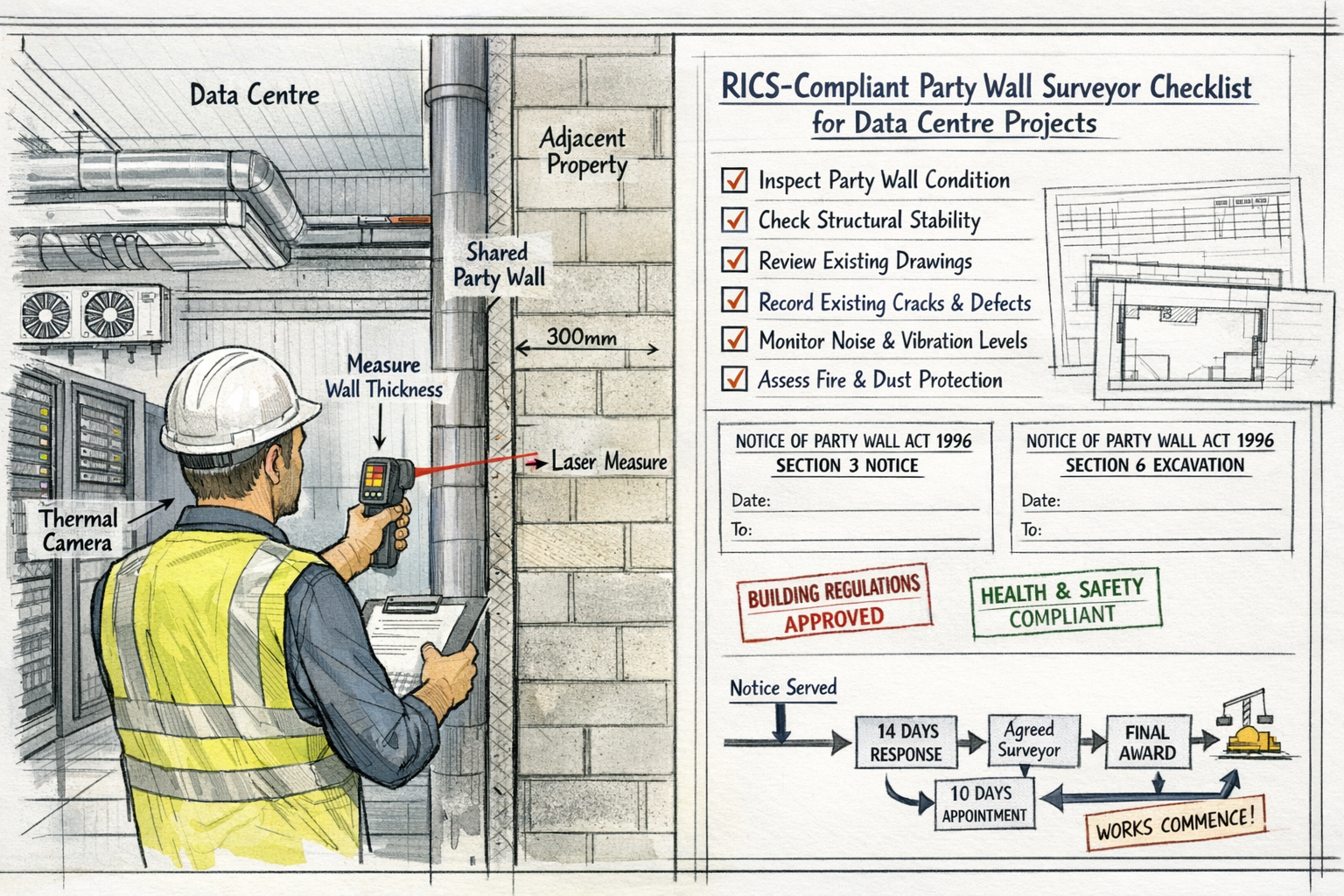
Proper notice preparation is critical to avoiding disputes and ensuring compliance with the Party Wall etc. Act 1996:
✅ Notice Content Requirements:
- Accurate description of proposed works in plain language
- Detailed drawings showing party wall elements affected
- Specification of work type (Section 1, 2, or 6)
- Proposed commencement date (minimum notice period complied with)
- Building owner's name and contact information
- Clear statement of adjoining owner's rights and response options
✅ Technical Documentation:
- Structural engineer's drawings of foundation design
- Cross-sections showing relationship to adjoining property
- Specification of materials and construction methods
- Vibration impact assessment for mechanical equipment
- Acoustic performance calculations for party walls
- Fire safety compliance documentation
✅ Service and Delivery:
- Serve notices to all identified adjoining owners simultaneously
- Use recorded delivery or personal service with proof
- Maintain detailed records of service dates and methods
- Provide explanatory cover letter in accessible language
- Include contact information for building owner's surveyor
- Set clear deadline for response (14 days from service)
For complex data centre projects, engaging an experienced party wall agreed surveyor early in the process can streamline notice preparation and reduce the risk of technical errors that trigger disputes.
Condition Survey Protocol Checklist
Comprehensive condition surveys protect both building owners and adjoining owners by establishing a factual baseline before construction commences:
✅ Pre-Survey Planning:
- Schedule surveys immediately after notice consent or surveyor appointment
- Coordinate access with adjoining owners (minimum 48 hours notice)
- Assemble survey team (surveyor, photographer, structural engineer if needed)
- Prepare survey equipment (laser measures, crack width gauges, levels)
- Review any previous surveys or structural reports for the property
- Plan survey route to cover all areas potentially affected by works
✅ Survey Execution:
- Photograph all elevations of adjoining property from multiple angles
- Document existing cracks with measurements and photographic records
- Record any existing defects, settlement, or structural issues
- Test for verticality and plumb using precision instruments
- Assess condition of finishes (plaster, decorations, flooring)
- Inspect roof spaces, basements, and concealed areas
- Install monitoring points for ongoing measurement if appropriate
✅ Documentation Standards:
- Produce detailed written description of property condition
- Include scaled floor plans with defect locations marked
- Attach comprehensive photographic schedule (minimum 50-100 images)
- Record date, time, weather conditions, and personnel present
- Obtain adjoining owner signature acknowledging survey completion
- Provide copies to all parties within 10 working days
- Retain master file with original photographs and notes
Professional Tip: For data centres with multiple adjoining properties, standardize the condition survey template to ensure consistency and facilitate comparison. Digital survey tools with cloud storage enable real-time documentation and reduce transcription errors.
Party Wall Award Preparation Checklist
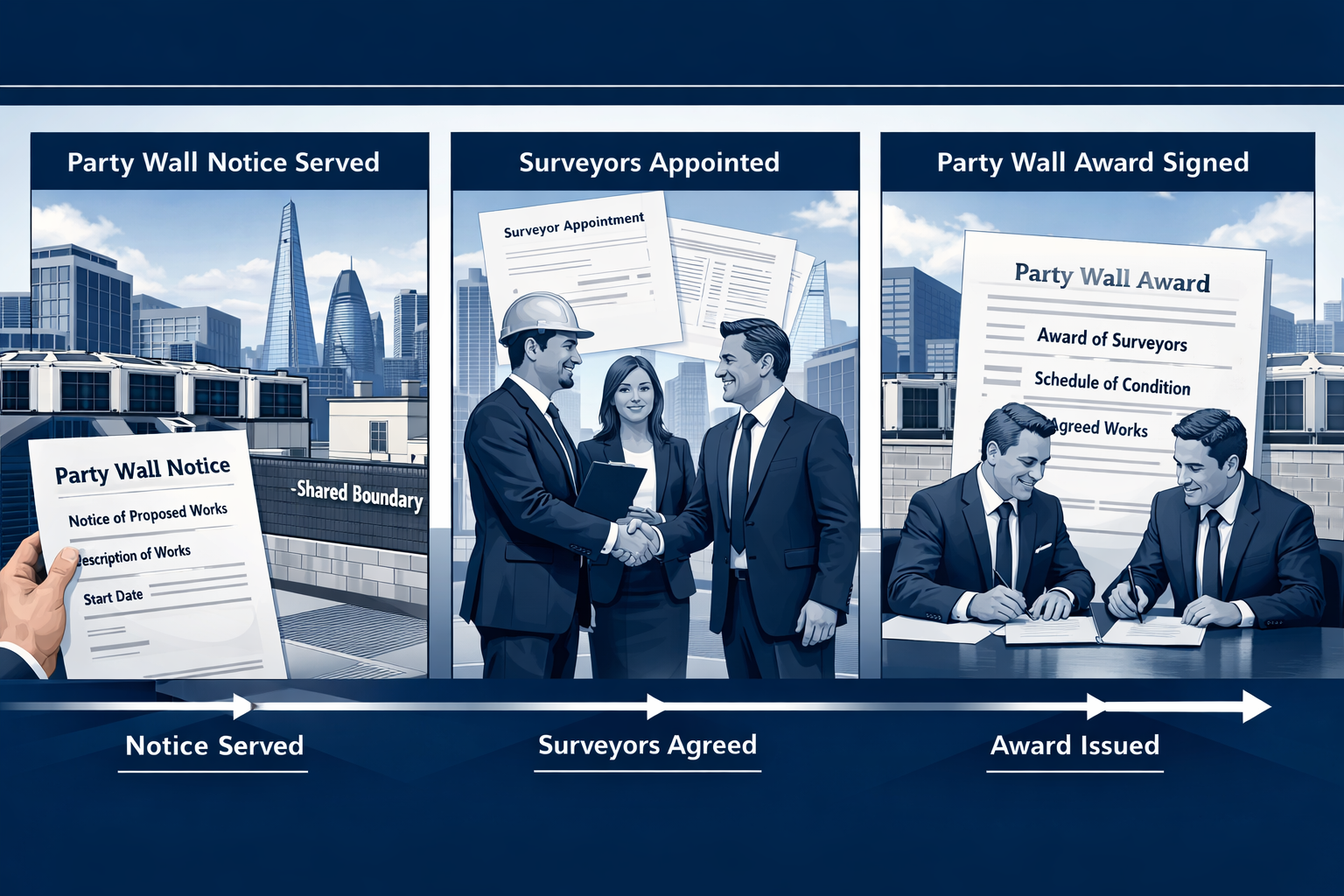
When adjoining owners consent to works or surveyors are appointed, the party wall award becomes the governing document for the project:
✅ Award Content Requirements:
- Detailed description of works authorized
- Specific construction methods and materials approved
- Working hours and days permitted
- Access rights and notice requirements
- Condition survey incorporated by reference
- Monitoring and inspection protocols
- Dispute resolution procedures
- Cost allocation and payment terms
- Security for expenses provisions (if applicable)
- Insurance requirements and evidence
✅ Technical Specifications:
- Foundation depth, width, and reinforcement details
- Underpinning methodology if required
- Temporary works specifications (shoring, propping)
- Vibration limits during construction and operation
- Noise attenuation measures
- Dust and debris control protocols
- Emergency contact procedures
- Damage rectification standards
✅ Legal and Administrative:
- Verify all parties correctly identified and named
- Ensure surveyors have proper appointments
- Include statutory right of appeal information
- Set reasonable timeframes for compliance
- Specify jurisdiction for dispute resolution
- Obtain signatures from appointed surveyors
- Serve award on all parties within 10 days of agreement
- File master copy with project documentation
Construction Phase Monitoring Checklist
Party wall obligations extend throughout the construction period and beyond:
✅ Ongoing Compliance:
- Conduct weekly site inspections by party wall surveyor
- Maintain photographic record of construction progress
- Monitor vibration levels with continuous data logging
- Respond to adjoining owner concerns within 48 hours
- Provide monthly progress reports to all parties
- Conduct interim condition surveys at key construction milestones
- Document any variations from approved award
- Obtain surveyor approval before implementing changes
✅ Damage Response Protocol:
- Investigate any damage claims within 24 hours
- Document alleged damage with photographs and measurements
- Compare to pre-construction condition survey
- Determine causation through technical assessment
- Notify insurers if damage attributable to works
- Agree remediation scope and schedule with adjoining owner
- Complete repairs to match existing materials and finishes
- Obtain sign-off from adjoining owner and surveyors
✅ Completion Documentation:
- Conduct final condition survey of all adjoining properties
- Compare to baseline survey identifying any changes
- Address any outstanding damage or defects
- Obtain completion certificates from surveyors
- Settle all outstanding surveyor fees and expenses
- Provide final photographic record to all parties
- Archive complete party wall file for future reference
- Update building manual with party wall documentation
Party Wall Challenges for Data Centre Expansions: Dispute Prevention Strategies
Early Engagement and Communication
The most effective strategy for avoiding party wall disputes is proactive communication before formal notices are served:
Pre-Notice Consultation: Data centre developers should consider informal meetings with adjoining owners 2-3 months before serving formal notices. This allows:
- Explanation of project benefits and timeline
- Discussion of construction methods and impact mitigation
- Opportunity to address concerns before positions harden
- Building trust and goodwill that facilitates later cooperation
- Identification of potential issues requiring design modifications
Neighbor Liaison Officers: For large-scale data centre projects affecting multiple properties, appointing a dedicated community liaison provides a single point of contact for concerns and questions. This role should:
- Maintain regular communication with all adjoining owners
- Provide construction updates and advance notice of noisy activities
- Respond promptly to complaints and concerns
- Coordinate access for inspections and surveys
- Build positive relationships that reduce dispute likelihood
Visual Communication Tools: Technical party wall notices can be intimidating to lay adjoining owners. Supplementing statutory notices with:
- 3D visualizations showing the relationship between properties
- Simple diagrams explaining foundation depths and proximity
- Plain-language summaries of rights and obligations
- FAQs addressing common concerns
- Contact information for questions and clarifications
Selecting the Right Surveyor Team
The choice of party wall surveyors significantly impacts project outcomes:
Building Owner's Surveyor Qualifications:
- RICS chartered status with party wall accreditation
- Demonstrated experience with commercial data centre projects
- Understanding of specialized foundation and vibration requirements
- Strong technical writing skills for clear award preparation
- Proven track record of dispute resolution
- Professional indemnity insurance adequate for project scale
Agreed Surveyor Advantages: When adjoining owners consent to a single agreed surveyor acting for both parties, benefits include:
- Reduced overall surveyor costs (single fee instead of two)
- Faster award preparation without negotiation delays
- Consistent interpretation of technical requirements
- Simplified communication and decision-making
- Lower risk of surveyor disagreements requiring third surveyor
However, agreed surveyor appointments require careful consideration of potential conflicts of interest and ensuring the surveyor can fairly represent both parties' interests.
Third Surveyor Selection: When building owner and adjoining owner appoint separate surveyors, those surveyors must jointly select a third surveyor to resolve any disagreements. Pre-agreeing the third surveyor before disputes arise can prevent delays:
- Include third surveyor nomination in initial award
- Select highly experienced RICS member with dispute resolution expertise
- Verify availability and willingness to serve if required
- Establish fee structure and decision-making timeline
- Ensure independence from both appointed surveyors
Technical Design Solutions
Thoughtful engineering design can eliminate or minimize party wall impacts:
Foundation Optimization:
- Use piled foundations to transfer loads deeper, reducing lateral pressure on boundaries
- Design pile caps to remain within the building owner's land
- Consider ground improvement techniques (grouting, soil stabilization) to reduce settlement risk
- Implement underpinning of adjoining structures proactively rather than reactively
Vibration Isolation:
- Specify spring-mounted equipment for all major mechanical systems
- Design separate foundations for cooling equipment isolated from main structure
- Install vibration monitoring systems with real-time alerts
- Conduct baseline vibration surveys before construction
- Establish trigger levels for investigation and remediation
Acoustic Design:
- Specify high-performance acoustic barriers for party walls
- Design HVAC systems to minimize noise transmission
- Use acoustic louvers and attenuators on external equipment
- Conduct acoustic modeling to predict and mitigate impacts
- Consider operational restrictions during sensitive hours
Construction Methodology:
- Specify low-vibration excavation techniques (hydraulic breakers vs. impact hammers)
- Plan construction sequencing to minimize cumulative impacts
- Use continuous flight auger piling instead of driven piles where feasible
- Implement dust suppression and debris containment systems
- Schedule noisy activities during least disruptive hours
Regulatory Framework: Party Wall Act 1996 and Data Centre Applications
Statutory Notice Requirements
The Party Wall etc. Act 1996 establishes three categories of notice relevant to data centre development:
Section 1 Notices – New Building on Boundary:
- Required when building a new wall on or astride the boundary line
- Minimum one month notice before work commences
- Adjoining owner may consent or require building entirely on building owner's land
- Relevant for purpose-built data centres on constrained sites
Section 2 Notices – Work to Existing Party Structures:
- Covers repairs, modifications, or demolition of existing party walls
- Minimum two months notice before work commences
- Applies to creating penetrations for services or strengthening existing walls
- Common in data centre fit-outs within existing buildings
Section 6 Notices – Excavation Near Adjoining Buildings:
- Required when excavating within 3 meters and below adjoining foundations
- Also required for excavation within 6 meters if cutting a 45-degree plane from adjoining foundations
- One month minimum notice period
- Critical for data centre basement construction and deep foundations
Notice Period Calculation: Notice periods run from the date of service, not posting. For data centre projects with compressed timelines, using recorded delivery or personal service with proof ensures notice periods begin immediately.
Rights and Obligations Under the Act
Understanding the balanced rights framework helps prevent disputes:
Building Owner Rights:
- Right to undertake necessary works for development
- Right to appoint own surveyor or propose agreed surveyor
- Right to access adjoining land for construction (with notice)
- Right to request security for expenses in certain circumstances
Adjoining Owner Rights:
- Right to consent or dissent to proposed works
- Right to appoint own surveyor at building owner's expense
- Right to comprehensive condition survey before works
- Right to compensation for damage caused by works
- Right to appeal award to County Court within 14 days
Surveyor Duties:
- Act impartially even when appointed by one party
- Prepare award determining matters in dispute
- Specify how and when works will be executed
- Determine costs and their allocation
- Resolve disputes through reasoned decisions
For detailed guidance on legal requirements for party walls, consulting with specialists experienced in commercial development ensures compliance with both statutory obligations and industry best practices.
Building Regulations Intersection
Data centre party wall work must simultaneously comply with Building Regulations:
Structural Stability (Approved Document A):
- Foundation designs must not compromise adjoining structures
- Temporary works must maintain structural integrity throughout construction
- Permanent works must achieve required safety factors
- Structural calculations must be submitted with Building Control application
Fire Safety (Approved Document B):
- Party walls must maintain required fire resistance ratings
- Penetrations for services must be properly fire-stopped
- Compartmentation must not be compromised
- Fire safety strategy must address party wall elements
Sound Insulation (Approved Document E):
- Party walls must achieve minimum acoustic performance standards
- Testing may be required to verify compliance
- Particularly relevant for data centres adjacent to residential properties
Ventilation (Approved Document F):
- Mechanical ventilation systems must not create unacceptable noise
- Extract systems must not affect adjoining properties
- Fresh air intakes must be positioned to avoid nuisance
Case Studies: Party Wall Challenges in Recent UK Data Centre Projects
Case Study 1: East London Hyperscale Development
Project Overview: A global cloud provider acquired a 4-hectare former industrial site in East London for development of a 100MW hyperscale data centre. The site was bounded by an occupied warehouse to the north, residential properties to the east, and a railway line to the south.
Party Wall Challenges:
- Excavation to 12 meters depth for cooling system infrastructure within 6 meters of warehouse with foundations at 2 meters
- Residential properties concerned about construction noise and vibration
- Railway infrastructure requiring specialized approvals and monitoring
- 47 separate adjoining owners requiring individual notices and engagement
Resolution Approach:
- Appointed experienced party wall surveyor 6 months before construction
- Conducted pre-notice consultation meetings with all adjoining owners
- Commissioned independent vibration consultant to establish baselines and limits
- Offered to appoint agreed surveyor for residential properties (85% acceptance rate)
- Installed real-time vibration monitoring with public web portal for transparency
- Implemented enhanced construction methodology with low-vibration equipment
Outcomes:
- Zero formal disputes despite complexity
- Construction commenced on schedule
- Total party wall costs: £180,000 (0.05% of project value)
- Positive community relations maintained throughout construction
- Model referenced by other developers for best practice
Case Study 2: Central London Colocation Expansion
Project Overview: An established colocation provider expanded into an adjacent unit within a multi-tenant commercial building in Central London, requiring modifications to the shared party wall for fiber and cooling infrastructure.
Party Wall Challenges:
- Shared wall between units was load-bearing with complex structural connections
- Freeholder consent required in addition to adjoining tenant
- Work needed to be completed during occupied hours in functioning data centre
- Fire safety and acoustic performance had to be maintained throughout
- Existing services within party wall complicated penetration design
Resolution Approach:
- Engaged structural engineer to design reinforcement scheme for penetrations
- Coordinated with building management and freeholder's surveyor
- Phased work to maintain operational continuity
- Implemented temporary fire barriers during construction
- Conducted acoustic testing to verify performance maintained
- Provided detailed party wall notice with comprehensive technical specifications
Outcomes:
- Work completed in 6-week program vs. 12-week initial estimate
- No operational disruption to either data centre
- Fire certification maintained throughout
- Adjoining tenant relationship strengthened through transparent communication
- Expansion enabled 40% capacity increase
Case Study 3: Dispute Resolution Through Third Surveyor
Project Overview: A regional data centre operator undertook foundation works for cooling tower installation, triggering Section 6 excavation notice requirements for an adjoining commercial property.
Party Wall Challenges:
- Adjoining owner's surveyor disputed foundation design adequacy
- Disagreement over need for underpinning of adjoining structure
- Conflicting structural engineer opinions on settlement risk
- Construction timeline pressure with grid connection deadline
- Escalating costs from surveyor disagreement delays
Resolution Approach:
- Building owner's surveyor and adjoining owner's surveyor appointed third surveyor
- Third surveyor commissioned independent geotechnical investigation
- Additional ground investigation revealed more favorable soil conditions than assumed
- Third surveyor determined modified foundation design adequate without underpinning
- Award issued incorporating third surveyor's determination
Outcomes:
- Dispute resolved in 8 weeks vs. potential 6+ months for court proceedings
- Avoided £250,000 underpinning cost through better ground investigation
- Construction recommenced with revised foundation design
- Third surveyor fee (£15,000) small relative to savings achieved
- Relationship between surveyors maintained for future cooperation
Future Trends: Party Wall Considerations for 2026 and Beyond
AI Growth Zones and Streamlined Processes
The government's AI Growth Zone initiative aims to accelerate data centre deployment through planning reforms [1]. However, party wall legislation remains unchanged, creating potential friction:
Planning vs. Party Wall Timeline Misalignment: Expedited planning approvals may create false expectations about construction commencement. Developers must educate stakeholders that party wall compliance operates on separate statutory timelines that cannot be compressed beyond minimum notice periods.
Coordinated Approval Processes: Forward-thinking local authorities are establishing data centre "fast-track" teams that coordinate planning, building control, and party wall guidance. While party wall matters remain between private parties, local authority facilitation of early surveyor engagement can prevent delays.
Technology-Enabled Party Wall Management
Digital tools are transforming party wall practice:
Digital Condition Surveys:
- 360-degree photography and photogrammetry create immersive records
- Laser scanning produces precise 3D models for comparison
- Drone surveys capture roof and elevation conditions safely
- Cloud-based platforms enable remote access by all parties
- AI-powered change detection identifies differences between baseline and post-construction surveys
Real-Time Monitoring Systems:
- IoT vibration sensors provide continuous data streams
- Automated alerts when thresholds exceeded
- Public dashboards build trust with adjoining owners
- Historical data supports causation analysis if damage alleged
- Integration with construction management systems
Blockchain-Based Award Records:
- Immutable records of party wall awards and consents
- Smart contracts for automatic surveyor fee payments
- Transparent audit trail for all parties
- Reduced administrative burden
- Enhanced security for sensitive documents
Sustainability and Party Wall Considerations
Data centre sustainability initiatives intersect with party wall matters:
Renewable Energy Integration: Rooftop solar installations and ground-source heat pumps may affect party structures, requiring careful party wall planning even for "green" upgrades.
Circular Economy Retrofits: Adapting existing buildings for data centre use often involves more extensive party wall work than new construction, as existing party walls must be modified rather than designed from scratch.
Embodied Carbon Reduction: Minimizing concrete use in foundations may require innovative designs with different party wall implications than traditional approaches.
Expert Recommendations for Data Centre Developers
Strategic Timeline Planning
Successful data centre developers integrate party wall compliance into critical path planning:
Month -6 to -4 (Pre-Acquisition):
- Commission party wall due diligence survey
- Identify all adjoining owners and potential complications
- Budget for party wall costs (typically 0.1-0.5% of construction value)
- Engage specialist party wall surveyor for initial consultation
Month -4 to -2 (Pre-Construction):
- Finalize foundation and construction methodology designs
- Prepare comprehensive party wall notices
- Conduct pre-notice consultation with adjoining owners
- Appoint building owner's surveyor or propose agreed surveyor
Month -2 to 0 (Notice Period):
- Serve formal party wall notices
- Respond to adjoining owner questions and concerns
- Facilitate surveyor appointments
- Conduct baseline condition surveys
- Negotiate and finalize party wall awards
Month 0+ (Construction Phase):
- Implement monitoring and inspection protocols
- Maintain regular communication with adjoining owners
- Address any issues promptly
- Document compliance with award terms
- Conduct completion surveys
Budget Allocation Guidelines
Party wall costs vary significantly based on project complexity:
| Project Scale | Surveyor Fees | Condition Surveys | Monitoring | Contingency | Total Budget |
|---|---|---|---|---|---|
| Small fit-out (1-2 adjoining owners) | £5,000-£10,000 | £2,000-£4,000 | £1,000-£2,000 | £2,000-£4,000 | £10,000-£20,000 |
| Medium development (3-10 adjoining owners) | £15,000-£40,000 | £8,000-£20,000 | £5,000-£10,000 | £7,000-£17,000 | £35,000-£87,000 |
| Large hyperscale (10+ adjoining owners) | £50,000-£150,000 | £25,000-£75,000 | £15,000-£40,000 | £22,000-£66,000 | £112,000-£331,000 |
Budget Considerations:
- Agreed surveyor appointments reduce costs by 30-40% vs. separate surveyors
- Complex structural issues (underpinning, temporary works) increase costs significantly
- Disputes requiring third surveyor add £10,000-£30,000
- Damage claims highly variable (£5,000-£500,000+) depending on severity
Risk Mitigation Checklist
✅ Technical Risk Management:
- Conduct comprehensive ground investigation before finalizing foundation design
- Commission independent structural review of party wall implications
- Specify low-risk construction methodologies even if higher initial cost
- Build contingency into design for potential underpinning requirements
- Plan temporary works to maintain adjoining structure stability
✅ Legal and Compliance Risk:
- Verify all adjoining owners correctly identified before serving notices
- Ensure notices contain all statutory information and are properly served
- Maintain meticulous records of all communications and service
- Obtain legal review of complex awards before execution
- Understand appeal rights and timelines
✅ Relationship Risk:
- Invest in early communication before formal process begins
- Appoint surveyors with excellent interpersonal skills
- Respond promptly and professionally to all concerns
- Provide regular updates throughout construction
- Address damage claims fairly and expeditiously
✅ Commercial Risk:
- Include party wall timeline in overall project schedule with realistic durations
- Secure grid connection agreements before committing to tight construction timelines
- Obtain party wall insurance to cover unexpected costs
- Build adequate contingency into project budget (minimum 10%)
- Identify alternative construction methodologies if disputes arise
Conclusion: Navigating Party Wall Challenges for Successful Data Centre Delivery
The Party Wall Challenges for Data Centre Expansions: Surveyor Checklists Amid UK Infrastructure Investment Surge represents a critical intersection of technological advancement and traditional property law. As the United Kingdom positions itself as a global leader in AI infrastructure, the ability to successfully navigate party wall compliance will increasingly differentiate successful developers from those facing costly delays and disputes.
The comprehensive surveyor checklists and strategies outlined in this guide provide a roadmap for proactive party wall management. By integrating party wall considerations into the earliest stages of site selection and design, data centre developers can transform potential obstacles into manageable compliance tasks that support rather than hinder project delivery.
Key success factors include:
🎯 Early engagement with adjoining owners before formal notices
📋 Comprehensive documentation through detailed condition surveys and awards
🤝 Experienced surveyor selection with data centre-specific expertise
⚙️ Thoughtful technical design that minimizes party wall impacts
📊 Realistic timeline and budget planning with adequate contingencies
🔍 Proactive monitoring throughout construction and completion phases
As data centre investment continues to surge through 2026 and beyond, the developers who master party wall compliance will secure competitive advantages in timeline certainty, cost control, and community relations. The stakes are too high—both in terms of capital investment and national infrastructure priorities—to treat party wall matters as an afterthought.
Actionable Next Steps
For data centre developers and project managers:
- Conduct immediate party wall audit of all projects in pipeline
- Engage RICS-qualified party wall surveyors for upcoming developments
- Implement standardized checklists from this guide across project teams
- Budget adequately for party wall compliance (0.1-0.5% of construction value)
- Establish pre-notice consultation protocols for community engagement
- Review and update construction methodologies to minimize party wall impacts
- Invest in monitoring technology for real-time compliance verification
For property professionals and surveyors:
- Pursue specialized training in data centre party wall matters
- Develop technical expertise in vibration, acoustics, and structural implications
- Build relationships with data centre developers and operators
- Stay current with evolving Building Regulations and industry standards
- Adopt digital tools for condition surveys and monitoring
- Share knowledge through professional networks and publications
The intersection of cutting-edge data infrastructure and century-old property legislation may seem incongruous, but it reflects the reality of building the future within existing urban fabric. By approaching party wall compliance with the same rigor and innovation that characterizes data centre technology itself, the industry can deliver the critical infrastructure the UK needs while respecting the rights and interests of all property owners.
For expert guidance on party wall matters specific to your data centre project, engaging qualified chartered surveyors early in the development process remains the single most effective strategy for successful outcomes. The investment in professional expertise pays dividends through reduced disputes, accelerated timelines, and the confidence that comes from knowing your project complies fully with all statutory requirements.
References
[1] 2026 The Year The Uks Ai Infrastructure Moves Into Full Acceleration – https://datacentreinsight.co.uk/2025/12/29/2026-the-year-the-uks-ai-infrastructure-moves-into-full-acceleration/
[2] The Uks Data Centre Boom Growth Trends Drivers And The Rising Power Challenge – https://www.oxfordeconomics.com/resource/the-uks-data-centre-boom-growth-trends-drivers-and-the-rising-power-challenge/
[3] What Will 2026 Bring For The Datacentre Sector – https://digitalisationworld.com/blogs/58606/what-will-2026-bring-for-the-datacentre-sector
[4] Uk Energy And Infrastructure – https://www.slaughterandmay.com/horizon-scanning/2026/energy-transition/uk-energy-and-infrastructure/
[5] Data Center Outlook – https://www.jll.com/en-uk/insights/market-outlook/data-center-outlook