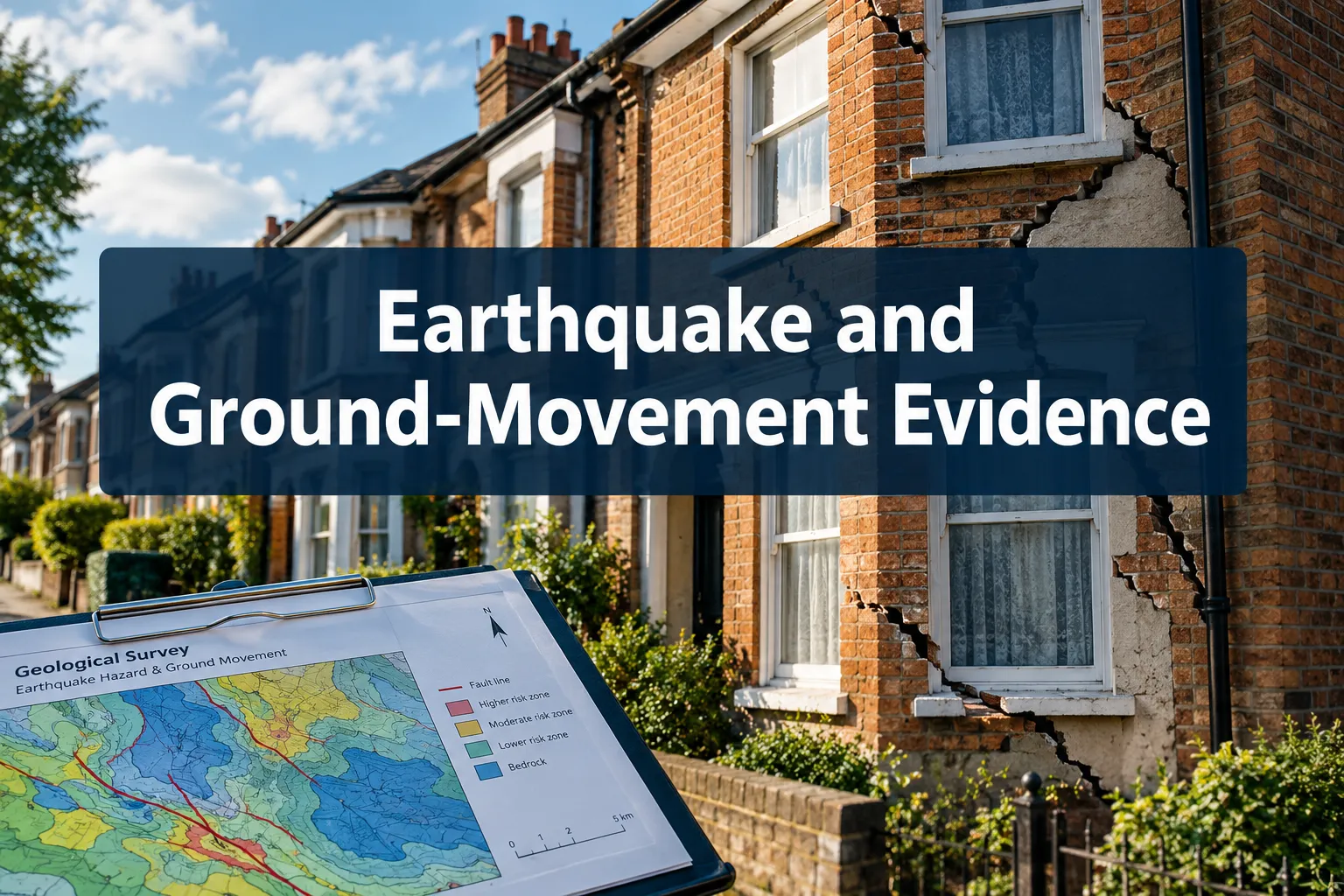
Fewer than 1 in 100 UK insurance claims each year relate to earthquake damage, yet ground movement of one kind or another contributes to thousands of surveying disputes annually. The gap between those two facts explains why earthquake and ground-movement evidence in UK property surveys: what counts as a defect? is a question that matters far more than the headline seismic risk figures suggest. Surveyors are not simply recording whether the earth has shaken; they are distinguishing between a dozen different causes of movement, each with different legal, insurance and valuation consequences.
Key Takeaways
- Seismic activity in the UK is low-level background risk; a shaking record alone never constitutes a defect, only observable building or ground distress does.
- Surveyors classify ground-movement evidence by cause (subsidence, heave, settlement, shrink-swell clay, vibration, landslip) because each carries different repair and insurance implications.
- The British Geological Survey's GeoSure and Property Subsidence Assessment datasets inform hazard context, but defect status is always condition-based, not map-based.
- A Level 3 building survey is the appropriate starting point when ground-movement evidence is present; a standalone specific defect report or structural engineer's opinion may follow.
- Crack width, pattern, location, activity and history together determine whether movement is a defect requiring remediation or a historic, stable feature requiring monitoring only.
Why UK Earthquakes Rarely Produce Survey Defects
The British Geological Survey monitors seismic activity continuously across the UK [8]. Most recorded events fall below magnitude 3.0, perceptible to occupants but incapable of causing structural damage to a well-built property. The 2026 seismic hazard maps, published by BGS, confirm that peak ground acceleration values across most of England, Scotland and Wales remain low by international standards [1][2]. Even in higher-hazard zones such as parts of Wales, the Scottish Highlands and the Midlands, the probability of damage-inducing shaking over a standard mortgage term is small.
That does not mean earthquakes are irrelevant to surveys. A swarm of small earthquakes, such as the events recorded near Silverdale in Lancashire in recent years, can prompt buyers and lenders to ask surveyors pointed questions about ground stability. The surveyor's job in those cases is to separate two distinct questions: first, has shaking caused any measurable damage to this specific building? Second, does the local geology present an ongoing ground-movement hazard that affects value or insurability?
The answer to the first question depends entirely on physical evidence at the property. Seismogram data [9] and hazard mapping [1] provide context, but they do not define a defect. A defect, under RICS standards [4], is a condition that adversely affects the building's performance, safety or value. Shaking that leaves no trace is not a defect. Cracking, displacement, settlement or loss of structural integrity that can be attributed to ground movement, seismic or otherwise, is.
How Surveyors Distinguish Seismic Effects from Other Ground Movement
This is the core diagnostic challenge in earthquake and ground-movement evidence in UK property surveys: what counts as a defect? Ground movement in UK buildings has many causes, and the physical evidence often looks similar regardless of origin.
The main causes a surveyor must separate are:
- Subsidence, downward movement of the ground beneath foundations, most commonly from clay shrinkage, tree root activity or mining legacy
- Heave, upward ground movement, typically from clay expansion after tree removal or prolonged wet periods
- Settlement, gradual compression of fill or made ground under load, common in post-war infill development
- Shrink-swell, seasonal vertical movement in clay soils, now mapped in detail through BGS GeoSure datasets [6]
- Vibration damage, cracking from traffic, piling, blasting or construction operations rather than natural seismic events
- Landslip, lateral movement of a slope, relevant in hillside properties and coastal locations
- Seismic damage, structural distress directly attributable to earthquake shaking
RICS consumer guidance on subsidence [5][7] sets out the criteria that separate genuine subsidence from other movement types. The same principles apply to seismic assessment: the surveyor looks for crack pattern, crack width, the relationship of cracks to structural elements, and whether movement appears active or historic.
Crack characteristics that guide diagnosis:
| Crack feature | What it suggests |
|---|---|
| Diagonal, stair-step through mortar joints | Differential foundation settlement or subsidence |
| Horizontal cracking at lintel or DPC level | Lateral pressure, heave or vibration |
| Vertical cracks at corners or returns | Thermal movement or differential settlement |
| Wide, tapered cracks (wider at top) | Ongoing active movement |
| Fine, uniform hairline cracks | Historic, stable movement; likely cosmetic |
| Cracks radiating from window or door corners | Classic subsidence or heave pattern |
Seismic damage, where it occurs at all in UK properties, tends to produce diagonal shear cracking in masonry, dislodged chimney stacks and displaced roof tiles. These features overlap significantly with subsidence and vibration damage. Without a confirmed seismic event of sufficient magnitude at the relevant date, a surveyor cannot attribute cracking to an earthquake on visual evidence alone.
For properties where ground-movement evidence is found, a Level 3 building survey is the appropriate instruction. It provides the depth of inspection needed to map crack patterns, assess structural integrity and recommend further investigation.
BGS Data, Hazard Maps and the Defect Threshold
The British Geological Survey provides several datasets that surveyors and environmental search providers use when assessing ground-movement risk [6]. The GeoSure suite covers natural ground instability including shrink-swell clays, landslides, dissolution features and compressible ground. A newer Property Subsidence Assessment dataset, sharpened for 2026, gives postcode-level clay-subsidence risk ratings that now appear routinely in conveyancing search results.
These datasets are hazard indicators, not defect records. A property sitting on a high shrink-swell clay rating in the BGS data has an elevated risk of future movement; it does not automatically have a defect. The defect threshold is crossed only when there is observable building distress, cracking, displacement, door or window binding, sloping floors, that can be linked to that ground condition.
This distinction matters for three practical reasons:
- Insurance, insurers use BGS-derived data to set subsidence excesses and premiums. A high-hazard rating without building distress may still affect insurability, but it is not the same as an active claim.
- Valuation, a Red Book valuation must reflect any material factor affecting value. Confirmed ground-movement defects are material; background hazard ratings are a risk factor to be noted, not a deduction in themselves.
- Mortgage lending, lenders may require specialist reports before releasing funds where ground-movement evidence is present. BGS data alone rarely triggers a retention; physical evidence of movement does.
The 2026 seismic hazard maps [1][2] follow the same logic. They quantify the probability of various levels of ground shaking over defined return periods. A property in a moderate-hazard zone is not defective. A property with cracked foundations in that zone requires investigation to establish whether the cracking is seismically induced, subsidence-related or from another cause entirely.
For guidance on what subsidence evidence looks like in practice, the detailed explanation at what does subsidence look like covers the visual indicators surveyors record during inspection.
Inspection Evidence, Monitoring and When an Expert Report Is Needed
A RICS Level 3 building survey addresses ground-movement evidence through a structured inspection process [3][4]. The surveyor records all visible cracking, measures crack widths where accessible, notes the relationship between cracks and structural elements, and assesses whether movement appears active or dormant. This is the foundation of any ground-movement defect assessment.
The inspection process in outline:
- Visual survey, systematic examination of external elevations, internal walls, ceilings, floors and roof structure for movement evidence
- Crack classification, width, pattern, location and probable cause recorded; BRE Digest 251 categories (1-5) commonly used
- Context check, BGS GeoSure data, mining legacy records, tree proximity, drainage condition and construction history reviewed
- Activity assessment, is movement ongoing or historic? Seasonal monitoring may be recommended before remediation
- Specialist referral, structural engineer, geotechnical specialist or mining consultant instructed where cause is unclear or damage is significant
Monitoring is particularly important where shrink-swell clay is the suspected cause. Clay movement is seasonal; a crack that appears wide in summer may partially close in winter. Recommending a 12-month monitoring period before structural intervention is standard RICS practice in those cases [5][7].
Where earthquake activity is a plausible contributing factor, for example, a property near a documented seismic swarm with cracking of recent origin, the surveyor may recommend a structural engineer's opinion specifically addressing dynamic loading effects. This is relatively rare in UK practice but is appropriate where the evidence warrants it.
A specific defect report is the right instruction when a buyer or owner wants a focused assessment of one identified problem, a crack, a displaced foundation, a sloping floor, rather than a full building survey. It allows a specialist to concentrate resources on the defect in question and provide a repair specification.
For properties where ground movement may have occurred during a tenancy or construction project, a schedule of condition report recorded before works begin provides the baseline evidence needed to attribute any subsequent cracking to its correct cause.
Repair Records, Insurance History and Valuation Impact
Ground-movement defects leave a paper trail that surveyors and solicitors examine as part of due diligence. Relevant documents include:
- Previous survey reports noting movement or recommending monitoring
- Insurance claims history, a subsidence claim, even one that was resolved, is a material disclosure
- Underpinning records, underpinning is a permanent feature of the property's history; it must be disclosed and affects insurability
- Building regulation completion certificates for any structural repairs
- Structural engineer's reports commissioned by previous owners
A property with a resolved, well-documented subsidence history is not necessarily unsaleable or unmortgageable. Many lenders will proceed subject to specialist reports confirming stability. The building survey vs valuation survey distinction matters here: a mortgage valuation may flag ground-movement risk and require further investigation, but it will not provide the detailed defect assessment a buyer needs to make an informed decision.
Valuation impact depends on the nature and status of the movement. Active, unresolved subsidence in a clay area with large trees nearby is a significant defect that will reduce value and may make the property unmortgageable until remediated. Historic, stable movement with no recurrence and a clean insurance record has a much smaller, sometimes negligible, valuation impact, though it must still be disclosed.
For London and South East properties, where London Clay is widespread and shrink-swell risk is elevated, ground-movement evidence in surveys is a routine finding rather than an exceptional one. The 2026 Property Subsidence Assessment dataset has sharpened how this risk is presented to buyers, making it more important than ever that surveyors explain the difference between hazard and defect clearly in their reports.
Frequently Asked Questions
Does a UK earthquake automatically create a defect in a property survey?
No. An earthquake creates a defect only if it produces observable building or ground distress, cracking, displacement, structural damage. A shaking record or seismic hazard rating alone is not a defect.
How does a surveyor tell earthquake damage from subsidence?
Crack pattern, location, width and the timeline of appearance are the primary tools. Earthquake damage in UK masonry typically produces diagonal shear cracks and may affect chimneys or roof structures. Without a confirmed seismic event of sufficient magnitude, surveyors cannot attribute cracking to an earthquake on visual evidence alone and will investigate all probable causes.
What is the BGS GeoSure dataset and why does it appear in my survey?
GeoSure is a British Geological Survey product that maps natural ground-instability hazards, including shrink-swell clays, landslides and compressible ground, at a national scale [6]. Surveyors use it to contextualise ground-movement evidence. A high GeoSure rating means elevated risk, not a confirmed defect.
Should I get a structural engineer's report if my survey flags ground movement?
In most cases, yes, where a RICS surveyor identifies active or significant ground-movement evidence, a structural engineer's opinion is the appropriate next step. The engineer can assess cause, recommend monitoring or remediation, and provide the specialist report that lenders and insurers require.
Does underpinning mean a property is defective?
Underpinning means the property had a ground-movement problem that was addressed structurally. It is a material fact that must be disclosed. Whether it constitutes an ongoing defect depends on the quality of the underpinning, its age and whether movement has recurred. Many underpinned properties are stable and insurable.
Can vibration from construction work cause the same damage as an earthquake?
Yes, in terms of crack patterns. Vibration from piling, demolition or heavy traffic can produce cracking indistinguishable from low-level seismic damage. A schedule of condition report recorded before nearby works begin is the standard way to establish a baseline and attribute any subsequent damage correctly.
What survey level is appropriate when ground movement is suspected?
A Level 3 building survey is the standard recommendation. It provides the most thorough visual inspection and allows the surveyor to comment in detail on structural condition, probable causes of movement and recommended further investigations. See the full guide to how much a building survey costs for current fee ranges.
Conclusion
Ground movement in UK properties covers a wide spectrum, from harmless hairline cracks caused by thermal expansion to active subsidence requiring underpinning. Seismic activity sits at the lower end of that spectrum for most UK locations, but it is not irrelevant, particularly in areas with documented earthquake swarms or where buyers and lenders ask specific questions about seismic risk.
The practical answer to earthquake and ground-movement evidence in UK property surveys: what counts as a defect? is this: defect status is always condition-based. Observable building distress, cracking, displacement, structural damage, that can be linked to ground movement constitutes a defect. Hazard maps, seismogram records and BGS datasets provide context and inform risk commentary, but they do not create defects in themselves.
Actionable steps for buyers, owners and their advisers:
- Instruct a Level 3 building survey on any property where ground-movement evidence is visible or the location suggests elevated risk.
- Ask the surveyor to check BGS GeoSure data, mining legacy records and tree proximity as part of their assessment.
- Obtain and review any previous survey reports, insurance claims history and structural engineer's reports before exchange.
- Where active movement is suspected, agree a monitoring period before committing to structural remediation.
- If construction works are planned nearby, commission a schedule of condition report before works begin to protect your position.
- For valuation questions where ground movement is a factor, instruct a RICS-registered surveyor to provide a Red Book valuation that explicitly addresses the movement evidence and its market impact.
Ground-movement evidence is one of the areas where a thorough survey pays for itself many times over. The cost of a specialist report is small relative to the cost of buying a property with an unresolved structural problem.
References
[1] BGS Report OR26-029 2026 Hazard Maps – earthquakes.bgs.ac.uk
[2] The 2026 Seismic Hazard Maps for the United Kingdom, the Channel Islands and the Offshore Exclus – data.gov.uk
[3] iSurv Downloads, Surveys – isurv.com
[4] iSurv Downloads, RICS Standards – isurv.com
[5] RICS Consumer Guide: Subsidence (PDF) – rics.org
[6] BGS Public Services – bgs.ac.uk
[7] RICS Consumer Guides, Subsidence – rics.org
[8] BGS Earthquake Seismology – bgs.ac.uk
[9] UK Earthquake Seismogram Data – data.gov.uk
[10] RICS Land Standards – rics.org