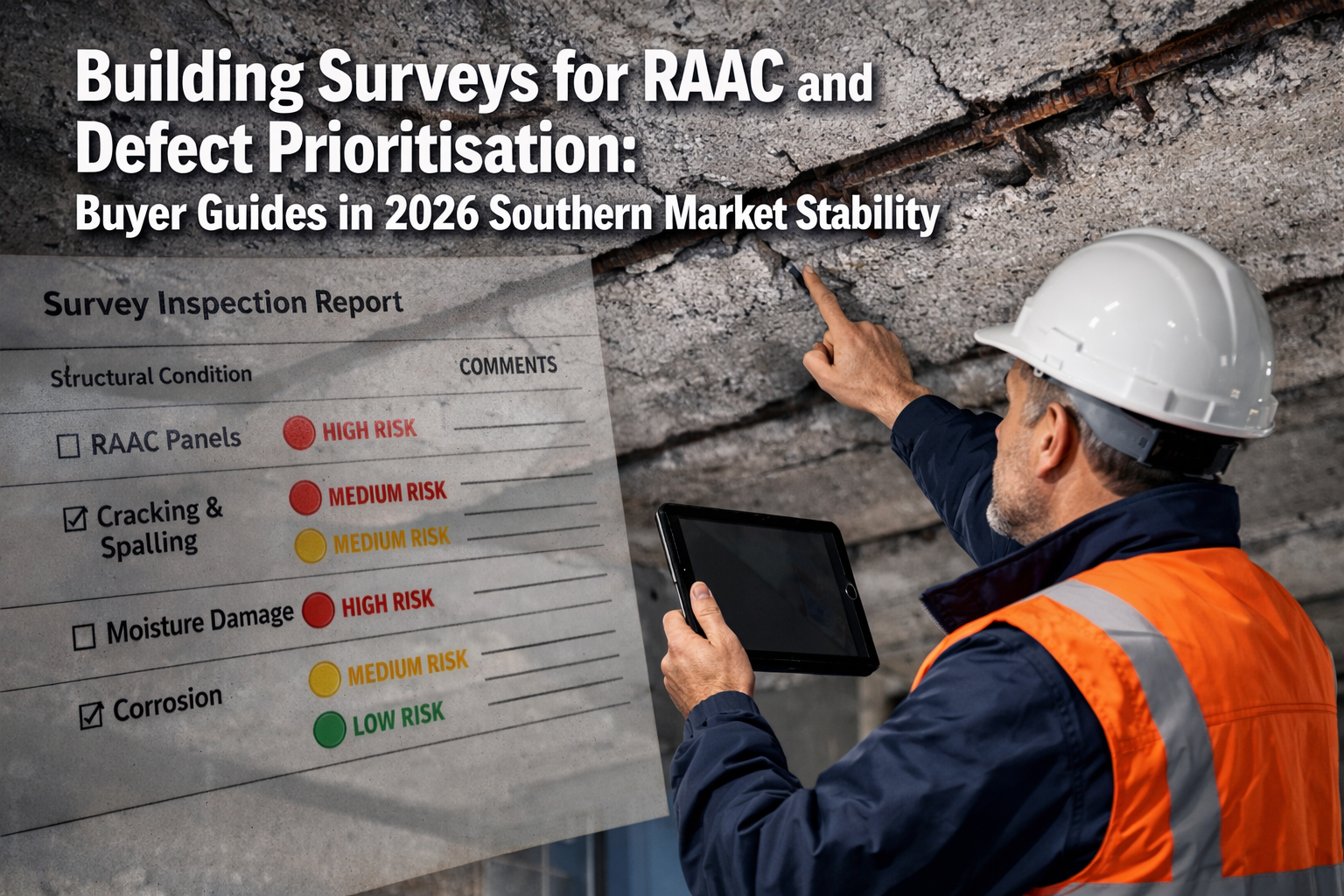

The Southern property market has entered a period of cautious optimism in 2026, but beneath the surface of stabilising prices lurks a critical concern that savvy buyers cannot afford to ignore. Reinforced Autoclaved Aerated Concrete (RAAC) and associated structural defects have transformed the landscape of property due diligence, making comprehensive Building Surveys for RAAC and Defect Prioritisation: Buyer Guides in 2026 Southern Market Stability essential tools for informed purchasing decisions. As demand rebounds across South East England and Surrey, properties built during the post-war construction boom now require unprecedented scrutiny before transactions can proceed with confidence.
The discovery of widespread RAAC installations in buildings constructed between the 1960s and 1990s has created both challenges and opportunities for property buyers. While some sellers face difficult conversations about remediation costs, informed purchasers armed with detailed survey data can negotiate favourable terms and secure properties at adjusted prices that reflect true structural conditions. Understanding how to commission the right level of survey, interpret defect prioritisation matrices, and leverage findings during negotiations has become a critical skill in the 2026 Southern market.
Key Takeaways
- Level 3 Building Surveys are now essential for properties built between 1960-1990 in the Southern market, providing detailed RAAC detection and comprehensive defect prioritisation with repair cost estimates
- Non-destructive testing methods including ground-penetrating radar and ultrasonic testing enable accurate RAAC identification without damaging property structures
- Water infiltration represents the primary degradation factor for RAAC, with moisture causing progressive deterioration, material crumbling, and steel reinforcement corrosion
- Three-tier remediation strategies (monitor, reinforce/repair, replace) offer property owners flexible approaches based on severity, with costs ranging from regular inspections to complete panel replacement
- Defect prioritisation empowers buyers to negotiate purchase prices effectively, securing properties at values that reflect true remediation requirements while the Southern market stabilises
Understanding RAAC: The Hidden Structural Concern in Southern Properties
What Makes RAAC Different from Traditional Concrete
Reinforced Autoclaved Aerated Concrete represents a fundamentally different material from conventional concrete. While traditional concrete achieves strength through dense composition, RAAC incorporates millions of tiny air bubbles created during manufacturing, resulting in a lightweight, porous structure. This bubble-filled composition made RAAC attractive during the post-war building boom when speed and cost-effectiveness dominated construction priorities.[4]
The material's porous nature creates inherent vulnerabilities that become critical over time:
- Reduced density compared to traditional concrete (approximately one-fifth the weight)
- Increased water absorption through interconnected bubble structure
- Limited lifespan of approximately 30 years, now exceeded in most installations
- Susceptibility to moisture damage causing progressive deterioration
Critical Manufacturing Defects and Failure Mechanisms
The most dangerous aspect of RAAC lies not in the material itself but in manufacturing quality control failures that occurred during production. Poor factory oversight resulted in critical defects that create sudden failure risks without warning signs.[3]
Misplaced transverse reinforcement represents the most serious defect identified in structural engineering assessments. Anchorage reinforcement designed to prevent shear failure at plank ends was frequently positioned incorrectly or omitted entirely during manufacturing. This defect creates the potential for catastrophic sudden collapse—the exact mechanism identified in the 2019 SCOSS roof collapse alert that triggered industry-wide concerns.[3]
Additional manufacturing inconsistencies include:
- Inadequate steel reinforcement coverage
- Inconsistent curing processes affecting structural integrity
- Variable quality control between different production facilities
- Lack of standardised installation documentation
Timeline and Property Types Most Affected
Properties constructed during specific periods face elevated RAAC risk, with the 1960s through 1990s representing the primary concern window. The Southern market, with its substantial stock of post-war residential and commercial buildings, contains significant concentrations of potentially affected properties.[4]
| Construction Period | RAAC Risk Level | Common Applications |
|---|---|---|
| 1960s-1970s | ⚠️ High | Flat roofs, floor panels, wall panels |
| 1980s-1990s | ⚠️ Moderate-High | Educational buildings, public structures |
| Pre-1960 | ✅ Minimal | RAAC not widely used |
| Post-1995 | ✅ Low | Alternative materials preferred |
The Southern market's stabilisation in 2026 partly reflects buyers' growing awareness of these timeline risks, with properties from affected periods now requiring enhanced due diligence before purchase completion.

Building Surveys for RAAC and Defect Prioritisation: Essential Survey Types in 2026
RICS Level 2 vs Level 3 Surveys for RAAC Detection
The choice between survey levels fundamentally impacts RAAC detection capability and subsequent negotiating power. The RICS Level 2 Survey (HomeBuyers Report) provides suitable assessment for conventional properties without suspected issues, employing a traffic-light rating system for structural concerns.[1] However, for properties with known or suspected RAAC presence, the RICS Level 3 Survey (Building Survey) delivers the comprehensive inspection necessary for informed decision-making.
Level 3 surveys offer critical advantages for RAAC assessment:
- Detailed structural analysis of ceiling voids, roof spaces, and concealed areas
- Comprehensive defect documentation with photographic evidence
- Repair cost estimates enabling accurate negotiation calculations
- Prioritised action plans distinguishing urgent from routine maintenance
For buyers targeting Southern market properties built during the 1960-1990 period, investing in a comprehensive building survey provides essential protection against hidden RAAC risks that could undermine property value and safety.
Advanced Non-Destructive Testing Methods
The evolution of RAAC detection technology has transformed survey capabilities in 2026. Non-destructive testing (NDT) methods now enable accurate assessment without causing structural damage, replacing invasive drilling techniques that risked further weakening compromised materials.[2]
Modern detection approaches include:
Ground-Penetrating Radar (GPR)
- Identifies internal structure and reinforcement positioning
- Detects voids, delamination, and moisture infiltration
- Provides real-time imaging of concealed concrete panels
- Non-invasive with no structural impact
Ultrasonic Testing
- Measures material density and identifies deterioration
- Detects internal cracking and separation
- Assesses reinforcement condition and placement
- Highly accurate for thickness measurements
Thermal Imaging
- Reveals moisture patterns indicating water infiltration
- Identifies areas of differential density
- Highlights potential failure zones through temperature variations
- Complements other testing methods
These advanced techniques enable surveyors to provide definitive RAAC identification and condition assessments, supporting the detailed defect prioritisation that empowers buyer negotiations in the stabilising Southern market.
Specialist RAAC Surveys and Inspection Protocols
Beyond standard building surveys, specialist RAAC assessments follow structured protocols developed through industry collaboration. The RAAC Playbook, aggregating knowledge from Loughborough University, Sweco, CPT, and Lucideon, establishes unified inspection methodologies that ensure consistent detection and assessment across the industry.[2]
Specialist surveys typically include:
-
Visual Inspection Phase
- Identification of characteristic RAAC features (texture, colour, weight)
- Assessment of visible deterioration signs
- Documentation of water damage indicators
- Evaluation of existing support structures
-
Technical Testing Phase
- NDT application using multiple complementary methods
- Reinforcement position verification
- Structural load capacity assessment
- Moisture content measurement
-
Risk Assessment Phase
- Failure probability calculation based on condition
- Occupancy risk evaluation
- Prioritised defect classification
- Remediation urgency determination
For commercial properties, commercial building surveys incorporate these specialist protocols, ensuring comprehensive RAAC assessment for buyers considering mixed-use or investment properties in the Southern market.

Defect Prioritisation Strategies for Informed Buyer Negotiations
Creating Comprehensive Defect Matrices
Effective defect prioritisation transforms raw survey data into actionable negotiating intelligence. A well-structured defect matrix categorises identified issues by urgency, cost, and impact on property value, enabling buyers to approach negotiations with clear remediation requirements and associated costs.
Priority Level Classification:
🔴 Critical/Urgent (Address Immediately)
- RAAC panels showing visible deterioration or sagging
- Misplaced reinforcement in load-bearing applications
- Active water infiltration affecting RAAC structures
- Structural movement or cracking in critical areas
🟡 Moderate (Address Within 12 Months)
- RAAC panels in good condition requiring monitoring protocols
- Minor moisture ingress with potential for progression
- Cladding defects allowing water penetration
- Roof deterioration affecting RAAC protection
🟢 Low Priority (Monitor/Plan for Future)
- RAAC panels in protected, low-stress applications
- Cosmetic defects without structural implications
- Routine maintenance items
- Preventative upgrades
This systematic approach enables buyers to distinguish between deal-breaking issues requiring immediate vendor remediation and negotiable items where price adjustments provide appropriate compensation.
Water Infiltration and Moisture-Related Defects
Water vulnerability represents the primary degradation mechanism for RAAC structures. The material's porous composition allows moisture infiltration into the bubble structure, causing accelerated decay, material crumbling, and corrosion of steel reinforcement.[2] In the Southern market's climate, with regular rainfall and humidity variations, moisture management becomes critical for RAAC longevity.
Common moisture-related defect patterns include:
- Roof penetrations allowing direct water access to RAAC panels
- Inadequate drainage causing water pooling on flat RAAC roofs
- Cladding failures permitting lateral moisture infiltration
- Condensation accumulation in poorly ventilated ceiling voids
Buyers should prioritise properties where existing moisture protection remains intact or where remediation costs can be accurately quantified. Specialist roof surveys provide detailed assessment of water protection systems, enabling precise cost estimation for necessary upgrades.
Hidden Defects and Concealed Deterioration Risks
The most challenging aspect of RAAC assessment involves hidden defects that remain invisible during standard inspections. Reinforcement corrosion and internal structural degradation may progress extensively while panels maintain acceptable external appearance.[3]
This concealment risk creates several implications for buyers:
- Surface condition does not reliably indicate structural integrity
- NDT testing becomes essential rather than optional
- Conservative assumptions should guide risk assessment
- Ongoing monitoring requirements must be factored into ownership costs
Properties with suspected but unconfirmed RAAC presence require particularly careful evaluation. Commissioning a specific defect report focused exclusively on RAAC detection and condition assessment provides the definitive information needed for confident decision-making.
Cost Estimation and Remediation Planning
Accurate remediation cost estimation transforms defect identification into negotiating leverage. The three-tier remediation strategy approved by industry standards offers buyers clear understanding of potential expenditure requirements.[1]
Remediation Approach Comparison:
| Strategy | Application | Typical Cost Range | Timeframe |
|---|---|---|---|
| Monitor | Good condition panels in low-risk areas | £500-£2,000/year for inspections | Ongoing |
| Reinforce/Repair | Moderate deterioration, accessible locations | £5,000-£25,000 depending on extent | 3-6 months |
| Replace | Severe deterioration, critical applications | £15,000-£100,000+ for complete removal | 6-12 months |
These cost ranges enable buyers to calculate appropriate price adjustments during negotiations. A property requiring £30,000 in RAAC remediation justifies corresponding reduction in offer price, plus additional compensation for disruption and project management burden.
For properties requiring extensive work, understanding the distinction between building surveys and homebuyer reports ensures buyers commission the appropriate level of assessment to support detailed cost estimation.

Navigating the 2026 Southern Market with RAAC Awareness
Market Stabilisation and Buyer Opportunities
The Southern property market's stabilisation in 2026 reflects a maturing understanding of RAAC implications rather than panic-driven devaluation. Sophisticated buyers recognise that RAAC presence does not automatically disqualify properties from consideration—instead, it creates opportunities for informed negotiations based on accurate remediation cost assessment.
Market dynamics favouring informed buyers include:
- Vendor motivation to complete sales despite RAAC disclosure requirements
- Price adjustments reflecting genuine remediation costs rather than speculative discounts
- Reduced competition from less-informed buyers avoiding RAAC properties entirely
- Professional survey data providing objective negotiating foundation
Buyers working with experienced chartered surveyors in South East London and South West London benefit from local market knowledge that contextualises RAAC findings within broader property value considerations.
Legal and Liability Considerations
The liability limitation barrier significantly impacts RAAC-related claims and buyer protections. Latent defect liability periods typically run 6-15 years depending on claim type, meaning most RAAC installations from the 1960s-1990s fall outside actionable periods.[5] This limitation makes remediation reliant on negotiated purchase price adjustments rather than post-completion legal recovery.
Critical legal considerations include:
- Vendor disclosure obligations regarding known RAAC presence
- Survey contingencies in purchase agreements
- Retention of funds pending remediation completion
- Professional indemnity coverage for survey accuracy
Buyers should ensure purchase agreements include appropriate protections based on survey findings, with legal counsel reviewing RAAC-specific clauses before exchange of contracts.
Regional Considerations Across the Southern Market
RAAC prevalence varies across Southern regions based on construction patterns during the critical 1960-1990 period. Understanding these regional variations helps buyers target appropriate survey intensity and negotiate effectively.
High-Risk Areas:
- Post-war expansion zones with rapid development
- Former local authority housing estates
- Educational and public building conversions
- Industrial-to-residential conversions
Lower-Risk Areas:
- Historic properties predating RAAC introduction
- Premium developments using traditional construction
- Recent constructions (post-1995)
- Properties with documented construction specifications
Buyers considering properties across multiple Southern locations benefit from engaging surveyors with specific regional expertise, such as chartered surveyors in Surrey or specialists in particular towns where RAAC prevalence is documented.
The RAAC Playbook and Industry Standardisation
The development of the RAAC Playbook represents a significant advancement in inspection and remediation consistency. This collaborative initiative aggregates expertise from leading academic and industry contributors, establishing unified methodologies that reduce the risk of inconsistent inspections and missed detections.[2]
Key Playbook contributions include:
- Standardised inspection protocols ensuring comprehensive assessment
- Shared knowledge base documenting RAAC variations and characteristics
- Best practice remediation approaches based on successful case studies
- Ongoing research integration as new findings emerge
This standardisation benefits buyers by ensuring survey quality consistency regardless of which accredited surveyor conducts the assessment. The Playbook's influence extends across the Southern market, raising overall inspection standards and improving buyer confidence in survey reliability.
Practical Steps for Buyers in 2026
Commissioning the Right Survey Level
Buyers should approach survey selection strategically based on property characteristics and RAAC risk indicators:
For properties built 1960-1990:
- Commission Level 3 Building Survey as standard
- Include specific RAAC detection requirements in survey brief
- Request NDT testing for ceiling voids and roof spaces
- Ensure surveyor has current RAAC Playbook training
For properties with confirmed RAAC:
- Engage specialist structural engineer alongside surveyor
- Request comprehensive remediation options with cost estimates
- Obtain multiple remediation quotes before finalising purchase
- Consider retention clauses in purchase agreement
Understanding what survey you need based on specific property characteristics ensures appropriate assessment depth without unnecessary expenditure on lower-risk properties.
Interpreting Survey Reports and Defect Priorities
Survey reports for RAAC-risk properties require careful interpretation to extract maximum negotiating value:
Focus on these report sections:
- Executive Summary – Overall risk assessment and urgent actions
- Defect Schedule – Itemised issues with priority classifications
- Cost Estimates – Remediation expenditure projections
- Recommendations – Surveyor's professional guidance on next steps
Pay particular attention to conditional language that may indicate uncertainty requiring further investigation. Phrases like "suspected RAAC" or "possible deterioration" signal areas where additional specialist assessment may strengthen negotiating position.
Negotiation Strategies Based on Survey Findings
Armed with comprehensive survey data, buyers can approach negotiations with confidence and precision:
Negotiation Approaches:
💼 Price Reduction Strategy
- Calculate total remediation costs from survey estimates
- Add 15-20% contingency for unforeseen complications
- Request purchase price reduction equal to full remediation cost
- Emphasise market impact of RAAC disclosure on future resale
🔧 Vendor Remediation Strategy
- Require vendor to complete critical repairs before completion
- Retain funds in escrow pending satisfactory remediation
- Obtain professional certification of completed works
- Suitable for urgent safety issues requiring immediate attention
⚖️ Hybrid Strategy
- Vendor addresses critical urgent defects before completion
- Price reduction compensates for moderate priority items
- Buyer accepts monitoring responsibility for low-priority issues
- Often achieves fastest transaction completion
The optimal approach depends on vendor motivation, property desirability, and buyer risk tolerance. Properties in competitive Southern market locations may require more flexible negotiation, while buyers can adopt firmer positions for properties with extended marketing periods.
Post-Purchase Monitoring and Maintenance
Buyers proceeding with RAAC-containing properties must implement structured monitoring protocols to ensure ongoing safety and preserve property value:
Monitoring Schedule:
- Annual visual inspections of all identified RAAC locations
- Professional surveys every 3-5 years to track deterioration progression
- Immediate assessment following significant weather events or structural alterations
- Documentation maintenance creating comprehensive property history
This ongoing commitment represents a real ownership cost that should factor into purchase decisions and long-term financial planning.
Industry Evolution and Future Outlook
Standardisation of Remediation Methodologies
The current lack of standardised remediation methodology creates inconsistency in repair approaches and outcomes.[2] However, ongoing industry collaboration through initiatives like the RAAC Playbook is progressively establishing best practices that will improve remediation reliability and cost predictability.
Expected developments include:
- Certified remediation contractors with specialised RAAC training
- Standardised repair specifications ensuring consistent quality
- Insurance products specifically designed for RAAC-containing properties
- Government guidance updates reflecting accumulated experience
These developments will gradually reduce uncertainty for property buyers, making RAAC presence a quantifiable factor rather than an unknown risk.
Technology Advances in Detection and Assessment
Non-destructive testing technology continues advancing, with 2026 seeing improved accuracy and reduced assessment costs compared to earlier years. Emerging technologies include:
- Artificial intelligence analysis of GPR and ultrasonic data
- Drone-based thermal imaging for roof and ceiling assessments
- 3D structural modelling integrating multiple NDT data sources
- Predictive deterioration algorithms forecasting future maintenance requirements
These advances benefit buyers by improving survey accuracy and enabling more precise remediation planning. Properties assessed using latest technology provide stronger foundations for confident purchasing decisions.
Market Adaptation and Value Normalisation
As the Southern market matures in its RAAC understanding, property values are normalising around realistic remediation cost assessments rather than fear-based devaluation. This market adaptation creates opportunities for buyers who invest in comprehensive surveys and approach negotiations with data-driven strategies.
Long-term market trends suggest:
- RAAC disclosure becoming standard in property marketing
- Pre-listing surveys by vendors to establish transparent pricing
- Specialist mortgage products accommodating remediation costs
- Value stabilisation for properties with documented RAAC management plans
Buyers entering the market in 2026 benefit from this evolving transparency, with clearer information enabling more confident decision-making than was possible during earlier uncertainty periods.
Conclusion
Building Surveys for RAAC and Defect Prioritisation: Buyer Guides in 2026 Southern Market Stability have become essential tools for navigating property purchases in an era of heightened structural awareness. The presence of RAAC in post-war buildings across the Southern market no longer represents an insurmountable obstacle but rather a factor requiring systematic assessment, accurate cost estimation, and informed negotiation.
The key to successful property acquisition in 2026 lies in commissioning appropriate survey levels—particularly Level 3 Building Surveys for properties built during the 1960-1990 period—and leveraging comprehensive defect prioritisation to guide purchase negotiations. Advanced non-destructive testing methods enable accurate RAAC detection without structural damage, while the three-tier remediation strategy provides clear frameworks for addressing identified issues.
Buyers who invest in thorough due diligence gain significant advantages in the stabilising Southern market. Armed with detailed survey data, precise remediation cost estimates, and understanding of defect priorities, informed purchasers can negotiate favourable terms that reflect genuine structural conditions rather than speculative concerns. The market's evolution toward transparency and standardisation creates opportunities for those willing to engage professionally with RAAC assessment rather than avoiding affected properties entirely.
Actionable Next Steps
- Identify RAAC risk based on property construction period (1960-1990 highest risk)
- Commission Level 3 Building Survey for at-risk properties with specific RAAC detection requirements
- Request NDT testing including ground-penetrating radar and ultrasonic assessment
- Obtain detailed cost estimates for all identified remediation requirements
- Develop negotiation strategy based on defect prioritisation and market conditions
- Engage specialist surveyors with current RAAC Playbook training and regional expertise
- Structure purchase agreements with appropriate protections and contingencies
- Plan ongoing monitoring if proceeding with RAAC-containing property
The Southern property market's stabilisation in 2026 reflects growing maturity in addressing RAAC challenges. Buyers equipped with comprehensive surveys, clear defect prioritisation, and strategic negotiation approaches can confidently navigate this landscape, securing properties at values that accurately reflect both opportunities and responsibilities inherent in post-war construction.
References
[1] RAAC Consumer Guide – https://www.rics.org/content/dam/ricsglobal/documents/consumer-guides/RAAC_consumer_guide.pdf
[2] Whats In The New RAAC Playbook – https://constructionmanagement.co.uk/whats-in-the-new-raac-playbook/
[3] RAACs v3 – https://www.scribd.com/document/675193188/RAACs-v3
[4] RAAC Property Buyers Guide Surveys Safety 2025 – https://www.surveyorlocal.co.uk/news/post/raac-property-buyers-guide-surveys-safety-2025
[5] Reinforced Autoclaved Aerated Concrete RAAC – https://www.brownejacobson.com/insights/2026-horizon-scanning-in-construction/reinforced-autoclaved-aerated-concrete-raac