
When property disputes escalate to litigation in 2026, the quality of expert witness testimony can make or break a case. As the UK property market continues its recovery trajectory following recent economic volatility, chartered surveyors must now navigate an increasingly complex landscape of market data, regulatory standards, and legal expectations. Expert witness preparation for 2026 property disputes: using recovery market data in court valuations has become more critical than ever, particularly as courts demand robust, RICS-compliant evidence that accurately reflects current market conditions.
The landscape shifted significantly in early 2026 when the Supreme Court ruling in Berk v. Choy clarified procedural requirements for expert witnesses in federal property disputes, making federal court more accessible for certain property-related claims.[1] This development, combined with evolving market recovery patterns across different UK regions, means that surveyors serving as expert witnesses must build increasingly sophisticated reports that withstand rigorous cross-examination and Daubert challenges.
Key Takeaways
- 📊 Recovery market data from 2024-2026 provides critical evidence for accurate property valuations in dispute scenarios, requiring surveyors to demonstrate regional price stabilization patterns
- ⚖️ Recent legal developments, including the 2026 Supreme Court ruling, have changed procedural requirements for expert witness certification in property disputes[1]
- 📋 RICS Red Book compliance remains fundamental to building defensible expert witness reports that courts will accept as credible evidence
- 🎯 Specialized training in expert witness methodology, including forming bulletproof opinions and effective report preparation, has become essential for surveyors handling litigation matters[2]
- 🏘️ Boundary and valuation disputes require distinct approaches to evidence gathering, with recovery market data playing different roles in each dispute type
Understanding the 2026 Property Dispute Landscape
The Evolution of Property Litigation in 2026
Property disputes in 2026 span a diverse range of scenarios, from boundary disagreements between neighbors to complex commercial valuation challenges. The recovery market following the 2022-2023 property downturn has created particular complications, as parties dispute whether valuations should reflect pre-correction values, trough values, or current recovery metrics.
Common property dispute categories requiring expert witness testimony include:
- Matrimonial property division cases requiring divorce valuations
- Boundary disputes involving encroachment and adverse possession claims
- Party wall damage claims requiring before-and-after valuations
- Compulsory purchase and eminent domain proceedings
- Professional negligence claims against surveyors and valuers
- Tax-related disputes including capital gains tax valuations
Impact of Recent Legal Developments
The January 2026 Supreme Court decision in Berk v. Choy established that state-law certificate of merit requirements do not apply in federal court proceedings.[1] This ruling has significant implications for property-related professional negligence claims, particularly in large construction matters where federal jurisdiction may apply. The decision removes certain upfront procedural burdens that previously disadvantaged property owners pursuing claims in federal venues.[1]
For expert witnesses, this means understanding jurisdictional nuances has become more important. Surveyors must work closely with retaining counsel to determine which procedural standards apply to their specific case, as requirements may vary significantly between state and federal courts.
Building Robust Expert Witness Reports with RICS Survey-Backed Evidence

The Foundation: RICS Red Book Compliance
The RICS Valuation – Global Standards (Red Book) provides the professional framework that courts expect expert witnesses to follow. In 2026, strict adherence to Red Book standards is not optional—it's the baseline for credibility. Professional valuation reports prepared for litigation must demonstrate compliance with:
- VPS 1-5: Technical and performance standards covering terms of engagement, inspections, and reporting
- VPGA guidance: Application-specific guidance for litigation and dispute resolution contexts
- UK national supplements: Additional requirements specific to UK jurisdictions
When preparing expert witness reports, surveyors should explicitly reference the Red Book sections they've followed, creating a clear audit trail that demonstrates professional competence and methodological rigor.
Incorporating Recovery Market Data Effectively
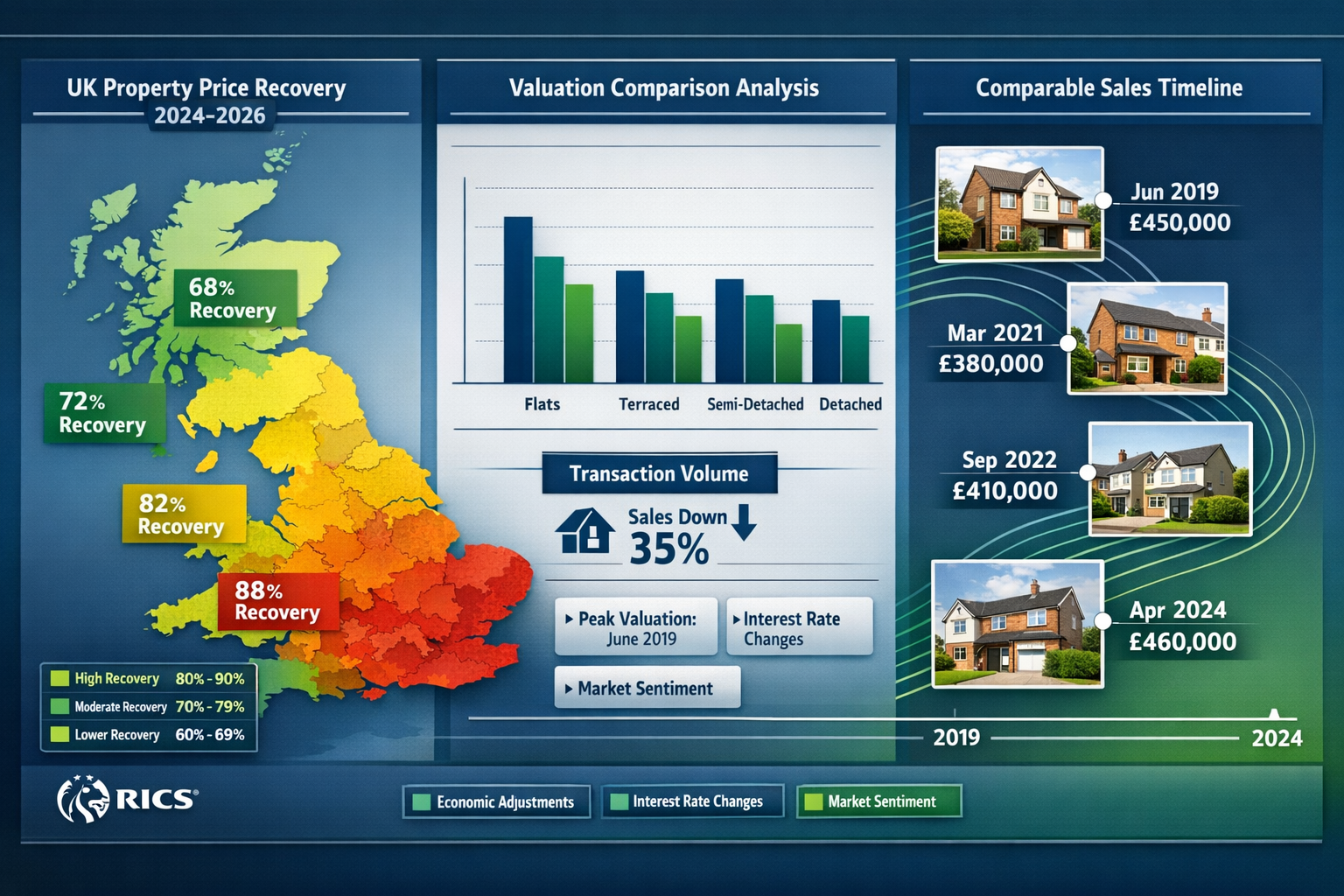
The property market recovery of 2024-2026 presents unique challenges for expert valuations. Different regions have experienced varied recovery trajectories, with some areas surpassing pre-correction values while others remain below peak levels. Expert witnesses must:
- Establish the relevant valuation date with precision, as market conditions may have changed significantly within weeks
- Gather comparable transaction data from the specific recovery period, avoiding reliance on pre-correction or trough-period comparables
- Document market sentiment indicators including transaction volumes, time-on-market statistics, and price-to-asking-price ratios
- Adjust for market conditions using time-based adjustments that reflect the recovery trajectory in the specific locality
- Explain regional variations with supporting data showing why certain areas recovered faster than others
Critical Elements of Defensible Expert Reports
Leading expert witness training programs in 2026, such as the 33rd Annual National Expert Witness Conference held in May, emphasize the importance of working closely with retaining counsel to understand legal issues and strengthen factual assumptions in expert reports.[2] This collaboration helps ensure reports withstand Daubert challenges and cross-examination.
Essential components of a robust expert witness report include:
| Report Element | Purpose | Key Considerations |
|---|---|---|
| Qualifications Statement | Establish credibility and expertise | Include RICS designation, relevant experience, prior expert witness assignments |
| Scope of Instructions | Define boundaries of opinion | Document what counsel requested and any limitations |
| Methodology Explanation | Demonstrate professional approach | Reference RICS standards, explain valuation methods chosen |
| Assumptions & Limitations | Protect against scope creep | Clearly state what was assumed and what falls outside expertise |
| Market Data Analysis | Support valuation conclusions | Present recovery market data with sources and adjustments |
| Comparable Evidence | Justify value conclusions | Provide detailed comparable analysis with adjustment rationale |
| Conclusions | State expert opinion clearly | Avoid equivocation while acknowledging reasonable ranges |
Experienced expert witnesses, such as Shawn Wilson, MAI, who has completed over 1,000 expert witness assignments since 1987, emphasize the importance of thorough documentation of methodology and conclusions to withstand challenges.[2]
Expert Witness Preparation for 2026 Property Disputes: Specialized Applications
Boundary Dispute Valuations
Boundary disputes require expert witnesses to address both the physical extent of disputed land and its impact on property values. In 2026, recovery market data plays a specific role in quantifying the diminution in value caused by boundary encroachments or disputed ownership.
Key considerations for boundary dispute expert testimony:
- 🗺️ Survey evidence integration: Coordinate with land surveyors to understand precise boundary locations
- 💷 Value impact quantification: Calculate the difference in value between the property with correct boundaries versus disputed boundaries
- 📐 Usability factors: Consider how boundary issues affect practical use, development potential, and marketability
- 🏡 Comparable analysis adjustments: Find comparables with similar boundary characteristics or adjust for differences
When preparing retrospective valuations for boundary disputes that originated years ago, experts must demonstrate market conditions at the relevant historical date while explaining how those conditions differed from current recovery market levels.
Matrimonial Property Division
Matrimonial valuations for divorce proceedings require particular sensitivity to timing and market fluctuations. The 2024-2026 recovery period has created scenarios where property values at separation date may differ significantly from values at final settlement.
Expert witnesses in matrimonial cases must:
- Provide valuations at multiple relevant dates (separation, petition filing, final hearing)
- Explain market movement between these dates using recovery data
- Consider whether properties should be valued with vacant possession or subject to occupation
- Address any improvements or deterioration during the separation period
- Present findings in accessible language for family court judges
Tax-Related Dispute Valuations
Tax disputes involving capital gains tax, probate valuations, or ATED valuations require expert witnesses to demonstrate market value at specific statutory dates. Recovery market data becomes crucial when these dates fall within the 2024-2026 recovery period.
Tax valuation expert testimony should:
- Reference HMRC guidance and case law precedents
- Demonstrate awareness of statutory definitions of market value
- Provide detailed comparable evidence from the relevant tax year
- Explain any special assumptions required by tax legislation
- Anticipate HMRC's likely challenges and preemptively address them
Preparing for Cross-Examination and Daubert Challenges
Understanding Daubert Standards in Property Disputes
The Daubert standard requires expert testimony to be based on reliable principles and methods applied reliably to the facts of the case. For property valuers, this means demonstrating that RICS-compliant methodology was followed and that recovery market data was analyzed appropriately.
Courts evaluate expert testimony based on:
- Whether the theory or technique can be (and has been) tested
- Whether it has been subjected to peer review and publication
- The known or potential error rate
- The existence and maintenance of standards controlling the technique's operation
- Whether the approach has general acceptance in the relevant professional community
RICS valuation methodology easily satisfies these criteria when properly documented and explained. The 2026 emphasis on expert witness training reflects the profession's recognition that technical competence alone is insufficient—surveyors must also communicate their methodology clearly to legal audiences.[2]
Effective Cross-Examination Preparation
The May 2026 SEAK National Expert Witness Conference dedicates significant programming to cross-examination preparation and trial presentation strategies.[2] Key preparation techniques include:
- Anticipate challenges: Review the opposing party's position and identify likely attack vectors
- Know your data intimately: Be prepared to explain every comparable, adjustment, and assumption
- Practice explaining technical concepts: Use plain language without sacrificing accuracy
- Maintain professional demeanor: Remain calm, objective, and non-defensive under pressure
- Acknowledge limitations: Admit what you don't know rather than speculating beyond expertise
- Stay within your scope: Resist attempts to draw opinions outside your instructions
"Working with retaining counsel to understand legal issues and strengthen factual assumptions, methodology, and conclusions in expert reports is essential to withstanding Daubert challenges and cross-examination." — Expert Witness Training Principle, 2026[2]
Common Pitfalls to Avoid
Even experienced surveyors can undermine their credibility through preventable errors. Common expert witness mistakes in 2026 property disputes include:
❌ Advocacy bias: Appearing to favor the retaining party rather than providing objective opinion
❌ Insufficient documentation: Failing to maintain detailed records of research and analysis
❌ Inconsistent methodology: Applying different standards to subject property versus comparables
❌ Ignoring contrary evidence: Cherry-picking data that supports desired conclusion
❌ Overreaching expertise: Opining on legal, structural, or other matters outside valuation expertise
❌ Poor report organization: Creating reports that are difficult to follow or lack clear conclusions
❌ Inadequate market data: Relying on insufficient comparable evidence or outdated market information
Leveraging Technology and Data Analytics in 2026
Digital Tools for Market Data Analysis
The 2026 property expert witness increasingly relies on sophisticated data analytics platforms to analyze recovery market trends. Modern tools enable:
- Real-time access to Land Registry transaction data across all UK regions
- Automated comparable property identification with customizable search parameters
- Statistical analysis of market trends including regression analysis and confidence intervals
- Visualization tools for creating compelling charts and graphs for court presentation
- Database management for organizing extensive comparable evidence
When using technology-generated data, expert witnesses must understand the underlying algorithms and be prepared to explain them under cross-examination. Courts expect experts to demonstrate that automated tools were used appropriately and that professional judgment was applied to the results.
Presenting Recovery Market Data Visually
Effective expert witness testimony in 2026 requires strong visual communication skills. Complex recovery market data becomes more persuasive when presented through:
- Time-series charts showing property price movements through the recovery period
- Heat maps illustrating regional variation in recovery rates
- Comparable grids organizing adjustment analysis in clear tabular format
- Before-and-after photographs documenting physical property conditions
- Location maps showing subject property and comparables with relevant features
Visual aids should be professional, clear, and free from unnecessary complexity. Each exhibit should support a specific point in the expert's testimony and be referenced explicitly in the written report.
Continuing Professional Development for Expert Witnesses
Specialized Training Requirements
The complexity of expert witness work in 2026 has led to increased emphasis on specialized training beyond core surveying qualifications. Organizations like SEAK offer comprehensive programs covering opinion formation, report writing, deposition strategies, and trial testimony techniques.[2]
Recommended continuing education topics include:
- Advanced RICS Red Book updates and application in litigation contexts
- Legal procedure and evidence rules in property disputes
- Cross-examination techniques and courtroom communication
- Ethics and professional conduct for expert witnesses
- Data analysis and statistical methods for property valuation
- Technology tools for market research and presentation
Surveyors who regularly serve as expert witnesses should maintain detailed records of their training, as opposing counsel may question whether they possess current knowledge of best practices.
Building an Expert Witness Practice
For chartered surveyors interested in developing an expert witness practice, 2026 offers significant opportunities. The combination of recovery market complexity, evolving legal standards, and increasing property dispute volumes creates strong demand for qualified experts.
Steps to establish credibility as an expert witness:
- Obtain relevant qualifications: Ensure RICS FRICS or MRICS designation with valuation specialism
- Gain diverse experience: Work across multiple property types and dispute scenarios
- Develop writing skills: Practice creating clear, concise, well-organized reports
- Invest in training: Attend expert witness conferences and specialized courses[2]
- Build relationships: Network with solicitors and barristers who handle property litigation
- Maintain objectivity: Develop reputation for impartial, reliable opinions
- Document everything: Create systems for thorough record-keeping and case management
Understanding valuation factors and staying current with the best London property valuation practices provides essential foundation knowledge for expert witness work.
Conclusion
Expert witness preparation for 2026 property disputes: using recovery market data in court valuations requires a sophisticated blend of technical expertise, legal awareness, and communication skills. As the UK property market continues its recovery trajectory, chartered surveyors serving as expert witnesses must demonstrate mastery of current market conditions while adhering to rigorous RICS professional standards.
The evolving legal landscape, highlighted by the January 2026 Supreme Court ruling in Berk v. Choy,[1] underscores the importance of understanding jurisdictional requirements and procedural nuances. Meanwhile, specialized training opportunities like the May 2026 SEAK National Expert Witness Conference[2] provide essential skills for forming bulletproof opinions and withstanding cross-examination.
Actionable Next Steps
For surveyors preparing to serve as expert witnesses in 2026 property disputes:
✅ Review and update your RICS Red Book knowledge to ensure compliance with current standards
✅ Invest in specialized expert witness training to develop courtroom communication and report-writing skills
✅ Build comprehensive market data resources covering recovery trends in your geographic areas of expertise
✅ Establish protocols for documentation that create clear audit trails for your methodology and conclusions
✅ Develop relationships with legal professionals who can provide guidance on jurisdictional requirements
✅ Practice explaining technical concepts in accessible language suitable for judges and juries
✅ Consider attending the 2026 expert witness conferences to learn from experienced practitioners[2]
The demand for credible, well-prepared expert witnesses in property disputes shows no signs of diminishing. By combining technical excellence with professional presentation skills and thorough understanding of recovery market dynamics, chartered surveyors can provide invaluable service to the legal system while building rewarding expert witness practices.
Whether addressing boundary disputes, matrimonial property divisions, or complex commercial valuations, the principles remain consistent: rigorous methodology, comprehensive documentation, objective analysis, and clear communication. These fundamentals, supported by robust recovery market data and RICS-compliant processes, create expert witness testimony that courts can rely upon with confidence.
References
[1] High Court Ruling Could Block Expert 4378849 – https://www.jdsupra.com/legalnews/high-court-ruling-could-block-expert-4378849/
[2] 33rd Annual National Expert Witness Conference May 2 3 2026 Clearwater Beach Fl – https://store.seak.com/33rd-annual-national-expert-witness-conference-may-2-3-2026-clearwater-beach-fl/