
The property valuation landscape has transformed dramatically. A mortgage application that once sailed through now faces rejection due to an automated valuation model (AVM) flagging the property £50,000 below the surveyor's assessment. The client demands answers. The lender questions professional judgment. The algorithm remains silent about its reasoning. Welcome to the new reality of AI-assisted valuations in 2026, where surveyors must navigate an increasingly complex intersection of technology, professional standards, and dispute resolution.
With the RICS global professional standard "Responsible use of artificial intelligence in surveying practice" taking effect on March 9, 2026 [1], chartered surveyors face unprecedented challenges in defending their valuations against algorithmic contradictions. This comprehensive guide explores AI-Assisted Valuations in 2026: RICS Best Practices for Surveyors Facing Algorithm Disputes, providing actionable strategies for maintaining professional authority while embracing technological advancement.

Key Takeaways
- Professional judgment remains paramount: The RICS standard establishes a mandatory "human-in-the-loop" model where AI assists but qualified surveyors retain final decision-making authority and accountability [1]
- Transparency is non-negotiable: Firms must disclose AI use in terms of engagement and provide written explanations of AI systems, limitations, and reliability assessments on client request [4]
- Risk management is mandatory: Organisations using AI in materially impactful ways must maintain quarterly-reviewed risk registers with RAG ratings documenting likelihood, impact, and mitigation strategies [2]
- Documentation defeats disputes: Written reliability assessments, bias risk documentation, and quality assurance sampling create defensible positions when algorithm outputs conflict with professional valuations
- Baseline competence is required: All staff must demonstrate understanding of AI types, limitations, failure modes, and inherent biases to comply with 2026 standards [3]
Understanding the New RICS AI Standard for Valuations
The implementation of RICS's landmark AI standard on March 9, 2026, represents the most significant regulatory shift in surveying practice in recent years. This mandatory framework applies to all RICS members and regulated firms across valuation, construction, infrastructure, and land services [1].
Core Principles of the 2026 Standard
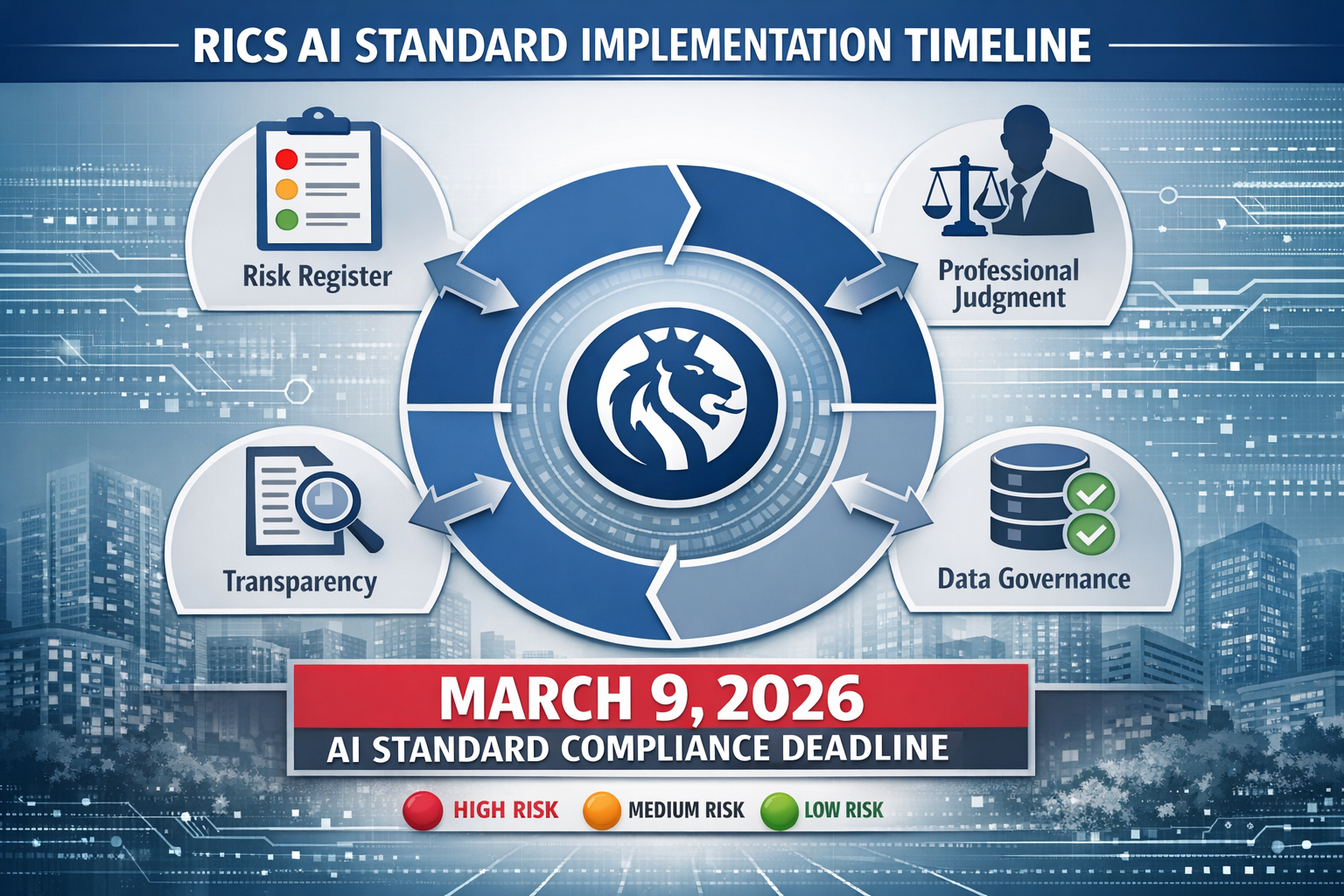
The standard establishes four foundational pillars that govern how surveyors must approach AI-assisted valuations:
1. Professional Accountability and Judgment 🎯
Surveyors must remain fully accountable for all work product, regardless of AI involvement. The final valuation conclusion must rest solely with qualified, RICS-registered valuers who apply professional skepticism throughout the process [1]. This "human-in-the-loop" requirement ensures that algorithms serve as tools rather than decision-makers.
2. Risk Management and Documentation 📋
Firms using AI in materially impactful ways must maintain a written risk register reviewed at least quarterly. Each entry must document:
- Risk description and category
- Likelihood and potential impact
- Mitigation plans and responsible parties
- Firm risk appetite alignment
- Regular status updates using RAG (red-amber-green) rating systems [2]
3. Transparency and Client Communication 💬
Terms of engagement must clearly disclose when and how AI will be used in property valuations. Firms must explain processes available to contest AI use and provide written explanations on request covering:
- Type of AI system employed
- Basic working principles
- Known limitations and failure modes
- Due diligence conducted on the system
- Risk identification and management approach
- Reliability decision rationale [4]
4. Data Governance and Quality Control 🔒
Robust data governance policies must safeguard private and confidential information while addressing the impact of poor-quality training data on output accuracy. This includes implementing quality assurance mechanisms through randomized dip-sampling of AI outputs [4].
Mandatory Baseline Competence Requirements
All staff working with AI systems must demonstrate understanding of:
- Different AI types and subsets (machine learning, neural networks, natural language processing)
- How AI systems work and their operational principles
- Limitations and potential failure modes
- Risks of erroneous outputs
- Inherent biases in training data that may affect valuation accuracy [3]
This requirement recognizes that valuation models trained on region-specific or property-type-specific data may generate inaccurate outputs when applied to different contexts. For instance, an AVM trained predominantly on suburban semi-detached properties may struggle with unique heritage properties or urban penthouses.
AI-Assisted Valuations in 2026: Implementing RICS Best Practices
Successful implementation of the RICS AI standard requires systematic changes to firm operations, documentation practices, and professional workflows. Here's how leading surveying practices are adapting to the new requirements.
Conducting Written Due Diligence on AI Systems
Before procuring or deploying any third-party AI valuation tools, firms must conduct comprehensive written due diligence [4]. This process should address:
| Due Diligence Area | Key Questions to Document |
|---|---|
| Data Sourcing | Where does training data originate? What geographic regions and property types are represented? How recent is the data? |
| Reliability Verification | What validation testing has the vendor conducted? What accuracy rates are demonstrated across different property types? |
| Information Quality | How does the system handle missing data? What data cleaning processes are employed? How are outliers managed? |
| Bias Assessment | Has the system been tested for regional, property-type, or demographic biases? What mitigation strategies exist? |
| Transparency | Can the system explain its reasoning? What level of output interpretability is provided? |
For chartered surveyors in London dealing with diverse property portfolios, this due diligence becomes particularly critical. An AVM performing well on standard residential properties may fail spectacularly when valuing listed buildings, properties with development potential, or unique architectural features.
Establishing Quality Assurance Through Sampling
The RICS standard requires randomized dip-sampling of AI outputs to verify accuracy and appropriateness [4]. Best practice implementation includes:
Sampling Protocol Design:
- Sample at least 10-15% of AI-assisted valuations monthly
- Ensure random selection across property types, values, and geographic areas
- Include both concordant and discordant cases (where AI and surveyor agree or disagree)
- Document sampling methodology and results
Review Criteria:
- Compare AI outputs against surveyor professional judgment
- Assess whether AI identified relevant comparables
- Evaluate adjustment accuracy for property-specific factors
- Check for systematic biases or patterns in errors
Corrective Action Process:
- Establish thresholds for acceptable variance
- Define escalation procedures when errors exceed thresholds
- Implement retraining or recalibration protocols
- Document lessons learned and system improvements
Creating Written Reliability Assessments
When using AI outputs in Red Book valuations, surveyors must prepare written reliability assessments that include [3]:
✅ Assumptions made about the AI system's operation and data quality
✅ Key concerns and reasons for those concerns (e.g., limited comparable data, property uniqueness, market volatility)
✅ Mitigation strategies to reduce identified concerns
✅ Impact on overall reliability of the valuation conclusion
✅ Fitness for purpose determination whether the AI output can reasonably be used for the intended purpose
✅ Professional supervision confirmation that the assessment was prepared under supervision of a qualified surveyor
This documentation becomes critical evidence when defending valuations in disputes. A well-constructed reliability assessment demonstrates professional diligence and provides clear reasoning for why a surveyor's judgment may differ from an algorithmic output.
Implementing Risk Registers for Valuation Practices
The mandatory risk register requirement [2] provides a structured framework for identifying and managing AI-related risks in valuation work:
Common Risks to Document:
🔴 High Risk (Red):
- Using AI systems without adequate training data for specialized property types
- Over-reliance on AI outputs without professional verification
- Inadequate disclosure of AI use to clients or lenders
🟡 Medium Risk (Amber):
- Potential bias in training data affecting certain property segments
- Time lags between market changes and AI model updates
- Client misunderstanding of AI role in valuation process
🟢 Low Risk (Green):
- Minor data quality issues in non-critical valuation factors
- Temporary system availability issues with backup procedures in place
- Staff training gaps with scheduled remediation
Quarterly Review Process:
- Assess whether risk ratings have changed
- Evaluate effectiveness of mitigation measures
- Identify new risks emerging from practice experience
- Update policies and procedures based on findings
Defending Valuations in Algorithm Disputes: Practical Strategies

When automated valuation models contradict professional surveyor assessments, disputes inevitably arise. Whether facing lender challenges, tribunal hearings, or client complaints, surveyors must be prepared to defend their professional judgment with robust evidence and clear reasoning.
Understanding Common Dispute Scenarios
Scenario 1: Lender Down-Valuation Disputes 💷
A mortgage applicant receives a surveyor's valuation of £650,000, but the lender's AVM flags the property at £595,000, jeopardizing the loan. The lender questions the surveyor's methodology and requests justification.
Defense Strategy:
- Provide detailed comparable evidence with specific adjustments explained
- Highlight property-specific features the AVM cannot adequately assess (recent renovations, location micro-factors, unique characteristics)
- Reference the written reliability assessment documenting AI limitations for this property type
- Demonstrate compliance with RICS valuation factors and Red Book standards
- Offer to discuss findings with lender's valuation team
Scenario 2: Matrimonial Valuation Challenges 👥
In divorce proceedings, one party produces an online AVM estimate £80,000 higher than the surveyor's professional valuation, claiming the surveyor undervalued the property.
Defense Strategy:
- Explain the "human-in-the-loop" principle and why professional judgment supersedes automated estimates
- Document the AVM's known limitations and bias risks for the property's characteristics
- Provide transparent methodology showing inspection findings, comparable analysis, and adjustment rationale
- Reference RICS standards requiring qualified surveyor oversight of AI outputs
- Present quality assurance sampling data demonstrating firm's valuation accuracy track record
Scenario 3: Probate Valuation Disputes with HMRC 🏛️
HMRC challenges a probate valuation using algorithmic market data suggesting a higher value, potentially increasing inheritance tax liability.
Defense Strategy:
- Provide comprehensive market evidence from the valuation date
- Demonstrate property-specific factors affecting marketability
- Reference written due diligence on AI systems showing their limitations for heritage or unique properties
- Show compliance with mandatory transparency and documentation requirements
- Offer detailed explanation of professional judgment process
Building a Defensible Documentation Trail
The strongest defense against algorithm disputes is comprehensive documentation created during the valuation process, not after challenges arise.
Essential Documentation Components:
📄 Inspection Records:
- Detailed property description with photographs
- Condition assessment and defects noted
- Unique features or characteristics affecting value
- Market position and location analysis
📄 Comparable Evidence:
- Minimum three comparable properties with full details
- Specific adjustments explained and quantified
- Market conditions at valuation date
- Evidence of comparable verification (not just AVM data)
📄 AI System Documentation:
- Written reliability assessment for any AI tools used
- Due diligence records on third-party systems
- Quality assurance sampling results
- Risk register entries relevant to the valuation
📄 Professional Judgment Rationale:
- Clear explanation of valuation approach selected
- Reasoning for departures from AI suggestions
- Assumptions and special assumptions stated
- Limitations and caveats clearly identified
📄 Client Communication Records:
- Terms of engagement disclosing AI use
- Written explanations provided on request
- Responses to queries about methodology
- Confirmation of compliance with RICS standards
Leveraging RICS Standards in Dispute Resolution
The 2026 RICS AI standard provides powerful support for surveyors defending professional valuations against algorithmic challenges:
Key Arguments to Deploy:
-
Professional Accountability Requirement [1]
- RICS mandates that final valuation conclusions rest with qualified surveyors, not algorithms
- Professional judgment must be applied with skepticism to all AI outputs
- Surveyors remain fully accountable regardless of AI involvement
-
Mandatory Bias Risk Assessment [3]
- RICS requires written documentation of inherent bias risks in AI systems
- Valuation models trained on specific data sets may not generalize to unique properties
- Professional surveyors must identify and mitigate these limitations
-
Quality Assurance Evidence [4]
- Firms must demonstrate randomized sampling and verification of AI accuracy
- Systematic quality control provides evidence of overall reliability
- Individual valuations benefit from firm-wide quality assurance processes
-
Transparency and Due Diligence [4]
- RICS requires comprehensive due diligence on AI systems before use
- Written reliability assessments demonstrate professional diligence
- Transparency obligations ensure clients understand AI role and limitations
Expert Witness Considerations
When disputes escalate to tribunal or court proceedings, surveyors may need to provide expert witness testimony defending their valuations against algorithmic contradictions.
Best Practices for Expert Witness Preparation:
🎯 Demonstrate RICS Compliance:
- Show adherence to all mandatory requirements of the AI standard
- Present risk registers, due diligence documentation, and quality assurance records
- Explain how professional judgment was applied throughout the process
🎯 Explain AI Limitations Clearly:
- Use plain language to describe how AVMs work and their inherent constraints
- Provide specific examples of why the algorithm may have produced different results
- Avoid technical jargon while maintaining professional credibility
🎯 Present Comparable Evidence:
- Bring detailed comparable analysis with photographs and descriptions
- Explain adjustment methodology with transparent reasoning
- Show market evidence supporting the professional valuation
🎯 Maintain Professional Objectivity:
- Acknowledge where AI outputs may have valid insights
- Explain disagreements without dismissing technology entirely
- Focus on professional standards and best practices rather than personal opinion
Preparing for Future Developments in AI-Assisted Valuations
The regulatory landscape continues to evolve. RICS has announced supplementary guidance on "Artificial intelligence in real estate valuation" scheduled for public consultation in Q2 2026, with publication expected later in 2026 [5]. This forthcoming guidance will address:
- How AI is currently applied within the valuation process
- Opportunities and risks AI may introduce to valuation practice
- Considerations relating to sourcing and verification of information obtained using AI tools
- Best practices for integrating AI into professional workflows
Operational Compliance Checklist
To ensure full compliance with current standards and readiness for future developments, firms should complete the following operational requirements [6]:
✓ Audit Existing AI Tools
- Inventory all AI systems currently in use
- Assess compliance with RICS due diligence requirements
- Identify gaps in documentation or risk assessment
- Plan remediation for non-compliant systems
✓ Revise Policies and Procedures
- Update data governance policies
- Enhance procurement procedures for AI systems
- Strengthen oversight and quality assurance protocols
- Implement mandatory documentation standards
✓ Invest in Staff Training
- Provide baseline AI competence training to all staff
- Develop specialized training for valuers using AI tools
- Create ongoing professional development programs
- Establish competence assessment mechanisms
✓ Enhance Client Communication
- Revise terms of engagement templates
- Create standard AI disclosure language
- Develop written explanation templates
- Train client-facing staff on transparency requirements
✓ Strengthen Documentation Systems
- Implement risk register templates and review schedules
- Create reliability assessment frameworks
- Establish quality assurance sampling protocols
- Develop dispute defense documentation procedures
Emerging Best Practices from Early Adopters
Leading surveying firms have developed innovative approaches to AI-assisted valuations that exceed minimum compliance requirements:
Hybrid Valuation Models:
Combining multiple AI systems with professional judgment to create triangulated valuations that leverage algorithmic efficiency while maintaining human oversight and property-specific expertise.
Client Education Initiatives:
Proactive client communication explaining the role of AI in modern valuations, setting realistic expectations, and building trust in the professional judgment process.
Continuous Learning Systems:
Implementing feedback loops where dispute outcomes and quality assurance findings continuously improve AI system selection, configuration, and reliability assessment processes.
Collaborative Industry Approaches:
Participating in industry working groups to share experiences, develop common standards, and contribute to the evolution of best practices in AI-assisted valuations.
Conclusion: Balancing Innovation with Professional Integrity
AI-Assisted Valuations in 2026: RICS Best Practices for Surveyors Facing Algorithm Disputes represents a fundamental shift in how property professionals approach their work. The technology offers unprecedented efficiency, data processing capabilities, and market insights. Yet it also introduces new risks, challenges to professional authority, and potential for disputes when algorithms contradict expert judgment.
The RICS standard implemented on March 9, 2026, provides a clear framework for navigating this complexity. By mandating professional accountability, comprehensive risk management, transparent client communication, and robust data governance, the standard ensures that human expertise remains at the center of the valuation process.
For surveyors facing algorithm disputes, success depends on three critical factors:
- Rigorous compliance with RICS documentation, due diligence, and quality assurance requirements
- Comprehensive evidence supporting professional judgment with detailed comparables, property-specific analysis, and transparent methodology
- Clear communication explaining AI limitations, bias risks, and the irreplaceable value of qualified surveyor expertise
Actionable Next Steps
Immediate Actions (This Week):
- Review your firm's current AI systems against RICS due diligence requirements
- Audit existing valuation files for compliance with documentation standards
- Schedule risk register review meetings for quarterly implementation
Short-Term Actions (This Month):
- Develop or update written reliability assessment templates
- Implement quality assurance sampling protocols for AI outputs
- Revise terms of engagement to include mandatory AI disclosures
- Provide baseline AI competence training to all staff
Long-Term Actions (This Quarter):
- Establish comprehensive risk registers with RAG rating systems
- Create firm-wide data governance policies
- Develop dispute defense documentation procedures
- Participate in RICS consultation on forthcoming AI valuation guidance
Ongoing Commitments:
- Maintain quarterly risk register reviews
- Conduct randomized quality assurance sampling
- Update staff training as AI systems and standards evolve
- Monitor industry developments and regulatory changes
The future of property valuation lies not in choosing between human expertise and artificial intelligence, but in combining both effectively. Surveyors who embrace this hybrid approach—leveraging AI's analytical power while maintaining professional judgment, rigorous documentation, and commitment to RICS standards—will be best positioned to defend their valuations, serve their clients, and advance the profession.
Whether you're conducting matrimonial valuations, probate assessments, or standard property valuations, the principles remain constant: professional accountability, transparent methodology, comprehensive documentation, and unwavering commitment to RICS best practices. In an era of algorithm disputes, these foundations provide the strongest defense and the clearest path forward.
References
[1] Rics Launches Landmark Global Standard On Responsible Use Of Ai In Surveying – https://www.rics.org/news-insights/rics-launches-landmark-global-standard-on-responsible-use-of-ai-in-surveying
[2] Responsible Use Of Artificial Intelligence In Surveying Practice September 2025 – https://www.rics.org/content/dam/ricsglobal/documents/standards/Responsible-use-of-artificial-intelligence-in-surveying-practice_September-2025.pdf
[3] Rics Apc Hot Topics 2026 Qa Practice – https://resources.apcguide.com/rics-apc-hot-topics-2026-qa-practice/
[4] Navigating The New Rics Ai Standard What It Means For Surveyors – https://www.artefact.com/blog/navigating-the-new-rics-ai-standard-what-it-means-for-surveyors/
[5] Ai In Real Estate Valuation – https://www.rics.org/profession-standards/rics-standards-and-guidance/sector-standards/valuation-standards/ai-in-real-estate-valuation
[6] Rics Sets The Standard Responsible Ai Use Becomes Mandatory In Surveying – https://beale-law.com/article/rics-sets-the-standard-responsible-ai-use-becomes-mandatory-in-surveying/