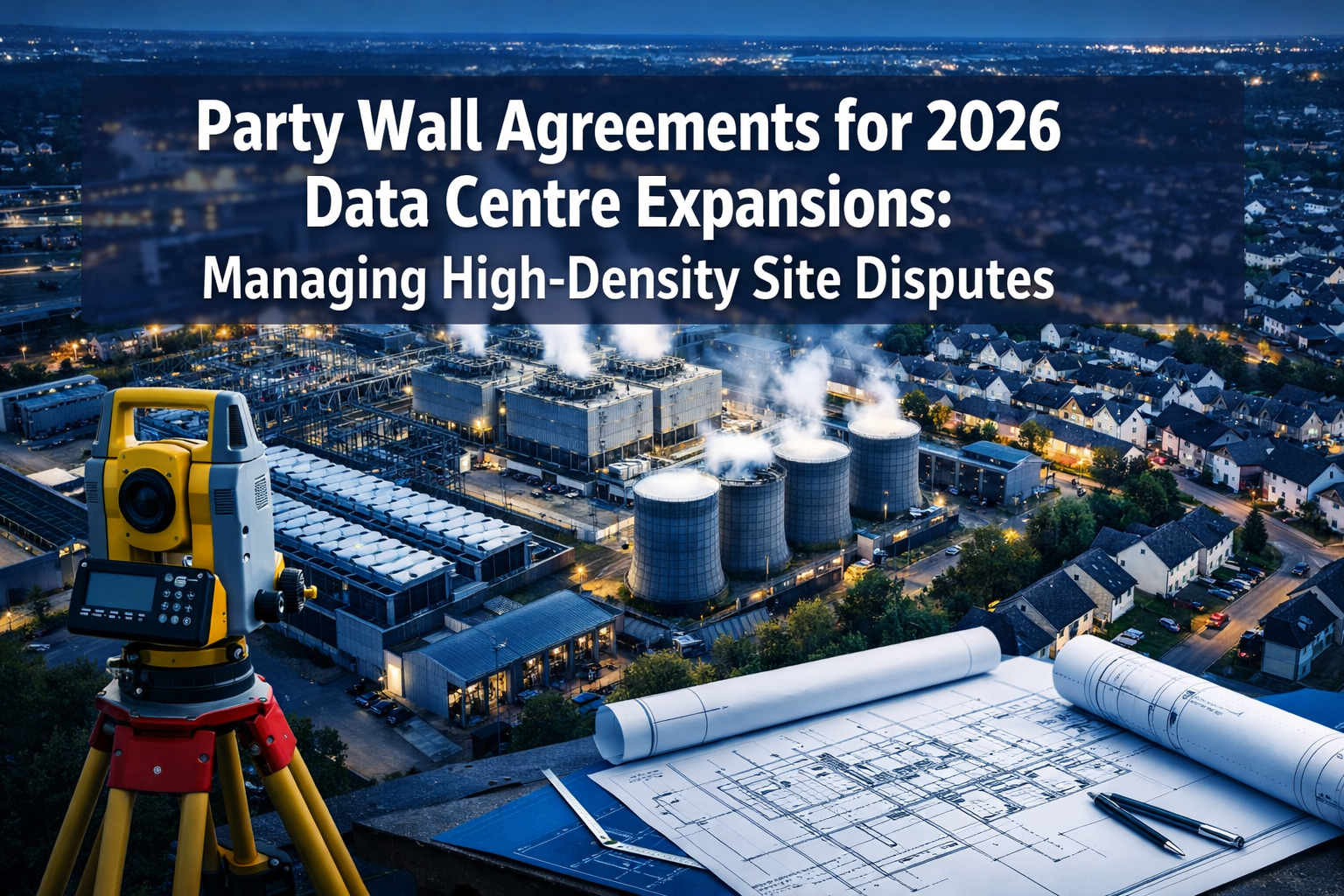
The explosive growth of artificial intelligence and cloud computing has transformed data centres from niche industrial facilities into critical infrastructure powerhouses. As 2026 unfolds, these energy-intensive behemoths are expanding at unprecedented rates across the UK's urban centres—and they're increasingly bumping up against residential and commercial neighbours. The result? A surge in complex party wall disputes involving noise, vibration, power infrastructure, and structural concerns that traditional party wall agreements were never designed to address. 🏗️
Party Wall Agreements for 2026 Data Centre Expansions: Managing High-Density Site Disputes represents a critical challenge for property owners, developers, and surveyors navigating this new landscape. With the UK government's National Data Strategy predicting data usage will double by 2026 [1], and the UK maintaining its position as the second-largest data centre market globally [1], the pressure on high-density urban sites has never been greater.
Key Takeaways
- Data centre expansions create unique party wall challenges including continuous vibration from cooling systems, 24/7 operational noise, and substantial power infrastructure requirements that affect adjoining properties
- RICS protocols for 2026 emphasize specialized assessment methods for high-density sites, including acoustic monitoring, vibration analysis, and thermal impact studies beyond traditional party wall surveys
- Multi-party construction environments significantly increase dispute risk, with even minor delays potentially causing millions in cost overruns for time-sensitive data centre projects [1]
- Proactive party wall awards must address ongoing operational impacts, not just construction phase concerns, establishing long-term monitoring and remediation frameworks
- UK hotspot areas require coordinated surveyor strategies as multiple simultaneous data centre projects in cities like London, Manchester, and Birmingham create cumulative neighbourhood impacts
Understanding Data Centre Party Wall Challenges in 2026
The Scale of Modern Data Centre Construction
Data centres in 2026 are fundamentally different from their predecessors. The facilities powering today's AI workloads and cloud infrastructure consume extraordinary amounts of electricity—often equivalent to small towns—and generate massive heat requiring industrial-scale cooling systems. When these facilities expand in high-density urban areas, the implications for adjoining owners extend far beyond typical construction concerns.
Key characteristics creating party wall complications:
- Continuous operational vibration from thousands of cooling fans and HVAC systems running 24/7
- Substantial excavation requirements for underground power infrastructure and cooling systems
- Heavy structural loads requiring deep foundations that may affect neighbouring properties
- Electromagnetic interference from high-voltage equipment affecting nearby buildings
- Heat rejection systems that alter the thermal environment of adjacent properties
The complex multi-party construction environment typical of data centre projects significantly increases dispute risk [1]. These facilities involve numerous stakeholders including developers, technology companies, power utilities, cooling system specialists, and telecommunications providers—all working simultaneously on tightly coordinated schedules where delays cascade rapidly.
Why Traditional Party Wall Approaches Fall Short
Standard party wall procedures were developed primarily for residential extensions, loft conversions, and conventional commercial developments. They focus heavily on the construction phase, with schedules of condition documenting pre-existing damage and party wall awards establishing temporary access rights and construction protocols.
Data centre expansions demand a fundamentally different approach because:
- Operational impacts often exceed construction impacts in severity and duration
- Technology obsolescence drives mid-construction scope changes that traditional contracts don't accommodate [1]
- Supply chain bottlenecks for specialized equipment create unpredictable delays affecting all parties [1]
- Phased procurement structures separate shell and fit-out work across multiple agreements [1]
- Ongoing monitoring requirements extend decades beyond initial construction completion
Party Wall Agreements for 2026 Data Centre Expansions: RICS Protocols and Best Practices
Specialized Assessment Requirements
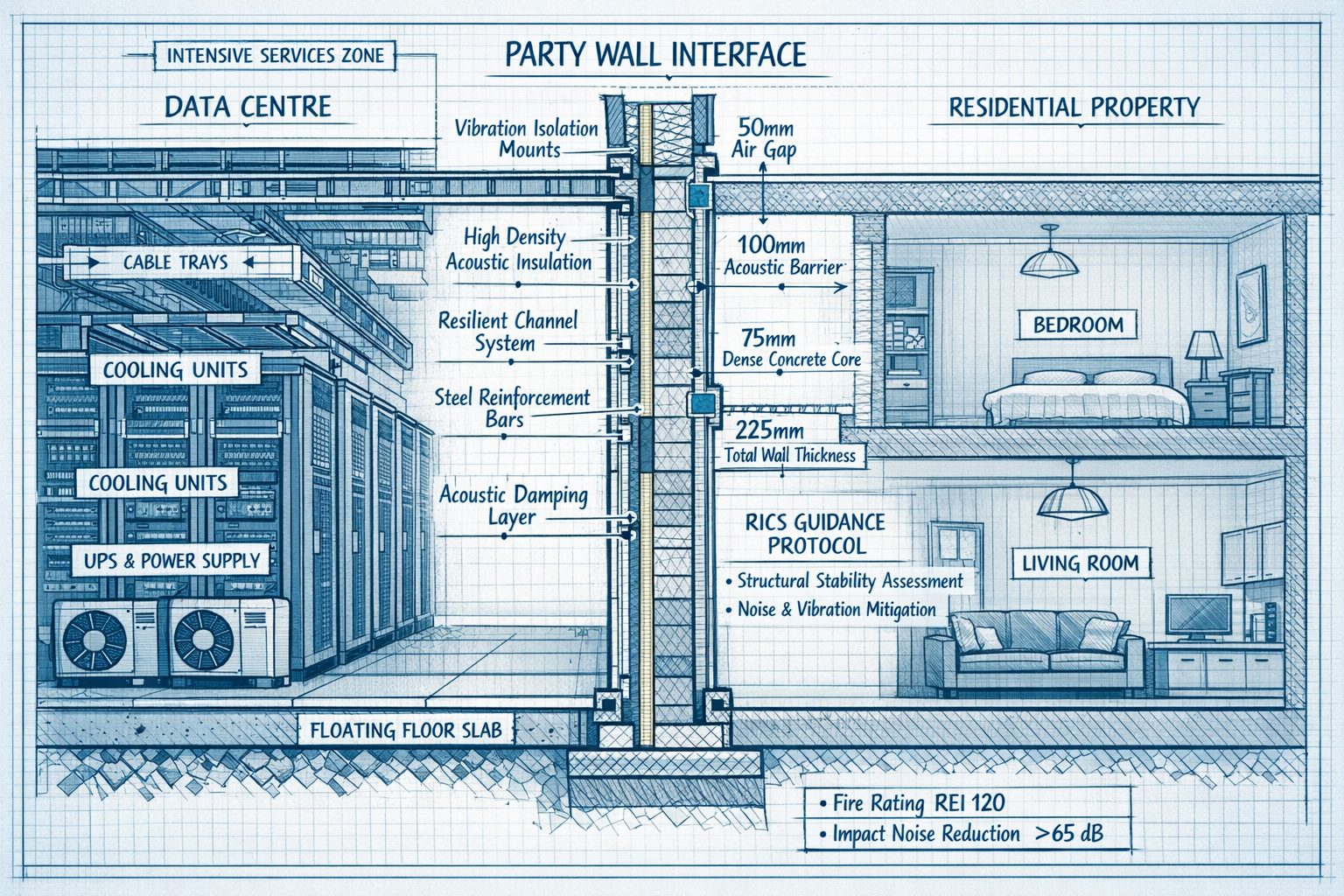
Surveyors handling party wall matters for data centre expansions in 2026 must conduct assessments that go well beyond traditional visual inspections and basic structural surveys. RICS guidance now emphasizes comprehensive baseline documentation across multiple technical domains [3].
Essential assessment components include:
| Assessment Type | Purpose | Key Measurements |
|---|---|---|
| Acoustic Baseline Survey | Document pre-existing noise levels | dB(A) readings at multiple times, frequency analysis |
| Vibration Monitoring | Establish normal ground vibration | Peak particle velocity (PPV), frequency spectrum |
| Thermal Imaging | Record existing temperature patterns | External wall temperatures, heat distribution |
| Structural Survey | Document building condition | Crack mapping, settlement monitoring points |
| Power Quality Assessment | Measure electrical environment | Voltage stability, harmonic distortion |
| Air Quality Testing | Record baseline particulate levels | PM2.5, PM10, temperature, humidity |
These comprehensive party wall schedules of condition provide essential evidence if disputes arise regarding operational impacts from the completed data centre.
Drafting Effective Party Wall Awards for Data Centres
Party wall awards for data centre developments must address both construction and post-completion operational phases. Leading surveyors in 2026 are incorporating specific provisions that traditional awards typically omit [3].
Critical award provisions include:
✅ Operational noise limits with specific dB(A) thresholds for different times of day
✅ Vibration monitoring protocols establishing acceptable PPV limits and measurement frequencies
✅ Thermal impact restrictions preventing heat rejection systems from affecting neighbouring properties
✅ Ongoing access rights for periodic condition inspections post-completion
✅ Remediation obligations with defined response timeframes when thresholds are exceeded
✅ Dispute resolution mechanisms including expert determination procedures
✅ Financial security provisions ensuring funds are available for remediation work
The award should explicitly recognize that data centre operations constitute ongoing "notifiable work" requiring continued compliance with party wall principles, even after construction completion [4].
Addressing Excavation and Foundation Concerns
Data centres require substantial excavation for power infrastructure, cooling systems, and structural foundations capable of supporting enormous equipment loads. The party wall excavation notice requirements under the Party Wall Act become particularly complex when dealing with these deep foundations in high-density areas.
Excavation challenges specific to data centres:
- Deep foundations often extending 10-15 meters below ground level
- Underground cooling infrastructure including water pipes and thermal exchange systems
- Power vaults and transformer chambers requiring substantial below-grade construction
- Emergency generator fuel tanks buried beneath the facility
- Fiber optic and telecommunications infrastructure connecting to multiple providers
The 3-metre rule becomes especially relevant, as data centre excavations frequently extend within three metres of neighbouring buildings and below their foundation levels. Surveyors must ensure proper notice is served and appropriate underpinning or protective measures are specified in the award.
Managing High-Density Site Disputes: Strategies for UK Hotspots
Geographic Concentration and Cumulative Impacts
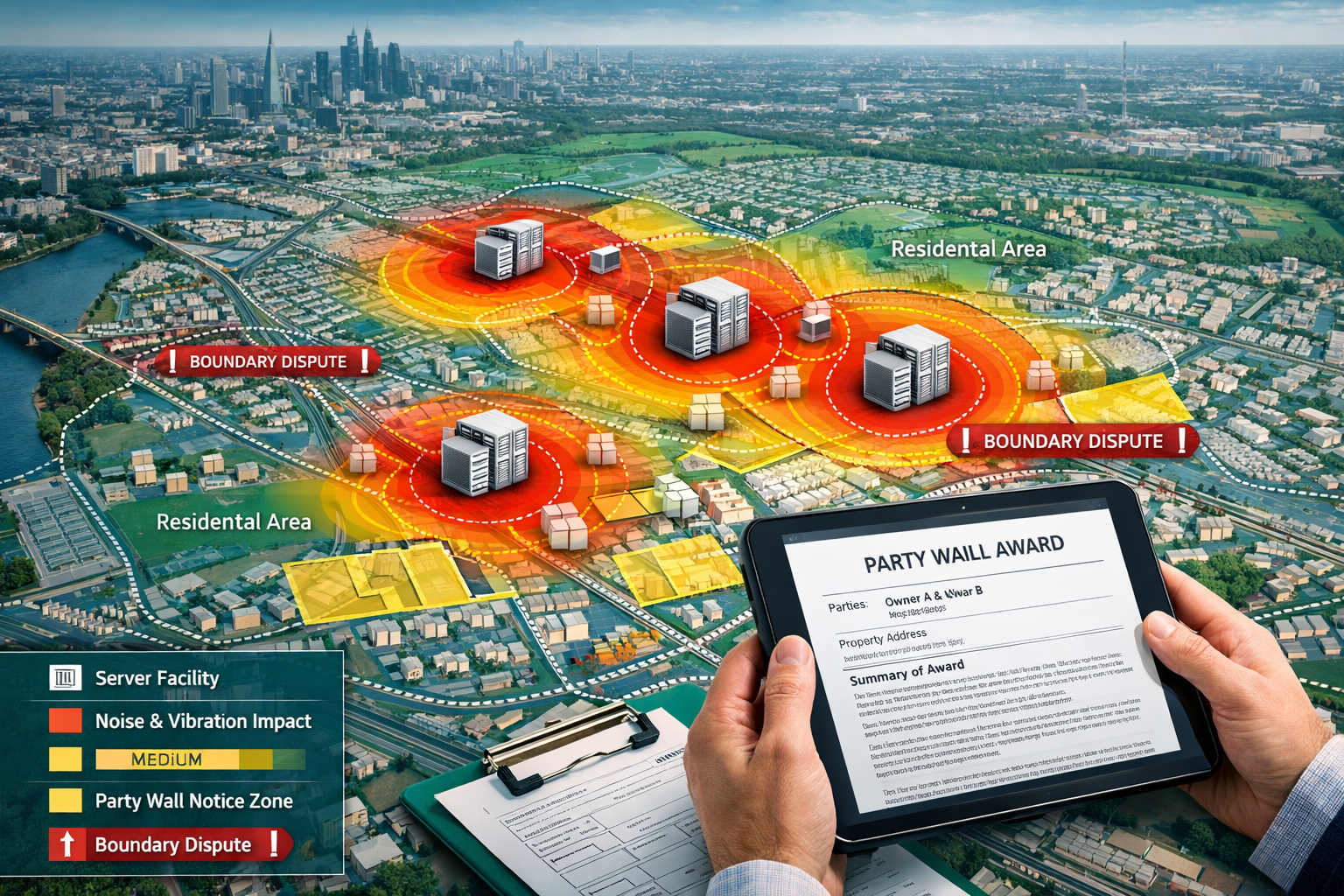
The UK data centre market exhibits strong geographic clustering, with facilities concentrating in specific hotspot areas where power availability, fiber connectivity, and land costs align favourably. London, Manchester, Birmingham, and the Thames Valley corridor host the majority of UK capacity, with multiple facilities often operating within close proximity [4].
This concentration creates cumulative impact challenges that individual party wall agreements struggle to address:
- Multiple simultaneous construction projects affecting the same residential areas
- Overlapping operational noise and vibration from several facilities
- Strain on local power grid infrastructure affecting all properties
- Traffic congestion from construction vehicles serving multiple sites
- Combined thermal impacts altering neighbourhood microclimates
Surveyors working in these hotspot areas must consider the aggregate effect of multiple data centre developments when assessing impacts on adjoining owners. A single facility might produce noise within acceptable limits, but three facilities operating simultaneously in the same neighbourhood may create unacceptable cumulative impacts [3].
Coordinated Surveyor Approaches
The complexity of data centre party wall matters often requires agreed surveyors with specialized expertise rather than the traditional approach of separate surveyors for building owner and adjoining owner. This coordinated approach offers several advantages:
Benefits of agreed surveyor arrangements:
🔹 Technical expertise – Single surveyor with data centre-specific knowledge
🔹 Cost efficiency – Reduced overall surveyor costs for all parties
🔹 Faster resolution – Streamlined decision-making without prolonged negotiations
🔹 Consistent standards – Uniform assessment criteria across multiple adjoining owners
🔹 Reduced adversarial dynamics – Neutral expert facilitating cooperation
However, adjoining owners should carefully consider whether an agreed surveyor arrangement truly serves their interests, particularly when facing well-resourced developers with repeat experience in data centre construction.
Dispute Resolution and Expert Determination
Despite best efforts at prevention, disputes frequently arise during both construction and operational phases of data centre developments. The high financial stakes—where even minor delays can cost millions [1]—create intense pressure for rapid resolution.
Common dispute triggers include:
- Scope changes during construction as technology requirements evolve [1]
- Supply chain delays for specialized equipment affecting project timelines [1]
- Vibration exceeding predicted levels once cooling systems become operational
- Noise complaints from 24/7 operations affecting residential neighbours
- Structural damage claims from excavation or operational vibration
- Access disputes when ongoing monitoring is required post-completion
Effective party wall awards establish clear dispute escalation procedures:
- Direct negotiation between surveyors (5-10 business days)
- Mediation with neutral third party (15 business days)
- Expert determination by specialist surveyor (30 business days)
- Arbitration or litigation as final resort
The awards should specify that expert determiners must have demonstrable experience with data centre developments, not just general construction expertise. Understanding the technical realities of cooling systems, power infrastructure, and operational requirements is essential for fair determinations [4].
Case Study: Managing Multi-Party Disputes in Urban Expansions
A 2026 data centre expansion in East London illustrates the challenges of managing high-density site disputes. The facility, expanding to accommodate AI workload growth, adjoined 17 residential properties and two commercial buildings. Initial party wall notices triggered concerns about:
- Continuous low-frequency noise from proposed additional cooling towers
- Vibration from new generator testing scheduled for monthly maintenance
- Excavation impacts on Victorian-era foundations in neighbouring terraced houses
- Access requirements for ongoing monitoring equipment installation
The appointed surveyors implemented a comprehensive strategy:
✔️ Conducted detailed baseline assessments across all affected properties
✔️ Established a community liaison committee with regular update meetings
✔️ Negotiated operational restrictions limiting generator testing to specific hours
✔️ Installed real-time monitoring systems with data accessible to adjoining owners
✔️ Created a rapid response protocol for addressing complaints within 24 hours
✔️ Secured financial guarantees for remediation work if impacts exceeded thresholds
This proactive approach prevented formal disputes despite the project's complexity, demonstrating that specialized party wall protocols can effectively manage even challenging data centre expansions [3].

Protecting Adjoining Owners: Rights and Remedies
Understanding Your Rights as an Adjoining Owner
Property owners adjacent to data centre developments possess significant legal protections under party wall legislation, but exercising these rights effectively requires understanding the unique aspects of data centre construction.
Key rights include:
- Right to appoint your own surveyor rather than accepting an agreed surveyor arrangement
- Right to comprehensive condition surveys documenting property state before work begins
- Right to ongoing access for monitoring impacts during construction and operations
- Right to compensation for damage to property caused by the works
- Right to require specific protective measures beyond those initially proposed
- Right to challenge inadequate party wall awards through dispute resolution
Many adjoining owners mistakenly believe they can prevent data centre development entirely. Party wall legislation doesn't provide veto power over development, but it does ensure proper procedures are followed and legitimate concerns are addressed through the award [3].
When to Seek Specialist Advice
Given the technical complexity of data centre party wall matters, adjoining owners should consider engaging specialist surveyors early in the process—ideally immediately upon receiving party wall notices. The relatively modest cost of professional surveyor services is typically covered by the building owner under party wall legislation.
Situations requiring immediate specialist input:
⚠️ Party wall notices for data centre construction or expansion
⚠️ Proposals involving excavation within 6 metres of your property
⚠️ Plans showing cooling towers or generators near your boundary
⚠️ Any work affecting shared walls or foundations
⚠️ Requests to use your property for access during construction
⚠️ Offers of "agreed surveyor" arrangements from developers
Specialist surveyors familiar with data centre developments understand the operational implications that general practice surveyors might overlook. They can ensure party wall awards address long-term operational impacts, not just construction phase concerns [4].
Monitoring and Enforcement
Party wall awards establish rights and obligations, but their effectiveness depends on proper monitoring and enforcement. For data centre developments, this monitoring must extend well beyond construction completion.
Effective monitoring strategies include:
📊 Baseline documentation – Comprehensive pre-work condition records
📊 Construction phase monitoring – Regular inspections and measurements
📊 Commissioning phase assessment – Testing when systems first activate
📊 Operational monitoring – Ongoing measurements of noise, vibration, and other impacts
📊 Periodic condition surveys – Annual or biannual property inspections
📊 Incident reporting systems – Documented procedures for raising concerns
When monitoring reveals breaches of award conditions, adjoining owners should follow the established dispute resolution procedures rather than attempting direct enforcement. The party wall award creates contractual obligations enforceable through the surveyor appointment mechanism, not through direct legal action between owners [3].
Future Trends: Party Wall Agreements for 2026 Data Centre Expansions and Beyond
Emerging Technologies and New Challenges
The data centre industry continues evolving rapidly, with emerging technologies creating new party wall challenges that surveyors must anticipate. Several trends are already visible in 2026 projects:
Liquid cooling systems – Next-generation data centres increasingly use direct liquid cooling rather than air-based systems, requiring different infrastructure with distinct party wall implications. Liquid cooling reduces noise but increases requirements for water supply, drainage, and potential leak containment [1].
Edge data centres – Smaller facilities distributed throughout urban areas bring data centre impacts to previously unaffected neighbourhoods. These edge facilities often occupy sites with more immediate residential adjacency than traditional large-scale data centres.
Renewable energy integration – On-site solar panels, battery storage, and backup generation create additional structural loads and potential electromagnetic interference requiring assessment in party wall surveys.
AI-specific infrastructure – The explosive growth of AI workloads drives demand for specialized facilities with even higher power densities and cooling requirements than traditional data centres [1].
Regulatory Evolution
UK regulatory frameworks are evolving to address data centre impacts more comprehensively. While party wall legislation remains the primary mechanism for managing construction impacts on adjoining owners, supplementary regulations are emerging:
- Planning conditions increasingly require acoustic and vibration assessments
- Environmental permits address cooling water discharge and thermal impacts
- Building regulations incorporate specific provisions for high-density computing facilities
- Grid connection requirements consider cumulative impacts on local power infrastructure
Surveyors must stay informed about these evolving requirements to ensure party wall awards align with broader regulatory obligations [4].
Best Practices for Developers
Data centre developers can significantly reduce party wall disputes through proactive strategies implemented before formal notices are served:
✅ Early community engagement – Inform neighbours about plans before formal processes begin
✅ Transparent communication – Provide clear information about operational impacts, not just construction
✅ Independent baseline surveys – Commission comprehensive condition surveys before serving notices
✅ Generous compensation offers – Recognize that goodwill investments prevent costly disputes
✅ Ongoing liaison commitments – Establish permanent community contact mechanisms
✅ Technology selection – Choose quieter equipment even when more expensive
✅ Acoustic engineering – Invest in sound attenuation beyond minimum requirements
These proactive measures often cost less than resolving a single protracted party wall dispute while preserving community relationships essential for long-term operations [3].
Conclusion
Party Wall Agreements for 2026 Data Centre Expansions: Managing High-Density Site Disputes represents one of the most complex challenges in contemporary property law and surveying practice. The explosive growth of data infrastructure—driven by AI adoption, cloud computing, and digital transformation—is placing unprecedented pressure on urban sites where these power-hungry facilities increasingly adjoin residential and commercial properties.
The key to successful management lies in recognizing that data centre party wall matters differ fundamentally from traditional construction projects. Surveyors must conduct comprehensive baseline assessments across acoustic, vibration, thermal, and structural domains. Party wall awards must address not just construction impacts but ongoing operational effects that continue for decades. Dispute resolution mechanisms must accommodate the technical complexity and high financial stakes characteristic of these developments.
For adjoining owners, understanding your rights and engaging specialist surveyors early in the process provides essential protection. For developers, proactive community engagement and investment in impact mitigation prevents costly disputes and preserves community relationships.
As the UK data centre market continues expanding—with data usage predicted to double by 2026 [1]—the importance of effective party wall protocols will only increase. Surveyors, developers, and property owners who master these specialized approaches will be best positioned to navigate the challenges ahead.
Next Steps
If you're an adjoining owner who has received party wall notices for data centre construction:
- Engage a specialist surveyor immediately—don't accept an agreed surveyor without independent advice
- Request comprehensive baseline surveys covering acoustic, vibration, and structural conditions
- Ensure the party wall award addresses operational impacts, not just construction
- Establish ongoing monitoring and dispute resolution mechanisms
If you're a developer planning data centre expansion:
- Conduct community engagement before serving formal party wall notices
- Commission independent baseline surveys to establish objective conditions
- Invest in acoustic and vibration mitigation beyond minimum requirements
- Establish permanent community liaison mechanisms for ongoing operations
If you're a surveyor handling data centre party wall matters:
- Develop specialized expertise in acoustic, vibration, and thermal assessment
- Ensure party wall awards address operational phase impacts comprehensively
- Establish monitoring protocols extending beyond construction completion
- Consider coordinated approaches when multiple properties are affected
For expert guidance on party wall matters involving data centre developments, consult with RICS-qualified surveyors who understand the unique challenges of these complex projects. The investment in specialist expertise pays dividends in preventing disputes and protecting all parties' interests.
References
[1] Data Centres – https://www.brownejacobson.com/insights/2026-horizon-scanning-in-construction/data-centres
[2] New Data Center Developments March 2026 – https://www.datacenterknowledge.com/data-center-construction/new-data-center-developments-march-2026
[3] Party Wall Awards In Data Centre Developments 2026 Protocols For High Density Urban Expansions – https://nottinghillsurveyors.com/blog/party-wall-awards-in-data-centre-developments-2026-protocols-for-high-density-urban-expansions
[4] Party Wall Surveys For Data Centre Expansions In The Uk Ai Boom Rics Guidance And Case Studies From 2026 Projects – https://nottinghillsurveyors.com/blog/party-wall-surveys-for-data-centre-expansions-in-the-uk-ai-boom-rics-guidance-and-case-studies-from-2026-projects