The UK housing market stands at a critical turning point in early 2026. After months of declining activity and price pressures, fresh data from the Royal Institution of Chartered Surveyors (RICS) reveals cautious optimism alongside persistent regional disparities that demand strategic responses from property professionals. The RICS January 2026 Survey Insights: Building Survey Strategies for Stabilising House Prices and Regional Divides demonstrates how national price stabilisation masks a widening North-South gap, creating distinct challenges for buyers, sellers, and surveyors across different regions.
For property professionals and prospective homeowners, understanding these market dynamics is essential for making informed decisions. The survey data indicates that while buyer enquiries are improving and long-term confidence is strengthening, significant regional variations require tailored approaches to property assessment and risk management. 🏘️
Key Takeaways
- Buyer demand is recovering gradually: New buyer enquiries improved to a net balance of -15% in January 2026, up from -21% in December, signaling easing downward pressure on market activity.[1]
- National house prices are stabilising: The price net balance reached -10% over three months, showing consistent improvement from October's low of -19% and suggesting a potential market turning point.[1]
- Regional divides are widening significantly: Scotland and Northern Ireland lead price growth while Southern regions including London, the South East, and East Anglia continue to lag due to affordability challenges.[1]
- Long-term confidence is strengthening: 43% of respondents anticipate higher house prices over the next 12 months—the most positive outlook since February 2025—while 12-month sales expectations surged to +35%.[1]
- Strategic building surveys are essential: The divergent regional conditions require tailored survey approaches to address specific risks, from Southern cladding concerns to Northern boom-market pressures.
Understanding the RICS January 2026 Survey Insights: Market Stabilisation Signals
The latest RICS residential market survey for January 2026 provides compelling evidence that the UK housing market is beginning to stabilise after a challenging period. However, the RICS January 2026 Survey Insights: Building Survey Strategies for Stabilising House Prices and Regional Divides reveal that this stabilisation is far from uniform across the country.
Key Demand Indicators Show Improvement
The survey data highlights several encouraging trends in buyer activity:
Buyer Enquiries Recovery 📈
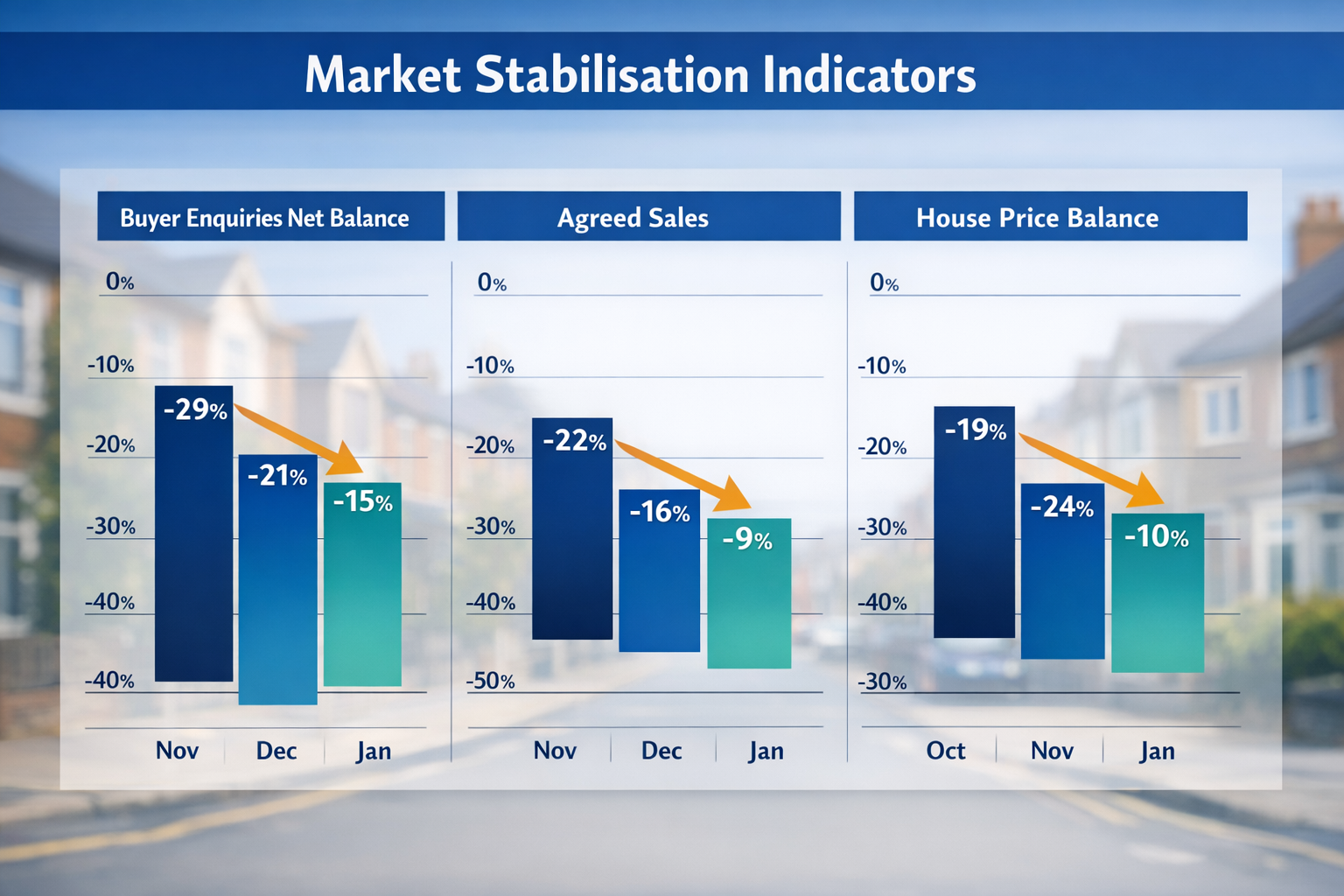
- Net balance improved to -15% in January 2026
- Significant improvement from -21% in December 2025
- Continuing upward trend from -29% in November 2025
- Indicates easing downward pressure on demand[1]
Agreed Sales Momentum
The agreed sales metric reached its least negative level since mid-2025, with a net balance of -9% in January. While transaction levels remain under pressure, the declining pace of deterioration suggests the market is finding a floor.[1]
Short-Term Caution Persists
Despite these improvements, the three-month sales outlook shows a modest net balance of +4%, reflecting ongoing near-term economic uncertainty. This cautious optimism is typical of markets in transition, where participants recognize improving fundamentals but remain wary of immediate volatility.[1]
Price Stabilisation: A National Turning Point
Perhaps the most significant finding in the RICS January 2026 Survey Insights: Building Survey Strategies for Stabilising House Prices and Regional Divides concerns house price trends. The national house price net balance improved to -10% over the past three months, demonstrating steady recovery from October 2025's low of -19%.[1]
This stabilisation is particularly noteworthy because it represents a potential inflection point. When combined with the fact that 43% of respondents anticipate higher house prices over the next 12 months—the most positive outlook since February 2025—it suggests growing professional confidence in price recovery.[1]
| Metric | October 2025 | December 2025 | January 2026 | Trend |
|---|---|---|---|---|
| Buyer Enquiries | -29% | -21% | -15% | ⬆️ Improving |
| Agreed Sales | Below -15% | -12% | -9% | ⬆️ Improving |
| House Price Balance | -19% | -12% | -10% | ⬆️ Stabilising |
| 12-Month Price Outlook | Negative | +35% | +43% | ⬆️ Strongly Positive |
Supply Constraints Continue
While demand shows signs of recovery, supply remains constrained. The net balance for new instructions stands at just +1% in January, barely changed from December's -1%.[3] More concerning, market appraisals show a net balance of -11%, suggesting that meaningful increases in new listings may still be some way off.[3]
This supply-demand imbalance has important implications for property valuations and the types of building surveys and inspections that buyers should commission in different market conditions.
Regional Divides in the RICS January 2026 Survey Insights: North-South Disparities Deepen
The most striking aspect of the RICS January 2026 Survey Insights: Building Survey Strategies for Stabilising House Prices and Regional Divides is the pronounced geographical variation in market performance. These regional disparities are not merely statistical curiosities—they have profound implications for property assessment strategies and risk management.
Northern Regions Lead Price Growth
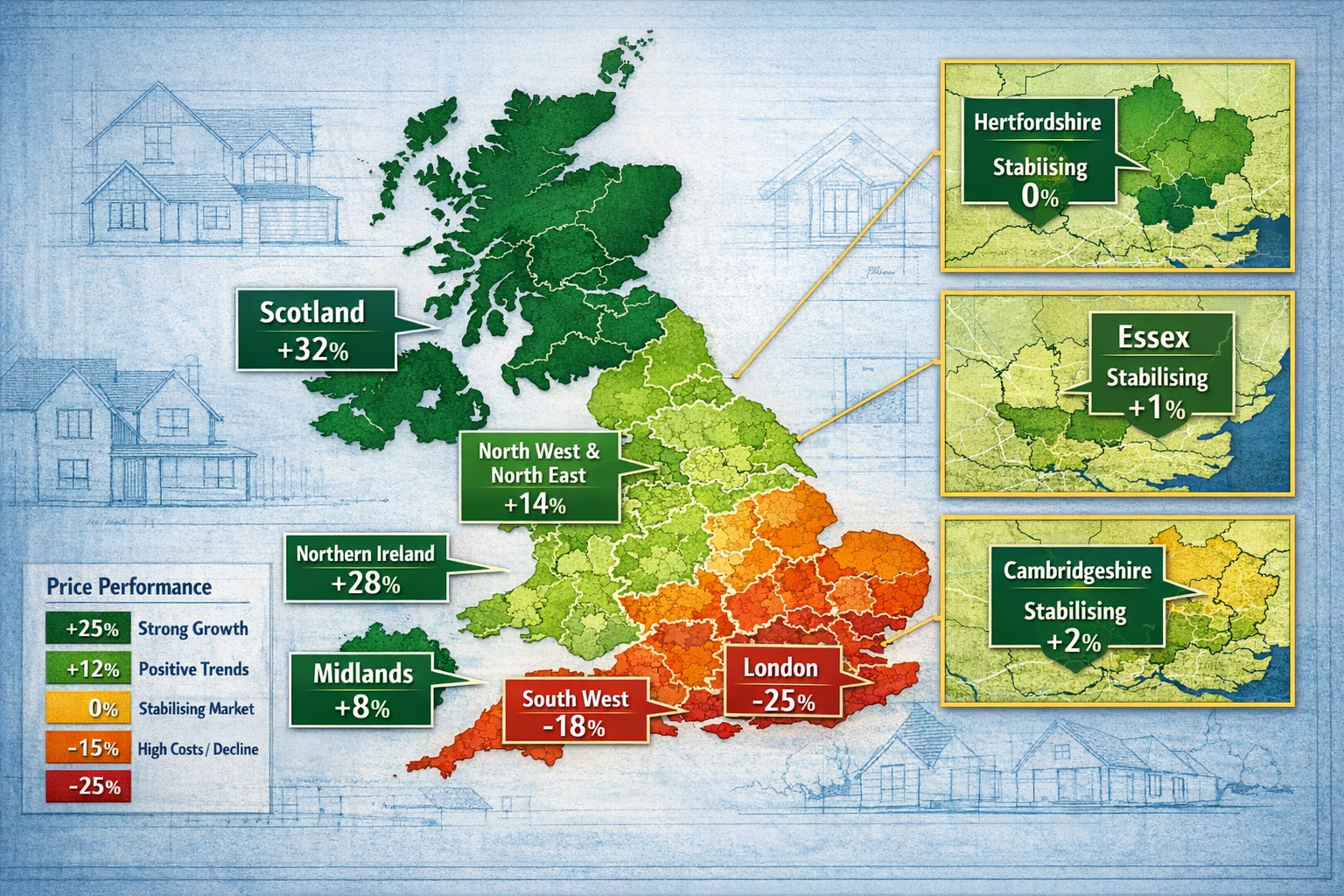
Scotland and Northern Ireland continue to record the strongest price performance in the January 2026 survey. These regions are experiencing genuine upward momentum, with positive net balances indicating more respondents reporting price increases than decreases.[1]
Additionally, upward trends are emerging in the North West and North of England, suggesting that the price recovery is gaining traction across multiple northern markets. This performance reflects several factors:
- Relative affordability compared to southern regions
- Stronger local economic conditions in certain sectors
- Migration patterns as remote work enables relocation
- Investment opportunities attracting buyers from higher-priced areas
For buyers in these regions, the strengthening market conditions make comprehensive property assessments even more critical. When prices are rising, there's a risk of overlooking defects or structural issues in the rush to secure a property. Chartered surveyors in northern regions report increased demand for thorough Level 3 Building Surveys to ensure buyers aren't overpaying for properties with hidden problems.
Southern Regions Face Persistent Challenges
In stark contrast, London, the South East, South West, and East Anglia remain significantly below the national average. These regions continue to grapple with persistent affordability challenges that constrain both buyer demand and price growth.[1]
However, the picture is not uniformly negative. The survey data indicates that conditions in these areas have improved modestly compared to previous months, suggesting stabilisation rather than continued deterioration.[1]
Regional Stabilisation in South East England
Areas including Hertfordshire, Essex, and Cambridgeshire are showing early signs of market stabilisation following a prolonged period of subdued activity. Confidence is gradually improving, and pricing is finding more consistent footing.[2]
Implications for Survey Strategy
These regional variations demand different approaches to property assessment:
Northern Boom Markets 🏗️
- Higher risk of overpaying in competitive conditions
- Need for thorough structural assessments to justify pricing
- Increased importance of comparable valuations
- Focus on identifying defects that could affect resale value
Southern Stabilising Markets 🏛️
- Greater negotiating leverage for buyers
- Opportunity to identify properties with price reduction potential
- Critical assessment of period property defects common in older housing stock
- Enhanced focus on cladding and building safety issues in flats
For properties across Central London, West London, and South West London, buyers should prioritize comprehensive surveys that address the specific challenges of older building stock and recent regulatory changes affecting property values.
Building Survey Strategies Based on RICS January 2026 Survey Insights
The RICS January 2026 Survey Insights: Building Survey Strategies for Stabilising House Prices and Regional Divides provide a clear framework for developing targeted property assessment approaches. Understanding market conditions should directly inform survey selection and focus areas.
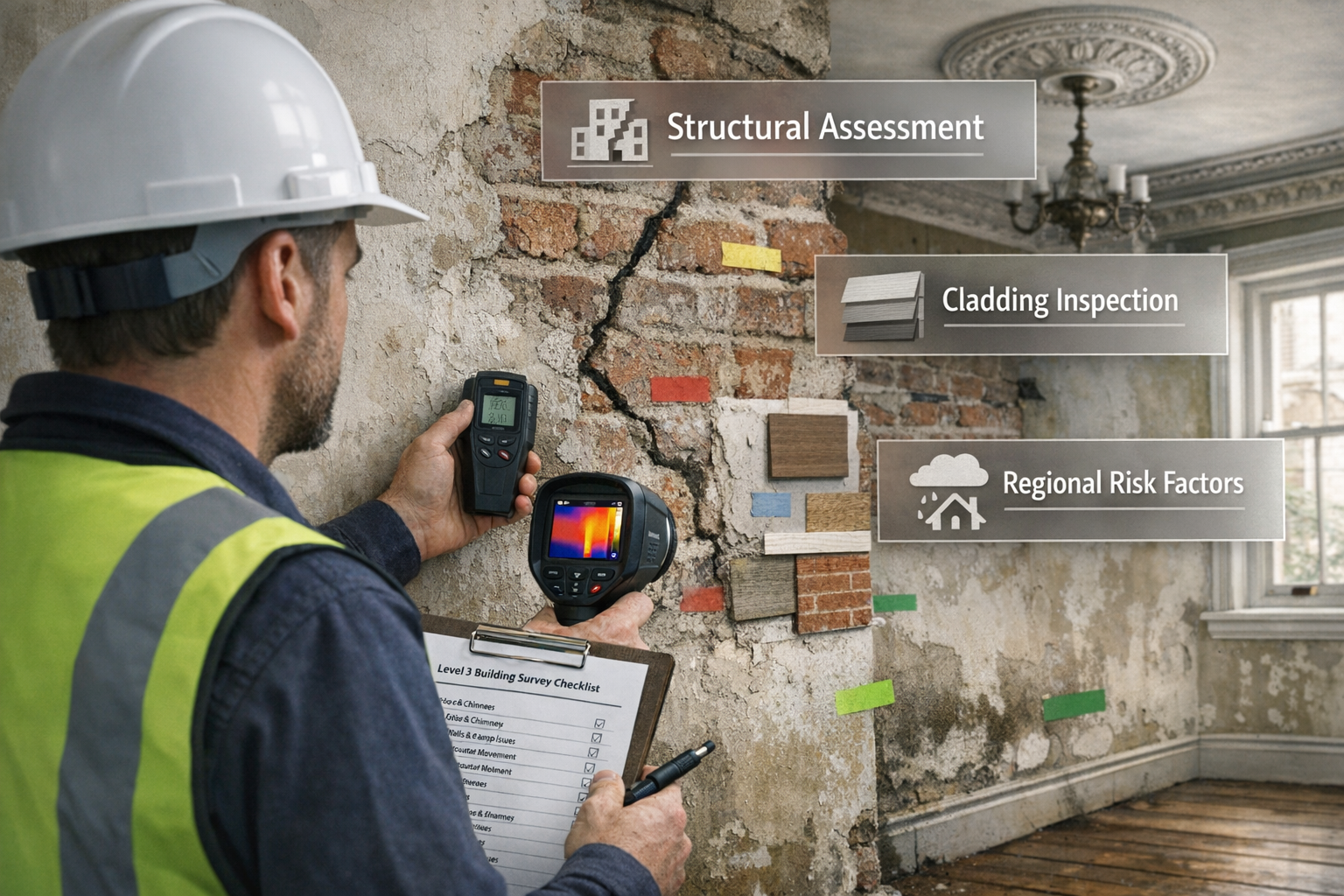
Matching Survey Level to Market Conditions
The RICS offers three main types of residential surveys, each suited to different property types and buyer needs. In the context of the January 2026 market conditions, selection should consider both property characteristics and regional market dynamics.
Level 1: RICS Home Survey (Condition Report)
- Suitable for newer properties in good condition
- Best for northern markets with modern housing stock
- Provides basic condition assessment
- Lower cost option for straightforward purchases
Level 2: RICS Home Survey (HomeBuyer Report)
- Most popular survey type for standard properties
- Appropriate for conventional houses and flats
- Identifies visible defects and urgent issues
- Good balance of detail and cost
Level 3: RICS Building Survey
- Most comprehensive inspection available
- Essential for older, altered, or unusual properties
- Detailed analysis of construction and condition
- Recommended for southern period properties and high-value purchases
For detailed guidance on survey selection, buyers should consult resources explaining the differences between HomeBuyer Reports and Building Surveys.
Regional Risk Factors Requiring Enhanced Scrutiny
The divergent market conditions highlighted in the RICS January 2026 Survey Insights: Building Survey Strategies for Stabilising House Prices and Regional Divides create distinct risk profiles across regions.
Southern England: Cladding and Building Safety Focus 🔍
The southern regions, particularly London and the South East, have a higher concentration of purpose-built flats and converted properties where building safety concerns are paramount. Recent regulatory changes following the Grenfell tragedy have created significant valuation uncertainties for affected properties.
Key survey considerations include:
- External wall system (EWS1) assessments for properties over 11 meters
- Fire safety evaluations for converted flats and HMOs
- Structural adequacy of period property conversions
- Damp and timber defects common in Victorian and Edwardian housing
For properties requiring specialist assessment, structural engineers can provide detailed evaluations of load-bearing elements and structural modifications.
Northern England: New Build Quality and Boom-Market Pressures 🏗️
The stronger market conditions in northern regions create different challenges. When prices are rising and competition is fierce, there's increased risk of:
- Rushing purchases without adequate due diligence
- Overlooking defects in new build properties
- Inadequate snagging on recently completed developments
- Overpaying relative to true property condition
For new build properties, comprehensive snagging surveys identify defects and finishing issues that developers should rectify before completion. This is particularly important in boom markets where developers may face capacity constraints affecting quality control.
Specific Defect Considerations by Property Type
Period Properties (Pre-1919)
- Solid wall construction requiring damp assessment
- Original roof coverings potentially nearing end of life
- Historic alterations requiring structural verification
- Period features requiring conservation expertise
Inter-War and Post-War Properties (1919-1980)
- Cavity wall tie corrosion in 1930s-1960s construction
- Concrete defects in post-war system-built housing
- Asbestos presence in properties built before 1999
- Original services requiring modernization assessment
Modern Properties (Post-1980)
- Cavity wall insulation issues
- UPVC window and door deterioration
- Flat roof problems on extensions
- Building regulation compliance for alterations
For properties showing signs of structural movement, specialized subsidence surveys can determine the cause, extent, and appropriate remediation approach.
Roof Condition Assessment in Different Market Conditions
Roof condition represents one of the most significant potential costs for property buyers. The RICS January 2026 Survey Insights: Building Survey Strategies for Stabilising House Prices and Regional Divides suggest different negotiating dynamics depending on regional market strength.
In Stronger Northern Markets:
- Sellers less likely to reduce prices for roof issues
- Buyers should budget for repairs rather than expect price reductions
- Comprehensive roof surveys essential for accurate cost estimation
- Consider drone roof surveys for safe, detailed assessment of inaccessible areas
In Stabilising Southern Markets:
- Greater opportunity to negotiate price reductions for roof defects
- Detailed survey evidence strengthens negotiating position
- Sellers more motivated to address issues or adjust price
- Comprehensive documentation of defects critical for negotiation
Boundary and Legal Considerations
Property boundaries can be a source of significant dispute and expense. While not directly addressed in the RICS market survey, boundary issues are particularly relevant in the current market conditions where:
- Buyers are conducting more thorough due diligence
- Sellers are motivated to resolve issues to facilitate sales
- Property values justify investment in professional surveys
Professional boundary surveys can identify discrepancies between title plans and physical boundaries, preventing future disputes. This is particularly important for properties with extensions, outbuildings, or garden structures that may encroach on neighboring land.
Long-Term Market Outlook and Strategic Implications
Beyond the immediate market conditions, the RICS January 2026 Survey Insights: Building Survey Strategies for Stabilising House Prices and Regional Divides reveal important trends for long-term market participants.
Twelve-Month Outlook Shows Strong Confidence
The survey data indicates that professional sentiment has shifted significantly toward optimism for the year ahead. The twelve-month sales outlook surged to +35%—the strongest reading since December 2024—demonstrating a substantial shift in market sentiment despite current subdued conditions.[1]
This confidence is mirrored in price expectations, with 43% of respondents anticipating higher house prices over the next 12 months.[1] This represents the most positive outlook since February 2025 and suggests that property professionals believe the market has weathered the worst of recent challenges.
Rental Market Dynamics Add Complexity
The survey also reveals important trends in the rental sector that have implications for property investment decisions:
Tenant Demand Improving 📊
- Tenant demand edged higher in the three months to January 2026
- Ending two consecutive quarters of flat or negative readings
- Indicating renewed interest in rental accommodation[1]
Landlord Supply Remains Constrained
- Landlord instructions remain firmly negative
- Ongoing exodus of small landlords from the market
- Regulatory changes continuing to impact supply decisions
- Driving ongoing rental price increases[1]
For investors considering buy-to-let purchases, these dynamics suggest continued rental yield support, but the importance of thorough property assessment remains paramount. Properties requiring significant maintenance or regulatory compliance work may see rental yields eroded by unexpected costs.
Building Survey Investment as Risk Management
In the context of stabilising but uncertain market conditions, comprehensive building surveys represent valuable risk management rather than optional expenses. The cost of a Level 3 Building Survey—typically £800-£1,500 for a standard property—is modest compared to the potential costs of undiscovered defects:
- Roof replacement: £8,000-£15,000+ for a typical house
- Subsidence remediation: £15,000-£50,000+ depending on severity
- Damp treatment and replastering: £3,000-£10,000+ per affected area
- Rewiring: £4,000-£8,000+ for a three-bedroom house
- Boiler and heating system replacement: £3,000-£6,000+
The RICS January 2026 Survey Insights: Building Survey Strategies for Stabilising House Prices and Regional Divides demonstrate that market conditions vary significantly by region, but the fundamental importance of thorough property assessment remains constant regardless of location.
Strategic Timing Considerations
The survey data suggests different strategic approaches depending on buyer circumstances and regional location:
For Buyers in Northern Markets:
- Act decisively when suitable properties appear
- Commission surveys quickly to avoid losing properties
- Budget for full asking prices with limited negotiation scope
- Prioritize comprehensive surveys to avoid overpaying for properties with hidden defects
For Buyers in Southern Markets:
- Take time for thorough due diligence
- Use detailed survey findings as negotiation leverage
- Consider properties that have been on the market longer
- Focus on identifying properties with price reduction potential based on condition
For Sellers in All Markets:
- Consider commissioning pre-sale surveys to identify and address issues
- Transparent disclosure of known defects builds buyer confidence
- Professional survey evidence can justify asking prices
- Addressing defects proactively may facilitate faster sales
Conclusion: Navigating Market Stabilisation with Strategic Survey Approaches
The RICS January 2026 Survey Insights: Building Survey Strategies for Stabilising House Prices and Regional Divides paint a picture of a UK housing market in transition. National stabilisation masks significant regional variations, with northern regions experiencing genuine price growth while southern areas gradually recover from prolonged affordability pressures. 🎯
For property buyers, sellers, and investors, these market dynamics create both opportunities and risks that demand strategic responses. The key findings are clear:
✅ Buyer demand is recovering but remains below historical norms
✅ House prices are stabilising nationally with strong regional variations
✅ Professional confidence is strengthening for the year ahead
✅ Supply constraints persist across most regions
✅ Regional divides are widening between North and South
In this environment, comprehensive building surveys are not optional extras but essential risk management tools. The specific survey approach should reflect both property characteristics and regional market conditions:
- Northern boom markets require thorough assessments to avoid overpaying in competitive conditions
- Southern stabilising markets benefit from detailed surveys that provide negotiation leverage
- Period properties demand specialized expertise regardless of location
- New builds require rigorous snagging surveys even in rising markets
Working with experienced chartered surveyors who understand local market conditions and property types ensures buyers receive relevant, actionable advice tailored to their specific circumstances.
Actionable Next Steps
For Property Buyers:
- Research local market conditions in your target area
- Determine appropriate survey level based on property type and age
- Commission surveys early in the purchase process
- Use survey findings to inform negotiations and decision-making
- Budget for identified repairs and maintenance requirements
For Property Sellers:
- Consider pre-sale surveys to identify potential buyer concerns
- Address significant defects before marketing where cost-effective
- Provide transparent disclosure of known issues
- Price realistically based on property condition and local market strength
For Property Investors:
- Factor comprehensive survey costs into acquisition budgets
- Assess rental market dynamics alongside purchase prices
- Consider long-term maintenance requirements in yield calculations
- Prioritize properties with clear structural and regulatory compliance
The UK housing market in 2026 presents a complex landscape of stabilising national trends and divergent regional realities. Success in this environment requires combining market intelligence with thorough property assessment—exactly the approach highlighted by the RICS January 2026 Survey Insights: Building Survey Strategies for Stabilising House Prices and Regional Divides. By matching survey strategies to market conditions and property characteristics, buyers can navigate this transition period with confidence and make informed decisions that protect their interests for years to come.
References
[1] Uk Resi Survey Jan 2026 Report Shows Early Signs Market Recovery Despite Caution – https://www.rics.org/news-insights/uk-resi-survey-jan-2026-report-shows-early-signs-market-recovery-despite-caution
[2] Uk Residential Market Survey January 2026 – https://www.navah-consulting.co.uk/news/uk-residential-market-survey-january-2026
[3] Uk Residential Market Survey January 2026 – https://www.rics.org/content/dam/ricsglobal/documents/market-surveys/uk-residential-market-survey/UK-Residential-Market-Survey_January-2026.pdf
[4] Rics Survey Shows Subdued Housing Market But Confidence Improves Heading Into 2026 – https://theintermediary.co.uk/2026/01/rics-survey-shows-subdued-housing-market-but-confidence-improves-heading-into-2026/