
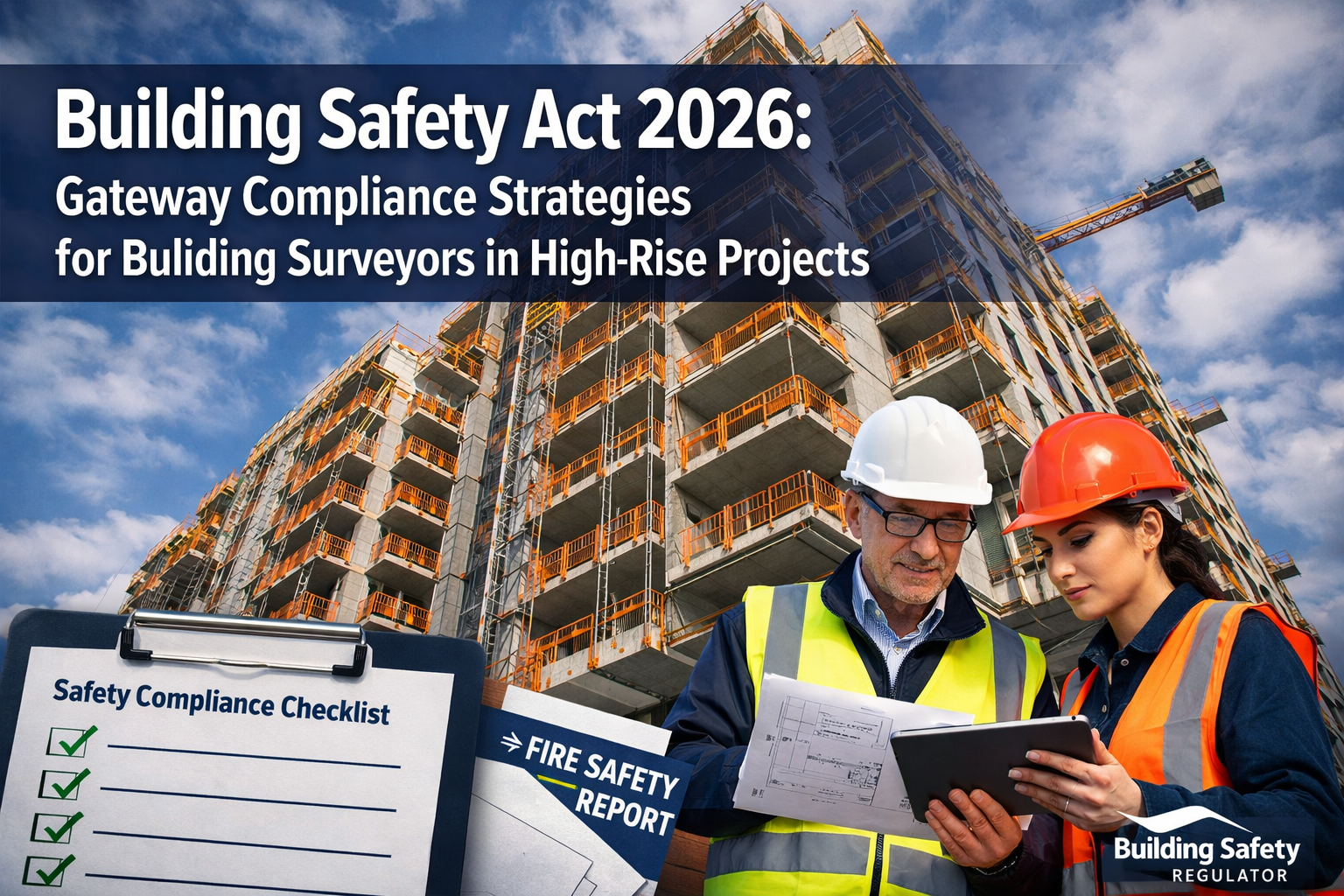
The construction landscape has changed forever. Following the devastating Grenfell Tower fire, the Building Safety Act 2026 has introduced the most significant regulatory overhaul in UK construction history. For building surveyors working on high-rise projects, understanding gateway compliance strategies isn't just about regulatory adherence—it's about protecting lives, avoiding career-ending penalties, and navigating a complex new system where the Building Safety Regulator (BSR) now operates as an independent watchdog with unprecedented enforcement powers.
The Building Safety Act 2026: Gateway Compliance Strategies for Building Surveyors in High-Rise Projects represents a fundamental shift from reactive building control to proactive safety management throughout the entire construction lifecycle. With the BSR's formal independence achieved on January 27, 2026, and the Building Safety Levy launching October 1, 2026, building surveyors must adapt quickly to avoid costly delays and legal consequences.
Key Takeaways
✅ Gateway approvals now control three critical stages of high-rise construction, requiring building surveyors to prepare comprehensive documentation before proceeding to the next phase
✅ Duty-holder responsibilities have expanded dramatically, with Principal Designers, Principal Contractors, and Building Safety Managers facing criminal liability for non-compliance
✅ Building Assessment Certificates (BACs) must be applied for within 28 days of BSR direction, requiring proactive preparation of resident engagement strategies and safety case reports
✅ Second staircase requirements become mandatory after September 30, 2026, for all new residential buildings 18 metres and above
✅ Enforcement escalation includes unlimited fines and imprisonment for landlords failing to remediate buildings by 2029, shifting from encouragement to strict enforcement
Understanding the Building Safety Act 2026: Gateway Compliance Framework
What Are the Three Gateways?
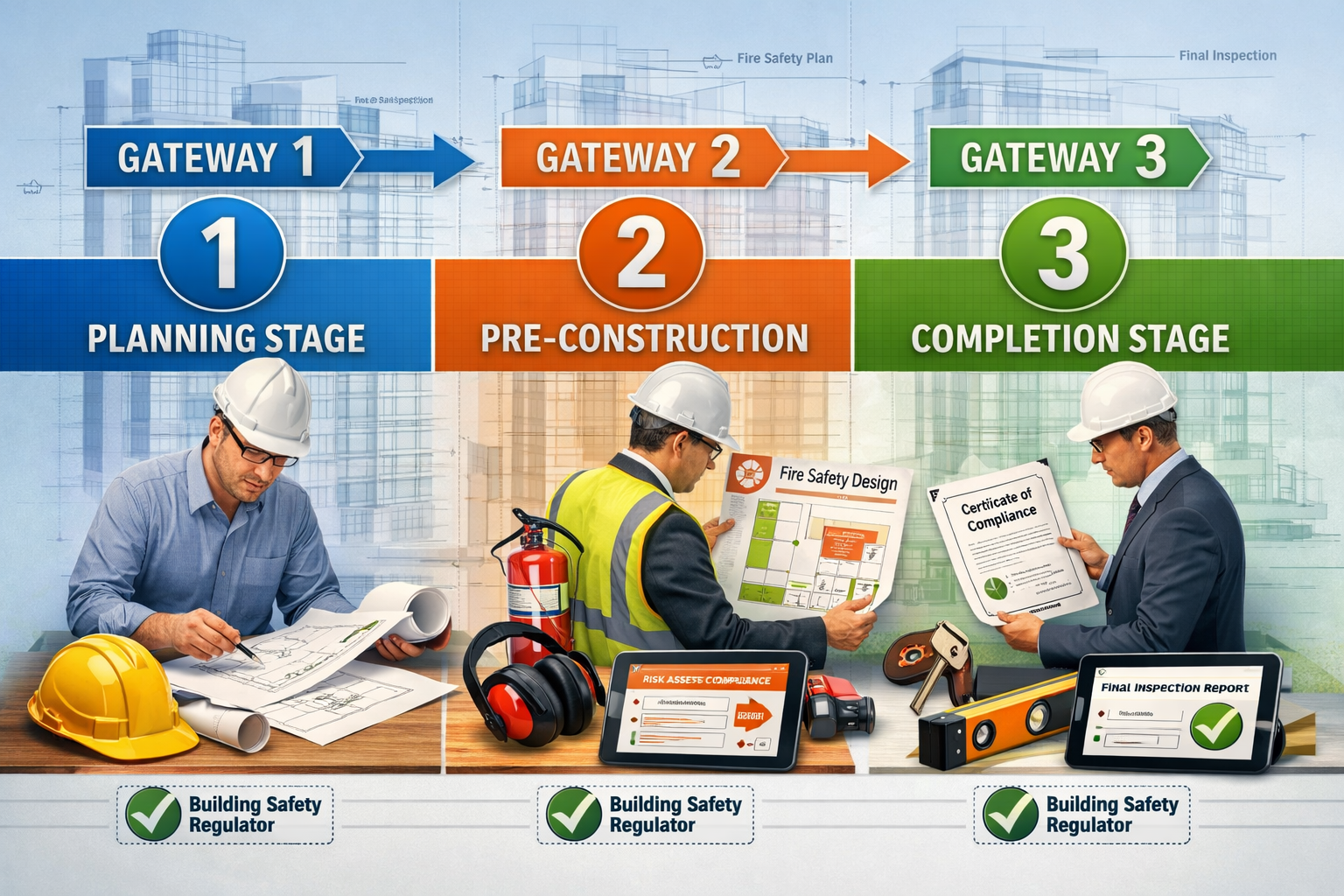
The gateway system represents the backbone of the Building Safety Act 2026: Gateway Compliance Strategies for Building Surveyors in High-Rise Projects. These mandatory checkpoints apply to all high-rise residential buildings (HRRBs)—defined as residential structures 18 metres or higher, or seven storeys and above.
Gateway 1: Planning Stage 🏗️
This initial gateway integrates with the planning permission process. Building surveyors must ensure:
- Fire safety statements accompany planning applications
- Consultation with the local fire and rescue service occurs
- Initial design considerations address fire safety from the outset
- Documentation demonstrates compliance with building regulations
Gateway 2: Pre-Construction Phase 📋
Before construction begins, building surveyors must secure approval from the BSR. This gateway requires:
- Detailed design information showing compliance with building regulations
- Fire and emergency file documentation
- Appointment of the Principal Designer and Principal Contractor
- Evidence of competency for all duty holders
- Confirmation of the "golden thread" information management system
The BSR's innovation unit, established in summer 2025, has significantly improved Gateway 2 approval times, addressing the historic backlog that plagued earlier implementations.
Gateway 3: Completion Stage ✅
Before occupation, building surveyors must obtain a completion certificate from the BSR, requiring:
- Evidence that the building was constructed according to approved plans
- Updated fire and emergency file
- Registration of the building with the BSR
- Appointment of the Accountable Person
- Resident engagement strategy in place
For building surveyors managing these complex requirements, working with experienced building surveyor services can streamline the gateway approval process and ensure nothing falls through the cracks.
Expanded Scope: 11-18 Metre Buildings
A significant development in 2026 involves the expansion of BSR oversight to residential buildings between 11-18 metres. Previously focused exclusively on buildings 18 metres and above, this extension dramatically increases the number of projects requiring gateway compliance.
Building surveyors must now:
- Assess whether projects fall within the new threshold
- Implement gateway procedures for medium-rise developments
- Budget additional time and resources for compliance activities
- Monitor the Building Safety Levy implications (buildings 11+ metres may be subject to levy charges)
This expansion reflects the government's commitment to comprehensive building safety reform, but it also creates substantial new workload for surveyors and developers.
Duty Holder Responsibilities and Building Surveyor Roles
The New Duty Holder Framework
The Building Safety Act 2026: Gateway Compliance Strategies for Building Surveyors in High-Rise Projects establishes clear accountability through defined duty holder roles. Building surveyors must understand these responsibilities to provide effective guidance.
| Duty Holder | Primary Responsibilities | Liability Exposure |
|---|---|---|
| Principal Designer | Oversee design phase safety, coordinate fire safety information, manage design risk assessments | Criminal prosecution for failures causing death or serious injury |
| Principal Contractor | Implement construction phase safety plans, maintain golden thread documentation, coordinate subcontractors | Unlimited fines for regulatory breaches |
| Building Safety Manager | Day-to-day safety management during construction, liaison with BSR, incident reporting | Professional sanctions and potential criminal liability |
| Accountable Person (AP) | Post-occupation building safety management, resident engagement, safety case maintenance | Enforcement action including prohibition orders |
| Principal Accountable Person (PAP) | Overall responsibility for high-rise building safety, BAC application, mandatory occurrence reporting | Criminal penalties including imprisonment |
Building Surveyor Compliance Checklist
Building surveyors play a crucial advisory role across all duty holder functions. The following checklist ensures comprehensive compliance:
Pre-Gateway 1 Preparation ✓
- Conduct preliminary fire risk assessment
- Review site constraints affecting fire safety design
- Identify all duty holders and verify competency
- Establish golden thread information management system
- Prepare fire safety statement for planning submission
Gateway 2 Documentation ✓
- Complete detailed fire safety design documentation
- Prepare building regulations compliance reports
- Document all material specifications with fire performance data
- Create construction phase safety management plans
- Establish mandatory occurrence reporting procedures
- Verify Principal Designer and Principal Contractor appointments
Gateway 3 Completion Requirements ✓
- Conduct final building safety inspections
- Verify as-built documentation matches approved designs
- Prepare resident engagement strategy
- Complete Building Assessment Certificate application materials
- Establish ongoing safety case reporting system
- Register building with BSR database
For projects requiring detailed structural assessments, building surveyors should consider specialized structural survey services to ensure comprehensive compliance documentation.

The "Golden Thread" Information Management
One of the most challenging aspects of the Building Safety Act 2026: Gateway Compliance Strategies for Building Surveyors in High-Rise Projects is maintaining the "golden thread"—a complete, accurate, and up-to-date record of building information throughout design, construction, and occupation.
Building surveyors must ensure:
- Digital information management systems capture all safety-critical data
- Version control tracks changes throughout the project lifecycle
- Accessibility allows duty holders and residents to access relevant information
- Accuracy reflects the as-built condition, not just design intent
- Continuity transfers seamlessly between project phases and duty holders
The golden thread isn't just a filing system—it's a living document that evolves with the building. Failure to maintain it can result in gateway approval delays and enforcement action.
Critical Compliance Deadlines and Regulatory Changes in 2026
Building Assessment Certificate (BAC) Timeline
For existing high-rise residential buildings, the Principal Accountable Person (PAP) must apply for a Building Assessment Certificate within 28 days of receiving direction from the BSR. However, waiting for this direction is a mistake.
Building surveyors should advise clients to prepare BAC documentation proactively:
Essential BAC Components:
- Resident Engagement Strategy – Demonstrating how residents are consulted on safety matters
- Mandatory Occurrence Reporting System – Procedures for reporting safety incidents to the BSR
- Safety Case Report – Comprehensive assessment of building safety risks and mitigation measures
- Building Information – Complete golden thread documentation
- Competency Evidence – Proof that the PAP and Building Safety Manager possess required skills
The BAC process represents a significant administrative burden. Building surveyors working across multiple high-rise properties should develop standardized templates while ensuring each building's unique characteristics are properly addressed.
Second Staircase Requirement Deadline: September 30, 2026 🚨
A critical deadline approaches: September 30, 2026 marks the end of the transitional period for Approved Document B amendments. From October 1, 2026, all new residential buildings 18 metres and above must include two separate escape stairs to receive Building Control approval.
Implications for Building Surveyors:
- Projects currently in planning must assess whether they can commence construction before the deadline
- Applications submitted before September 30, 2026 can utilize transitional provisions allowing single staircases
- Building work must actually commence (not just receive approval) before the deadline
- Projects delayed past September 30, 2026 face significant redesign costs and timeline extensions
This requirement fundamentally changes high-rise residential design, reducing developable floor area and increasing construction costs. Building surveyors must advise clients immediately if projects risk missing this deadline.
For commercial projects with different requirements, commercial building surveys can help identify compliance obligations specific to non-residential high-rise structures.
Building Safety Levy Launch: October 1, 2026 💰
The Building Safety Levy officially launches on October 1, 2026, charging most new residential developments of 10 or more dwellings. This levy aims to raise £3.4 billion for unsafe building remediation.
Key Levy Details:
- Charge basis: Calculated per square metre of gross internal floor area
- Exemptions: Social housing developments are exempt
- Discounts: Brownfield site developments receive reduced rates
- Threshold consultation: Purpose-built student accommodation (PBSA) threshold may increase from 30 to 50 or 120 bedspaces (consultation closes March 10, 2026, with results expected summer 2026)
Building surveyors must incorporate levy costs into project financial planning. The levy represents a significant additional expense that affects development viability, particularly for smaller schemes near the 10-dwelling threshold.
Remediation Enforcement Escalation: 2029 Deadline ⚖️
The government has shifted "from encouragement to enforcement" regarding building remediation. By the end of 2029, landlords face severe consequences:
Buildings Over 18 Metres:
- Landlords failing to remediate face unlimited fines
- Criminal prosecution including potential imprisonment
- Enforcement action escalates progressively throughout 2027-2029
Buildings Between 11-18 Metres:
- Properties not remediated or scheduled for completion by 2029 face investigation
- BSR enforcement powers include prohibition orders preventing occupation
- New criminal offence: Obstructing assessment or remediation of unsafe buildings over 11 metres without reasonable excuse
Building surveyors conducting assessments on existing high-rise properties must provide clear remediation recommendations with realistic timelines. Underestimating the scope of required work could leave clients facing enforcement action.
Practical Compliance Strategies for Building Surveyors
Strategy 1: Early Engagement with the BSR
The BSR offers pre-application advice services (charged under their statutory fee powers). Building surveyors should encourage clients to engage early, particularly for complex or innovative designs.
Benefits of early engagement:
- Clarify regulatory expectations before significant design investment
- Identify potential compliance issues when changes are less costly
- Build positive working relationship with regulator
- Reduce risk of gateway approval delays
Strategy 2: Competency Documentation
The Act places significant emphasis on duty holder competency. Building surveyors must maintain comprehensive evidence of their qualifications and experience:
- Professional memberships (RICS, CIOB, etc.)
- Continuing professional development records
- Project-specific training (fire safety, golden thread systems, etc.)
- Professional indemnity insurance documentation
- References from previous high-rise projects
Consider developing a "competency portfolio" that can be quickly provided during gateway submissions.
Strategy 3: Leveraging Technology for Golden Thread Management
Digital tools are essential for managing the golden thread effectively. Building surveyors should evaluate:
- Building Information Modeling (BIM) platforms with safety information integration
- Document management systems with version control and audit trails
- Mobile inspection apps for real-time data capture during site visits
- Compliance tracking software monitoring gateway milestone progress
- Collaboration platforms enabling duty holder coordination
Technology investment pays dividends through reduced administrative burden and improved compliance accuracy.
Strategy 4: Building Multidisciplinary Teams
The complexity of high-rise compliance requires expertise beyond traditional building surveying. Successful projects involve:
- Fire safety engineers designing and validating fire safety strategies
- Structural engineers ensuring building integrity under fire conditions
- Building services engineers designing fire suppression and detection systems
- Legal advisors navigating duty holder contracts and liability allocation
- Project managers coordinating gateway submissions and stakeholder communication
Building surveyors should develop networks of trusted specialists who understand the Building Safety Act requirements. For projects requiring specialized expertise, commercial property surveyors can provide additional technical resources.

Strategy 5: Resident Engagement Planning
For existing buildings requiring BACs, resident engagement is mandatory but often overlooked until the last minute. Building surveyors should help clients develop:
- Communication protocols explaining safety measures in accessible language
- Consultation mechanisms gathering resident feedback on safety concerns
- Incident reporting procedures enabling residents to report safety issues
- Regular updates keeping residents informed about building safety status
- Accessibility considerations ensuring engagement reaches all residents including those with disabilities or language barriers
Effective resident engagement not only satisfies regulatory requirements but also builds trust and reduces complaints.
Hiring Trends: The Rise of Fire Safety Specialists 🔥
The Building Safety Act 2026: Gateway Compliance Strategies for Building Surveyors in High-Rise Projects has created unprecedented demand for fire safety expertise. Construction industry hiring trends in 2026 reflect this shift:
In-Demand Roles
Fire Safety Engineers
- Salary range: £45,000-£85,000 depending on experience
- Responsibilities: Design fire safety strategies, conduct fire risk assessments, validate compliance with Approved Document B
- Qualifications: IFE membership, relevant engineering degree, Building Safety Act training
Building Safety Managers
- Salary range: £50,000-£75,000
- Responsibilities: Day-to-day construction phase safety management, BSR liaison, golden thread maintenance
- Qualifications: Construction management background, fire safety training, proven high-rise experience
Compliance Coordinators
- Salary range: £35,000-£55,000
- Responsibilities: Gateway submission preparation, documentation management, duty holder coordination
- Qualifications: Administrative excellence, building regulations knowledge, attention to detail
Golden Thread Specialists
- Salary range: £40,000-£65,000
- Responsibilities: Information management system implementation, BIM coordination, data accuracy verification
- Qualifications: Digital systems expertise, construction industry knowledge, information management skills
Building Surveyor Skill Development
To remain competitive, building surveyors should invest in:
- Fire safety training through recognized institutions (IFE, FPA)
- Building Safety Act specialist courses offered by RICS and CIOB
- BIM and digital information management certifications
- Project management qualifications (APM, PRINCE2)
- Legal awareness training covering duty holder liabilities
The most successful building surveyors in 2026 are those who position themselves as compliance specialists, not just technical assessors.
Common Pitfalls and How to Avoid Them
Pitfall 1: Underestimating Gateway Approval Timelines
Despite BSR improvements, gateway approvals still require significant time. Building surveyors must:
- Build 8-12 week approval periods into project schedules
- Prepare comprehensive submissions to avoid requests for additional information
- Maintain regular communication with BSR case officers
- Have contingency plans for approval delays
Pitfall 2: Inadequate Duty Holder Appointment Documentation
Simply naming duty holders isn't sufficient. Building surveyors must ensure:
- Written appointment letters clearly define responsibilities
- Competency evidence is collected and verified
- Professional indemnity insurance covers Building Safety Act liabilities
- Succession planning addresses duty holder changes during long projects
Pitfall 3: Golden Thread Data Gaps
Incomplete information management systems cause gateway failures. Avoid this by:
- Conducting regular golden thread audits throughout the project
- Establishing clear data capture protocols for all team members
- Implementing quality control checks before gateway submissions
- Maintaining backup systems to prevent data loss
Pitfall 4: Neglecting Resident Engagement
For existing buildings, poor resident engagement undermines BAC applications. Building surveyors should:
- Start engagement activities months before BAC application
- Document all resident interactions systematically
- Address resident concerns promptly and transparently
- Provide multiple communication channels (digital, printed, in-person)
Pitfall 5: Ignoring Transitional Provisions
The September 30, 2026 second staircase deadline creates significant risk. Building surveyors must:
- Review all active projects against the deadline immediately
- Advise clients of redesign implications if deadline will be missed
- Secure building control approvals before the deadline
- Ensure construction actually commences before September 30, 2026
The BSR's Independence: What It Means for Building Surveyors
The BSR's transition to an independent executive non-departmental public body on January 27, 2026 represents a significant governance shift. While the regulator's functions remain unchanged, building surveyors should expect:
Increased Regulatory Scrutiny
Independence strengthens the BSR's ability to:
- Conduct thorough gateway reviews without political pressure
- Enforce compliance more aggressively
- Impose penalties without ministerial interference
- Develop regulatory guidance based on technical merit rather than policy considerations
Streamlined Decision-Making
The new structure eliminates bureaucratic layers, meaning:
- Faster response times to pre-application inquiries
- More consistent regulatory interpretation
- Clearer guidance on complex compliance issues
- Better coordination across the construction lifecycle
Fee-Based Services
The BSR now has statutory powers to charge for advice and services. Building surveyors should:
- Budget for pre-application advice fees
- Evaluate cost-benefit of early BSR engagement
- Factor BSR fees into client proposals
- Consider whether paid advice reduces overall project risk
Ongoing HSE Support
The Health and Safety Executive continues supporting the BSR until December 2026, providing:
- Technical expertise during the transition period
- Continuity for ongoing gateway applications
- Knowledge transfer to BSR staff
- Backup capacity during peak application periods
Building surveyors can expect minimal disruption during this transition, though the BSR may become more stringent as it establishes its independent identity.
Preparing for Future Regulatory Developments
The Building Safety Act represents an evolving regulatory framework. Building surveyors should monitor:
PBSA Threshold Consultation Results (Summer 2026)
The government consultation on purpose-built student accommodation thresholds closes March 10, 2026. Results expected in summer 2026 will determine whether PBSA developments face levy charges at 30, 50, or 120 bedspaces.
Action for building surveyors: Review PBSA projects in the pipeline and prepare for potential threshold changes affecting project viability.
Expanded Building Types
Future regulations may extend gateway requirements to:
- Hospitals and healthcare facilities
- Educational institutions
- Hotels and apart-hotels
- Mixed-use developments with residential components
Action for building surveyors: Develop expertise in non-residential high-rise compliance to position for market expansion.
Enhanced Digital Requirements
The golden thread concept will likely evolve toward:
- Standardized data formats across the industry
- Real-time information sharing with regulators
- Integration with smart building systems
- Blockchain or similar technologies for information integrity
Action for building surveyors: Invest in digital skills and stay current with information management technology developments.
Conclusion
The Building Safety Act 2026: Gateway Compliance Strategies for Building Surveyors in High-Rise Projects represents the most significant regulatory transformation in UK construction history. Building surveyors who adapt quickly will find substantial opportunities, while those who resist change face obsolescence and potential liability.
Success in this new environment requires:
✅ Comprehensive understanding of the three-gateway approval process and duty holder responsibilities
✅ Proactive preparation for critical deadlines including the September 30, 2026 second staircase requirement and 2029 remediation enforcement escalation
✅ Technology adoption for golden thread information management and compliance tracking
✅ Multidisciplinary collaboration with fire safety specialists, engineers, and legal advisors
✅ Continuous professional development to maintain competency in this rapidly evolving regulatory landscape
Next Steps for Building Surveyors
Immediate Actions (Next 30 Days):
- Audit all active high-rise projects against September 30, 2026 deadline
- Review duty holder appointments and competency documentation
- Assess golden thread information management systems for gaps
- Register for Building Safety Act specialist training courses
- Develop relationships with fire safety engineers and compliance specialists
Medium-Term Actions (Next 3-6 Months):
- Implement digital compliance tracking systems
- Create standardized gateway submission templates
- Build competency portfolio demonstrating Building Safety Act expertise
- Engage with BSR for pre-application advice on complex projects
- Monitor PBSA threshold consultation results and adjust project planning accordingly
Long-Term Strategic Planning:
- Position practice as Building Safety Act compliance specialist
- Develop niche expertise in specific building types or gateway stages
- Build multidisciplinary teams capable of managing entire gateway process
- Stay informed about regulatory developments and industry best practices
- Consider whether to pursue Building Safety Manager or Principal Designer roles
The Building Safety Act has fundamentally changed what it means to be a building surveyor in 2026. Those who embrace these changes, invest in specialized knowledge, and prioritize safety above all else will thrive in this new regulatory environment.
For building surveyors seeking expert guidance on high-rise compliance strategies, working with experienced building surveyor services ensures projects meet the rigorous standards of the Building Safety Act while avoiding costly delays and penalties.
The construction industry has entered a new era where safety is paramount, accountability is clear, and compliance is non-negotiable. Building surveyors stand at the forefront of this transformation, protecting lives while enabling the development of safe, high-quality residential buildings across the UK.