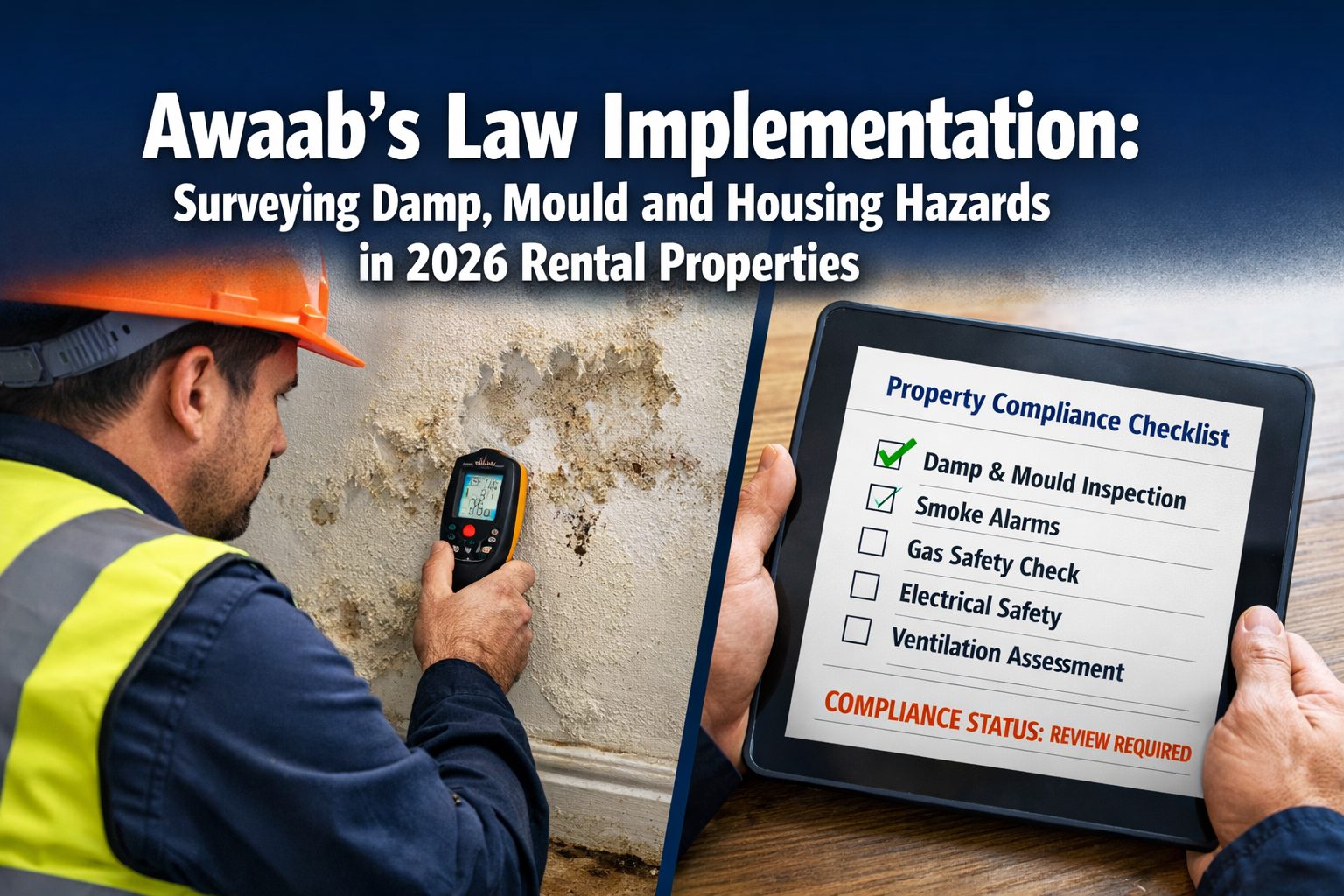
The tragic death of two-year-old Awaab Ishak in 2020 from prolonged exposure to mould in his family's social housing flat sparked a fundamental shift in UK housing legislation. As of 2026, Awaab's Law Implementation: Surveying Damp, Mould and Housing Hazards in 2026 Rental Properties represents one of the most significant regulatory changes in decades, transforming how landlords, surveyors, and housing providers approach property safety. With Phase 1 already in effect since October 2025 and Phase 2 launching in October 2026, the legislation creates strict statutory timeframes for investigating and remedying housing hazards—making rapid, professional surveying protocols not just best practice, but a legal requirement.
For chartered surveyors and property professionals, understanding the technical requirements and compliance protocols under Awaab's Law has become essential. The legislation demands documented evidence, precise timelines, and specialist pathology reporting that can withstand regulatory scrutiny. Social landlords who fail to meet these standards face enforcement action, while surveyors who can deliver compliant assessments are experiencing unprecedented demand for their expertise.
Key Takeaways
- Phase 1 is currently active (since October 2025), covering damp, mould, and emergency hazards with mandatory investigation within 24 hours for emergencies and 10 working days for significant hazards [1]
- Phase 2 launches October 2026, expanding coverage to include excess cold/heat, fire hazards, electrical risks, and structural concerns—representing a major stress test for the housing sector [2]
- Digital documentation is legally mandatory, requiring timestamped evidence of when problems were reported, inspections conducted, and remedial actions completed [3]
- Surveyors must complete hazard assessments within strict timeframes, with repair work commencing within 5 working days of hazard confirmation [1]
- Private landlords are expected to face similar requirements in 2026, making compliance preparation urgent across all rental sectors [6]
Understanding Awaab's Law Implementation: Surveying Damp, Mould and Housing Hazards in 2026 Rental Properties
The Legislative Framework and Phased Rollout
Awaab's Law represents a fundamental restructuring of landlord obligations under the Housing Health and Safety Rating System (HHSRS). The legislation introduces mandatory statutory timeframes that remove discretion from hazard response, creating legally enforceable deadlines that housing providers must meet [1].
The phased implementation follows a strategic expansion model:
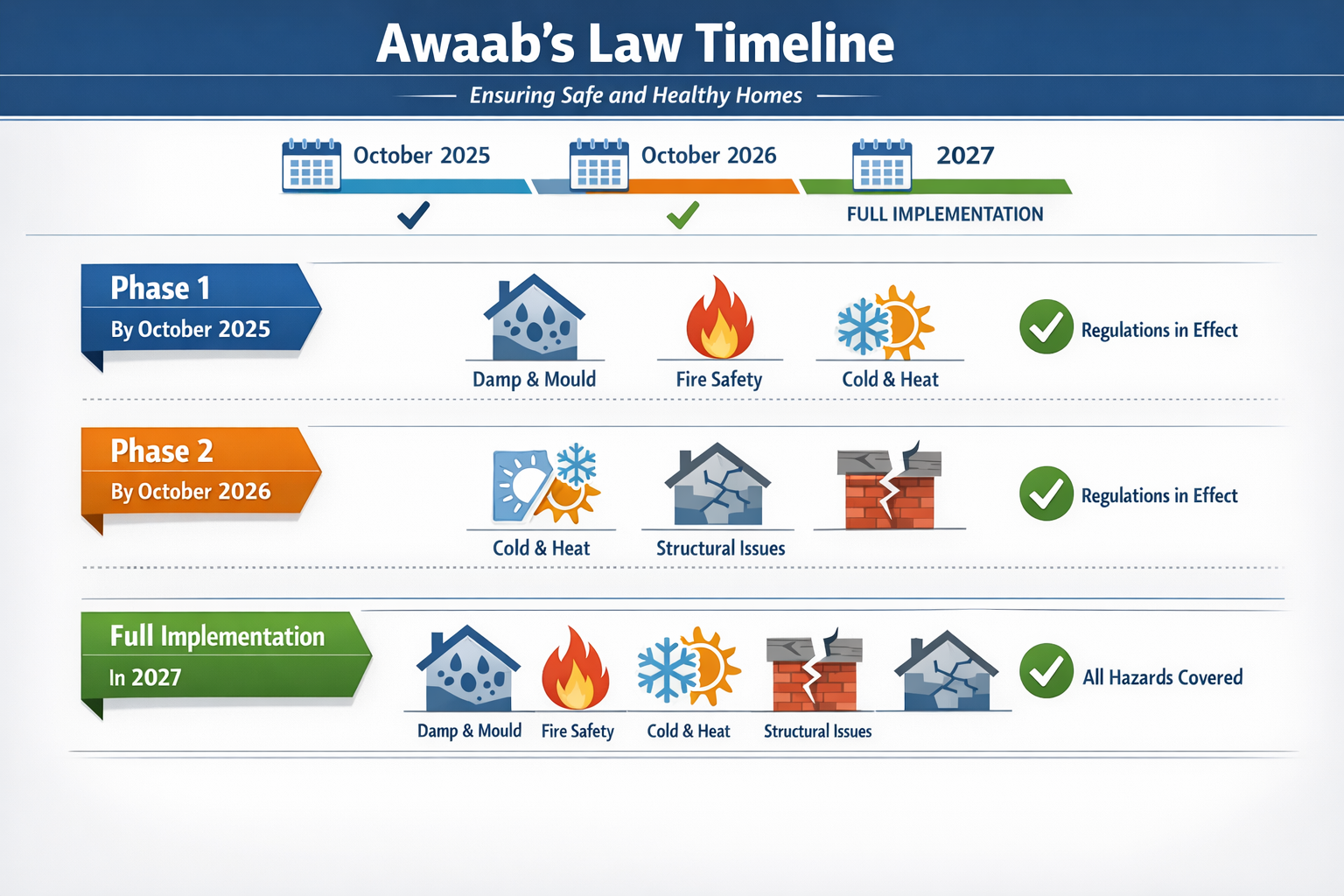
| Phase | Effective Date | Hazards Covered | Status in 2026 |
|---|---|---|---|
| Phase 1 | October 27, 2025 | Damp, mould, emergency hazards | ✅ Currently active |
| Phase 2 | October 2026 | Excess cold/heat, fire, electrical, falls, structural collapse | 🔜 Launching soon |
| Phase 3 | 2027 | All remaining HHSRS hazards | 📅 Planned |
Emergency hazards under Phase 1 require immediate action. Social landlords must investigate within 24 hours and make the property safe when an emergency is reported [1]. This creates unprecedented pressure on surveying resources, as housing providers need access to qualified professionals who can respond rapidly with compliant assessments.
Significant hazards follow a structured timeline:
- Investigation: Must be completed within 10 working days
- Written outcome: Provided to tenants within 3 working days of investigation completion
- Repair commencement: Within 5 working days of hazard confirmation
- Preventive works: Must fully commence within 12 weeks [1]
For chartered surveyors across London and surrounding regions, these timeframes demand streamlined assessment protocols and immediate availability for urgent inspections.
Scotland's Implementation Timeline
Scotland follows a parallel but distinct implementation schedule. Scottish landlords face an October 6, 2026 commencement date, with investigations required within 3 working days and remedial work commencing within 5 working days [4]. Additionally, all Scottish social landlords should have specific damp and mould policies in place by April 2026, with timescales at least as ambitious as those set in the regulations [5].
This creates a dual-jurisdiction challenge for surveyors operating across the UK, requiring familiarity with both English and Scottish regulatory frameworks.
Why This Matters for Property Professionals
Housing providers that have not built compliant processes are already subject to enforcement action as of March 2026 [3]. This is not a future consideration—it is a present legal obligation. The Regulator of Social Housing has made clear that compliance failures will result in regulatory intervention, making professional surveying support a critical risk management tool for landlords.
Surveyor Protocols for Rapid Hazard Assessment Under Awaab's Law
Stock Condition Surveys and Proactive Identification
Traditional reactive maintenance models are no longer sufficient under Awaab's Law. Housing providers must implement comprehensive stock condition surveys that identify potential hazards before tenant complaints trigger statutory investigation timelines [3].
Professional surveyors conducting stock condition assessments under Awaab's Law should follow these enhanced protocols:
🔍 Pre-Inspection Preparation
- Review historical maintenance records for the property
- Identify previous damp, mould, or structural concerns
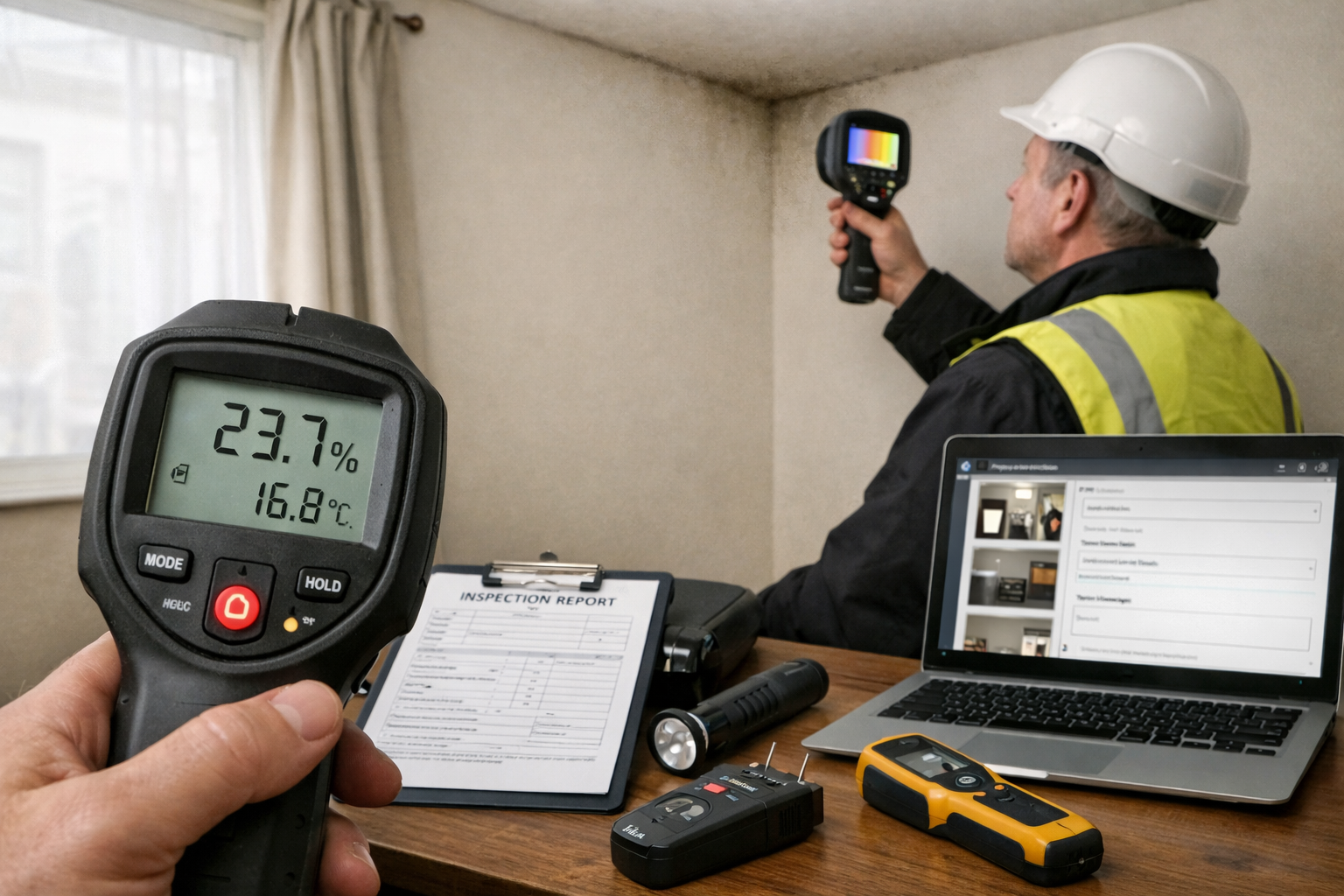
- Prepare calibrated moisture detection equipment
- Ensure thermal imaging cameras are functioning correctly
- Load digital reporting templates with mandatory data fields
📋 On-Site Assessment Methodology
- Visual inspection: Document all visible signs of damp, mould, condensation, or water ingress
- Moisture mapping: Use electronic moisture meters to identify hidden dampness in walls, ceilings, and floors
- Thermal imaging: Capture thermal photographs showing cold spots, insulation defects, and heat loss patterns
- Ventilation assessment: Evaluate adequacy of ventilation systems and airflow
- Structural evaluation: Identify any defects contributing to moisture penetration (damaged gutters, missing roof tiles, cracked masonry)
- Photographic evidence: Take timestamped photographs from multiple angles with clear reference points
📊 Hazard Classification
Surveyors must classify hazards according to HHSRS severity ratings:
- Category 1 hazards: Serious and immediate risks requiring urgent action
- Category 2 hazards: Less serious but still significant risks
- Emergency hazards: Immediate threats to health and safety
This classification determines the statutory response timeline, making accurate assessment critical for landlord compliance.
For properties requiring more detailed structural analysis, residential structural engineers can provide specialized assessments of load-bearing elements and structural integrity concerns.
Digital Documentation and Traceability Requirements
Awaab's Law creates mandatory digital accountability. Social landlords must demonstrate through verifiable records [3]:
- ⏰ When problems were reported (date, time, method of contact)
- 🔎 When inspections took place (surveyor identity, date, time)
- 📸 What evidence was gathered (photographs, moisture readings, thermal images)
- ✅ Which actions were assigned (work orders, contractor details)
- ✔️ When issues were resolved (completion certificates, follow-up inspections)
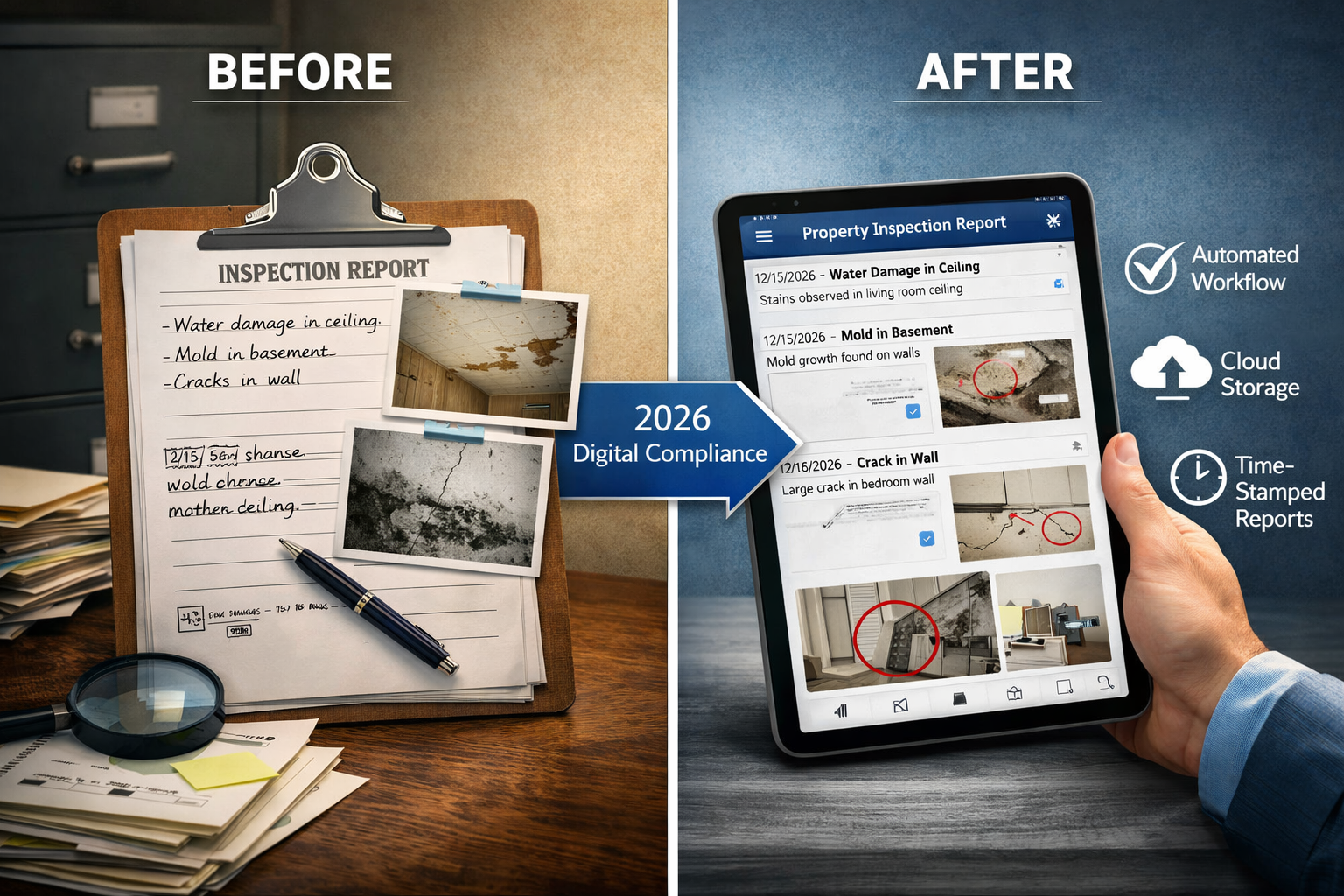
This creates a legally binding audit trail that must withstand regulatory scrutiny. Surveyors should use digital reporting platforms that automatically timestamp entries, upload inspection photos with metadata, and integrate with landlord work order systems.
Modern surveying practices increasingly rely on cloud-based inspection software that:
- Generates compliant reports in standardized formats
- Automatically calculates deadline dates based on hazard classification
- Sends automated alerts when statutory timeframes are approaching
- Creates exportable compliance records for regulatory audits
Response Timelines and Coordination Protocols
Meeting Awaab's Law timeframes requires coordinated response protocols between surveyors, landlords, and contractors. Best practice models include:
Emergency Response (24-Hour Timeline)
- Hour 0-2: Initial tenant report received and logged
- Hour 2-6: Surveyor dispatched for emergency assessment
- Hour 6-12: On-site inspection completed, hazard confirmed
- Hour 12-24: Immediate safety measures implemented (property made safe)
Significant Hazard Response (10-Day Timeline)
- Day 1-3: Initial surveyor inspection scheduled and completed
- Day 4-7: Detailed pathology investigation (if required)
- Day 8-10: Written investigation outcome prepared and delivered to tenant
- Day 11-15: Remedial works commence (5 working days after confirmation)
For complex cases requiring specialist input, subsidence surveys or roof surveys may be necessary to identify underlying structural causes of damp and water ingress.
Phase 2 Expansion: Preparing for October 2026 and Beyond
Expanded Hazard Categories
Phase 2 of Awaab's Law Implementation, launching in October 2026, represents what industry experts call "one of the most significant regulatory shifts in social housing for decades" [2]. The expansion dramatically broadens the scope of statutory timeframes to include:
🔥 Fire and Electrical Hazards
- Faulty wiring and electrical installations
- Inadequate fire detection systems
- Blocked escape routes
- Combustible materials in common areas
❄️ Excess Cold and Heat
- Inadequate heating systems
- Poor insulation causing thermal discomfort
- Overheating in summer months
- Fuel poverty-related temperature issues
🏗️ Structural and Safety Hazards
- Risk of falls on stairs and uneven surfaces
- Structural collapse concerns
- Explosion risks from gas installations
- Hygiene and food safety hazards
This expansion will stress-test social landlords' ability to manage compliance across multiple simultaneous hazard categories [2]. Housing providers must prepare now by:
- Expanding surveyor panels to include specialists in electrical, fire safety, and structural engineering
- Implementing comprehensive property audits before October 2026
- Upgrading digital tracking systems to handle multiple hazard categories
- Training staff on expanded hazard identification protocols
Specialist Pathology Reporting and Case Studies
The complexity of hazards under Phase 2 demands specialist pathology reporting that goes beyond surface-level inspection. Professional surveyors are increasingly called upon to provide detailed causation analysis that identifies root causes rather than symptoms.
Case Study: Damp Pathology Investigation
A social housing provider in North London received a tenant complaint about persistent mould in a ground-floor flat. Under Awaab's Law Phase 1 requirements, they commissioned a comprehensive pathology investigation within the 10-day statutory timeframe.
Investigation Process:
- Initial inspection (Day 2): Visual assessment identified mould growth on external walls
- Moisture mapping (Day 3): Electronic moisture meters revealed elevated readings behind plasterwork
- Thermal imaging (Day 4): Infrared survey showed cold bridging at wall-floor junction
- Invasive investigation (Day 6): Removal of plasterboard revealed failed damp-proof course and rising damp
- Pathology report (Day 9): Detailed causation analysis identified building defect requiring structural remediation
Outcome: The pathology report provided legally compliant evidence of the hazard, identified the root cause, and specified remedial works. The landlord commenced repairs within the statutory 5-day timeframe, avoiding enforcement action.
This case demonstrates the value of specialist surveying expertise in meeting Awaab's Law requirements. Generic property inspections are insufficient—landlords need surveyors who can deliver forensic-level pathology analysis under tight statutory deadlines.
Case Study: Multi-Hazard Assessment Preparation
A housing association in Essex is preparing for Phase 2 implementation by conducting comprehensive multi-hazard stock condition surveys across its 3,000-property portfolio. The association engaged chartered surveyors to develop a systematic assessment protocol covering:
- Thermal performance testing to identify excess cold hazards before winter 2026
- Electrical installation condition reports (EICRs) for properties approaching re-inspection dates
- Fire safety assessments of common areas and means of escape
- Structural surveys identifying fall risks from uneven surfaces and damaged steps
Strategic Benefit: By proactively identifying hazards before Phase 2 commencement, the housing association can schedule remedial works outside the pressured statutory timeframes, reducing compliance risk and avoiding emergency response costs.
Private Landlord Implications
While Awaab's Law currently applies to social housing, private landlords are expected to face similar requirements in 2026 [6]. Industry observers note that private landlords will be judged on:
- Speed of response to damp and mould complaints
- Quality of documentation demonstrating investigation and remediation
- Specialist insight from qualified surveyors and contractors
Private landlords who adopt Awaab's Law protocols voluntarily will be better positioned when formal regulations extend to the private rented sector. This creates a significant opportunity for surveyors to expand their client base by offering Awaab's Law-compliant inspection services to forward-thinking private landlords.
For landlords managing commercial properties, understanding parallel compliance requirements through commercial property surveyors can provide valuable cross-sector insights.
Building Surveyor Capacity and Specialist Demand
The Surveyor Skills Gap
The compressed timeframes under Awaab's Law create unprecedented demand for surveyors who can deliver:
✅ Rapid response availability for emergency hazard assessments
✅ Technical expertise in damp pathology, thermal performance, and building defects
✅ Digital competency with compliant reporting platforms
✅ Legal knowledge of HHSRS classification and statutory requirements
✅ Clear communication with tenants, landlords, and contractors
Housing providers report difficulty securing surveyor capacity during peak demand periods, particularly for emergency assessments requiring 24-hour response. This skills gap represents a significant business opportunity for surveying firms that can scale their operations to meet statutory demand.
Developing Compliant Inspection Protocols
Surveying firms should develop standardized inspection protocols specifically designed for Awaab's Law compliance. These protocols should include:
Pre-Inspection Phase:
- Client briefing on statutory timeframes and reporting requirements
- Review of tenant complaint details and property history
- Equipment preparation checklist (moisture meters, thermal cameras, PPE)
- Digital reporting template selection based on hazard type
Inspection Phase:
- Systematic room-by-room assessment following consistent methodology
- Calibrated equipment readings with photographic evidence
- Tenant interview (if present) documenting symptoms and concerns
- Immediate safety hazard identification and communication to landlord
Post-Inspection Phase:
- Same-day data upload to digital reporting system
- Hazard classification according to HHSRS criteria
- Deadline calculation for landlord response
- Automated report generation with timestamped evidence
- Client delivery within statutory communication timeframes
Follow-Up Phase:
- Post-remediation inspection to verify hazard resolution
- Updated documentation confirming compliance
- Tenant communication confirming works completion
- Digital record archiving for regulatory audit trail
Firms that systematize these protocols can deliver consistent, compliant assessments at scale—positioning themselves as preferred suppliers for housing providers managing large property portfolios.
Marketing Specialist Services
Surveyors with expertise in damp pathology, thermal imaging, and building defect diagnosis should actively market their specialist capabilities to housing providers preparing for Awaab's Law compliance. Effective positioning includes:
- Case study portfolios demonstrating successful hazard investigations within statutory timeframes
- Compliance credentials highlighting knowledge of HHSRS and Awaab's Law requirements
- Digital capabilities showcasing technology platforms that deliver automated compliance reporting
- Rapid response guarantees offering 24-hour emergency assessment availability
- Training services helping housing provider staff identify hazards requiring surveyor investigation
The regulatory pressure created by Awaab's Law represents a sustained, long-term demand driver for specialist surveying services. Firms that position themselves as compliance partners rather than transactional service providers will capture the greatest market share.
For surveyors operating across multiple regions, establishing presence in key markets through central London and surrounding areas ensures broad geographic coverage for housing provider clients.
Practical Compliance Strategies for Housing Providers
Implementing Proactive Inspection Programs
Waiting for tenant complaints to trigger statutory investigation timelines is a high-risk strategy. Leading housing providers are implementing proactive inspection programs that identify and remediate hazards before they generate compliance obligations.
Recommended Inspection Frequency:
- High-risk properties (ground floor, solid wall construction, previous damp history): Annual inspections
- Standard properties: Biennial inspections
- New builds and recently renovated properties: Inspection at 1 year, then every 3 years
These proactive surveys should be conducted by qualified surveyors using the same rigorous protocols required for statutory Awaab's Law investigations. The investment in proactive inspection is significantly lower than the cost of emergency response, enforcement action, and reputational damage from compliance failures.
Technology Investment for Compliance
Digital documentation is not optional under Awaab's Law—it is a legal requirement [3]. Housing providers should invest in:
Property Management Systems with integrated compliance tracking:
- Automated deadline calculations based on hazard classification
- Workflow management for surveyor instructions and contractor appointments
- Tenant communication logs with timestamped records
- Document management for inspection reports and photographic evidence
Surveyor Integration Platforms that connect external surveyors directly to landlord systems:
- Real-time inspection data upload from surveyor mobile devices
- Standardized report formats ensuring consistent data capture
- Automated compliance alerts when statutory deadlines approach
- Audit trail generation for regulatory inspections
Tenant Reporting Portals that create documented evidence from the moment of complaint:
- Online hazard reporting forms with automatic timestamp and reference number
- Photograph upload capability allowing tenants to submit visual evidence
- Automated acknowledgment emails confirming receipt and expected response timeline
- Status tracking allowing tenants to monitor investigation progress
These technology investments deliver compliance assurance while reducing administrative burden on housing provider staff.
Staff Training and Hazard Recognition
Frontline housing staff—including repairs coordinators, housing officers, and customer service teams—require training in hazard recognition and escalation protocols. Staff should be able to:
- Identify potential Category 1 hazards requiring urgent surveyor assessment
- Distinguish between emergency and significant hazard timelines
- Document tenant complaints with sufficient detail for surveyor briefing
- Communicate statutory response timelines to tenants accurately
- Escalate cases appropriately when statutory deadlines are at risk
Regular training updates are essential as the legislation expands through Phase 2 and Phase 3, ensuring staff remain current with evolving hazard categories and compliance requirements.
Conclusion
Awaab's Law Implementation: Surveying Damp, Mould and Housing Hazards in 2026 Rental Properties represents a fundamental transformation in UK housing regulation. With Phase 1 already active since October 2025 and Phase 2 launching in October 2026, the legislation creates strict statutory timeframes that demand rapid, professional surveying responses and meticulous digital documentation.
For housing providers, compliance requires proactive stock condition surveys, investment in digital tracking systems, and access to qualified surveyors who can deliver assessments within compressed statutory deadlines. The risk of enforcement action makes professional surveying support a critical risk management tool rather than an optional expense.
For chartered surveyors, Awaab's Law creates sustained demand for specialist expertise in damp pathology, thermal imaging, and building defect diagnosis. Firms that develop standardized compliance protocols, invest in digital reporting capabilities, and market their rapid response services will capture significant market share in a regulatory environment that shows no signs of relaxing.
For tenants, the legislation provides enforceable rights to safe, hazard-free housing with documented response timelines that landlords must meet. The digital accountability requirements ensure that complaints cannot be ignored or delayed without regulatory consequences.
Actionable Next Steps
For Housing Providers:
- Audit current compliance status against Phase 1 requirements for damp, mould, and emergency hazards
- Engage qualified surveyors to conduct proactive stock condition surveys before Phase 2 commencement
- Implement digital tracking systems that create compliant audit trails for all hazard investigations
- Prepare for Phase 2 by identifying properties at risk for excess cold, fire hazards, and structural concerns
- Review surveyor panel capacity to ensure adequate rapid response availability
For Surveyors:
- Develop standardized Awaab's Law inspection protocols with consistent methodology and digital reporting
- Market specialist capabilities in damp pathology and hazard assessment to housing provider clients
- Invest in digital reporting platforms that deliver automated compliance documentation
- Establish rapid response capacity for emergency hazard assessments within 24-hour timeframes
- Create case study portfolios demonstrating successful statutory timeline compliance
For Private Landlords:
- Adopt Awaab's Law protocols voluntarily to prepare for expected regulatory expansion
- Commission professional surveys for properties with damp, mould, or structural concerns
- Implement digital documentation of all hazard complaints and remediation actions
- Engage specialist contractors for complex damp pathology investigations
- Review insurance coverage for potential compliance-related claims
The expansion of Awaab's Law through 2026 and 2027 will continue to elevate the importance of professional surveying expertise in the rental housing sector. Those who prepare now—whether housing providers, surveyors, or landlords—will navigate the regulatory landscape with confidence, while those who delay face increasing compliance risk and potential enforcement action.
For comprehensive property surveying services that meet Awaab's Law compliance requirements, explore our full range of surveying solutions designed to support landlords and housing providers across London and the surrounding regions.
References
[1] Awaabs Law – https://www.ecosafegroup.co.uk/post/awaabs-law
[2] How Awaabs Law Will Be Stress Tested In 2026 – https://theintermediary.co.uk/2026/02/how-awaabs-law-will-be-stress-tested-in-2026/
[3] Awaabs Law In Practice What Housing Providers Must Prepare For Now – https://www.planradar.com/gb/awaabs-law-in-practice-what-housing-providers-must-prepare-for-now/
[4] Awaabs Law Duties Set To Commence In October 2026 – https://scottishlandlords.com/news-and-campaigns/news/awaabs-law-duties-set-to-commence-in-october-2026/
[5] Awaabs Law Ssi Sfha And Alacho To Ctte 14 January 2026 – https://www.parliament.scot/-/media/files/committees/local-gov/correspondence/2026/awaabs-law-ssi_sfha-and-alacho-to-ctte_14-january-2026.pdf
[6] Awaabs Law Private Landlords 2026 – https://www.idealresponse.co.uk/blog/awaabs-law-private-landlords-2026/