{"cover":"Professional landscape format (1536×1024) hero image with bold text overlay 'Party Wall Implications of Northern Renewal Megaprojects: Survey Protocols for Manchester and Liverpool Booms' in extra large 72pt white sans-serif font with dark shadow and semi-transparent navy overlay box, centered in upper third. Background shows dramatic aerial view of Manchester and Liverpool skyline with construction cranes, high-rise towers under development, and urban renewal zones. Split composition showing both cities connected by transport infrastructure. Color scheme: deep navy blue, construction orange, steel grey, white text. High contrast, editorial magazine quality, professional architectural photography style with dynamic urban development energy.","content":["Detailed landscape format (1536×1024) image showing professional surveyor in high-visibility vest and hard hat conducting party wall inspection at construction site boundary between existing Victorian terraced houses and new high-rise development. Surveyor holds digital tablet with survey documentation, measuring equipment visible, construction scaffolding in background, close-up of shared wall structure with measurement annotations overlaid, Manchester city skyline visible behind. Color palette: safety orange, construction yellow, brick red, professional blue. Technical documentation aesthetic with measurement callouts and inspection checklist visible on tablet screen. Photorealistic, professional construction photography style.","Wide-angle landscape format (1536×1024) image depicting organized construction site office interior with large wall-mounted planning board showing party wall notice timeline flowchart with color-coded stages from initial notification through completion. Desk in foreground displays spread of party wall documentation, architectural plans, notice templates, and survey reports. Digital screens show property boundary maps of Manchester Victoria North and Liverpool Kings Dock developments with highlighted party wall zones. Professional construction manager reviewing documents. Color scheme: organized office blues, document whites, highlight yellows, planning greens. Clean, systematic, professional project management aesthetic with visible checklists and protocol documents.","Detailed landscape format (1536×1024) split-screen comparison image showing two distinct high-density urban scenes: left side displays Manchester's 76-storey Viadux tower construction site with multiple adjoining properties and party wall interfaces marked with red boundary lines; right side shows Liverpool's planned 70-storey Kings Dock tower site with waterfront properties and shared wall considerations highlighted. Both scenes include overlay graphics showing dispute resolution pathways, surveyor contact points, and notice service zones. Aerial perspective with technical annotation style, architectural visualization quality. Color palette: construction site greys, legal document blues, warning reds for boundaries, professional survey greens. Technical, informative, comparative urban planning aesthetic with clear visual distinction between the two cities."]"}
The construction cranes dominating Manchester and Liverpool's skylines in 2026 tell a story of unprecedented urban transformation. With £4 billion Victoria North development, a 76-storey Viadux tower, and Liverpool's planned 70-storey Kings Dock skyscraper, these northern powerhouses are experiencing construction booms that rival London's most ambitious projects.[1][4][5] Yet beneath the excitement of these megaprojects lies a complex web of party wall implications that developers, property owners, and surveyors must navigate with precision.
Understanding the Party Wall Implications of Northern Renewal Megaprojects: Survey Protocols for Manchester and Liverpool Booms has become essential for anyone involved in property development or ownership in these rapidly transforming cities. With over 8,000 homes currently under construction in Manchester alone, the frequency of party wall disputes has increased dramatically, requiring robust protocols and systematic approaches to manage the complexities of high-density urban development.[4]
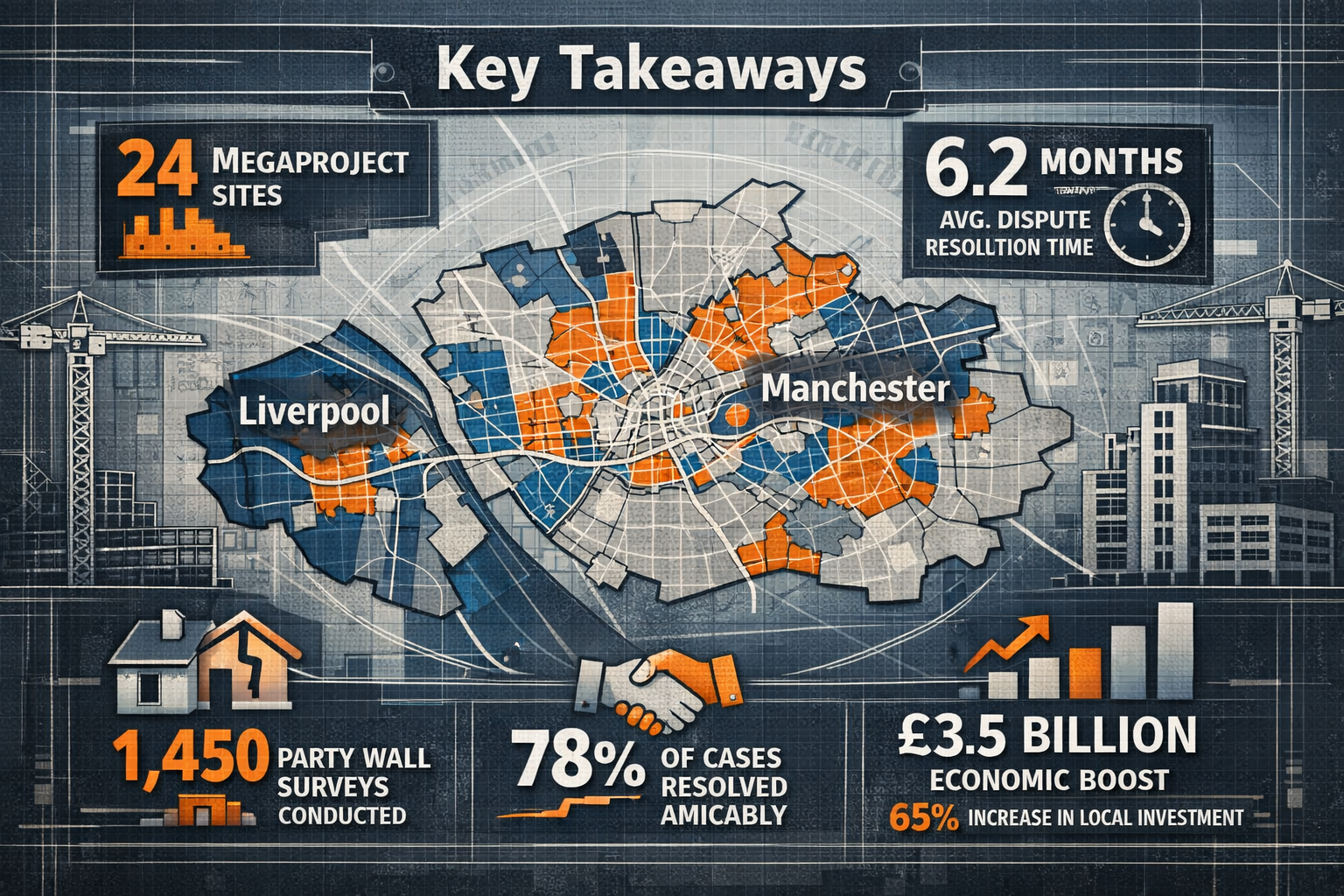
Key Takeaways
- 🏗️ Manchester and Liverpool's megaprojects (Victoria North, Viadux tower, Kings Dock development) create unprecedented party wall challenges requiring specialized survey protocols
- 📋 Systematic notice procedures are essential for managing multiple adjoining properties in high-density developments, with timelines extending 2-6 months before construction
- ⚖️ Dispute resolution frameworks must address the unique complexities of large-scale urban renewals, including coordinated surveyor appointments and phased construction impacts
- 🔍 Pre-construction surveys documenting existing property conditions are critical for protecting all parties in densely packed urban environments
- 📊 Coordinated management systems tracking hundreds of party wall notices simultaneously are now necessary for megaproject success
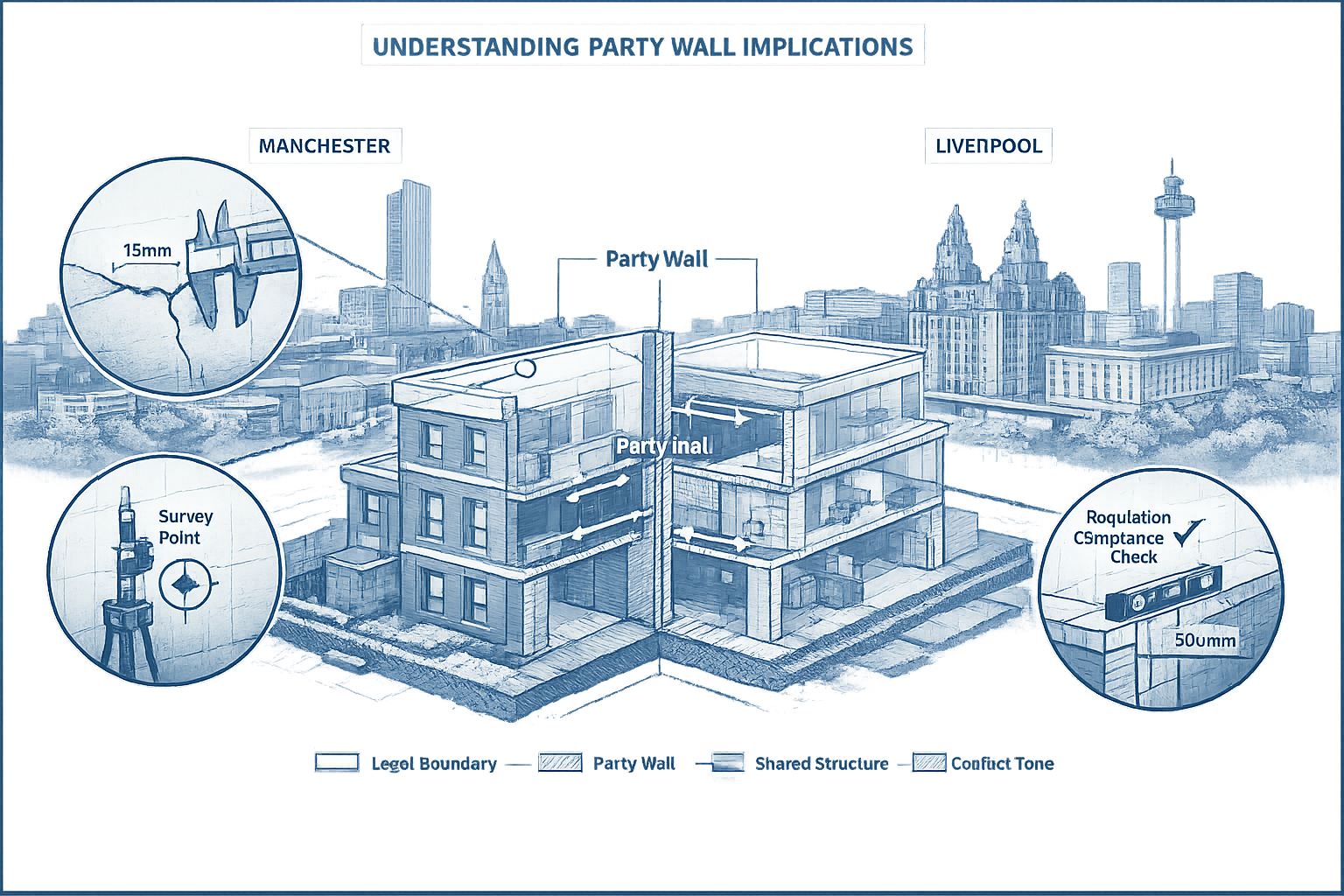
Understanding Party Wall Implications in Northern Megaprojects
The Scale of Development in Manchester and Liverpool
The transformation of Manchester and Liverpool in 2026 represents one of the most significant urban renewal periods in British history. Manchester's Victoria North project alone encompasses 15,000 new homes across a massive regeneration zone, while the city's construction activity has reached record levels with development cranes visible across multiple districts.[1][4]
Liverpool's ambitious Kings Dock project, featuring a 221.5-metre tower set for public consultation in spring 2026, demonstrates the city's commitment to waterfront transformation.[5] These developments create complex party wall scenarios that differ fundamentally from traditional single-property extensions or conversions.
Why Megaprojects Create Unique Party Wall Challenges
Large-scale urban renewal projects introduce several complications that standard party wall procedures weren't originally designed to handle:
Volume of Affected Properties: A single megaproject may interface with dozens or even hundreds of existing properties, requiring coordinated notice serving and survey management.
Phased Construction Timelines: Multi-year construction periods mean party wall implications evolve over time, with different properties affected at different stages.
Mixed-Use Complexity: Modern developments combining residential, commercial, and retail spaces create varied party wall scenarios within single projects.
Infrastructure Integration: Projects like Manchester's £3 billion Haweswater Aqueduct and the Bee Network transport system involve underground works that trigger party wall excavation notices across wide geographical areas.[1]
The Legal Framework in High-Density Developments
The Party Wall etc. Act 1996 applies equally to megaprojects as it does to small-scale developments, but the practical application requires adapted protocols. Understanding legal requirements for party walls becomes more complex when dealing with:
- Multiple simultaneous notices to different property owners
- Coordinated surveyor appointments across numerous properties
- Phased construction requiring sequential or overlapping party wall awards
- Commercial and residential interfaces requiring different communication approaches
The fundamental principle remains unchanged: property owners undertaking work that affects shared walls, boundaries, or nearby foundations must serve proper notice and obtain consent or awards before proceeding.
Survey Protocols for Managing Party Wall Notices in Large-Scale Urban Renewals
Pre-Development Assessment and Planning
Successful management of Party Wall Implications of Northern Renewal Megaprojects: Survey Protocols for Manchester and Liverpool Booms begins long before construction starts. Developers must implement comprehensive assessment protocols:
Property Identification and Mapping
Create detailed boundary surveys identifying every property potentially affected by the development. This includes:
- Properties sharing walls or boundaries
- Properties within 3 metres of excavation works (triggering the party wall 3 metre rule)
- Properties within 6 metres of deeper excavations
- Properties affected by temporary works, scaffolding, or access requirements
Digital mapping systems should track each property's status through the party wall process, from initial identification through notice serving, surveyor appointment, and award completion.
Timeline Development
Megaprojects require extended party wall timelines that account for:
- 2-month minimum notice periods for most party wall works
- 1-month notice periods for line of junction works
- Additional time for surveyor appointments and award preparation (typically 2-4 months)
- Dispute resolution periods if disagreements arise
- Phased construction requiring sequential notices
For a project like Victoria North with 15,000 homes, the party wall process may need to begin 12-18 months before the first construction activity.[1]
Systematic Notice Serving Procedures
Checklist for Notice Preparation
✅ Identify all affected owners and occupiers (including leaseholders and tenants)
✅ Prepare accurate technical descriptions of proposed works
✅ Include detailed drawings and specifications showing party wall interfaces
✅ Specify construction timelines and phasing relevant to each property
✅ Provide clear contact information for project representatives
✅ Explain party wall rights and response requirements in plain language
✅ Serve notices by recorded delivery with proof of service
✅ Maintain comprehensive tracking systems for all notices served
Managing Multiple Property Owners
Large developments require coordinated communication strategies:
Community Consultation Sessions: Host information events explaining the party wall process before formal notices are served. This proactive approach reduces anxiety and disputes.
Dedicated Party Wall Coordinators: Assign specific team members to manage party wall communications, ensuring consistency and responsiveness.
Standardized Documentation: Develop template notices, information sheets, and FAQs that maintain legal compliance while being accessible to non-specialists.
Phased Notice Serving: Serve notices in logical groups based on construction phasing, rather than overwhelming all neighbors simultaneously.
Surveyor Appointment and Coordination
The Role of Agreed Surveyors in Megaprojects
For large-scale developments, appointing party wall agreed surveyors who can act impartially for both building owners and adjoining owners offers significant advantages:
- Streamlined administration with single surveyor managing multiple properties
- Consistent approach to condition surveys and awards
- Reduced costs compared to separate surveyors for each property
- Faster resolution of technical questions
However, adjoining owners retain the absolute right to appoint their own surveyors, and this choice must be respected and facilitated.
Managing Multiple Surveyor Relationships
When different adjoining owners appoint different surveyors, megaprojects require surveyor coordination protocols:
Regular Coordination Meetings: Schedule periodic meetings with all appointed surveyors to discuss project progress, timing, and concerns.
Shared Information Platforms: Provide secure access to project documentation, drawings, and schedules for all surveyors.
Standardized Award Templates: Work with surveyors to develop consistent award structures that address common concerns while allowing for property-specific variations.
Third Surveyor Arrangements: Establish clear procedures for appointing third surveyors to resolve disputes, including pre-agreed selection criteria.
Condition Survey Protocols
Pre-Construction Documentation
Comprehensive schedule of condition reports form the foundation of party wall protection:
Photographic Documentation: High-resolution photographs of all rooms, external elevations, and specific features in adjoining properties.
Crack Mapping: Detailed drawings showing location, length, and width of existing cracks, with measurements and photographs.
Structural Assessment: Professional evaluation of existing structural conditions, including any pre-existing defects or concerns.
Services Documentation: Record condition of utilities, drainage, and services that might be affected by works.
Special Features: Document decorative finishes, historical features, or valuable installations requiring particular care.
Survey Standards for High-Density Developments
In densely packed urban environments like those being created in Manchester and Liverpool, condition surveys must address:
- Vibration sensitivity of older properties adjacent to major construction
- Settlement risks from deep excavations in variable ground conditions
- Cumulative impacts from multiple concurrent developments
- Access arrangements for monitoring during construction
- Baseline measurements for vibration and noise monitoring
Managing Disputes in Megaproject Contexts
Despite best efforts, party wall disputes arise more frequently in large-scale developments due to the volume of properties involved and the extended construction periods.
Early Dispute Resolution Strategies
Proactive Communication: Maintain regular updates to adjoining owners about construction progress, timing changes, and any issues arising.
Rapid Response Systems: Establish procedures for addressing concerns immediately, before they escalate to formal disputes.
Mediation Options: Offer informal mediation before proceeding to formal third surveyor appointments.
Transparent Documentation: Maintain meticulous records of all communications, decisions, and actions taken.
Checklist for Dispute Management
✅ Document the dispute in writing with specific details
✅ Review the party wall award for relevant provisions
✅ Attempt informal resolution through direct discussion
✅ Engage surveyors to mediate technical disagreements
✅ Consider third surveyor appointment if resolution fails
✅ Maintain construction compliance with award terms during dispute
✅ Document all resolution efforts for potential legal proceedings
✅ Learn from disputes to improve protocols for future phases
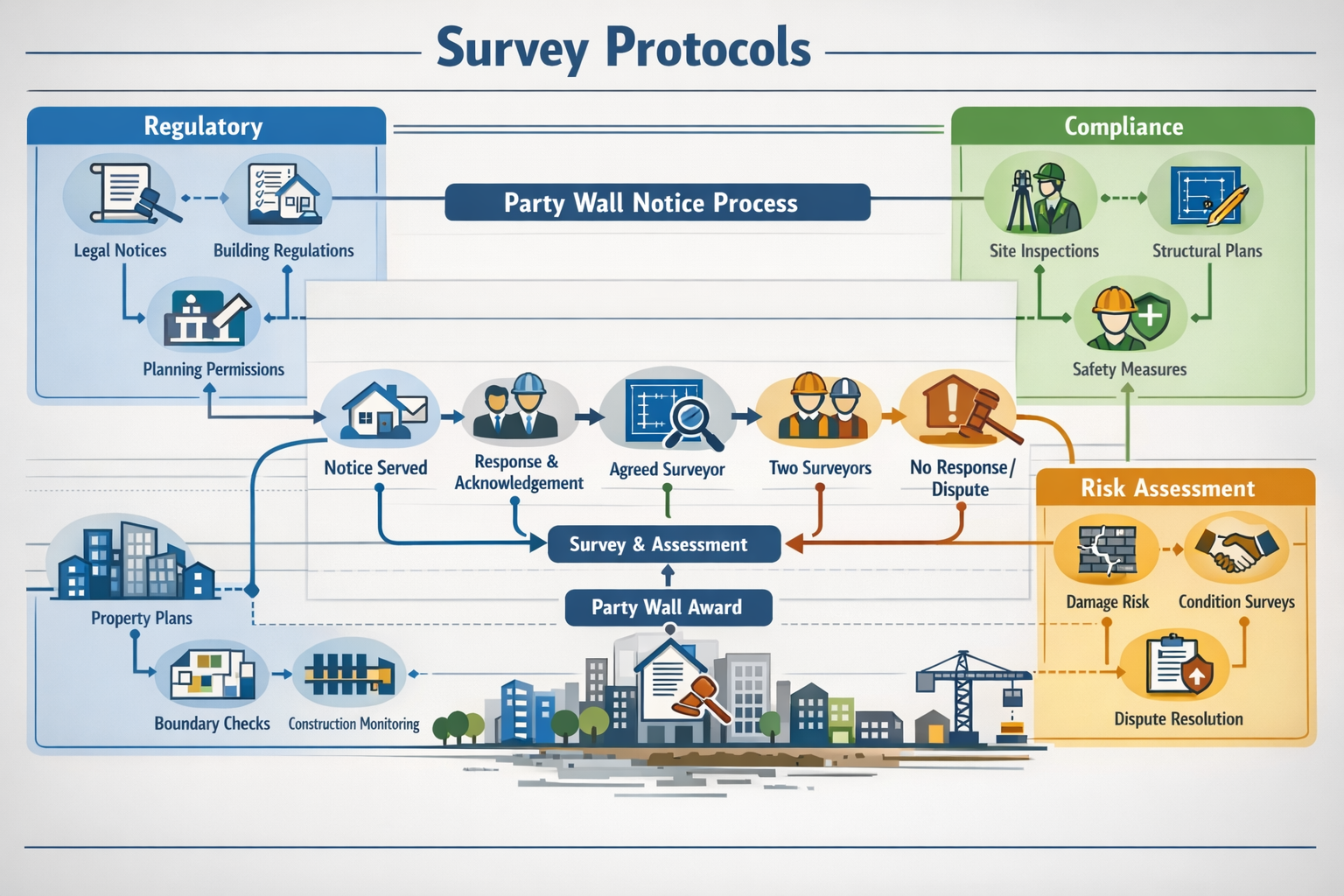
High-Density Dispute Management: Manchester and Liverpool Case Studies
Manchester's Victoria North: Coordinating 15,000 Homes
The £4 billion Victoria North project represents perhaps the most complex party wall challenge in current UK development.[1] Managing party wall implications across such a vast area requires unprecedented coordination:
Phased Approach: The development divides into multiple sub-phases, each with its own party wall timeline. Early phases inform protocols for later phases, creating continuous improvement.
Community Liaison Teams: Dedicated teams maintain relationships with existing residents throughout the multi-year construction period, addressing party wall concerns alongside broader construction impacts.
Digital Tracking Systems: Sophisticated software tracks the status of hundreds of party wall notices, surveyor appointments, and awards, ensuring nothing falls through administrative gaps.
Lessons for Other Megaprojects: Victoria North demonstrates that early investment in party wall infrastructure—including dedicated personnel, systems, and protocols—pays dividends in reduced disputes and smoother construction progress.
Liverpool Kings Dock: Waterfront Complexity
Liverpool's planned 70-storey tower at Kings Dock introduces unique party wall considerations related to waterfront development:[5]
Maritime Infrastructure: Party wall implications extend to dock walls, maritime structures, and underground services unique to waterfront locations.
Mixed Ownership: Waterfront developments often involve complex ownership structures including port authorities, commercial landlords, and residential owners, each requiring tailored party wall approaches.
Foundation Challenges: Deep piling and foundation works in waterfront locations trigger party wall excavation requirements across wider areas due to ground conditions.
Public Consultation Integration: The spring 2026 public consultation period provides opportunity to address party wall concerns before formal planning submission, demonstrating proactive stakeholder engagement.[5]
The Viadux Tower: High-Rise Considerations
Manchester's 76-storey Viadux/Nobu tower illustrates party wall challenges specific to super-tall buildings:[1]
Extended Construction Periods: Multi-year construction timelines require party wall awards that anticipate evolving impacts on adjoining properties.
Deep Excavations: Foundation works for super-tall structures often extend deep underground, triggering party wall requirements for properties well beyond immediate neighbors.
Crane Operations: Tower crane positions and operations may affect party wall considerations, particularly regarding access and temporary works.
Phased Occupancy: As lower floors become occupied while upper floors continue construction, party wall obligations may shift from developer to new occupants.
Common Themes Across Northern Megaprojects
Analysis of Party Wall Implications of Northern Renewal Megaprojects: Survey Protocols for Manchester and Liverpool Booms reveals consistent patterns:
🔑 Early Engagement: Successful projects begin party wall processes 12-18 months before construction, not the statutory minimum periods.
📱 Technology Integration: Digital platforms for tracking notices, surveys, and awards prove essential for managing complexity at scale.
👥 Dedicated Resources: Megaprojects require specialized party wall coordinators, not just general construction managers handling party walls alongside other duties.
🤝 Relationship Focus: Maintaining positive relationships with adjoining owners throughout multi-year projects prevents disputes more effectively than purely procedural compliance.
📊 Data-Driven Improvement: Systematic tracking of disputes, delays, and resolutions enables continuous protocol refinement across project phases.
Practical Checklists for Developers and Property Owners
Developer's Megaproject Party Wall Checklist
Phase 1: Pre-Development (12-18 months before construction)
✅ Commission comprehensive boundary and title surveys
✅ Identify all properties potentially affected by works
✅ Develop detailed construction phasing plans
✅ Establish party wall budget (typically 1-3% of construction costs for megaprojects)
✅ Appoint experienced party wall coordinators
✅ Implement digital tracking systems
✅ Develop communication strategies and materials
✅ Host initial community consultation sessions
Phase 2: Notice Period (2-6 months before construction)
✅ Prepare technically accurate party wall notices
✅ Serve notices by recorded delivery with proof
✅ Track responses and consent/dissent
✅ Facilitate surveyor appointments for dissenting owners
✅ Coordinate surveyor access for condition surveys
✅ Respond promptly to questions and concerns
✅ Maintain detailed records of all communications
✅ Update construction teams on party wall requirements
Phase 3: Award Preparation (1-4 months before construction)
✅ Provide surveyors with comprehensive project information
✅ Participate in surveyor site visits and inspections
✅ Review draft awards for accuracy and feasibility
✅ Negotiate reasonable conditions and requirements
✅ Ensure awards address construction phasing
✅ Obtain signed awards before commencing works
✅ Distribute copies to all relevant parties
✅ Brief construction teams on award obligations
Phase 4: Construction Period
✅ Comply strictly with award terms and conditions
✅ Maintain required insurance coverage
✅ Facilitate surveyor monitoring visits
✅ Respond immediately to damage reports or concerns
✅ Document any variations from planned works
✅ Serve additional notices if works change
✅ Maintain communication with adjoining owners
✅ Address disputes promptly through proper channels
Phase 5: Post-Construction
✅ Facilitate final condition inspections
✅ Address any identified damage promptly
✅ Complete required remedial works
✅ Obtain sign-offs from surveyors
✅ Archive all party wall documentation
✅ Review process for lessons learned
✅ Update protocols for future phases
Adjoining Owner's Protection Checklist
Property owners adjacent to megaprojects face unique challenges requiring proactive protection:
✅ Respond to party wall notices within 14 days to preserve rights
✅ Consider appointing your own surveyor rather than agreeing to building owner's surveyor
✅ Ensure condition surveys are comprehensive and accurate
✅ Photograph your property independently before works commence
✅ Understand your rights under the Party Wall Act
✅ Maintain records of all notices, correspondence, and surveys
✅ Report concerns immediately to appointed surveyors
✅ Document any damage with photographs and descriptions
✅ Understand party wall consent implications before agreeing to variations
✅ Seek professional advice for complex situations
Surveyor's Megaproject Management Checklist
Party wall surveyors working on large-scale developments require enhanced protocols:
✅ Assess capacity before accepting multiple appointments
✅ Establish coordination with other surveyors on the project
✅ Implement systematic documentation and tracking systems
✅ Conduct thorough condition surveys with detailed crack mapping
✅ Prepare comprehensive awards addressing phased construction
✅ Include monitoring provisions for extended construction periods
✅ Specify clear procedures for reporting damage or concerns
✅ Maintain impartiality while representing client interests
✅ Respond promptly to queries from all parties
✅ Document all decisions and communications thoroughly
✅ Consider third surveyor selection criteria in advance
✅ Stay updated on megaproject-specific challenges and solutions
Integration with Broader Construction Management
Coordinating Party Wall Requirements with Other Consents
Megaprojects involve multiple regulatory frameworks that intersect with party wall obligations:
Planning Permission: While party wall matters are separate from planning, coordinating timelines ensures party wall awards are in place when planning permission is granted.
Building Control: Party wall awards must align with building regulations approvals, particularly regarding structural works and foundations.
Environmental Permits: Noise, vibration, and dust controls required by environmental permits should complement party wall award conditions.
Highway Access: Temporary works affecting public highways may have party wall implications for adjacent properties.
Understanding these interactions prevents conflicts between different regulatory requirements and ensures smooth project progression.
Risk Management and Insurance
Megaprojects require enhanced insurance arrangements addressing party wall risks:
Contractor's All Risks Insurance: Must provide adequate coverage for damage to property during party wall works.
Professional Indemnity: Surveyors working on megaprojects need sufficient coverage given the potential scale of claims.
Public Liability: Extended coverage addressing the volume of adjoining properties and extended construction periods.
Latent Defects Insurance: May be required for major developments, with party wall implications for long-term structural performance.
Party wall awards should specify insurance requirements clearly, with evidence of coverage provided before works commence.
Technology and Digital Solutions
Modern megaprojects increasingly leverage technology for party wall management:
Digital Notice Serving: Electronic service of notices (where legally compliant) accelerates processes and provides clear audit trails.
Survey Apps: Mobile applications enable surveyors to conduct condition surveys efficiently, with integrated photography, crack mapping, and report generation.
Project Management Platforms: Cloud-based systems track party wall status across hundreds of properties, with automated reminders and status updates.
Monitoring Systems: Automated vibration and movement monitoring provides real-time data on construction impacts, enabling rapid response to concerns.
Virtual Consultations: Video conferencing enables efficient surveyor coordination and owner consultations, particularly valuable across large geographical areas.
Future Trends in Northern Urban Renewal
Evolving Regulatory Landscape
The unprecedented scale of northern megaprojects may drive regulatory evolution:
Streamlined Procedures: Potential development of expedited party wall procedures specifically for large-scale regeneration projects, while maintaining owner protections.
Digital Standards: Emerging standards for electronic notice service and digital awards may become mainstream, improving efficiency.
Enhanced Enforcement: Greater regulatory oversight of party wall compliance in megaprojects may develop, ensuring developer accountability.
Community Infrastructure Levy Integration: Possible integration of party wall considerations into broader development contribution frameworks.
Sustainability and Party Wall Implications
Modern developments increasingly prioritize sustainability, creating new party wall considerations:
Retrofit Requirements: Existing properties adjacent to new developments may require thermal upgrades, potentially triggering additional party wall works.
Shared Energy Systems: District heating and shared renewable energy infrastructure create new forms of party wall relationships.
Green Infrastructure: Living walls, green roofs, and sustainable drainage systems at boundaries require careful party wall management.
Circular Economy: Deconstruction rather than demolition, with material reuse, may affect party wall procedures and timelines.
Skills Development and Professional Standards
The complexity of Party Wall Implications of Northern Renewal Megaprojects: Survey Protocols for Manchester and Liverpool Booms demands enhanced professional capabilities:
Specialized Training: Development of megaproject-specific party wall training for surveyors, developers, and construction managers.
Accreditation Schemes: Potential emergence of specialist accreditations for party wall surveyors working on large-scale urban renewal.
Knowledge Sharing: Industry forums and case study publications enabling professionals to learn from major projects.
Technology Competence: Integration of digital tools and platforms into professional standards and training.
Conclusion
The Party Wall Implications of Northern Renewal Megaprojects: Survey Protocols for Manchester and Liverpool Booms represent a defining challenge for the UK construction industry in 2026. As Manchester's Victoria North, Viadux tower, and Liverpool's Kings Dock development reshape these cities' skylines, the party wall frameworks protecting property owners must evolve to match the scale and complexity of modern urban renewal.[1][4][5]
Success requires systematic approaches that go beyond minimum statutory compliance. Developers must invest in dedicated party wall infrastructure—specialized personnel, digital tracking systems, and proactive communication strategies—from the earliest project stages. The traditional approach of treating party wall matters as administrative formalities proves wholly inadequate for megaprojects affecting hundreds of properties over multi-year construction periods.
For property owners adjacent to these transformative developments, understanding party wall rights and exercising them proactively provides essential protection. Appointing qualified surveyors, ensuring comprehensive condition surveys, and maintaining detailed records safeguard interests throughout extended construction periods.
Professional surveyors play pivotal roles in balancing development needs with owner protections. Enhanced coordination, systematic documentation, and megaproject-specific expertise enable effective management of unprecedented complexity while maintaining the impartiality essential to party wall procedures.
Actionable Next Steps
For Developers Planning Megaprojects:
- Establish dedicated party wall teams 12-18 months before construction
- Implement digital tracking systems for managing multiple notices and awards
- Budget 1-3% of construction costs for comprehensive party wall management
- Engage experienced party wall surveyors familiar with large-scale projects
- Develop community consultation strategies integrating party wall information
For Property Owners Adjacent to Developments:
- Respond to party wall notices within 14 days to preserve your rights
- Consider appointing your own surveyor for independent representation
- Document your property's condition comprehensively before works begin
- Understand the party wall process through resources like party wall act questions
- Maintain organized records of all party wall communications and documentation
For Construction Professionals:
- Invest in specialized training for megaproject party wall management
- Develop technology competencies for digital notice serving and tracking
- Build networks with other professionals working on large-scale developments
- Stay current with evolving protocols and best practices
- Contribute to industry knowledge sharing through case studies and forums
The northern renewal boom demonstrates that proactive, systematic, and technology-enabled party wall management is no longer optional for megaprojects—it's essential infrastructure for successful urban transformation. As Manchester and Liverpool continue their remarkable growth trajectories, the party wall protocols developed today will shape construction practices for decades to come.
By implementing the checklists, strategies, and frameworks outlined in this guide, all parties can navigate the Party Wall Implications of Northern Renewal Megaprojects: Survey Protocols for Manchester and Liverpool Booms successfully, protecting rights while enabling the transformative development these cities deserve.
References
[1] Watch – https://www.youtube.com/watch?v=akX21l9gso8
[2] Govt Reveals Why Liverpool Crewe Didnt Make New Towns Cut – https://www.placenorthwest.co.uk/govt-reveals-why-liverpool-crewe-didnt-make-new-towns-cut/
[3] Party Wall Agreements In Data Centre Developments 2026 Compliance Amid Ai Driven Uk Demand – https://nottinghillsurveyors.com/blog/party-wall-agreements-in-data-centre-developments-2026-compliance-amid-ai-driven-uk-demand
[4] Council Leader Responds To The Annual Crane Survey – https://www.manchester.gov.uk/news-stories/2026/council-leader-responds-to-the-annual-crane-survey
[5] Plans Have Been Revealed For The Tallest Skyscraper In Liverpool Heres Where It Will Rank Among The Uks Biggest Buildings 031326 – https://www.timeout.com/uk/news/plans-have-been-revealed-for-the-tallest-skyscraper-in-liverpool-heres-where-it-will-rank-among-the-uks-biggest-buildings-031326