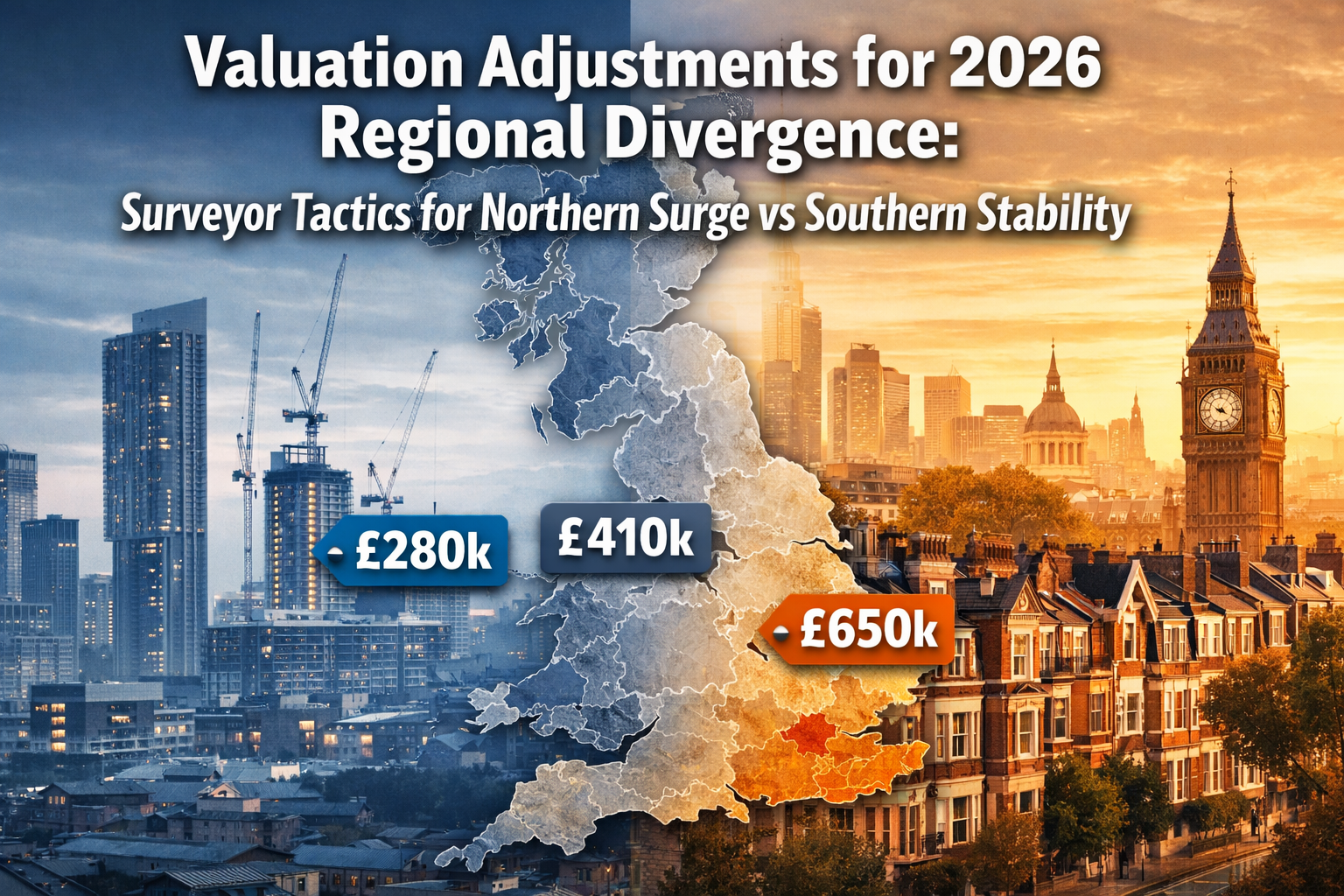

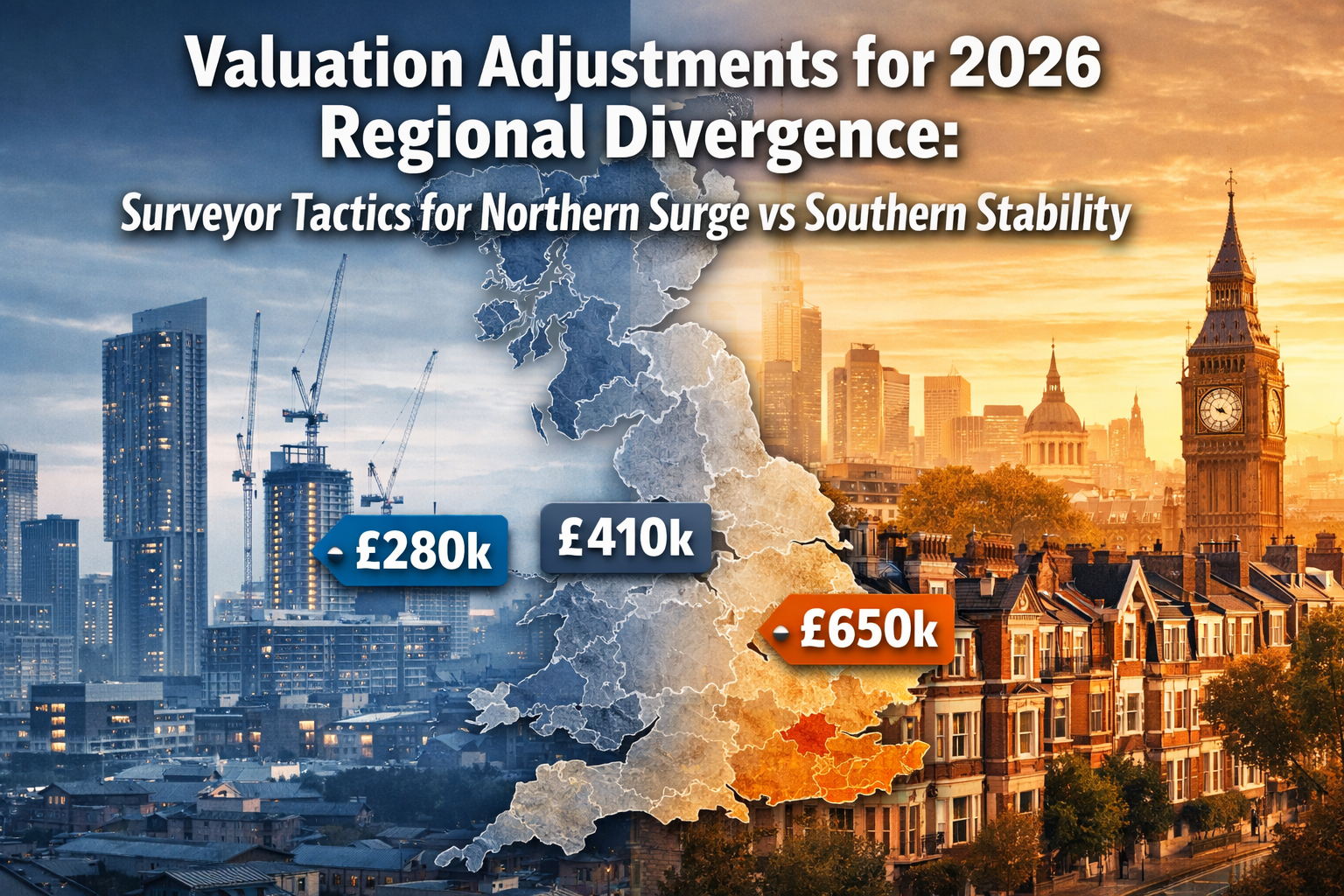
The UK property market in 2026 presents a fascinating paradox: while national growth forecasts hover around 4-5%, the reality beneath these averages reveals dramatic regional divergence that demands sophisticated surveyor strategies. Manchester and Liverpool are experiencing unprecedented renewal through megaprojects, while London and the South East encounter price ceilings that challenge traditional valuation approaches. For property surveyors navigating Valuation Adjustments for 2026 Regional Divergence: Surveyor Tactics for Northern Surge vs Southern Stability, understanding these contrasting market dynamics has never been more critical.
This seismic shift in regional performance requires surveyors to abandon one-size-fits-all methodologies. The northern surge, fueled by infrastructure investment and corporate relocations, demands growth-oriented valuation frameworks. Meanwhile, southern stability necessitates precision adjustments that account for market maturity and constrained appreciation potential.
Key Takeaways
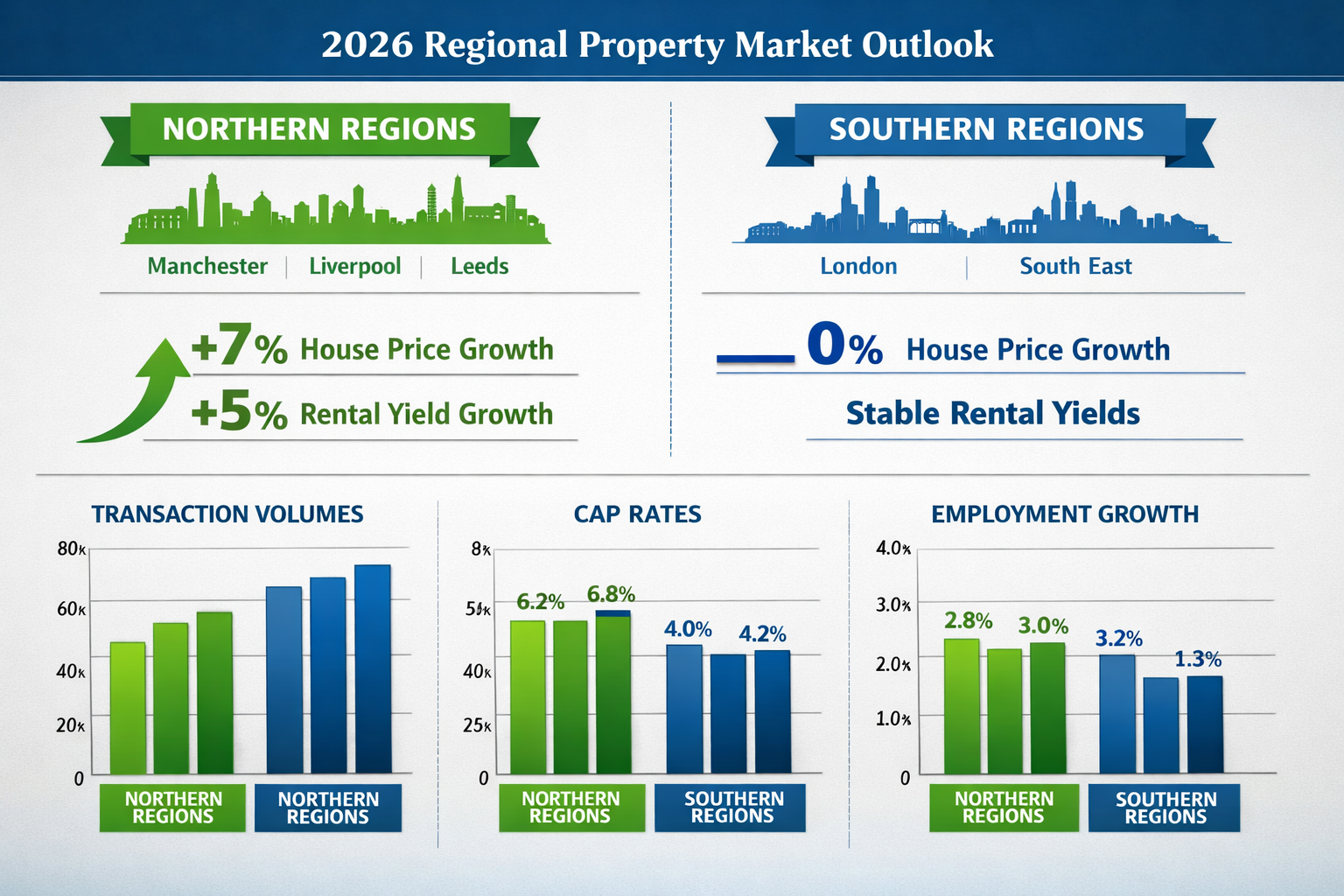
- Northern regions like Manchester and Liverpool are experiencing 6-8% annual growth driven by infrastructure megaprojects and corporate relocations, requiring growth-adjusted valuation methodologies
- Southern markets including London and the South East face price ceilings with 1-3% appreciation, demanding conservative comparable selection and maturity-based adjustments
- Regional employment diversification is the primary driver of valuation divergence, with northern cities absorbing technology and professional services sectors previously concentrated in the South
- Cap rate compression in northern markets (5.5-6.2%) versus stabilization in southern markets (4.8-5.3%) requires region-specific yield analysis for investment properties
- Surveyor tactics must incorporate regional economic indicators, infrastructure timelines, and demographic shifts to deliver accurate 2026 valuations across the UK property landscape
Understanding the 2026 Regional Property Landscape
The UK property market has entered a period of pronounced regional divergence that fundamentally alters how chartered surveyors approach valuations. While national headlines tout moderate 4-5% growth, this aggregate figure masks extraordinary variation between northern renewal zones and southern established markets.
The Northern Surge: Manchester, Liverpool, and Leeds
Northern England cities are experiencing a property renaissance unprecedented in recent decades. Manchester's £1.5 billion infrastructure programme, Liverpool's waterfront regeneration, and Leeds' financial services expansion have created demand-supply imbalances that favor appreciation.
Key indicators driving northern valuations include:
- 📈 Employment growth of 3-4% annually in technology and professional services sectors
- 🏗️ Infrastructure investment exceeding £8 billion across the Northern Powerhouse initiative
- 🏢 Corporate relocations from London bringing 15,000+ high-paying jobs since 2024
- 🎓 University expansion creating sustained rental demand in student and young professional segments
For surveyors conducting valuations in northern regions, these factors necessitate forward-looking adjustments that account for anticipated appreciation beyond historical comparables.
Southern Stability: London and the South East
In contrast, London and South East markets exhibit characteristics of mature, price-constrained environments. Property values in prime central London and established commuter zones like Surrey and Berkshire have reached ceilings dictated by affordability limits and outmigration trends.
Southern market characteristics include:
- 💷 Price-to-income ratios at historical highs (12-15x in London versus 6-8x in Manchester)
- 📉 Net migration showing 25,000+ annual exodus to northern cities and home counties
- 🏘️ Inventory constraints in desirable areas maintaining price floors despite demand softening
- 💼 Hybrid work patterns reducing London proximity premiums by 8-12%
Surveyors working in South East London or West London must apply conservative comparable adjustments that reflect market maturity rather than historical growth trajectories.
Global Context and Regional Parallels
The UK's regional divergence mirrors patterns observed in other developed markets. Research indicates that global REIT valuations show significant regional variation, with equity multiples nearly 30% cheaper than historical levels in certain markets[1]. This global context suggests that regional specialization in valuation approaches represents best practice rather than local anomaly.
Similarly, US markets demonstrate comparable patterns. Midwest cities like Columbus and Indianapolis are showing outsized growth compared to previously hot markets in Texas and Florida[4]. These parallels validate the strategic imperative for UK surveyors to develop region-specific expertise.
Valuation Adjustments for 2026 Regional Divergence: Core Methodology Shifts
Implementing effective Valuation Adjustments for 2026 Regional Divergence: Surveyor Tactics for Northern Surge vs Southern Stability requires fundamental methodology shifts that go beyond traditional comparable analysis.

Northern Growth-Adjusted Valuation Framework
For northern surge markets, surveyors must incorporate prospective value indicators that traditional retrospective analysis overlooks. This requires a multi-layered approach:
Infrastructure Proximity Premiums
Properties within 1km of major infrastructure projects (HS2 stations, tram extensions, regeneration zones) warrant location premiums of 8-15% above comparable properties in non-infrastructure zones. When conducting a building survey, surveyors should document proximity to confirmed infrastructure timelines.
Employment Base Diversification Multipliers
Northern cities experiencing corporate relocations demonstrate stronger appreciation potential. Properties in employment catchment areas (15-minute commute) of major corporate campuses should receive multiplier adjustments of 1.05-1.12 on comparable valuations.
Rental Yield Compression Analysis
As northern markets mature, cap rates are compressing from historical 6.5-7.5% toward 5.5-6.2%. Investment property valuations must account for this yield compression, which increases capital values independent of rental income growth.
Example Calculation:
- Property generating £24,000 annual rent
- Historical cap rate: 7.0% → Value: £342,857
- 2026 compressed cap rate: 6.0% → Value: £400,000
- Appreciation from yield compression alone: 16.7%
Southern Maturity-Based Adjustment Framework
Southern market valuations require conservative adjustments that recognize price ceilings and demand constraints.
Comparable Selection Tightening
In mature markets like Richmond or Kingston, surveyors must narrow comparable selection criteria:
- ✅ Temporal proximity: Use comparables from past 3-4 months (versus 6-12 months in growth markets)
- ✅ Micro-location precision: Limit comparables to 0.5km radius rather than broader postal districts
- ✅ Property condition parity: Adjust heavily for condition differences as buyers exhibit increased sensitivity
Affordability Ceiling Analysis
Southern valuations must incorporate affordability constraints as hard ceilings. Calculate:
- Median household income for target demographic
- Maximum mortgage at 4.5x income multiple
- Deposit assumptions (15-20% for first-time buyers, 25-35% for movers)
- Effective price ceiling = Maximum mortgage + Typical deposit
Properties approaching these ceilings warrant downward adjustments of 3-8% to reflect limited buyer pool expansion.
Outmigration Demand Dampening
Areas experiencing net outmigration require demand adjustment factors. Properties in zones with documented population decline should receive 2-5% downward adjustments to account for weakening demand fundamentals.
Hybrid Approaches for Transitional Zones
Certain areas—including outer London boroughs, Thames Valley corridors, and major motorway junctions—exhibit hybrid characteristics requiring blended methodologies. Surveyors in Hertfordshire, Buckinghamshire, or Oxfordshire should:
- Weight northern growth factors at 30-40% and southern stability factors at 60-70%
- Monitor quarterly shifts in weighting as regional dynamics evolve
- Document rationale transparently in valuation reports
Surveyor Tactics: Practical Implementation Strategies
Translating regional divergence understanding into actionable surveyor tactics requires systematic implementation across valuation workflows.
Data Source Diversification
Regional divergence demands regional data. Surveyors must move beyond national databases to incorporate:
- 🏙️ Local authority planning data: Track approved developments, infrastructure timelines, and zoning changes
- 📊 Regional employment statistics: Monitor job creation by sector and wage growth trends
- 🚇 Transport authority investment schedules: Identify properties benefiting from confirmed improvements
- 🎯 Corporate relocation announcements: Anticipate demand shifts from major employer moves
For RICS registered valuers, incorporating these diverse data sources demonstrates due diligence and supports defensible valuation conclusions.
Segmented Comparable Databases
Maintain separate comparable databases for northern growth markets and southern stability markets. This segmentation enables:
- More accurate trend analysis within regional contexts
- Appropriate adjustment factor calibration for each market type
- Clearer identification of outlier transactions requiring investigation
When preparing a Red Book valuation, clearly document which regional database informed comparable selection.
Client Communication Protocols
Regional divergence creates client education opportunities and requirements:
For Northern Market Clients:
- Emphasize growth potential while managing expectations about volatility
- Explain infrastructure timeline risks and benefits
- Discuss optimal holding periods to capture appreciation (typically 5-7 years)
For Southern Market Clients:
- Set realistic appreciation expectations (1-3% annually)
- Highlight stability benefits and lower volatility
- Focus on property quality and location micro-factors as primary value drivers
Specialized Valuation Products
Different regional dynamics warrant specialized valuation approaches:
Development Appraisals in Northern Markets
Northern growth areas require sophisticated development appraisals incorporating:
- Phased appreciation assumptions
- Infrastructure completion contingencies
- Pre-sale velocity projections based on regional demand indicators
Matrimonial and Probate Valuations in Southern Markets
For matrimonial valuations or probate valuations in southern regions, emphasize:
- Current market value conservatism
- Limited forced-sale discounts due to inventory constraints
- Micro-location premiums for truly exceptional properties
Technology Integration for Regional Analysis
Modern surveyor tactics leverage technology for regional divergence analysis:
- GIS mapping tools: Visualize infrastructure proximity and demographic shifts
- Automated valuation models (AVMs): Calibrate separately for northern and southern regions
- Predictive analytics: Model appreciation scenarios under different infrastructure and employment assumptions
- Drone surveys: For drone roof surveys that enhance property documentation in competitive markets
Continuous Professional Development
Regional divergence necessitates ongoing surveyor education:
- 📚 Attend regional market briefings and economic development forums
- 🤝 Network with local estate agents, developers, and planning authorities
- 📈 Monitor regional REIT performance and institutional investment flows
- 🎓 Pursue specialized credentials in regional market analysis
Commercial Property Considerations in Regional Divergence
While residential property receives significant attention, commercial property valuations exhibit even more pronounced regional divergence in 2026.
Office Market Bifurcation
Office valuations demonstrate extreme regional variation:
Northern Growth Markets:
- Grade A office space in Manchester city center: £35-42 per sq ft, 95%+ occupancy
- Demand driven by corporate relocations and technology sector expansion
- Cap rates compressing to 5.5-6.0% for prime assets
- Valuation approach: Emphasize rental growth potential and tenant quality
Southern Mature Markets:
- Grade A office space in central London: £65-85 per sq ft, but 12-15% vacancy in secondary locations
- Hybrid work patterns creating structural oversupply in Class B/C stock
- Cap rates stable at 4.5-5.0% for prime, widening to 7.0%+ for secondary
- Valuation approach: Surgical asset quality bifurcation and tenant covenant analysis
This bifurcation mirrors patterns observed in US markets, where Class A Uptown Dallas shows strong absorption while Class B and C assets face structural headwinds[3].
Industrial and Logistics
Regional divergence affects industrial property differently:
- Northern advantage: Lower land costs and strategic M62/M6 corridor positioning
- Southern advantage: Proximity to London consumption centers and port access
- Valuation tactics: Weight location factors 40% (versus 25% in pre-divergence era)
Retail and Hospitality
Retail valuations require hyper-local analysis regardless of region:
- High street performance varies street-by-street based on pedestrian flows
- Hospitality benefits from tourism (southern bias) and business travel (northern growth)
- Commercial building surveys must assess catchment demographics with precision
Risk Factors and Valuation Contingencies
Implementing Valuation Adjustments for 2026 Regional Divergence: Surveyor Tactics for Northern Surge vs Southern Stability requires acknowledging inherent risks and incorporating appropriate contingencies.
Northern Market Risks
Infrastructure Delivery Risk:
Northern growth assumptions depend heavily on infrastructure project completion. Surveyors should:
- Discount infrastructure premiums by 20-30% for projects beyond 2028 completion
- Document infrastructure dependencies explicitly in valuation reports
- Monitor project progress and update valuations if delays emerge
Overheating Risk:
Rapid appreciation creates bubble concerns. Warning signs include:
- Price growth exceeding wage growth by >3 percentage points for 18+ months
- Speculative investor activity exceeding 25% of transactions
- New construction supply significantly exceeding absorption rates
Employment Concentration Risk:
Northern growth driven by specific sectors (technology, professional services) creates vulnerability to sector-specific downturns.
Southern Market Risks
Affordability Crisis Deepening:
If wage growth continues lagging property prices, southern markets face demand destruction risks requiring significant downward revaluation.
Outmigration Acceleration:
Current outmigration trends could accelerate if northern quality-of-life improvements and remote work normalization continue.
Policy Intervention Risk:
Government policies targeting southern property wealth (additional stamp duty, mansion taxes) could suppress valuations.
Universal Risk Factors
Both regions face shared risks:
- Interest rate volatility: Mortgage rate increases of 1%+ would dampen all markets
- Economic recession: National GDP contraction would override regional dynamics
- Climate change impacts: Flood risk and energy efficiency requirements affect all regions
Surveyors should incorporate these risks through:
- Scenario analysis showing valuation ranges under different assumptions
- Explicit risk disclosure in valuation reports
- Regular valuation updates (quarterly for volatile northern markets, semi-annually for stable southern markets)
Case Studies: Regional Valuation in Practice
Case Study 1: Manchester City Center Apartment
Property: Two-bedroom apartment, 850 sq ft, new build, 0.3km from HS2 terminus site
Traditional Valuation Approach: £285,000 (based on comparable sales 6 months prior)
2026 Regional Divergence Adjustments:
- Infrastructure proximity premium: +12% (£34,200)
- Employment growth multiplier: +6% (£17,100)
- Cap rate compression (for buy-to-let investors): +8% (£22,800)
- Adjusted Valuation: £359,100
Rationale: Property benefits from confirmed HS2 completion (2028), proximity to MediaCityUK expansion (3,500 new jobs), and rental yield compression from 6.5% to 5.8% as institutional investors enter market.
Case Study 2: South West London Victorian Terrace
Property: Three-bedroom Victorian terrace, South West London, 1,400 sq ft, good condition
Traditional Valuation Approach: £875,000 (based on comparable sales 12 months prior)
2026 Regional Divergence Adjustments:
- Comparable temporal tightening: -3% (£26,250) [older comparables overstated current market]
- Affordability ceiling constraint: -4% (£35,000) [approaching maximum buyer capacity]
- Outmigration demand dampening: -2% (£17,500)
- Micro-location premium (exceptional street): +5% (£43,750)
- Adjusted Valuation: £840,000
Rationale: Property in mature market with limited appreciation potential. While location quality supports premium, broader market constraints necessitate conservative valuation below historical trend.
Case Study 3: Leeds Commercial Office Conversion
Property: Former office building, 12,000 sq ft, approved conversion to 15 apartments, West Yorkshire
Traditional Development Appraisal: £2.8M site value
2026 Regional Divergence Adjustments:
- Accelerated absorption rate: +15% [6-month vs. 12-month sellout assumption]
- Premium pricing for new stock: +8% [limited new build supply]
- Construction cost inflation: -6% [regional labor constraints]
- Adjusted Development Value: £3.1M site value
Rationale: Northern market dynamics support faster sales and premium pricing, offsetting construction cost pressures.
Future-Proofing Valuation Strategies
As regional divergence continues evolving, surveyors must future-proof their methodologies:
Quarterly Regional Recalibration
Establish quarterly reviews of regional adjustment factors:
- Monitor leading indicators (employment data, planning approvals, infrastructure progress)
- Recalibrate premiums and discounts based on actual market performance
- Document methodology changes transparently
Scenario Planning Integration
Incorporate three-scenario analysis in complex valuations:
- Base case: Current trends continue (60% probability weight)
- Acceleration case: Regional divergence intensifies (25% probability weight)
- Convergence case: Regional differences narrow (15% probability weight)
Weight scenarios by probability to derive expected value ranges.
Cross-Regional Expertise Development
Surveyors should develop dual-region expertise rather than specializing exclusively:
- Maintain active case experience in both northern and southern markets
- Understand contrasting dynamics through direct observation
- Build networks across regional boundaries
Regulatory and Standards Evolution
Monitor RICS guidance evolution regarding regional adjustments:
- Participate in consultation processes for valuation standards updates
- Advocate for regional-specific guidance within Red Book framework
- Share best practices through professional forums and publications
Conclusion
Valuation Adjustments for 2026 Regional Divergence: Surveyor Tactics for Northern Surge vs Southern Stability represents more than technical methodology refinement—it reflects fundamental restructuring of UK property markets. The northern surge, driven by infrastructure investment, corporate relocations, and employment diversification, demands growth-oriented valuation frameworks that look beyond historical comparables. Meanwhile, southern stability requires conservative approaches acknowledging price ceilings, affordability constraints, and mature market dynamics.
Surveyors who master these regional distinctions will deliver superior value to clients through:
✅ Accurate valuations that reflect true market conditions rather than outdated national averages
✅ Risk-appropriate advice acknowledging regional-specific opportunities and challenges
✅ Defensible methodologies grounded in regional data and transparent adjustment rationale
✅ Strategic insights that position clients for optimal outcomes in divergent markets
Actionable Next Steps
For surveyors seeking to implement regional divergence strategies immediately:
- Audit current comparable databases: Separate northern and southern transactions, recalibrate adjustment factors by region
- Establish regional data feeds: Subscribe to local authority planning portals, employment statistics, and infrastructure project trackers
- Update valuation templates: Incorporate regional adjustment sections with explicit documentation requirements
- Schedule client education sessions: Proactively communicate regional dynamics to existing and prospective clients
- Pursue continuing education: Attend regional market seminars and develop cross-regional expertise
- Review insurance coverage: Ensure professional indemnity policies adequately cover regional valuation complexity
The 2026 property landscape rewards surveyors who embrace regional complexity rather than retreat to oversimplified national averages. By implementing sophisticated regional divergence tactics, chartered surveyors position themselves as indispensable advisors navigating the most dynamic property market transformation in decades.
Whether conducting valuations in Essex, Hampshire, or Sussex, the principles outlined here provide frameworks for accurate, defensible, and strategically valuable property assessments that serve clients' best interests in an era of unprecedented regional divergence.
References
[1] 2026 Global Reits Outlook Regional Divergence And Sector Opportunities – https://www.centersquare.com/insights/2026-global-reits-outlook-regional-divergence-and-sector-opportunities/
[3] Texas Real Estate 2026 Opportunity Window High Net Worth Investors – https://www.eregtx.com/insights/texas-real-estate-2026-opportunity-window-high-net-worth-investors/
[4] 2026 Real Estate Outlook What Leading Housing Economists Are Watching – https://www.nar.realtor/magazine/real-estate-news/2026-real-estate-outlook-what-leading-housing-economists-are-watching