{"cover":"Professional landscape format (1536×1024) hero image with bold text overlay 'Digital Tools Transforming Party Wall Workflows: Cloud and AI for 2026 Award Drafting' in extra large 70pt white sans-serif font with dark shadow and semi-transparent navy overlay box, positioned center-upper third. Background shows modern surveyor's office with dual monitors displaying architectural plans and AI-powered party wall software interface, cloud connectivity icons, digital award documents on screen, professional UK surveyor reviewing tablet with building facade visible through window. Color scheme: deep navy blue, white, electric blue accents. High contrast, magazine cover quality, editorial style with rule of thirds composition, visually balanced and engaging","content":["Landscape format (1536×1024) image showing split-screen composition: left side displays traditional paper-based party wall notice with handwritten annotations and physical filing cabinets in dated office; right side shows modern cloud-based dashboard on sleek monitor with real-time collaboration features, multiple user avatars, synchronized document editing, mobile device showing same interface, wireless connectivity symbols, progress bars, notification badges. Color gradient from sepia tones transitioning to vibrant blues and greens. Includes floating UI elements showing version control, timestamp markers, and collaboration indicators. Professional lighting, high detail, technology transformation concept","Landscape format (1536×1024) image featuring AI-powered party wall award drafting interface on large desktop screen with intelligent template suggestions panel on right sidebar, predictive text fields auto-populating excavation depths and distances, machine learning algorithm visualization showing pattern recognition from previous awards, risk assessment heat map overlay on architectural cross-section diagram, automated clause recommendation bubbles, natural language processing indicators, neural network visualization in background, surveyor's hand hovering over mouse with confidence score percentages displayed. Modern office environment, cool blue and purple color scheme, futuristic yet professional aesthetic, detailed UI elements","Landscape format (1536×1024) image showing aerial view of urban renewal area in London with semi-transparent digital overlay displaying interconnected party wall projects across multiple properties, data visualization nodes connecting adjacent buildings, real-time dispute resolution dashboard in foreground showing declining trend graph, RICS compliance checkmarks, interoperability symbols linking different software platforms, cloud infrastructure diagram floating above cityscape, mobile devices held by surveyors on different rooftops showing synchronized data, reduction in dispute statistics displayed as infographic elements. Golden hour lighting, professional architectural photography style, technology integration theme"]"}
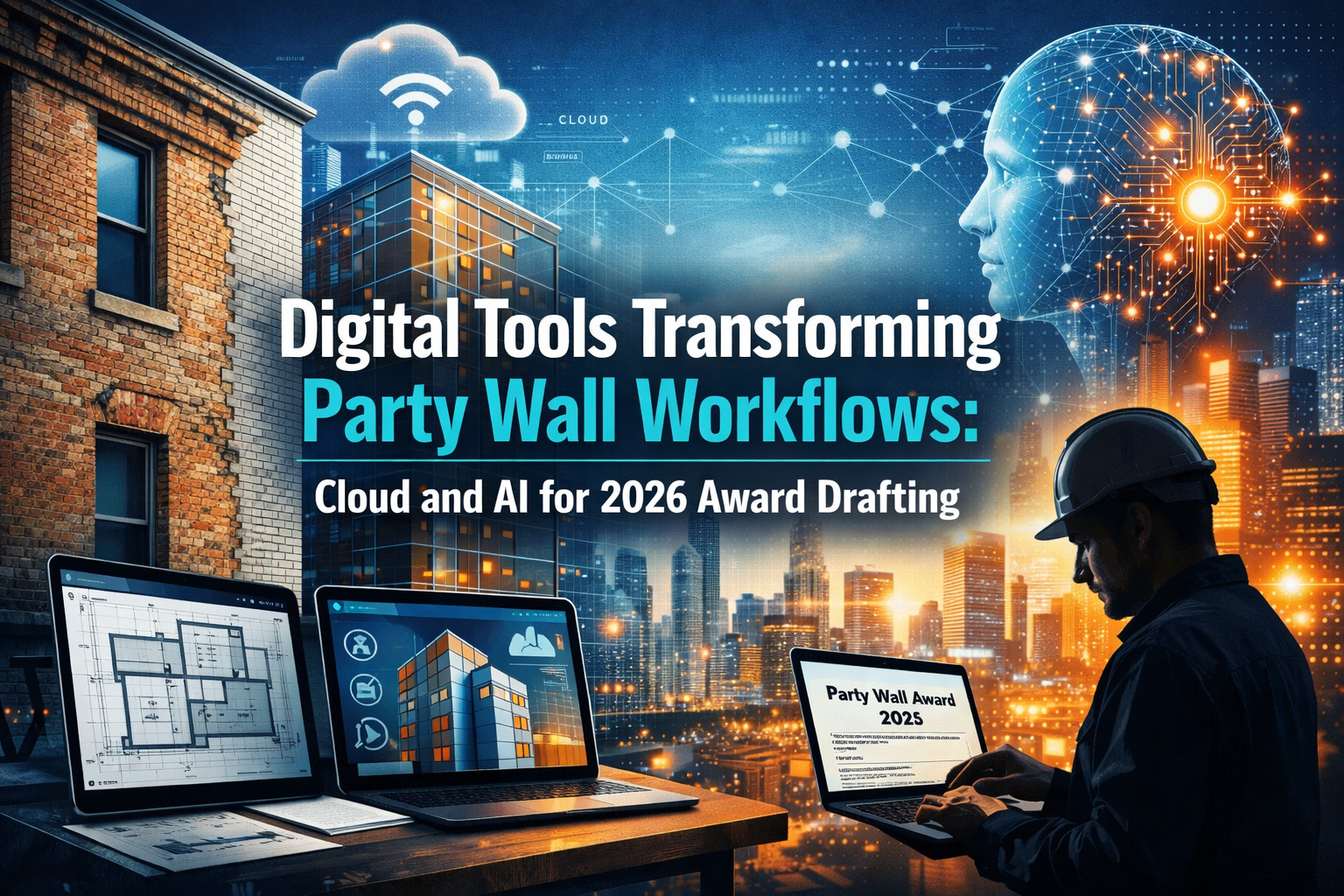
The party wall surveying profession stands at a pivotal moment in 2026. Traditional paper-based workflows, manual notice preparation, and isolated award drafting are giving way to sophisticated cloud platforms and artificial intelligence tools that promise to revolutionize how surveyors manage cases, collaborate with stakeholders, and reduce disputes. Digital Tools Transforming Party Wall Workflows: Cloud and AI for 2026 Award Drafting represents more than technological advancement—it signals a fundamental shift in professional practice that enhances accuracy, speeds resolution, and improves outcomes for all parties involved.
As urban renewal accelerates across high-demand areas, the volume and complexity of party wall matters continue to grow. Surveyors juggling multiple cases simultaneously face mounting pressure to deliver precise, timely awards while maintaining compliance with the Party Wall Act 1996. Cloud-based collaboration platforms and AI-powered drafting assistants now offer practical solutions to these challenges, enabling real-time coordination between appointed and agreed surveyors, predictive analysis of excavation risks, and automated compliance checking against RICS guidance on interoperability standards.
Key Takeaways
- 🚀 Cloud platforms enable real-time collaboration between building owners, adjoining owners, and surveyors, reducing communication delays and accelerating case resolution
- 🤖 AI-powered templates automatically generate predictive notices for excavations, calculate safe working distances, and suggest appropriate protective measures based on historical data
- ✅ Automated compliance checking ensures awards meet RICS guidance on interoperability and Party Wall Act requirements, minimizing errors and potential disputes
- 📊 Data analytics from digital workflows reveal patterns in dispute causes, enabling proactive risk management in high-demand renewal areas
- 💡 Integration capabilities connect party wall software with surveying tools, building information modeling (BIM), and project management systems for seamless workflows
The Evolution of Party Wall Workflows: From Paper to Cloud
Traditional Challenges in Party Wall Practice
For decades, party wall surveyors relied on paper-based systems, manual correspondence, and isolated document preparation. This traditional approach created numerous bottlenecks:
Communication delays between parties often extended case timelines unnecessarily. Postal notices took days to arrive, responses required additional waiting periods, and coordinating schedules for joint inspections involved multiple phone calls and emails.
Document version control presented constant challenges. When multiple surveyors worked on the same award, tracking changes, maintaining consistency, and ensuring all parties reviewed the latest version became increasingly difficult. Lost amendments and conflicting clauses frequently emerged during final review stages.
Limited data accessibility meant surveyors couldn't easily reference previous cases, compare similar excavation scenarios, or learn from past dispute resolutions. Valuable institutional knowledge remained trapped in filing cabinets rather than informing current practice.
Manual calculation errors in measurements, distances, and technical specifications occasionally crept into notices and awards despite careful review. These mistakes sometimes triggered disputes that could have been prevented with automated verification.
The Digital Transformation Imperative
Construction technology has evolved rapidly across the building industry, with digital tools becoming standard practice for project management, design coordination, and compliance documentation [1]. Party wall surveying naturally follows this trajectory, adopting cloud-based platforms that address traditional workflow limitations while introducing new capabilities.
The shift toward Digital Tools Transforming Party Wall Workflows: Cloud and AI for 2026 Award Drafting reflects broader industry trends toward:
- Centralized data management that makes case information accessible from any location
- Automated workflows that reduce manual administrative tasks
- Enhanced collaboration through shared digital workspaces
- Improved accuracy via built-in validation and error checking
- Better client experience with transparent progress tracking and faster resolution
Modern party wall software platforms now offer integrated solutions that handle everything from initial party wall notice preparation through final award delivery, with cloud synchronization ensuring all stakeholders access current information in real-time [2].
Cloud Platforms Revolutionizing Party Wall Collaboration
Real-Time Coordination Between Surveyors
Cloud-based party wall platforms fundamentally change how appointed surveyors and agreed surveyors work together. Rather than exchanging documents via email or postal service, professionals now collaborate within shared digital environments that provide:
Simultaneous document access allows both surveyors to review schedules of condition, photographic records, and draft award sections without waiting for file transfers. Changes made by one surveyor appear instantly for the other, eliminating version confusion.
Integrated communication threads attach directly to specific document sections, creating clear audit trails of discussions, decisions, and agreed modifications. This transparency proves invaluable if questions arise later about how particular award clauses were determined.
Mobile accessibility enables surveyors to update case files during site inspections, immediately uploading photographs, measurements, and observations while details remain fresh. This real-time data capture improves accuracy and reduces the administrative burden of later transcribing handwritten notes.
Automated notifications alert relevant parties when actions require attention—when an adjoining owner responds to a notice, when a draft award section needs review, or when statutory timeframes approach expiration. These proactive reminders help surveyors manage multiple cases efficiently without missing critical deadlines.
Enhanced Stakeholder Transparency
Cloud platforms extend beyond surveyor-to-surveyor collaboration, creating transparent workflows that include building owners, adjoining owners, and their respective legal advisors. This inclusive approach reduces anxiety and builds trust throughout the process.
Client portals provide building and adjoining owners with secure access to case progress, uploaded documents, and scheduled milestones. Rather than wondering about status or waiting for update calls, stakeholders can check progress whenever convenient, reducing inquiry volume for busy surveyors.
Document repositories organize all case materials—initial notices, responses, schedules of condition, correspondence, draft awards, and final documents—in chronologically ordered, searchable libraries. This organization proves especially valuable for complex cases involving loft conversions or multiple adjoining properties where documentation volume grows substantial.
Progress dashboards visualize case stages, showing completed steps, current activities, and upcoming milestones. This transparency helps manage expectations and demonstrates professional progress, particularly important in high-demand renewal areas where development timelines face intense scrutiny.
RICS Guidance on Interoperability Standards
The Royal Institution of Chartered Surveyors recognizes that effective digital transformation requires interoperability between different software platforms used by various professionals involved in construction projects. Party wall surveyors increasingly work alongside architects using BIM software, structural engineers with specialized calculation tools, and project managers coordinating overall development timelines.
Data exchange standards ensure party wall software can export information in formats compatible with other construction technology platforms. This interoperability prevents information silos and enables seamless integration of party wall considerations into broader project planning [3].
API connections between party wall platforms and complementary tools create automated workflows. For example, excavation depths specified in architectural plans can automatically populate party wall notice templates, ensuring consistency and reducing manual data entry errors.
Cloud infrastructure compatibility allows party wall software to integrate with enterprise document management systems, client relationship management platforms, and accounting software used by surveying practices. This integration streamlines business operations beyond just technical case management.
The emphasis on interoperability reflects recognition that Digital Tools Transforming Party Wall Workflows: Cloud and AI for 2026 Award Drafting must function as part of larger construction technology ecosystems rather than isolated applications [4].
AI-Powered Award Drafting and Predictive Analysis

Intelligent Template Systems
Artificial intelligence brings transformative capabilities to award drafting, moving beyond simple document templates to intelligent systems that adapt content based on case-specific circumstances. Modern AI-powered party wall software analyzes case parameters and automatically generates appropriate clauses, schedules, and specifications.
Context-aware clause selection examines the type of work proposed—excavation, structural alteration, new wall construction—and suggests relevant award provisions from comprehensive clause libraries. Rather than manually searching through previous awards or reference materials, surveyors receive intelligent recommendations tailored to current case requirements.
Automated specification generation calculates technical requirements based on input parameters. When excavation depth and proximity to adjoining foundations are specified, AI systems automatically determine appropriate underpinning requirements, temporary support specifications, and monitoring protocols consistent with engineering best practices.
Consistency checking reviews draft awards to identify contradictions, missing sections, or inconsistent terminology. This automated quality control catches errors that might escape manual review, particularly in lengthy awards addressing complex projects with multiple work categories.
Learning algorithms improve recommendation accuracy over time by analyzing which clauses prove effective in similar situations and which generate subsequent disputes or clarification requests. This continuous improvement means AI drafting assistance becomes increasingly valuable as case history accumulates [5].
Predictive Notices for Excavation Works
Excavation near party walls presents particular risks requiring careful assessment and appropriate protective measures. AI-powered analysis transforms this assessment process from reactive evaluation to predictive planning.
Risk scoring algorithms analyze excavation parameters—depth, distance from boundary, soil conditions, existing foundation types—and generate quantitative risk assessments. These scores help surveyors prioritize attention and recommend proportionate protective measures rather than applying overly conservative or insufficient provisions.
Automated calculation of safe working distances applies the Party Wall Act 3 metre rule and 6 metre rule with precision, accounting for excavation depth variations across the site and identifying exactly which portions of adjoining properties fall within notifiable zones.
Protective measure recommendations suggest appropriate safeguards based on risk assessment results. High-risk excavations trigger recommendations for underpinning, temporary support, or specialized foundation techniques, while lower-risk work may require only monitoring protocols. These AI-generated suggestions provide starting points that surveyors can refine based on professional judgment and site-specific factors.
Historical pattern analysis examines outcomes from similar previous excavations, identifying which protective measures proved adequate and which cases experienced problems despite precautions. This data-driven approach helps surveyors learn from collective professional experience rather than relying solely on individual case history.
Natural Language Processing for Award Clarity
Clear, unambiguous language in party wall awards prevents misunderstandings and reduces potential disputes. AI systems employing natural language processing (NLP) now assist surveyors in achieving optimal clarity and consistency.
Readability analysis evaluates draft award text and identifies overly complex sentences, technical jargon without explanation, or ambiguous phrasing. Suggestions for simplification help ensure awards remain accessible to building owners and adjoining owners who may lack technical expertise.
Terminology consistency checking ensures the same terms are used consistently throughout awards. If "building owner" appears in some sections while "developer" appears elsewhere referring to the same party, NLP algorithms flag this inconsistency for correction.
Clause conflict detection identifies sections that might contradict each other or create confusion about requirements. For example, if one clause specifies working hours while another section implies different timing restrictions, the AI system alerts surveyors to resolve the discrepancy.
Plain language translation offers simplified versions of technical specifications for inclusion in owner summaries or explanatory sections, making awards more accessible without compromising technical precision in detailed specification sections.
Reducing Disputes Through Digital Workflows in Renewal Areas
Proactive Risk Management in High-Demand Locations
Urban renewal areas experiencing intensive development activity present particular challenges for party wall practice. Multiple simultaneous projects, aging building stock, and compressed development timelines create conditions where disputes can easily arise. Digital Tools Transforming Party Wall Workflows: Cloud and AI for 2026 Award Drafting offer specific advantages in these demanding environments.
Geographic case clustering analysis identifies areas with high party wall activity, allowing surveyors to anticipate potential cumulative impacts when multiple adjacent properties undergo development simultaneously. This awareness enables proactive coordination that traditional isolated case management might miss.
Building condition databases maintained across multiple cases create valuable historical records. When a property appears as an adjoining owner in a new case, surveyors can reference previous schedules of condition, known structural concerns, and past dispute triggers, enabling more informed assessment and targeted protective measures.
Dispute pattern recognition analyzes cases that progressed to formal party wall disputes or required third surveyor involvement, identifying common factors that contributed to disagreements. These insights inform best practices that help surveyors avoid similar problems in current cases.
Early warning systems monitor case progress and flag situations that statistically correlate with increased dispute risk—delayed responses, contentious correspondence tone, unrealistic expectations, or technical complexities beyond typical scope. Early identification enables surveyors to invest additional attention in communication and stakeholder management before minor concerns escalate.
Improved Communication and Documentation
Many party wall disputes stem from communication breakdowns or documentation gaps rather than genuine technical disagreements. Digital workflows address these root causes directly.
Comprehensive audit trails automatically record all communications, document versions, and decision points throughout case progression. This complete history proves invaluable if questions arise about notification timing, response handling, or award development rationale. The transparency often prevents disputes by providing clear evidence of proper procedure.
Standardized communication templates ensure all required information appears in notices, responses, and correspondence. AI-powered systems prompt surveyors to include necessary details that might otherwise be overlooked in manually drafted communications, reducing the likelihood of procedural challenges.
Multi-channel notification systems deliver important communications through multiple methods—email, SMS, portal notifications, and traditional post when required—ensuring critical information reaches stakeholders reliably. Delivery confirmation tracking provides evidence of proper notification, addressing a common dispute trigger.
Visual documentation tools facilitate comprehensive photographic records and annotated drawings that clearly communicate existing conditions and proposed work scope. Cloud storage with automatic organization by date and location ensures this crucial evidence remains accessible and properly attributed throughout case duration.
Data-Driven Insights for Professional Development
The aggregated data from digital party wall workflows creates opportunities for professional learning and practice improvement that were impossible with isolated paper-based systems.
Benchmarking metrics allow surveyors to compare their case resolution times, dispute rates, and client satisfaction scores against anonymized peer data. This comparison identifies areas where individual practice might benefit from refinement or where particular approaches prove especially effective.
Continuing professional development resources can be targeted based on actual practice patterns. If a surveyor handles numerous excavation cases but few shared chimney matters, educational recommendations can focus on less-familiar scenarios to broaden expertise.
Industry trend analysis reveals emerging issues before they become widespread problems. If data shows increasing disputes related to particular construction techniques or building types, professional bodies can develop guidance proactively rather than reacting after problems become endemic.
Evidence-based practice evolution grounds professional standards in actual outcome data rather than tradition or assumption. When digital workflows demonstrate that particular approaches consistently produce better results, these insights can inform updated best practices and professional guidance.
Implementation Considerations for Digital Transformation

Selecting Appropriate Technology Platforms
Surveyors considering digital transformation face numerous software options with varying capabilities, integration features, and cost structures. Thoughtful selection ensures technology investments deliver genuine value rather than creating new complications.
Essential feature assessment should prioritize capabilities that address specific practice pain points. Surveyors primarily handling straightforward cases may need different functionality than those regularly managing complex developments or working as agreed surveyors coordinating between multiple parties.
Integration requirements depend on existing technology ecosystems within surveying practices. Platforms offering robust API connections and data export capabilities provide flexibility for connecting with accounting systems, document management tools, and client relationship management software already in use.
Scalability considerations ensure selected platforms accommodate practice growth without requiring disruptive platform changes. Cloud-based solutions typically offer flexible pricing tiers that scale with case volume, avoiding large upfront investments while supporting expansion.
Vendor stability and support warrant careful evaluation. Party wall cases often span months or years, requiring reliable long-term platform availability. Vendor track records, user community size, and support responsiveness indicate whether platforms will remain viable investments [6].
Training and adoption support significantly influence successful implementation. Platforms offering comprehensive training resources, responsive technical support, and gradual feature adoption pathways help surveyors transition smoothly rather than struggling with overwhelming complexity.
Data Security and Professional Obligations
Digital workflows introduce important considerations around data protection, client confidentiality, and professional liability that surveyors must address thoughtfully.
GDPR compliance requires that party wall software handles personal data appropriately, with proper consent management, data retention policies, and individual rights support. Cloud platforms should demonstrate compliance through certifications and transparent data handling practices.
Confidentiality protections ensure sensitive information about property conditions, owner circumstances, and dispute details remains secure. Encryption for data transmission and storage, robust access controls, and audit logging of data access provide necessary safeguards.
Backup and disaster recovery procedures protect against data loss from technical failures, cyber incidents, or provider disruptions. Understanding backup frequency, geographic redundancy, and recovery time commitments helps surveyors assess platform reliability.
Professional indemnity considerations may require discussion with insurance providers about how digital workflows affect coverage. Some insurers offer favorable terms for practices using quality management systems that include digital compliance checking and audit trails.
Client consent and transparency about digital tools usage maintains trust and meets professional obligations. Clear communication about how cloud platforms function, where data resides, and who can access information demonstrates respect for client concerns while explaining efficiency benefits.
Change Management and Practice Integration
Technology alone doesn't transform workflows—successful digital adoption requires thoughtful change management that addresses human factors alongside technical implementation.
Gradual transition approaches reduce disruption by implementing digital tools incrementally rather than attempting complete overnight transformation. Starting with new cases while maintaining traditional methods for in-progress matters allows learning without jeopardizing ongoing work.
Staff training investment ensures all team members understand new systems and feel confident using them effectively. Hands-on practice with sample cases, regular check-ins during early adoption, and accessible reference materials support skill development.
Process redesign opportunities emerge as digital capabilities enable approaches impossible with paper-based systems. Rather than simply replicating existing workflows digitally, surveyors should consider how cloud collaboration and AI assistance might enable improved processes that better serve clients.
Client education helps building owners and adjoining owners understand and appreciate digital workflow benefits. Brief explanations of portal access, real-time updates, and enhanced transparency position technology as client service improvements rather than surveyor conveniences.
Continuous improvement mindset recognizes that digital transformation represents ongoing evolution rather than one-time implementation. Regular review of which features prove most valuable, which remain underutilized, and what additional capabilities might benefit practice ensures technology investments deliver maximum return.
Future Directions for Party Wall Technology
Emerging Capabilities on the Horizon
The trajectory of Digital Tools Transforming Party Wall Workflows: Cloud and AI for 2026 Award Drafting suggests several emerging capabilities that will further enhance professional practice in coming years.
Augmented reality integration may enable surveyors to overlay digital information onto physical spaces during inspections, visualizing proposed excavations in relation to existing structures, highlighting areas requiring particular attention, or annotating observations directly onto three-dimensional spatial records.
Predictive maintenance recommendations could analyze building condition data from schedules of condition across multiple properties, identifying patterns that suggest preventive interventions before problems develop. This proactive approach might reduce damage incidents and associated disputes.
Automated dispute resolution assistance might employ AI analysis of disagreement points, suggesting compromise positions based on similar cases, highlighting relevant precedents, or identifying creative solutions that address underlying interests rather than stated positions.
Blockchain-based verification could provide tamper-proof records of notice service, response timing, and agreed provisions, creating indisputable evidence of procedural compliance that prevents disputes about process even when substantive disagreements arise.
Voice-activated documentation may allow surveyors to dictate observations during inspections, with AI transcription and automatic organization into appropriate award sections, reducing administrative burden while maintaining comprehensive records.
Professional Standards Evolution
As digital tools become standard practice, professional bodies will likely develop updated guidance addressing technology-enabled workflows, ethical considerations, and quality standards for digital practice.
Digital competency requirements may become explicit components of professional qualifications, ensuring all practicing surveyors possess baseline technology skills necessary for effective modern practice. Continuing professional development programs will likely expand technology training offerings.
Quality assurance frameworks for digital workflows could establish standards for AI-generated content review, ensuring human professional judgment appropriately oversees automated suggestions rather than accepting them uncritically.
Interoperability protocols may become formalized requirements, ensuring party wall software maintains compatibility with broader construction technology ecosystems and preventing proprietary systems from creating information silos.
Ethical guidelines for AI usage in professional practice will likely address questions about transparency with clients regarding automated assistance, appropriate human oversight of AI recommendations, and accountability when technology-assisted decisions prove problematic.
Broader Industry Integration
Party wall practice exists within larger construction and property development contexts. Future digital tools will likely strengthen connections between party wall workflows and related professional activities.
Building Information Modeling (BIM) integration could automatically extract relevant information from architectural models to populate party wall notices, ensure consistency between design intent and award provisions, and facilitate coordination between party wall surveyors and design teams [2].
Planning and building control coordination might enable automated cross-referencing between party wall awards, planning permissions, and building regulation approvals, identifying potential conflicts early and ensuring consistent requirements across regulatory frameworks.
Property transaction integration could make party wall information readily available during conveyancing, with digital records accessible to solicitors, mortgage lenders, and prospective purchasers, improving transparency about existing party wall agreements and ongoing matters.
Insurance industry connections might enable party wall data to inform property insurance underwriting, claims assessment, and risk management recommendations, creating feedback loops that incentivize proper party wall procedures through premium adjustments.
Conclusion
Digital Tools Transforming Party Wall Workflows: Cloud and AI for 2026 Award Drafting represents a fundamental evolution in professional practice that enhances accuracy, efficiency, and stakeholder satisfaction while reducing disputes. Cloud platforms enable real-time collaboration between surveyors, building owners, and adjoining owners, eliminating communication delays and version control problems that plagued traditional paper-based workflows. AI-powered drafting assistance generates predictive notices for excavations, suggests appropriate protective measures based on historical data, and ensures awards maintain consistency and clarity.
The benefits prove particularly valuable in high-demand urban renewal areas where multiple simultaneous developments, aging building stock, and compressed timelines create challenging conditions. Digital workflows enable proactive risk management through pattern recognition, comprehensive documentation with complete audit trails, and data-driven insights that inform continuous professional improvement. Adherence to RICS guidance on interoperability ensures party wall software integrates seamlessly with broader construction technology ecosystems, preventing information silos and enabling coordinated project delivery.
Actionable Next Steps
For surveyors ready to embrace digital transformation:
-
Assess current workflow pain points to identify which digital capabilities would deliver the most immediate value for your specific practice circumstances
-
Research available platforms by requesting demonstrations, speaking with current users, and evaluating how different solutions address your priority requirements
-
Start small with pilot implementation on new cases while maintaining traditional methods for in-progress matters, allowing learning without disrupting ongoing work
-
Invest in comprehensive training for yourself and team members, ensuring everyone feels confident using new systems effectively
-
Engage clients proactively about digital workflow benefits, positioning technology as service improvements that enhance their experience and outcomes
-
Review and refine regularly by assessing which features prove most valuable, identifying underutilized capabilities, and adjusting practices to maximize technology benefits
-
Stay informed about emerging capabilities through professional development programs, industry publications, and vendor communications about new features and best practices
The transformation of party wall practice through cloud platforms and artificial intelligence isn't a distant future possibility—it's happening now in 2026. Surveyors who embrace these digital tools position themselves to deliver superior service, manage growing caseloads efficiently, and reduce disputes that frustrate all parties involved. The question isn't whether to adopt digital workflows, but how quickly to implement them to remain competitive and provide the professional excellence clients deserve.
For comprehensive guidance on party wall matters and professional surveying services, explore our resources on party wall matters and connect with experienced chartered surveyors who understand both traditional practice and modern digital workflows.
References
[1] Construction Technology – https://www.permitflow.com/blog/construction-technology
[2] Blog – https://partywallpro.com/blog
[3] Digital Construction Tools – https://www.planera.io/post/digital-construction-tools
[4] Allplan 2026 Smarter Workflows Sustainable Design And Seamless Collaboration From Concept To Construction – https://www.allplan.com/blog/allplan-2026-smarter-workflows-sustainable-design-and-seamless-collaboration-from-concept-to-construction/
[5] The 15 Best Software Tools For Construction Projects In 2026 – https://edcontrols.com/news-insights/the-15-best-software-tools-for-construction-projects-in-2026
[6] Connecting The Physical And Digital Worlds Of Construction – https://www.hp.com/us-en/newsroom/blogs/2026/connecting-the-physical-and-digital-worlds-of-construction.html