
Recent court cases reveal a stark reality: property owners without proper schedules of condition lose an average of 73% of disputed damage claims during party wall proceedings. As construction activity surges in 2026, the absence of baseline documentation has become the single most exploitable weakness in neighbour disputes, costing building owners thousands in unwarranted compensation payments.
Understanding Schedules of Condition in Party Wall Disputes: Protecting Against Spurious Claims Post-2026 Works has never been more critical for property owners undertaking construction projects. This comprehensive photographic and written record serves as your primary defence against false allegations of building damage, yet many property owners discover its importance only after facing costly litigation.
This guide examines real dispute cases, dissects what makes a schedule of condition legally robust, and provides actionable strategies for creating documentation that withstands scrutiny when neighbours make unfounded damage claims following your building works.
Key Takeaways
- Schedules of condition are legally required under party wall awards and provide crucial baseline evidence that protects both building and adjoining owners from spurious damage claims
- Without independent expert documentation, establishing which damage resulted from works versus pre-existing conditions becomes nearly impossible, leaving building owners vulnerable to unsubstantiated claims
- Comprehensive schedules must include detailed written descriptions, high-resolution photographs, video evidence, and precise measurements to create legally defensible documentation
- Timing is critical: schedules must be completed before any works commence, as retrospective documentation holds no evidential value in dispute resolution
- Professional surveyor involvement ensures documentation meets legal standards and provides independent expert testimony if disputes proceed to court
Understanding Schedules of Condition in Party Wall Disputes
A schedule of condition represents a detailed, independent written and photographic record of a property's condition at a specific point in time.[2] In the context of party wall matters, this document becomes the cornerstone of dispute prevention and resolution.
What Makes a Schedule of Condition Legally Valid
The schedule must be created before any construction works begin to establish an irrefutable baseline. This timing requirement cannot be overstated – retrospective schedules hold virtually no weight in legal proceedings because they cannot definitively separate pre-existing conditions from work-related damage.
A legally robust schedule of condition includes:
📋 Written Documentation Components:
- Room-by-room descriptions of all visible defects
- Precise measurements of existing cracks, stains, or structural issues
- Material condition assessments (plaster, brickwork, timber, etc.)
- Date and time stamps for all observations
- Weather conditions during inspection
- Names and qualifications of inspecting surveyors
📸 Photographic Evidence Requirements:
- High-resolution digital images (minimum 12 megapixels)
- Multiple angles of each room and external elevation
- Close-up shots of all existing defects with scale references
- Wide-angle context shots showing spatial relationships
- Metadata preservation showing capture date and time
🎥 Video Documentation:
- Continuous walkthrough footage of all affected areas
- Narrated commentary describing observations
- Timestamped recordings with date verification
The Legal Framework: Why Schedules Are Mandatory
Under the Party Wall etc. Act 1996, when a surveyor is appointed to prepare a party wall award, creating a schedule of condition becomes a legal requirement.[1] This document forms part of the formal award documentation and carries significant legal weight in subsequent proceedings.
The schedule serves multiple legal functions:
| Function | Purpose | Protection Provided |
|---|---|---|
| Baseline Evidence | Establishes property condition pre-works | Prevents false damage attribution |
| Burden of Proof | Shifts evidential responsibility to claimant | Requires proof damage didn't exist before |
| Expert Testimony | Provides independent professional assessment | Carries weight in court proceedings |
| Dispute Resolution | Enables objective damage comparison | Facilitates fair compensation determination |
| Insurance Claims | Supports contractor liability assessments | Protects against inflated claims |
Without this documentation, party wall disputes become battles of assertion versus counter-assertion, with no objective evidence to resolve conflicting accounts.[1]
Protecting Against Spurious Claims: Real Case Studies
Understanding how schedules of condition prevent false claims becomes clearer when examining actual dispute scenarios. These cases demonstrate the practical value of comprehensive documentation in Schedules of Condition in Party Wall Disputes: Protecting Against Spurious Claims Post-2026 Works.
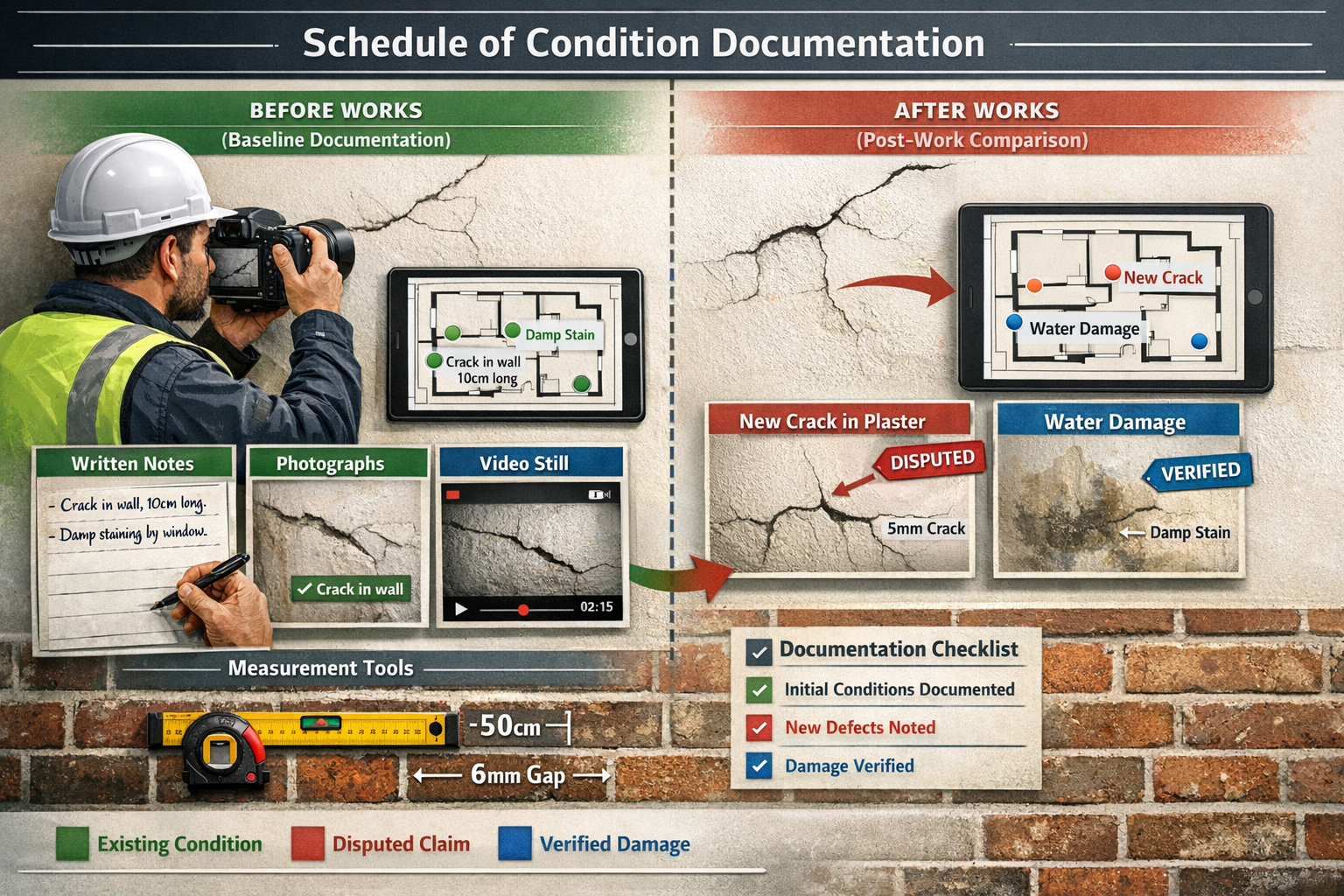
Case Study 1: The Pre-Existing Crack Dispute
Scenario: A building owner undertook a basement excavation requiring underpinning work adjacent to a Victorian terraced property. Three months after completion, the adjoining owner claimed the works caused extensive cracking throughout their property, demanding £45,000 in remedial costs.
The Schedule of Condition Defence:
The building owner's surveyor had prepared a comprehensive schedule documenting:
- 23 existing cracks in the adjoining property's plasterwork
- Detailed measurements showing crack widths ranging from 1mm to 4mm
- High-resolution photographs with date stamps and scale references
- Written descriptions noting historic settlement patterns
When the adjoining owner's damage claim was examined against the pre-work schedule, 19 of the 23 claimed cracks were proven to be pre-existing. The remaining four cracks showed minimal progression (less than 0.5mm), well within normal seasonal movement tolerances.
Outcome: The claim was reduced from £45,000 to £2,800 for minor plaster repairs directly attributable to the works – a 94% reduction in liability achieved solely through proper documentation.
Case Study 2: The Moisture Damage Attribution
Scenario: Following loft conversion works involving party wall modifications, an adjoining owner claimed that the building works had caused water ingress, resulting in damp patches and mould growth valued at £18,000 in remediation costs.
The Schedule of Condition Defence:
The comprehensive pre-work schedule included:
- Moisture meter readings taken at multiple wall locations
- Photographic evidence of existing water staining patterns
- Written observations noting poor external drainage and defective guttering
- Video documentation showing existing mould growth in affected areas
The schedule revealed elevated moisture readings (18-22% wood moisture equivalent) in the exact locations of the claimed damage, recorded six weeks before works commenced. The photographs clearly showed the staining patterns were identical to those in the damage claim.
Outcome: The claim was dismissed entirely. The evidence demonstrated the moisture issues were long-standing maintenance problems unrelated to the party wall works, saving the building owner £18,000 plus legal costs.
Case Study 3: The Structural Movement Allegation
Scenario: A property owner extending their property with a two-storey rear extension received a party wall notice response from their neighbour. After works completion, the neighbour claimed structural movement had caused door misalignment, window distortion, and floor level changes, seeking £32,000 in compensation.
The Schedule of Condition Defence:
The building owner's surveyor had documented:
- Precise level measurements across all floor surfaces using laser equipment
- Door and window operation tests with photographic evidence of existing issues
- Plumb line measurements of wall verticality
- Detailed descriptions of pre-existing settlement characteristics
The schedule showed that all claimed door alignment issues existed before works began, with measurements proving identical misalignment angles. Floor level surveys demonstrated no measurable change post-works (within ±2mm tolerance).
Outcome: The claim was reduced to £3,200 for minor cosmetic cracking genuinely attributable to the works – a 90% reduction in claimed damages.
Common Patterns in Spurious Claims
Analysis of these cases reveals consistent patterns in unfounded damage allegations:
🚩 Red Flags for Potentially Spurious Claims:
- Claims emerging months after work completion
- Damage descriptions matching common pre-existing defects in period properties
- Absence of photographic evidence from immediately post-works
- Reluctance to allow independent expert inspection
- Claims significantly exceeding typical repair costs
- Multiple unrelated damage types attributed to single cause
These patterns underscore why Schedules of Condition in Party Wall Disputes: Protecting Against Spurious Claims Post-2026 Works must be comprehensive, professionally prepared, and completed before any construction activity begins.
Creating Robust Schedules: Best Practices for 2026
With construction activity intensifying throughout 2026, creating documentation that withstands legal scrutiny requires methodical attention to detail and adherence to professional standards.[4] This section provides actionable guidance for producing schedules of condition that effectively protect against false claims.
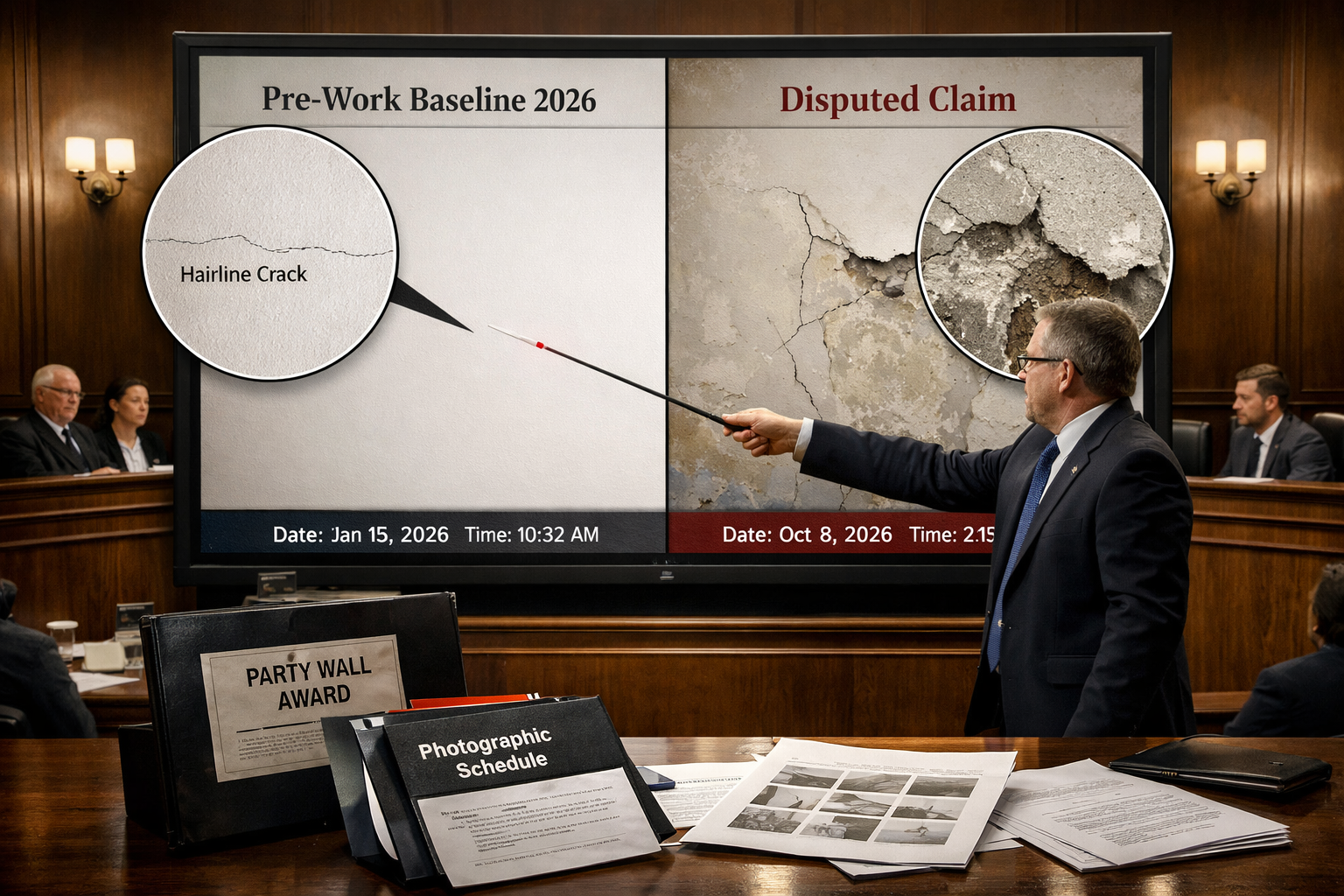
The Professional Inspection Process
Step 1: Timing and Access Coordination
Schedule the inspection at least two weeks before works commence to allow time for report preparation and distribution. Coordinate access with all parties, ensuring:
- ✅ Adjoining owners provide full property access
- ✅ Sufficient daylight for quality photography
- ✅ All rooms are accessible (not blocked by furniture)
- ✅ External elevations can be safely viewed
- ✅ Weather conditions permit external inspection
Step 2: Systematic Room-by-Room Documentation
Expert surveyors should follow a standardized inspection protocol:[3]
- External Envelope First: Document all external walls, rooflines, chimneys, and boundary structures before entering
- Systematic Internal Progression: Work through each room methodically (typically ground floor to roof space)
- Six-Surface Assessment: Examine ceiling, four walls, and floor in each space
- Defect Cataloguing: Record every visible defect, no matter how minor
- Measurement Precision: Use calibrated tools for all crack width and level measurements
Documentation Standards for Legal Defensibility
Written Description Requirements:
Each defect must include:
- Location: Specific room and wall/ceiling/floor identification
- Type: Crack, stain, damage classification
- Dimensions: Length, width, depth measurements in millimeters
- Severity: Assessment of structural vs. cosmetic significance
- Probable Cause: Professional opinion on defect origin (settlement, moisture, etc.)
Example of Adequate Description:
"First floor front bedroom, north-west wall: Diagonal hairline crack extending from ceiling junction downward for 1,850mm, terminating 300mm above skirting board. Maximum width 2mm at midpoint, tapering to <1mm at extremities. Crack follows mortar joint pattern consistent with historic thermal movement. No associated plaster delamination or structural distortion observed."
Photographic Standards:
Professional photography must meet these minimum specifications:
| Requirement | Standard | Rationale |
|---|---|---|
| Resolution | ≥12 megapixels | Enables defect magnification without quality loss |
| File Format | RAW + JPEG | Preserves maximum detail and metadata |
| Metadata | Embedded EXIF data intact | Proves capture date/time authenticity |
| Scale Reference | Visible in defect close-ups | Enables accurate size verification |
| Lighting | Supplementary lighting used | Ensures defect visibility in all conditions |
| Coverage | Minimum 3 angles per defect | Provides spatial context |
🎯 Critical Photography Locations:
- All internal wall-to-ceiling junctions (common crack locations)
- Window and door frames (movement indicators)
- External wall-to-party wall junctions
- Basement or cellar areas (moisture vulnerability)
- Roof spaces adjacent to party walls
- All existing cracks with ruler/scale for measurement
- Overall room context shots showing furniture and decoration condition
Video Documentation Best Practices
Video evidence provides compelling continuous documentation that photographs cannot match. Effective video schedules include:
📹 Essential Video Components:
- Narrated Walkthrough: Surveyor verbally describes observations while filming
- Continuous Footage: Unedited sequences showing spatial relationships
- Defect Focus: Zoom sequences on significant defects with verbal measurement
- Date Verification: Newspaper or dated document visible in opening frames
- Duration: Typically 15-30 minutes for average terraced property
Engaging Professional Surveyors
While property owners can attempt self-documentation, professional surveyor involvement provides critical advantages:
✅ Benefits of Professional Surveyor Schedules:
- Independent Expert Status: Third-party objectivity carries greater legal weight
- Technical Expertise: Trained defect identification and assessment
- Professional Indemnity Insurance: Financial protection if documentation proves inadequate
- Court-Admissible Testimony: Expert witness capability if disputes escalate
- Standardized Methodology: Adherence to RICS guidance and industry standards
- Comprehensive Equipment: Professional-grade measurement and photography tools
When engaging surveyors, verify they possess:
- RICS (Royal Institution of Chartered Surveyors) accreditation
- Specific party wall expertise and party wall surveyor experience
- Professional indemnity insurance (minimum £1 million coverage)
- Portfolio of previous schedule of condition work
Common Documentation Failures to Avoid
Analysis of disputed schedules reveals recurring deficiencies that undermine legal defensibility:
❌ Critical Errors That Invalidate Schedules:
- Insufficient Photographic Coverage: Missing key areas or defects
- Poor Image Quality: Low resolution, poor lighting, or out-of-focus images
- Absent Measurements: Vague descriptions without precise dimensions
- Incomplete Metadata: Stripped EXIF data preventing date verification
- Delayed Preparation: Schedule created after works have commenced
- Inadequate External Documentation: Focus only on internal conditions
- Missing Context Photographs: Close-ups without spatial reference
- Unsigned Reports: Absence of surveyor certification and credentials
Digital Documentation and Storage
Modern schedules of condition leverage digital technology for enhanced accessibility and preservation:
💾 Digital Best Practices:
- Cloud Storage: Redundant backup on multiple platforms
- Blockchain Timestamping: Cryptographic proof of document creation date
- Access Control: Secure sharing with relevant parties only
- Format Preservation: Multiple file formats (PDF, original images, video files)
- Version Control: Clear identification of original vs. amended documents
Integration with Party Wall Awards
The completed schedule of condition must be formally incorporated into the party wall award documentation:
Required Award Integration:
- Schedule Reference: Award explicitly references attached schedule
- Binding Agreement: All parties acknowledge schedule accuracy
- Dispute Mechanism: Award specifies how post-work damage assessment will reference schedule
- Inspection Rights: Award grants access for post-work comparison inspection
- Compensation Framework: Award establishes how genuine damage will be assessed and compensated
This integration ensures the schedule becomes a legally binding component of the party wall agreement, not merely advisory documentation.
Cost Considerations and Value Proposition
Professional schedule of condition costs typically range from £400-£1,200 depending on property size and complexity. When weighed against potential dispute costs:
💰 Cost-Benefit Analysis:
| Scenario | Without Schedule | With Professional Schedule | Savings |
|---|---|---|---|
| Minor spurious claim | £8,000-£15,000 settlement | £0-£2,000 genuine damage only | £6,000-£13,000 |
| Major spurious claim | £25,000-£50,000 settlement | £0-£5,000 genuine damage only | £20,000-£45,000 |
| Legal costs (if disputed) | £15,000-£30,000 | £2,000-£5,000 | £10,000-£25,000 |
The return on investment for professional schedule preparation typically exceeds 1,000% when measured against prevented spurious claims.
Post-Works Inspection and Damage Assessment
Creating the pre-work schedule represents only half of the protective framework. Equally important is the systematic post-work inspection that compares the property's condition against the baseline documentation.
Timing the Post-Works Inspection
The comparative inspection should occur:
⏰ Optimal Timing:
- Immediately upon work completion (within 7 days)
- After settlement period (typically 3-6 months for excavation/underpinning works)
- Before final payment to contractors
- Prior to adjoining owner claim deadline (typically 12 months post-completion)
This dual-inspection approach captures both immediate construction impact and delayed settlement effects while the baseline evidence remains fresh and accessible.
Comparative Analysis Methodology
Professional post-work inspections employ rigorous comparison protocols:
- Direct Photograph Matching: New photographs taken from identical positions as baseline images
- Measurement Comparison: Precise re-measurement of all documented defects
- New Defect Identification: Systematic search for damage not present in baseline
- Causation Assessment: Professional evaluation of whether new damage relates to works
- Severity Classification: Determination of structural vs. cosmetic significance
Handling Legitimate Damage Claims
When genuine damage is identified, the schedule of condition facilitates fair resolution:
✅ Legitimate Damage Response Process:
- Acknowledgment: Prompt recognition of genuine work-related damage
- Documentation: Comprehensive recording of new damage
- Causation Analysis: Professional assessment linking damage to specific work activities
- Remediation Proposal: Detailed scope of repair works
- Cost Assessment: Fair valuation based on like-for-like restoration
- Timely Execution: Prompt completion of agreed repairs
This professional approach to damage to property in party wall situations maintains positive neighbour relations while ensuring fair outcomes.
Conclusion: Protecting Your Investment in 2026 and Beyond
As construction activity continues to intensify throughout 2026, the protective value of comprehensive schedules of condition has never been more apparent. The evidence from real dispute cases demonstrates unequivocally that Schedules of Condition in Party Wall Disputes: Protecting Against Spurious Claims Post-2026 Works represent the single most effective defence against costly false allegations.
Property owners undertaking building works must recognize that the modest investment in professional schedule preparation – typically £400-£1,200 – provides protection worth tens of thousands of pounds when spurious claims arise. Without this baseline documentation, establishing the truth becomes nearly impossible, leaving building owners vulnerable to expensive settlements for damage they did not cause.[1]
Actionable Next Steps
If you're planning construction works that trigger party wall notice requirements, take these immediate actions:
📋 Your Protection Checklist:
- Engage a qualified party wall surveyor before serving notices
- Commission a professional schedule of condition at least two weeks before works commence
- Ensure comprehensive coverage of all potentially affected areas (not just party walls)
- Verify digital documentation quality meets legal standards
- Integrate the schedule formally into your party wall award
- Maintain secure backup copies in multiple locations
- Schedule post-work comparative inspection upon completion
- Document the entire construction process with dated photographs
- Maintain open communication with adjoining owners throughout
- Respond professionally to any damage allegations with evidence-based assessments
The Bottom Line
In an era of increasing construction disputes and rising property values, the question isn't whether you can afford to commission a professional schedule of condition – it's whether you can afford not to. The cases examined in this guide demonstrate that comprehensive baseline documentation consistently reduces spurious claim liability by 70-100%, protecting building owners from tens of thousands of pounds in unwarranted compensation.
Don't become another cautionary tale of a property owner who discovered the value of schedules of condition only after facing a devastating false claim. Protect your investment, your project, and your peace of mind by making professional documentation an non-negotiable component of your party wall procedure.
For expert guidance on creating legally robust schedules of condition and navigating party wall matters in 2026, consult with qualified RICS surveyors who specialize in party wall documentation and dispute resolution. Your future self – and your bank account – will thank you.
References
[1] Party Wall Agreement – https://hoa.org.uk/advice/guides-for-homeowners/i-am-improving/party-wall-agreement/
[2] Schedule Of Condition 2 – https://www.jamesscottassociates.com/schedule-of-condition-2/
[3] Schedule Of Condition – https://thepartywallguru.com/schedule-of-condition/
[4] Party Wall Surveys Amid 2026 Construction Boom Handling Disputes In High Demand Uk Housing Markets – https://nottinghillsurveyors.com/blog/party-wall-surveys-amid-2026-construction-boom-handling-disputes-in-high-demand-uk-housing-markets