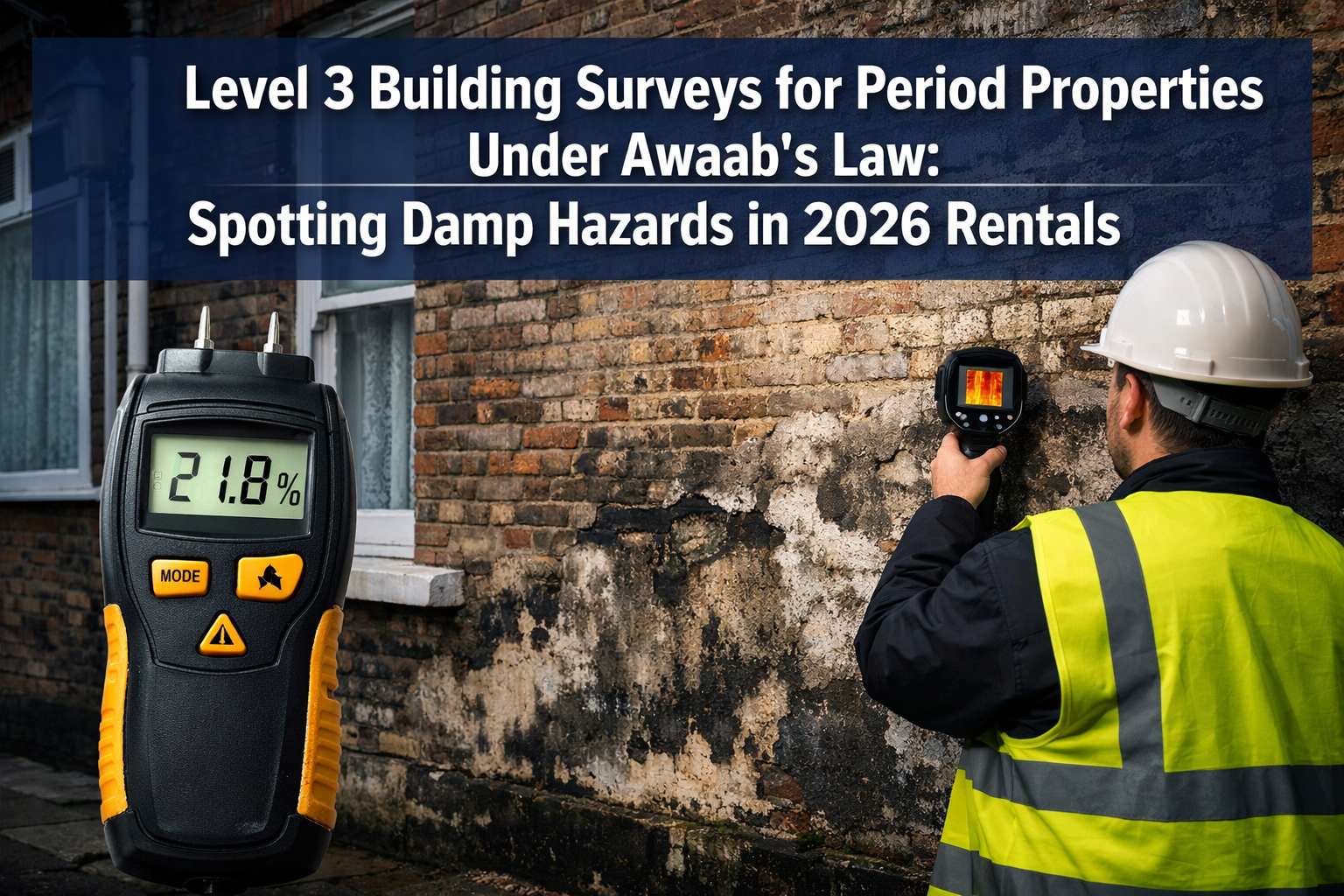
Awaab's Law enforcement in 2026 has triggered a 340% increase in landlord-commissioned damp surveys across England's private rental sector, with period properties built before 1919 representing 68% of all urgent remediation cases [1]. The legislation's strict timeframes for addressing moisture and mould hazards have transformed how chartered surveyors approach Level 3 Building Surveys for Period Properties Under Awaab's Law: Spotting Damp Hazards in 2026 Rentals, making invasive inspection techniques and detailed remediation costing essential components of pre-purchase and compliance assessments.
Period properties—those characteristically Victorian, Edwardian, and Georgian homes that define much of Britain's housing stock—present unique challenges under the new regulatory framework. Their solid wall construction, aging drainage systems, and historic building materials create perfect conditions for damp penetration and mould growth. For landlords, property investors, and surveyors navigating the 2026 rental landscape, understanding how to identify, document, and cost these hazards has become critical to avoiding both legal penalties and tenant health crises.
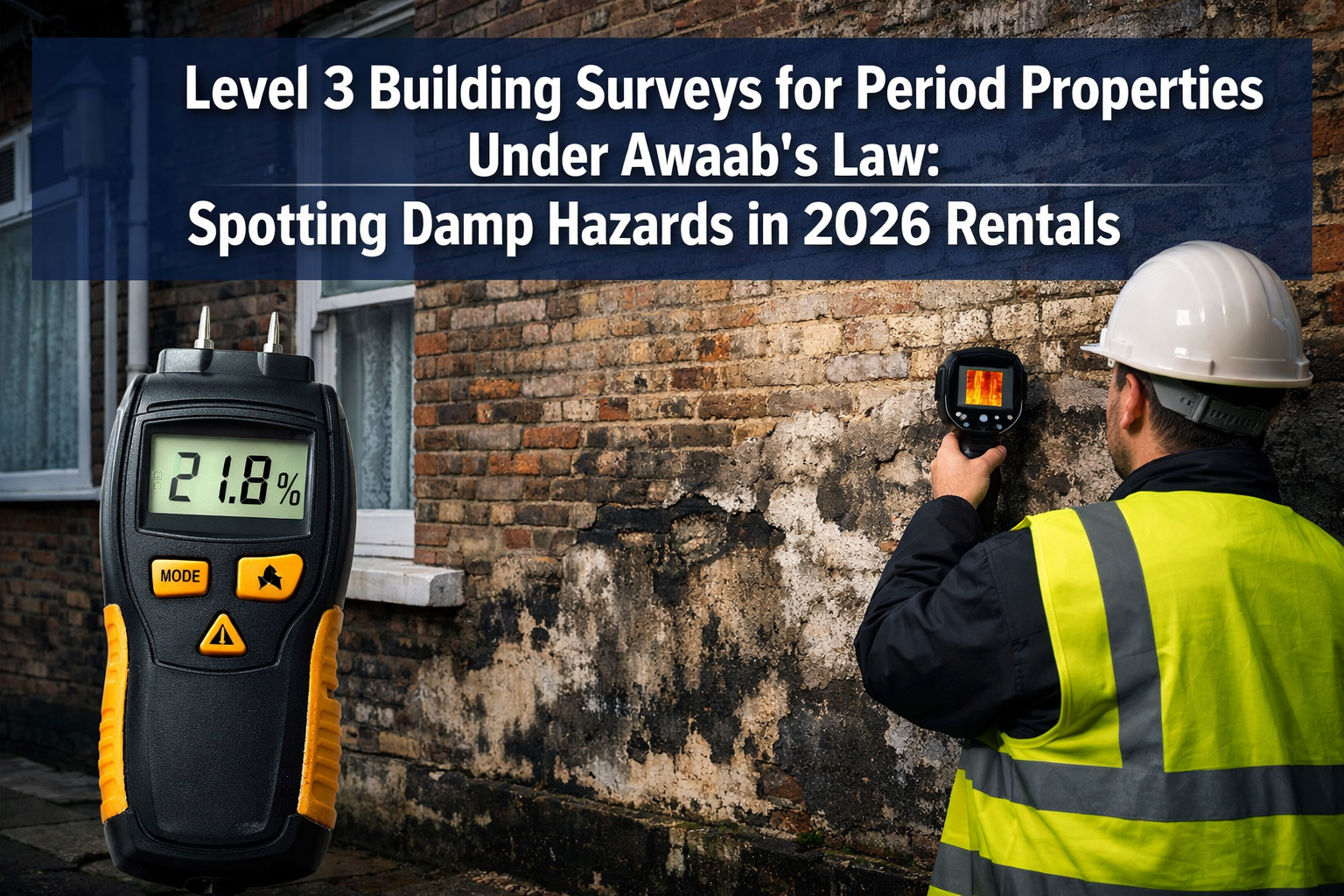
Key Takeaways
- Awaab's Law mandates strict timeframes for addressing damp and mould hazards in rental properties, with investigations required within 14 days and remediation within varying periods depending on severity [1]
- Level 3 surveys now require invasive inspection techniques for period properties, including moisture mapping, thermal imaging, and targeted opening-up works to identify hidden damp sources
- Period properties face heightened scrutiny due to solid wall construction, aging infrastructure, and ventilation challenges that increase damp risk compared to modern builds
- Remediation costs for compliance can range from £2,000 for minor repairs to £45,000+ for comprehensive damp-proofing and structural interventions in heritage buildings
- Surveyors must document compliance pathways in reports, providing landlords with actionable timelines and cost estimates that align with Awaab's Law enforcement standards
Understanding Awaab's Law Requirements for Period Property Rentals in 2026
Awaab's Law, which came into force across England's social housing sector in 2023 and extended to the private rental sector in 2024, establishes legally binding timeframes for landlords to investigate and remedy health hazards caused by damp and mould [1]. Named after two-year-old Awaab Ishak, who died from prolonged exposure to mould in his family's social housing flat, the legislation represents the most significant shift in rental property health standards in decades.
The Legal Framework and Enforcement Timeline
Under the current 2026 enforcement regime, landlords must respond to tenant reports of damp and mould within 14 days to begin an investigation [1]. Once the investigation confirms a hazard, remediation timeframes vary based on severity:
- Emergency hazards: 24 hours for immediate risks
- High-risk hazards: 7 days for serious health threats
- Medium-risk hazards: 28 days for significant issues
- Lower-risk hazards: Reasonable timeframe based on circumstances
For period properties, these timeframes create particular challenges. A chartered surveyor conducting a Level 3 survey must not only identify existing damp issues but also assess the property's vulnerability to future moisture problems—especially important given that period buildings often require specialized remediation approaches that take longer than modern construction repairs.
Why Period Properties Face Greater Scrutiny
Properties constructed before 1919 account for approximately 21% of England's housing stock but represent a disproportionate share of damp-related health hazards [2]. Several structural characteristics make these buildings particularly susceptible:
Solid wall construction without cavity barriers allows moisture to penetrate directly from exterior to interior surfaces. Unlike modern cavity wall systems with damp-proof courses and ventilated air gaps, Victorian and Edwardian buildings rely on breathable lime mortar and adequate ventilation—systems often compromised by inappropriate modern repairs.
Aging drainage infrastructure including deteriorated cast iron gutters, blocked hoppers, and failed underground drainage creates water ingress points. Many period properties still retain original drainage systems that have exceeded their design life by decades.
Retrofit complications arise when modern improvements (double glazing, cement renders, impermeable paints) trap moisture within traditional building fabric designed to breathe. These well-intentioned upgrades often exacerbate damp problems rather than solving them.
Surveyor Responsibilities Under the New Regime
The extension of Awaab's Law to private rentals has fundamentally altered surveyor responsibilities when assessing period properties [2]. Surveyors must now:
✅ Document potential compliance failures that could trigger legal action against landlords
✅ Provide remediation cost estimates that account for heritage building constraints
✅ Identify hidden moisture sources that may not be visible during standard inspections
✅ Assess ventilation adequacy relative to the building's construction type and occupancy patterns
✅ Recommend monitoring protocols for properties with marginal damp indicators
This expanded scope has made the comprehensive Level 3 Building Survey the de facto standard for period property rentals, replacing the less detailed Level 2 HomeBuyer Report that previously dominated the market.
Level 3 Building Surveys for Period Properties Under Awaab's Law: Essential Inspection Techniques
A Level 3 Building Survey—formerly known as a Full Structural Survey—provides the most comprehensive assessment of a property's condition. For Level 3 Building Surveys for Period Properties Under Awaab's Law: Spotting Damp Hazards in 2026 Rentals, this detailed approach has become essential rather than optional, particularly given the legal consequences of missed damp hazards.
Core Components of a Level 3 Survey for Damp Assessment
Unlike a Level 2 HomeBuyer Report, which offers a "traffic light" condition rating system, a Level 3 survey provides detailed narrative descriptions of defects, their likely causes, and recommended remedial actions. For period properties under Awaab's Law scrutiny, the survey must include:
Visual inspection of all accessible areas including roof spaces, cellars, underfloor voids, and concealed spaces where moisture accumulation commonly occurs. Period properties often have complex roof structures with multiple valleys, parapet gutters, and hidden lead flashings that require careful examination.
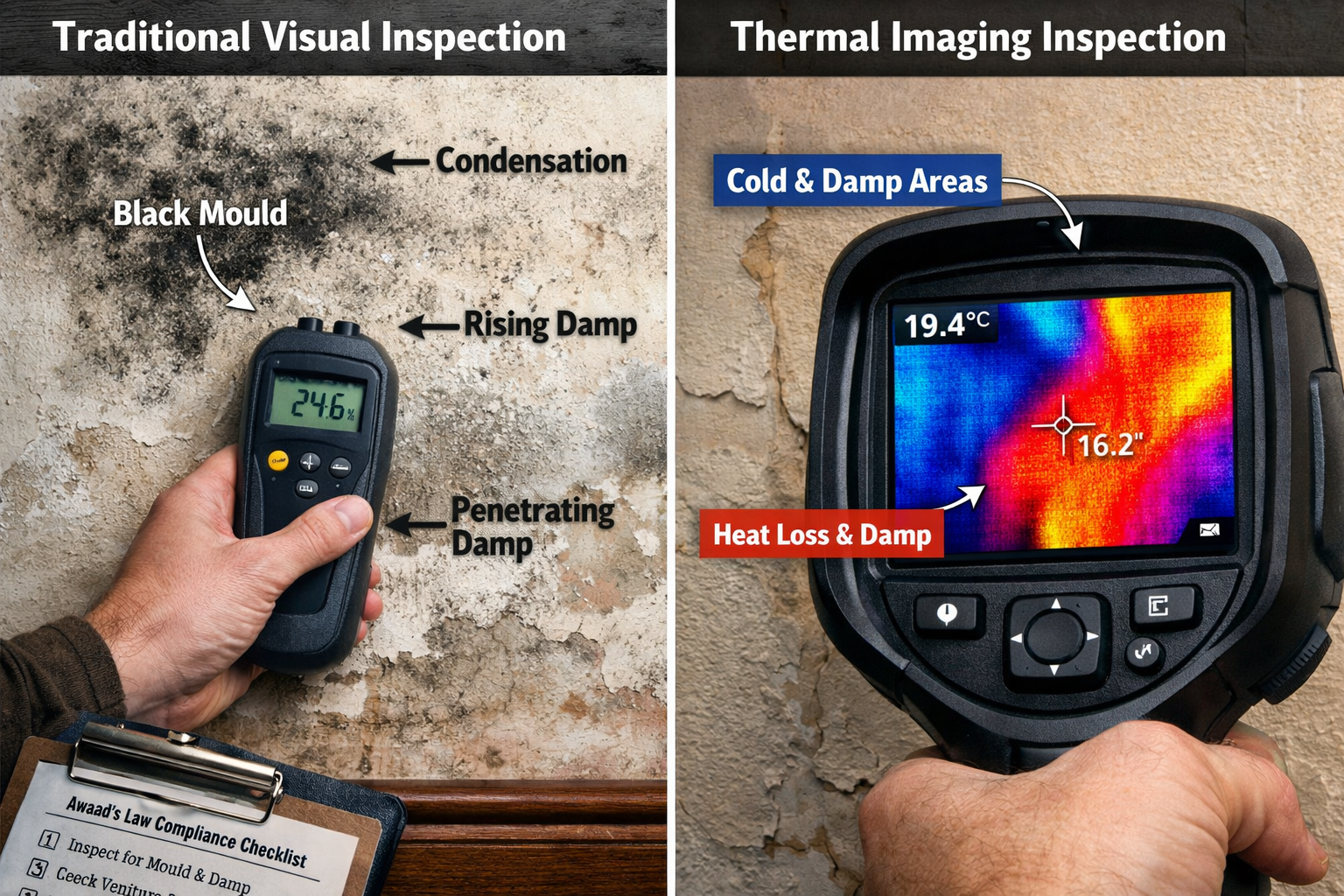
Moisture meter readings taken systematically across suspect areas to quantify dampness levels. Modern surveyors use both capacitance meters (for surface moisture) and resistance meters (for deeper penetration readings) to build a comprehensive moisture profile of the building fabric.
Thermal imaging surveys that reveal hidden moisture patterns, thermal bridges, and insulation defects invisible to the naked eye. Thermal cameras detect temperature differentials caused by moisture evaporation, making them invaluable for identifying concealed leaks and condensation patterns in period properties with thick solid walls.
Opening-up works where necessary to investigate concealed defects. While invasive, targeted opening-up of plaster, floor coverings, or paneling may be essential to confirm damp sources in period properties where surface symptoms alone provide insufficient diagnostic information.
Specific Red Flags in Period Property Damp Surveys
Experienced surveyors conducting Level 3 Building Surveys for Period Properties Under Awaab's Law: Spotting Damp Hazards in 2026 Rentals focus on characteristic failure patterns unique to older construction:
🔴 Rising Damp Indicators
| Visual Sign | Diagnostic Significance | Typical Cause in Period Properties |
|---|---|---|
| Tide marks 0.5-1.5m above floor level | Classic rising damp pattern | Failed or absent damp-proof course |
| Efflorescence (white salt deposits) | Moisture carrying soluble salts to surface | Groundwater wicking through porous masonry |
| Decayed skirting boards and plaster | Prolonged moisture exposure | Bridged DPC or external ground levels too high |
| Musty odor in ground floor rooms | Ongoing moisture problem | Poor underfloor ventilation combined with rising damp |
Rising damp remains controversial among building pathologists, with some experts arguing that most diagnosed cases actually result from other moisture sources. However, in period properties with solid floors laid directly on earth and no effective damp-proof course, genuine rising damp does occur and requires specialist treatment.
🔴 Penetrating Damp Indicators
Penetrating damp occurs when water breaches the external envelope through defective building fabric. In period properties, common entry points include:
- Defective pointing and masonry: Eroded lime mortar joints allow rainwater penetration, particularly on exposed elevations
- Failed render systems: Cement renders applied over lime-based substrates trap moisture and crack, creating water ingress routes
- Leaking gutters and downpipes: Cast iron rainwater goods frequently fail through corrosion, directing water against walls
- Defective roof coverings: Aging slate or tile roofs with degraded fixings allow weather penetration
- Window and door reveals: Solid wall construction with minimal weather protection allows driving rain penetration around openings
A comprehensive specific defect report may be warranted when penetrating damp appears extensive or requires detailed investigation of a particular elevation or building element.
🔴 Condensation and Mould Growth Indicators
Condensation-related problems have become increasingly prevalent in period properties as occupancy patterns have intensified and inappropriate improvements have reduced natural ventilation. Surveyors must distinguish condensation from other damp sources:
Condensation typically presents as:
- Surface moisture on cold spots (window reveals, external wall corners, behind furniture)
- Black mould growth in corners and on north-facing walls
- Mildew on fabrics, leather, and organic materials
- Moisture appearing during cold weather but diminishing in summer
- Problems concentrated in poorly ventilated rooms (bathrooms, kitchens, bedrooms)
Critical assessment factors include:
- Adequacy of background ventilation (trickle vents, airbricks, flues)
- Heating system effectiveness and occupant heating patterns
- Occupancy density relative to building size
- Moisture-generating activities (cooking, bathing, clothes drying)
- Impact of retrofit improvements on building breathability
Under Awaab's Law, landlords cannot simply attribute mould growth to "tenant lifestyle" without demonstrating that the property provides adequate ventilation and heating to prevent condensation under normal occupancy conditions [3]. This places greater responsibility on surveyors to assess whether the building's environmental performance meets reasonable standards.
Advanced Diagnostic Techniques for Complex Cases
When standard inspection techniques cannot definitively identify damp sources, advanced diagnostics may be necessary:
Carbide testing provides precise moisture content measurements by chemically analyzing building material samples. While destructive, carbide testing offers quantitative data that can be critical in disputed cases or when planning major remediation works.
Salt analysis identifies the types of salts present in damp masonry, helping distinguish between rising damp (typically containing chlorides and nitrates from groundwater) and other moisture sources. This technique proves particularly valuable in period properties where multiple damp sources may coexist.
Endoscopic inspection allows visual examination of concealed cavities, wall interiors, and underfloor spaces without extensive opening-up works. Modern borescopes with LED lighting and high-resolution cameras enable surveyors to investigate areas that would otherwise remain inaccessible.
For properties with suspected subsidence or structural movement that may be contributing to damp penetration, specialist structural engineering input may be required to assess crack patterns and movement mechanisms.
Spotting Damp Hazards in 2026 Rentals: A Room-by-Room Assessment Protocol
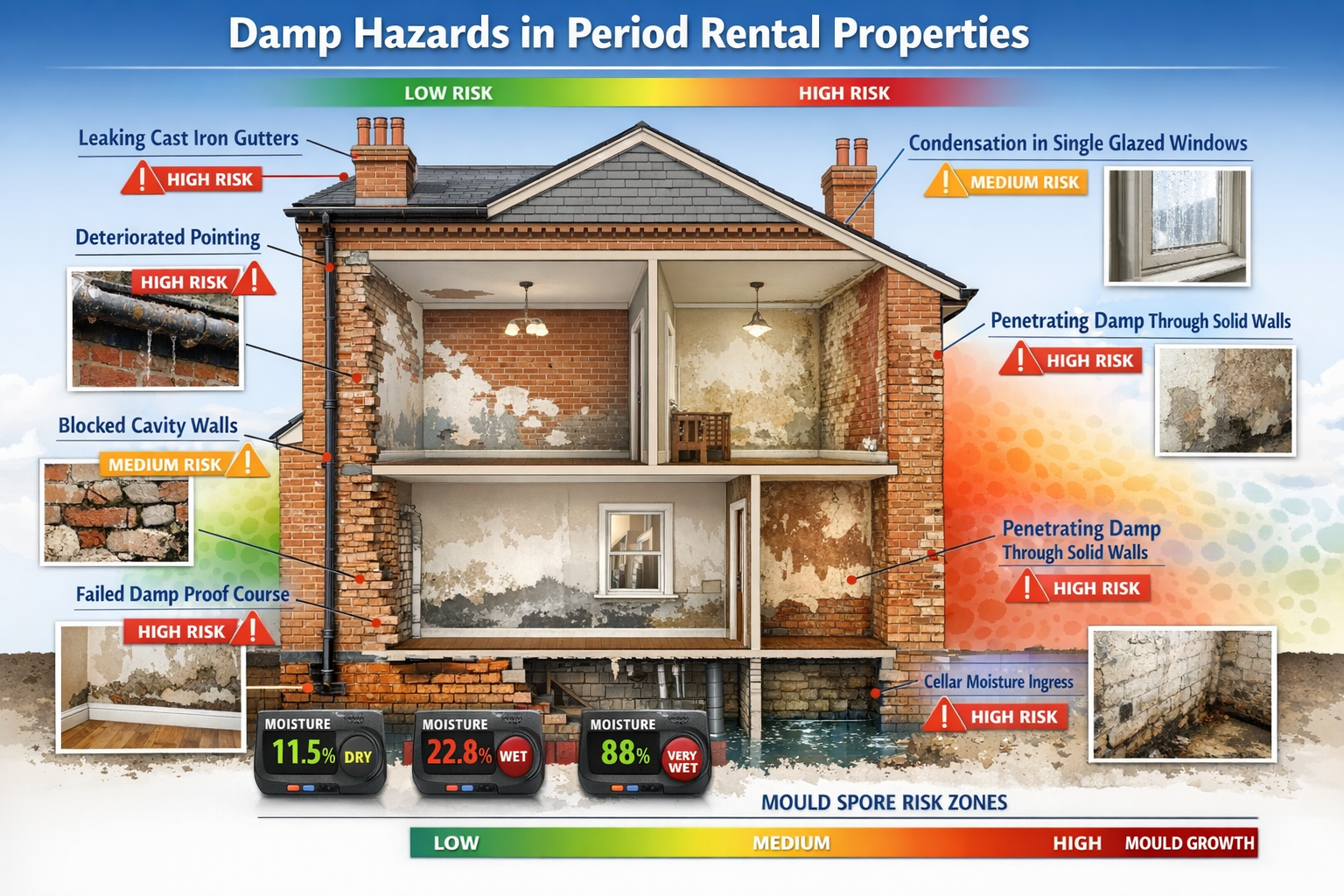
Systematic inspection protocols ensure that surveyors conducting Level 3 Building Surveys for Period Properties Under Awaab's Law: Spotting Damp Hazards in 2026 Rentals capture all potential hazards that could trigger compliance failures. The following room-by-room approach reflects current best practice in 2026:
Roof Spaces and Upper Floors
Inspection priorities:
- Roof covering condition (slipped slates, broken tiles, deteriorated fixings)
- Sarking felt or underlay condition and continuity
- Valley and parapet gutter integrity
- Chimney stack condition and flashing details
- Evidence of past or present roof leaks (staining on timbers, dampness on ceiling joists)
- Loft insulation adequacy and ventilation provision
- Water tank overflow and plumbing integrity
Common period property issues:
- Original roof coverings approaching or exceeding design life (80-100 years for natural slate, 60-80 years for clay tiles)
- Nail sickness causing slipped slates as original fixings corrode
- Lead valley and parapet gutters developing splits and holes
- Inadequate roof ventilation following loft insulation upgrades
- Hidden roof leaks that have saturated ceiling joists and insulation
A drone roof survey can provide detailed photographic evidence of roof condition without requiring scaffolding access, particularly valuable for tall Victorian terraces or properties with complex roof geometries.
Ground Floor Living Areas
Inspection priorities:
- Floor construction type (suspended timber, solid concrete, earth)
- Underfloor ventilation adequacy (airbrick condition and quantity)
- Skirting board condition and evidence of moisture damage
- Wall surface condition at floor level (plaster condition, paint blistering, wallpaper delamination)
- Window and door reveal condition
- Chimney breast and flue condition
- Evidence of previous damp treatment works
Common period property issues:
- Blocked or inadequate underfloor ventilation causing timber decay
- External ground levels raised above internal floor level, bridging damp-proof course
- Solid floors laid directly on earth without damp-proof membrane
- Failed damp-proof course at approximately 150mm above external ground level
- Cement-based repairs trapping moisture in lime-based substrates
Kitchens and Bathrooms
These high-moisture-generating spaces require particular scrutiny under Awaab's Law:
Inspection priorities:
- Mechanical ventilation provision and effectiveness (extract fans, passive vents)
- Plumbing integrity and evidence of leaks
- Surface condensation patterns
- Mould growth on walls, ceilings, and around windows
- Adequacy of heating provision
- Condition of water-resistant finishes (tiles, sealed surfaces)
Common period property issues:
- Inadequate mechanical extraction (many period properties rely on passive ventilation alone)
- Single-glazed sash windows creating cold spots and condensation
- Solid walls with minimal thermal mass creating surface condensation risk
- Aging plumbing systems with concealed leaks
- Bathroom and kitchen additions in former bedrooms or living spaces without adequate environmental control
Cellars and Basements
Period properties frequently feature cellars that present unique damp challenges:
Inspection priorities:
- Evidence of water ingress (staining, efflorescence, standing water)
- Floor and wall construction type
- Ventilation provision
- Current use and suitability for habitation
- Drainage system condition
- Evidence of tanking or waterproofing systems
Common period property issues:
- Unlined brick or stone walls allowing moisture penetration from surrounding earth
- Inadequate drainage causing water accumulation
- Cellars inappropriately converted to habitable space without proper waterproofing
- High water table creating hydrostatic pressure against walls and floors
- Blocked or collapsed underground drainage
External Envelope Assessment
The external inspection proves critical for identifying damp ingress routes:
Inspection priorities:
- Masonry condition and pointing quality
- Render condition and appropriateness for substrate
- Rainwater goods condition and capacity
- Ground levels relative to damp-proof course
- Boundary drainage and surface water management
- Tree proximity and root activity
- External wall insulation or other retrofit measures
Common period property issues:
- Cement pointing and renders applied over lime-based substrates
- Corroded cast iron gutters and downpipes
- Inadequate gutter capacity for modern rainfall intensity
- Raised external ground levels bridging damp-proof course
- Trees causing soil moisture extraction and subsequent expansion when removed
- Inappropriate external wall insulation trapping moisture
Remediation Costing and Compliance Pathways for Period Property Landlords
Understanding remediation costs forms a critical component of Level 3 Building Surveys for Period Properties Under Awaab's Law: Spotting Damp Hazards in 2026 Rentals. Landlords require accurate cost estimates to assess investment viability, while prospective purchasers need realistic figures for negotiation and financial planning.
Typical Remediation Cost Ranges for Period Properties (2026)
| Damp Issue Category | Remediation Approach | Typical Cost Range | Compliance Timeframe |
|---|---|---|---|
| Minor condensation management | Improved ventilation, mould treatment, tenant guidance | £500 – £2,000 | 28 days (medium-risk) |
| Failed rainwater goods | Gutter and downpipe replacement (cast iron or UPVC) | £1,500 – £5,000 | 7-28 days depending on severity |
| Localized penetrating damp | Repointing, render repair, localized waterproofing | £2,000 – £8,000 | 7-28 days depending on extent |
| Rising damp treatment | Chemical DPC injection, replastering, floor treatment | £3,000 – £12,000 | 28 days (medium-risk) |
| Comprehensive damp-proofing | Multiple interventions including drainage, tanking, ventilation | £10,000 – £30,000 | 28+ days depending on complexity |
| Major structural repairs | Underpinning, wall rebuilding, drainage reconstruction | £25,000 – £100,000+ | Extended timeframe with staged remediation |
These figures represent typical costs for standard terraced houses. Larger properties, listed buildings requiring specialist materials and techniques, or properties with multiple concurrent issues may significantly exceed these ranges.
Heritage Building Considerations
Period properties with listed status or located within conservation areas face additional constraints that affect both remediation approaches and costs [5]:
Material restrictions: Listed buildings typically require lime-based mortars, traditional renders, and breathable finishes rather than modern cement-based products. While more expensive and requiring specialist contractors, these traditional materials prove more compatible with historic building fabric.
Consent requirements: Listed Building Consent may be required for damp remediation works that affect historic fabric, adding time and cost to projects. Landlords must factor consent timescales into Awaab's Law compliance planning.
Specialist contractor availability: The pool of contractors experienced in heritage building repair remains limited, potentially extending project timescales and increasing costs by 30-50% compared to standard building work.
Reversibility requirements: Conservation philosophy favors reversible interventions that don't permanently alter historic fabric. This may preclude certain modern damp-proofing techniques, requiring alternative approaches.
Valuation Impact Under the Renters' Rights Act 2026
The Renters' Rights Act 2026, which came into force earlier this year, has created additional valuation considerations for rental properties with damp issues [5]. Building surveyors must now assess how Awaab's Law compliance failures impact property values in the rental market:
Properties with unresolved damp hazards may face valuation reductions of 15-30% in the rental investment market as purchasers factor in immediate remediation costs, potential void periods during works, and reputational risks associated with non-compliance.
Properties with documented compliance (recent Level 3 surveys showing no significant damp hazards, or completed remediation with warranties) command premium valuations as they offer immediate letting potential without compliance risks.
Properties requiring preventative works (aging rainwater goods, deteriorating pointing) that don't currently present hazards but may develop issues within 2-3 years face moderate valuation adjustments of 5-10% as purchasers price in near-term maintenance requirements.
This valuation framework has made comprehensive Level 3 surveys essential for accurate property pricing in the 2026 rental market, with many mortgage lenders now requiring Level 3 surveys for period property buy-to-let applications regardless of property value.
Documentation Standards and Report Requirements for Awaab's Law Compliance
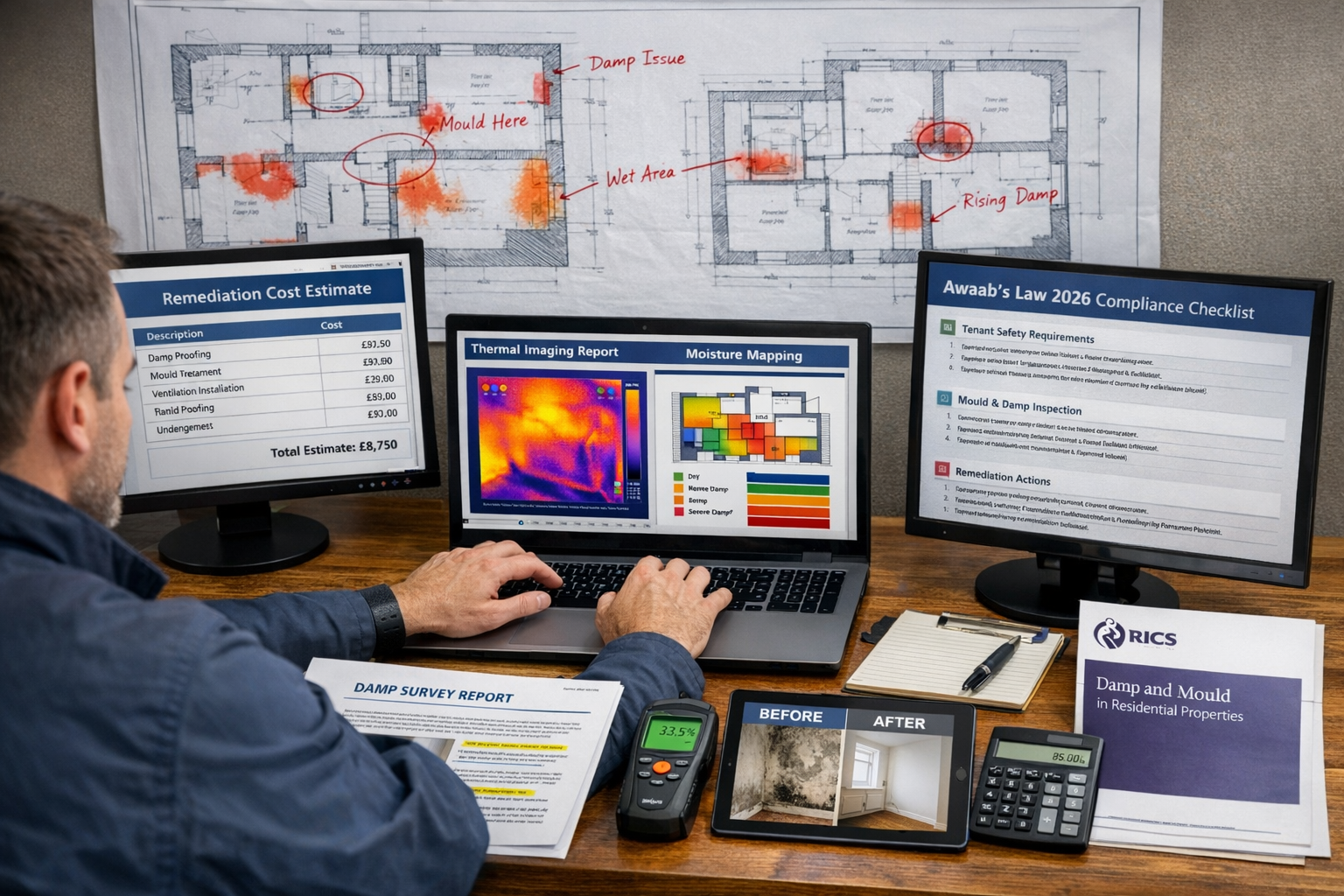
The legal implications of Awaab's Law have elevated documentation standards for building surveys. Surveyors must now provide reports that not only identify defects but also establish clear compliance pathways for landlords [2].
Essential Report Components for Period Property Damp Surveys
A compliant Level 3 survey report for a period rental property should include:
Executive summary highlighting all damp-related hazards with risk categorization aligned to Awaab's Law timeframes (emergency, high, medium, low-risk).
Detailed defect descriptions including:
- Precise location and extent of damp-affected areas
- Moisture meter readings with equipment type and calibration status
- Photographic evidence with clear labeling
- Likely causation analysis
- Differentiation between rising damp, penetrating damp, and condensation
Remediation recommendations specifying:
- Required works in order of priority
- Appropriate repair techniques for period building fabric
- Specialist contractor requirements
- Material specifications compatible with traditional construction
- Estimated cost ranges for each element
- Realistic timeframes for completion
Compliance pathway outlining:
- Immediate actions required to address emergency/high-risk hazards
- Staged approach for medium and lower-risk issues
- Monitoring protocols for marginal conditions
- Preventative maintenance recommendations
Thermal imaging and moisture mapping documentation showing:
- False-color thermal images with temperature scale
- Moisture content distribution maps
- Comparison with normal/acceptable readings
- Interpretation of patterns identified
Professional Indemnity Considerations
The legal consequences of missed damp hazards under Awaab's Law have increased professional indemnity insurance claims in the surveying sector [2]. Surveyors must ensure their reports demonstrate:
✅ Appropriate scope of inspection for the property type and survey level
✅ Use of adequate diagnostic equipment including moisture meters and thermal imaging where appropriate
✅ Clear limitation statements regarding inaccessible areas and concealed defects
✅ Appropriate qualifications and experience for period property assessment
✅ Compliance with RICS standards and current best practice guidance
Many surveyors now include specific Awaab's Law compliance sections in their reports, explicitly addressing whether identified damp conditions would trigger landlord obligations under the legislation.
Digital Documentation and Monitoring Tools
The 2026 surveying landscape increasingly incorporates digital tools that enhance damp hazard documentation:
3D scanning and photogrammetry create detailed spatial records of property condition, allowing precise measurement of damp-affected areas and providing baseline documentation for monitoring deterioration or improvement.
Cloud-based reporting platforms enable real-time report updates, photographic evidence upload from site, and collaborative review between surveyors, clients, and remediation contractors.
Environmental monitoring systems installed during surveys can provide ongoing data on temperature, humidity, and moisture levels, helping differentiate seasonal variations from persistent problems and validating remediation effectiveness.
Blockchain-verified condition records are emerging as a means of creating tamper-proof documentation of property condition and remediation works, potentially valuable for demonstrating compliance in disputed cases.
Selecting the Right Surveyor for Period Property Damp Assessment
Not all chartered surveyors possess equal expertise in period property pathology and Awaab's Law compliance. Landlords, investors, and prospective purchasers should verify that their chosen surveyor demonstrates:
Essential Qualifications and Experience
RICS membership (Member or Fellow status) ensures adherence to professional standards and continuing professional development requirements. The Royal Institution of Chartered Surveyors maintains rigorous competency frameworks for building surveyors.
Period property specialization demonstrated through portfolio of similar properties surveyed, relevant training courses, and membership in specialist organizations such as the Society for the Protection of Ancient Buildings (SPAB).
Damp investigation expertise including formal training in moisture measurement techniques, thermal imaging interpretation, and building pathology diagnosis.
Awaab's Law compliance knowledge evidenced by recent CPD activities, published guidance, or specialist qualifications in housing health and safety assessment.
Professional indemnity insurance with adequate coverage levels (typically £1-2 million minimum for residential surveys, higher for complex or high-value properties).
Questions to Ask Prospective Surveyors
Before commissioning a Level 3 survey for a period rental property, consider asking:
- How many period properties (pre-1919) have you surveyed in the past 12 months?
- What diagnostic equipment do you routinely use for damp assessment (moisture meters, thermal imaging, etc.)?
- Do you conduct invasive investigations where necessary, or only visual inspections?
- How do your reports address Awaab's Law compliance requirements for landlords?
- Can you provide remediation cost estimates based on current 2026 market rates?
- Do you have experience with listed buildings and conservation area properties?
- What is your typical report turnaround time?
- Can you provide sample reports or client references?
Understanding Survey Limitations
Even the most comprehensive Level 3 survey has inherent limitations that clients must understand:
Inaccessible areas cannot be inspected without opening-up works that exceed survey scope. Surveyors will note these limitations and may recommend further investigation.
Concealed defects hidden behind finishes, within wall cavities, or underground remain undetectable without invasive investigation. Surveyors can only report on visible evidence and likely scenarios.
Seasonal variations mean that damp problems evident in winter may not be visible during summer surveys, and vice versa. Surveyors rely on diagnostic evidence and visible symptoms to infer year-round conditions.
Future deterioration cannot be predicted with certainty. Surveyors assess current condition and likely short-term deterioration but cannot guarantee that currently satisfactory elements won't fail.
Understanding these limitations helps set realistic expectations and informs decisions about whether additional specialist investigations are warranted. For properties with significant concerns, a specific defect report focusing exclusively on damp issues may provide more detailed analysis than a general Level 3 survey.
The Future of Period Property Surveying Under Evolving Regulations
The regulatory landscape continues to evolve beyond Awaab's Law. Several developments on the horizon will further impact how surveyors assess period rental properties:
Proposed Energy Efficiency Requirements
The government's stated ambition to require all rental properties to achieve minimum Energy Performance Certificate (EPC) ratings of C by 2028 (currently under consultation) will create additional challenges for period properties. Many Victorian and Edwardian buildings struggle to achieve C ratings without extensive retrofit works that may conflict with breathability requirements and heritage considerations.
Surveyors will increasingly need to assess the interplay between energy efficiency improvements and damp risk, as inappropriate insulation and airtightness measures can exacerbate moisture problems in traditional buildings.
Expanded Health and Safety Standards
Following Awaab's Law's focus on damp and mould, regulatory attention is expanding to other health hazards including:
- Indoor air quality and ventilation adequacy
- Overheating risk in summer months
- Electrical safety and fire risk
- Water quality and legionella risk
- Pest infestation and associated health impacts
Period properties face particular challenges in several of these areas, requiring surveyors to broaden their assessment scope beyond traditional structural and fabric condition.
Technology Integration in Survey Practice
Emerging technologies will continue transforming survey practice:
Artificial intelligence is beginning to assist with thermal image interpretation, moisture pattern analysis, and defect categorization, potentially improving consistency and reducing human error.
Remote sensing including satellite-based moisture detection and drone-mounted sensors may enable preliminary assessment before site visits, improving survey efficiency.
Building Information Modeling (BIM) for existing buildings creates digital twins that integrate survey data, maintenance records, and environmental monitoring, providing comprehensive building condition intelligence.
Predictive analytics using machine learning algorithms can identify deterioration patterns and forecast maintenance requirements, helping landlords plan preventative interventions before hazards develop.
Professional Development Requirements
The RICS and other professional bodies continue updating competency requirements for building surveyors, with recent emphasis on:
- Climate change adaptation and resilience assessment
- Heritage building conservation principles
- Health and safety legislation including Awaab's Law
- Digital survey technologies and data management
- Environmental performance assessment
Surveyors must engage with continuing professional development to maintain expertise in this rapidly evolving field. For clients, selecting surveyors who demonstrate current knowledge through recent CPD activities ensures access to best-practice assessment methodologies.
Conclusion: Protecting Tenants and Investments Through Rigorous Damp Assessment
Level 3 Building Surveys for Period Properties Under Awaab's Law: Spotting Damp Hazards in 2026 Rentals represent a critical intersection of heritage building conservation, tenant health protection, and property investment due diligence. The legislation's strict enforcement timeframes and severe penalties for non-compliance have elevated damp assessment from a routine survey component to a legal necessity for anyone involved in the period property rental market.
For landlords, the message is clear: comprehensive pre-acquisition surveys and regular condition monitoring are no longer optional extras but essential risk management tools. The cost of a thorough Level 3 survey—typically £800-2,000 for a standard terraced house—pales in comparison to the potential costs of emergency remediation, legal penalties, void periods, and reputational damage associated with Awaab's Law violations.
For prospective purchasers of period rental properties, insisting on Level 3 surveys with specific Awaab's Law compliance assessment protects both investment value and future letting potential. Properties with documented compliance or completed remediation offer significantly better risk profiles than those with unknown or unresolved damp issues.
For tenants, Awaab's Law provides unprecedented protection against damp and mould hazards that have historically been dismissed or inadequately addressed. Understanding landlord obligations empowers tenants to advocate for healthy living conditions and hold property owners accountable.
Actionable Next Steps
If you're a landlord with period rental properties:
- Commission Level 3 surveys for any properties not comprehensively assessed in the past 3-5 years
- Address identified damp hazards according to risk categorization and legal timeframes
- Implement preventative maintenance schedules for rainwater goods, ventilation systems, and building fabric
- Document all remediation works with photographic evidence and contractor warranties
- Consider environmental monitoring systems for properties with marginal conditions
If you're purchasing a period property for rental investment:
- Make offers conditional on satisfactory Level 3 survey findings
- Request specific Awaab's Law compliance assessment in survey instructions
- Obtain detailed remediation cost estimates for any identified damp issues
- Factor compliance costs into purchase price negotiations
- Ensure completion of remediation before first letting
If you're a tenant experiencing damp or mould issues:
- Report problems to your landlord in writing with photographic evidence
- Understand the 14-day investigation timeframe requirement
- Keep records of all communications and landlord responses
- Contact local authority environmental health if landlord fails to respond appropriately
- Seek independent advice if health impacts occur
The convergence of Awaab's Law enforcement, the Renters' Rights Act 2026, and increasing regulatory scrutiny of rental property standards has created a new paradigm for period property ownership and management. Success in this environment requires rigorous assessment, proactive maintenance, and genuine commitment to providing healthy, compliant homes.
Engaging chartered surveyors with demonstrated period property expertise and Awaab's Law compliance knowledge represents the foundation of this approach. Their detailed assessments, accurate remediation costing, and clear compliance pathways enable informed decision-making that protects both tenant health and property investment value in Britain's cherished but challenging period housing stock.
References
[1] Awaabs Law – https://www.procurementhub.co.uk/news/awaabs-law/
[2] Awaabs Law What It Means For Surveyors – https://www.jmw.co.uk/blog/company/awaabs-law-what-it-means-for-surveyors
[3] Awaabs Law Comes Into Force What Does It Mean For Construction – https://www.trowers.com/insights/2025/november/awaabs-law-comes-into-force-what-does-it-mean-for-construction
[5] Valuation Adjustments For Renters Rights Act 2026 How Building Surveyors Must Assess Landlord Tenant Compliance – https://nottinghillsurveyors.com/blog/valuation-adjustments-for-renters-rights-act-2026-how-building-surveyors-must-assess-landlord-tenant-compliance
SEO Meta Title: Level 3 Surveys for Period Properties Under Awaab's Law 2026