
Over 4.6 million private rented sector (PRS) properties in England now fall under expanded hazard assessment requirements that include excess cold and heat alongside structural collapse risks. As Awaab's Law Phase 2 takes full effect in 2026, landlords undertaking insulation retrofits must navigate party wall procedures that simultaneously address temperature hazards and comply with strict investigation timelines. Understanding how Party Wall Surveys for Excess Temperature Hazards Under Awaab's Law 2026: RICS Protocols for PRS Insulation Upgrades intersect has become essential for surveyors, landlords, and building professionals managing compliance obligations in multi-occupancy properties.
The 2026 expansion introduces unprecedented complexity: emergency hazards demand resolution within 24 hours, while significant hazards—including temperature-related issues—require investigation within 10 working days [3][4]. When insulation upgrades affect party walls, surveyors must document pre-existing thermal deficiencies, assess thermal bridging risks, and ensure remedial works don't create new hazards in adjoining properties. This convergence of party wall legislation and health hazard compliance creates a challenging regulatory landscape.
Key Takeaways
- ⚖️ Awaab's Law Phase 2 (2026) now covers excess cold, heat, fire, electrical hazards, and structural collapse in PRS properties, requiring investigation of significant hazards within 10 working days
- 📋 Enhanced party wall notices must reference PRS database compliance objectives, hazard category classification, assigned remedy timelines, and tenant occupation status
- 🔍 Party wall surveyors must document pre-existing structural and thermal deficiencies that could constitute collapse or temperature hazards when conducting awards
- ⏱️ Strict compliance timelines apply: written summary to tenants within 3 working days, remedial works beginning within 5 working days, completion within 12 weeks for complex projects
- 🎯 Person-centred hazard assessment is mandatory, considering tenant vulnerability, age, and health conditions when evaluating temperature hazard severity
Understanding Awaab's Law 2026 Extensions to Private Rental Properties
Awaab's Law originated from the tragic death of two-year-old Awaab Ishak in 2020, who died from prolonged exposure to mould in social housing. The legislation initially focused on damp and mould in social housing but has expanded significantly through the Renters' Rights Bill to encompass the private rented sector [7].
Phase 2 Hazard Categories
The 2026 expansion introduces five additional hazard categories beyond the original damp and mould focus [1][2]:
| Hazard Category | Investigation Timeline | Common Causes in PRS |
|---|---|---|
| Excess Cold | 10 working days | Poor insulation, single glazing, inadequate heating |
| Excess Heat | 10 working days | Lack of ventilation, poor insulation, south-facing exposure |
| Fire Hazards | 24 hours (emergency) | Faulty wiring, blocked exits, inadequate detection |
| Electrical Hazards | 24 hours (emergency) | Outdated wiring, damaged sockets, non-compliant installations |
| Structural Collapse | 24 hours (emergency) | Foundation issues, wall deterioration, roof defects |
Emergency hazards (fire, electrical, structural collapse) must be investigated and resolved within 24 hours, while significant hazards like excess temperature require investigation within 10 working days [3]. This distinction fundamentally shapes how surveyors approach party wall assessments for insulation projects.
Decent Homes Standard Criterion E
The reformed Decent Homes Standard establishes Criterion E as a standalone requirement ensuring properties remain free from damp and mould [7]. This ambitious standard extends beyond reactive responses to tenant complaints, requiring landlords to proactively maintain properties in hazard-free conditions.
For temperature hazards specifically, landlords must ensure:
✅ Adequate insulation in walls, roofs, and floors
✅ Functional heating systems capable of maintaining comfortable temperatures
✅ Proper ventilation to prevent condensation and heat buildup
✅ Energy-efficient glazing where reasonably practical
When insulation upgrades involve party walls, compliance becomes more complex. Works affecting shared structures require proper party wall notice procedures while simultaneously addressing existing temperature hazards.
Party Wall Surveys for Excess Temperature Hazards Under Awaab's Law 2026: Enhanced Documentation Requirements
The intersection of party wall legislation and Awaab's Law creates new documentation standards for surveyors. Traditional party wall procedures focused primarily on structural integrity and damage prevention. The 2026 protocols demand comprehensive hazard assessment integrated into every party wall survey.
Enhanced Party Wall Notice Components
Enhanced party wall notices for 2026 must now include four critical elements beyond traditional structural information [5]:
- PRS Database Compliance Objectives: Reference to how proposed works address specific hazard categories registered in the property's compliance database
- Awaab's Law Hazard Category Classification: Clear identification of which hazard categories (excess cold, excess heat, structural) the works will remediate
- Assigned Timeline for Remedy: Specific timeframes aligned with Awaab's Law investigation and completion requirements
- Tenant Occupation Status: Documentation of whether properties are occupied, tenant vulnerability factors, and person-centred assessment considerations
This enhanced documentation ensures adjoining owners understand not just the structural implications but also the health and safety compliance drivers behind proposed works. For landlords undertaking cavity wall insulation or external wall insulation (EWI) projects, these notices provide legal protection while demonstrating compliance intent.
Pre-Existing Deficiency Documentation
Party wall surveyors must now document pre-existing structural deficiencies that could constitute collapse hazards during party wall awards [2]. This requirement extends to thermal deficiencies that may contribute to excess temperature hazards:
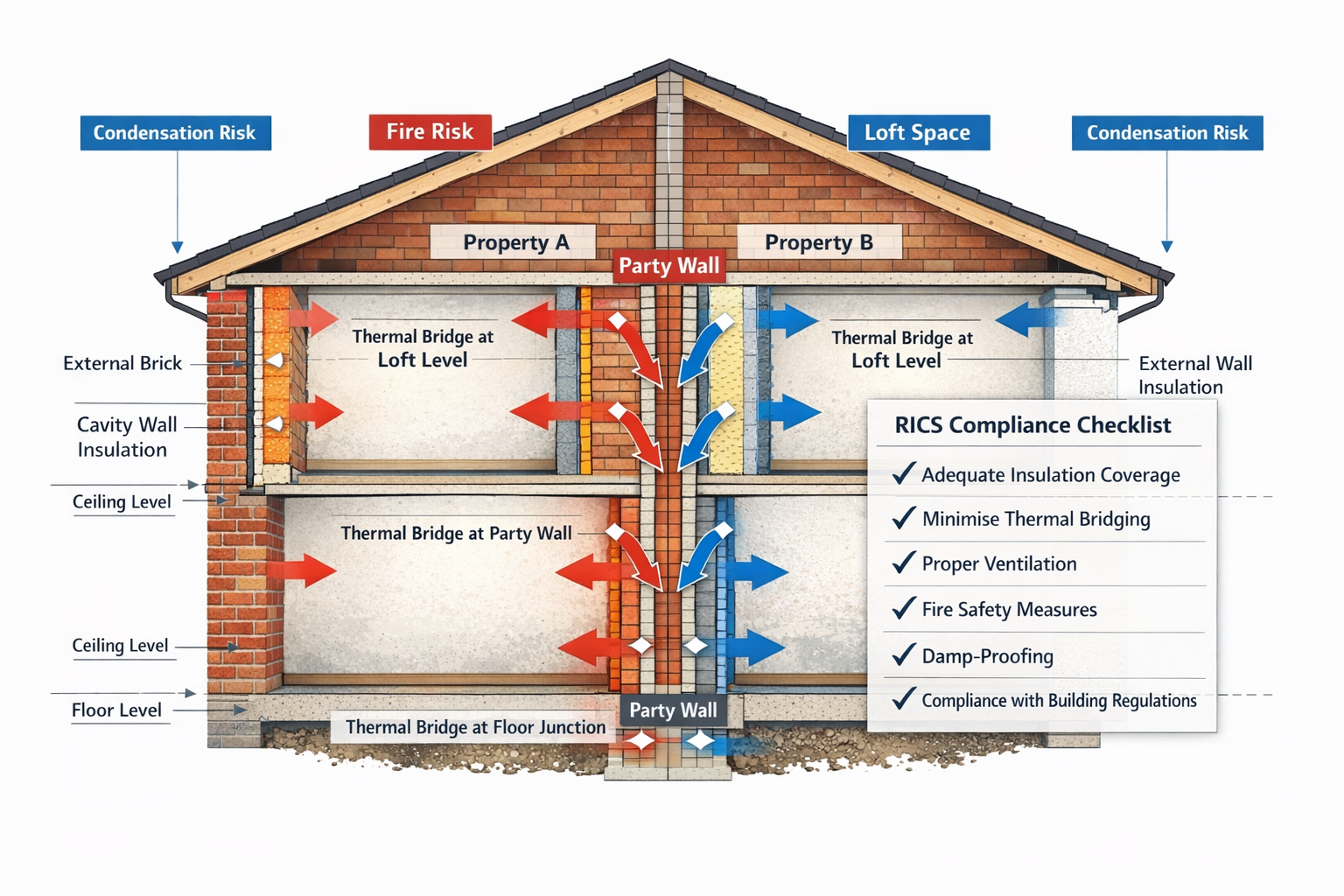
- Thermal bridging points where heat loss occurs through structural elements
- Missing or degraded insulation in cavity walls or roof spaces
- Air leakage pathways around window frames, service penetrations, or wall junctions
- Condensation patterns indicating inadequate ventilation or insulation performance
- Existing temperature differentials between properties sharing party walls
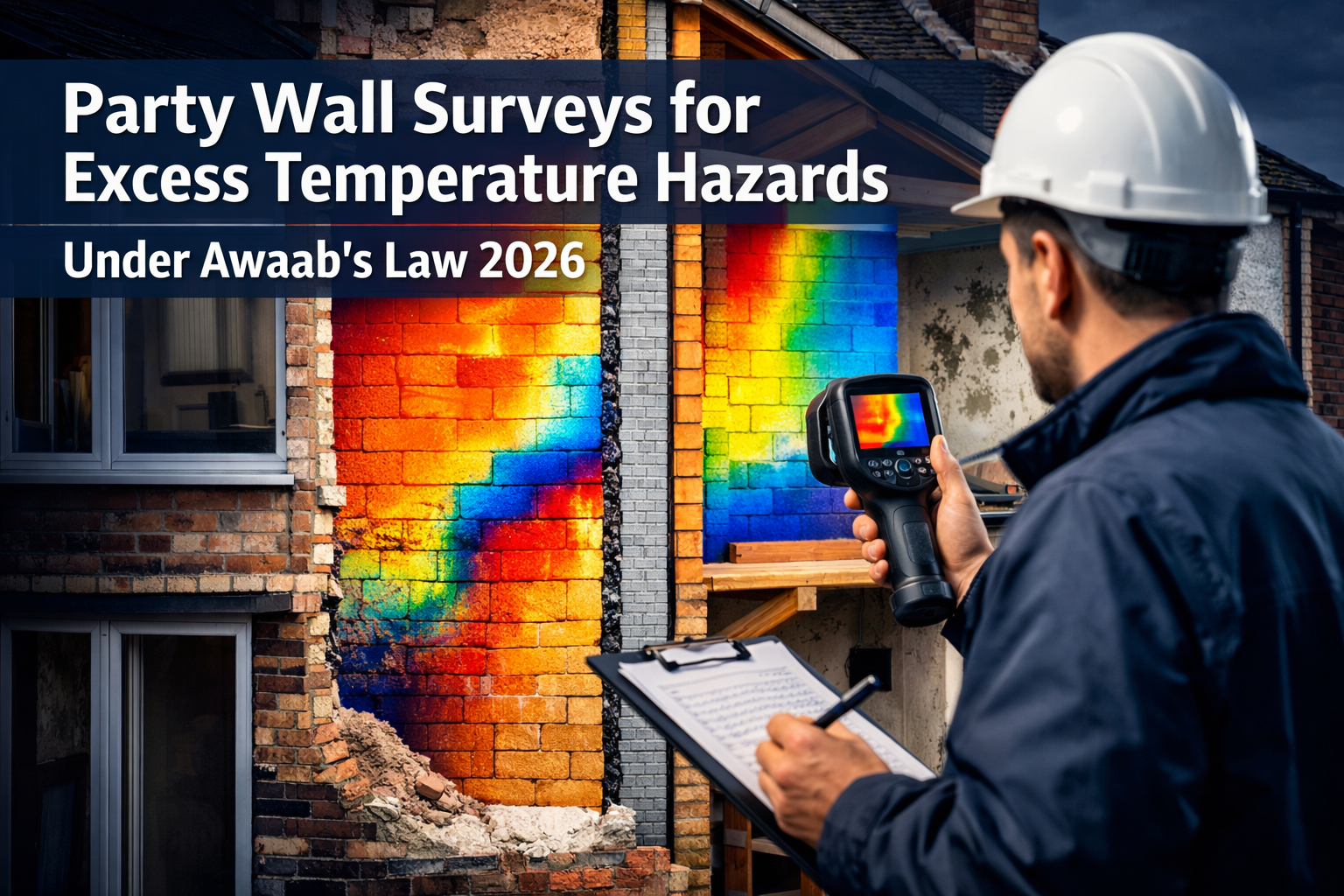
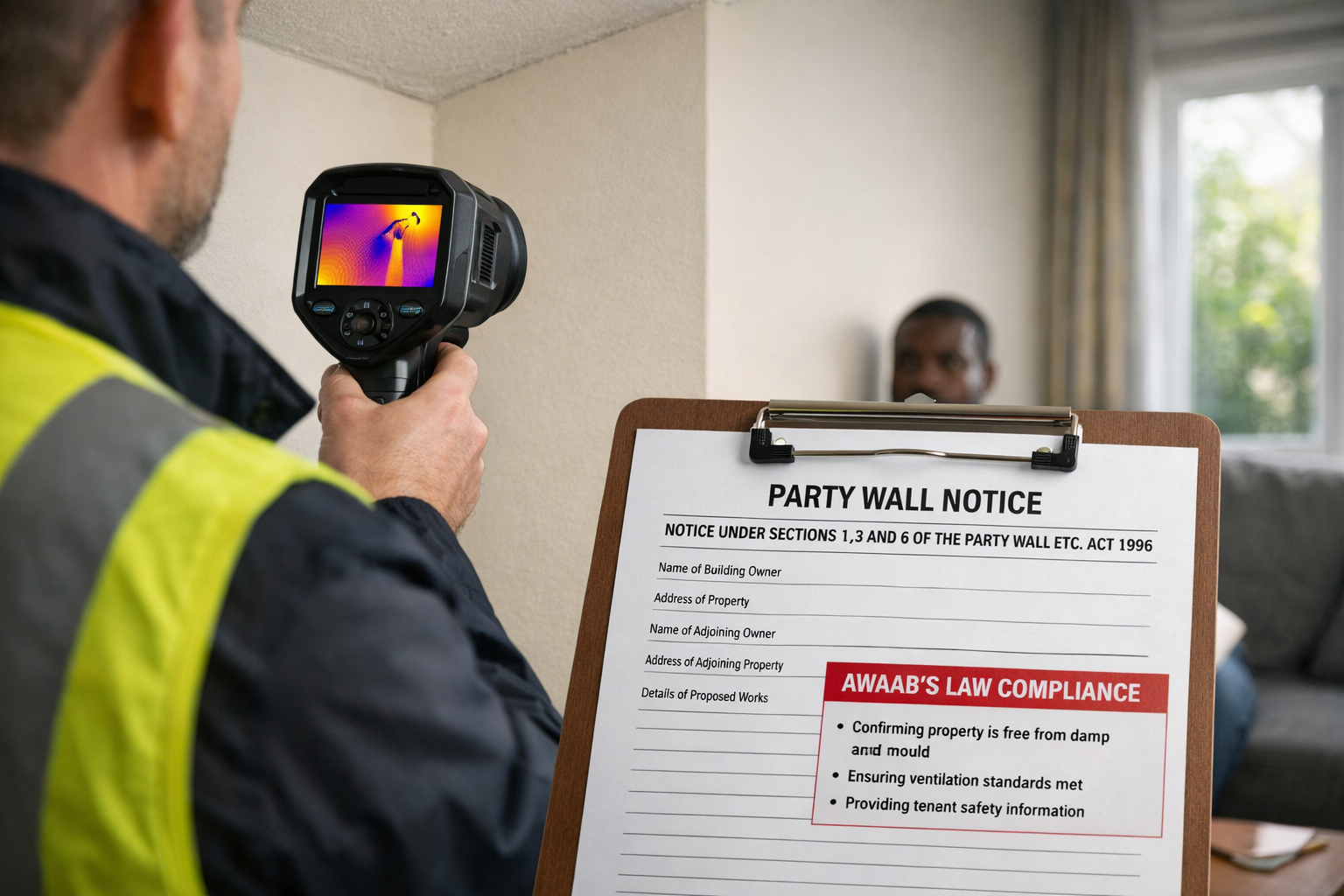
When conducting party wall awards, surveyors should use thermal imaging cameras to identify temperature variations across party wall surfaces. This baseline documentation protects all parties by establishing pre-existing conditions before insulation works commence.
RICS Consultation on Updated Guidance
RICS launched a formal consultation in April-May 2026 on updated party wall practice guidance, seeking input on the draft 8th edition of Party Wall Legislation and Procedure [6]. This consultation addresses:
🔹 Competence standards for surveyors assessing health hazards alongside structural concerns
🔹 Consistency in hazard classification across different surveying practices
🔹 Integration protocols for Awaab's Law compliance within traditional party wall procedures
🔹 Documentation standards for person-centred assessments
The consultation period reflects recognition that party wall surveyors require updated training and standardized protocols to meet 2026 compliance expectations. Surveyors should engage with chartered surveyors familiar with both party wall legislation and health hazard assessment methodologies.
RICS Protocols for PRS Insulation Upgrades: Thermal Bridging Assessment Checklists
Insulation retrofits in PRS properties frequently involve party walls, particularly in terraced housing and converted flats. The RICS protocols for Party Wall Surveys for Excess Temperature Hazards Under Awaab's Law 2026 establish systematic approaches to identifying and mitigating thermal bridging risks during neighbouring works.
Thermal Bridging Risk Assessment Framework
Thermal bridging occurs when heat flows through materials with higher thermal conductivity, creating cold spots that can lead to condensation, mould growth, and excess cold hazards. Common thermal bridges in party wall contexts include:
| Thermal Bridge Location | Risk Level | Mitigation Strategy |
|---|---|---|
| Party wall/external wall junction | High | Insulation continuity detailing, thermal break installation |
| Party wall/floor junction | Medium | Cavity barrier with insulation wrap, airtightness sealing |
| Party wall/roof junction | High | Loft insulation extension, eaves ventilation balance |
| Service penetrations | Medium | Insulated service boxes, fire-rated sealing |
| Window/door reveals | Medium | Insulated reveal linings, thermal break sills |
Surveyors conducting party wall assessments for insulation upgrades should apply this five-stage thermal bridging checklist:
Stage 1: Pre-Work Thermal Survey
Before issuing party wall consent, conduct comprehensive thermal imaging of:
- Internal party wall surfaces in both properties
- External wall surfaces where party walls intersect
- Floor and ceiling junctions with party walls
- Window and door openings in party walls
- Service penetrations (pipes, cables, vents)
Document baseline temperatures using calibrated thermal imaging equipment. Record ambient conditions, heating status, and outdoor temperatures to ensure comparable future assessments.
Stage 2: Insulation Design Review
Review proposed insulation specifications against party wall structural requirements:
✓ Cavity wall insulation: Verify cavity width, existing ties, damp-proof course integrity
✓ External wall insulation: Assess party wall boundary implications, fire barrier requirements
✓ Internal wall insulation: Evaluate space loss, ventilation impacts, condensation risk
✓ Roof insulation: Check party wall height, fire separation, ventilation pathways
Ensure insulation design maintains or improves thermal performance across the entire party wall junction, not just the primary elevation being upgraded.
Stage 3: Person-Centred Hazard Assessment
Awaab's Law requires person-centred hazard assessment considering tenant circumstances [3]. When evaluating temperature hazards during party wall surveys, document:
- Tenant age and vulnerability status (elderly, young children, disabled)
- Pre-existing health conditions (respiratory issues, cardiovascular conditions)
- Occupancy patterns (home-working, shift patterns affecting heating use)
- Energy affordability constraints affecting heating adequacy
- Previous temperature-related complaints or health impacts
A temperature condition that scores as "low risk" under standardized HHSRS (Housing Health and Safety Rating System) assessment may constitute a significant hazard for a vulnerable tenant with asthma. Surveyors must apply professional judgment informed by tenant-specific factors.
Stage 4: Construction Phase Monitoring
During insulation installation affecting party walls, surveyors should:
- Verify insulation continuity at party wall junctions through site inspections
- Monitor for unintended thermal bridging created by fixings, brackets, or service installations
- Assess temporary exposure risks if works expose previously insulated areas
- Document any structural discoveries that reveal additional hazards (damp penetration, timber decay, electrical defects)
- Ensure fire separation integrity where party walls provide compartmentation
For complex projects, interim thermal imaging during construction can identify problems before final finishes conceal defects. This proactive approach prevents future party wall disputes arising from inadequate thermal performance.
Stage 5: Post-Completion Verification
Within the 3-working-day written summary requirement [3], surveyors should provide tenants with:
📄 Thermal performance verification comparing pre- and post-work thermal imaging
📄 Hazard remediation confirmation documenting how works addressed identified temperature hazards
📄 Ongoing maintenance guidance for maintaining thermal performance
📄 Ventilation usage instructions to prevent condensation while maintaining comfort
Post-completion verification protects landlords from future compliance challenges by demonstrating works achieved intended hazard remediation outcomes.
Insulation Upgrade Scenarios and Party Wall Implications
Different insulation approaches create distinct party wall considerations:
Scenario 1: Cavity Wall Insulation in Mid-Terrace Property
A landlord proposes cavity wall insulation for a mid-terrace PRS property. Party walls exist on both sides. The surveyor must:
- Confirm cavity continuity across party wall boundaries (some terraces have shared cavity construction)
- Assess whether insulation injection pressure could affect adjoining properties
- Verify existing cavity barriers at party wall junctions meet fire regulations
- Document any existing damp penetration that insulation might exacerbate
- Ensure party wall agreements cover potential access requirements
Scenario 2: External Wall Insulation on Semi-Detached Property
External wall insulation extending to party wall boundaries requires:
- Clear boundary definition to avoid trespass onto adjoining property
- Fire barrier installation at party wall junctions
- Coordination of insulation thickness to avoid creating water traps
- Assessment of whether EWI creates new thermal bridging at uninsulated party wall
- Consideration of visual impact on adjoining property value
Scenario 3: Loft Insulation Upgrade in Converted Flat
Loft insulation in converted properties with party wall separations demands:
- Verification that party walls extend full height to underside of roof covering
- Assessment of fire separation adequacy if party walls don't reach roof
- Evaluation of ventilation pathways that may bypass party wall separations
- Consideration of sound insulation impacts from additional loft insulation
- Documentation of any structural deficiencies in party wall construction
Each scenario requires tailored party wall notices addressing specific Awaab's Law compliance objectives relevant to the insulation approach.
Compliance Timelines and Remedial Works Coordination
The strict timelines imposed by Awaab's Law create coordination challenges when party wall procedures intersect with hazard remediation requirements. Understanding how these timelines interact is essential for surveyors managing PRS insulation upgrades.
Timeline Integration Framework
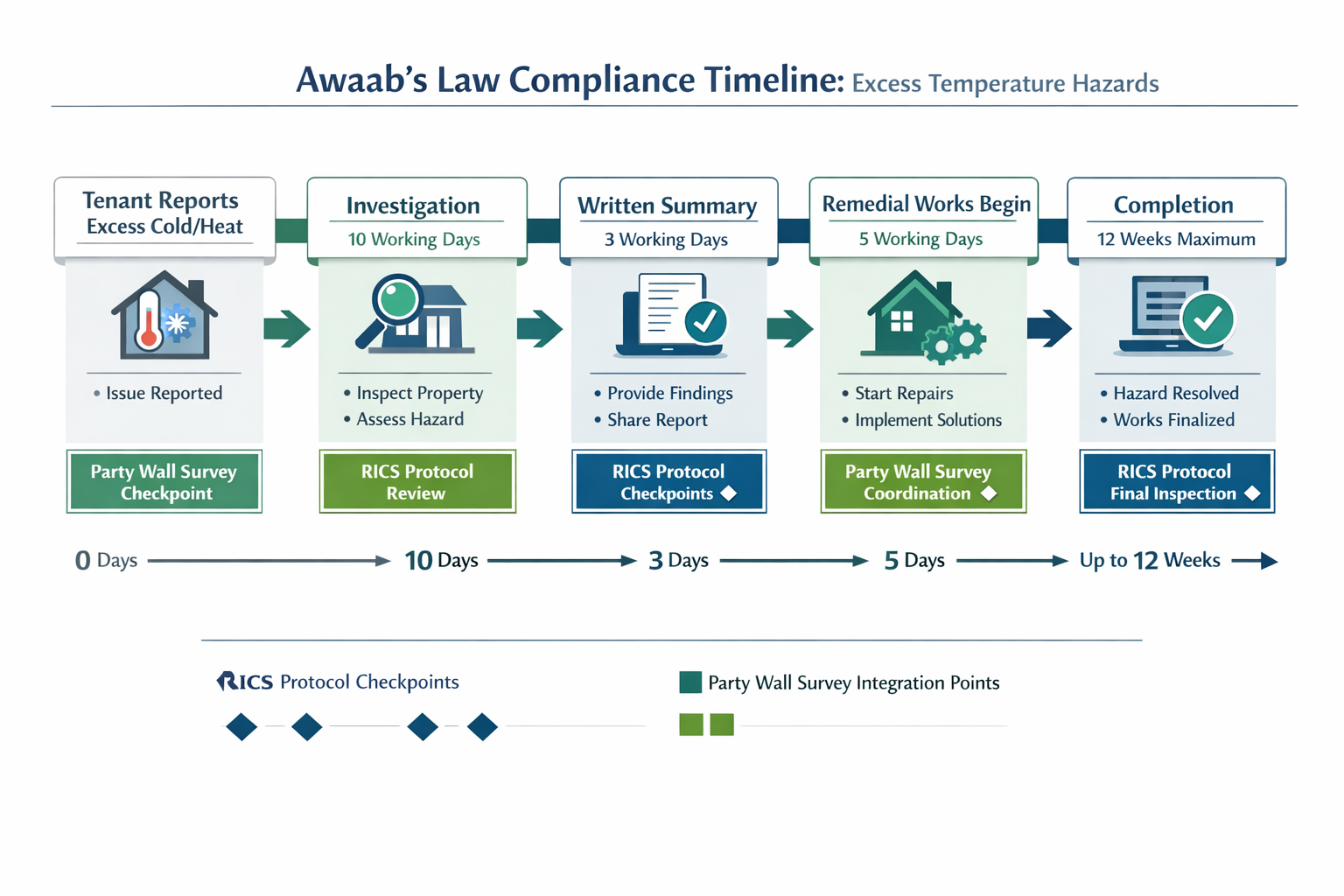
Awaab's Law Investigation Timeline: 10 working days for significant hazards (excess cold/heat)
Party Wall Notice Period: Typically 2 months for building works, 1 month for excavations
Written Summary Requirement: 3 working days after investigation concludes
Remedial Works Commencement: 5 working days after written summary
Works Completion: Maximum 12 weeks for complex or long-term works [3]
When a tenant reports excess cold related to inadequate insulation, and remediation requires party wall procedures, landlords face a timing dilemma:
❌ Cannot delay investigation beyond 10 working days to complete party wall procedures
❌ Cannot commence works without proper party wall consent
❌ Cannot exceed 12-week completion deadline for remedial works
The solution requires parallel processing:
- Immediate investigation (within 10 working days) to assess hazard and determine remediation approach
- Simultaneous party wall notice service if investigation identifies party wall implications
- Interim hazard mitigation (temporary heating, draught-proofing) while party wall procedures progress
- Accelerated party wall agreement using surveyors experienced in Awaab's Law timelines
- Coordinated works commencement once both party wall consent and Awaab's Law timelines align
Interim Mitigation Strategies
While party wall procedures progress, landlords must implement interim measures to address temperature hazards:
🔧 Temporary heating provision: Portable heaters, upgraded heating system settings
🔧 Draught exclusion: Temporary sealing of air leakage points not requiring party wall works
🔧 Thermal curtains or secondary glazing: Non-structural improvements reducing heat loss
🔧 Humidity control: Dehumidifiers preventing condensation while insulation works await consent
These interim measures demonstrate compliance intent and protect tenant health while respecting party wall legislation. Documentation of interim measures should form part of the written summary provided to tenants.
Coordinating Multiple Adjoining Owners
In terraced properties or flat conversions, insulation upgrades may affect multiple party walls with different adjoining owners. Coordination complexity increases when:
- Different adjoining owners have varying response times to party wall notices
- Some adjoining owners consent while others appoint surveyors
- Adjoining properties have different existing insulation levels creating thermal bridging risks
- Staggered completion of party wall agreements delays overall project timeline
Surveyors should recommend phased approaches that allow partial works to commence where party wall consent is secured, while continuing negotiations for remaining boundaries. However, phasing must not compromise thermal performance by creating incomplete insulation envelopes.
For properties with complex ownership structures, engaging chartered surveyors with boundary dispute experience early in the process can prevent delays that jeopardize Awaab's Law compliance timelines.
Surveyor Competence and Training Requirements
The convergence of party wall legislation, building pathology, thermal physics, and health hazard assessment demands enhanced surveyor competence. Traditional party wall surveyors may lack thermal assessment expertise, while building surveyors may be unfamiliar with party wall procedures.
Core Competencies for 2026 Compliance
Surveyors conducting Party Wall Surveys for Excess Temperature Hazards Under Awaab's Law 2026 should demonstrate:
Technical Competencies:
- Thermal imaging interpretation and calibration
- Building physics understanding (U-values, thermal bridging, condensation risk)
- HHSRS assessment methodology for temperature hazards
- Party wall legislation (Party Wall etc. Act 1996)
- Building regulations (Part L – Conservation of fuel and power)
Procedural Competencies:
- Enhanced party wall notice drafting incorporating hazard classifications
- Person-centred assessment documentation
- Timeline coordination between party wall and Awaab's Law requirements
- Multi-party negotiation in complex ownership structures
- Interim mitigation strategy development
Communication Competencies:
- Plain language explanation of technical findings to tenants
- Clear documentation for landlords balancing legal and compliance obligations
- Effective liaison with adjoining owners regarding health hazard context
- Professional reporting meeting RICS standards
The RICS consultation on updated party wall guidance specifically addresses competence standards, recognizing that 2026 requirements exceed traditional party wall surveyor training [6].
Professional Development Pathways
Surveyors should pursue continuing professional development (CPD) covering:
- Thermal assessment training: Thermography certification, building physics courses
- Health hazard assessment: HHSRS training, person-centred assessment methodologies
- Awaab's Law compliance: Regulatory update seminars, case study analysis
- Party wall advanced practice: Complex scenarios, dispute resolution, accelerated procedures
Professional bodies including RICS, RPSA (Residential Property Surveyors Association), and CIOB (Chartered Institute of Building) offer relevant CPD programs addressing these integrated competencies.
Legal Consequences and Enforcement
Failure to comply with Awaab's Law obligations constitutes a breach of tenancy agreement and exposes landlords to significant penalties. Understanding enforcement mechanisms helps surveyors advise clients on compliance priorities.
Enforcement Powers and Penalties
Local housing authorities can:
⚖️ Issue improvement notices requiring specific remedial works within defined timelines
⚖️ Impose civil penalties up to £30,000 for serious breaches
⚖️ Prosecute landlords for persistent non-compliance
⚖️ Issue rent repayment orders requiring refund of up to 12 months' rent to affected tenants
⚖️ Revoke selective licensing in areas with additional licensing schemes
When party wall disputes delay Awaab's Law compliance, landlords cannot cite party wall procedures as justification for missing investigation or remediation timelines. The law requires landlords to manage both obligations simultaneously.
Liability Considerations for Surveyors
Surveyors conducting party wall assessments that fail to identify or adequately document temperature hazards face potential professional liability claims. Key liability risks include:
- Inadequate hazard identification: Missing thermal bridging risks or pre-existing temperature hazards
- Insufficient person-centred assessment: Failing to consider tenant vulnerability factors
- Timeline mismanagement: Providing advice that causes landlords to breach Awaab's Law deadlines
- Incomplete documentation: Party wall awards lacking hazard classification or compliance objectives
Professional indemnity insurance should cover Awaab's Law-related claims. Surveyors should verify coverage extends to health hazard assessment activities beyond traditional structural party wall work.
Case Study: Thermal Bridging Dispute
A landlord undertook external wall insulation on a mid-terrace PRS property following tenant complaints of excess cold. The party wall surveyor approved works without assessing thermal continuity at party wall junctions. Post-completion, the tenant continued experiencing cold conditions due to uninsulated party walls creating significant thermal bridges.
The local authority issued an improvement notice requiring additional works. The landlord incurred:
- £8,500 additional insulation costs for party wall junction remediation
- £2,000 party wall surveyor fees for second assessment
- £1,200 temporary accommodation costs during additional works
- £5,000 civil penalty for failing to remediate within original 12-week timeline
The landlord pursued professional negligence claims against the original surveyor for inadequate thermal assessment. This case illustrates the financial and legal consequences of insufficient integration between party wall procedures and Awaab's Law compliance.
Practical Implementation: Step-by-Step Process
For landlords and surveyors managing PRS insulation upgrades involving party walls, this step-by-step process ensures compliance with Party Wall Surveys for Excess Temperature Hazards Under Awaab's Law 2026 requirements:
Step 1: Initial Hazard Assessment (Day 1-5)
Upon receiving tenant complaint or during routine inspection:
- Conduct thermal imaging survey of affected areas
- Document tenant vulnerability factors for person-centred assessment
- Assess whether hazard meets "significant" threshold requiring 10-day investigation
- Identify whether remediation will involve party wall works
- Engage appropriately qualified surveyor if party wall implications identified
Step 2: Parallel Procedure Initiation (Day 6-10)
Within 10-working-day investigation timeline:
- Complete formal hazard investigation and classification
- Determine remediation approach (insulation type, extent, methodology)
- Serve party wall notices on adjoining owners if works affect party structures
- Implement interim mitigation measures to address immediate hazard
- Prepare written summary for tenant (due by Day 13)
Step 3: Written Summary and Works Planning (Day 11-15)
Within 3 working days of investigation completion:
- Provide tenant with written summary including:
- Hazard classification and severity
- Proposed remediation approach
- Timeline for works commencement and completion
- Interim measures in place
- Party wall procedure status
- Finalize technical specifications for insulation works
- Obtain contractor quotes and availability
- Continue party wall negotiations with adjoining owners
Step 4: Party Wall Resolution (Day 16-60)
During standard party wall notice period:
- Respond to adjoining owner questions or surveyor appointments
- Conduct party wall surveys documenting pre-existing conditions
- Prepare party wall award incorporating:
- Enhanced documentation (hazard classification, compliance objectives)
- Thermal bridging mitigation requirements
- Access provisions and work schedules
- Condition schedules with thermal imaging baseline
- Secure party wall consent or award
- Monitor that party wall timeline doesn't breach 12-week completion deadline
Step 5: Works Commencement (Within 5 Working Days of Summary)
As soon as party wall consent secured:
- Mobilize contractors for insulation installation
- Conduct pre-commencement site meeting covering:
- Party wall award requirements
- Thermal performance specifications
- Access arrangements with adjoining owners
- Quality control checkpoints
- Implement construction phase monitoring per Stage 4 checklist
- Maintain communication with tenant regarding progress
Step 6: Completion and Verification (Within 12 Weeks Maximum)
Before 12-week deadline:
- Complete insulation installation per specifications
- Conduct post-completion thermal imaging verification
- Prepare completion documentation for tenant including:
- Thermal performance comparison (before/after)
- Hazard remediation confirmation
- Maintenance guidance
- Ventilation usage instructions
- Obtain party wall completion sign-off from adjoining owners
- Update PRS database compliance records
This structured process ensures both party wall legislation and Awaab's Law requirements receive proper attention without compromising either obligation.
Conclusion
The expansion of Awaab's Law in 2026 to encompass excess temperature hazards in private rented properties fundamentally changes how surveyors approach party wall assessments for insulation upgrades. Party Wall Surveys for Excess Temperature Hazards Under Awaab's Law 2026: RICS Protocols for PRS Insulation Upgrades demand integrated expertise spanning thermal assessment, health hazard evaluation, and traditional party wall procedures.
Surveyors must now document pre-existing thermal deficiencies, assess thermal bridging risks at party wall junctions, and ensure remedial works meet strict compliance timelines while respecting party wall legislation. Enhanced party wall notices must reference hazard classifications, compliance objectives, and tenant circumstances, creating transparency for all parties involved.
The strict timelines—10 working days for investigation, 3 working days for written summaries, 5 working days for works commencement, and 12 weeks for completion—require parallel processing of party wall procedures and hazard remediation. Interim mitigation strategies protect tenant health while formal procedures progress, demonstrating compliance intent and reducing legal exposure.
Next Steps for Landlords and Surveyors
For Landlords:
- Engage surveyors with demonstrated competence in both party wall procedures and thermal assessment
- Implement proactive temperature monitoring to identify hazards before tenant complaints
- Budget for enhanced party wall survey costs reflecting additional hazard assessment requirements
- Maintain comprehensive documentation of all investigations, interim measures, and remediation works
- Consider portfolio-wide insulation upgrades to address temperature hazards systematically
For Surveyors:
- Pursue CPD covering thermal imaging, HHSRS assessment, and Awaab's Law compliance
- Update party wall notice templates to incorporate enhanced 2026 documentation requirements
- Invest in thermal imaging equipment and calibration protocols
- Develop relationships with specialists for complex multi-disciplinary assessments
- Engage with RICS consultation processes to shape emerging practice standards
For Property Professionals:
- Familiarize yourself with the five-stage thermal bridging assessment checklist
- Understand person-centred assessment requirements and vulnerability factors
- Recognize when projects require specialist surveyor expertise beyond traditional party wall work
- Implement timeline management systems coordinating party wall and Awaab's Law deadlines
The convergence of party wall legislation and health hazard compliance represents a permanent shift in PRS property management. Surveyors who develop integrated competencies and systematic assessment protocols will provide essential professional services protecting landlord compliance, tenant health, and adjoining owner interests. As RICS guidance evolves through 2026 and beyond, staying current with updated protocols and enforcement precedents remains critical for all professionals operating in this complex regulatory environment.
For comprehensive party wall services that integrate Awaab's Law compliance requirements, consult with experienced party wall surveyors who understand the technical and legal complexities of 2026 regulations.
References
[1] Building Surveys And Awaabs Law 2026 Extensions Identifying Electrical Fire And Temperature Hazards In Prs Properties – https://nottinghillsurveyors.com/blog/building-surveys-and-awaabs-law-2026-extensions-identifying-electrical-fire-and-temperature-hazards-in-prs-properties
[2] Awaabs Law Extensions To Prs In 2026 Party Wall And Building Survey Protocols For New Hazard Categories – https://nottinghillsurveyors.com/blog/awaabs-law-extensions-to-prs-in-2026-party-wall-and-building-survey-protocols-for-new-hazard-categories
[3] Awaabs Law Is Here The Surveyors Guide For Compliance – https://www.surventrix.com/blog/awaabs-law-is-here-the-surveyors-guide-for-compliance
[4] Awaabs Law – https://www.rics.org/news-insights/awaabs-law
[5] Party Wall Notice Requirements For Prs Database Compliance Works Surveyor Tactics Post Renters Rights Act Registration In 2026 – https://nottinghillsurveyors.com/blog/party-wall-notice-requirements-for-prs-database-compliance-works-surveyor-tactics-post-renters-rights-act-registration-in-2026
[6] Rics Launches Consultation On Updated Party Wall Practice Guidance – https://www.rics.org/news-insights/rics-launches-consultation-on-updated-party-wall-practice-guidance
[7] Consultation On A Reformed Decent Homes Standard For Social And Privately Rented Homes – https://www.gov.uk/government/consultations/consultation-on-a-reformed-decent-homes-standard-for-social-and-privately-rented-homes/consultation-on-a-reformed-decent-homes-standard-for-social-and-privately-rented-homes