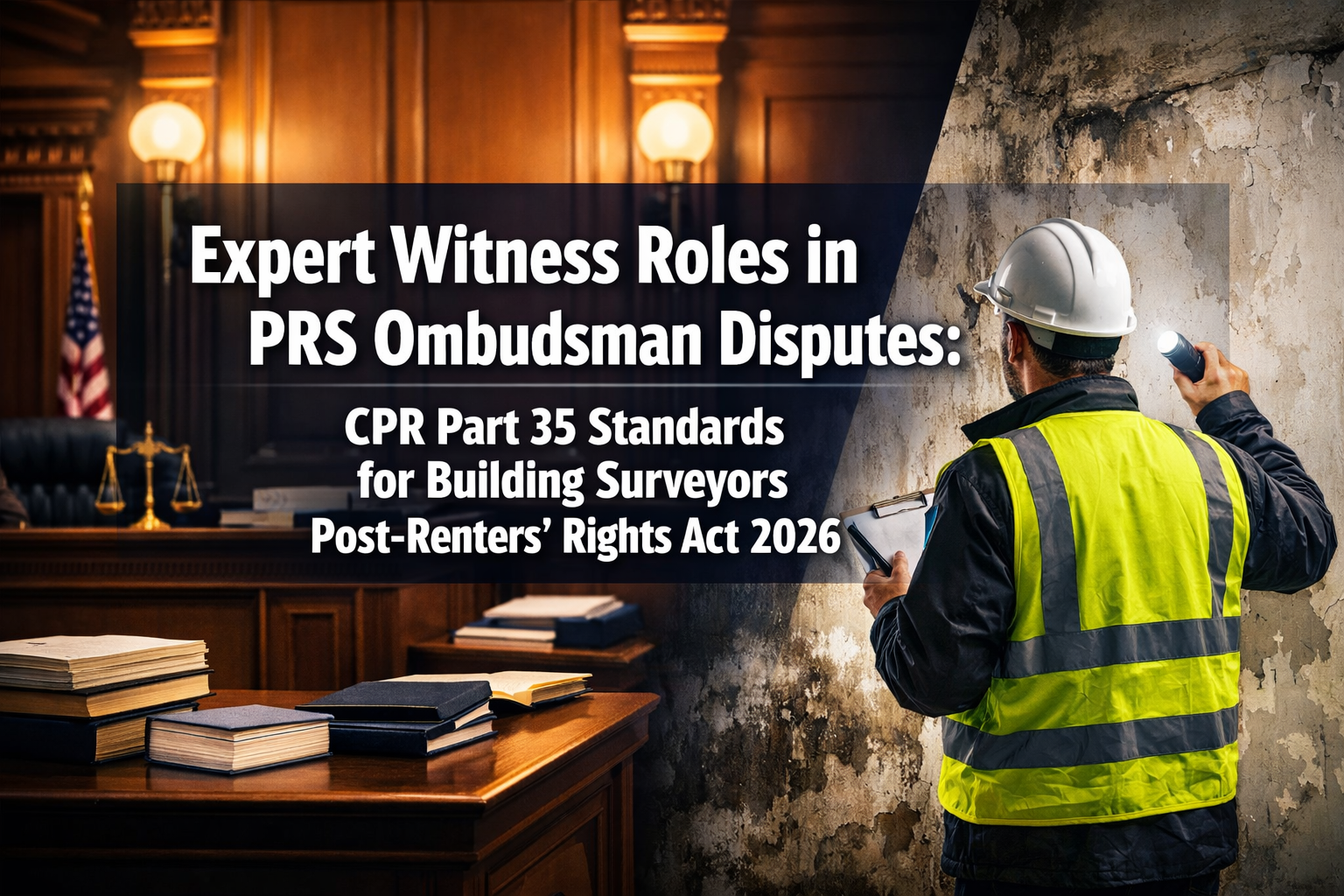
Over 65% of private rented sector disputes escalating to formal resolution in 2026 involve contested property condition evidence — yet a significant proportion of expert witness reports submitted in these cases fail to meet the standards required under CPR Part 35. With the new mandatory PRS Ombudsman scheme operational from May 2026 under the Renters' Rights Act 2026, the stakes for building surveyors acting as expert witnesses have never been higher. Understanding Expert Witness Roles in PRS Ombudsman Disputes: CPR Part 35 Standards for Building Surveyors Post-Renters' Rights Act 2026 is now an essential competency, not an optional specialism.
Key Takeaways 📋
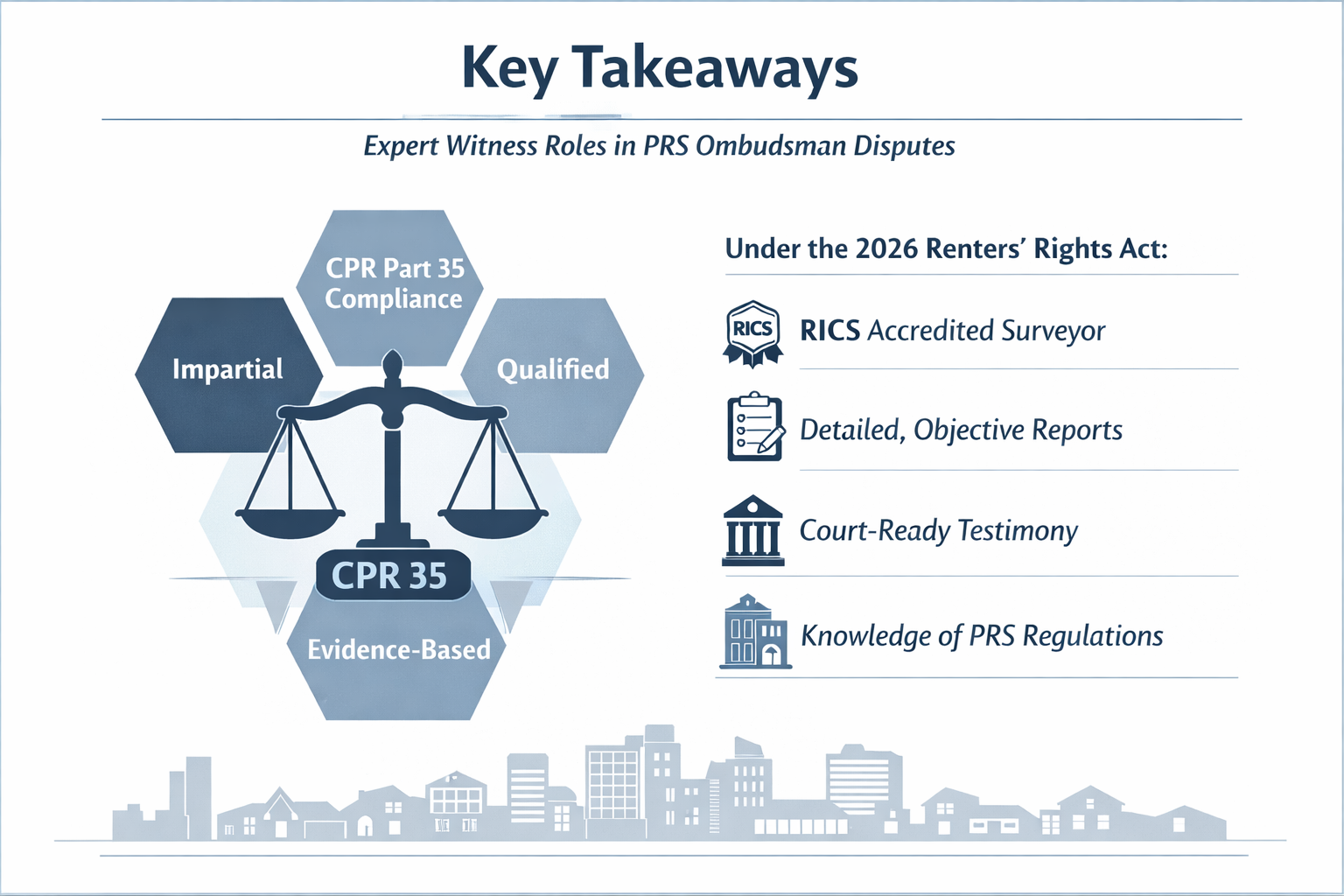
- The PRS Ombudsman, mandatory from May 2026, handles landlord-tenant disputes faster than courts — but still requires CPR Part 35-compliant expert evidence for complex defect and valuation cases.
- Building surveyors acting as expert witnesses owe their primary duty to the tribunal or ombudsman, not to the instructing party [2].
- CPR Part 35 report requirements — including qualifications, materials relied upon, assumptions, and a statement of truth — apply in ombudsman proceedings where expert evidence is formally submitted [7].
- The Renters' Rights Act 2026 has expanded Section 8 grounds and introduced new habitability standards, making technically precise surveying evidence critical for both landlords and tenants.
- RICS members must demonstrate specific competence in expert witness conduct and complete relevant training to fulfil their professional obligations [1].
The PRS Ombudsman in 2026: A New Dispute Landscape
The Renters' Rights Act 2026 fundamentally restructured how landlord-tenant conflicts are resolved in England. The mandatory PRS Ombudsman scheme replaced the patchwork of voluntary redress schemes, requiring all private landlords to register. The scheme handles disputes ranging from deposit deductions and rent increases to serious disrepair claims and contested Section 8 possession grounds.
This shift matters enormously for building surveyors. Previously, expert evidence in PRS disputes was largely confined to county court proceedings. Now, ombudsman adjudicators are routinely receiving and weighing technical reports on:
- Structural defects and their causation
- Damp, mould, and condensation — particularly relevant under the new Decent Homes Standard applied to the PRS
- Dilapidations and end-of-tenancy condition disputes
- Valuation evidence supporting or contesting rent reduction claims
The ombudsman process is designed for speed. Most cases are resolved within 8–12 weeks. This compressed timeline places new pressure on surveyors to produce reports that are simultaneously thorough, compliant, and accessible to non-technical adjudicators.
💬 "The ombudsman is not a court, but it demands court-quality evidence. Surveyors who treat it as a less formal arena do so at their client's peril."
For surveyors working across London and the South East, the volume of PRS Ombudsman referrals is already significant. Those offering expert witness report services in London are seeing demand rise sharply as landlords and tenants alike seek technically credible evidence to support their positions.
Understanding CPR Part 35: The Foundation of Expert Witness Roles in PRS Ombudsman Disputes
What CPR Part 35 Actually Requires
CPR Part 35 governs expert evidence in civil proceedings in England and Wales [7]. While the PRS Ombudsman is not a civil court, its procedural framework increasingly mirrors CPR standards, particularly for complex technical disputes. Surveyors submitting expert reports to the ombudsman should treat CPR Part 35 compliance as the baseline.
The core requirements under CPR Part 35 include [2][7]:
| Requirement | What It Means in Practice |
|---|---|
| Overriding duty to the court/tribunal | The expert's primary obligation is to the adjudicator, not the instructing party |
| Statement of truth | The report must confirm the expert's genuine belief in its contents |
| Qualifications and experience | The report must clearly set out why the expert is qualified to give the opinion |
| Materials relied upon | All documents, inspections, and data sources must be listed |
| Assumptions made | Any assumptions underpinning opinions must be explicitly stated |
| Range of opinion | Where opinion varies, the range should be acknowledged |
| Summary of conclusions | A clear, accessible summary must be included |
The overriding duty is the most critical element. Building surveyors must recognise that their role is not to advocate for the party who instructed them, but to assist the adjudicator in reaching a fair and informed decision [2]. This distinction is frequently misunderstood, particularly by surveyors new to expert witness work.
The Duty of Independence
CPR 35.3 is unambiguous: an expert's duty to the court overrides any obligation to the person who instructed or is paying them [7]. In the context of PRS Ombudsman disputes, this means:
- A surveyor instructed by a landlord must report honestly even where findings support the tenant's position
- A surveyor instructed by a tenant must acknowledge limitations in their evidence
- Opinions must be based on evidence and professional expertise, not on what the client wants to hear
RICS members have additional professional obligations here. The RICS requires members to demonstrate competence in expert witness conduct and to understand legal processes and court expectations before accepting expert witness instructions [1]. Failure to meet these standards can result in professional disciplinary action, quite apart from the damage a non-compliant report does to a client's case.
Expert Witness Roles in PRS Ombudsman Disputes: Section 8 Grounds and Evidence Standards
How the Renters' Rights Act 2026 Changed Section 8
The Renters' Rights Act 2026 significantly reformed possession grounds. The abolition of Section 21 'no-fault' evictions means that landlords seeking possession must now rely entirely on Section 8 grounds. Several of these grounds directly engage building surveying expertise:
- Ground 1A (new): Landlord intends to sell the property — requires evidence the property is in a condition suitable for sale
- Ground 3 (expanded): Deterioration of the property — requires technical evidence of the nature, extent, and cause of damage
- Ground 10/11 (rent arrears): Where tenants argue rent should be reduced due to disrepair, surveying evidence on property condition becomes central
- Habitability grounds: The expanded Decent Homes Standard for the PRS means landlords face possession challenges where tenants counterclaim on condition
In each scenario, the quality of expert witness evidence can determine the outcome. An adjudicator presented with a CPR Part 35-compliant report from a chartered surveyor in London will give it significantly more weight than an informal letter of opinion.
Case Study: Damp and Mould Dispute — Section 8 Ground 3
Scenario: A landlord in West London served a Section 8 notice citing deterioration of the property (Ground 3) after a tenant caused condensation damp through inadequate ventilation. The tenant counterclaimed that the damp was structural, predating their tenancy, and sought a rent reduction through the PRS Ombudsman.
Expert evidence required:
- Causation analysis (condensation vs. penetrating/rising damp)
- Timeline of defect development
- Assessment of whether the property met the Decent Homes Standard at the start of the tenancy
- Quantification of any remediation costs
Outcome: The surveyor's CPR Part 35-compliant report, which clearly stated the materials relied upon (including a schedule of condition prepared at tenancy commencement), was accepted by the adjudicator. The report's statement of truth and clear acknowledgement of the range of expert opinion on causation gave it credibility. The landlord's possession claim succeeded on the evidence.
Case Study: Dilapidations and Deposit Disputes
Scenario: A tenant in North London disputed a landlord's deduction of £4,200 from their deposit for alleged damage to internal walls and flooring. The landlord submitted a contractor's quote; the tenant submitted photographs. The PRS Ombudsman requested expert evidence on the condition of the property.
What the ombudsman needed:
- An objective assessment of the condition at the end of the tenancy
- Differentiation between fair wear and tear and tenant damage
- Quantification of reasonable remediation costs
A dilapidations survey prepared to CPR Part 35 standards — with clear qualifications, methodology, and a statement of truth — provided the adjudicator with the technical foundation to make a fair award. Informal contractor quotes, by contrast, carry little evidential weight in ombudsman proceedings.
Practical Standards for CPR Part 35-Compliant Reports in Ombudsman Proceedings
Structuring the Report
A CPR Part 35-compliant expert witness report for PRS Ombudsman proceedings should follow this structure:
- Introduction and instructions received
- Expert's qualifications and relevant experience [2]
- Inspection methodology and date(s)
- Documents and materials relied upon [2]
- Assumptions made
- Findings of fact (what was observed)
- Expert opinion (interpretation of findings)
- Range of opinion (where applicable)
- Summary of conclusions
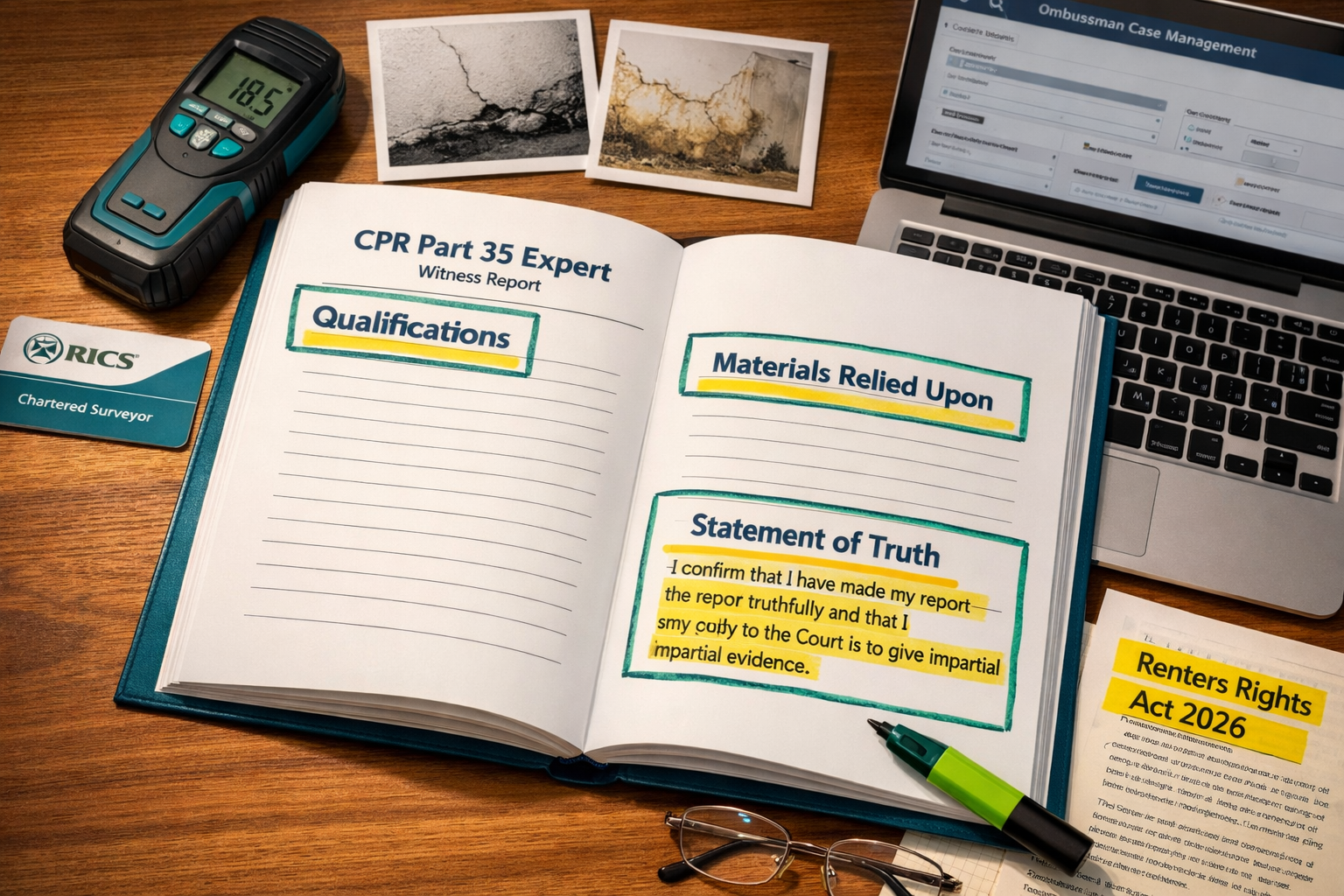
- Statement of truth [2][7]
The statement of truth must confirm that the expert understands their duty to the court/tribunal and that the report represents their genuine, independent professional opinion [7].
Responding to Instructions and Deadlines ⏰
CPR Part 35 requires experts to respond promptly to instructions and comply with deadlines set by the court or tribunal [2]. In PRS Ombudsman proceedings, this means:
- Acknowledging instructions within 48 hours
- Confirming availability to meet the ombudsman's timetable before accepting instructions
- Flagging conflicts of interest immediately
- Submitting reports by the stated deadline — late reports risk exclusion from the proceedings
The ombudsman's faster resolution timeline (8–12 weeks) means there is little room for delay. Surveyors who accept instructions they cannot fulfil within the required timeframe risk both their client's case and their professional reputation.
Joint Expert Instructions
Where both parties agree, the PRS Ombudsman may direct that a single joint expert be appointed. This is increasingly common in lower-value disputes. The joint expert's duty of independence is, if anything, even more critical — they must be seen to be entirely neutral by both parties [7].
For surveyors considering joint expert appointments, the expert witness report services available through experienced chartered surveying firms provide a useful benchmark for the standard of evidence expected.
Expert Witness Roles in PRS Ombudsman Disputes: Professional Competence and RICS Standards
RICS Requirements for Expert Witnesses
RICS members acting as expert witnesses must meet specific competence requirements [1]. These include:
- ✅ Demonstrable expertise in the relevant area of building surveying
- ✅ Training in expert witness conduct — understanding CPR Part 35 obligations
- ✅ Knowledge of legal processes — how ombudsman and court proceedings work
- ✅ Awareness of professional ethics — the duty of independence above all
The RICS Professional Statement on Conflicts of Interest and the RICS Guidance Note on Expert Witness both apply. Surveyors should review these before accepting any expert witness instruction in 2026.
Common Failures in PRS Expert Reports
Research into expert witness reports submitted in lettings market disputes in 2026 identifies recurring failures [5]:
| Failure | Impact on Case |
|---|---|
| No statement of truth | Report given little or no weight |
| Qualifications not stated | Expert's credibility questioned |
| Materials relied upon not listed | Findings cannot be verified |
| Advocacy tone (partisan language) | Report may be disregarded entirely |
| Missing range of opinion | Adjudicator cannot assess reliability |
| Late submission | Evidence excluded |
These failures are avoidable. A surveyor who understands CPR Part 35 and their duty of independence will produce a report that withstands scrutiny — and genuinely assists the adjudicator in reaching a fair outcome.
Valuation Evidence in Ombudsman Disputes
Beyond condition disputes, valuation evidence is increasingly relevant in PRS Ombudsman cases. Rent reduction claims, fair market rent assessments, and compensation calculations all require RICS-compliant valuation reports. Surveyors providing valuation reports in London for ombudsman proceedings should ensure these meet both RICS Red Book standards and CPR Part 35 requirements where they are being submitted as expert evidence.
Similarly, where disputes involve schedule of dilapidations assessments, the report must clearly distinguish between the surveyor's factual observations and their professional opinions on causation and cost.
Conclusion: Actionable Next Steps for Building Surveyors in 2026
The mandatory PRS Ombudsman scheme has created a new and growing market for expert witness services from building surveyors — but it has also raised the bar for the quality of evidence required. Expert Witness Roles in PRS Ombudsman Disputes: CPR Part 35 Standards for Building Surveyors Post-Renters' Rights Act 2026 represent both a professional opportunity and a significant responsibility.
Actionable Next Steps ✅
- Review CPR Part 35 in full and ensure every expert report you produce meets its structural requirements [7].
- Complete RICS-approved expert witness training if you have not already done so — this is a professional requirement, not optional [1].
- Build a CPR Part 35 report template specific to PRS Ombudsman proceedings, incorporating all mandatory sections including the statement of truth.
- Assess conflicts of interest before accepting any instruction — independence is non-negotiable [2].
- Engage with the PRS Ombudsman's procedural guidance as it develops through 2026 — the scheme is new and its evidence requirements will be refined through early cases.
- Collaborate with legal advisors to ensure your reports address the specific legal questions arising from Section 8 grounds under the Renters' Rights Act 2026.
Building surveyors who invest in understanding these standards will be well-positioned to provide genuinely valuable expert witness services in one of the most active dispute resolution arenas of 2026. Those who do not risk producing reports that are disregarded — and clients who lose cases they should have won.
References
[1] Expert Witness Duties Responsibilities – https://ww3.rics.org/uk/en/journals/built-environment-journal/expert-witness-duties-responsibilities.html
[2] The Responsibilities Of An Expert Witness Under Civil Procedure Rules Part 35 – https://paramedic-expert.com/the-responsibilities-of-an-expert-witness-under-civil-procedure-rules-part-35/
[4] Expert Witness Cpr Part 35 – https://www.kelhamconcept.com/professional-services/expert-witness-cpr-part-35/
[5] Expert Witness Roles In 2026 Lettings Market Disputes Navigating Tenant Demand Surge And Landlord Constraints – https://nottinghillsurveyors.com/blog/expert-witness-roles-in-2026-lettings-market-disputes-navigating-tenant-demand-surge-and-landlord-constraints
[6] Residential Buildings – https://www.jspubs.com/expert-witness/si/r/residential-buildings/
[7] Part 35 – https://www.justice.gov.uk/courts/procedure-rules/civil/rules/part35