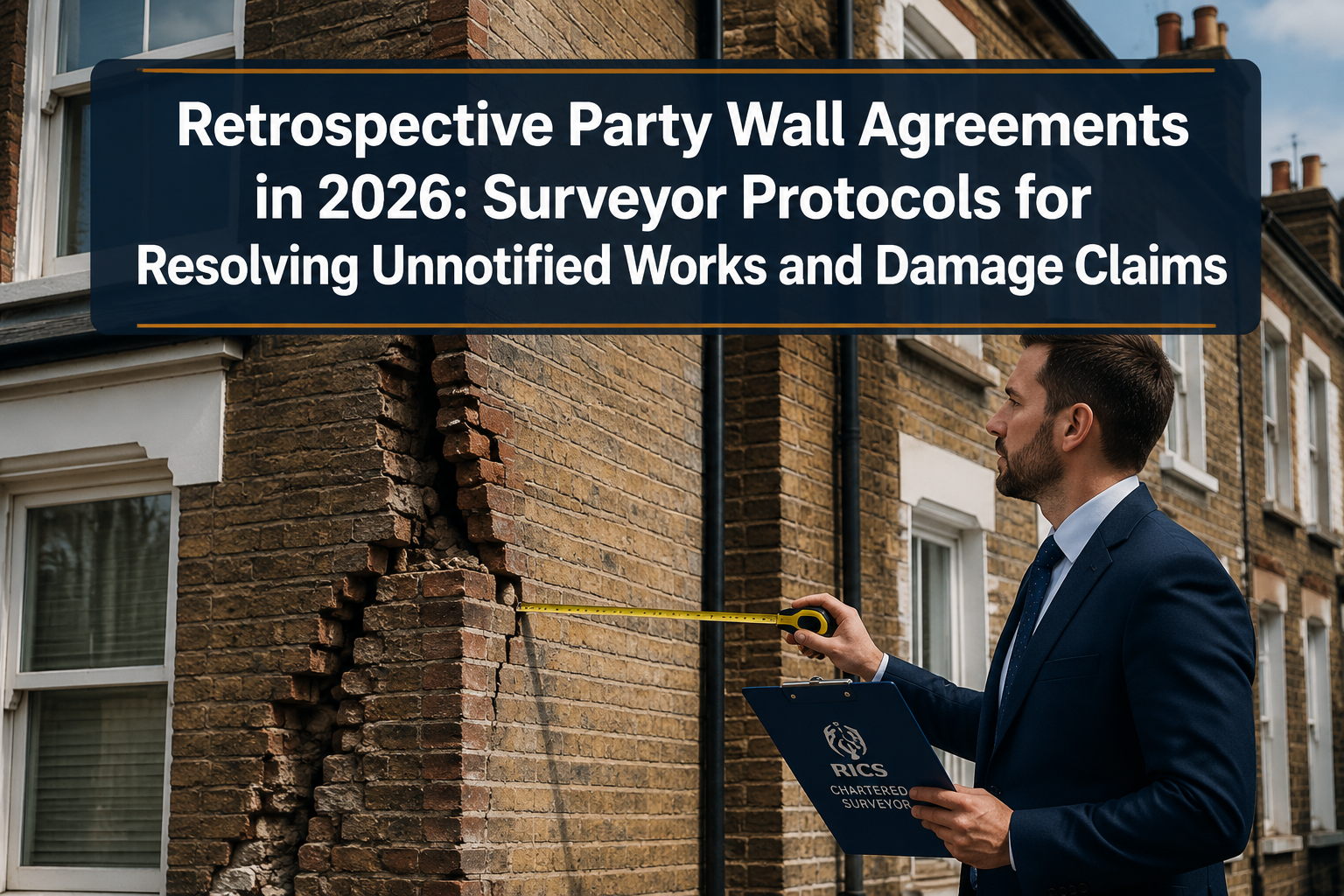

Nearly one in five residential construction disputes handled by party wall surveyors in England and Wales now involves works that were carried out without proper statutory notice — a figure that has climbed steadily alongside the post-pandemic home renovation boom and the 2026 housing market recovery. When a building owner skips the notice stage and proceeds with construction, the consequences ripple outward: cracked plasterwork, subsidence risks, fractured neighbour relationships, and the looming threat of costly litigation.
This article explains everything property owners, adjoining owners, and practitioners need to know about Retrospective Party Wall Agreements in 2026: Surveyor Protocols for Resolving Unnotified Works and Damage Claims — from the statutory framework that governs these situations to the precise steps surveyors follow when works have already been completed without notice.
Key Takeaways 📋
- Party Wall Notices cannot be served retrospectively — once works are complete, formal statutory procedures no longer apply, and disputes shift to common law territory.
- A retrospective party wall agreement is a practical, surveyor-led mechanism to resolve post-works disputes, document damage, and establish liability outside of court.
- The Schedule of Condition is the cornerstone document in any retrospective process — without it, proving pre-existing versus new damage becomes extremely difficult.
- Surveyors must remain independent throughout the retrospective process; the building owner's contractor or project surveyor cannot serve this role.
- Early professional engagement dramatically reduces costs — retrospective processes are almost always more expensive and time-consuming than proactive compliance.
What Is a Retrospective Party Wall Agreement and When Is It Needed?
A retrospective party wall agreement is a formal document drawn up by appointed surveyors between a building owner and an adjoining owner to address works that have already commenced or been completed in breach of the Party Wall etc. Act 1996 [1]. The breach typically arises from one of two failures: the building owner did not serve a Party Wall Notice before starting work, or they failed to appoint surveyors correctly under Section 10 of the Act [1].
It is critical to understand what a retrospective agreement is not: it is not a way of backdating statutory compliance. The law is clear — Party Wall Notices can only be served in advance of construction works. Once works are complete, the formal party wall procedures under the Act are no longer available, and disputes must be handled under common law instead [3]. A retrospective agreement is therefore a pragmatic workaround — a voluntary, surveyor-facilitated arrangement that mimics the protections of a formal Award without the statutory backing.
Common Triggers in 2026 🏗️
The situations most likely to generate a need for retrospective party wall procedures include:
| Work Type | Party Wall Act Section | Risk Level Without Notice |
|---|---|---|
| Loft conversions affecting party wall | Section 2 | High |
| Rear extensions with new foundations | Section 6 (3-metre rule) | Very High |
| Damp proof course insertion | Section 2 | Medium |
| Basement excavations | Section 6 | Extreme |
| Chimney removal or alteration | Section 2 | Medium |
With the 2026 property market recovery encouraging more homeowners to extend and convert, the volume of unnotified works — and the retrospective disputes that follow — is rising sharply [8].
The Legal Landscape: Why the Party Wall Act 1996 Still Matters After Works Complete
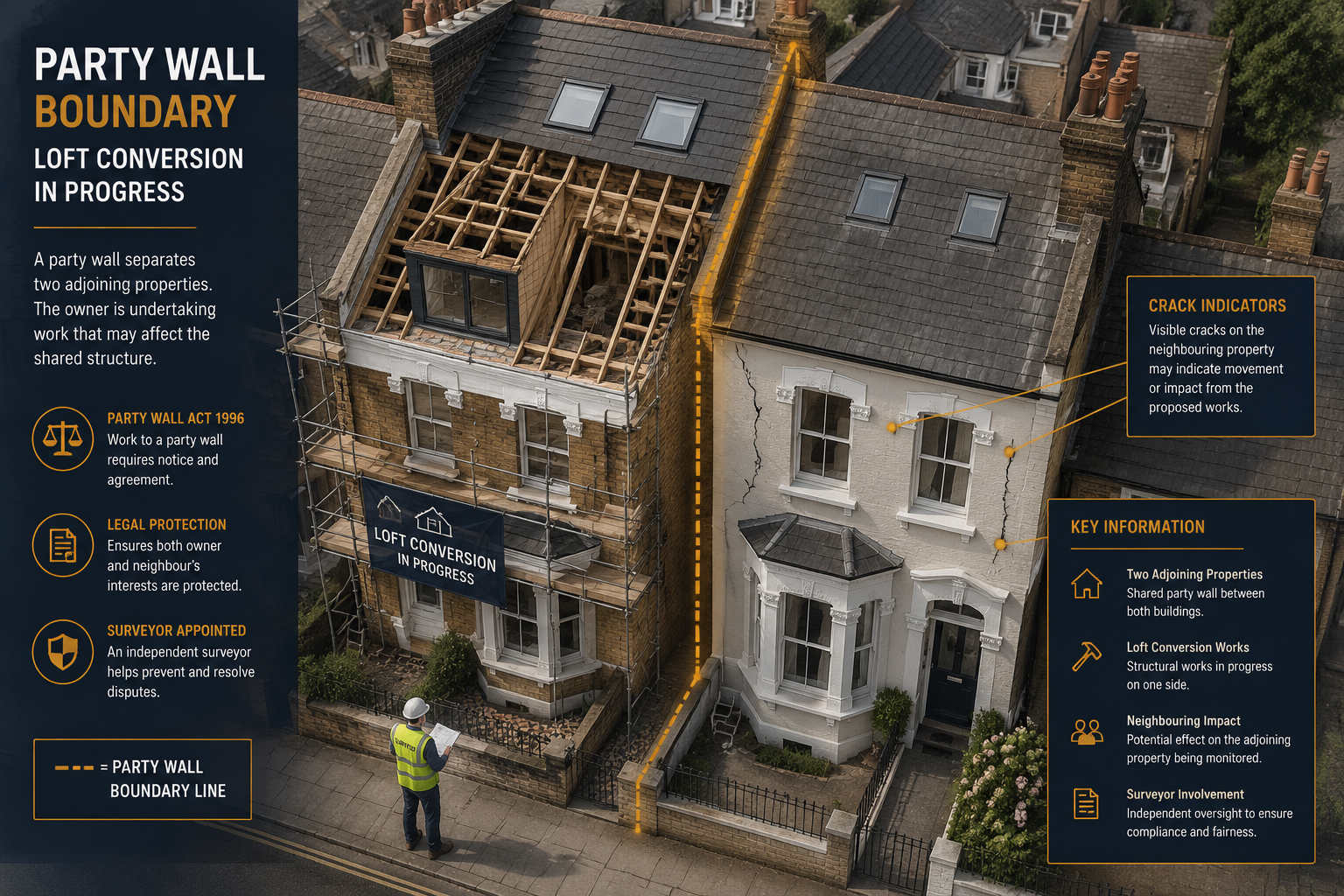
The Party Wall etc. Act 1996 applies exclusively to properties in England and Wales — it does not extend to Scotland or Northern Ireland [2]. This geographic scope is the first thing a surveyor must confirm when approached about a retrospective matter.
Once confirmed, the surveyor must assess which sections of the Act were engaged by the works carried out. The most commonly breached provisions are:
- Section 1 — new walls on or at the boundary line
- Section 2 — works to an existing party wall or party structure
- Section 6 — excavations within 3 or 6 metres of a neighbouring structure
Understanding what a party wall dispute actually involves under the Act is essential before determining whether a retrospective route is viable or whether common law remedies are the only option.
When Common Law Takes Over
If works are fully completed and no notice was ever served, the adjoining owner's primary remedies lie in:
- Negligence claims — if damage was caused by a failure to exercise reasonable care
- Nuisance claims — if the works unreasonably interfered with the enjoyment of the neighbouring property
- Trespass — if works physically encroached on the adjoining owner's land or structure
💬 "A retrospective agreement does not erase the statutory breach — it provides a structured, evidence-based framework for resolving the consequences of that breach without resorting to litigation."
This distinction matters enormously for cost recovery, which is addressed later in this article.
Surveyor Protocols for Retrospective Party Wall Agreements in 2026: A Step-by-Step Guide
Understanding the precise surveyor protocols for resolving unnotified works and damage claims is the heart of this topic. The process differs from a standard party wall procedure in several important ways.
Step 1: Initial Assessment and Scope Confirmation
The appointed surveyor's first task is to determine:
- What works were carried out — and whether they fall within the scope of the Party Wall etc. Act 1996
- Whether works are ongoing or complete — this determines whether any statutory route remains open
- The extent of any visible damage — a preliminary inspection of both properties is essential
- The relationship between the parties — whether dialogue is still possible or has broken down entirely
For works involving excavations near a boundary, the Party Wall Act 3-metre rule is a frequent point of contention in retrospective cases, particularly where basement or extension foundations have been dug without notice.
Step 2: Appointment of Surveyors
This is where the independence requirement becomes critical. When a retrospective party wall agreement is needed, either:
- An agreed surveyor is appointed jointly by both parties, or
- Each party appoints their own party wall surveyor, who then together select a third surveyor in case of deadlock [2]
⚠️ The building owner's architect, contractor, or project manager cannot act as the agreed surveyor. The surveyor must be genuinely independent and act impartially in the interests of resolving the dispute fairly [1].
Both parties should be aware of party wall surveyor costs at this stage. In retrospective cases, fees are typically higher than standard party wall procedures because the surveyor must reconstruct the pre-works condition from available evidence rather than conducting a straightforward pre-works inspection.
Step 3: Compiling the Retrospective Schedule of Condition
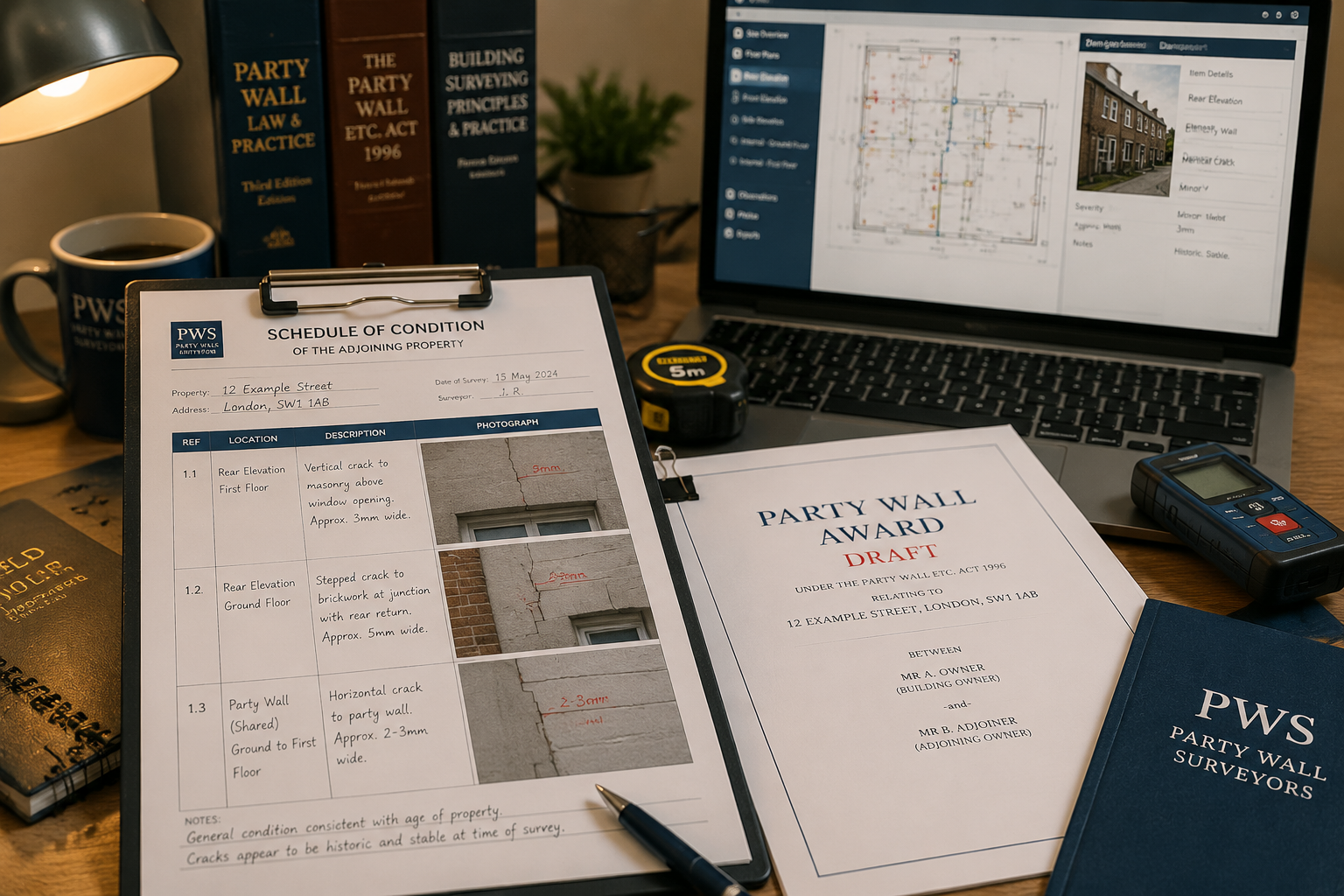
The Schedule of Condition is arguably the most important document in any retrospective party wall matter [6]. In a standard party wall process, this schedule is compiled before works begin, providing a photographic and written record of the neighbouring property's condition [2].
In a retrospective scenario, the surveyor must reconstruct this baseline using:
- 📸 Photographs taken before works — from the adjoining owner, estate agent listings, Google Street View, or any other pre-works imagery
- 🗂️ Previous survey reports — including any HomeBuyer Reports or Building Surveys on the adjoining property
- 🏠 Witness statements — from the adjoining owner describing the property's condition before works commenced
- 🔍 Expert analysis — to distinguish pre-existing defects from works-related damage
A detailed party wall schedule of condition forms the evidential backbone of any subsequent damage claim. Without it, attributing specific cracks or defects to the unnotified works becomes a matter of expert opinion rather than documented fact — significantly weakening the adjoining owner's position.
Step 4: Drafting the Retrospective Party Wall Award
Once the schedule of condition is compiled, the surveyor(s) draft a Party Wall Award — the formal document that records:
- The nature and extent of works carried out
- The condition of the adjoining property (as reconstructed)
- Any damage attributable to the works
- Remediation requirements and timelines
- Cost allocation between the parties [1][8]
The Award also clarifies the scope of works actually carried out versus what may have been originally planned — an important distinction where the building owner exceeded the works described in any informal communication [2].
Step 5: Damage Assessment and Cost Recovery
Where damage has occurred, the surveyor must quantify it. This typically involves:
- A structural engineer's report if load-bearing elements are affected
- Contractor quotes for remediation works
- Assessment of consequential losses — for example, if the adjoining owner had to vacate temporarily
💬 "In retrospective cases, the building owner who failed to serve notice carries a significantly heavier burden — both reputationally and financially — than one who followed the statutory process from the outset."
Cost recovery in retrospective cases follows the general party wall principle: the building owner bears the costs of works that were for their benefit. However, because the breach of statute may also give rise to common law claims, the adjoining owner may have additional remedies beyond what a standard Award would provide [8].
Practical Tactics for Adjoining Owners: Protecting Your Position
If works have already been carried out on a neighbouring property without notice, adjoining owners should act quickly and strategically.
Immediate Actions ✅
- Document everything now — photograph all visible damage with timestamps, noting the date works were observed to begin and end [4]
- Preserve any pre-works evidence — dig out old estate agent photos, previous survey reports, or any images taken before the works started
- Do not carry out repairs to damaged areas before the surveyor has inspected — this destroys evidence
- Seek professional advice immediately from a qualified party wall surveyor who specialises in dispute resolution
What NOT to Do ❌
- Do not attempt to negotiate directly with the building owner's contractor
- Do not accept informal verbal assurances about repairs without written confirmation [4]
- Do not delay — the longer the gap between works completing and a claim being made, the harder it becomes to establish causation
For homeowners in London and the South East, specialist surveyors covering areas such as South East London, Richmond, and Islington are well-placed to advise on retrospective matters given the high density of terraced and semi-detached properties in these areas.
Retrospective Agreements vs. Litigation: A Cost-Benefit Analysis
One of the most common questions in 2026 retrospective party wall matters is whether to pursue a surveyor-led retrospective agreement or go straight to court. The answer, in almost every case, is to pursue the surveyor route first.
| Factor | Retrospective Agreement | Common Law Litigation |
|---|---|---|
| Average cost | £1,500–£5,000+ | £15,000–£50,000+ |
| Timeline | 4–12 weeks | 12–36 months |
| Evidence required | Surveyor-assessed | Court-standard proof |
| Relationship impact | Moderate | Severe |
| Enforceability | Binding Award | Court judgment |
| Specialist expertise | Built-in | Must be separately instructed |
From dissent to a finalised Award, even complex retrospective cases typically resolve within 4–12 weeks once surveyors are appointed [4]. Compare this to the multi-year timeline and five-figure costs of County Court proceedings, and the case for the surveyor route becomes compelling.
Prevention: Why Proactive Compliance Always Wins
The clearest lesson from every retrospective party wall case is that prevention is dramatically cheaper than cure. Serving a proper party wall notice before works begin costs a fraction of what retrospective dispute resolution demands in time, money, and stress [3][5].
Building owners planning works in 2026 should:
- Identify early whether proposed works fall under the Party Wall etc. Act 1996 — particularly for loft conversions, extensions, and excavations near boundaries
- Serve notice at least one to two months before planned start dates (two months for party structure works, one month for line of junction works)
- Commission a Schedule of Condition of the neighbouring property before works begin — this protects both parties
- Appoint a qualified surveyor proactively, rather than reactively after a complaint arises [3]
For loft conversions specifically, understanding the party wall requirements for loft conversions before breaking ground is essential — these works almost always engage Section 2 of the Act.
Conclusion: Act Early, Document Thoroughly, Appoint Independently
Retrospective Party Wall Agreements in 2026: Surveyor Protocols for Resolving Unnotified Works and Damage Claims represent one of the most complex and consequential areas of residential property practice. As the housing market recovery drives more renovation activity, the risk of unnotified works — and the disputes that follow — will only grow.
Actionable Next Steps
For building owners who have already carried out unnotified works:
- Engage an independent party wall surveyor immediately
- Do not attempt to minimise or conceal the scope of works
- Be prepared to fund the retrospective process and any legitimate damage claims
For adjoining owners who have suffered damage:
- Document all damage with photographs and timestamps now
- Preserve any pre-works evidence you can locate
- Appoint your own independent party wall surveyor — do not rely on the building owner's surveyor
- Understand that a retrospective agreement, while imperfect, is almost always faster and cheaper than litigation
For both parties:
- Maintain written records of all communications
- Engage qualified professionals early
- Approach the process with a view to resolution rather than confrontation
The surveyor-led retrospective process exists precisely because disputes happen — and because resolving them through structured, evidence-based professional practice is almost always better for everyone than the alternative.
References
[1] What Is A Retrospective Party Wall Agreement – https://iconsurveyors.co.uk/faqs/what-is-a-retrospective-party-wall-agreement/
[2] Party Wall Agreement – https://hoa.org.uk/advice/guides-for-homeowners/i-am-improving/party-wall-agreement/
[3] Can I Serve Party Wall Notices Retrospectively – https://stokemont.com/advice/can-i-serve-party-wall-notices-retrospectively/
[4] Party Wall Dispute – https://onlinearchitecturalservices.com/party-wall-dispute/
[5] Understanding Party Wall Act What Homeowners Need Know Before Renovating – https://www.partywallslimited.com/blog/understanding-party-wall-act-what-homeowners-need-know-before-renovating
[6] Party Wall Schedule Of Condition – https://onlinearchitecturalservices.com/party-wall-schedule-of-condition/
[7] Retrospective Party Wall Agreement – https://legalbeagles.info/forums/forum/legalbeagles-consumer-forums/welcome-forum/1560950-retrospective-party-wall-agreement
[8] Retrospective Party Wall Awards – https://www.coburnspartywall.co.uk/retrospective-party-wall-awards.html