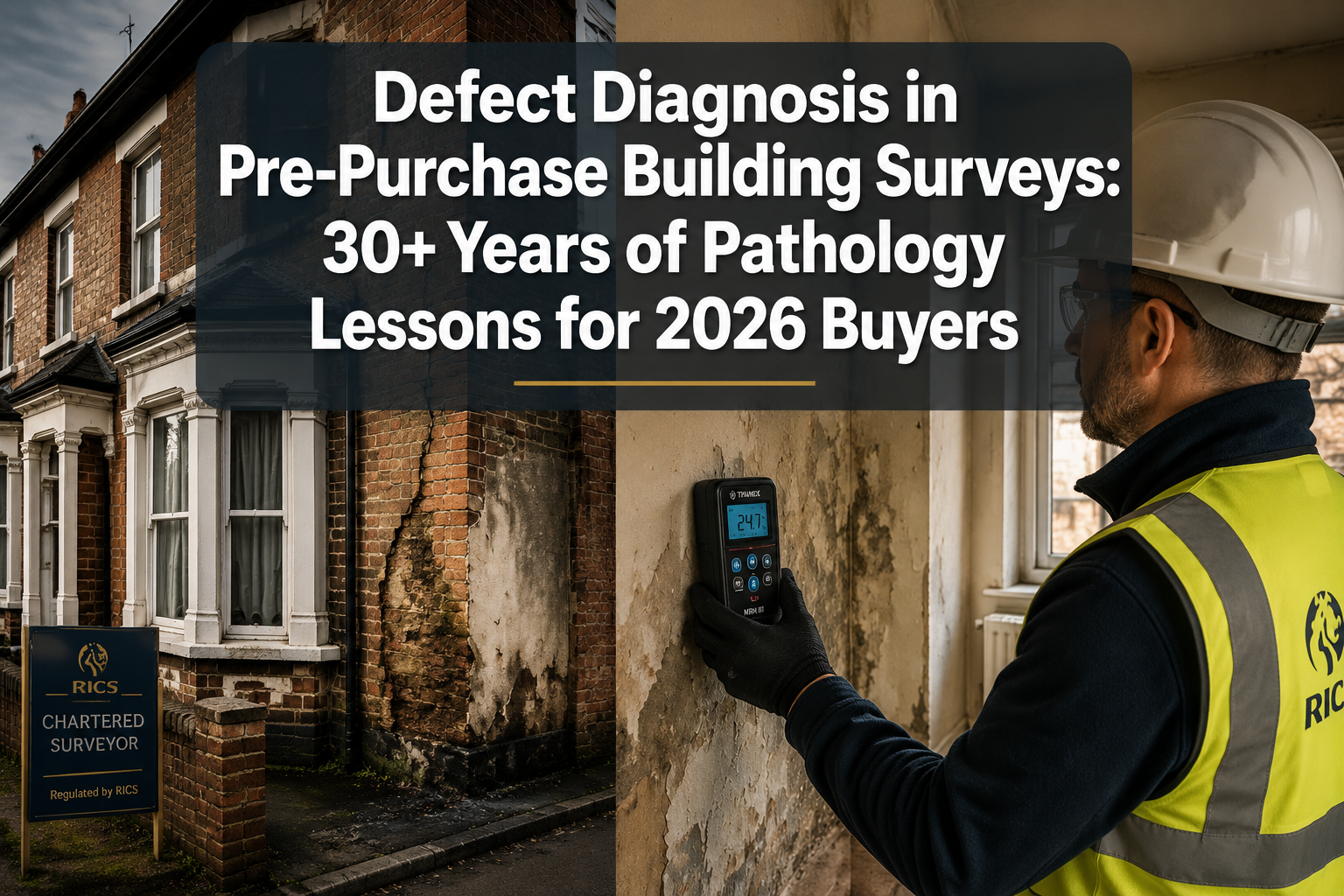

Nearly one in five UK property transactions encounters a significant renegotiation or collapse after a building survey uncovers defects the buyer never anticipated — and in a 2026 market where prices are stabilising after years of volatility, that leverage matters more than ever. Defect diagnosis in pre-purchase building surveys: 30+ years of pathology lessons for 2026 buyers is not simply a checklist exercise. It is a forensic discipline, shaped by decades of accumulated building science, that separates an informed buyer from an expensive mistake.
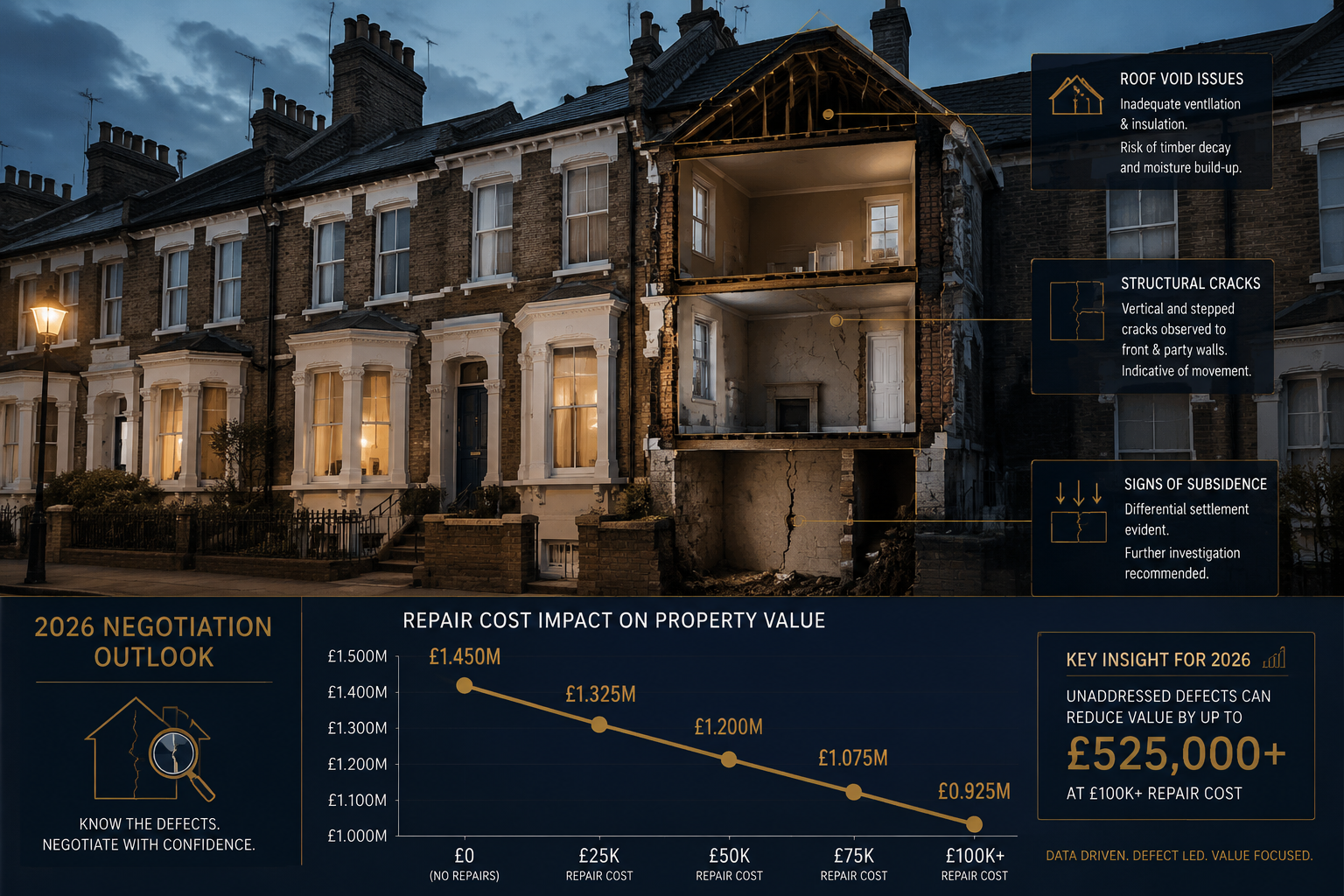
This guide draws on over three decades of surveying practice, current RICS methodology, and the most common — and costly — defects identified in Level 3 building surveys to give 2026 buyers a clear, actionable understanding of what a thorough survey really looks for, why root-cause diagnosis matters, and how findings translate directly into purchase price and long-term ownership costs.
Key Takeaways 📋
- Damp, roof defects, and structural movement are consistently the three highest-cost defect categories revealed in pre-purchase surveys [1]
- Root-cause diagnosis — not just symptom identification — is what separates a useful survey from a generic report [2]
- A Level 3 (Full Building) Survey is the only product that provides the depth of analysis needed for older, extended, or non-standard properties
- Hidden defects can reduce a property's market value by 5–20%, giving informed buyers real negotiating power in a stabilising 2026 market
- Early defect identification protects buyers from surprise costs, supports mortgage and insurance applications, and enables confident decision-making [1]
What 30+ Years of Building Pathology Actually Teaches Us
The phrase "building pathology" sounds clinical, but its meaning is practical: understanding why buildings fail, not just that they fail. Experienced surveyors who have inspected thousands of properties across different eras, construction types, and climates develop a pattern-recognition ability that no software can replicate. They know that a hairline crack above a doorframe in a 1930s semi-detached means something entirely different from the same crack in a 1970s system-built flat.
Defect diagnosis in pre-purchase building surveys: 30+ years of pathology lessons for 2026 buyers rests on one foundational principle: context is everything. A proper diagnosis requires the surveyor to consider the entire building — its construction type, age, orientation, drainage, proximity to trees, soil conditions, and any recent alterations — before drawing conclusions [2]. A north-facing wall with damp staining demands a different diagnostic pathway than the same staining on a south-facing elevation.
💬 "Treating the symptom instead of the cause leads to unnecessary expense. Installing a damp-proof system when the real problem is a leaking gutter solves nothing — and may complicate future repairs." [2]
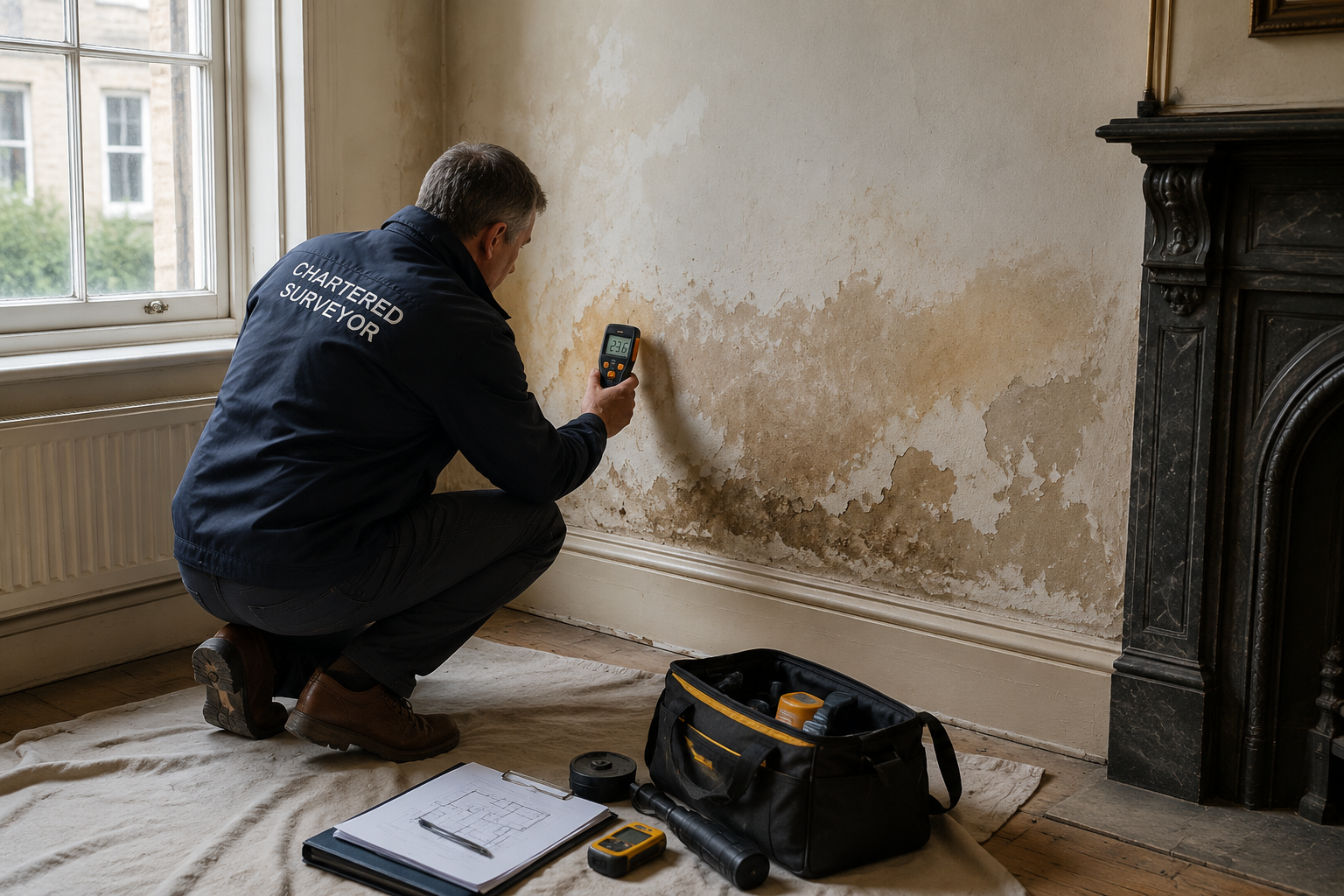
This is why on-site physical access is non-negotiable. Photographs, estate agent descriptions, and even video walkthroughs cannot substitute for a trained surveyor pressing a moisture meter against a wall, probing timber with a bradawl, or observing the precise pattern of cracking in context [2].
The Hierarchy of Defect Severity
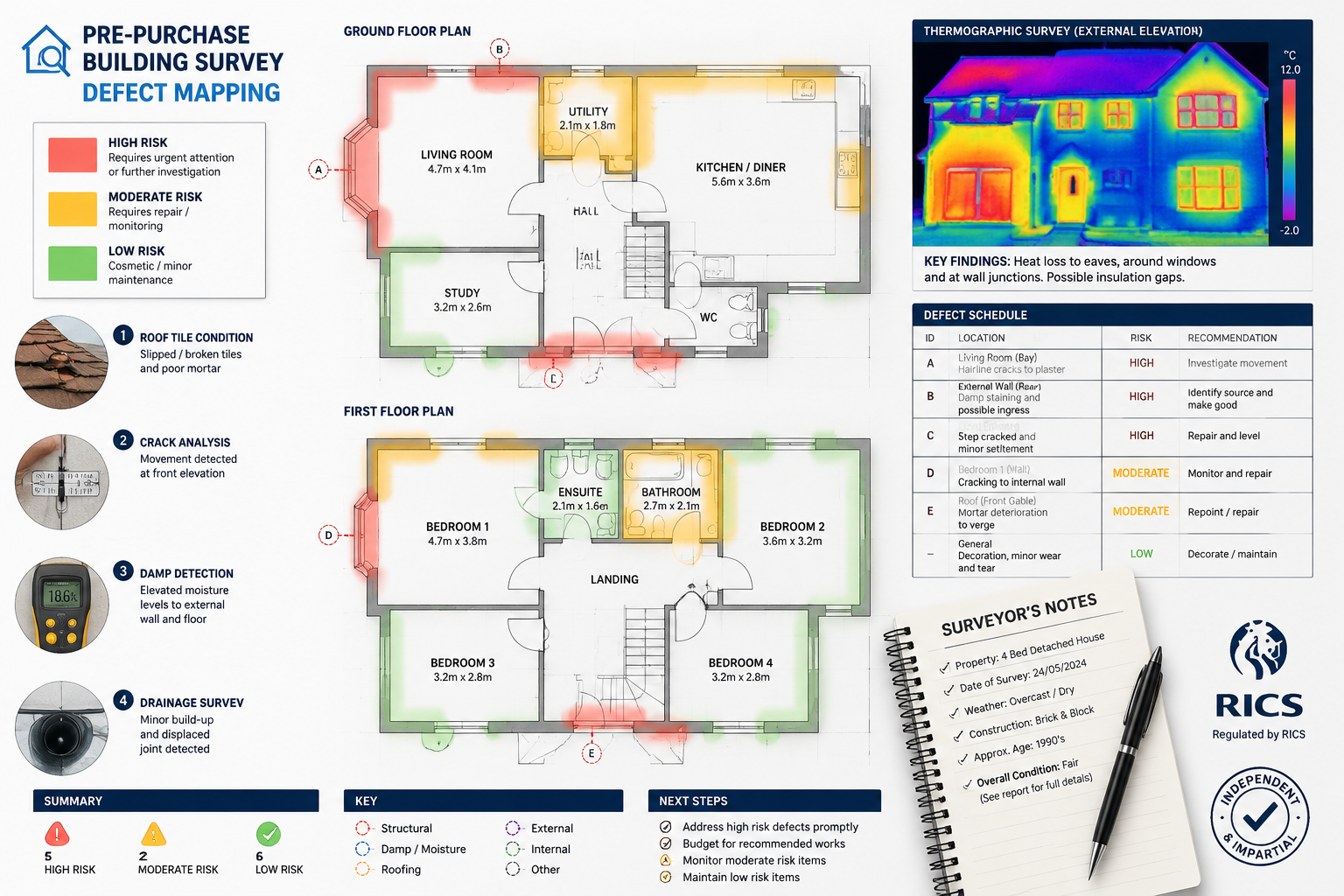
Not all defects are equal. Experienced surveyors mentally triage findings into three broad bands:
| Severity | Description | Examples |
|---|---|---|
| 🔴 Critical | Immediate safety risk or major structural failure | Active subsidence, dangerous electrics, severe roof failure |
| 🟡 Significant | Material impact on value or habitability | Rising damp, failed flat roof, extensive rot in timbers |
| 🟢 Maintenance | Routine wear requiring attention | Minor pointing repairs, worn sealant, dated boiler |
Understanding this hierarchy helps buyers prioritise remedial budgets and negotiate with confidence.
The Big Three: Damp, Roofs, and Structural Movement
Data from RICS-regulated surveys consistently shows that damp, roof problems, and structural movement are the defects most likely to generate surprise costs for homeowners [1]. Each deserves detailed attention.
🌧️ Damp: The Most Misdiagnosed Defect in British Property
Damp remains one of the most frequently reported issues in property surveys — and one of the most frequently misdiagnosed [1]. It presents in three distinct forms, each with a different cause, different remedy, and very different cost implication:
- Rising damp — moisture travelling upward through ground-floor walls via capillary action, often indicating a failed or absent damp-proof course (DPC)
- Penetrating damp — water entering through defective walls, windows, roofs, or flashings
- Condensation — moisture generated internally, exacerbated by poor ventilation or inadequate insulation [1]
The critical diagnostic error — made by inexperienced surveyors and specialist damp companies alike — is diagnosing rising damp when the actual cause is penetrating damp or condensation. This leads buyers to commission expensive chemical DPC injection that does nothing to address the real problem [2].
A skilled Level 3 survey will use a combination of moisture meters, hygrometers, and visual pattern analysis to distinguish between these categories before recommending any remedial action. For properties where damp is a suspected issue, a specific defect report can provide the targeted forensic analysis needed to establish cause and cost.
🏠 Roof Defects: The Most Expensive Surprise
The roof is consistently identified as one of the most critical and expensive components to repair [1]. A full roof replacement on a typical three-bedroom semi-detached property can cost £8,000–£20,000 in 2026, making roof condition a pivotal factor in purchase price negotiations.
Common roof defects identified in surveys include:
- Missing or slipped tiles/slates — often indicating nail fatigue in older roofs
- Sagging roof timbers — suggesting overloading, rot, or inadequate original design
- Failed flashings at chimneys, abutments, and valleys
- Inadequate ventilation leading to interstitial condensation and timber decay
- Blocked or defective guttering causing water ingress at eaves [1]
A dedicated roof survey in London provides the granular assessment needed when a standard survey flags roof concerns — particularly for flat roofs, complex roof geometries, or properties where access limitations prevented a full inspection.
🏗️ Structural Movement: Cracks, Subsidence, and Settlement
Structural cracking is perhaps the most anxiety-inducing finding in any survey — but not all cracks are equal. Diagonal stair-step cracking through brickwork, tapered cracks wider at the top, or doors and windows sticking can indicate active subsidence, while uniform horizontal cracking at mortar courses may simply reflect thermal movement in older masonry.
The diagnostic process for structural movement requires the surveyor to assess:
- Crack pattern, width, and taper — to distinguish settlement from subsidence
- Proximity to trees — particularly willows, oaks, and poplars on clay soils
- Drainage condition — leaking drains are a leading cause of localised subsidence
- Construction type — Victorian terraces behave very differently from post-war concrete frames
For properties where structural movement is identified or suspected, a subsidence survey in London provides the specialist investigation — including trial pits, drain testing, and engineer liaison — that a standard survey cannot.
How Defect Diagnosis in Pre-Purchase Building Surveys Shapes 2026 Valuations
In a stabilising market, defect findings have direct and quantifiable valuation consequences. This is where the pathology lessons of 30+ years translate into real financial outcomes for 2026 buyers.
The Negotiation Arithmetic
Consider a property listed at £650,000. A Level 3 survey reveals:
- Roof requiring full replacement: £14,000
- Rising damp treatment (correctly diagnosed as penetrating damp from failed flashing): £3,500
- Structural crack requiring monitoring and minor underpinning investigation: £8,000
- Total identified remedial cost: £25,500
An informed buyer, armed with a detailed survey report, can reasonably request a price reduction reflecting these costs — or require the seller to complete works before exchange. In a market where sellers are no longer receiving multiple competing offers, this leverage is significant.
💬 "Full surveys help buyers budget for repairs, renegotiate purchase prices if needed, walk away from risky investments, prioritise safety and compliance issues, and secure necessary insurance or lending." [1]
Choosing the Right Survey Level
Not every property needs the same level of investigation. The choice between survey types has significant implications for the depth of defect diagnosis achieved:
| Survey Type | Best For | Defect Depth |
|---|---|---|
| RICS Home Survey Level 2 (Homebuyer Report) | Modern, standard-construction properties in good condition | Moderate |
| RICS Home Survey Level 3 (Full Building Survey) | Pre-1980 properties, extended, altered, or non-standard construction | Comprehensive |
| Specific Defect Report | Single identified concern (e.g., crack, damp patch) | Targeted |
For most buyers considering older London and South East properties, understanding the difference between a homebuyer report and a building survey is the essential first step in commissioning the right product.
Hidden Defects and Insurance Implications
Several defect categories identified in surveys have direct insurance consequences. Subsidence history, undisclosed alterations, and Japanese knotweed can all affect buildings insurance availability and premium levels. An accurate insurance reinstatement valuation ensures that any policy taken out reflects the true rebuild cost — particularly important where survey findings reveal non-standard construction materials or significant structural complexity.
A Comprehensive Defect Checklist: What a Level 3 Survey Covers
Professional building surveys assess every accessible element of the property [3]. Here is what a thorough Level 3 inspection examines:
External Elements 🔍
- Roof coverings, chimneys, flashings, and guttering
- External walls — brickwork, render, cladding, pointing
- Windows, doors, and external joinery
- Damp-proof course level and condition
- Drainage: inspection chambers, gullies, surface water management [1][4]
Structural Elements 🔍
- Foundation condition and evidence of movement
- Load-bearing walls and beam supports
- Floor structure — suspended timber or concrete slab
- Roof structure — rafters, purlins, ridge, and ceiling joists
Internal Elements 🔍
- All rooms: walls, ceilings, floors, and joinery
- Bathrooms and kitchens — waterproofing, ventilation, pipework
- Roof space and cellar/basement where accessible
- Fireplaces and chimney breasts [3]
Services 🔍
- Electrical installation (visual inspection, age, condition)
- Heating system — boiler age, controls, visible pipework
- Plumbing — water pressure, visible pipework, signs of leaks
- Insulation — loft, walls, and pipe lagging [3]
⚠️ Important: A building survey is a visual inspection. It does not include opening up of floors, walls, or ceilings, nor does it test electrical or gas installations to the standard of a specialist report. Where surveys flag concerns, specialist follow-up investigations are recommended.
Pathology Lessons Applied: Property-Type Specific Risks in 2026
Different property types carry different defect profiles. Here is a quick-reference guide for 2026 buyers:
🏘️ Victorian and Edwardian Terraces (Pre-1919)
- Primary risks: Damp (solid wall construction has no cavity), timber decay, lead pipes, knob-and-tube wiring, settlement cracking
- Survey focus: DPC condition, roof structure, chimney stacks, drainage
🏠 Inter-War Semi-Detached (1919–1939)
- Primary risks: Cavity wall tie corrosion, asbestos in outbuildings, aging electrical systems
- Survey focus: Wall tie condition, roof felting, electrical consumer unit
🏢 Post-War and System-Built (1945–1980)
- Primary risks: Non-standard construction (concrete frames, prefabricated panels), flat roof failure, asbestos
- Survey focus: Construction type identification, flat roof condition, structural integrity
🏙️ Modern Properties (Post-1980)
- Primary risks: Snagging defects in newer builds, NHBC warranty expiry issues, poor-quality extensions
- Survey focus: Extension quality, drainage, energy performance [5]
For buyers of new-build properties, a snagging report identifies construction defects before legal completion — a critical step that many first-time buyers overlook.
Applying Defect Diagnosis in Pre-Purchase Building Surveys: Practical Steps for 2026 Buyers
The pathology lessons of three decades converge on a clear process for 2026 buyers:
Step 1: Commission the Right Survey Early
Do not wait until after exchange. Commission a Level 3 survey as soon as an offer is accepted. Early identification of defects preserves maximum negotiating time and avoids the sunk-cost pressure of a late survey.
Step 2: Read the Report Critically
Survey reports use condition ratings (typically 1–3 or traffic light systems). Focus on Condition 3 items first — these require urgent attention. Do not dismiss Condition 2 items; they represent the medium-term maintenance liability that affects total cost of ownership.
Step 3: Obtain Specialist Quotes for Flagged Items
A survey report is a diagnosis, not a cost schedule. For any significant defect, obtain at least two contractor quotes before using the figure in negotiations. Surveyors can provide indicative cost ranges, but specialist trades provide binding estimates.
Step 4: Use Findings in Price Negotiations
Present survey findings professionally — through solicitors or directly — with supporting contractor quotes. Avoid emotional negotiation; frame requests as factual cost adjustments.
Step 5: Revisit Insurance and Valuation
Where defects affect rebuild complexity, ensure the buildings insurance reinstatement figure is accurate. Where significant structural issues are found, consider whether a Red Book valuation is needed to support mortgage lending.
Conclusion: The Survey Is the Investment 🏆
Defect diagnosis in pre-purchase building surveys: 30+ years of pathology lessons for 2026 buyers ultimately delivers one thing: certainty. In a property market where prices are stabilising and buyers have more time to make informed decisions, a thorough Level 3 survey is not a cost — it is the most valuable due diligence investment available.
The accumulated lessons of building pathology are clear: diagnose the cause, not just the symptom [2]; assess the whole building, not just the visible surface [2]; and translate findings into financial reality before contracts are exchanged [1].
Actionable Next Steps for 2026 Buyers:
- ✅ Determine the right survey level — use the homebuyer report vs building survey comparison to decide
- ✅ Commission a RICS-regulated Level 3 survey from a chartered surveyor with demonstrable experience in the property type and era
- ✅ Request a specific defect report for any single concern flagged before or during the survey process
- ✅ Obtain contractor quotes for all Condition 3 items within 7–10 days of receiving the report
- ✅ Review insurance and valuation requirements in light of survey findings before exchange
The building will stand for another century. The survey takes a day. The decision to invest in proper defect diagnosis is the one that protects everything that follows.
References
[1] What Defects Do Building Surveys Usually Reveal And Why You Should Care – https://lloyddixongroup.com/what-defects-do-building-surveys-usually-reveal-and-why-you-should-care/
[2] Watch – https://www.youtube.com/watch?v=W_-tGXDLAuw
[3] What Defects Do Building Surveyors Look For – https://www.propertyhealthcheck.ie/what-defects-do-building-surveyors-look-for/
[4] 5 Top Issues Found During Pre Purchase Building Inspections And Why Theyre So Important To Spot – https://www.bestwestbuilding.com.au/blog/5-top-issues-found-during-pre-purchase-building-inspections-and-why-theyre-so-important-to-spot/
[5] Home Inspection Trends Reshaping The 2026 Housing Market – https://www.housingwire.com/articles/home-inspection-trends-reshaping-the-2026-housing-market/