Nearly 40% of party wall disputes in 2026 stem from preventable errors made at the notice stage — not from disagreements about the construction work itself [3]. That single statistic reframes the entire challenge. The Party Wall etc. Act 1996 is not complicated legislation, but its procedural requirements are unforgiving. A single omission in a notice can pause a loft conversion for months, expose a building owner to legal challenge, or void the entire process — forcing a fresh start from scratch.
This article examines Party Wall Notices in Practice: The Most Common Drafting Errors That Trigger Delay or Invalidity with a focus on the notice types, service rules, timing obligations, and real-world mistakes that cause avoidable disputes — particularly for extensions, excavations, and internal structural works.
Key Takeaways 📌
- Nearly 40% of 2026 party wall disputes originate from notice-stage errors, not construction disagreements [3]
- There are three distinct notice types under the Act, each with different trigger works and timing rules
- The most costly errors involve wrong timing, vague descriptions, and incomplete owner identification
- Written consent from a neighbour is not a substitute for a formal Party Wall Award
- Omitting a Schedule of Condition — even when consent is given — creates serious legal exposure
- Professional notice drafting is frequently cheaper than the delays caused by defective DIY notices [1]
Understanding the Three Notice Types and When They Apply
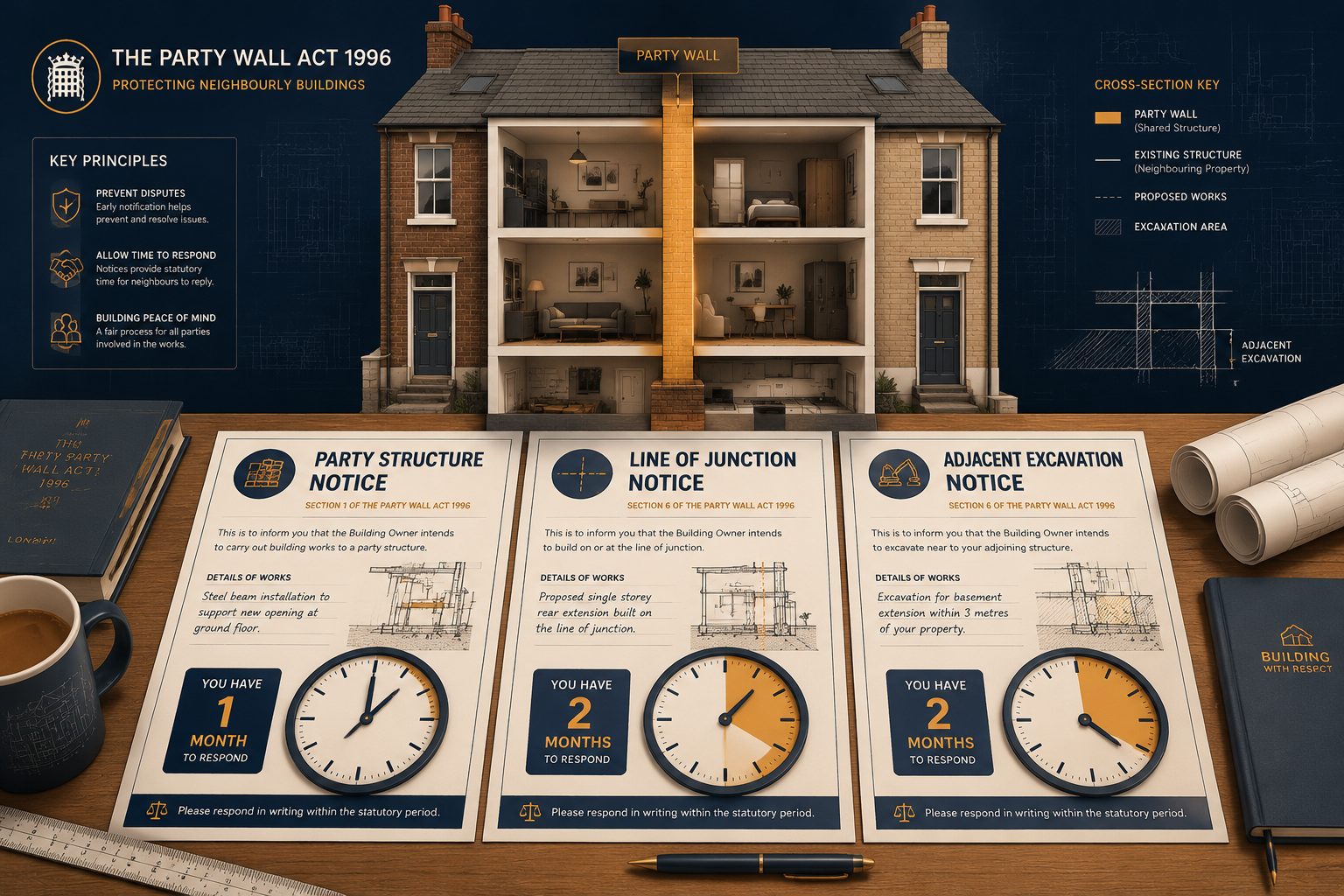
Before exploring drafting errors, it is essential to understand the framework. The Party Wall etc. Act 1996 establishes three distinct notice types, each triggered by different categories of work. Misidentifying which notice applies — or missing the trigger entirely — is itself one of the most common errors practitioners encounter [1].
1. Party Structure Notice (Section 3)
This notice applies to works on an existing party wall or party floor, such as:
- Cutting into a party wall to insert a steel beam
- Raising or underpinning a party wall
- Cutting away chimney breasts or projections
- Installing wall ties or flashing
⏱️ Minimum notice period: 2 months before works commence [7]. This is the most frequently misapplied timing rule in practice.
2. Line of Junction Notice (Section 1)
This notice is required when a building owner intends to build a new wall at or astride the boundary line. It applies to new extensions, garden walls, and outbuildings that sit on or near the boundary.
⏱️ Minimum notice period: 1 month before works commence.
3. Adjacent Excavation Notice (Section 6)
This notice is triggered when excavation works are planned within 3 metres of a neighbouring structure (where the excavation will go deeper than the neighbour's foundations), or within 6 metres where the excavation cuts a line drawn at 45° downward from the neighbour's foundations.
⏱️ Minimum notice period: 1 month before works commence.
💡 Pull Quote: "Serving the wrong notice type is as problematic as serving no notice at all — it provides no statutory protection and may need to be re-served in full."
For a comprehensive overview of how these notices fit into the wider process, the Party Wall Matters guide provides useful context for both building owners and adjoining owners.
Party Wall Notices in Practice: The Most Common Drafting Errors That Trigger Delay or Invalidity
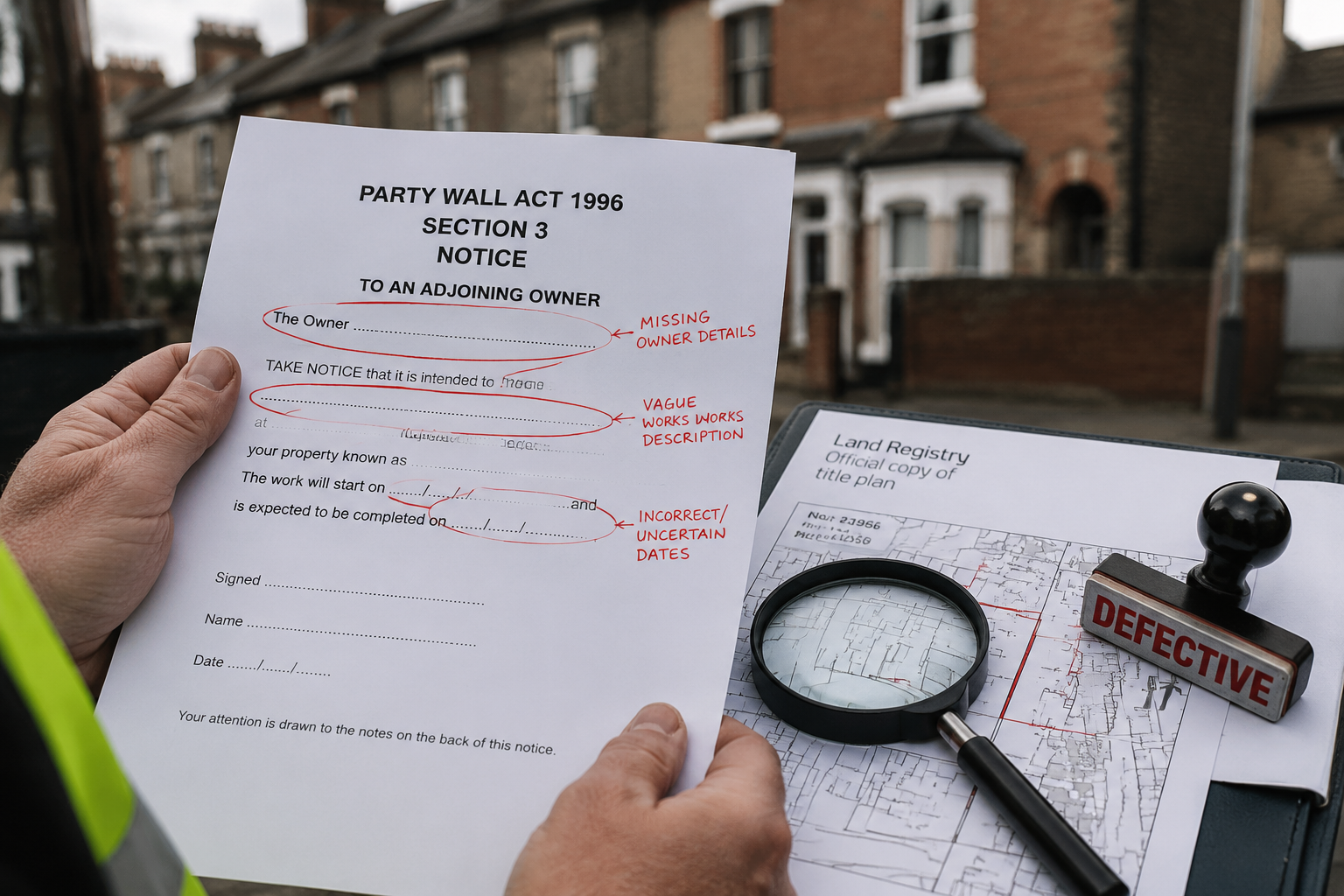
With the notice framework established, the focus shifts to the errors that actually derail projects. These fall into several clear categories.
❌ Error 1: Wrong or Insufficient Timing
Timing is consistently identified as the most costly drafting error in practice [1]. Many building owners serve notice only a few weeks before their planned start date, failing to account for:
- The statutory minimum notice period (1 or 2 months depending on notice type)
- The 14-day response window for adjoining owners
- The additional time required if dissent is served and surveyors must be appointed
- The time needed to prepare and agree a Party Wall Award
Realistic timeline for a Party Structure Notice:
| Stage | Minimum Time |
|---|---|
| Notice period | 2 months |
| Adjoining owner response window | 14 days |
| Surveyor appointment and Award preparation | 4–8 weeks |
| Total realistic lead time | 3–4 months minimum |
Serving a notice too late does not simply delay the start date by the shortfall — it can pause the entire project while the process restarts [1].
❌ Error 2: Vague or Incomplete Description of Works
A notice must describe what works are proposed, where they will occur, how they will be carried out, and when they are intended to start. Notices that use loose language — such as "general building works" or "structural alterations" — are non-compliant [1][6].
Common omissions include:
- No structural drawings or plans attached
- No specification of the method of work (e.g., type of beam, underpinning method)
- No proposed start date or programme
- No reference to which specific wall, floor, or structure is affected
This is especially relevant for party wall works during loft conversions, where multiple notice types may be required simultaneously and the scope of works is often complex.
❌ Error 3: Incomplete or Incorrect Identification of Adjoining Owners
The Act requires notice to be served on all relevant adjoining owners — not just the people who happen to live next door. Errors here include:
- Notifying only the occupier rather than the legal owner
- Failing to identify all owners of a building (e.g., multiple leaseholders and a freeholder)
- Not checking Land Registry records to confirm ownership
- Missing management companies or head lessors in leasehold properties [1]
A notice served on the wrong person has no legal effect. If a relevant owner is missed entirely, the notice is invalid and the building owner has no statutory protection — even if works have already commenced [6].
❌ Error 4: Misidentifying Whether a Notice Is Required at All
Practitioners frequently make errors in both directions: serving notices when the Act does not require them, or — far more seriously — failing to serve notices when the Act clearly does [1].
Works that commonly trigger the Act but are overlooked:
- Internal works that involve cutting into or removing sections of a party wall (even if the external face is untouched)
- Excavations for extensions within the 3-metre or 6-metre zones
- Chimney breast removals on a party wall — see the party wall shared chimneys guide for specific considerations
- Insulation works to party walls — explored in detail in the party wall insulation resource
Carrying out notifiable works without a valid notice exposes the building owner to injunction proceedings and potential liability for any damage caused.
❌ Error 5: Treating Written Consent as a Party Wall Award
One of the most significant misconceptions in practice is the belief that a neighbour's written consent removes all further obligations [1][2]. It does not.
Written consent confirms that the adjoining owner does not dissent and does not require a Party Wall Award. However, it does not:
- Provide the same legal protections as a formal Award
- Remove the need to document the condition of the adjoining property before works begin
- Protect the building owner if the adjoining owner later claims damage
This connects directly to the next error.
❌ Error 6: Omitting the Schedule of Condition
Even where consent is freely given, skipping the Schedule of Condition is a serious mistake [1]. A Schedule of Condition is a photographic and written record of the adjoining property's condition before works commence.
Without it:
- There is no baseline against which to assess any damage claims
- The building owner cannot demonstrate that a crack or defect pre-existed the works
- The adjoining owner cannot prove that a new defect was caused by the works
Both parties are left exposed. In practice, this omission generates more post-construction disputes than almost any other single error [1].
❌ Error 7: Incorrect Method of Service
The Act specifies how notices must be served. Acceptable methods include:
- Personal delivery to the adjoining owner
- Delivery by post to the owner's last known address
- Affixing to the property if the owner is unknown or cannot be found after reasonable enquiry
Email is not a statutory method of service under the Act, though it may be used as a supplementary communication. Relying solely on email — or informally handing a notice to an occupier rather than the legal owner — renders the notice invalid [6].
Party Wall Notices in Practice: Avoiding Invalidity Through Professional Compliance

The 2026 Regulatory Context
The Royal Institution of Chartered Surveyors (RICS) launched a consultation on the draft 8th edition of Party Wall Legislation and Procedure across April and May 2026, seeking feedback from surveyors, legal professionals, and dispute resolution practitioners [5]. The consultation reflects growing recognition that procedural compliance — including notice drafting — requires clearer, more consistent guidance across the profession [8].
Industry data from 2026 shows that the majority of party wall disputes now stem from improper notice service rather than substantive disagreements about construction methods [2][3]. This shift signals heightened enforcement of procedural compliance and underscores the importance of getting notices right at the outset.
The Real Cost of Getting It Wrong
The financial case for professional notice drafting is straightforward [1]:
| Scenario | Estimated Cost |
|---|---|
| Professional notice drafting | £200–£600 (typical range) |
| Project delay of 6–8 weeks | £3,000–£15,000+ (contractor standing time, extended hire costs, finance charges) |
| Injunction proceedings | £5,000–£25,000+ (legal fees) |
| Re-serving invalid notices and restarting process | 2–4 months additional delay |
💡 Pull Quote: "A defective notice does not just delay a project — it can void the entire statutory process, leaving the building owner without legal protection and exposed to injunction."
Practical Checklist: Before Serving Any Notice ✅
Use this checklist to reduce the risk of invalidity:
- Identify the correct notice type(s) for the proposed works
- Confirm all adjoining owners via Land Registry searches
- Calculate the correct notice period and work backwards from the intended start date
- Prepare accurate drawings and a clear written description of works
- Specify the proposed start date and programme
- Arrange for a Schedule of Condition regardless of whether consent is anticipated
- Confirm the method of service is statutory (post or personal delivery)
- Keep proof of service (certificate of posting, signed delivery receipt)
For those navigating the process for the first time, the Party Wall Act questions resource addresses the most common points of confusion in plain language.
When to Appoint a Surveyor
Where works are complex, where relationships with neighbours are strained, or where the project involves significant excavation or structural alteration, appointing a party wall agreed surveyor early in the process is strongly advisable. An agreed surveyor acts for both parties, reducing costs and timescales compared to the two-surveyor model.
Understanding the party wall surveyor cost structure helps building owners budget accurately and avoid the false economy of attempting complex notices without professional support.
Conclusion: Get the Notice Right — or Pay the Price Later
Party Wall Notices in Practice: The Most Common Drafting Errors That Trigger Delay or Invalidity is not an abstract compliance exercise. Every error identified in this article — wrong timing, vague descriptions, missed owners, invalid service, absent Schedules of Condition — has a direct, measurable cost in time and money.
The good news is that every one of these errors is entirely preventable.
Actionable Next Steps
- Start early. Build a minimum of 3–4 months into any project programme for party wall compliance before works begin.
- Check Land Registry. Always verify the legal ownership of adjoining properties — do not rely on assumptions about who lives next door.
- Describe works precisely. Attach drawings, specifications, and a proposed programme to every notice.
- Commission a Schedule of Condition. Do this regardless of whether consent is expected or received.
- Use statutory service methods. Post or personal delivery — not email alone.
- Seek professional advice early. For complex or contentious projects, a qualified party wall surveyor will almost always save more than their fee.
The Party Wall Agreement guide provides further detail on what a properly constituted agreement and Award should contain — a useful reference point for anyone preparing to serve notice in 2026.
References
[1] Partywallsurveyoressex – https://www.oseimc.com/partywallsurveyoressex
[2] Common Mistakes In Party Wall Notices How Surveyors Fix Dissent And Delays – https://partywallsurveyorlondon.uk/blogs/common-mistakes-in-party-wall-notices-how-surveyors-fix-dissent-and-delays/
[3] Validity Of Party Wall Notices Common Errors And How Surveyors Validate Compliance – https://partywallsurveyorlondon.uk/blogs/validity-of-party-wall-notices-common-errors-and-how-surveyors-validate-compliance/
[5] Rics Launches Consultation On Updated Party Wall Practice Guidance – https://www.rics.org/news-insights/rics-launches-consultation-on-updated-party-wall-practice-guidance
[6] Party Wall Notice Drafting Errors That Invalidate Compliance Avoiding Legal Challenges Before Work Begins – https://partywallsurveyorlondon.uk/blogs/party-wall-notice-drafting-errors-that-invalidate-compliance-avoiding-legal-challenges-before-work-begins/
[7] Party Wall Surveys In 2026 Urban Renewal Managing High Demand Disputes And Neighbour Relations – https://princesurveyors.co.uk/blog/party-wall-surveys-in-2026-urban-renewal-managing-high-demand-disputes-and-neighbour-relations/
[8] Rics 8th Edition Party Wall Guidance 2026 Whats Changed And How Surveyors Must Adapt – https://wimbledonsurveyors.com/rics-8th-edition-party-wall-guidance-2026-whats-changed-and-how-surveyors-must-adapt/