

Fewer than one in three expert witness reports submitted in UK property cases fully satisfy Civil Procedure Rules on the first attempt — a statistic that costs claimants time, money, and credibility in court. Understanding what separates a robust, court-ready report from a fatally flawed one is not just a concern for lawyers. It matters to every property owner, landlord, or developer who may one day find themselves in a boundary dispute, defect claim, or valuation disagreement. This guide breaks down the precise standards that govern Expert Witness Reports in UK Property Disputes: What Makes a Surveyor's Evidence Court-Ready? — from CPR compliance and impartiality obligations to site inspection protocols and the common errors that sink otherwise strong cases.
Key Takeaways
- ✅ CPR Part 35 compliance is non-negotiable — any report that fails to meet its requirements risks being excluded by the court.
- ✅ The expert's overriding duty is to the court, not the client — impartiality must be demonstrable, not just declared.
- ✅ Structure, site inspection quality, and photographic evidence are the three pillars of a court-ready surveyor's report.
- ✅ Common mistakes — vague language, unsupported opinions, and missing declarations — routinely weaken expert evidence in boundary, defect, and valuation disputes.
- ✅ RICS Registered Expert Witness status provides a significant credibility advantage in UK legal proceedings.
The Legal Framework: CPR Part 35 and Why It Governs Everything
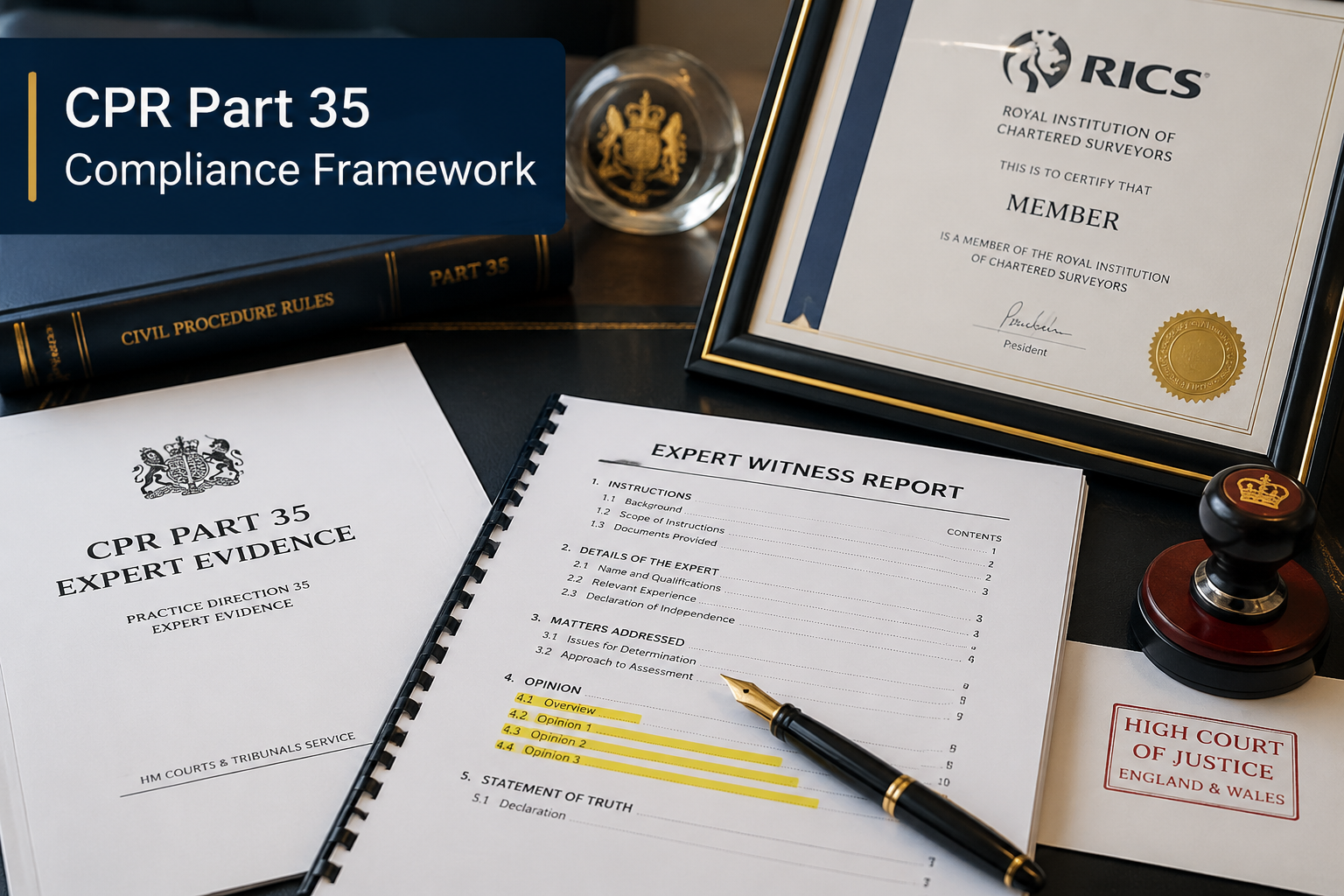
The Civil Procedure Rules (CPR) Part 35 is the binding legal framework for all expert evidence presented in English and Welsh courts. No matter how technically brilliant a surveyor may be, if their report does not comply with CPR Part 35, it can be rejected, restricted, or given little weight by the judge. [1][2]
What CPR Part 35 Actually Requires
The key rules within CPR Part 35 that every expert witness report must address include [3]:
| CPR Rule | Requirement |
|---|---|
| Rule 35.1 | Expert evidence must be restricted to what is reasonably required |
| Rule 35.2 | Clear definitions and interpretation of expert roles |
| Rule 35.3 | The expert's overriding duty is to the court, not the instructing party |
| Rule 35.4 | The court has power to restrict expert evidence at any time |
| Rule 35.5 | Expert evidence must generally be given in a written report |
💡 Pull Quote: "The expert's duty to the court overrides any obligation to the person from whom the expert has received instructions or by whom the expert is paid." — CPR Part 35.3
This last point — the duty to the court — is perhaps the most misunderstood aspect of expert witness work. A surveyor instructed by a claimant cannot simply advocate for that claimant's position. They must provide an honest, independent assessment, even if that assessment is unfavourable to the party paying their fees. [4]
The Role of Practice Directions
Alongside CPR Part 35 itself, the accompanying Practice Direction 35 sets out the mandatory contents of an expert's report. These include:
- A statement of the expert's qualifications
- Details of any literature or materials relied upon
- A statement that the expert understands their duty to the court
- A statement of truth
- Confirmation that the report complies with CPR requirements
Missing any of these elements is not a minor administrative oversight — it can render the entire report inadmissible.
What Makes a Surveyor's Evidence Court-Ready: Structure, Inspection, and Impartiality
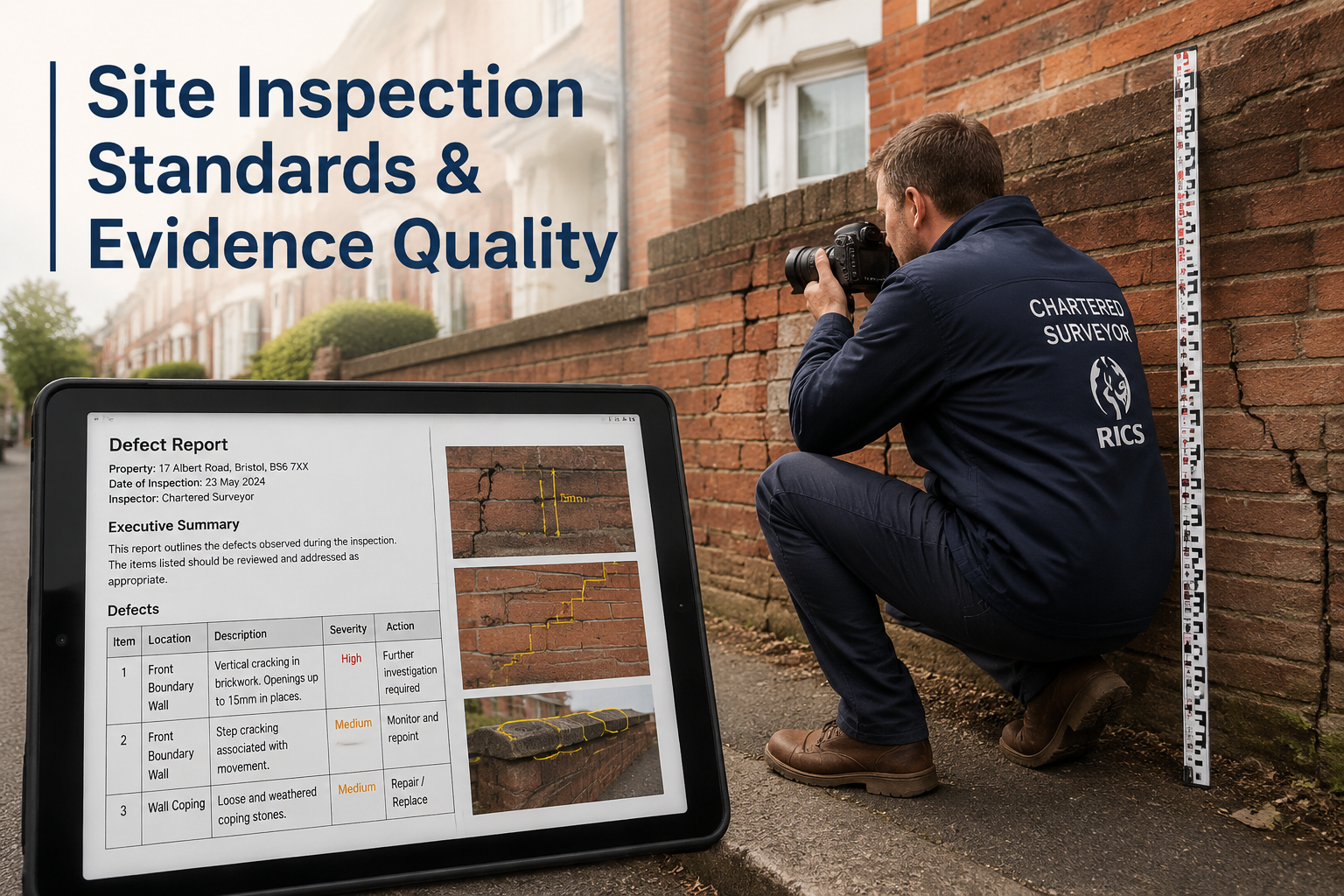
Understanding the legal framework is only the starting point. The practical quality of the report — how it is structured, what the site inspection covers, and how opinions are expressed — determines whether it will genuinely influence the outcome of a dispute.
1. The Mandatory Report Structure
A court-ready expert witness report in a UK property dispute is not a standard survey document reformatted with a legal header. It follows a specific structure [4][5]:
- Introduction and instructions received — who instructed the expert, what questions were posed, and what documents were reviewed
- Expert's qualifications and experience — relevant credentials, RICS membership, years of practice, and specific expertise in the dispute type
- Methodology — how the inspection was conducted, what tools were used, and what standards were applied
- Factual findings — objective observations from the site inspection, supported by annotated photographs
- Analysis and opinion — reasoned conclusions linked explicitly to the factual findings
- Declaration of truth and independence — the mandatory CPR statement confirming the expert's overriding duty to the court
Each section must flow logically into the next. Courts are not impressed by verbose reports that bury key findings in dense prose. Clarity and logical structure are themselves a form of credibility.
2. Site Inspection Standards: The Foundation of Factual Evidence
No expert witness report in a property dispute can be court-ready without a thorough, documented site inspection. Technical analysis must be specific and itemised, covering compliance, product suitability, workmanship quality, visible damage, and installation performance — providing the factual evidence courts require for informed decisions. [6]
For boundary disputes, this means physically attending the site, measuring distances, reviewing title deeds against physical features, and recording the condition of walls, fences, and hedges. For defect claims, it means a methodical inspection of the affected elements, often using specialist equipment. For valuation disputes, it means a formal inspection of the subject property alongside comparable evidence.
Surveyors preparing reports for boundary disputes or party wall matters must be especially rigorous in documenting the physical condition of shared structures before and after any works. A schedule of condition report prepared before works commence can be invaluable as a baseline document in subsequent litigation.
🔍 Key inspection elements that courts expect to see evidenced:
- Date, time, and weather conditions at inspection
- Names of all parties present
- Equipment used (e.g., damp meter, thermal imaging camera, drone)
- Specific locations of defects, referenced to floor plans or site plans
- Annotated, timestamped photographs
The use of drone roof surveys and other specialist inspection technology is increasingly accepted — and expected — in complex defect cases where access limitations would otherwise restrict the scope of evidence.
3. Photographic Evidence: Quality and Annotation Matter
Photographs are not optional extras in a court-ready report — they are primary evidence. Courts expect:
- High-resolution images that clearly show the defect or condition in question
- Scale references (a ruler or measuring tape in frame) where dimensions are relevant
- Annotations identifying the specific feature or defect shown
- Sequential numbering that cross-references the written findings
A photograph of a crack in a wall that is blurry, poorly lit, or unaccompanied by any annotation provides little evidential value. Worse, it can suggest a lack of professional rigour that undermines the entire report.
4. Demonstrating Impartiality: The Expert's Most Critical Obligation
Impartiality is not simply a matter of declaring independence in the report's opening paragraphs. It must be demonstrated throughout the document. [4] Courts — and opposing legal teams — are skilled at identifying reports that function as advocacy documents dressed up as expert opinion.
Signs of bias that weaken expert evidence include:
- Selectively citing only evidence that supports the instructing party's case
- Failing to acknowledge limitations in the inspection or methodology
- Using emotive or partisan language
- Refusing to concede any point that might assist the opposing party
⚖️ Pull Quote: "An expert who appears to be an advocate for their client's position will be given little weight by the court, regardless of their technical qualifications."
The RICS Registered Expert Witness status — which requires surveyors to demonstrate compliance with professional standards and undergo specific training — provides a measurable indicator of impartiality and credibility. [2] In 2026, updated RICS standards place heightened emphasis on the quality and relevance of expert evidence, particularly in the context of homebuying reform disputes. [10]
Common Mistakes That Weaken Expert Evidence in Boundary, Defect, and Valuation Disputes
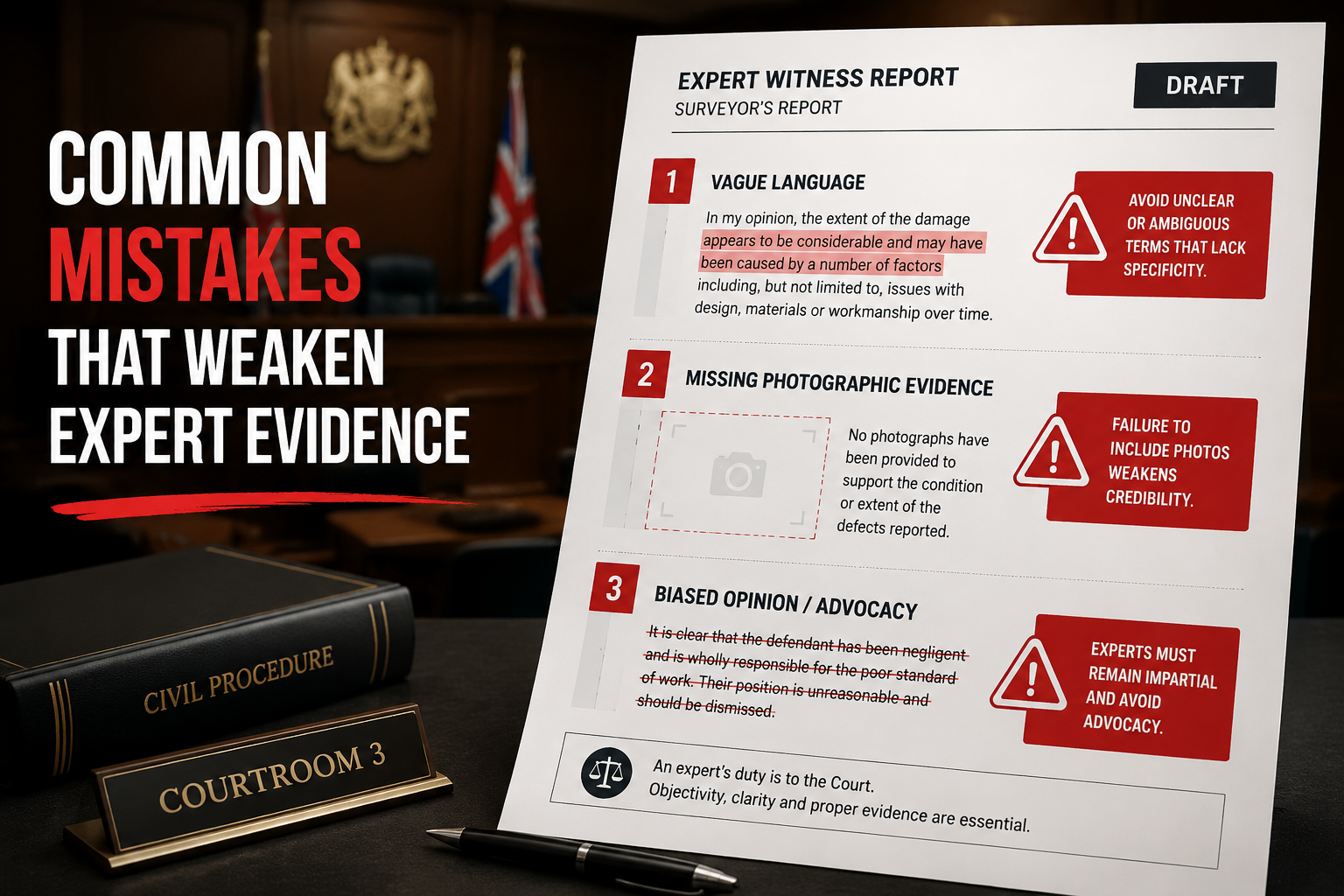
Even experienced surveyors can produce reports that fail to meet court standards. The following errors are among the most frequently cited reasons why expert evidence is challenged, restricted, or rejected.
Mistake 1: Vague or Unqualified Opinions
Phrases such as "it appears that" or "in my view, the defect may have been caused by" are problematic in expert reports. Courts require opinions to be expressed with appropriate certainty, supported by specific reasoning. Where genuine uncertainty exists, it must be quantified — for example, "on the balance of probabilities" or "it is more likely than not."
Mistake 2: Failing to Address the Questions Actually Posed
Expert witnesses are instructed to answer specific questions. A report that provides extensive technical commentary but fails to directly answer the instructing questions wastes the court's time and signals a lack of professional discipline. Every section of the report should be traceable back to the original instructions.
Mistake 3: Insufficient or Undocumented Inspection
A report based on a brief site visit, limited to visible areas, and supported by only a handful of photographs will not withstand cross-examination. Opposing counsel will probe the scope and duration of the inspection. If the expert cannot demonstrate that their inspection was thorough and systematic, their conclusions become vulnerable.
For complex structural matters, surveyors should consider whether a structural survey or specialist investigation — such as a subsidence survey — is required to underpin the expert opinion adequately.
Mistake 4: Missing or Incorrect CPR Declarations
The statement of truth and the expert's declaration of their overriding duty to the court are mandatory. Omitting them — or using outdated wording — is a technical deficiency that can be exploited by opposing parties. Reports should also confirm that the expert's fees are not contingent on the outcome of the case.
Mistake 5: Ignoring Contrary Evidence
A court-ready report acknowledges and engages with evidence or arguments that might support the opposing party's position. Failing to do so does not make the contrary evidence disappear — it simply makes the expert appear partisan or uninformed.
Mistake 6: Inadequate Valuation Methodology
In valuation disputes — whether arising from professional negligence, financial remedy proceedings, or retrospective property valuations — the methodology must be explicitly stated and defensible. Courts expect surveyors to identify comparable transactions, explain adjustments, and demonstrate how the final figure was reached. [1][7]
Disputes involving party wall damage claims frequently require both a technical assessment of the damage and a valuation of the diminution in value — two distinct expert tasks that must each be handled with rigour.
Types of Property Disputes Where Expert Witness Reports Are Required
Expert witness reports in UK property disputes span a wide range of dispute categories. Understanding which type of report is needed — and what it must contain — is essential for both solicitors and property owners. [1][5]
Common Dispute Categories
| Dispute Type | Key Expert Evidence Required |
|---|---|
| Boundary disputes | Title deed analysis, physical measurements, condition of boundary features |
| Defect claims | Itemised defect schedule, causation analysis, remediation cost estimate |
| Valuation disputes | Comparable evidence, methodology statement, market analysis |
| Party wall disputes | Pre- and post-works condition records, damage attribution |
| Professional negligence | Standard of care assessment, breach identification, loss quantification |
| Dilapidations | Schedule of dilapidations, costings, diminution in value |
For those involved in party wall disputes or neighbour disputes, the expert witness report may need to work alongside — or be distinguished from — a Party Wall Award, which serves a different legal function.
Practical Considerations: Costs, Timelines, and Choosing the Right Expert
What Does an Expert Witness Report Cost?
Costs vary significantly depending on case complexity, the expert's seniority, and the scope of inspection required. As a general guide, reports for specialist installation disputes (such as windows, doors, and roof lights) start from approximately £1,499 including VAT. [6] Complex valuation or structural defect cases involving multiple inspections, extensive comparable research, or joint expert meetings will typically cost considerably more.
How Long Does It Take?
Following a site inspection, a CPR Part 35-compliant expert witness report is typically delivered within 10–15 working days. [6] Where court deadlines are tight, it is essential to instruct an expert as early as possible in the litigation process.
Selecting the Right Expert
The UK Register of Expert Witnesses maintains searchable listings of professionals with expertise in residential buildings, enabling parties and their solicitors to identify suitably qualified experts. [9] Key selection criteria include:
- ✔️ RICS membership and, ideally, RICS Registered Expert Witness status [2]
- ✔️ Demonstrable experience in the specific dispute type
- ✔️ Familiarity with CPR Part 35 and court procedures
- ✔️ A track record of producing reports that withstand cross-examination
- ✔️ Professional indemnity insurance
For those seeking expert surveyor advice on property disputes across London and the surrounding regions, engaging a chartered surveyor in London with specific litigation support experience is strongly recommended.
Conclusion: Actionable Next Steps for Court-Ready Expert Evidence
The question of Expert Witness Reports in UK Property Disputes: What Makes a Surveyor's Evidence Court-Ready? ultimately comes down to three things: legal compliance, professional rigour, and demonstrable independence. A report that ticks all three boxes gives the court what it needs to make an informed decision — and gives the instructing party the best possible foundation for their case.
Actionable next steps:
- Instruct early — engage an expert witness surveyor as soon as litigation becomes likely, not after proceedings have commenced.
- Define the questions clearly — work with your solicitor to draft precise questions for the expert that directly address the legal issues in dispute.
- Verify CPR compliance — confirm that the expert is familiar with CPR Part 35 and has produced court-compliant reports previously.
- Check RICS credentials — prioritise surveyors with RICS Registered Expert Witness status for maximum credibility.
- Allow adequate time — factor in 10–15 working days for report delivery, plus additional time for any joint expert meetings or supplementary reports.
- Review the draft — solicitors should review the draft report for CPR compliance before it is finalised, checking that all mandatory declarations are present and correctly worded.
Property disputes are rarely simple. But with the right expert, a properly structured report, and a clear understanding of what courts expect, the evidence presented can be compelling, credible, and court-ready.
References
[1] Expert Witness And Dispute Resolution – https://www.savills.co.uk/services/valuation/expert-witness-and-dispute-resolution.aspx
[2] Expert Witness Reports – https://www.house-survey.co.uk/expert-witness-reports/
[3] Expert Witness Reports – https://www.shpvaluers.co.uk/expert-witness-reports/
[4] Expert Witness Report – https://www.watsons-property.co.uk/valuation-survey/survey-services/expert-witness-report/
[5] Expert Witness Reports For Property Disputes What Uk Courts Expect From Chartered Surveyors – https://wimbledonsurveyors.com/expert-witness-reports-for-property-disputes-what-uk-courts-expect-from-chartered-surveyors/
[6] Expert Witness Report Main – https://www.risaltd.co.uk/expert-witness-report-main
[7] Expert Witness – https://www.struttandparker.com/services/estates-farms-and-land/land-management/expert-witness
[8] How Can Stags Help Settle Your Property Disputes – https://www.stags.co.uk/articles/how-can-stags-help-settle-your-property-disputes
[9] Residential Buildings – https://www.jspubs.com/expert-witness/si/r/residential-buildings/
[10] Expert Witness Roles In 2026 Homebuying Reform Disputes Defending Survey Evidence Under New Upfront Standards – https://nottinghillsurveyors.com/blog/expert-witness-roles-in-2026-homebuying-reform-disputes-defending-survey-evidence-under-new-upfront-standards