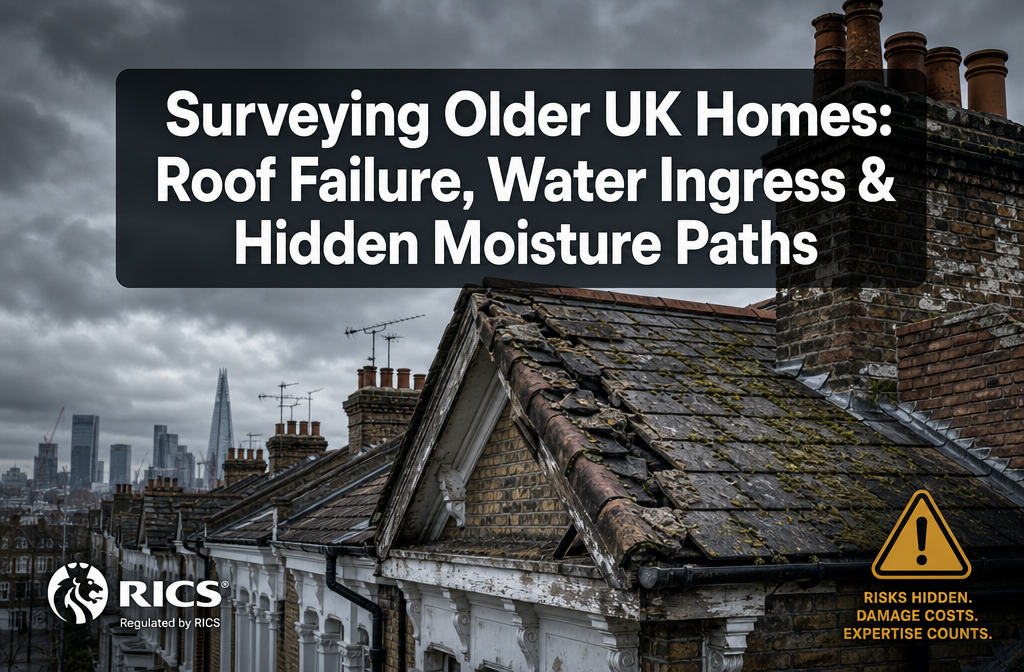

By the time a damp stain appears on a bedroom ceiling, moisture may have been travelling silently through a roof structure for months — or even years. In older UK housing stock, the gap between a visible symptom and its actual root cause is often vast, and it is precisely this gap that makes surveying older UK homes for roof failure, water ingress, and hidden moisture paths one of the most technically demanding tasks a chartered surveyor can undertake. A Level 3 Building Survey (formerly known as a Full Structural Survey) exists to close that gap — but only when it is conducted with the right priorities, the right tools, and a deep understanding of how pre-war and post-war construction behaves over time.
In 2026, with millions of UK buyers purchasing properties built before 1950, the stakes have never been higher. A poorly scoped survey that misses a failing valley gutter or an undetected cavity moisture bridge can leave a buyer facing five-figure repair bills within months of completion.
Key Takeaways 🔑
- Symptoms and causes are rarely in the same place — water ingress detected at ceiling level often originates from a roof junction, chimney detail, or parapet wall several metres away.
- Level 3 surveys must go beyond visual inspection — moisture meters, thermal imaging, and drone surveys are increasingly essential tools for older UK properties.
- Chimney stacks, valleys, and flat roof abutments are the highest-risk zones in pre-1960s housing and should receive dedicated attention in any report.
- Hidden moisture paths through cavities and timber voids can cause structural decay long before any interior sign appears.
- A strong Level 3 report distinguishes root causes from secondary effects, giving buyers actionable intelligence rather than a list of symptoms.
Why Older UK Homes Present Unique Moisture Challenges
The UK has one of the oldest housing stocks in Europe. A significant proportion of homes currently on the market were built between 1880 and 1960 — an era of solid-wall construction, natural slate roofing, lime mortar, and lead or cast-iron rainwater goods. These materials were well-suited to the construction methods of their time, but they age in complex and often unpredictable ways.
The Age Factor: What Changes Over Time
| Construction Era | Common Roof Material | Key Failure Risks |
|---|---|---|
| Pre-1919 (Victorian/Edwardian) | Natural Welsh slate, clay tiles | Nail fatigue, ridge failure, chimney decay |
| 1919–1944 (Inter-war) | Concrete interlocking tiles, early flat roofs | Tile crazing, felt degradation, parapet leaks |
| 1945–1970 (Post-war) | Asbestos cement, early bitumen felt | Brittle fracture, felt shrinkage, valley failure |
| 1970–1990 | Concrete tiles, UPVC guttering | Mortar shrinkage, gutter joint failure |
What makes older properties particularly challenging is that defects rarely present in isolation. A failing chimney stack does not simply leak at the flashing — it can introduce moisture into a roof void that then travels along rafters, saturates insulation, and eventually reaches a ceiling joist several rooms away. The surveyor's job is to trace that entire journey, not merely note the stain at its terminus.
💬 "The most dangerous defect in an older home is not the one you can see — it is the one that has been quietly redistributing water through the structure for years."
How Level 3 Surveys Should Approach Roof Failure in Older Properties
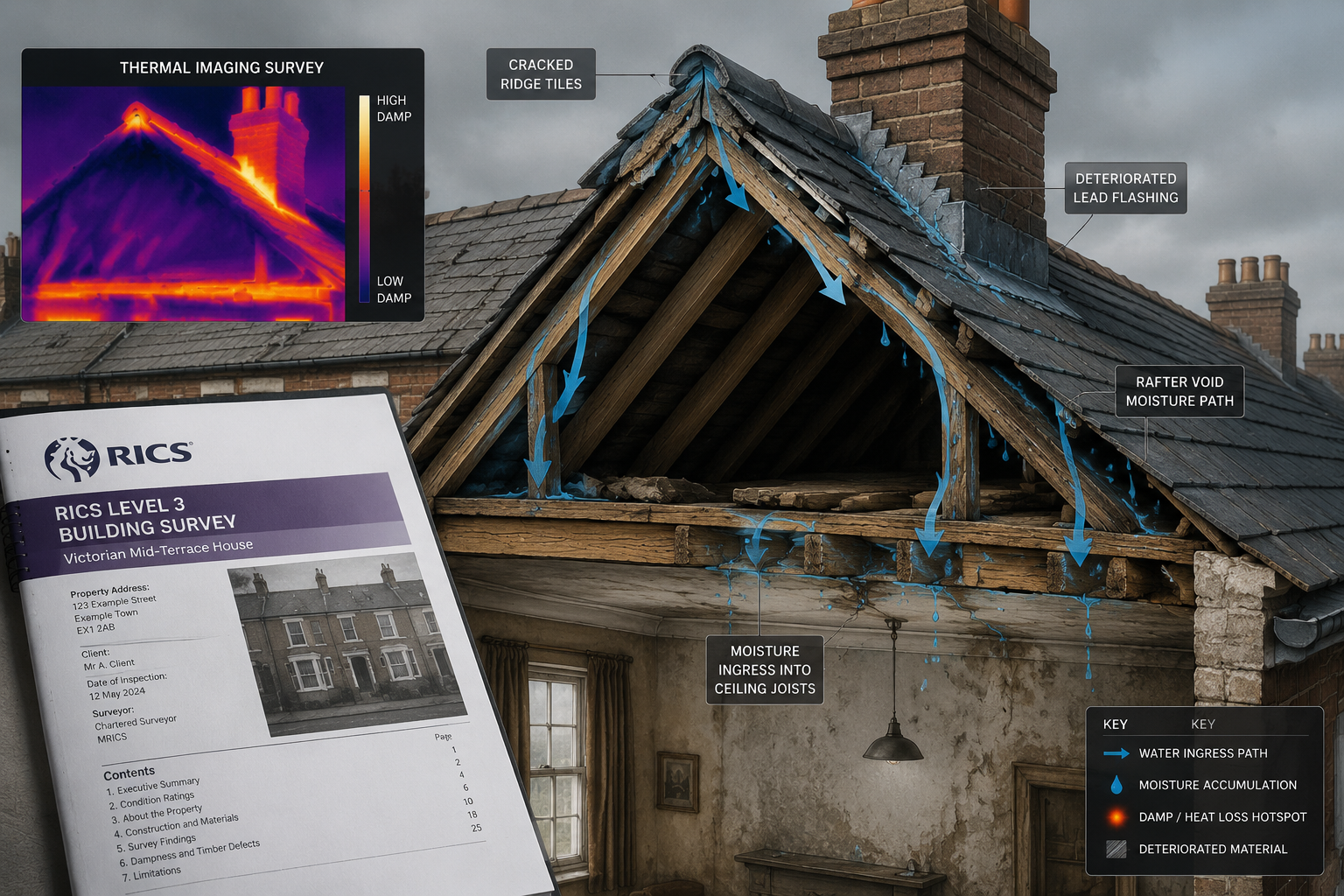
When surveying older UK homes for roof failure, water ingress, and hidden moisture paths, a Level 3 report must do considerably more than note that "slates are missing" or "the chimney requires repointing." The RICS Home Survey Standard (2021) sets a clear expectation that Level 3 surveys provide a thorough inspection and detailed assessment — but it is the surveyor's professional judgement that determines whether that standard is genuinely met.
The Roof Structure: Looking Beyond the Surface
A competent Level 3 inspection of an older roof should assess:
- Roof covering condition — not just visible slipped or missing tiles, but the condition of the substrate beneath. Are battens rotting? Is the sarking felt (where present) intact or absent entirely?
- Ridge and hip details — mortar-bedded ridges are a common failure point in properties over 40 years old. Cracked or hollow-sounding ridge mortar allows water to track directly into the roof void.
- Valley construction — open lead valleys, swept tile valleys, and laced valleys each have different failure modes. In Victorian terraces, lead valleys are frequently undersized by modern standards and prone to ponding.
- Rafter and purlin condition — where roof void access is possible, the structural timbers should be assessed for wet rot, beetle infestation, and any evidence of previous or active moisture ingress.
- Flat roof sections — many older UK homes feature flat-roofed extensions or bay roof returns. These are statistically the most common source of water ingress in the housing stock and deserve dedicated commentary in any Level 3 report.
For properties where direct roof access is limited or unsafe, a drone roof survey can provide high-resolution imagery of ridge lines, chimney flashings, and valley details that would otherwise be invisible from ground level or a loft hatch.
Chimney Stacks: The Most Underestimated Defect Source
Chimney stacks are responsible for a disproportionate share of water ingress in older UK homes. A single chimney can introduce moisture through multiple simultaneous failure points:
- Failed or absent lead flashings at the base of the stack
- Cracked or eroded pointing in the brickwork allowing direct water absorption
- Defective chimney pots or missing cowls permitting rainwater ingress down the flue
- Deteriorated haunching (the mortar fillet around the pot base)
- Spalled brickwork caused by frost action on saturated masonry
A Level 3 report should identify which failure mode is active — because each requires a different remedial approach. Replacing a flashing when the real problem is saturated brickwork will not resolve the leak. For a detailed understanding of what a thorough roof inspection should cover, a professional roof survey scoped specifically for older properties is often the most appropriate starting point.
Tracing Hidden Moisture Paths: The Core Skill in Level 3 Reporting
The single most important differentiator between an adequate Level 3 survey and an excellent one is the surveyor's ability to trace moisture paths — to follow water from where it enters the building envelope to where it manifests as a defect, and to identify every point along that route where secondary damage may be occurring.
How Water Travels Through Older Construction
In solid-wall Victorian and Edwardian properties, there is no cavity to interrupt moisture migration. Water that penetrates the outer leaf of brickwork can travel laterally through the wall, downward through mortar joints, or inward to internal finishes. In cavity-wall inter-war and post-war homes, the cavity was designed to interrupt this path — but cavity wall insulation (where retrofitted), wall ties (where corroded), and mortar droppings (where present on cavity ledges) can all create moisture bridges that defeat the cavity's purpose entirely.
Common hidden moisture paths in older UK homes include:
- 🔵 Parapet walls — where flat roof abutments meet vertical masonry without adequate upstand or flashing
- 🔵 Chimney breast voids — where removed chimney breasts leave open voids that channel moisture from the stack above
- 🔵 Eaves details — where fascia boards and soffit voids allow wind-driven rain to penetrate behind the roof covering
- 🔵 Dormer cheeks — where lead soakers or render finishes have failed at the junction between dormer walls and the main roof slope
- 🔵 Flat roof drains — where blocked or undersized outlets cause ponding that eventually forces water through the roof deck
Tools That Level 3 Surveyors Should Deploy
A visual inspection alone is insufficient for surveying older UK homes for roof failure, water ingress, and hidden moisture paths. The following instruments should be considered standard in a thorough Level 3 inspection:
| Tool | Purpose | What It Reveals |
|---|---|---|
| Calibrated moisture meter | Surface and subsurface moisture content | Active versus historic dampness, migration patterns |
| Thermal imaging camera | Temperature differential mapping | Wet insulation, cold bridges, hidden moisture accumulation |
| Borescope / endoscope | Visual inspection of voids | Cavity condition, rafter decay, hidden leaks |
| Drone with HD camera | Aerial roof inspection | Ridge, flashing, and valley condition from above |
| Hygrometer | Relative humidity measurement | Condensation risk assessment |
Not every survey will require every tool — but a surveyor who relies solely on visual observation and a basic pin moisture meter is operating at the lower boundary of what a Level 3 report demands.
What a Strong Level 3 Report Should Prioritise: Practical Guidance
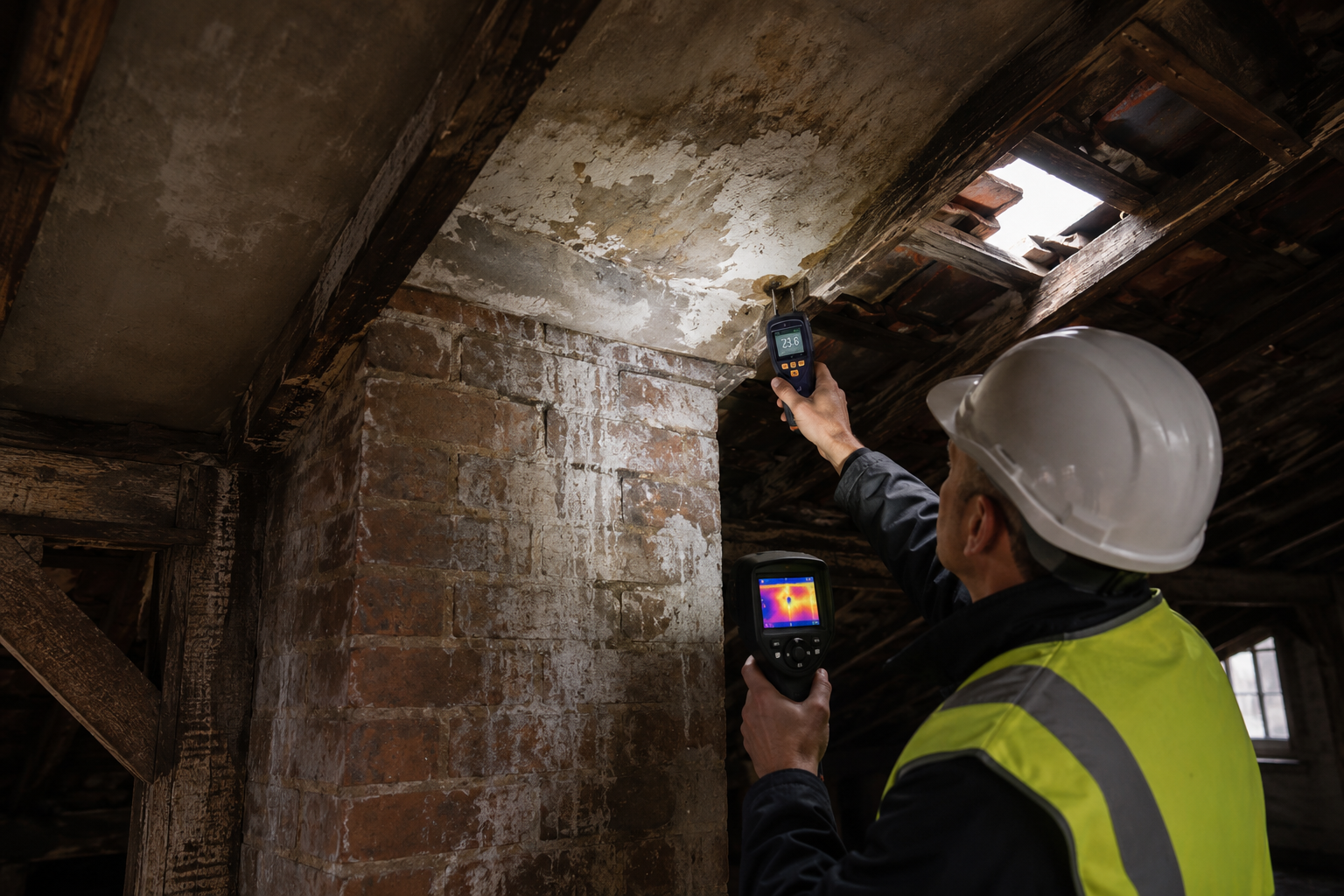
When surveying older UK homes for roof failure, water ingress, and hidden moisture paths: what Level 3 reports should prioritise comes down to a clear hierarchy of investigation and reporting.
Prioritisation Framework for Level 3 Reports
🔴 Immediate Priority (Urgent Action Required)
- Active water ingress with evidence of ongoing structural wetting
- Wet rot or beetle infestation in principal roof timbers (rafters, purlins, wall plates)
- Failed flat roof coverings with ponding water
- Chimney stacks showing structural instability or severe spalling
🟠 Short-Term Priority (Action Within 12 Months)
- Slipped, cracked, or missing roof coverings exceeding isolated tiles
- Failed valley linings or lead flashings showing open joints
- Blocked or defective rainwater goods causing persistent overflow
- Evidence of past water ingress with unresolved moisture in timbers
🟡 Medium-Term Priority (Monitor and Plan)
- Mortar pointing in early stages of erosion
- Aged but intact flat roof coverings approaching end of service life
- Minor condensation staining without evidence of structural moisture
Distinguishing Root Causes from Secondary Symptoms
A Level 3 report that lists "damp staining to bedroom ceiling" without identifying whether the cause is a failed valley, a chimney flashing, a blocked gutter, or interstitial condensation has failed its primary purpose. Every moisture-related observation in the report should be accompanied by:
- The probable source of moisture entry
- The path by which moisture has travelled to the observed location
- The extent of secondary damage along that path
- The recommended remedial action targeted at the root cause
This distinction matters enormously for buyers. A stain caused by a blocked gutter costs £150 to resolve. The same stain caused by a failed valley with saturated roof timbers beneath may cost £8,000–£15,000. Only a properly scoped Level 3 survey will tell the difference.
If you are unsure whether a Level 3 survey is the right product for an older property you are purchasing, the guide to choosing the right survey type provides a clear framework for making that decision.
Reporting Standards and What Buyers Should Expect
A Level 3 Building Survey report should be a working document — not a liability-limiting exercise in vague language. Buyers commissioning surveys on older UK properties should expect:
- Specific descriptions of each defect, not generic condition ratings alone
- Photographic evidence of key findings, including moisture meter readings where relevant
- Cost guidance — not necessarily precise quotes, but indicative repair cost ranges that allow buyers to assess risk
- Clear prioritisation of defects by urgency and financial impact
- Recommendations for specialist investigation where the surveyor's inspection has been limited
Where a surveyor recommends further specialist investigation — for example, a structural engineer's assessment of a chimney breast, or a roofing contractor's detailed inspection of a flat roof — this is not a failure of the survey. It is the appropriate professional response to a limitation of access or a defect beyond the surveyor's scope. What matters is that the recommendation is specific, actionable, and clearly explained.
For properties with complex histories of alteration or extension, a schedule of condition report may also be relevant — particularly where the buyer intends to carry out further works and needs a documented baseline of the property's condition before proceeding.
Buyers who discover significant defects after purchase and believe their survey was inadequate may also wish to explore the role of an expert witness report in pursuing a professional negligence claim.
Common Mistakes in Level 3 Surveys of Older UK Homes
Even experienced surveyors can fall into patterns that reduce the effectiveness of a Level 3 report on older properties. The most common shortcomings include:
- Treating inaccessible areas as non-reportable — where a roof void cannot be entered, the surveyor should use alternative methods (borescope, thermal imaging) rather than simply noting "not inspected"
- Confusing condensation with penetrating damp — these have entirely different causes and remedies, and misidentification leads to ineffective repairs
- Failing to correlate interior and exterior observations — a damp patch on an interior wall and a failed flashing on the exterior above it are the same defect; the report should make this connection explicit
- Under-reporting flat roof risk — flat roofs on older extensions are frequently the most expensive repair on the property and deserve proportionate attention
- Omitting rainwater goods from the assessment — blocked, leaking, or undersized gutters and downpipes are a primary cause of wall saturation in older UK homes and should be assessed as part of any roof-related investigation
Conclusion: Actionable Steps for Buyers and Surveyors
Surveying older UK homes for roof failure, water ingress, and hidden moisture paths demands a level of technical rigour that goes well beyond a standard visual walkthrough. The most costly defects in older UK housing stock are almost never the ones that announce themselves — they are the ones that have been quietly redistributing water through roof structures, chimney voids, and cavity walls for years before anyone notices.
For buyers commissioning a Level 3 survey in 2026, the actionable steps are clear:
- ✅ Specify your expectations upfront — ask the surveyor explicitly how they will assess roof condition, what tools they will use, and how they will handle inaccessible areas.
- ✅ Request drone or thermal imaging for any property with a complex roofline, chimney stacks, or flat roof sections — these are not optional extras for older homes, they are best practice.
- ✅ Read the report critically — if a moisture observation has no identified cause, ask for clarification before exchange of contracts.
- ✅ Use the report as a negotiation tool — a well-evidenced Level 3 report with cost guidance gives buyers leverage to renegotiate price or request remedial works as a condition of sale.
- ✅ Commission specialist follow-up where recommended — do not ignore a surveyor's recommendation for further investigation. It exists because the risk is real.
For older UK properties across London and the surrounding regions, working with chartered surveyors experienced in the local housing stock is the single most effective way to ensure that a Level 3 report delivers the protection it promises. The difference between a survey that spots a hidden moisture path and one that misses it is not a matter of luck — it is a matter of expertise, methodology, and professional commitment to finding root causes rather than cataloguing symptoms.