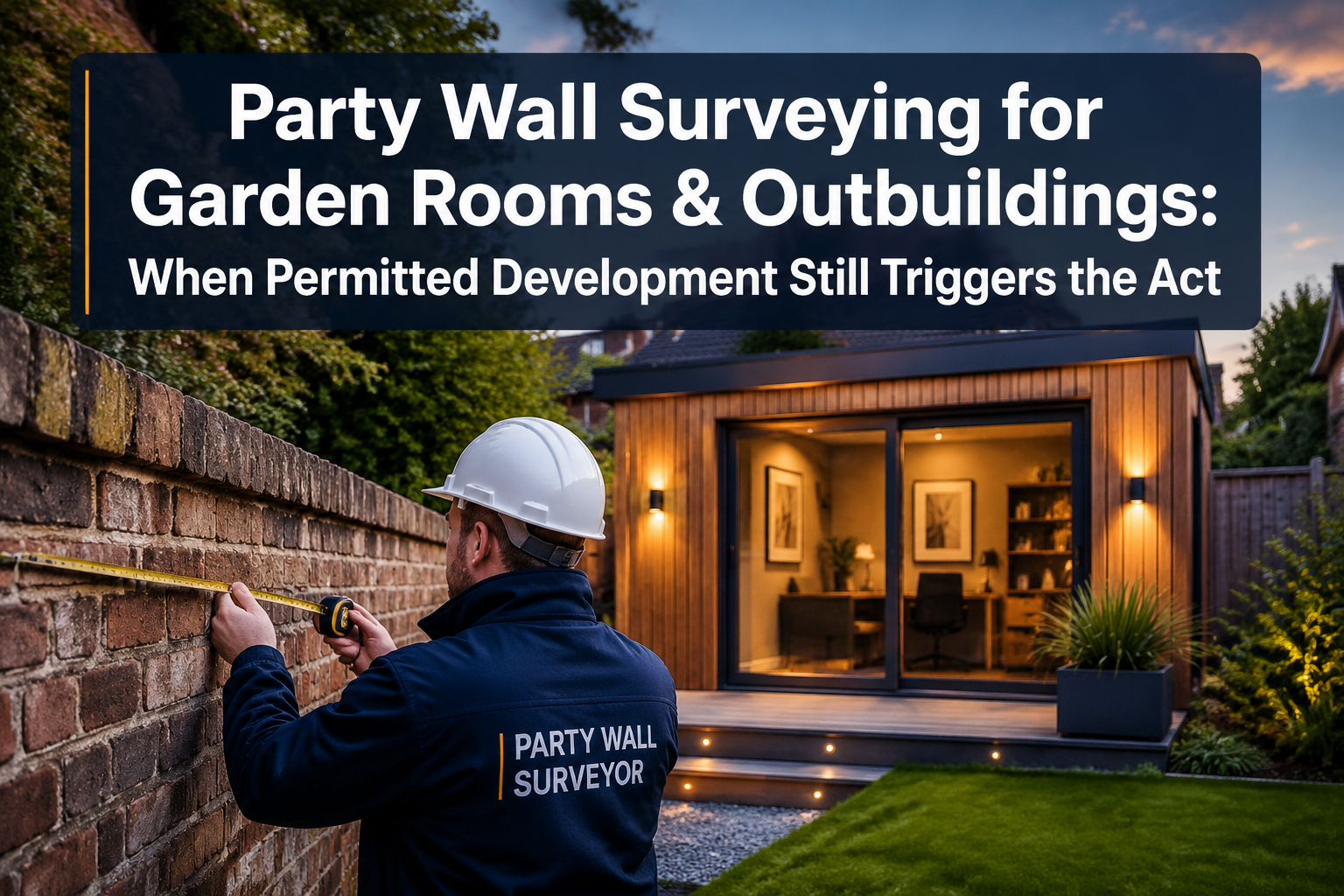

Nearly one million garden rooms and outbuildings were added to UK properties in the five years following the 2020 shift to home working — and a significant proportion of those owners had no idea they were triggering legal obligations under the Party Wall etc. Act 1996. The assumption is almost universal: "I've got permitted development rights, so I don't need to worry about anything else." That assumption is wrong, and it can be costly.
Party Wall Surveying for Garden Rooms and Outbuildings: When 'Permitted Development' Still Triggers the Act is a subject that sits at the crossroads of planning law and property law — two entirely separate legal frameworks that operate independently of each other. Understanding where they diverge is essential for any homeowner planning a garden office, studio, gym, or outbuilding in 2026.
Key Takeaways 📋
- Permitted development (PD) rights relate to planning law only — they do not exempt you from the Party Wall etc. Act 1996.
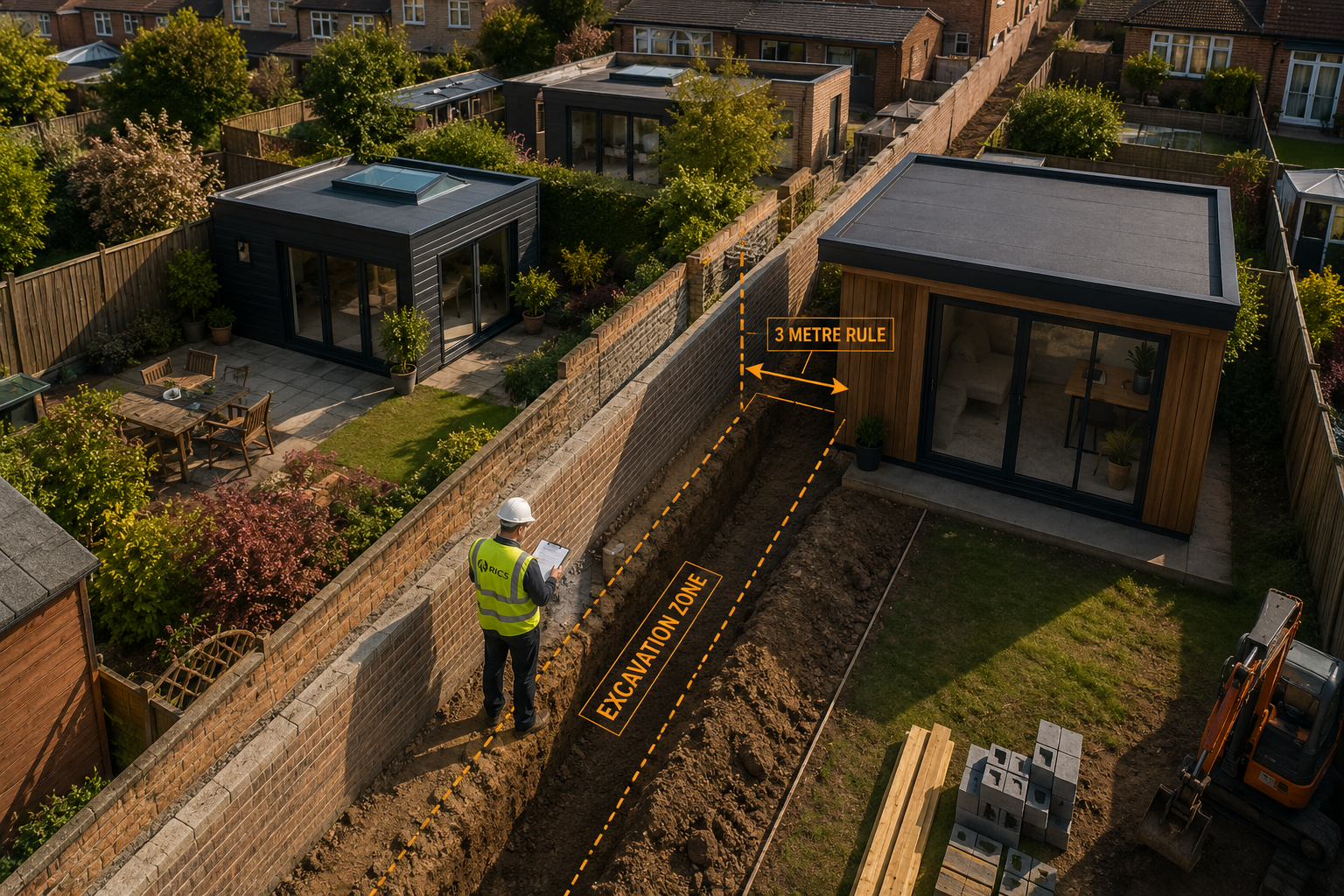
- Foundations dug within 3 metres of a neighbour's structure, or within 6 metres under the 45-degree rule, trigger the Act regardless of PD status.
- Boundary proximity — building on or close to the boundary line — can bring the Act into play even for a small garden room.
- A Party Wall Notice must be served before work begins, not after a dispute arises.
- Early advice from a qualified party wall surveyor protects both the building owner and the adjoining owner from costly disputes and damage to property.
The Garden Room Boom: Why This Issue Matters More Than Ever in 2026
The post-pandemic transformation of UK gardens into productive workspaces has been remarkable. Garden offices, artist studios, home gyms, and annexes have become standard features in suburban and semi-rural properties. Manufacturers report lead times stretching into months, and planning departments across England have seen a surge in retrospective queries.
The appeal of permitted development is obvious. Under Class E of Schedule 2 to the Town and Country Planning (General Permitted Development) (England) Order 2015, most outbuildings in residential gardens can be built without a formal planning application, provided they meet specific criteria:
| Permitted Development Criteria (Class E) | Requirement |
|---|---|
| Maximum height (dual-pitched roof) | 4 metres |
| Maximum height (other roofs) | 2.5 metres |
| Position | Must not be forward of the principal elevation |
| Use | Incidental to the enjoyment of the dwelling |
| Coverage | Must not exceed 50% of the curtilage |
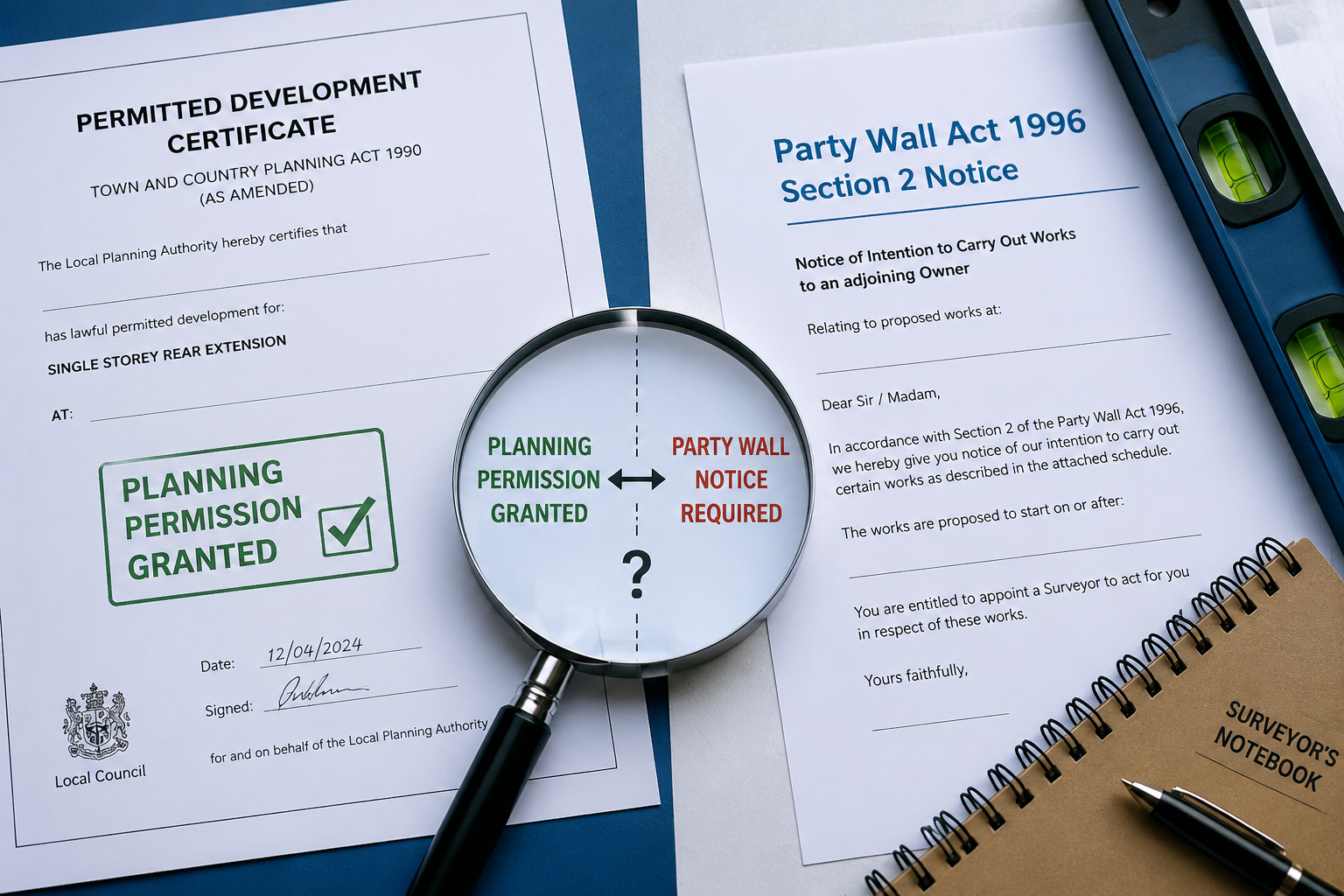
What this table does not include — because it has nothing to do with planning — is any reference to the Party Wall etc. Act 1996. These are separate legal instruments, and confusing them is the single most common mistake homeowners make.
💬 Pull Quote: "Getting planning permission — or not needing it — tells you nothing about your obligations to your neighbours under party wall legislation."
Understanding the Party Wall etc. Act 1996: The Basics for Garden Structures
The Party Wall etc. Act 1996 covers three main categories of work, all of which can be triggered by garden room and outbuilding projects:
1. Work on or to a Party Wall or Party Fence Wall (Section 2)
A party fence wall is a wall that stands on the boundary line and is used by both neighbours — a classic garden boundary wall. If your garden room project involves cutting into, raising, underpinning, or otherwise altering such a wall, Section 2 of the Act applies. This is true even if the wall is just a low brick boundary wall that you intend to use as part of the outbuilding's structure.
2. New Building at or Astride the Boundary Line (Section 1)
If you plan to build a garden room on the boundary line, or with a wall that sits astride the boundary, a Section 1 notice is required. This applies even to timber-framed structures where one wall is positioned exactly on the property boundary.
3. Excavations Near Neighbouring Structures (Section 6) — The Most Overlooked Trigger ⚠️
This is where most garden room owners are caught out. Section 6 of the Act applies when:
- Foundations are dug within 3 metres of any part of a neighbouring building or structure, AND the new foundations go deeper than the neighbour's foundations.
- Foundations are dug within 6 metres of a neighbouring structure and fall within a 45-degree line drawn downward from the bottom of the neighbour's foundations.
For a full explanation of how these distances work in practice, see our detailed guide on the Party Wall Act 3 metre rule.
Many urban and suburban gardens are simply not large enough to avoid these zones. A garden room positioned at the far end of a 10-metre garden may still have its concrete pad or strip foundations within 3 metres of the neighbour's rear extension or conservatory.
When 'Permitted Development' Still Triggers the Act: The Critical Scenarios
Party Wall Surveying for Garden Rooms and Outbuildings: When 'Permitted Development' Still Triggers the Act becomes most urgent in these real-world scenarios:
Scenario A: The Compact Urban Garden 🏙️
In London and other dense urban areas, rear gardens can be as short as 5–8 metres. A garden office positioned at the rear boundary will almost certainly have its foundations within 3 metres of the neighbour's rear wall. The Section 6 notice requirement is virtually unavoidable.
Scenario B: The Shared Boundary Wall Used as a Structural Element
Some garden room manufacturers offer designs that incorporate the existing boundary wall as a rear wall of the structure. This approach is cost-effective but directly engages Section 2 of the Act. Any cutting, fixing, or loading onto a party fence wall requires a notice to be served.
Scenario C: Retaining Walls and Changes in Ground Level
Garden rooms on sloped plots often require retaining walls to create a level platform. Retaining walls involve significant excavation and can alter drainage and ground pressure near the boundary. These works frequently fall within the Section 6 excavation provisions, and the retaining wall itself may constitute a new structure at or near the boundary line.
Scenario D: Detached Garages and Workshop Conversions
Converting or extending a detached garage that sits close to the boundary is another common trigger. If the garage shares a wall with a neighbouring structure — or if new foundations are needed for an extension — the Act applies.
Scenario E: Larger Outbuildings Requiring Deeper Foundations
A standard garden shed on a timber frame base may not trigger the Act. But a substantial garden room — particularly one with a concrete slab, strip foundations, or screw pile foundations — is a different matter. The depth and proximity of those foundations determine whether Section 6 applies.
The Notice Process: What Homeowners and Surveyors Need to Know
Once it is established that the Act applies, the process is straightforward — but it must be followed correctly. Understanding party wall consent is the first step.
Step 1: Serve the Correct Notice
The building owner (the person carrying out the work) must serve written notice on all adjoining owners. Notice periods vary:
- Section 1 (new wall at boundary): 1 month's notice
- Section 2 (work to existing party wall): 2 months' notice
- Section 6 (excavation): 1 month's notice
Step 2: Await Consent or Dissent
The adjoining owner has 14 days to respond. They can:
✅ Consent — work can proceed without a formal award
❌ Dissent — a surveyor (or surveyors) must be appointed
🔇 Not respond — deemed dissent after 14 days
Step 3: Appoint Surveyors and Agree an Award
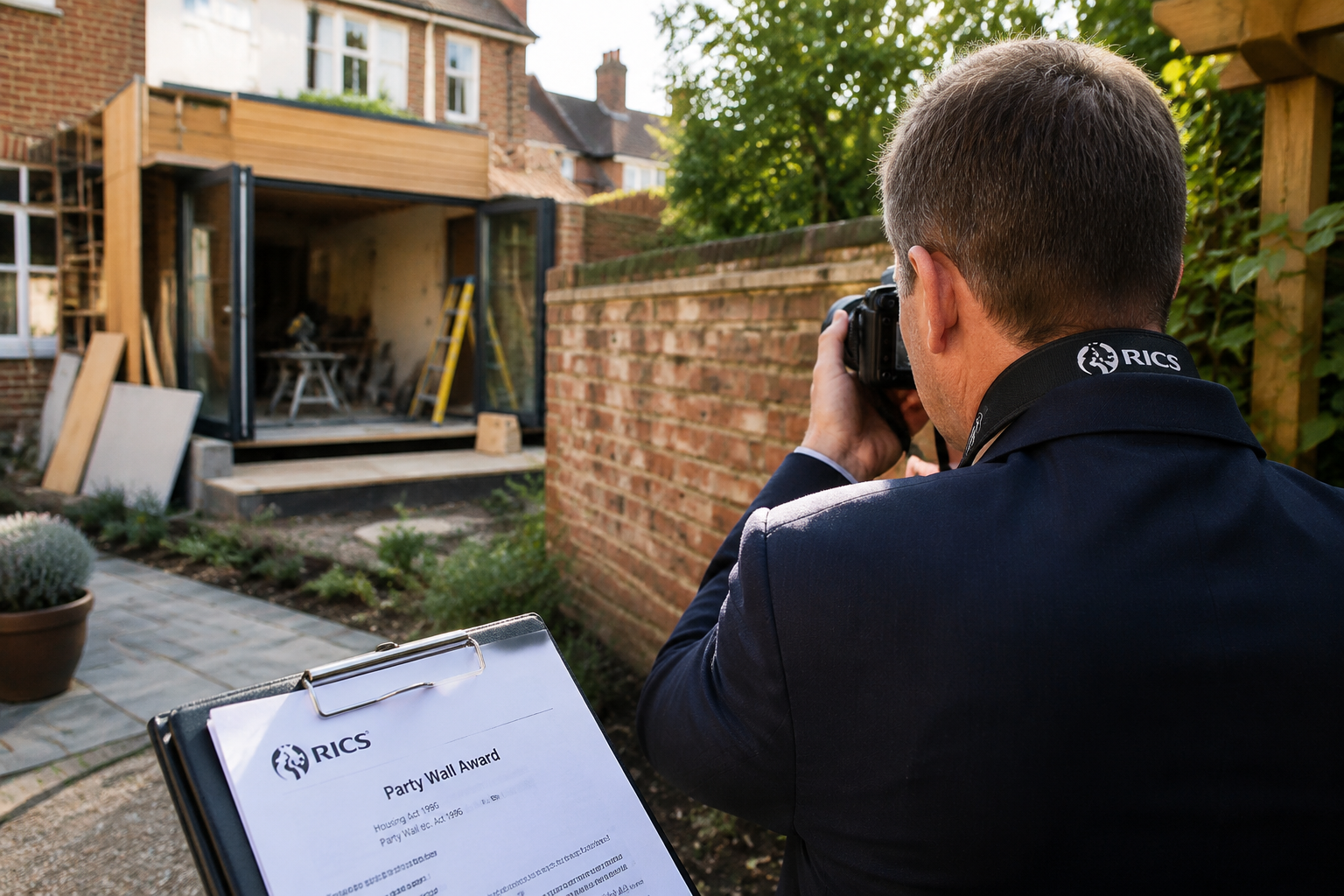
If the neighbour dissents or fails to respond, a party wall award must be prepared. This is a legally binding document that sets out how the work will be carried out, the hours of working, and protections for the adjoining property.
A party wall schedule of condition of the neighbouring property is typically prepared before work begins, creating a photographic and written record of its pre-existing state. This is critical protection for both parties if a dispute about damage to property arises later.
How Surveyors Should Advise Owners Early: Best Practice in 2026
The most effective approach to party wall surveying for garden rooms and outbuildings is proactive, early engagement — ideally before the owner has committed to a design or signed a contract with a builder.
The Pre-Design Consultation
A brief consultation with a party wall surveyor at the design stage can:
- Identify whether the proposed structure will trigger the Act
- Suggest design modifications that reduce or eliminate notice requirements (e.g., adjusting foundation depth or repositioning the structure)
- Estimate the likely timeline for the notice process so it can be factored into the project programme
- Provide cost clarity — understanding party wall surveyor costs upfront avoids budget surprises
Common Mistakes Surveyors See 🚫
| Mistake | Consequence |
|---|---|
| Starting work without serving notice | Injunction risk; work may have to stop |
| Assuming PD rights eliminate Act obligations | Legal liability; neighbour can seek damages |
| Serving notice too late | Project delays of weeks or months |
| Using incorrect notice form | Notice may be invalid; process restarts |
| Ignoring retaining wall implications | Section 6 breach; potential structural damage claims |
The Importance of Neighbour Relations
Party wall matters are not just legal formalities — they affect real relationships. A surveyor who advises a client to engage early, explain the project clearly to neighbours, and serve proper notices is doing far more than fulfilling a statutory obligation. They are helping to prevent the kind of party wall disputes that can become entrenched, expensive, and deeply damaging to neighbourly relations.
💬 Pull Quote: "A two-minute conversation with a surveyor before signing the builder's contract can save months of delay and thousands of pounds in legal costs."
Frequently Asked Questions About Garden Room Party Wall Issues
Q: My garden room is only 2.5m tall and well within PD limits. Do I still need to worry about the Party Wall Act?
Yes. Height and planning status are irrelevant to the Act. What matters is the position of the foundations relative to neighbouring structures and whether any work involves a party fence wall.
Q: My neighbour has already built a garden room without serving notice on me. What can I do?
You have rights under the Act even after work has started. For guidance on what to do if a neighbour is carrying out party wall work on your boundary, seek advice from a qualified surveyor promptly.
Q: Can I use the same surveyor as my neighbour?
Yes — an "agreed surveyor" can act for both parties, which is often more cost-effective and quicker. However, both parties must genuinely consent to this arrangement.
Q: What if my garden room uses screw pile foundations instead of concrete?
Screw piles (helical piles) can still trigger Section 6 if they are installed within 3 metres of a neighbouring structure and at a depth greater than the neighbour's foundations. The type of foundation is less important than its depth and proximity.
Q: Does the Act apply in Scotland or Wales?
The Party Wall etc. Act 1996 applies in England and Wales only. Scotland has different legislation governing boundary wall matters.
The Cost of Getting It Wrong
Ignoring party wall obligations for a garden room project is not a victimless oversight. The potential consequences include:
- 🚧 Injunctions stopping work mid-build
- 💰 Damages claims for structural damage to neighbouring property
- ⏱️ Significant project delays while the notice process is retrospectively completed
- 📉 Impact on property sale — solicitors will identify missing party wall awards during conveyancing
- 🤝 Irreparable damage to neighbourly relationships
The cost of proper party wall surveying is modest relative to the cost of a garden room project — and negligible compared to the cost of a dispute. For those with questions about specific situations, a comprehensive party wall act FAQ resource can provide further clarity.
Conclusion: Act Early, Build with Confidence
The garden room boom shows no signs of slowing in 2026. As more homeowners invest in high-quality outbuildings — some costing £30,000 to £80,000 or more — the stakes of getting the legal framework wrong are rising accordingly.
The core message is simple: permitted development rights and the Party Wall etc. Act 1996 are entirely separate legal frameworks. Having one does not exempt you from the other.
Actionable Next Steps ✅
- Before finalising your garden room design, consult a RICS-qualified party wall surveyor to assess whether the Act applies to your specific project.
- Share your proposed foundation details and site plan with the surveyor — depth and proximity to boundaries are the key variables.
- Serve the correct notices with the required notice period before any groundworks begin.
- Commission a schedule of condition of neighbouring properties before work starts to protect all parties.
- Keep your neighbours informed throughout the project — good communication prevents disputes before they start.
- If in doubt, seek professional advice early — the cost of a consultation is a fraction of the cost of a dispute.
Whether building a compact garden office or a substantial outbuilding, the Party Wall etc. Act 1996 deserves the same careful attention as any other aspect of the project. Surveyors who make this clear to clients at the earliest opportunity are providing a genuinely valuable service — one that protects property, relationships, and peace of mind.