

By March 2026, the RICS Residential Market Survey recorded a house price net balance of approximately -15%, with respondents across the UK describing a market where borrowing costs remain stubbornly high and closed sales data is so thin that valuers are confronting what practitioners now call "valuation blind spots" [6]. For the chartered surveyor asked to produce a Red Book-compliant opinion of value — one that will satisfy a lender, survive a tribunal, or hold up under cross-examination — this is not an abstract problem. It is a daily professional reality.
Valuation surveying in a high-rate, low-transaction market: evidencing value with sparse comparables demands more than a wider comparable search. It requires a structured, documented, and defensible methodology that layers multiple evidence streams, applies explicit adjustments, and communicates uncertainty honestly. This article sets out exactly how to do that.
Key Takeaways 📌
- Thin markets require layered evidence, not a single comparable-led point estimate. Surveyors must triangulate sales data, income approaches, and real-time market indicators.
- Time adjustments to stale comparables are mandatory in a high-rate environment — and must be explicitly documented, not implied.
- AVMs trained on 2020–2022 data are unreliable in current conditions; RICS-regulated surveyors are right to challenge and override them with real-time intelligence.
- Material Valuation Uncertainty (MVU) disclosures are not a weakness — they are a professional and legal obligation when evidence is genuinely sparse.
- Expert witness and tribunal work in thin markets demands an "evidence matrix" approach with clear hierarchy, transparent adjustments, and scenario sensitivity analysis.
Why High-Rate, Low-Transaction Conditions Break Conventional Valuation Methods
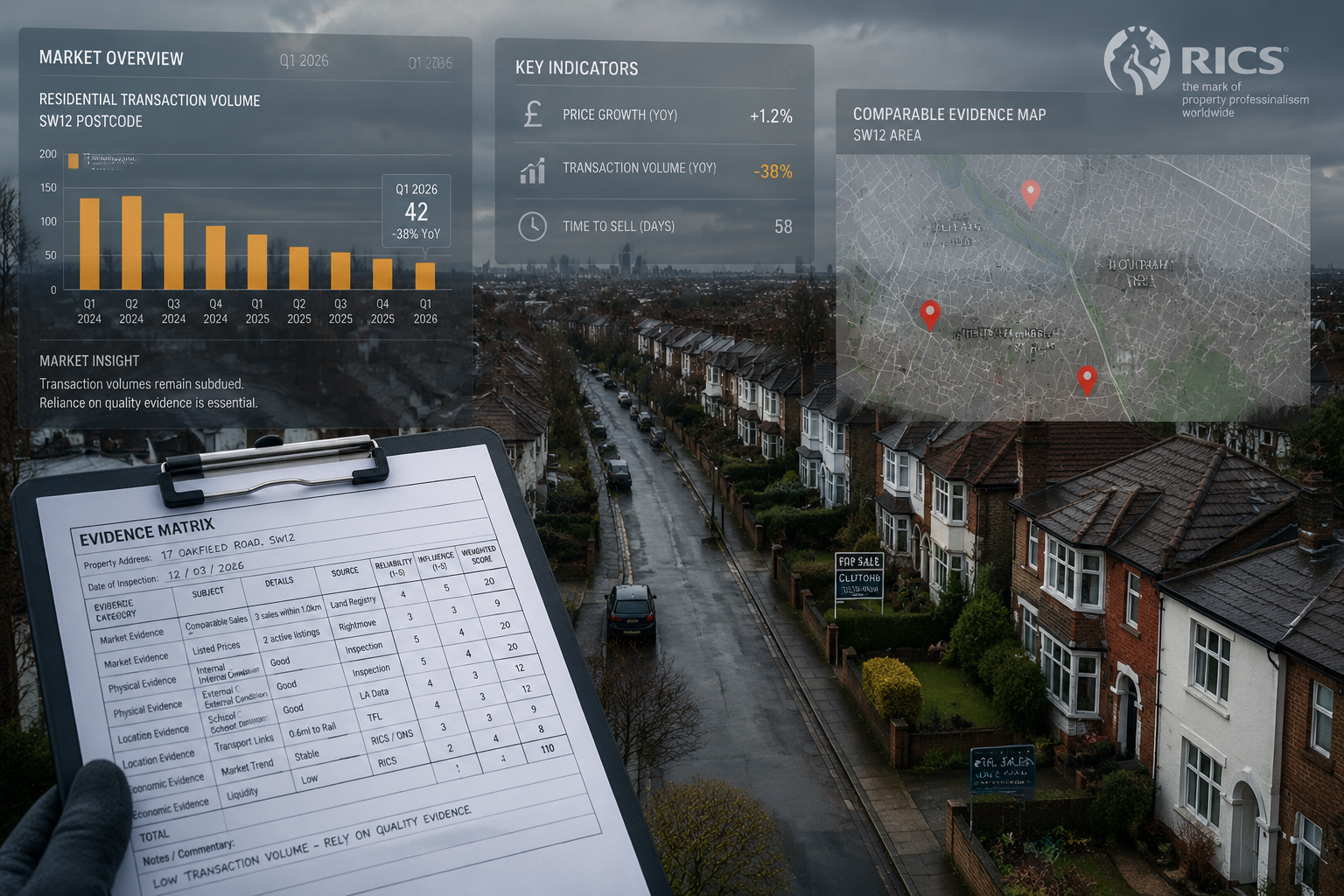
Standard comparable sales analysis rests on a simple assumption: enough arm's-length transactions have occurred recently enough, and locally enough, to anchor an opinion of value. When interest rates stay elevated, that assumption collapses.
In early 2026, transaction counts have begun to recover modestly in some UK sub-markets, but prices remain flat or slightly negative year-on-year [4]. This "volume first, price later" pattern is particularly treacherous for automated valuation models (AVMs). Models trained on the high-liquidity years of 2020–2022 systematically under-price risk when rates are high and buyer pools are thin [6]. A surveyor who simply accepts an AVM output without interrogating its data vintage is not just professionally exposed — they may be materially misleading a client or lender.
The Specific Risks in Sparse Markets
| Risk | Impact on Valuation |
|---|---|
| Stale comparables (12+ months old) | Overstate value if market has softened |
| Distressed or non-arm's-length sales | Understate value if used uncritically |
| Thin buyer pool | Widens bid-ask spread; achievable price ≠ asking price |
| AVM over-reliance | Systematic mispricing of risk in illiquid segments |
| Regional divergence | National index trends mask local micro-market reality |
💬 "In a high-rate, low-transaction market, evidencing value with sparse comparables is not a technical inconvenience — it is the central professional challenge of 2026 valuation practice."
Understanding the key factors that influence property valuation becomes even more critical when the market itself provides so little direct evidence. Surveyors must know which levers to pull and, crucially, how to document each one.
Advanced Techniques for Evidencing Value When Comparables Are Sparse
1. Widen the Search — But Adjust Explicitly
The first response to thin local evidence is to widen the geographic and temporal search window. However, this only helps if the surveyor applies explicit, documented adjustments for:
- Time: A comparable from 18 months ago in a market that has since softened by 4–6% must be adjusted downward. The adjustment percentage should be derived from index data (e.g., ONS HPI, Halifax, Nationwide) cross-referenced with local RICS survey sentiment [1].
- Location: A comparable from a neighbouring postcode may have different transport links, school catchments, or flood risk profiles. Each difference requires a reasoned adjustment.
- Condition and specification: A refurbished comparable used to value an unmodernised property without adjustment is a professional error.
RICS-regulated firms in 2026 are explicitly recalibrating valuation protocols to widen both the search radius and time window for comparable evidence, while making time-adjustments more transparent [1]. This is not optional guidance — in a lender report or tribunal setting, the absence of documented adjustments is a red flag.
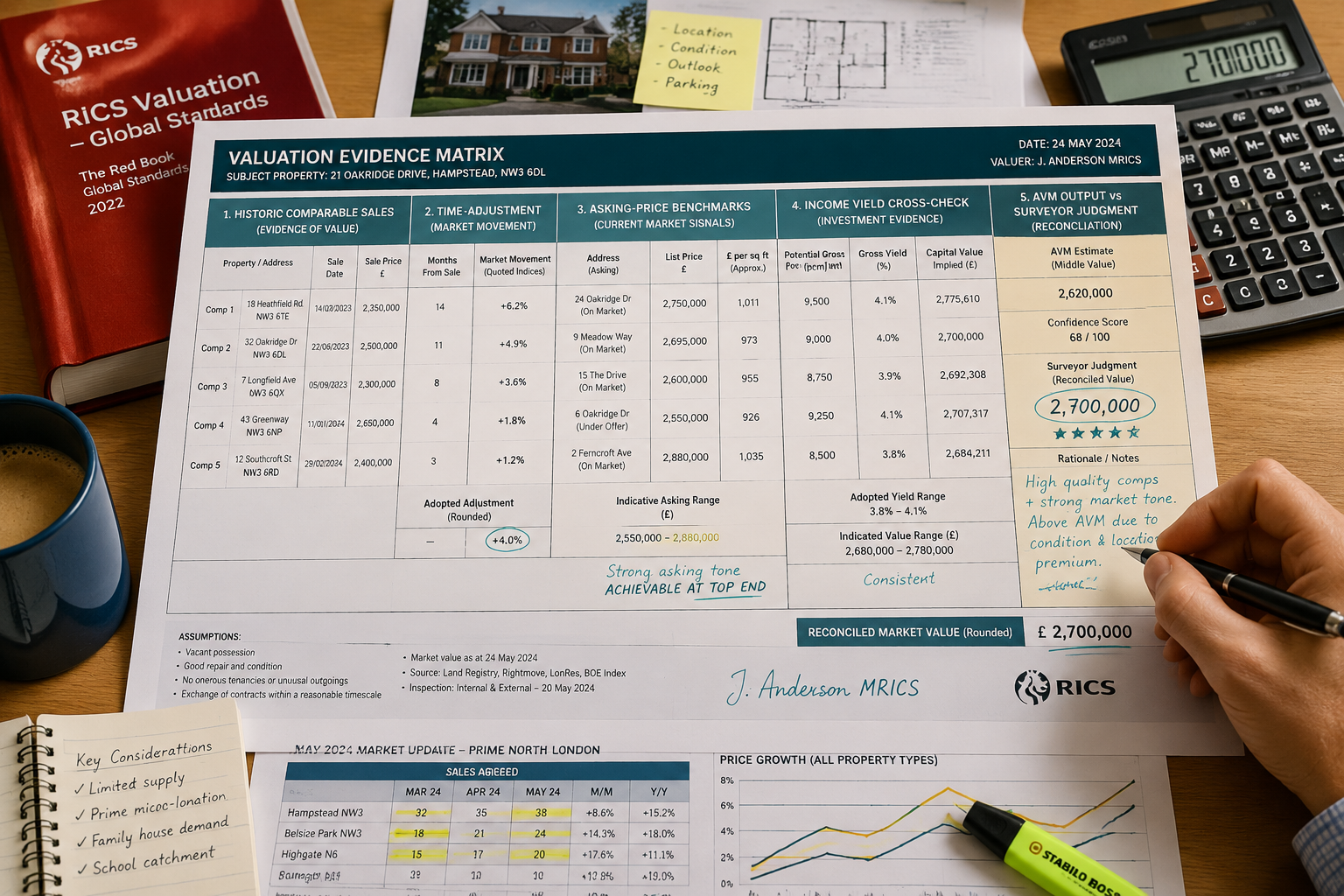
2. Build an Evidence Matrix — Not a Single Comp
Wimbledon-based RICS valuers describe a "layered evidence" approach that replaces the traditional single-comparable-led estimate with a structured evidence matrix [5]:
Layer 1 — Historic Comparable Sales
Adjusted for time, location, condition, and tenure. Even two or three genuine arm's-length sales, properly adjusted, are more defensible than six unadjusted ones.
Layer 2 — Current Asking Price Benchmarks
Active listings provide a ceiling. Apply a discount calibrated from the local listing-to-sale price ratio (e.g., if recent deals are closing at 96% of asking, discount accordingly). This ratio is a micro-market diagnostic that AVMs rarely capture [5].
Layer 3 — Income/Yield Cross-Check
Capitalise the market rent at a yield derived from current financing terms and comparable investment transactions. In a high-rate environment, yields have softened — the cross-check will often produce a lower figure than the sales comparison approach, which is itself a signal worth documenting.
Layer 4 — Real-Time Surveyor Intelligence
Inspection feedback, buyer resistance levels, renegotiation frequency, and days-on-market data are not anecdotal — they are evidence. RICS commentary for spring 2026 explicitly privileges this "real-time" intelligence over AVM outputs in thin markets [6].
3. Apply Micro-Market Diagnostics
Rather than relying on headline price indices, experienced valuers in stabilising markets are shifting to granular diagnostics [5]:
- 📊 Listing-to-sale price ratio: Are properties achieving asking price, or settling at a discount?
- ⏱️ Average days on market: Shortening days-on-market is a leading indicator of strengthening demand — but should only support upward adjustments when the trend is sustained and documented.
- 🔄 Sale fall-through rate: High fall-through rates signal buyer financing stress and a thinner effective market than headline transaction counts suggest.
- 📉 Local absorption rate: How many months of supply exist at current sales pace? Above six months typically indicates a buyer's market.
These diagnostics are especially valuable for RICS registered valuers in London operating in micro-markets where one or two streets can behave very differently from the surrounding borough.
4. Use Valuation Support Indicators for Commercial and Specialist Property
For commercial assets and specialist properties — where transaction evidence is often non-existent or not arm's-length — the income approach and discounted cash flow (DCF) become primary, not supplementary [2]. Key drivers in these cases include:
- Tenant covenant strength and lease length
- Probability of tenant default or non-renewal
- REIT-implied cap rates and NAV discounts
- Credit spreads and sector equity performance as corroborative indicators [7]
RICS practice notes for 2025–2026 explicitly encourage triangulating the three traditional approaches (sales, income, cost) with these "valuation support indicators" when direct transaction evidence is limited [7]. For those instructed on commercial building surveys in London, integrating these indicators into the valuation narrative is increasingly standard practice.
5. Avoid "Chasing the Turn" on Thin Evidence
As price expectations shift from negative to cautiously positive in some UK markets in 2026, there is professional pressure to reflect emerging optimism in valuations. Resist it unless the evidence base is solid [9].
Guidance from Prince Surveyors emphasises a clear hierarchy [9]:
- Primary weight: Achieved prices from the last 6–12 months, even if volumes are low
- Secondary, supporting: Rising asking prices and improved sentiment indicators
- Documented justification: Any upward adjustment to comparables must be tied to observable, measurable improvements — not optimism
This discipline is what separates a defensible Red Book valuation from one that will be challenged at a mortgage panel review or in tribunal proceedings.
Valuation Surveying in a High-Rate, Low-Transaction Market: Defending Figures to Lenders, Tribunals, and as an Expert Witness
The most demanding test of valuation surveying in a high-rate, low-transaction market: evidencing value with sparse comparables is not the initial report — it is the scrutiny that follows.

Lender Reports: What Mortgage Panels Expect in 2026
Lenders in 2026 are acutely aware of AVM limitations in thin markets. Mortgage panel surveyors are expected to:
- Document the comparable search process — how many sales were reviewed, over what radius and time period, and why specific ones were selected or rejected
- Show all adjustments — with percentage figures and the data source underpinning each
- Flag Material Valuation Uncertainty (MVU) where evidence is genuinely sparse, in accordance with RICS Red Book Global Standards
- Provide a sensitivity commentary — illustrating the impact of a thinner buyer pool, higher debt-service coverage ratios, and lender stress tests at current interest rates [1]
The dual-scenario approach — a primary Market Value (MV) based on best available comparables, plus a sensitivity analysis showing the impact of further yield softening — is increasingly expected in lender reports for higher-value or non-standard properties [1].
For clients navigating the cost of an RICS valuation, it is worth understanding that this additional analytical rigour is part of what a properly instructed RICS valuer delivers — and why fee-cutting in this area carries professional risk.
Tribunal and Expert Witness Work
In tribunal settings — whether Leasehold Valuation Tribunal (LVT), Upper Tribunal (Lands Chamber), or matrimonial proceedings — the surveyor's evidence will be tested against a structured standard. Key requirements include:
Transparency of the evidence hierarchy: The tribunal must be able to see exactly what evidence was used, in what order of priority, and why. An evidence matrix presented clearly is far more persuasive than a narrative that buries adjustments in prose.
Explicit disclosure of uncertainty: Claiming false precision in a thin market is worse than acknowledging uncertainty. A well-reasoned range, with a central estimate and documented justification for where within that range the subject property sits, is more credible than a single unsupported figure.
Distinguishing modelled value from achievable price: Industry guidance in 2026 stresses that valuers must clearly distinguish between "modelled fair value" and what is actually achievable in the current buyer pool [1]. Tribunals are increasingly sophisticated about this distinction.
For matrimonial valuations specifically, where one party may be motivated to argue for a higher or lower figure, a rigorous evidence matrix with transparent adjustments is the most effective defence against challenge from the opposing expert.
Using RICS Valuations as Negotiation Anchors
Beyond formal proceedings, formally instructed RICS valuations are increasingly used as price negotiation anchors in 2026 — particularly where asking prices still reflect 2021–2022 peak sentiment [3]. Buyers are successfully using conservative mortgage valuations to negotiate reductions or condition-based adjustments. Sellers with well-evidenced reports — clearly documented comparables, explicit adjustments, and a robust market narrative — are better positioned to resist opportunistic low offers in illiquid segments [3].
For anyone considering a retrospective valuation on a London property, the same principles apply: the quality of the evidence trail is what determines whether the figure stands up under scrutiny.
Disclosing Material Valuation Uncertainty: Professional Obligation, Not Weakness
A common misconception among clients — and occasionally among less experienced practitioners — is that a Material Valuation Uncertainty (MVU) disclosure undermines the valuation. It does not. Under RICS Red Book Global Standards, MVU disclosure is a professional obligation when the evidence base is insufficient to support a confident point estimate.
In a high-rate, low-transaction market, MVU disclosures are not rare edge cases. They are a routine feature of responsible practice. The disclosure should:
- State clearly what evidence is available and what is absent
- Quantify the uncertainty range where possible
- Explain what additional evidence would be needed to narrow that range
- Avoid implying false precision by presenting a single figure without context
💬 "A valuation that honestly discloses its evidential limitations is more legally defensible — and more professionally credible — than one that papers over thin evidence with confident language."
Conclusion: Actionable Steps for Valuers in Thin Markets
Valuation surveying in a high-rate, low-transaction market: evidencing value with sparse comparables is the defining professional challenge of 2026. The surveyors who navigate it successfully are not those with access to more data — they are those with the discipline to structure, adjust, and document the data they have.
Immediate Action Steps ✅
- Audit your comparable search process: Can you demonstrate, in writing, why each comparable was selected, adjusted, and weighted? If not, rebuild the process now.
- Implement an evidence matrix template: Formalise the layered approach — sales, income, asking-price benchmarks, and real-time indicators — as a standard output for every instruction in thin markets.
- Challenge every AVM output: Cross-reference against local micro-market diagnostics (listing-to-sale ratio, days on market, fall-through rate) before accepting or rejecting.
- Use MVU disclosures proactively: Do not wait for a challenge. Disclose uncertainty clearly, with a reasoned range and documented justification.
- Build your real-time intelligence network: Inspection feedback, agent conversations, and buyer sentiment data are evidence. Systematise how you capture and record them.
- Engage specialist support where needed: For complex or specialist properties, consult with chartered surveyors in London experienced in illiquid and niche market valuations.
The market will eventually normalise. Until it does, the surveyor who masters the art of evidencing value with sparse comparables will be the one clients, lenders, and tribunals trust most.
References
[1] Building Surveys Under Modest 2-5% Price Growth: Adjusting Valuation Protocols When Market Momentum Outpaces Transaction Activity – https://www.canterburysurveyors.com/blog/building-surveys-under-modest-2-5-price-growth-adjusting-valuation-protocols-when-market-momentum-outpaces-transaction-activity/
[2] Dealing with Uncertainty in Valuation of Specialized Properties (DIVA Portal) – https://www.diva-portal.org/smash/get/diva2:1874939/FULLTEXT01.pdf
[3] How Valuations Impact Property Sales and Negotiation Strategies – https://trustsurveyors.com/how-valuations-impact-property-sales-and-negotiation-strategies/
[4] Market Commentary: Volume First, Price Later in Rate-Constrained Markets – https://www.youtube.com/watch?v=5lsH5jbpuyA
[5] Valuation Surveys in Stabilising Markets: Techniques for Assessing Properties When Price Momentum Remains Subdued – https://wimbledonsurveyors.com/valuation-surveys-in-stabilising-markets-techniques-for-assessing-properties-when-price-momentum-remains-subdued/
[6] Navigating Uncertainty in Spring 2026 Valuations: How RICS Real-Time Surveyor Data Outperforms Automated Valuation Models – https://nottinghillsurveyors.com/blog/navigating-uncertainty-in-spring-2026-valuations-how-rics-real-time-surveyor-data-outperforms-automated-valuation-models
[7] Beyond the Three Approaches: How Valuation Support Indicators Can Strengthen – https://www.reit.com/news/blog/market-commentary/beyond-three-approaches-how-valuation-support-indicators-can-strengthen
[9] Valuation Surveys in Stabilizing Markets: Adapting RICS Techniques When Price Expectations Shift from Negative to Positive – https://princesurveyors.co.uk/blog/valuation-surveys-in-stabilizing-markets-adapting-rics-techniques-when-price-expectations-shift-from-negative-to-positive/