
Over 4.98 million leasehold dwellings exist in England alone — and a significant proportion of their owners will, at some point, find themselves locked in a disagreement over value. Whether the dispute centres on a lease extension premium, an enfranchisement price, or service charge liability, valuation disputes in leasehold flats: how surveyors support evidence for tribunal and court cases is a topic that directly affects millions of property owners, landlords, and investors across the UK in 2026.
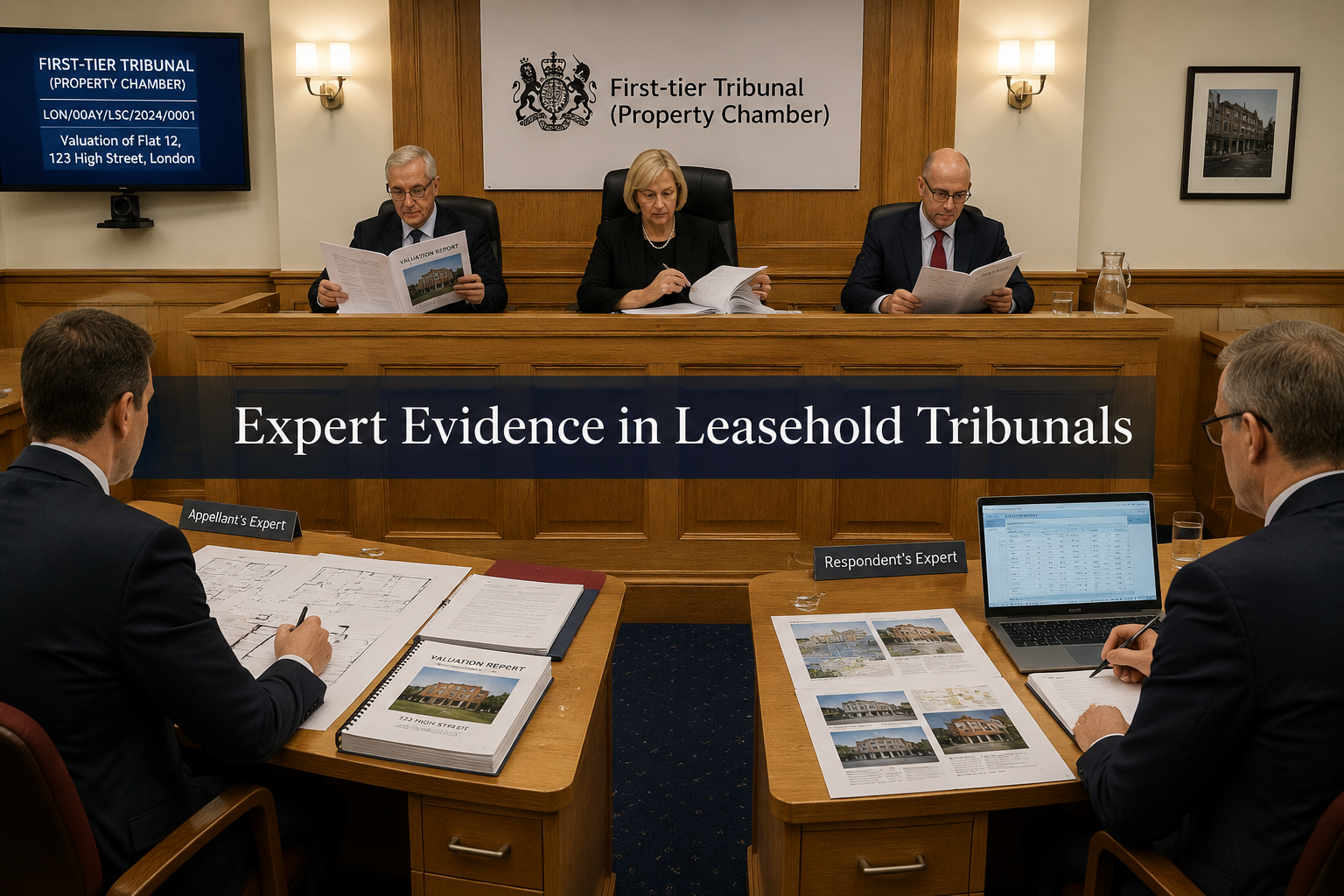
When those disagreements escalate to the First-tier Tribunal (Property Chamber) or the Upper Tribunal (Lands Chamber), the quality of surveyor evidence can be the single most decisive factor in the outcome. A poorly prepared valuation report — or one that fails to engage with the opposing expert's assumptions — can cost a leaseholder or freeholder tens of thousands of pounds.
Key Takeaways 📌
- Surveyors acting as expert witnesses must prioritise the tribunal's needs over their client's interests — impartiality is a legal obligation, not a preference.
- Relativity, deferment rates, and comparable evidence are the three most contested valuation inputs in leasehold disputes.
- Failure to agree common ground before a hearing can result in the tribunal simply splitting the difference between two expert positions — often to neither party's advantage.
- A RICS Red Book-compliant valuation forms the bedrock of defensible evidence in both tribunal and court proceedings.
- Early instruction of a specialist leasehold surveyor dramatically improves the strength of evidence and can facilitate settlement before a hearing.
Understanding the Tribunal Landscape for Leasehold Valuation Disputes
The First-tier Tribunal (Property Chamber) handles the vast majority of residential leasehold valuation disputes in England and Wales [2]. Its jurisdiction covers lease extension premiums under the Leasehold Reform, Housing and Urban Development Act 1993, collective enfranchisement claims, service charge disputes, and administration charge challenges.
Informed leaseholders have become increasingly willing to use this route. Reports indicate that tribunal actions by leasehold owners have risen by as much as 165 per cent as awareness of legal rights has grown [6]. In 2026, that trend continues to accelerate, driven partly by ongoing leasehold reform debates and greater access to specialist legal and surveying advice [3][9].
💬 "The tribunal process is not a last resort — it is a legitimate and increasingly well-used mechanism for resolving valuation disagreements that parties cannot settle between themselves."
The Upper Tribunal (Lands Chamber) handles appeals on points of law or valuation methodology, and its decisions set binding precedent. Understanding how both bodies evaluate surveyor evidence is essential for anyone entering a leasehold dispute.
For leaseholders and freeholders in the capital, working with experienced chartered surveyors in London who understand tribunal procedure is a critical first step.
The Surveyor's Role: Expert Witness Obligations and Valuation Disputes in Leasehold Flats
Duty to the Tribunal, Not the Client
A surveyor instructed as an expert witness owes their primary duty to the tribunal, not to the party paying their fees. This is enshrined in Civil Procedure Rule 35 and reinforced by RICS guidance on expert witness practice. Failure to maintain independence can result in evidence being disregarded entirely — a costly outcome for the client.
This does not mean a surveyor cannot advocate for a well-reasoned position. It means that every figure, assumption, and methodology must be capable of withstanding cross-examination and must be honestly held.
What a Leasehold Valuation Report Must Cover
A robust expert valuation report for tribunal use typically addresses:
| Valuation Component | Why It Matters |
|---|---|
| Freehold value | The baseline for calculating the premium |
| Relativity | The ratio of leasehold to freehold value — highly contested |
| Deferment rate | The rate used to discount future freehold reversion |
| Capitalisation rate | Applied to ground rent income streams |
| Comparable transactions | Market evidence supporting key assumptions |
| Repair assumptions | Whether the property is valued in current condition or notional repair |
| Hope value / marriage value | Relevant where leases fall below 80 years |
Each of these components can be — and frequently is — disputed. A RICS Red Book valuation in London provides the professional framework within which these figures must be presented.
Key Battlegrounds: Relativity, Enfranchisement, and Repair Assumptions

Relativity: The Most Contested Input
Relativity expresses the value of a leasehold interest (with its existing lease) as a percentage of the freehold value. A flat with 60 years remaining might have a relativity of around 80–85%, meaning the leasehold is worth 80–85% of what it would be worth if owned freehold.
The problem is that there is no single agreed relativity graph. Different graphs — produced by Gerald Eve, Savills, Beckett and Kay, and others — produce materially different results, particularly for shorter leases. A difference of just 2–3 percentage points in relativity can translate into a premium difference of £10,000–£30,000 on a London flat.
Surveyors must:
- ✅ Identify which graph(s) they are relying upon and why
- ✅ Consider whether "graph" evidence or "standing back" market evidence is more appropriate
- ✅ Address the opposing expert's chosen graph directly
Enfranchisement Premiums: Collective Complexity
Collective enfranchisement — where a group of leaseholders purchase the freehold of their building — involves valuing the freeholder's interest across multiple flats simultaneously. This introduces additional complexity:
- Banding of lease lengths across different flats
- Valuation of intermediate leasehold interests (head leases)
- Development potential and hope value
- Apportionment of the total premium between participating leaseholders
For those considering buying the freehold in London, understanding how these components interact is vital before entering negotiations or tribunal proceedings.
Lease Extension Impacts and the 80-Year Cliff
When a lease falls below 80 years, marriage value becomes payable — the leaseholder must share 50% of the value created by the extension with the freeholder. This creates a sharp increase in premium costs and is one of the most common triggers for disputes.
Surveyors must carefully evidence:
- The current leasehold value (pre-extension)
- The freehold value
- The reversionary value of the extended lease
- The marriage value calculation and its split
Repair Assumptions: A Frequently Overlooked Variable
The assumed state of repair at the valuation date can materially affect the freehold value and, consequently, the premium. If a building has significant structural defects or deferred maintenance, should the valuation assume the property is in good repair (as the statute may require) or in its actual condition?
This is particularly relevant in older mansion blocks and converted Victorian properties. Surveyors who fail to address repair assumptions explicitly leave their evidence vulnerable to challenge. Understanding dilapidation surveys and their interaction with leasehold valuations can strengthen the evidential picture considerably.
How Tribunals Evaluate Expert Evidence: Lessons from Real Cases
The Regnolruf Court Decision: A Cautionary Tale
A First-tier Tribunal decision from December 2020 — concerning a flat at 8 Regnolruf Court, London — offers a striking illustration of what happens when expert surveyors fail to narrow their differences [1].
Both surveyors produced valuations that were only approximately 2% apart in their final figures. Yet they could not agree on two fundamental inputs: the floor area of the flat and the appropriate price per square foot. Rather than preferring one expert's evidence wholesale, the Tribunal:
- Averaged the floor area figures provided by each surveyor
- Used £275/sq ft as a midpoint between the two rates suggested
- Added 0.5% to reflect comparable evidence on the premium
- Rounded the long leasehold value to £290,000
- Determined the lease extension price at £46,037
The lesson is stark: if experts cannot agree on basic factual matters, the tribunal will simply split the difference — and neither party may be satisfied with the result [1].
💡 Pull Quote: "Tribunals are not obliged to prefer one expert over another. Where the gap is narrow and the reasoning is thin, a compromise figure is the most likely outcome."
The Importance of a Joint Statement
Most tribunal procedures require expert surveyors to produce a joint statement before the hearing, setting out:
- Areas of agreement
- Areas of disagreement
- The reasons for disagreement
This document is critically important. A well-constructed joint statement narrows the issues, reduces hearing time, and demonstrates to the tribunal that both experts have engaged seriously with the evidence. Failure to engage constructively in the joint statement process is viewed dimly by tribunals [4].
Comparable Evidence: Quality Over Quantity
Tribunals consistently prefer a small number of well-analysed comparables over a large volume of poorly explained transactions. Each comparable must be:
- ✅ Adjusted for lease length differences
- ✅ Adjusted for floor level and aspect
- ✅ Adjusted for condition and specification
- ✅ Sourced from verifiable records (Land Registry, auction results, etc.)
Surveyors who simply list transactions without explaining their relevance or making appropriate adjustments will find their evidence carries little weight.
Preparing Defensible Valuation Evidence: Practical Steps for Surveyors and Their Clients
Step 1: Instruct Early and Instruct a Specialist
General practice surveyors are not always equipped to handle leasehold tribunal work. The methodology is highly specialised, and the procedural requirements are demanding. Instructing a surveyor with specific experience in leasehold valuation disputes — ideally one who has appeared before the First-tier or Upper Tribunal — is essential.
For those in the south-east, valuation services in London from a specialist firm provide the foundation for credible expert evidence.
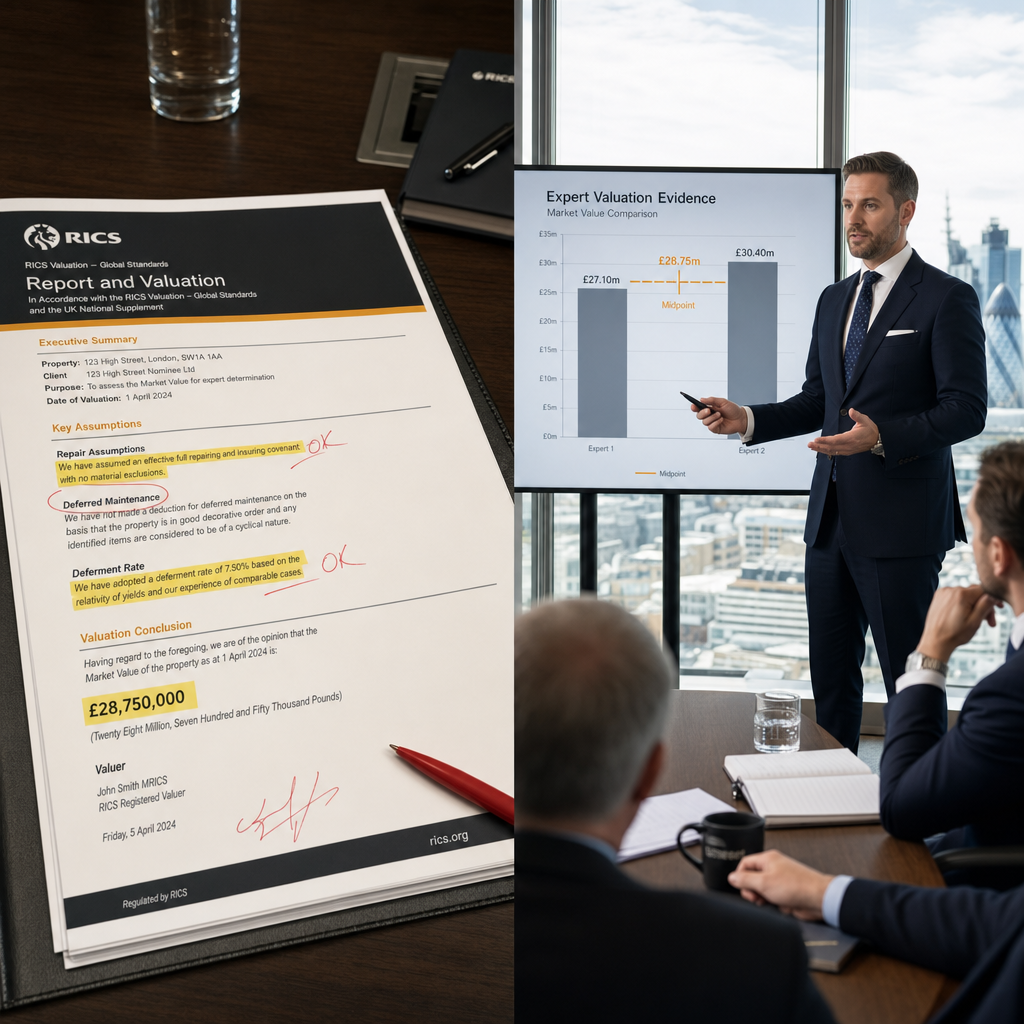
Step 2: Commission a RICS-Compliant Valuation Report
The report must comply with the RICS Valuation – Global Standards (Red Book). This means:
- A clear statement of the basis of value
- Disclosure of any conflicts of interest
- A transparent methodology
- Properly supported comparable evidence
A comprehensive valuation report that meets these standards will withstand scrutiny far more effectively than an informal opinion letter.
Step 3: Address the Opposing Expert's Assumptions Directly
One of the most common weaknesses in tribunal valuation evidence is the failure to engage with the opposing expert's methodology. A surveyor who simply restates their own position without addressing why the other expert's approach is wrong will not persuade a tribunal.
The report — and any supplemental evidence — must:
- Identify the specific points of disagreement
- Explain why the preferred approach is more reliable
- Acknowledge any areas of genuine uncertainty
Step 4: Understand the Cost Implications
Tribunal proceedings carry cost risks. While the First-tier Tribunal does not generally award costs (except in cases of unreasonable behaviour), the Upper Tribunal can. Understanding RICS valuation costs and the overall financial exposure of a dispute helps clients make informed decisions about whether to proceed to hearing or seek a negotiated settlement.
Step 5: Consider Retrospective Valuation Where Relevant
In some disputes — particularly those involving historical lease extensions or enfranchisement claims where the valuation date is in the past — a retrospective property valuation in London may be required. This demands access to historical comparable evidence and a thorough understanding of market conditions at the relevant date.
The Evolving Legal Landscape in 2026
The leasehold reform agenda continues to reshape the landscape for valuation disputes in 2026. The Leasehold and Freehold Reform Act 2024 introduced significant changes to the enfranchisement and lease extension process, and further secondary legislation is expected to follow [9][3].
Key developments affecting valuation disputes include:
- Abolition of marriage value for leases under 80 years (when implemented) — this will fundamentally alter premium calculations
- Prescribed deferment and capitalisation rates — reducing (but not eliminating) disputes over these inputs
- Extended rights for commercial premises within mixed-use buildings
- Increased transparency requirements for freeholders in service charge disputes [5]
Surveyors advising clients in 2026 must stay current with these legislative changes and understand how they interact with existing case law from the Upper Tribunal.
Conclusion: Taking Action Before a Dispute Escalates
Valuation disputes in leasehold flats — and how surveyors support evidence for tribunal and court cases — will remain a significant feature of the property landscape for years to come. The stakes are high: a poorly evidenced valuation can cost a leaseholder or freeholder tens of thousands of pounds, and a badly managed tribunal process can result in a compromise outcome that satisfies neither party.
Actionable next steps for leaseholders and freeholders:
- Seek specialist advice early — before serving or responding to a Section 42 or Section 13 notice
- Commission a RICS Red Book-compliant valuation from a surveyor with leasehold tribunal experience
- Engage constructively in the joint statement process — narrowing issues before the hearing reduces cost and uncertainty
- Understand the key valuation inputs — relativity, deferment rate, repair assumptions — and ensure your surveyor addresses each one explicitly
- Monitor legislative developments in 2026 that may affect the calculation of premiums
- Consider the full cost picture before deciding whether to proceed to tribunal or negotiate a settlement
Whether the dispute involves a single flat in a converted Victorian terrace or a large mansion block with dozens of participating leaseholders, the quality of surveyor evidence is the cornerstone of a successful outcome. Working with experienced, RICS-regulated professionals who understand both the valuation methodology and the tribunal process is not optional — it is essential.
References
[1] 8 Regnolruf Ct Published Decision 1st December 2020 – https://assets.publishing.service.gov.uk/media/5fd8bc38e90e071beab9d346/8_Regnolruf_Ct__Published_Decision_1st_December_2020.pdf
[2] Leasehold Valuation Tribunal – https://en.wikipedia.org/wiki/Leasehold_valuation_tribunal
[3] Commercial Real Estate Disputes In 2026 Whats Coming Into View – https://www.ashurst.com/en/insights/commercial-real-estate-disputes-in-2026-whats-coming-into-view/
[4] Residential Property Tribunal Decisions – https://www.gov.uk/residential-property-tribunal-decisions
[5] Real Estate Litigation 2026 – https://practiceguides.chambers.com/practice-guides/real-estate-litigation-2026
[6] Informed Leasehold Owners Increase Leasehold Valuation Tribunal Actions By 165 Per Cent – https://www.leaseholdknowledge.com/informed-leasehold-owners-increase-leasehold-valuation-tribunal-actions-by-165-per-cent/
[9] Property Litigation 2026 Taking Stock And Looking Ahead – https://www.brownejacobson.com/insights/property-litigation-2026-taking-stock-and-looking-ahead