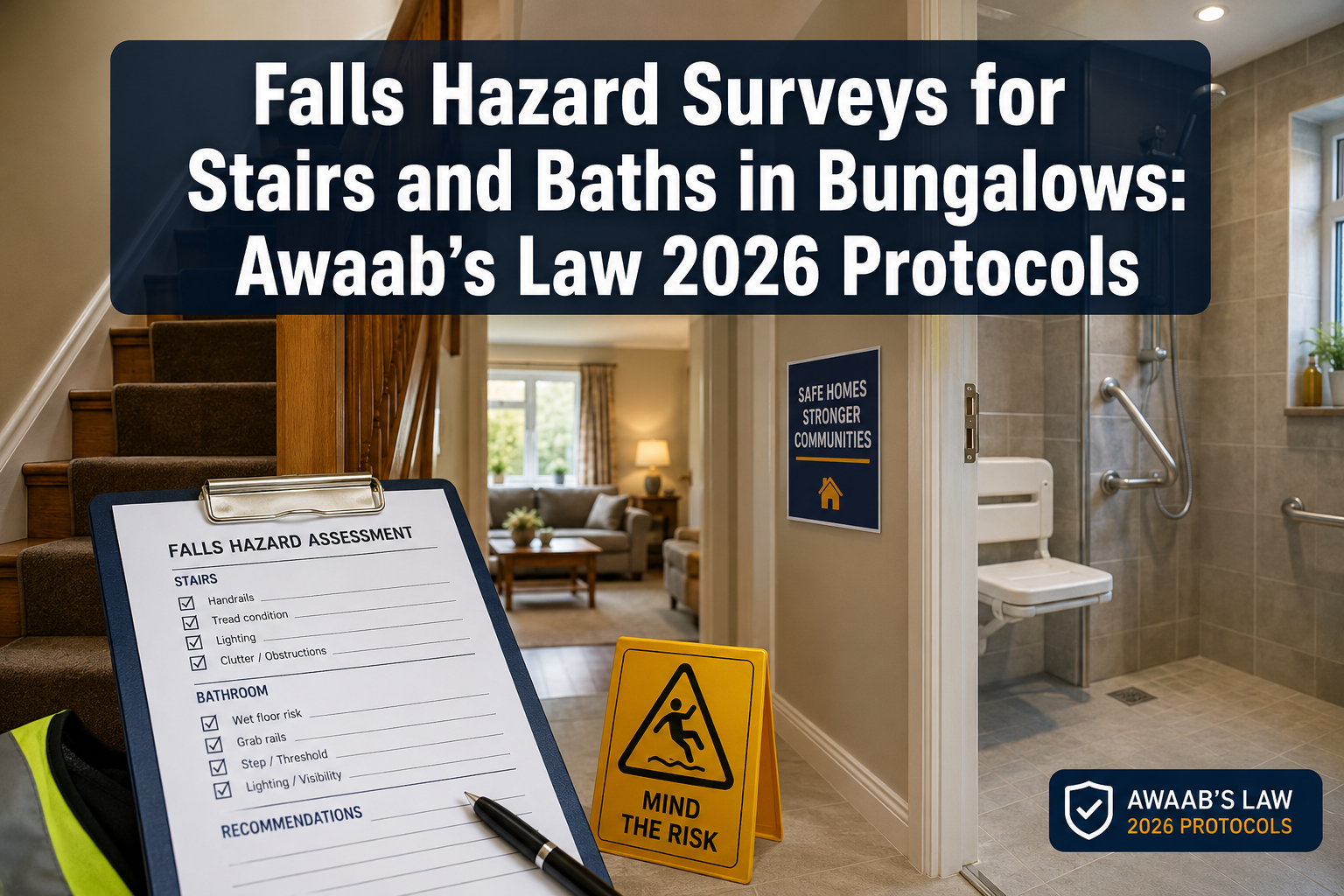

Every year, over 6,000 people in England die as a result of falls in the home — and the majority of those deaths involve older adults living in single-storey properties. Yet until the expansion of Awaab's Law in 2026, formal hazard survey protocols for social housing focused almost exclusively on damp, mould, and excess cold or heat. Falls Hazard Surveys for Stairs and Baths in Bungalows: Awaab's Law 2026 Protocols Beyond Excess Temperature now change that picture entirely, compelling landlords and housing associations to treat stair and bathroom fall risks with the same legal urgency as thermal hazards.
This article explains what these expanded protocols mean in practice, how Level 3 assessments work in bungalow settings, and why compliance is not just a legal duty but a genuine life-saving intervention.
Key Takeaways 📋
- Awaab's Law 2026 extends hazard-response timelines and scope beyond damp/mould to include falls hazards — specifically stairs and bathrooms in bungalows occupied by vulnerable tenants.
- Bungalows present unique risk profiles because single-storey layouts often house elderly or disabled residents, where bathroom and step hazards are statistically the most dangerous.
- Level 3 Building Surveys are the recommended tool for identifying structural and non-structural falls risks in these properties.
- Landlords face strict response deadlines under the 2026 protocols, with emergency hazards requiring action within 24 hours.
- Party wall extensions to bungalows introduce new falls hazard considerations that must be assessed before and after construction.
What Awaab's Law 2026 Means for Falls Hazards — Beyond Excess Temperature
Awaab's Law was originally enacted in memory of two-year-old Awaab Ishak, who died in 2020 from prolonged exposure to severe mould in a Rochdale social housing flat. The initial legislation, introduced through the Social Housing (Regulation) Act 2023, focused on hazards related to damp and excess temperature. However, the 2026 expansion significantly broadens the scope of the law.
Under the 2026 protocols, registered social landlords (RSLs) and local authority housing providers must now:
- Respond to reported falls hazards within 14 days for standard risks.
- Act within 24 hours where a falls hazard presents an immediate danger to life.
- Commission a formal hazard survey when a falls risk is identified or reported in a qualifying property.
- Document remediation actions with evidence and timelines.
💬 "The 2026 protocols recognise what housing professionals have known for years: falls are as lethal as cold homes, and bungalows are ground zero for that risk." — Housing safety commentator, 2026.
The Housing Health and Safety Rating System (HHSRS) has always categorised falls on stairs and falls in bathrooms as Category 1 hazards when sufficiently severe. What changes in 2026 is the mandatory, time-bound response framework that mirrors the damp-and-mould obligations Awaab's Law originally created.
Why Bungalows Demand Specialist Falls Hazard Surveys for Stairs and Baths
The Demographic Reality
Bungalows are disproportionately occupied by older adults and people with mobility impairments. According to NHS data, people aged 65 and over account for approximately 80% of fall-related hospital admissions. When a bungalow is a social housing property, the intersection of vulnerable occupant + substandard housing conditions creates a foreseeable and preventable risk.
Bungalow-specific falls hazards differ from those in multi-storey properties in several key ways:
| Hazard Type | Bungalow Risk Factor | Multi-Storey Risk Factor |
|---|---|---|
| Internal stairs | Step access to split-levels or loft rooms | Full staircase between floors |
| Bathroom/wet room | Frequently adapted for elderly tenants | Standard installation more common |
| External steps | Single entry point, often poorly lit | Multiple access routes |
| Threshold strips | More frequent due to extensions | Less common |
| Flooring transitions | Often mixed across open-plan layouts | Contained to individual rooms |
What a Level 3 Bungalow Survey Covers
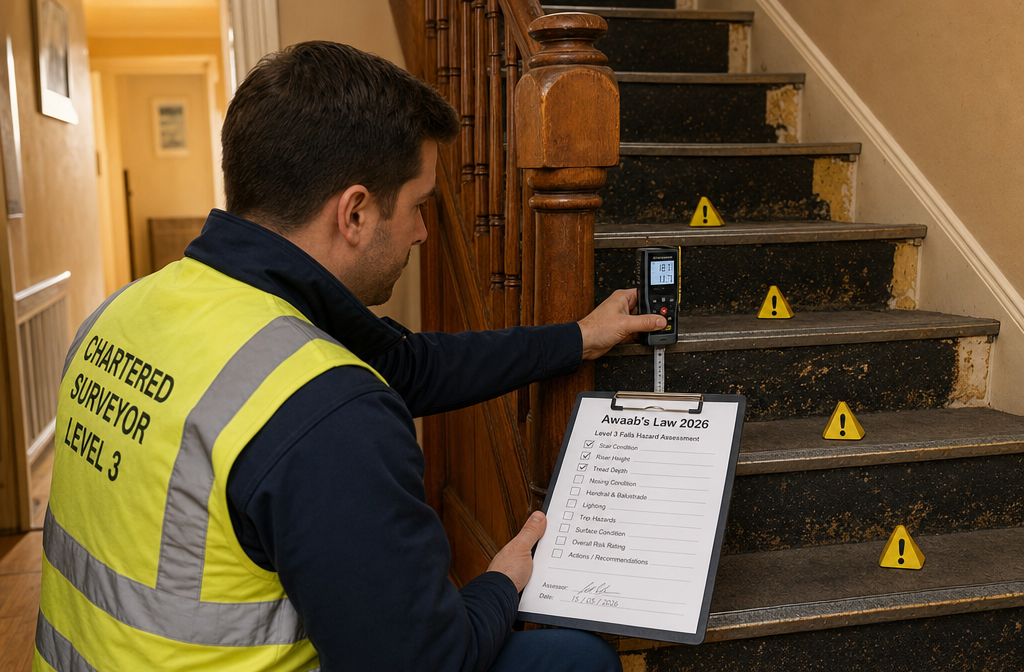
A structural survey for a bungalow at Level 3 is the most thorough form of residential inspection available. When commissioned specifically for falls hazard compliance, it should assess:
Stair-related elements:
- Step riser height consistency (HHSRS flags inconsistency above 18mm variance)
- Tread depth and nosing condition
- Handrail presence, height (900mm–1000mm recommended), and fixity
- Lighting levels on approach and descent
- Surface slip resistance (measured using a pendulum test where required)
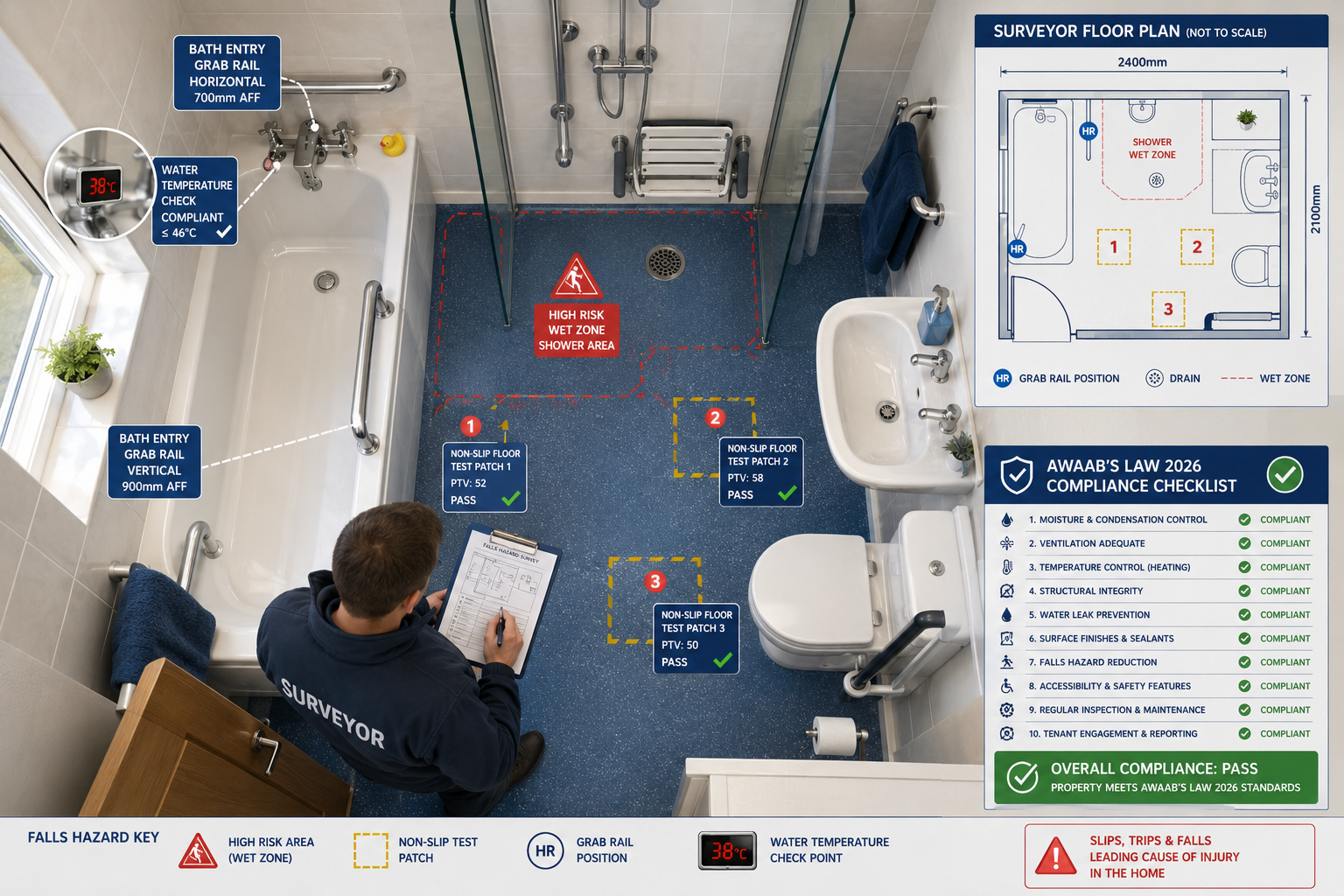
Bathroom and wet room elements:
- Bath and shower entry height and grab rail provision
- Floor surface slip resistance (wet and dry)
- Hot water temperature at the tap (still assessed under thermal hazard protocols)
- Door threshold height
- Emergency egress considerations
For landlords unsure which survey type is most appropriate, a guide to what survey you need can help clarify the right level of inspection before commissioning work.
Conducting Falls Hazard Surveys for Stairs and Baths in Bungalows: Awaab's Law 2026 Protocols in Practice
The Survey Process: Step by Step
A compliant falls hazard survey under the 2026 protocols is not a tick-box exercise. It requires a systematic, evidence-based approach carried out by a qualified surveyor — ideally a Chartered Surveyor with HHSRS training.
Stage 1 — Pre-survey desktop review
- Review tenancy history and any reported repairs
- Obtain existing floor plans (especially relevant for extended bungalows)
- Identify occupant vulnerability profile (age, disability, mobility aids)
Stage 2 — On-site inspection
- Physical measurement of all stair elements
- Slip resistance testing in bathrooms (wet conditions simulated)
- Photographic evidence of every identified hazard
- Thermal imaging where excess temperature hazards are also suspected
Stage 3 — HHSRS scoring
- Each falls hazard is scored using the HHSRS likelihood and harm outcome matrices
- Category 1 hazards (score above 1,000) trigger mandatory landlord action
- Category 2 hazards are documented for planned maintenance
Stage 4 — Report and remediation schedule
- A specific defect report documents each hazard with photographic evidence, HHSRS score, and recommended remediation
- Timelines are assigned in line with Awaab's Law 2026 response requirements
Common Defects Found in Bungalow Surveys 🔍
The most frequently identified falls hazards in bungalow social housing properties include:
- ⚠️ Worn or missing stair nosings — particularly in properties with loft conversions or split-level additions
- ⚠️ Inadequate grab rails — absent or incorrectly positioned at bath and shower entry points
- ⚠️ Smooth ceramic floor tiles — installed in bathrooms without slip-resistant treatment
- ⚠️ Raised thresholds — between original bungalow structure and extensions, creating trip hazards
- ⚠️ Poor lighting — especially in hallways leading to bathrooms during night hours
- ⚠️ Loose handrails — fixed to walls with insufficient fixings, particularly in older properties
Party Wall Extensions and New Falls Hazard Obligations
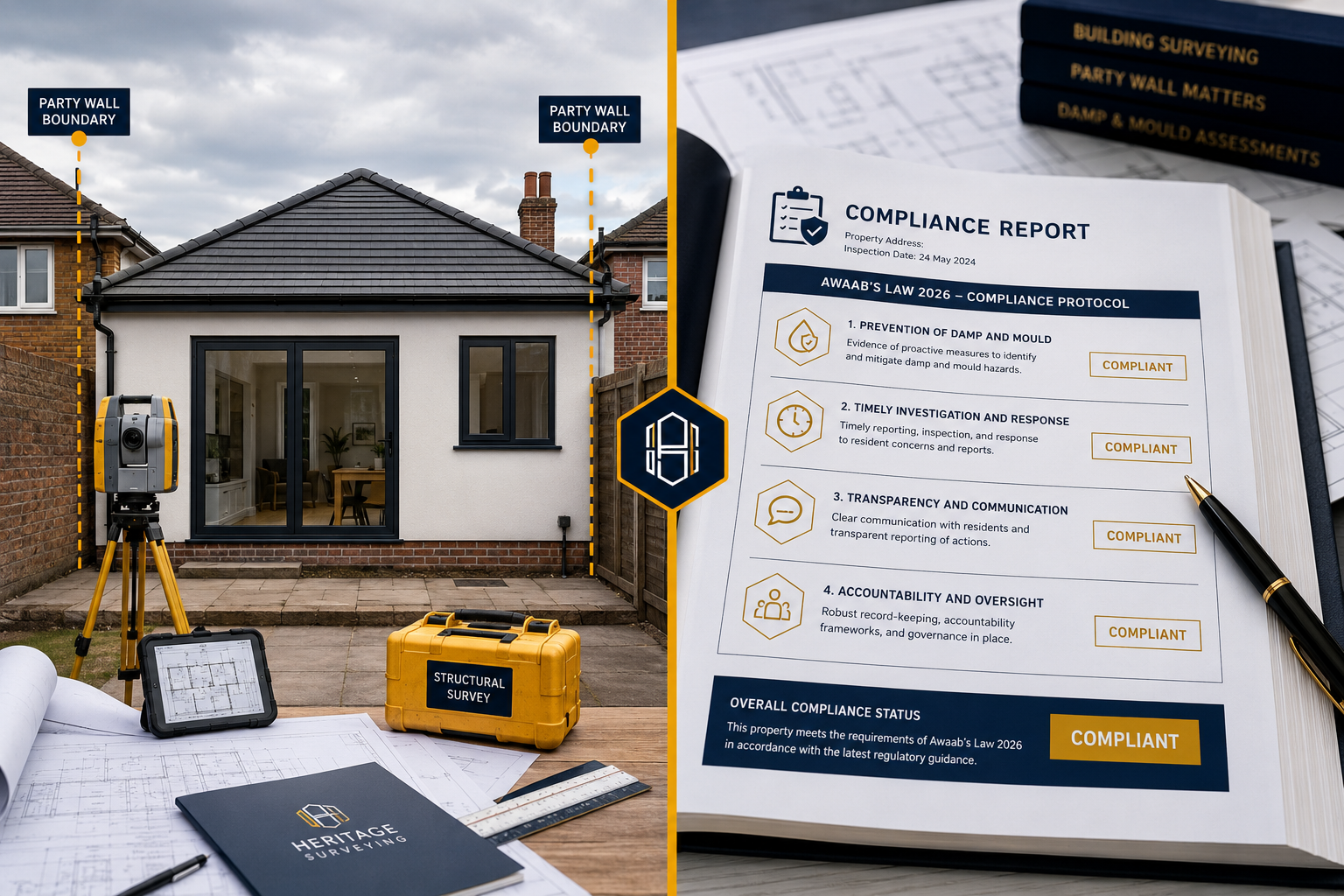
One area that catches many bungalow landlords off guard is the interaction between extension works and falls hazard compliance. When a bungalow is extended under permitted development or following a licence to alter, the new junction between old and new structure frequently introduces threshold hazards, flooring level changes, and altered circulation routes.
Under the 2026 protocols, any extension that modifies the layout of a bungalow occupied by a social housing tenant must be accompanied by a post-completion falls hazard assessment. This is particularly relevant where:
- A rear or side extension creates a new access route to the bathroom
- A loft conversion introduces stairs into a previously single-level property
- A garage conversion alters the main entry threshold
Party wall works also carry obligations. Where a bungalow shares a boundary wall with a neighbouring property and extension works are planned, a schedule of condition report should be completed before works begin — both to protect the party wall and to establish a baseline for any falls hazard changes that result from construction activity.
Landlord Obligations, Timelines, and Enforcement in 2026
The Response Framework
The 2026 Awaab's Law expansion sets out a clear tiered response system for falls hazards:
| Hazard Severity | Response Required | Timeline |
|---|---|---|
| Emergency (imminent risk of serious injury) | Immediate temporary fix + permanent remediation plan | Within 24 hours |
| Urgent (Category 1 HHSRS score) | Formal written remediation plan | Within 14 days |
| Non-urgent (Category 2 HHSRS score) | Planned maintenance schedule | Within 12 weeks |
Failure to comply exposes landlords to enforcement action by the Regulator of Social Housing (RSH), civil liability claims from injured tenants, and — in serious cases — referral to the Housing Ombudsman.
What Landlords Must Document
Compliance is not just about fixing hazards — it is about proving that hazards were identified, assessed, and remediated within the required timeframes. Landlords should maintain:
- Dated survey reports with HHSRS scores
- Photographic evidence pre- and post-remediation
- Contractor invoices and completion certificates
- Tenant communication records
- Re-inspection reports confirming hazard removal
For landlords managing multiple bungalow properties, a dilapidation survey approach — typically used in commercial settings — can be adapted to create a systematic baseline record across a portfolio, making compliance tracking considerably more manageable.
Choosing the Right Surveyor for Awaab's Law 2026 Compliance
Not every surveyor is equipped to deliver a compliant falls hazard survey under the 2026 protocols. The right professional should hold:
- RICS membership (Chartered Surveyor status)
- HHSRS assessment training — ideally certified through a recognised housing authority programme
- Experience with bungalow typologies — particularly post-war social housing stock
- Knowledge of Awaab's Law 2026 requirements and the associated regulatory guidance
When selecting a surveyor, landlords should ask for evidence of previous HHSRS-scored reports and familiarity with the specific response timeline requirements of the 2026 framework. A chartered surveyor with demonstrated housing compliance experience is the appropriate choice for this type of instruction.
For properties where structural concerns accompany falls hazards — for example, where a staircase shows signs of movement or a bathroom floor has deflected — input from a residential structural engineer may also be required as part of the assessment process.
Beyond Compliance: The Broader Case for Falls Hazard Surveys
It would be a mistake to view Falls Hazard Surveys for Stairs and Baths in Bungalows: Awaab's Law 2026 Protocols Beyond Excess Temperature purely through a compliance lens. The human case is equally compelling.
Consider the typical occupant profile of a social housing bungalow in 2026: a tenant in their late 70s, possibly using a walking frame, living alone, with a bathroom that was last refurbished in the early 2000s. The grab rail is loose. The bath entry is 580mm high with no step. The floor tiles are polished ceramic. None of these defects would trigger a damp survey — but every one of them is a foreseeable cause of a life-altering fall.
💬 "Falls hazard assessments in bungalows are not a bureaucratic exercise. They are the difference between a tenant living independently and a tenant spending the rest of their life in a care home following a preventable accident."
The 2026 protocols give housing providers the framework, the timelines, and — crucially — the legal obligation to act. For tenants, that translates into safer homes. For landlords, it translates into reduced liability, fewer emergency repairs, and demonstrable compliance with the Decent Homes Standard.
Conclusion: Actionable Next Steps for Landlords and Housing Providers
Falls Hazard Surveys for Stairs and Baths in Bungalows: Awaab's Law 2026 Protocols Beyond Excess Temperature represent a significant and overdue expansion of housing safety law in England. The key actions for landlords and housing associations in 2026 are clear:
✅ Audit your bungalow portfolio — identify all properties occupied by vulnerable tenants and prioritise those with unremediated bathroom or stair concerns.
✅ Commission Level 3 surveys from RICS-qualified surveyors with HHSRS training — not generic property inspections.
✅ Establish a documented response system that records hazard identification, scoring, remediation, and re-inspection in line with the 24-hour and 14-day timelines.
✅ Review extension and adaptation works — ensure any recent or planned party wall or extension works include a post-completion falls hazard assessment.
✅ Train housing management staff to recognise and correctly report falls hazards so that the response clock starts at the right moment.
✅ Engage tenants proactively — many falls hazards are first noticed by residents, and a clear reporting pathway reduces the risk of unreported dangers.
The law has moved. The standards have risen. And for the thousands of vulnerable tenants living in bungalows across England, that shift cannot come soon enough.