Over 60% of construction disputes in England and Wales involve allegations of defective or non-compliant building works — and a significant proportion of those disputes hinge entirely on the quality of a single expert witness report. When retrospective building works are at the centre of a legal or tribunal claim, the difference between winning and losing often comes down to whether the surveyor followed RICS protocols correctly.
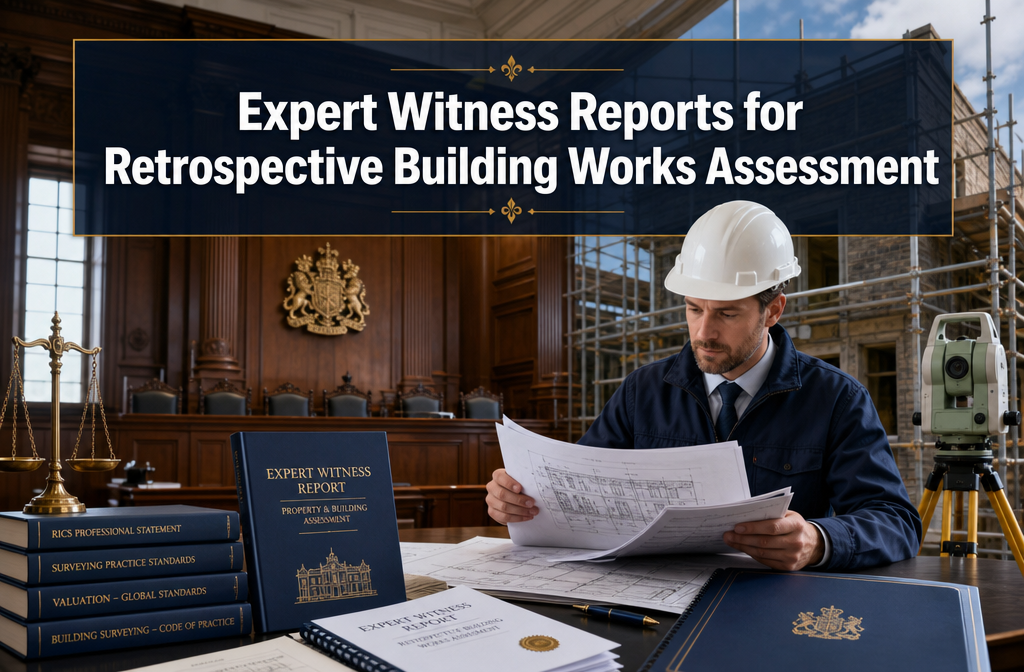
Expert Witness Reports for Retrospective Building Works Assessment: RICS Standards and Dispute Resolution is a specialist area that sits at the crossroads of building pathology, professional ethics, and civil procedure. Whether a homeowner believes they were overcharged for shoddy renovation work, a leaseholder suspects a contractor bypassed building regulations, or a developer faces a negligence claim over a failed retrofit scheme, the expert witness report is the instrument that translates technical findings into legally admissible evidence.
This guide explains exactly how those reports should be structured, what RICS standards govern them in 2026, and how they function within formal dispute resolution processes.
Key Takeaways 📋
- RICS members acting as expert witnesses have a primary duty to the court or tribunal — not to the instructing client — and must remain independent at all times.
- The RICS "Surveyors acting as expert witnesses" practice statement is mandatory for all RICS members giving expert evidence, including in retrospective building works disputes.
- The RICS Retrofit Standard is now a key benchmark when assessing historic energy-related or fabric upgrade works, and is increasingly cited in defective retrofit disputes [1].
- CPR Part 35 (Civil Procedure Rules) governs expert evidence in England and Wales courts; equivalent rules apply in tribunals and arbitration.
- Retrospective assessment protocols must address regulatory compliance, workmanship standards, and whether costs charged were reasonable — all within a clearly documented methodology.
What Is a Retrospective Building Works Assessment?
A retrospective building works assessment is a formal technical evaluation of construction, renovation, or refurbishment works that have already been completed. Unlike a pre-construction survey, the expert is examining finished (or partially finished) work — often years after completion — to determine:
- Whether the works complied with applicable building regulations at the time
- Whether workmanship met the standard of a reasonably competent contractor
- Whether the materials specified and installed were appropriate
- Whether the costs charged were fair and proportionate
- Whether any defects observed are attributable to the works in question
These assessments arise in a wide range of disputes: neighbour disputes following party wall works, insurance claims after failed insulation or waterproofing, consumer disputes where homeowners allege overcharging, and professional negligence claims against architects or surveyors.
For property owners in London and the South East, engaging a chartered surveyor with expert witness experience is the critical first step. The surveyor must be able to assess not just what went wrong, but whether what went wrong constitutes a breach of a recognised standard.
Common Triggers for Retrospective Assessments
| Dispute Type | Typical Issue | Relevant Standard |
|---|---|---|
| Defective retrofit/insulation | Moisture ingress, thermal failure | RICS Retrofit Standard [1] |
| Party wall damage | Structural cracking, subsidence | Party Wall etc. Act 1996 |
| Overcharging disputes | Inflated bills, unnecessary works | RICS cost guidance |
| Building regulation breaches | Unauthorised alterations | Building Regulations 2010 |
| Negligent specifications | Wrong materials, unsafe design | Professional negligence law |
RICS Standards Governing Expert Witness Reports for Retrospective Building Works Assessment
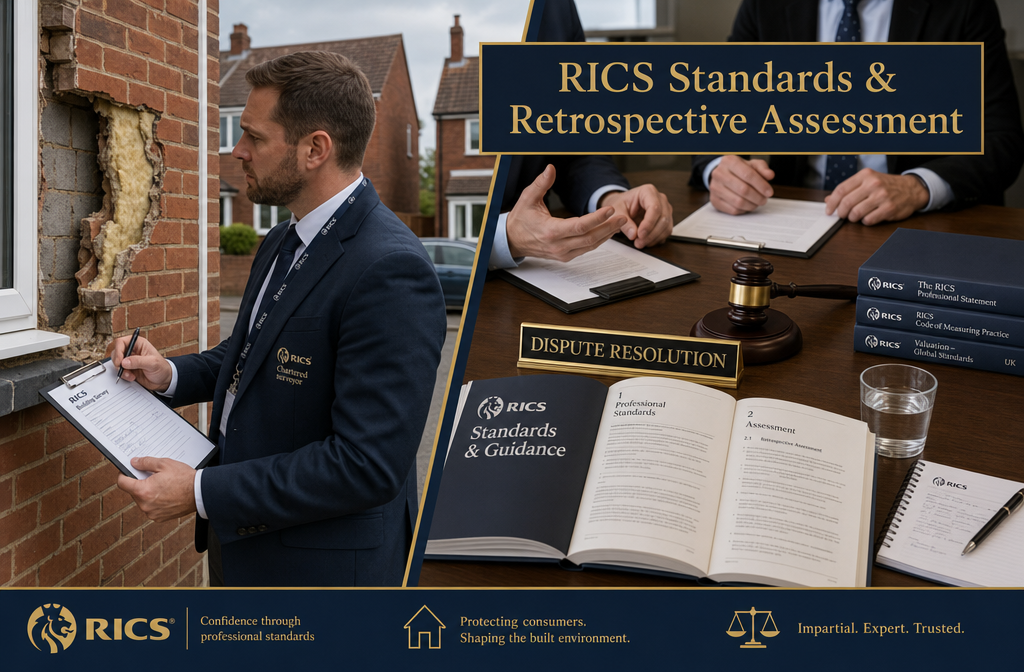
RICS has established a clear and mandatory framework for members who act as expert witnesses. Understanding this framework is essential for both the surveyor preparing the report and the parties relying on it. [4]
The "Surveyors Acting as Expert Witnesses" Practice Statement
The cornerstone document is the RICS practice statement "Surveyors acting as expert witnesses", which is mandatory for all RICS members giving expert evidence. Its core requirements include:
1. Primary duty to the court or tribunal
The expert's overriding obligation is to assist the decision-maker — not to advance the case of the instructing party. This is non-negotiable and distinguishes an expert witness from an advocate.
2. Independence and impartiality
The surveyor must not be influenced by the commercial interests of the client. Any prior relationship with the parties must be disclosed.
3. Competence in the specific subject matter
RICS requires that any member accepting expert witness instructions on defective or retrospective works must be able to demonstrate appropriate knowledge and experience in that specific area — or must decline the instruction [9]. A general practice surveyor should not, for example, accept instructions on specialist structural failure without the relevant expertise.
4. Clear explanation of assumptions and limitations
Every expert witness report must set out the assumptions made, the information relied upon, and the limitations of the assessment. This is particularly important in retrospective cases where original construction records may be incomplete or unavailable.
5. Avoidance of advocacy
The report must present findings objectively. Where there is a range of professional opinion, the expert should acknowledge it rather than suppress inconvenient evidence.
💬 "An expert witness who acts as an advocate undermines not only their own credibility but the integrity of the entire dispute resolution process." — RICS Practice Statement principle
CPR Part 35 and Procedural Compliance
In England and Wales courts, expert evidence is governed by Civil Procedure Rules Part 35. Key requirements include:
- The report must contain a statement that the expert understands their duty to the court
- The expert must confirm the report is their own and contains their true professional opinion
- The report must state the substance of all material instructions received
- Where the expert has not been able to give a definitive opinion, reasons must be given
For tribunal proceedings — including First-tier Tribunal (Property Chamber) hearings and arbitration — equivalent procedural rules apply, though the specific format may vary.
The RICS Retrofit Standard: A Growing Force in Dispute Resolution
The RICS Retrofit Standard has become an increasingly important benchmark in 2026, particularly for disputes involving energy performance upgrades, insulation schemes, and fabric improvements [1]. This mandatory professional statement requires RICS members to:
- Accurately assess existing buildings before recommending retrofit measures
- Recommend measures that are safe, suitable, and evidence-based
- Record and justify decisions clearly
When an expert witness is asked to assess whether a past retrofit project was competently designed or specified, the Retrofit Standard provides a clear benchmark for what a reasonably competent RICS surveyor should have done at the time [10]. This is especially relevant in disputes about failed cavity wall insulation, external wall insulation (EWI) failures, and moisture-related damage following energy upgrades.
For a deeper understanding of how defects are documented in building surveys, see our guide to specific defect reports and structural surveys in London.
How to Structure an Expert Witness Report for Retrospective Works
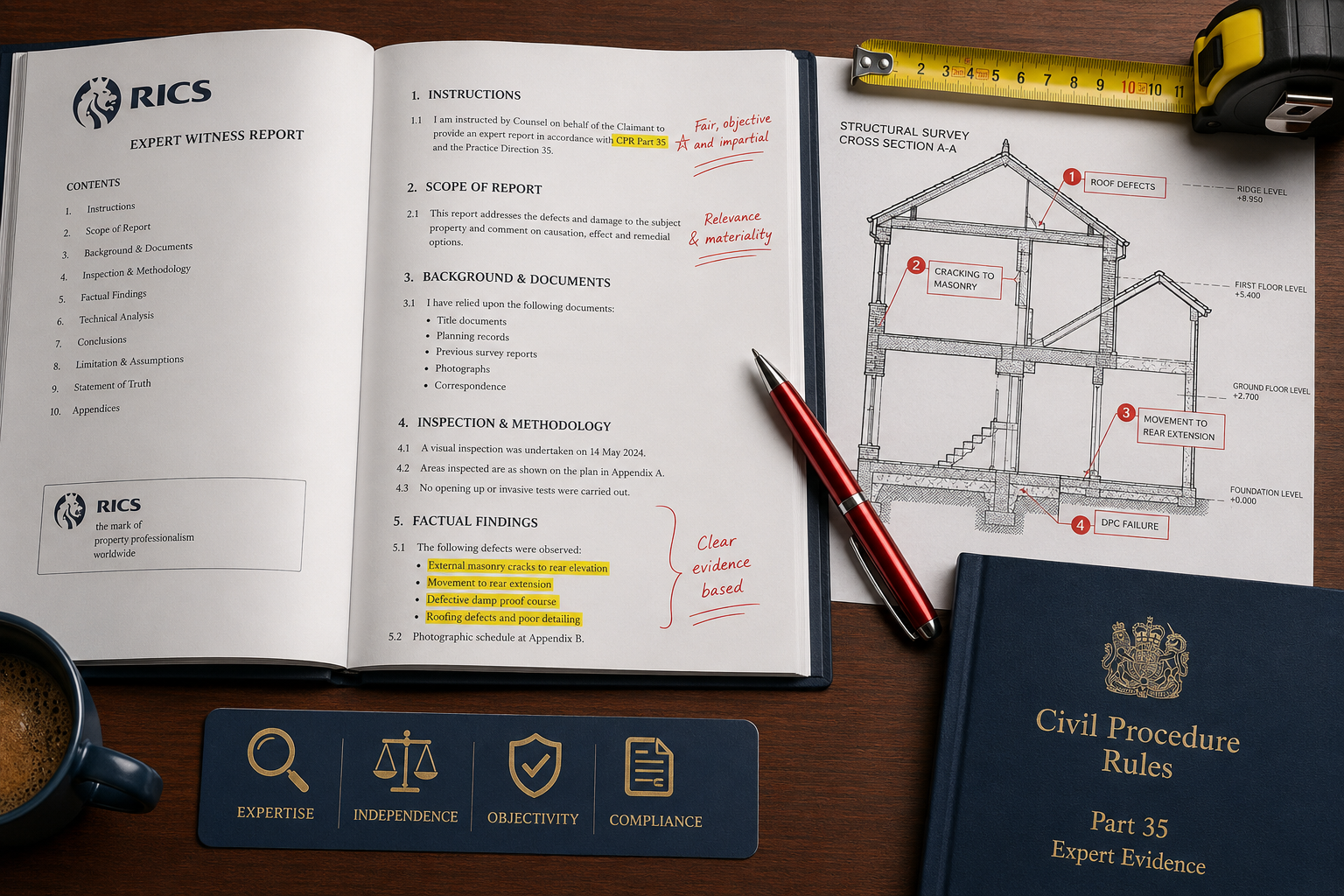
A well-structured expert witness report for retrospective building works follows a logical, court-ready format. The following structure reflects both RICS guidance and CPR Part 35 requirements [4][9].
Section 1: Instructions and Scope
This section sets out:
- Who instructed the expert and when
- The specific questions the expert has been asked to address
- Any limitations on the scope of the inspection (e.g., restricted access, absence of original drawings)
Section 2: Qualifications and Experience
The expert must demonstrate their competence to opine on the specific issues in dispute. For retrospective building works, this typically means:
- RICS membership and relevant designations (MRICS/FRICS)
- Specific experience in building pathology, defect diagnosis, or the relevant construction type
- Any relevant specialist qualifications (e.g., in retrofit, structural assessment, or party wall matters)
Section 3: Documents and Information Reviewed
A complete list of all documents, drawings, specifications, photographs, and reports reviewed. In retrospective cases, this may include:
- Original planning applications and building regulation approvals
- Contractor invoices and schedules of works
- Previous survey reports or schedule of condition reports
- Correspondence between the parties
- Photographs taken at the time of the works
Section 4: Site Inspection Findings
A factual, objective account of what was observed during the site inspection. This section should:
- Describe the current condition of the works
- Identify defects, with photographic evidence
- Note any testing carried out (e.g., moisture readings, thermal imaging)
- Avoid opinion at this stage — save analysis for later sections
Section 5: Analysis Against Applicable Standards
This is the technical core of the report. The expert analyses the observed works against:
✅ Building Regulations applicable at the date of the works
✅ British Standards and industry codes of practice
✅ RICS professional standards (including the Retrofit Standard where relevant) [1]
✅ The standard of a reasonably competent contractor or surveyor
Where costs are in dispute, the expert should also assess whether the charges were reasonable by reference to industry pricing guides and market rates at the time.
Section 6: Opinion and Conclusions
The expert's professional opinion, clearly stated and directly addressing each question posed in the instructions. Where there is genuine uncertainty, this must be acknowledged. The expert should not overstate the strength of their conclusions.
Section 7: Statement of Truth
A mandatory declaration confirming the expert's duty to the court, independence, and that the report represents their true professional opinion.
Protocols for Evaluating Regulatory Compliance and Overcharging
One of the most practically important aspects of expert witness reports for retrospective building works assessment is the evaluation of whether works were overcharged or non-compliant with regulations. These two issues often arise together in consumer disputes.
Assessing Regulatory Compliance
The expert must establish what regulations applied at the date the works were carried out — not the current regulations. This is a critical point. Building Regulations are periodically updated, and a retrospective assessment must apply the standards in force at the relevant time.
Key questions include:
- Was building regulation approval obtained where required?
- Were the works inspected and signed off by a building control officer?
- Do the works comply with the approved drawings and specifications?
- Where no approval was obtained, do the works nonetheless meet the standard that would have been required?
For works involving party walls — a common source of disputes — it is also necessary to assess compliance with the Party Wall etc. Act 1996. Understanding what constitutes a party wall dispute and the procedural requirements that should have been followed is essential context for any expert assessing retrospective works near a shared boundary.
Similarly, for works near boundaries, a boundary survey may be needed to establish whether encroachment occurred during the works.
Assessing Whether Works Were Overcharged
Overcharging disputes require the expert to assess:
| Assessment Area | Method |
|---|---|
| Reasonableness of labour rates | Comparison with RICS/BCIS cost data and market rates |
| Appropriateness of materials specified | Assessment against specification and alternatives available |
| Necessity of works carried out | Evaluation of whether each item was genuinely required |
| Accuracy of quantities | Measurement and comparison against invoiced quantities |
| Profit and overhead margins | Comparison with industry norms |
The expert should be careful to distinguish between overcharging (charging more than a reasonable market rate for work actually done) and unnecessary works (charging for work that should not have been done at all). These are legally distinct and require different analysis.
The Role of a Schedule of Condition
Where a schedule of condition report was prepared before the works began, this provides an invaluable baseline for the expert. It allows a direct comparison between the pre-works condition and the current state, making it far easier to attribute specific defects to the works in question rather than pre-existing conditions.
Where no schedule of condition exists — which is unfortunately common in consumer disputes — the expert must work harder to establish causation, often relying on photographic evidence, witness statements, and the inherent logic of the defect pattern observed.
Dispute Resolution Pathways and the Expert's Role
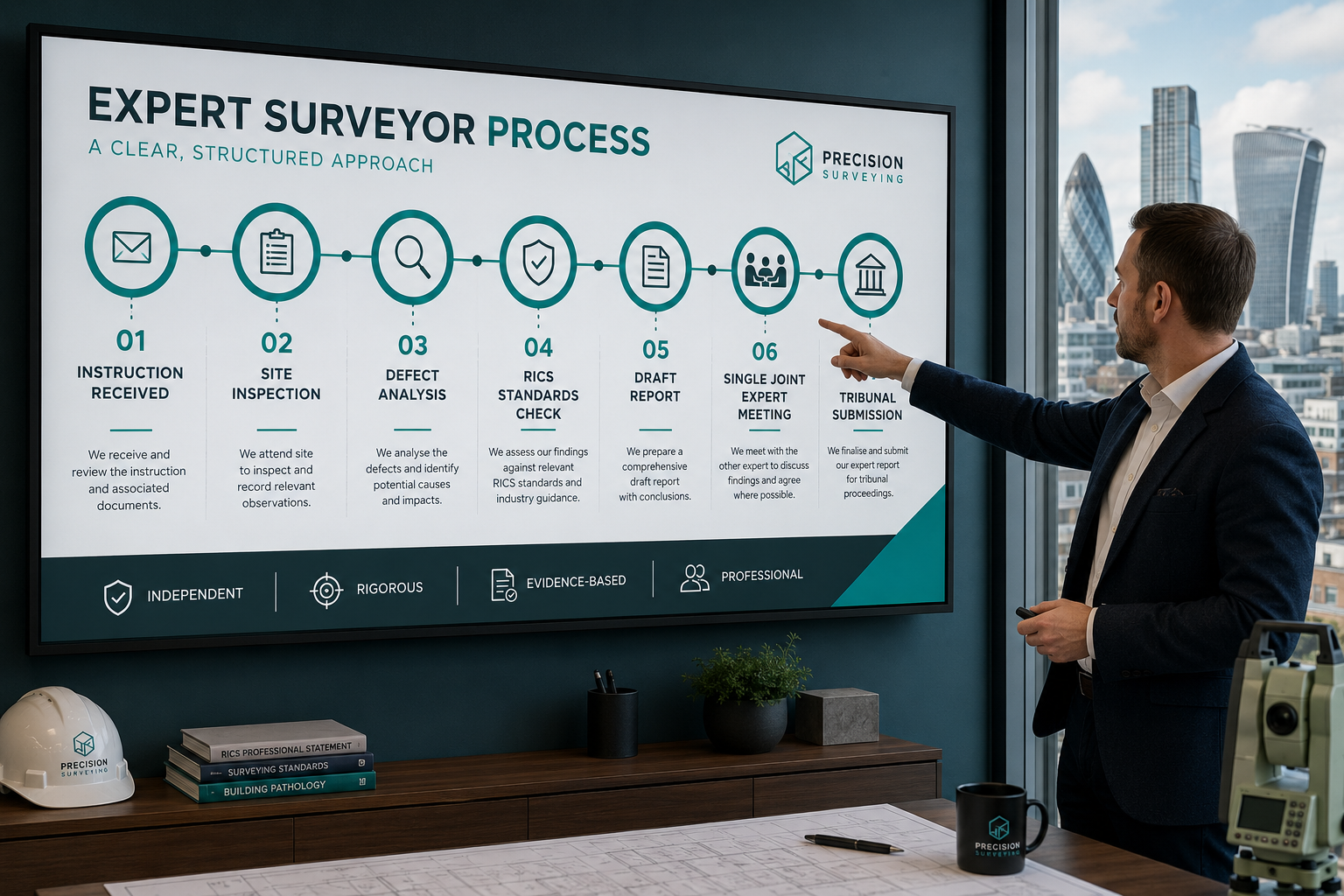
Expert witness reports for retrospective building works assessment are used across multiple dispute resolution forums in 2026. Understanding which forum applies affects how the report should be structured and presented.
Civil Courts (County Court / High Court)
For higher-value claims, CPR Part 35 applies in full. The court may appoint a Single Joint Expert (SJE) — instructed by both parties jointly — or allow each party to appoint their own expert. Where each party has an expert, the court will often direct a without-prejudice experts' meeting to narrow the issues in dispute, followed by a joint statement setting out areas of agreement and disagreement.
First-Tier Tribunal (Property Chamber)
Many leasehold and property disputes — including service charge disputes and disputes about the reasonableness of works — are heard in the First-tier Tribunal. The tribunal has its own procedural rules but generally follows similar principles regarding expert evidence.
Arbitration and Adjudication
Construction disputes are frequently resolved through adjudication under the Housing Grants, Construction and Regeneration Act 1996, or through arbitration. Both forums accept expert evidence, though the procedural requirements differ from court proceedings.
Mediation
Expert reports are also used in mediation to inform settlement negotiations. In this context, the report does not need to comply with CPR Part 35 in the same way, but it should still be objective and technically robust to carry weight with the mediator and the opposing party.
For property owners in London and surrounding areas, working with chartered surveyors in London who have experience across all these forums ensures the report is fit for purpose regardless of which dispute resolution pathway is ultimately pursued.
Choosing the Right Expert: Competence, Independence, and RICS Membership
Not every surveyor is qualified to act as an expert witness on retrospective building works. RICS is explicit that members must only accept instructions where they have the relevant competence [9]. When selecting an expert, the following criteria should be considered:
🔍 RICS membership — MRICS or FRICS designation confirms adherence to professional standards
🔍 Relevant specialism — Experience in building pathology, defect diagnosis, or the specific type of work in dispute
🔍 Expert witness experience — Familiarity with CPR Part 35, tribunal procedures, and the discipline of giving evidence
🔍 Independence — No prior relationship with either party that could compromise impartiality
🔍 Geographic knowledge — Familiarity with local construction practices, costs, and market conditions
For disputes involving properties in London and the South East, local expertise matters. Surveyors with knowledge of boundary disputes resolution and the specific construction types common in the region are better placed to provide authoritative opinions on retrospective works.
Conclusion: Actionable Next Steps
Expert Witness Reports for Retrospective Building Works Assessment: RICS Standards and Dispute Resolution is a demanding but essential discipline. When retrospective building works are disputed — whether the issue is regulatory compliance, workmanship quality, or overcharging — a properly structured, RICS-compliant expert witness report is the foundation of any credible claim or defence.
Here are the key actionable steps for 2026:
- Engage a qualified RICS expert early — ideally before formal proceedings begin, to assess the merits of the case and preserve evidence.
- Gather all available documentation — original quotes, invoices, planning approvals, building regulation certificates, photographs, and any pre-works surveys.
- Commission a schedule of condition for any ongoing or future works to create a baseline record that protects all parties.
- Understand which dispute resolution forum applies — this affects the procedural requirements for the expert report.
- Ensure the expert is genuinely independent — an expert who appears to be an advocate for the instructing party will lose credibility with the tribunal or court.
- Reference applicable RICS standards — including the Retrofit Standard where energy or fabric works are involved — to benchmark the quality of the works assessed [1][4].
The stakes in retrospective building works disputes are high. A technically rigorous, procedurally compliant expert witness report — prepared by a competent, independent RICS surveyor — is the most powerful tool available to any party seeking a fair resolution.
References
[1] RICS Retrofit Standard Guide – https://goreport.com/rics-retrofit-standard-guide/
[2] Building Safety Act FAQs – https://www.rics.org/news-insights/building-safety-act-faqs
[4] RICS Standards and Guidance – https://www.rics.org/profession-standards/rics-standards-and-guidance
[9] Building Surveying Standards – https://www.rics.org/profession-standards/rics-standards-and-guidance/sector-standards/building-surveying-standards
[10] Building Survey Standards Post-2026 RICS Retrofit Summit Enhanced Protocols for Energy and Quality Assessments – https://princesurveyors.co.uk/blog/building-survey-standards-post-2026-rics-retrofit-summit-enhanced-protocols-for-energy-and-quality-assessments/